HAC News: June 1, 2016

HAC News Formats. pdf

June 1, 2016
Vol. 45, No. 10

• Senate committee approves FY17 USDA funding bill • HUD funding for FY17 passes House committee • Modest rental housing remains out of reach nationwide for minimum wage earners • RD encourages multifamily properties to offer summer meal program for kids • Permission restored for states to transfer unused Rental Assistance • YouthBuild funds available • RUS seeks comments on energy efficiency loans • Revisions to IHBG formula proposed • FHA offers changes to its reverse mortgage program • Report recommends better integration of health care and housing for seniors • Native CDFIs have helped improve access to capital and credit • Locations of new businesses show economic recovery weaker in rural America • HAC to hold webinar on VA home loan guaranty program

HAC News Formats. pdf

June 1, 2016
Vol. 45, No. 10

Senate committee approves FY17 USDA funding bill. S. 2956 funds most rural housing programs at their FY16 levels, and provides increases requested by the Administration’s budget for Sections 521, 542, and 538. It also raises Section 515 rental housing to $40 million, higher than either the budget or the House bill.The Committee’s report tells the department to work with others to find long-term solutions to rural rental housing issues, particularly maturing mortgages. To encourage nonprofits and PHAs to purchase USDA-financed rental housing, the bill provides returns on investment, increased asset management fees, and a $1 million pilot program offering technical assistance to purchasers. The bill also requires USDA to report quarterly on Rental Assistance use. Unlike the House bill (see HAC News, 4/20/16), the Senate’s version would not expand use of Section 542 vouchers to include tenants in properties whose mortgages mature. More details are posted on HAC’s website. [tdborder][/tdborder]

USDA Rural Dev. Prog.
(dollars in millions)

FY16
Approp.

FY17 Budget Proposal

FY17 House Cmte. Bill (H.R. 5054)

FY17 Senate Cmte. Bill
(S. 2956)

502 Single Fam. Direct
Self-Help setaside

$900
5

$900
0

$1,000
5

$900
5

502 Single Family Guar.

24,000

24,000

24,000

24,000

504 VLI Repair Loans

26.3

26.3

26.3

26.3

504 VLI Repair Grants

28.7

28.7

28.7

28.7

515 Rental Hsg. Direct Lns.

28.4

33.1

35

40

514 Farm Labor Hsg. Lns.

23.9

23.9

23.9

23.9

516 Farm Labor Hsg. Grts.

8.3

8.3

8.3

8.3

521 Rental Assistance

1,390

1,405

1,405

1,405

523 Self-Help TA

27.5

18.5

30

27.5

533 Hsg. Prsrv. Grants

3.5

0

5

3.5

538 Rental Hsg. Guar.

150

230

200

230

Rental Prsrv. Demo. (MPR)

22

19.4

22

22

542 Rural Hsg. Vouchers

15

18

18

18

Rural Cmnty. Dev’t Init.

4

4

4

4

HUD funding for FY17 passes House committee. On May 24 the full House Appropriations Committee approved the Transportation-HUD bill summarized in the HAC News, 5/19/16.

Modest rental housing remains out of reach nationwide for minimum wage earners. Out of Reach 2016: No Refuge for Low Income Renters, by the National Low Income Housing Coalition, says there is no state, metropolitan area, or county in the U.S. where a full-time worker earning minimum wage can afford a two-bedroom apartment at HUD’s Fair Market Rent. An interactive map online provides data for states and localities.

RD encourages multifamily properties to offer summer meal program for kids. More information is available in an Unnumbered Letter dated May 10, 2016 and online.

Permission restored for states to transfer unused Rental Assistance. For a one-year trial, state directors will be allowed to reallocate unused RA within each state. RA lost to prepayment, foreclosure, or mortgage maturity will continue to be recaptured by the national office. Contact a USDA RD state office.

YouthBuild funds available. The Department of Labor offers YouthBuild grants to provide education, occupational skills training, and employment services to disadvantaged youth who serve their communities. Apply by July 6. Contact Kia Mason, DOL, 202-693-2606.

RUS seeks comments on energy efficiency loans. The new Rural Energy Savings Program will make loans to rural families and small businesses to implement cost-saving energy efficiency measures. The Rural Utilities Service asks for input by June 23 on measuring results and on providing technical assistance and training to entities carrying out RESP. Contact Titilayo Ogunyale, RUS, 202-720-0736.

Revisions to IHBG formula proposed. Comments are due August 1 on the Indian Housing Block Grant program allocation formula. The proposed changes reflect consensus decisions reached by HUD and the NAHASDA negotiated rule-making committee. Contact Randall R. Akers, HUD, 202-402-7598.

FHA offers changes to its reverse mortgage program. To reduce risks to its Mutual Mortgage Insurance Fund, FHA proposes to amend regulations to strengthen its Home Equity Conversion Mortgages. Comments are due July 18. Contact Karin Hill, HUD, 202-402-3084.

Report recommends better integration of health care and housing for seniors. Healthy Aging Begins at Home, published by the Bipartisan Policy Center’s Senior Health and Housing Task Force, examines the need for housing affordable to low-income seniors and for integrating health care and supportive services with housing. It recommends making ending senior homelessness a major national priority; investing in the Low Income Housing Tax Credit; establishing a new senior-supportive housing program; making federal regulatory policies more encouraging; engaging the private and nonprofit sectors more broadly; and adopting state and local land-use policies that promote a range of affordable housing options for their seniors.

Native CDFIs have helped improve access to capital and credit. Access to Capital and Credit in Native Communities, commissioned from the Native Nations Institute by the CDFI Fund, concludes there are better options today than in 2001, and finds the CDFI Fund’s Native programs have been critical sources of technical assistance and training in addition to capital. Native Communities still need additional capital and credit, however. To address the needs, the report identifies key strategies for Native communities and the federal government. A related data review will be released on the CDFI Fund’s site.

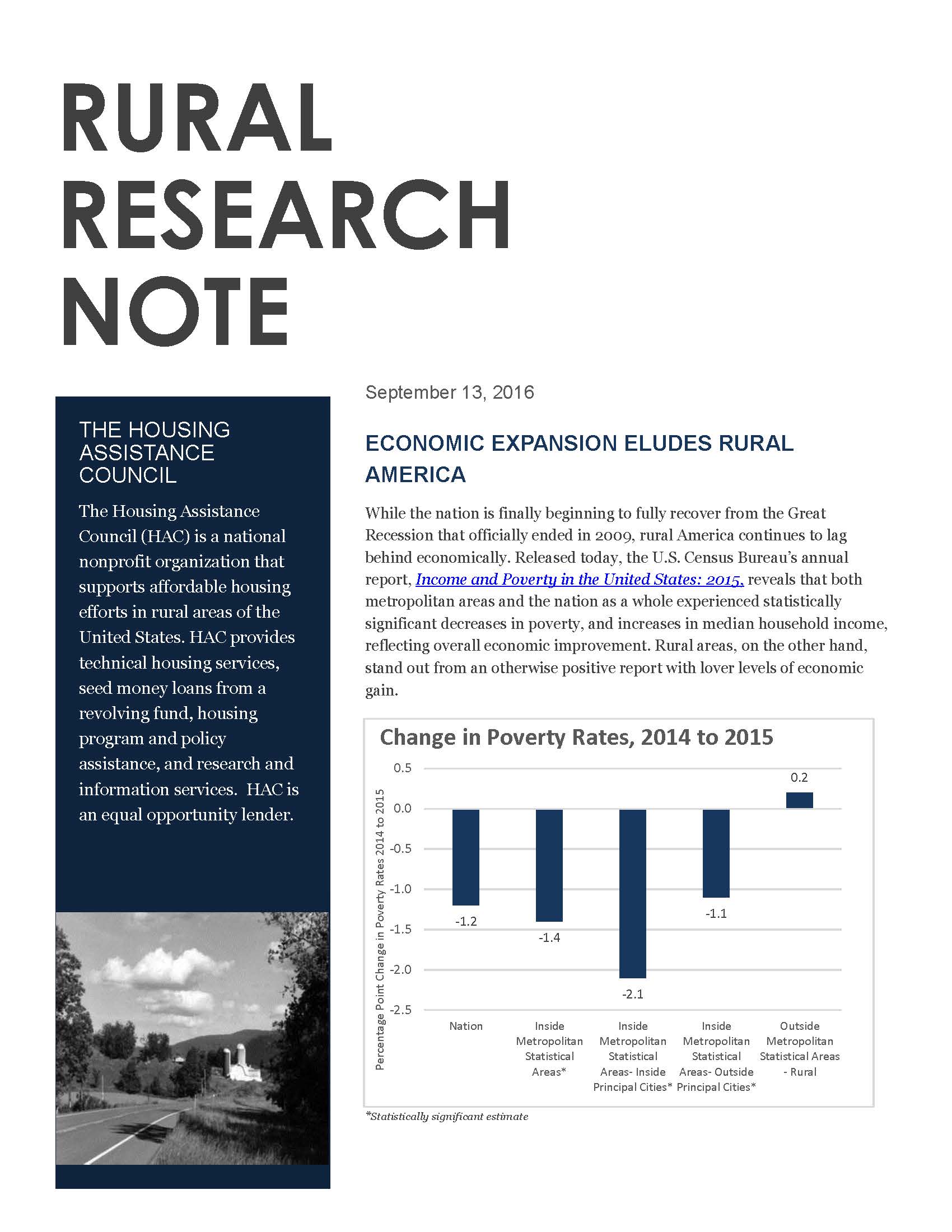
Locations of new businesses show economic recovery weaker in rural America. The New Map of Economic Growth and Recovery, published by the Economic Innovation Group, surveys the economic landscape emerging from the Great Recession and compares it to previous recovery periods. It finds fewer new businesses have been started, those that do start are concentrated in a smaller number of more populous counties, and counties driving the nation’s economic recoveries have shifted from smaller to larger ones. “Many communities will see fewer employment opportunities as a result,” the report states, “and depressed entrepreneurship will leave their local economies more vulnerable to the downsides of inevitable economic shifts to come.”

HAC to hold webinar on VA home loan guaranty program. “VA Housing Resources for Heroes: An In-depth Overview of the VA Home Loan Guaranty Benefit” is set for Wednesday, June 8, at 2:00 Eastern time. The webinar is free but registration is required. Contact Shonterria Charleston, HAC, 404-892-4824.

USDA Rural Development Obligations FY 16 – April

Download complete report (Through April FY 2016)

thumb usda-obs-cover

The Housing Assistance Council (HAC) presents this month’s report on Fiscal Year 2016 USDA Rural Housing program obligations.

As of the end of April, USDA obligated 68,207 loans, loan guarantees, and grants totaling about $8.98 billion. This is less than obligation levels from the same time last year when there were 79,277 loans, loan guarantees, and grants obligated totaling about $10.5 billion.

Single Family Housing Program Highlights

The Section 502 Guaranteed loan program, the largest of the Single Family Housing programs, obligated $8.4 billion (60,652) in loan guarantees. This is about $1.65 billion (12,447) less than the same time last year.

For the Section 502 Direct program, there have been nearly $434 million (3,292 loans) in loan obligations so far in FY 2016; about $110.9 million (646 loans) more than the same time last year. Very low-income (VLI) loan obligations comprised 30.7 percent of the total Section 502 Direct loan dollars obligated so far this year. Last year at this time, 32.9 percent of the Section 502 Direct loan dollars obligated were for VLI loans.

The Section 504 Repair and Rehabilitation programs obligated 1,511 loans representing $8.11 million. This is 446 more loans or $2 million higher than this time last year. There were 2,642 Section 504 grants totaling about $16.3 million. This is $1.9 million (286 grants) more than obligated this time last year.

So far this year, USDA obligated 13 Section 523 grants totaling $8.4 million and 13 credit sale loans of Single Family properties totaling $930,037.

Multi-Family Housing Programs

There have been 51 Section 538 Guaranteed Rental Housing loans obligated so far this year totaling $78.7 million. This represents 23 more loans and $37.9 million more than this time last year.

For the Farm Labor Housing program, 2 loans for $4.2 million has been obligated so far this year. This time last year, there were 4 FLH loans and 2 grants representing about $1.3 million and $2 million respectively. There have also been 7 Multifamily Housing Preservation & Revitalization loans ($3.8 million) obligated.

Section 521 Rental Assistance obligations reached $986.2 million (209,931 units) in March. This is about $1.9 million more (but 11,215 fewer units) than this time last year.

There were 2,869 Rural Housing Voucher obligations representing $10.8 million, an increase of 171 units or $1.3 million higher than the same time last year.

Download the combined document.

Individual Program Files

Summary Files

Summary of Rural Development Obligations
Summary Data of Rural Development Obligations Compared to Previous Year
Summary Data of Rural Development Obligations Compared to Previous Month
Summary Chart of Rural Development Obligations
USDA Rural Development Eligible Areas

Single Family Housing Program Obligations

Section 502 Direct Homeownership Total Obligations
Section 502 Direct Homeownership Low and Very Low Obligations
Section 502 Guaranteed Homeownership Obligations
Section 504 Total Home Rehab Obligations
Section 523 Self-Help Technical Assistance Grant Obligations
Section 524 Site Loans Obligations

Multi-Family Housing Program Obligations

Section 514/516 Farm Labor Housing Obligations
Section 515 Rental Housing Obligations
Section 521 Rental Assistance Obligations
Section 533 Housing Preservation Obligations
Section 538 Guaranteed Rental Obligations
Multifamily Housing Tenant Voucher Obligations
Multifamily Housing Revitalization Demonstration Program

Unallocated Program Obligations

Section 306 Water/Wastewater Grant Obligations
Section 509 Compensation for Construction Defects
Multifamily and Single-family Housing Credit Sales

* The Rural Housing Service (RHS) monthly obligation reports are produced by the Housing Assistance Council (HAC) 1025 Vermont Ave., NW, Suite 606, Washington, DC 20005. The monthly figures derive from HAC tabulations of USDA –RHS 205c, d, and f report data. For questions or comments about the obligation reports, please contact Michael Feinberg at 202-842-8600 or michael@ruralhome.org.

HAC News: May 19, 2016

HAC News Formats. pdf

May 19, 2016
Vol. 45, No. 9

• Senate adopts FY17 HUD funding measure, House releases bill • USDA FY17 funding consideration begins in Senate • Some Continuums of Care see renewal funding cut • Correction: streamlined refinancing applies to Section 502 direct loans also • Sexual orientation and gender protection proposed for Native American programs • HUD seeks comment on broadband and on climate change hazards • Stakeholder calls on Section 515 to continue • RD corrects environmental regs • Guidance on implementation of Section 502 packaging available • Rural child poverty increased as income inequality grew • HAC report describes older veterans

HAC News Formats. pdf

May 19, 2016
Vol. 45, No. 9

Senate adopts FY17 HUD funding measure, House releases bill. The Senate passed its Transportation-HUD appropriations bill on May 19, after adopting an amendment lifting until 2019 the two-year commitment deadline for HOME funds, and rejecting an amendment that would have stopped HUD implementation of its Affirmatively Furthering Fair Housing regulations. The Administration has threatened a veto of the Senate bill, listing numerous objections including the funding levels for Tenant-Based Rental Assistance and for Homeless Assistance Grants. The House version of the bill would keep many programs at FY16 levels, with decreases in tenant vouchers and an increase in housing counseling. The House T-HUD Appropriations Subcommittee approved it on May 18, and the full committee will take it up on May 24. Updates will be posted on HAC’s website when available. [tdborder][/tdborder]

HUD Program
(dollars in millions)

FY16
Approp.

FY17 Budget Proposal

FY17 House Subcmte. Bill

FY17 Senate Cmte. Bill
H.R. 2577

Cmty. Devel. Fund
CDBG

3,060
3,000

2,880
2,800

3,060
3,000

3,000
3,000

HOME

950

950

950

950

Self-Help Homeownshp. (SHOP)

10

10a

10

10

Tenant-Based Rental Assistance
VASH setaside

19,628
60

20,854
7c

20,189
7c

20,432
57

Project-Based Rental Asstnce.

10,622

10,816

10,901

10,901

Public Hsg. Capital Fund

1,900

1,865

1,900

1,925

Public Hsg. Operating Fund

4,500

4,569

4,500

4,675

Choice Neighbrhd. Initiative

125

200

100

80

Native Amer. Hsg. Block Grant

650

700

655

647

Homeless Assistance Grantsb

2,250

2,664

2,487

2,330

Hsg. Opps. for Persons w/ AIDS

335

335

335

335

202 Hsg. for Elderly

432.7

505

505

505

811 Hsg. for Disabled

150.6

154

154

154

Fair Housing

65.3

70

65.3

65

Healthy Homes & Lead Haz. Cntl.

110

110

130

135

Housing Counseling

47

47

55

47

Local Housing Policy Grants

300d

a. The FY17 Administration budget, like past budget requests, proposes to make SHOP a setaside in HOME. Congress has consistently rejected that proposal. b. Includes the Rural Housing Stability Program, which is not yet operational. c. Tribal VASH setaside. d. Proposed as mandatory spending.

USDA FY17 funding consideration begins in Senate. TheSenate Agriculture Appropriations Subcommit-tee approved a spending bill on May 17 and the full committee will consider it on May 19. A press release says the bill includes $900 million for Section 502 loans, $24 billion for Section 502 loan guarantees, and $1.4 billion for Rental Assistance. The bill’s text has not yet been released. The House committee passed its version, H.R. 5054, in April (see HAC News, 4/20/16).

Some Continuums of Care see renewal funding cut. As a result of changes to HUD’s FY15 homelessness funding competition, some CoCs received increases but a number of others had funding for ongoing projects reduced. HUD emphasized rapid rehousing and permanent supportive housing, while awards for transitional housing fell. HUD acknowledges that some grantees now “face the difficult task of finding alternative funding for, downsizing, or closing down longstanding programs,” but says the total number of people served nationwide will increase. The National Alliance to End Homelessness’s blog offers analysis and suggestions. Find an area CoC here.

Correction: streamlined refinancing applies to Section 502 direct loans also. The May 4, 2016 HAC News reported that USDA RD adopted amendments to the regulations for Section 502 guaranteed loans but did not note that one of them, a new refinance option, is available for Section 502 direct borrowers also. Contact Lilian Lipton, RD, 202-260-8012.

Sexual orientation and gender protection proposed for Native American programs. A proposed rule would require HUD’s Native American and Native Hawaiian programs to be open to all regardless of sexual orientation, gender identity, or marital status. HUD promulgated this rule for other programs in 2012. Comments are due July 8. Contact Camille E. Acevedo, HUD, 202-708-1793.

HUD seeks comment on broadband and on climate change hazards. Comments are due July 18 on two proposed rules. One would require installation of broadband infrastructure at the time of new construction or substantial rehabilitation of multifamily rental housing funded or supported by HUD, with limited exceptions. Contact people vary by program and are listed in the proposed regulation. The second would require jurisdictions to include broadband and natural hazard risks in their Consolidated Plans. They would have to describe existing broadband access in low- and moderate-income housing, and consider providing access where there is none. They would also have to “consider incorporating resilience to natural hazard risks, taking care to anticipate how risks will increase due to climate change.” Contact Lora Routt, HUD, 202-402-4492.

Stakeholder calls on Section 515 to continue. To register for announcements of upcoming quarterly calls on the Section 515 program, contact Timothy James, RD, 919-873-2056. Those who have registered in the past do not need to register again. (These are separate from the Section 538 calls announced in the HAC News, 5/4/16.)

RD corrects environmental regs. The changes apply to a rule issued in March (see HAC News, 3/4/16).

Guidance on implementation of Section 502 packaging available. RD published anUnnumbered Letter (dated May 6, 2016) that provides guidance on the implementation of the certified loan application packaging process, which becomes effective on May 19. Contact Tammy Repine, RD, 360-753-7677.

Rural child poverty increased as income inequality grew. A USDA Economic Research Service report, Understanding the Rise in Rural Child Poverty, 2003-14, and an article based on the report, explain that nonmetro child poverty rates rose 2003-2011 during economic growth and recession periods, then fell 2012-1014 but remained well above 2003 levels. ERS determined that growth in income inequality accounted for most of the increase in rural child poverty.

HAC report describes older veterans. Over two-thirds of U.S. veterans are age 55 and older and their numbers are rising, according to Aging Veterans in the United States, an analysis of data on the older veteran population. The majority are homeowners, and more than half of older veteran renters are cost burdened.

Aging Veterans in the United States

A snapshot of older veterans and their social, economic, and housing characteristics.

To better understand and inform strategies and policies for America’s aging veterans, the Housing Assistance Council has published Aging Veterans in the United States an analysis of data describing the older veteran population.

The United States is on the cusp of an extensive and far-reaching demographic transformation as the senior population is expected to nearly double by 2050. This is similarly the case for the veteran segment of the population who make up about 9 percent of the U.S. population. A large and growing proportion of this veteran population is composed of those age 55 and over, “older” Americans. As this group grows older, it is important to consider their unique characteristics and issues, which include health problems and physical limitations associated with aging. A rapidly aging population will significantly impact nearly all aspects of the nation’s social, economic, and housing systems.

HAC News: May 4, 2016

HAC News Formats. pdf

May 4, 2016
Vol. 45, No. 8

• Senate Committee approves bill to hold funds steady for many HUD programs in FY17 • House’s USDA spending bill would require 10-20-30 targeting • Rural rental preservation bills introduced • RD explains new Rental Assistance calculations • Mortgage disclosures updated for Section 502 direct • Amendments issued to regulations for Section 502 guaranteed • Register for notice of calls on Section 538 program • HUD to test new inspection process for voucher housing • Distribution of Housing Trust Fund dollars announced • USDA RD updates lead paint guidance • Annual Adjustment Factors for Section 8 released • GAO recommends changes in USDA’s risk management for Section 502 guarantee program

HAC News Formats. pdf

May 4, 2016
Vol. 45, No. 8

Senate Committee approves bill to hold funds steady for many HUD programs in FY17. S. 2844 would keep the HOME program at $950 million and SHOP at $10 million, would increase Section 202 and voucher funds, and would decrease amounts for homelessness programs and Native American housing. The Appropriations Committee declined to accept the Administration’s proposal to eliminate the HOME set-aside for CHDOs. The full Senate is likely to take up the bill sometime in May. [tdborder][/tdborder]

HUD Program
(dollars in millions)

FY15
Approp.

FY16
Approp.

FY17 Budget Proposal

FY17 Senate Cmte. Bill
S. 2844

Cmty. Devel. Fund
CDBG

3,066
3,000

3,060
3,000

2,880
2,800

3,000
3,000

HOME

900

950

950

950

Self-Help Homeownshp. (SHOP)

10

10

10a

10

Tenant-Based Rental Assistance
VASH setaside

19,304
75

19,628
60

20,854
7c

20,432
57

Project-Based Rental Asstnce.

9,330

10,622

10,816

10,901

Public Hsg. Capital Fund

1,875

1,900

1,865

1,925

Public Hsg. Operating Fund

4,440

4,500

4,569

4,675

Choice Neighbrhd. Initiative

80

125

200

80

Native Amer. Hsg. Block Grant

650

650

700

647

Homeless Assistance Grantsb

2,135

2,250

2,664

2,330

Hsg. Opps. for Persons w/ AIDS

330

335

335

335

202 Hsg. for Elderly

436

432.7

505

505

811 Hsg. for Disabled

135

150.6

154

154

Fair Housing

65.3

65.3

70

65

Healthy Homes & Lead Haz. Cntl.

110

110

110

135

Housing Counseling

47

47

47

47

Local Housing Policy Grants

300d

a. The FY17 Administration budget, like past budget requests, proposes to make SHOP a setaside in HOME. Congress has consistently rejected that proposal. b. Includes the Rural Housing Stability Program, which is not yet operational. c. The FY17 budget proposes $7 million for a tribal VASH setaside. d. Proposed as mandatory spending.

House’s USDA spending bill would require 10-20-30 targeting. Section 750 of H.R. 5054, the House FY17 funding bill for USDA (see HAC News, 4/20/16), would mandate at least 10 percent of RD spending be allocated to counties with 20% or higher poverty levels over 30 years (the 1990, 2000, and 2010 Censuses). At a February 11 House committee hearing on USDA’s budget, Agriculture Secretary Tom Vilsack said the programs already exceed that amount.

Rural rental preservation bills introduced. On April 12 Rep. Ann Kuster (D-NH) and Sen. Jeanne Shaheen (D-NH) introduced H.R. 4908 and S. 2783. The bills would “decouple” Section 521 Rental Assistance from Section 515 mortgages so RA can continue after a mortgage matures, make USDA Section 542 vouchers available to tenants in properties whose mortgages mature, authorize the MPR program (currently a demonstration), and require uniform terms for purchasers using tax credits. Neither bill is scheduled for committee action yet.

RD explains new Rental Assistance calculations. An Unnumbered Letter dated March 18, 2016 describes the new “Obligation Tool” that is being used in FY16 to calculate RA contract renewals for each property based on a weighted average of that property’s usage rate over the preceding 12 months. Contact a USDA RD state office.

Mortgage disclosures updated for Section 502 direct. USDA RD’s Procedure Notice (PN) 485 updates RD’s Handbook 1-3550 to implement the provisions of the TILA-RESPA Integrated Disclosure rule. Changes impact loan processing and supporting documentation requirements. Contact a USDA RD field office.

Amendments issued to regulations for Section 502 guaranteed. USDA’s changes expand lender indemnification authority, add a new refinance option called ‘‘streamlined-assist,’’ and incorporate the CFPB’s Qualified Mortgage definition. Contact Lilian Lipton, RD, 202-260-8012.

Register for notice of calls on Section 538 program. RD will continue holding periodic calls or web meetings with stakeholders about the Section 538 guaranteed rental housing program. To receive notices when calls are scheduled – even if you registered for these calls in the past – contact Monica Cole, USDA, 202-720–1251.

HUD to test new inspection process for voucher housing. Congressional report language for HUD’s FY16 appropriations told HUD to implement a single inspection protocol for public housing and voucher units. Comments are due July 5 on a proposal for the first step towards that change, a demonstration designed to test a new method of assessing the physical condition of housing assisted by HUD vouchers. Contact Daniel R. Williams, HUD, 202-475-8586.

Distribution of Housing Trust Fund dollars announced. HUD divided $174 million among the 50 states, D.C., Puerto Rico, American Samoa, Guam, the Northern Mariana Islands, and the U.S. Virgin Islands. These entities must now include public participation in developing their own allocation plans, guided by HUD Notice CPD-16-07. The National Low Income Housing Coalition has developed a model allocation plan.

USDA RD updates lead paint guidance. Administrative Notice 4800 offers guidance to RD staff on implementing an amended EPA rule. Contact a USDA RD field office.

Annual Adjustment Factors for Section 8 released. Details are online. Contact a HUD office.

GAO recommends changes in USDA’s risk management for Section 502 guarantee program. Rural Housing Service: Actions Needed to Strengthen Management of the Single Family Mortgage Guarantee Program (GAO-16-193) discusses USDA’s process for estimating program costs and how well its policies and procedures match OMB’s standards for managing credit programs. GAO found USDA was consistent with most OMB standards and suggested making changes to become consistent with the others.

Join HAC on May 18 for “Serving our Aging Veterans.” HAC’s third annual veterans symposium, to be held in Washington, DC, will focus on housing, health, and other needs faced by the rapidly expanding population of older veterans. There is no charge for the event, but advance registration is required. For more information, contact Janice Clark, HAC, 202-842-8600, or Shonterria Charleston, HAC, 404-892-4824.

HAC News: April 20, 2016

HAC News Formats. pdf

April 20, 2016
Vol. 45, No. 7

• House committee passes FY17 USDA spending bill • Senate subcommittee addresses FY17 HUD spending • RUS offers rural broadband loans, guarantees, and grants • Indian CDBG application period opens • Jobs Plus funds available • 2016 New Markets Tax Credits combined with 2015 funding round • Homelessness data examined at national and state levels • Typical low-income household’s expenses exceeded income in 2014 • HAC offers Section 502 packaging training June 28-30

HAC News Formats. pdf

April 20, 2016
Vol. 45, No. 7

House committee passes FY17 USDA spending bill. On April 19, the House Appropriations Committee approved a bill that provides steady or increased funding levels for USDA’s rural housing programs. It increases Section 523 self-help technical assistance funding to $30 million and raises Section 502 direct to $1 billion. Section 521 Rental Assistance and Section 542 vouchers would receive amounts that, according to the Administration’s budget, will allow for renewal of all current aid, new RA for new farmworker housing properties, and new vouchers for tenants in properties leaving the Section 515 program for any reason, including mortgage maturity. It also includes Administration language that would extend voucher eligibility and allow USDA to set priorities for voucher distribution.

USDA Rural Dev. Prog.
(dollars in millions)

FY15
Approp.

FY16
Approp.

FY17 Budget Proposal

FY17 House Cmte. Bill

502 Single Fam. Direct
Self-Help setaside

$900
5

$900
5

$900
0

$1,000
5

502 Single Family Guar.

24,000

24,000

24,000

24,000

504 VLI Repair Loans

26.3

26.3

26.3

26.3

504 VLI Repair Grants

28.7

28.7

28.7

28.7

515 Rental Hsg. Direct Lns.

28.4

28.4

33.1

35

514 Farm Labor Hsg. Lns.

23.6

23.9

23.9

23.9

516 Farm Labor Hsg. Grts.

8.3

8.3

8.3

8.3

521 Rental Assistance

1,089

1,390

1,405

1,405

523 Self-Help TA

27.5

27.5

18.5

30

533 Hsg. Prsrv. Grants

3.5

3.5

0

5

538 Rental Hsg. Guar.

150

150

230

200

Rental Prsrv. Demo. (MPR)

17

22

19.4

22

542 Rural Hsg. Vouchers

7

15

18

18

Rural Cmnty. Dev’t Init.

4

4

4

4

The Committee’s report tells USDA to provide it with a list of criteria used to define ‘‘rural in character’’ in determining what places are considered rural and therefore eligible for housing program funding.

Senate subcommittee addresses FY17 HUD spending. The Senate Transportation-HUD Appropriations Subcommittee approved a bill on April 19. The measure’s text will not be released until the full committee considers it on April 21, but the committee did announce the bill provides $950 million for HOME and $300 billion for CDBG. The subcommittee’s top Democrat, Sen. Jack Reed (D-RI), released a statement supporting the bill. HAC will post updates at ruralhome.org when available.

RUS offers rural broadband loans, guarantees, and grants. Nonprofits, for-profits, and governments or tribes can apply for Community Connect grants by June 17. Those entities as well as coops can apply for Farm Bill Broadband Loans and Loan Guarantees by July 7. For either program, contact Shawn Arner, RUS, 202-720-0800.

Indian CDBG application period opens.CDBG for Indian Tribes and Alaska Native Villages applications from tribes and tribal organizations are due June 14. Contact a HUD ONAP Regional Office.

Jobs Plus funds available. PHAs with at least 200 non-elderly-only households are eligible, and the deadline is June 13. Contact HUD staff.

2016 New Markets Tax Credits combined with 2015 funding round. The CDFI Fund will not hold a new allocation round this year. It will allocate $3.5 billion for 2015 and $3.5 billion for 2016 under its 2015 NMTC funding notice. The deadline was December 16, 2015.

Homelessness data examined at national and state levels.The State of Homelessness in America 2016, by the National Alliance to End Homelessness, examines recent trends and also those from before the Great Recession to the present. For example, although doubled-up households fell 9% from 2013 to 2014, the number of poor people living doubled up was 52% higher in 2014 than in 2007.

Typical low-income household’s expenses exceeded income in 2014. A Pew Charitable Trusts Issue Brief on “Household Expenditures and Income” shows that by 2014 the median expenditures of working-age households had returned to pre-recession levels, but income did not. In 2004, the typical household in the lowest one-third of income levels had $1,500 of income left over after expenses, but in 2014 their expenses exceeded income by $2,300. Housing costs for those with incomes in the lowest third grew by 50% from 1996 to 2014. (Figures were adjusted for inflation).

HAC offers Section 502 packaging training June 28-30. “Section 502 Packaging Certification Training for Nonprofit Housing Developers,” to be held in Burlington, VT, is an advanced course for those experienced in using Section 502 direct and/or other affordable housing mortgage products. Following the course, participants are encouraged to take the online certification exam. Register online. Contact Shonterria Charleston, HAC, 404-892-4824.

USDA Rural Development Obligations FY 16 – March

Download complete report (Through March FY 2016)

thumb usda-obs-cover

The Housing Assistance Council (HAC) presents this month’s report on Fiscal Year 2016 USDA Rural Housing program obligations.

As of the end of March, USDA obligated 56,760 loans, loan guarantees, and grants totaling about $7.46 billion. This is less than obligation levels from the same time last year when there were 67,388 loans, loan guarantees, and grants obligated totaling about $8.9 billion.

Single Family Housing Program Highlights

The Section 502 Guaranteed loan program, the largest of the Single Family Housing programs, obligated $7.0 billion (50,513) in loan guarantees. This is about $1.59 billion (11,896) less than the same time last year.

For the Section 502 Direct program, there have been nearly $355 million (2,699 loans) in loan obligations so far in FY 2016; about $105.2 million (635 loans) more than the same time last year. Very low-income (VLI) loan obligations comprised 30.4 percent of the total Section 502 Direct loan dollars obligated so far this year. Last year at this time, 33.6 percent of the Section 502 Direct loan dollars obligated were for VLI loans.

The Section 504 Repair and Rehabilitation programs obligated 1,250 loans representing $6.75 million. This is 374 more loans or $1.7 million higher than this time last year. There were 2,213 Section 504 grants totaling about $13.6 million. This is $1.6 million (248 grants) more than obligated this time last year.

So far this year, USDA obligated 2 Section 523 grants totaling $1.3 million and 12 credit sale loans of Single Family properties totaling $859,477.

Multi-Family Housing Programs

There have been 47 Section 538 Guaranteed Rental Housing loans obligated so far this year totaling $75.3 million. This represents 21 more loans and $38.4 million more than this time last year.

For the Farm Labor Housing program, one loan for $2.2 million has been obligated so far this year. This time last year, there were 4 FLH loans and 2 grants representing about $1.3 million and $2 million respectively. There have also been 3 Multifamily Housing Preservation & Revitalization loans ($1.6 million) obligated.

Section 521 Rental Assistance obligations reached $977.2 million (207,855 units) in March. This is about $218 million (37,203 units) higher than this time last year.

There were 2,751 Rural Housing Voucher obligations representing $10.4 million, an increase of 330 units or $1.9 million higher than the same time last year.

Download the combined document.

Individual Program Files

Summary Files

Summary of Rural Development Obligations
Summary Data of Rural Development Obligations Compared to Previous Year
Summary Data of Rural Development Obligations Compared to Previous Month
Summary Chart of Rural Development Obligations
USDA Rural Development Eligible Areas

Single Family Housing Program Obligations

Section 502 Direct Homeownership Total Obligations
Section 502 Direct Homeownership Low and Very Low Obligations
Section 502 Guaranteed Homeownership Obligations
Section 504 Total Home Rehab Obligations
Section 523 Self-Help Technical Assistance Grant Obligations
Section 524 Site Loans Obligations

Multi-Family Housing Program Obligations

Section 514/516 Farm Labor Housing Obligations
Section 515 Rental Housing Obligations
Section 521 Rental Assistance Obligations
Section 533 Housing Preservation Obligations
Section 538 Guaranteed Rental Obligations
Multifamily Housing Tenant Voucher Obligations
Multifamily Housing Revitalization Demonstration Program

Unallocated Program Obligations

Section 306 Water/Wastewater Grant Obligations
Section 509 Compensation for Construction Defects
Multifamily and Single-family Housing Credit Sales

* The Rural Housing Service (RHS) monthly obligation reports are produced by the Housing Assistance Council (HAC) 1025 Vermont Ave., NW, Suite 606, Washington, DC 20005. The monthly figures derive from HAC tabulations of USDA –RHS 205c, d, and f report data. For questions or comments about the obligation reports, please contact Michael Feinberg at 202-842-8600 or michael@ruralhome.org.

HAC News: April 6, 2016

HAC News Formats. pdf

April 6, 2016
Vol. 45, No. 6

• April is Fair Housing Month • HUD issues guidance on fair housing for those with criminal • New federal rule protects religious liberties of beneficiaries and providers • CFPB proposes to expand provisions for small rural lenders • FY16 income limits released • Section 538 loan guarantees available • ROSS funds offered • Fair housing assessment tool for PHAs released • Medicaid can provide supportive housing services, issue brief says • Housing problems contribute to higher health care spending, researchers report • U.S. lacks 7.2 million rents for extremely low-income renters • USDA spending in FY15 emphasized guarantees, celebrated self-help • HAC presents third CRA webinar

HAC News Formats. pdf

April 6, 2016
Vol. 45, No. 6

April is Fair Housing Month.

HUD issues guidance on fair housing for those with criminal records. HUD’s Office of General Counsel explains that the Fair Housing Act bans discrimination based on criminal history. Contact a HUD local office.

New federal rule protects religious liberties of beneficiaries and providers. USDA, HUD, VA, and other agencies published a joint regulation to implement Executive Order 13559. Beneficiaries receiving federal social service programs’ aid through faith-based organizations cannot be discriminated against based on religion and may request an alternative provider. Agencies’ funding decisions must be based solely on merit, without regard to an organization’s religious affiliation or lack thereof. Contact Norah Deluhery, USDA, 202-720-2032; Paula Lincoln, HUD, 202-708-2404; Stephen B. Dillard, VA, 202-461-7689.

CFPB proposes to expand provisions for small rural lenders. An interim final rule expands the identification of small rural creditors that are eligible to originate balloon-payment qualified mortgages and that are exempt from the requirement to establish escrow accounts for higher-priced mortgages. Comments are due April 25. Contact Carl Owens, CFPB, 202-435-7700.

FY16 income limits released. The median family incomes and income limits are used by HUD, USDA, and other agencies.

Section 538 loan guarantees available. Commitments will be made first to approved and complete applica-tions from prior years’ notices, then to approved applicants applying under this notice through December 31, 2017. Contact a USDA RD state office.

ROSS funds offered. Nonprofits, PHAs, and tribal entities are eligible for HUD’s Resident Opportunity and Self-Sufficiency Program, which enables them to hire service coordinators to assess residents’ needs and link them to supportive services. Deadline is May 16. Contact Dina.Lehmann-Kim@hud.gov.

Fair housing assessment tool for PHAs released. Comments are due May 23 on the tool for PHAs to plan fair housing compliance (see HAC News, 3/18/16). Contact Dustin Parks, HUD, 202-708-1112.

Medicaid can provide supportive housing services, issue brief says. The Technical Assistance Collaborative’s Using Medicaid to Finance and Deliver Services in Supportive Housing: Challenges and Opportunities for Community Behavioral Health Organizations and Behavioral Health Authorities reports some states are finding that Medicaid can be a cost-effective resource to finance and deliver some of the flexible services and supports that people with behavioral health disorders need to succeed in settings like integrated permanent supportive housing.

Housing problems contribute to higher health care spending, researchers report.Housing as a Health Care Investment,” by the National Housing Conference and Children’s HealthWatch, says homelessness and unstable or unaffordable housing can harm the health of vulnerable infants and young children and contribute to higher health care spending. It includes policy recommendations.

U.S. lacks 7.2 million rents for extremely low-income renters. The Gap: The Affordable Housing Gap Analysis, 2016, published by the National Low Income Housing Coalition, documents a shortage of 7.2 million affordable and available rental units for the nation’s 10.4 million extremely low-income renter households, those with incomes at or below 30% of their area median. Three-quarters of ELI renters are severely cost-burdened, spending more than half their income on rent and utilities. The report provides data at the national, state, and metro area levels.

USDA spending in FY15 emphasized guarantees, celebrated self-help. HAC’s annual USDA Rural Housing Program Funding Activity Year End Report includes detailed data for each program and each state. The Section 502 program guaranteed 134,000 loans and made 7,000 direct loans. Over 800 self-help loans were made, and USDA celebrated the program’s 50th anniversary and 50,000th house. More than 8,600 rental units were repaired or rehabilitated with multifamily program funds, and 2,187 new units were built. Demand for Section 542 preservation vouchers rose to 4,400 units representing $15.6 million, with half those funds coming from the Multifamily Preservation and Revitalization program.

HAC presents third CRA webinar. “CRA in Rural America Part III: Investments in Rural Communities,” set for April 13 at 2:00 Eastern time, will provide an evaluation of lenders that consistently earn outstanding CRA ratings. To register click here. Contact Shonterria Charleston, HAC, 404-892-4824. Materials from the first two CRA webinars are posted here.

USDA Rural Development Obligations FY 16 – February

Download complete report (Through February FY 2016)

thumb usda-obs-cover

The Housing Assistance Council (HAC) presents this month’s report on Fiscal Year 2016 USDA Rural Housing program obligations.

As of the end of February, USDA obligated 44,974 loans, loan guarantees, and grants totaling about $6.03 billion. This is less than obligation levels from the same time last year when there were 55,738 loans, loan guarantees, and grants obligated totaling about $7.4 billion.

Single Family Housing Program Highlights

The Section 502 Guaranteed loan program, the largest of the Single Family Housing programs, obligated $5.7 billion (41,025) in loan guarantees. This is about $1.48 billion (11,129) less than the same time last year.

For the Section 502 Direct program, there have been over $283 million (2,163 loans) in loan obligations so far in FY 2016; about $105.8 million (667 loans) more than the same time last year. Very low-income (VLI) loan obligations comprised 31.29 percent of the total Section 502 Direct loan dollars obligated so far this year.

The Section 504 Repair and Rehabilitation programs obligated 793 loans representing $4,442,681. This is 119 more loans or $750,846 higher than this time last year. There were 938 Section 504 grants totaling $5.55 million. This is $2.6 million (431 grants) fewer than obligated this time last year.

So far this year, USDA obligated 2 Section 523 grants totaling $1.3 million and 9 credit sale loans of Single Family properties totaling $619,192.

Multi-Family Housing Programs

Section 521 Rental Assistance obligations reached $861.7 million (180.219 units) in November. This is about $103 million (9,540 units) higher than this time last year.

There were 2,210 Rural Housing Voucher obligations representing $8,294,560, an increase of 361 units or $1.8 million higher than the same time last year.

Download the combined document.

Individual Program Files

Summary Files

Summary of Rural Development Obligations
Summary Data of Rural Development Obligations Compared to Previous Year
Summary Data of Rural Development Obligations Compared to Previous Month
Summary Chart of Rural Development Obligations
USDA Rural Development Eligible Areas

Single Family Housing Program Obligations

Section 502 Direct Homeownership Total Obligations
Section 502 Direct Homeownership Low and Very Low Obligations
Section 502 Guaranteed Homeownership Obligations
Section 504 Total Home Rehab Obligations
Section 523 Self-Help Technical Assistance Grant Obligations
Section 524 Site Loans Obligations

Multi-Family Housing Program Obligations

Section 514/516 Farm Labor Housing Obligations
Section 515 Rental Housing Obligations
Section 521 Rental Assistance Obligations
Section 533 Housing Preservation Obligations
Section 538 Guaranteed Rental Obligations
Multifamily Housing Tenant Voucher Obligations
Multifamily Housing Revitalization Demonstration Program

Unallocated Program Obligations

Section 306 Water/Wastewater Grant Obligations
Section 509 Compensation for Construction Defects
Multifamily and Single-family Housing Credit Sales

* The Rural Housing Service (RHS) monthly obligation reports are produced by the Housing Assistance Council (HAC) 1025 Vermont Ave., NW, Suite 606, Washington, DC 20005. The monthly figures derive from HAC tabulations of USDA –RHS 205c, d, and f report data. For questions or comments about the obligation reports, please contact Michael Feinberg at 202-842-8600 or michael@ruralhome.org.

USDA Rural Housing Program Funding Activity Year End Report (FY 15)

USDA RD Rural Housing Program Obligations Year End Report FY 2015Fiscal Year (FY) 2015 USDA Rural Housing Program Funding Activity Year End Report

usda-fy15-obs-yo coverFiscal Year (FY) 2015 USDA Rural Housing Program Funding Activity Year End Report

The Housing Assistance Council tabulated data using the USDA Finance Office obligation reports (USDA/Rural Development report code 205c, d and f) and data from the USDA Single Family Housing and Multifamily Housing Divisions in the National Office. The comprehensive report includes tables and maps showing obligation data by program and by State. The report also includes data by fiscal year for each of the programs since program inception.

This document is available by its individual chapters or as one large compiled document. The compilation document is formatted to print as double-sided pages for printers that are able to print on both sides of the paper. Each chapter starts with a divider page which is intentionally blank to maintain consistency throughout the document.

2015, 164 pages

Download the Full Report
Executive summary

CONTENTS

Introduction/Table of Contents

  1. Summary of USDA Rural Housing Obligations
  2. Single Family Housing Program Obligations
  3. Multifamily Housing Program Obligations
  4. Other Program Obligations
  5. State Obligation Tables
  6. Historical Activity for Selected Programs
  7. Direct Loan Share of Total Obligations for Selected Programs
  8. Homeowner and Tenant Average Income By State
  9. Appropriation and Obligation Tables
  10. About the Data

GET THE HAC NEWS!

Sign-up for HAC information products

SIGN UP HERE

Housing Assistance Council   |  1828 L Street. N.W., Suite 505, Washington, D.C. 20036
(202) 842-8600 (202) 347-3441 hac@ruralhome.org |

Board Portal

HAC is an equal opportunity provider, employer, and lender. | Civil Rights | Privacy