HAC News: August 18, 2022

TOP STORIES

Inflation Reduction Act includes housing energy provisions

On August 16, President Biden signed the Inflation Reduction Act, the scaled-back version of the Build Back Better Act. BBB would have put substantial funding into existing USDA and HUD housing programs, whereas the IRA’s housing provisions focus on increasing energy efficiency and climate resilience. They include creation of a new HUD-administered program that will make loans and grants to properties assisted by HUD’s Section 202, 811, and 236 programs, and those with Section 8 project-based vouchers.

Loan payment program for Black farmers replaced

The Inflation Reduction Act replaces the loan repayment program for Black and other disadvantaged farmers that was created in the 2021 American Recovery and Reinvestment Act. Implementation of the ARPA effort had been frozen pending the resolution of several lawsuits claiming that basing repayments on race was discriminatory. The IRA’s version will provide payments to anyone who experienced past discrimination in USDA farm lending programs. It also includes grants and loans “to improve land access (including heirs’ property and fractionated land issues) for underserved farmers, ranchers, and forest landowners.” Additional funds are allocated for outreach, education, research, equity commissions, and other aid.

Assistance available for transferring Section 515 properties

USDA recently awarded funding to technical assistance providers, including HAC, to help nonprofits acquire and preserve Section 515 rental properties. HAC will assist properties located in Alabama, Florida, Georgia, Kentucky, Mississippi, North Carolina, South Carolina, and Tennessee. Current owners of 515 properties who are interested in transferring ownership to a nonprofit organization, or nonprofits who are interested in acquiring one, can reach out to Kristin Blum, HAC. To find a TA provider in another state, click the Contact tab at this link. TA is also available for transfers of Section 514/516 farmworker properties in some states; click the Contact tab at this link.

Census estimates housing units undercounted in rural and Native areas, requests input

  • Nationwide, there was no statistically significant undercount or overcount of housing units in the 2020 decennial census, the Census Bureau calculates. The bureau’s Post-Enumeration Survey report on the housing unit count does identify some statistically significant variations at the regional and state levels. It also estimates a 4.2% net undercount in the most remote rural places where internet and mail delivery are limited. It calculates a national net undercount of 7% for housing units on American Indian Reservations, though not in other types of Native lands. PES reports on the 2020 counts of population and of certain characteristics were published earlier this year.
  • The Census Bureau requests comments on improving participation in the 2030 Census. It is particularly interested in ways to reach the Black, American Indian and Alaska Native, and Hispanic or Latino populations, as well as young children aged 0-4, because these groups were undercounted in 2020 and previous years. Comments are due November 15. For more information, contact Jennifer Reichert, Census, 301-763-6712.

RuralSTAT

With 39 confirmed deaths, the July floods in eastern Kentucky were the deadliest non-tropical flash floods in the U.S. since 1977. Source: The Weather Channel.

OPPORTUNITIES

Housing Stability Evaluation Incubator offers support

The Housing Stability Evaluation Incubator will assist housing service providers to increase their capacity to generate and utilize evidence about programs that aim to address homelessness or foster housing stability. The Abdul Latif Jameel Poverty Action Lab offers funding, training, and technical support for nonprofits, government agencies, and others to design randomized evaluations of their programs. An existing data collection infrastructure is not necessary, and sample sizes can be small for some projects. J-PAL will hold a webinar for potential applicants on August 25. Letters of interest are due October 17. For more information, sign up for a conversation with J-PAL staff or contact Bridget Mercier, J-PAL.

REGULATIONS AND FEDERAL AGENCIES

Fair lending data to be required for mortgage loans in secondary market

Fannie Mae and Freddie Mac will require lenders that service loans to obtain and maintain fair lending data on borrowers’ age, race, ethnicity, gender, and preferred language. The data will transfer with servicing throughout the mortgage term. Servicers must implement this change starting on March 1, 2023.

New multifamily benchmarks proposed for Fannie Mae and Freddie Mac

The Federal Housing Finance Agency proposes to set 2023 and 2024 multifamily housing goals for Fannie Mae and Freddie Mac based on percentages of loan purchases rather than number of units. Comments are due October 17. For more information, contact Ted Wartell, FHFA, 202-649-3157.

Ahmad becomes RD Deputy Under Secretary

Farah Ahmad, formerly Chief of Staff in the Office of the Under Secretary for Rural Development, was recently promoted to Deputy Under Secretary, after Justin Maxson left USDA.

PUBLICATIONS AND MEDIA

New tool maps environmental justice and health by location

An Environmental Justice Index from the Centers for Disease Control and Prevention provides census tract level analysis ranking the cumulative impacts of environmental injustice on health. CDC suggests this tool can be used by organizations, researchers, and others to “identify and prioritize areas that may require special attention or additional action to improve health and health equity, educate and inform the public about their community, analyze the unique, local factors driving cumulative impacts on health to inform policy and decision-making, and establish meaningful goals and measure progress towards environmental justice and health equity.”

Treasury makes economic argument for racial equity

In the first of a planned series of blog posts detailing the strain that racial inequality places on the economy, Treasury Department officials outline the origins and persistence of racial inequality and its importance for U.S. economic growth. As an example of its impact, they note that up to 40% of growth in U.S. GDP per capita between 1960 and 2010 can be attributed to increases in the shares of women and Black men working in highly skilled occupations. “Our economy as a whole cannot be as productive as possible,” the authors write, “unless all individuals are given the opportunity to be as productive as possible.”

Survey finds CDBG Disaster Recovery program important to grantees

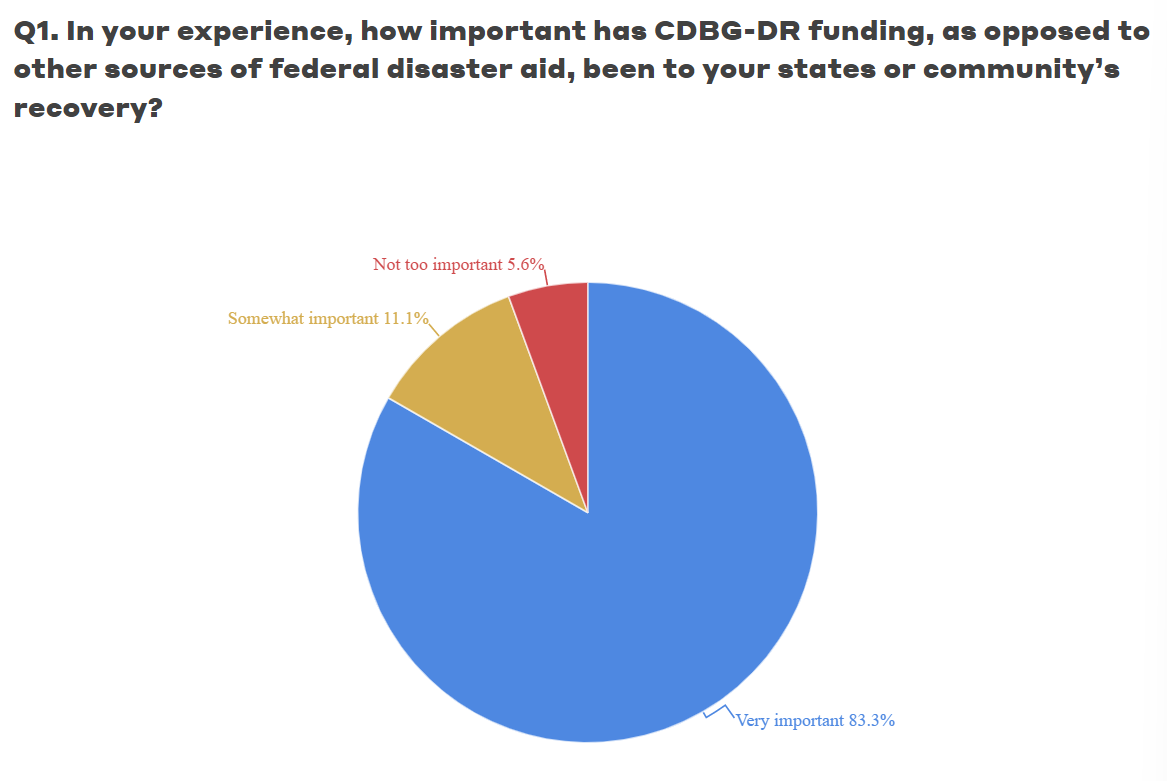
The Bipartisan Policy Center and the Council of State Community Development Agencies surveyed officials from 36 Community Development Block Grant Disaster Recovery program grantees about the program’s benefits and difficulties, as well as their priorities for reform. Almost all (94%) said CDBG-DR funding was very or somewhat important to their state or community’s recovery. A majority (69%) said that housing was the most important unmet need CDBG-DR addressed. Respondents strongly supported permanent statutory authorization of the program as well as more standardized program forms and templates.

Climate change brings higher temperatures

An analysis of current and future heat events released by First Street Foundation predicts that much of the middle of the U.S. will experience heat indices above 125 degrees by 2053. Find your home’s risk factors on First Street’s map. For a different perspective, Brown University’s Climate Opportunity Map shows local benefits that would result from investment in clean energy and climate solutions.

Annual Kids Count report focuses on mental health

The Annie E. Casey Foundation’s 2022 KIDS COUNT® Data Book presents annual data about economic well-being, education, health, and family and community at the national and state levels, and ranks states in overall child well-being. This year the report focuses on the mental health crisis in American children, linking it to poverty, housing cost burdens, and under-resourced communities. Challenges are greater for BIPOC children than for white children.

Most young adults stay close to home, even if wages are higher elsewhere

An interactive data tool created by the U.S. Census Bureau and Harvard University allows users to examine migration patterns from or to specific “commuting zones,” which are clusters of counties with strong commuting ties. An accompanying study, The Radius of Economic Opportunity: Evidence from Migration and Local Labor Markets, reports that 80% of young adults live within 100 miles of where they grew up. White young adults are more likely to leave their childhood CZ than their Black peers and to travel farther when they do leave. Those from higher-income families are also more likely to move. The researchers conclude that the individuals who benefit most from local wage growth are those who grew up nearby.

Paper examines links between housing justice and gender justice

The current housing crisis is based in underinvestment and policies that stripped wealth from women, people of color, and people with disabilities, says a report from the National Women’s Law Center, the Insight Center, and the Groundwork Collaborative. The Roots of Discriminatory Housing Policy: Moving Toward Gender Justice in Our Economy explains that before the coronavirus pandemic, women – particularly women of color – were more likely to rent their homes and to spend the majority of their income on housing. During the pandemic, Black and Latina women have been more likely than white, non-Hispanic men to be behind on rent and mortgage payments and to be at risk of eviction. The report’s recommendations for change are based on treating housing as a public good, not a commodity.

Dramatic overdose increases predicted for opioid epidemic’s fourth wave

Research from Northwestern University Feinberg School of Medicine predicts that the historic high rates of overdose deaths will continue to grow exponentially in a coming fourth wave. The study’s primary author states that the combination of synthetic opioids and stimulants will continue to increase overdoses across both rural and urban counties.

HAC

HAC seeks Housing Specialist – Native American Communities; and Loan Officer, Rental Preservation

  • The Housing Specialist – Native American Communities is responsible for providing direct technical assistance, coaching, and training to tribal communities, tribal housing departments, tribal housing authorities, and nonprofit organizations serving tribal communities. Travel is required. This position is eligible for telecommuting.
  • The Loan Officer, Rental Preservation, conducts rental housing lending and preservation technical assistance activities. This work includes marketing, originating, and underwriting new loan transactions. The Loan Officer also provides hands-on technical assistance to nonprofits that are seeking to acquire and preserve existing USDA-financed (Section 515) rental developments. This position is eligible for telecommuting.

Need capital for your affordable housing project?

HAC’s loan fund provides low interest rate loans to support single- and multifamily affordable housing projects for low-income rural residents throughout the U.S. and territories. Capital is available for all types of affordable and mixed-income housing projects, including preservation, new development, farmworker, senior and veteran housing. HAC loan funds can be used for pre-development, site acquisition, site development, construction/rehabilitation and permanent financing. Contact HAC’s loan fund staff at hacloanfund@ruralhome.org, 202-842-8600.

Please note: HAC is not able to offer loans to individuals or families. Borrowers must be nonprofit or for-profit organizations or government entities (including tribes).

Want to reprint a HAC News item?

Please credit the HAC News and provide a link to HAC’s website. Thank you!

 

HAC Submits Community Reinvestment Act Comments


The Community Reinvestment Act is essential to communities across the nation. Through CRA, financial services have been made available to many places that might otherwise be overlooked. In spring 2022 the three federal agencies that regulate banks and other lenders – the Office of the Comptroller of the Currency, the Federal Reserve Board, and the Federal Deposit Insurance Corporation – jointly issued a proposed new CRA rule. This proposal, and the many efforts which will follow, are critically important to ensure not only that current CRA-related activities and investments continue but that they expand to reach populations and communities for which access to affordable finance is still elusive.

This is especially important in rural communities across the country as many are considered high credit need areas. CRA modernization will help incentivize more lending in these areas and increase community development activities. As rural communities continue to change, the CRA must adjust as well to reflect modern lending practices. The proposed rule has the potential to further increase lending in high need rural areas, but HAC has a number of recommendations to optimize CRA’s impact.

HAC believes a final rule could further increase CRA’s impact on underserved rural communities if it:

  1. includes activities in rural communities as an additional impact factor, informed by the most precise, density-based definitions already used by policymakers and the research community;
  2. ensures uniform treatment of all CDFIs and supports the most transformative CDFI activities in underserved rural communities;
  3. modifies the definition of affordable housing to enable housing providers to respond effectively to the unique income demographics and constraints on government capacity of rural communities;
  4. clarifies how consequential the impact factors can be for a bank’s community development test performance and overall rating; and
  5. prevents banks with a substantial number of rural assessment areas from “gaming” the NPR’s performance benchmarks under the retail lending test.

To learn more about HAC’s full recommendations, read our full comment letter.

Other comments submitted to OCC are posted online and can be reviewed here.

HUD CDBG-DR grantees surveyed

Bipartisan Policy Center surveyed CDBG-DR grantees to better support communities as they recover from disasters. Takeaways include almost all respondents found CDBG-DR funding to be somewhat or very important to their state or community’s recovery and 69 percent of survey respondents say that housing is the unmet need that CDBG-DR funding has been most important in addressing. See survey results.

HAC News: August 8, 2022

TOP STORIES

Senate proposes FY23 funding levels

On July 28, the Senate Appropriations Committee released its version of all appropriations bills for fiscal 2023, which begins on October 1, 2022. HAC has posted summaries and tables of relevant parts of the USDA and HUD bills. The Senate has not scheduled action on any of these measures. The House has passed a “minibus” bill that combines appropriations measures for several agencies, including USDA and HUD, but the fiscal year is expected to begin with a continuing resolution holding government spending at FY22 levels. Final appropriations are not likely to be completed until after the midterm elections.

  • Like the administration’s budget request and the bill passed by the House, the Senate committee’s USDA bill would keep many rural housing programs at or near their current funding levels. It would provide $100 million for Section 515, twice as much as in FY22 but lower than the amounts proposed by the administration and the House. It would not extend new RA contracts created under the American Rescue Plan Act. It includes $10 million for the Rural Partners Network and $15 million for the Institute for Rural Partnerships.
  • The Senate’s Transportation-HUD bill would increase funding for many HUD programs, including raising SHOP to $17 million from its current $12.5 million. It does not cover the new $500 million manufactured housing program that was in the House’s HUD appropriations bill or the Housing Supply Fund proposed in the administration’s budget, and does not match the House’s or administration’s numbers of new vouchers.
  • The Senate’s HUD bill would reauthorize the Native American Housing Assistance and Self-Determination Act (NAHASDA). It would also permanently authorize the CDBG Disaster Recovery program and make other changes intended to get disaster recovery aid to survivors more quickly; similar provisions were also included in the House’s minibus appropriations bill.

HUD issues economic justice agenda to help renters build assets

Bridging the Wealth Gap: An Agenda for Economic Justice and Asset Building for Renters enumerates actions HUD will take to help low-income renters build assets through increased savings, access to mainstream banking, and credit score improvement. The agenda describes the expansion of asset building practices for renters as “a reparative tool for economic justice.”

HAC submits Community Reinvestment Act comments

In its response to a proposed rule from the three federal agencies that regulate banks, HAC generally supported their efforts to overhaul the process for determining whether lenders are complying with the Community Reinvestment Act, which requires them to meet the credit needs of the communities where they work. To increase CRA’s impact on underserved rural communities, HAC suggested the regulators should explicitly consider bank activities in rural areas and their performance based on race, should not raise the size threshold for determining whether a bank receives a more stringent evaluation, and should give more weight to community development activities.

RuralSTAT

40% of the most remote counties outside metro areas had no places with sufficient primary medical care in 2017, compared with only 16% of metro counties that lacked those resources. Source: Economic Research Service, USDA.

OPPORTUNITIES

HUD funds available for homelessness, Native housing, and self-sufficiency; HAC summarizes rural funding offer

Changes encourage governments to use recovery funds for housing

The Treasury Department has updated its guidance to state and local governments on their use of State and Local Fiscal Recovery Funds for pandemic-related housing needs. Items 2.14 and 4.9 in Treasury’s FAQs address allowable affordable housing expenditures, including those made in conjunction with USDA’s MPR rental preservation program. A new Affordable Housing How-To Guide explains how to combine SLFRF monies with other federal housing funds. For more information, email SLFRF@treasury.gov.

Uses updated for unobligated Emergency Rental Assistance funds

Revisions to the Treasury Department’s FAQs on the Emergency Rental Assistance program give some added flexibilities to state and local governments that spend most of their ERA2 funds by October 1. They can use the unobligated monies for affordable housing construction, rehabilitation, and preservation and for operations of affordable housing projects where ERA2 funds have been previously used.

Fed requests survey responses on pandemic impacts

The Federal Reserve System and partners are conducting a survey to learn how the effects of the coronavirus pandemic are evolving within low- to moderate-income communities and among the organizations serving them. Questions address supply chain disruptions, inflation, housing instability, employee retention, and more. Responses are requested by August 23. For more information, contact Surekha Carpenter, Federal Reserve.

CAPITOL HILL

New congressional caucuses address CDFIs and disasters

The website of the newly formed Senate Community Development Finance Caucus says the body “will be the platform where policymakers can coordinate and expand on public and private-sector efforts in support of the missions of Community Development Financial Institutions (CDFIs) and Minority Depository Institutions (MDIs).” In the House, a new Congressional Disaster Preparedness and Recovery Caucus intends to advance legislation and policies that provide efficient, equitable relief for disaster survivors, help communities to recover, and support disaster preparedness.

Senate committee hears about rental housing affordability

An August 2 hearing convened by the Senate Committee on Banking, Housing, and Urban Affairs, The Rent Eats First: How Renters and Communities are Impacted by Today’s Housing Market, included testimony from eviction expert Matthew Desmond and National Low Income Housing Coalition President and CEO Diane Yentel. They offered data and recommendations for policy changes to support renters.

REGULATIONS AND FEDERAL AGENCIES

USDA proposes to let lenders approve Section 502 loan guarantees

USDA review and approval is currently required at two stages in the process of making a Section 502 guaranteed loan. To streamline the process, USDA is proposing to allow lenders to obtain Delegated Lender status to approve Section 502 guaranteed loans with limited to no USDA involvement. Comments are due October 3. For more information, contact Sara Thieleke, USDA, 314-457-5242.

Revisions proposed for VA Homeless Grant and Per Diem Program

The Department of Veterans Affairs proposes to amend the regulations that govern its Homeless Providers Grant and Per Diem Program. It would change the allowable per diem rate VA provides to grant recipients and eligible entities for homeless veterans, establish a new rate for homeless veterans who care for a minor dependent, and make technical corrections. Comments are due September 30. For more information, contact Chelsea Watson, VA, 813-979-3570.

Comments sought on minority CDFIs

The CDFI Fund requests comments on the criteria and process it will use to designate a Community Development Financial Institution as a Minority Lending Institution. No federal funding is currently connected to an MLI designation, but the CDFI Fund hopes to recognize these CDFIs and to identify barriers they experience in providing access to capital. Comments are due November 25. For more information, contact Jeff Merkowitz, CDFI Fund.

Rural and Tribal communities to receive wastewater assistance

USDA and the EPA have launched a pilot initiative to help address wastewater management issues in 11 rural and Tribal communities. The agencies intend to help historically underserved communities identify and pursue federal funding opportunities to address their wastewater needs. EPA plans to offer more information online about getting technical assistance for community wastewater.

EVENTS

Webinar series to address Housing First

Four webinars from the National Low Income Housing Coalition and National Alliance to End Homelessness will cover topics related to homelessness and Housing First. The sessions are designed to push back against increasingly negative attitudes about people experiencing homelessness. They begin on August 15 and continue every other Monday.

White House hosts summit on eviction reform.

A White House Summit on Building Lasting Eviction Prevention Reform held on August 2 emphasized the importance of creating long-term policy solutions to ensure Americans can remain in their homes. Speakers emphasized that eviction reform requires input and buy-in from many different sectors and is most successful when communities have a multifaceted approach.

PUBLICATIONS AND MEDIA

Renters struggle as costs far outpace wage changes

The average minimum wage worker in the U.S. would have to work 96 hours per week to afford a modest two-bedroom rental home, according to the National Low Income Housing Coalition’s Out of Reach: The High Cost of Housing 2022 report. The annual study highlights the disparity between what renters can afford and what is available in the rental market. Information available on NLIHC’s site includes state summaries and the raw data.

HAC posts guide for Kentucky flood survivors

HAC offers an online resource guide as a source of information for individuals and families dealing with housing loss and damage from the recent rain and flooding in eastern Kentucky. Other disaster resources from HAC include Rural Resilience and a Disaster Response for Rural Communities Guide.

National Tribal broadband strategy recommended

Tribal Broadband: National Strategy and Coordination Framework Needed to Increase Access reports on a Government Accountability Office review of federal efforts to improve broadband on Tribal lands. Based on its research, GAO recommends that the White House and Commerce Department specifically address tribal needs within a national broadband strategy and within the American Broadband Initiative.

HAC

HAC seeks Training Coordinator and Loan Officer, Rental Preservation.

  • The Training Coordinator will support the successful management and delivery of HAC’s training activities as well as its biennial National Rural Housing Conference. The role requires strong logistical training events experience, exceptional attention to detail, and a passion for creating high-quality training events for attendees. This position is eligible for telecommuting.
  • The Loan Officer, Rental Preservation, conducts rental housing lending and preservation technical assistance activities. This work includes marketing, originating, and underwriting new loan transactions. The Loan Officer also provides hands-on technical assistance to nonprofits that are seeking to acquire and preserve existing USDA-financed (Section 515) rental developments. This position is eligible for telecommuting.

Need capital for your affordable housing project?

HAC’s loan fund provides low interest rate loans to support single- and multifamily affordable housing projects for low-income rural residents throughout the U.S. and territories. Capital is available for all types of affordable and mixed-income housing projects, including preservation, new development, farmworker, senior and veteran housing. HAC loan funds can be used for pre-development, site acquisition, site development, construction/rehabilitation and permanent financing. Contact HAC’s loan fund staff at hacloanfund@ruralhome.org, 202-842-8600.

Please note: HAC is not able to offer loans to individuals or families. Borrowers must be nonprofit or for-profit organizations or government entities (including tribes).

Want to reprint a HAC News item?

Please credit the HAC News and provide a link to HAC’s website. Thank you!
 

HAC Concerned about Buy America Requirements

Build America, Buy America

The U.S. Department of Agriculture (USDA), the Department of Housing and Urban Development (HUD), and other federal agencies are subject to a “Build America, Buy America” (BABA) requirement in the Infrastructure Investment and Jobs Act of 2021, which mandates that iron, steel, manufactured products, and construction materials used in infrastructure projects be American made. The provision applies to most federally funded infrastructure projects; it is not limited to projects funded through the 2021 Act.

HAC Comments to USDA, July 2022

On July 29, 2022, the Housing Assistance Council (HAC) submitted comments to the U.S. Department of Agriculture (USDA), which proposed to establish waivers from Buy America requirements for purchases of de minimis, small grants, and minor components of infrastructure projects.

Key Takeaways

  • Housing and community facilities should not be considered public infrastructure under the Build America, Buy America Act.
  • If housing and community facilities are considered public infrastructure, it would be in the public interest to waive the Buy America preference for USDA’s programs to finance these construction projects so that scarce funds and staff resources can be devoted to addressing the current housing crisis.
  • Waivers for purchases of de minimis, small grants, and minor components of infrastructure projects would also be in the public interest.

HAC Comments to HUD, July 2022

HAC expressed concern about the impact of “Buy America” requirements on affordable housing in comments it submitted to the U.S. Department of Housing and Urban Development (HUD) on July 15, 2022.

Key Takeaways

  • Buy America preferences should not apply to assisted housing. HUD’s priority should be to address the affordable housing crisis. Furthermore, the law defines infrastructure as projects that benefit the general public, while assisted housing is available to only a subset of the general population.
  • HUD should not apply Buy America preferences to owner-occupied housing because the Office of Management and Budget has specifically stated that private homes are not considered to be infrastructure.
  • HUD should not apply Buy America preferences when HUD assistance is used for infrastructure that is built solely to support affordable housing, as is the case with the Self-Help Homeownership Opportunity Program (SHOP).
  • HUD should not apply Buy America preferences to housing that receives less than $250,000 in federal funding, to developments with fewer than eight units, or to situations when HUD funding covers only a small portion of the per unit development cost.
  • HUD should issue expedited waivers for materials that experience price spikes.
  • HUD should provide guidance to help reduce administrative burdens on entities that receive HUD funding.

Eastern Kentucky Flooding Disaster Guide

Since July 26th southeastern Kentucky has seen some of the worst flooding in the state’s history, according to Kentucky Gov. Andy Beshear. The region has received about 12 inches of rain with another two expected on Friday. So far 15 fatalities have been reported and hundreds are trapped in flooded areas. Hundreds of homes are expected to be destroyed by this flood, along with vital infrastructure in many towns and rural areas. This disaster is ongoing, and the full impacts have not been assessed yet. HAC offers the following guide as a source of information for individuals and families dealing with direct housing loss and damage from the rain and flooding. For more information, please see HAC’s disaster resources: Rural Resilience and Disaster Response for Rural Communities Guide.

If your house is inaccessible or currently uninhabitable, emergency, transient housing will likely be made available to provide immediate shelter for those in need. Organizations and resources available to assist with emergency transient housing in previous similar disasters include the Red Cross, Salvation Army, Church World Service, Mennonite Disaster Service, and state- and city-run emergency shelters. If you are in need of emergency, transient housing, you can text SHELTER and your Zip Code to 43362 (4FEMA) to find where the shelter closest to you is located.

FEMA makes available temporary assistance funding for residents of counties affected by flooding. Temporary assistance can include grants for temporary housing and home repairs, low-cost loans to cover uninsured property losses, and other programs to help individuals and business owners recover from the effects of the disaster. To see if you are eligible for funding, you can apply online at https://www.disasterassistance.gov/ or call FEMA’s toll-free helpline at 1-800-621-FEMA(3362). When applying, make sure to have a pen and paper as well as the following information: your social security number, current and pre-disaster address, a telephone number where you can be contacted, insurance information, total household income, a routing and account number from your bank if you are interested in having disaster assistance funds transferred directly into your bank account, and a description of your losses that were caused by the disaster.

Tips

Please keep in mind the following safety protocols for flooding:

  • Only call 911 if you have an immediate need for medical attention or evacuation assistance.
  • If you can’t get through to 911 on first try, keep calling.
  • DO NOT DRIVE through high water and DO NOT DRIVE AROUND BARRICADES! Just 2 feet of water can sweep your vehicle away.
  • DO NOT WALK through flood waters. Just 6 inches of moving water can knock you down.
  • If your home floods, STAY THERE. You are safer at home than trying to navigate flooded streets on foot.
  • If floodwaters rise around your car but the water is NOT MOVING, abandon the car and move to higher ground. Do not leave the car and enter MOVING water.
  • STAY AWAY from streams, rivers, and creeks during heavy rainfall. These areas can flood quickly and with little warning.
  • MOVE important items – especially important documents like insurance policies – to the highest possible floor. This will help protect them from flood damage.
  • DISCONNECT electrical appliances and do not touch electrical equipment if you are wet or standing in water. You could be electrocuted.

This flooding event is a reminder that all residents in this area should carry flood insurance. Contact your insurance agent for more information about purchasing flood insurance or visit the National Flood Insurance Program at www.fema.gov/national-flood-insurance-program or call 1-888-379-9531. Please keep in mind that new insurance policies take 30 days to go into effect.

If your home has experienced damage, remember to check the outside of your home before you enter. Look for loose power lines, broken or damaged gas lines, foundations cracks, missing support beams, or other damage. It may be safest to ask a building inspector or contractor to check the structure before you enter. Do not force jammed doors open, as they may be providing needed support to the rest of the home. Sniff for gas to ensure there are no natural or propane gas leaks. If you do have a propane tank system, make sure to turn off all valves and contact a propane supplier to check the system before you use it again. Check floors and ceilings to ensure they are not sagging from water damage. This can be especially hazardous. Take photographs of any damage as you may need them for insurance claims or FEMA claims later on.

Resources

Apply for FEMA Assistance by registering online at www.DisasterAssistance.gov. FEMA Disaster Assistance Helpline answers questions about the help offered by FEMA, how to apply for assistance, or the information in your account.

Toll-free helpline: 1-800-621-FEMA (3362)
For hearing impaired callers only:
1-800-462-7585 (TTY)
1-800-621-3362 (Video Relay Service)
Operators are multilingual and calls are answered seven days a week from 7 a.m. to 11 p.m. ET

American Red Cross Disaster Service: For referrals and updates on Red Cross shelter services in your area, locate a local Red Cross office through: https://www.redcross.org/find-help or by calling 1-800-RED CROSS (1-800-733-2767)
The Red Cross helps disaster victims by providing safe shelter, hot meals, essential relief supplies, emotional support and health services like first aid. Trained Red Cross workers often meet one-on-one with families to develop individual plans and identify available resources to help aid recovery.

STATE HOUSING AGENCY
Kentucky Housing Corporation
1231 Louisville Road, Frankfort, KY 40601
Phone:502-564-7630
Phone: 800-633-8896 (KY only)
https://www.kyhousing.org

HUD STATE FIELD OFFICE

Gene Snyder Courthouse
601 W. Broadway, Room 110
Louisville, KY 40202
Phone: (502) 582-5251
Fax: (502) 582-6074
TTY: (800) 648-6056
Email: Customer Service

USDA RURAL DEVELOPMENT STATE OFFICE

Thomas Carew, State Director
771 Corporate Drive, Suite 200
Lexington, KY 40503
Phone: (859) 224-7300
Fax: (855) 661-8335
https://www.rd.usda.gov/ky

STATE EMERGENCY MANAGEMENT AGENCY
Kentucky Emergency Management
100 Minuteman Pkwy, Frankfort, KY 40601
Phone: (800) 255-2587
https://kyem.ky.gov/Pages/default.aspx

HAC News: July 21, 2022

TOP STORIES

House approves FY23 funding for USDA, HUD, others.

On July 20 the House passed a minibus appropriations bill, approving funding levels for several federal agencies including USDA and HUD. The Senate has not yet begun actions on FY23 appropriations, and a continuing resolution is expected to be needed to begin the fiscal year on October 1, 2022.

USDA considers Buy America waivers.

USDA proposes to waive Build America, Buy America (BABA) Act requirements for small awards, small parts of larger awards, and minor components of infrastructure projects financed by the department. Comments are due by August 2 to sm.OCFO.ffac@usda.gov. These waivers would be in effect for five years. USDA did not include any RD housing or community facilities programs on an initial list of programs that finance infrastructure, but it does mention multifamily housing and CF in the new waiver proposal, indicating it may be considering some of these activities to be infrastructure. (USDA has also requested the BABA requirements be suspended for all Rural Development-financed activities for six months.) For more information, contact Tyson Whitney, USDA, 202-720-8978. HAC has posted a summary of BABA requirements and their status, along with comments HAC submitted to HUD about its implementation of the law.

CDBG-Disaster Recovery authorization measure passes.

On July 14 when the House passed H.R. 7900, the FY23 National Defense Authorization Act, it included (p. H6599) an amendment that would permanently authorize HUD’s Community Development Block Grant-Disaster Recovery program. Authorization could make the program’s funding more predictable and reliable. The provision must be adopted by the Senate as well in order to become law.

RuralSTAT

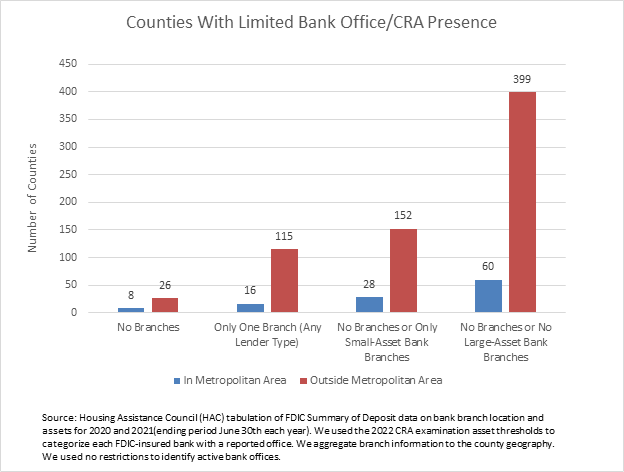
Sixty counties in metropolitan areas have limited banking options, compared to 399 counties outside metro areas. Source: HAC tabulation of FDIC data.

OPPORTUNITIES

Veterans housing repair grants available.

Nonprofit organizations offering nationwide or statewide programs that primarily serve veterans or low-income individuals are eligible for the Veterans Housing Rehabilitation and Modification Pilot Program from HUD and VA. Grants may be used to modify or rehabilitate eligible veterans’ primary residences or to provide grantees’ affiliates with technical, administrative, and training support related to those services. Apply by August 24. For more information, contact Jovette Bryant, HUD, 877-787-2526.

HAC offers rural creative placemaking grants.

HAC’s 2022 Creative Placemaking for Rural Initiative, under USDA’s Rural Placemaking Innovation Challenge Initiative, will provide support and technical assistance to create and implement innovative placemaking strategies. USDA RD defines placemaking as a collaborative process among public, private, philanthropic, and community partners to strategically improve the social, cultural, and economic structure of a community. For more information, contact HAC staff, cpr@ruralhome.org.

CDFI Fund extends Equitable Recovery Program deadline.

The CDFI Equitable Recovery Program will make awards to certified Community Development Financial Institutions to expand lending, grant making, and investment activity in low- or moderate-Income communities and to borrowers, including minorities, that have significant unmet capital or financial services needs and were disproportionately impacted by the COVID-19 pandemic, and to enable CDFIs to build organizational capacity to accomplish these activities. Applications are now due September 22. For more information, contact CDFI Fund staff, erp@cdfi.treas.gov, 202-653-0421.

REGULATIONS AND FEDERAL AGENCIES

Housing advocates push for more fundamental changes to the Community Reinvestment Act.

Shelterforce offers a roundup of feedback about the proposed CRA rule. Including explicit references to race, imposing stronger requirements for small banks serving rural areas, and making bank data available to the public are suggested. The deadline to submit comments is August 5.

Updated FAQs address Emergency Rental Assistance.

The Treasury Department has updated its Frequently Asked Questions on Emergency Rental Assistance for pandemic-impacted tenants. Among the changes, new answer 44 makes clear that ERA administrators may not impose additional eligibility criteria, including employment or job training requirements, as a condition of providing ERA assistance. Other new posts on the ERA site include a notice regarding ERA1 recapture for Tribal governments.

HUD proposes temporary Fair Market Rent calculation changes.

HUD’s methodology for calculating Fair Market Rents relies on the American Community Survey, but the Census Bureau is not releasing 2020 ACS data because of the pandemic’s impacts on data collection, so HUD proposes to changes the way it calculates FMRs for FY23.  Comments are due August 12. For more information, contact Adam Bibler, HUD, 202-402-6057.

Manufactured home code amendments suggested.

HUD proposes to adopt amendments to the Federal Manufactured Home Construction and Safety Standards, along with relevant regulations and installation standards, recommended by the Manufactured Housing Consensus Committee. Comments are due September 19. For more information, contact Teresa B. Payne, HUD, 202-402-2698.

USDA announces fees for some guaranteed loans.

FY23 fee rates will be effective October 1 with applications for guaranteed loans under USDA Rural Development’s Community Facilities, Water and Waste Disposal, Business and Industry, and Rural Energy for America programs. These fees may be adjusted after passage of final FY23 appropriations. For more information, contact Michele Brooks, USDA, 202-690-1078.

PUBLICATIONS AND MEDIA

Report quantifies “housing underproduction.”

Housing Underproduction™ in the U.S. 2022, published by Up for Growth, reports that the U.S. needed 3.8 million more homes in 2019, twice as many as in 2012. The report includes some rural data and some at the state level – noting, for example, that the extent of underproduction and the reasons for it vary from place to place – although it emphasizes metropolitan areas. The writers propose policy changes, but say that “socially vulnerable communities” need different, more targeted approaches.

Recommendations offered for building rural outdoor recreation economies.

Rural Outdoor Recreation Economies: Challenges and Opportunities, from the Aspen Institute Community Strategies Group, suggests tactics including collaborations, careful planning, workforce training, and requiring short-term rentals to be owner-occupied.

Survey found rising evictions in HUD properties.

A National Housing Law Project survey of legal aid attorneys found that in many places evictions in HUD-assisted housing are returning to pre-pandemic levels or higher. Tenants with housing vouchers have fared worse than tenants in public housing. Although HUD provided ways to adjust rents quickly, it did not require PHAs to use them and also did not require PHAs or voucher holders’ landlords to apply for emergency rental assistance, so many did not. The survey report includes recommendations for improvement.

Rural prosperity lessons summarized.

Learning Through Collaboration: Field Leaders Drive Critical Conversations, a post on the Aspen Institute’s community development blog, describes the work and learnings on equitable rural prosperity developed through the Rural Opportunity and Development (ROAD) collaboration among the Aspen Institute Community Strategies Group, HAC, the Rural Community Assistance Partnership, Rural LISC, and the Federal Reserve Board. For more information, contact Devin Deaton, Aspen Institute.

Some LIHTC properties have below market rents after leaving the program.

Low-Income Housing Tax Credit (LIHTC) at Risk examines the risks of expiring LIHTC restrictions and the outcomes for properties that exit the program. Freddie Mac researchers found that about 61% of units that left the LIHTC program remained affordable for tenants with incomes at 60% of area median. The analysis did not include properties outside metropolitan areas because they were considered to have a lower risk of exiting.

HAC

HAC seeks Training Coordinator; Portfolio Manager, Self Help Housing; and Loan Officer, Rental Preservation.

  • The Training Coordinator will support the successful management and delivery of HAC’s training activities as well as its biennial National Rural Housing Conference. The role requires strong logistical training events experience, exceptional attention to detail, and a passion for creating high-quality training events for attendees. This position is eligible for telecommuting.
  • The Portfolio Manager, Self Help Housing, is responsible for asset management, monitoring, and reporting for a portfolio of primarily self-help housing loans made to rural affordable housing entities throughout the U.S. These responsibilities include SHOP grant management and compliance activities. This position is eligible for telecommuting.
  • The Loan Officer, Rental Preservation, conducts rental housing lending and preservation technical assistance activities. This work includes marketing, originating, and underwriting new loan transactions. The Loan Officer also provides hands-on technical assistance to nonprofits that are seeking to acquire and preserve existing USDA-financed (Section 515) rental developments. This position is eligible for telecommuting.

Need capital for your affordable housing project?

HAC’s loan fund provides low interest rate loans to support single- and multifamily affordable housing projects for low-income rural residents throughout the U.S. and territories. Capital is available for all types of affordable and mixed-income housing projects, including preservation, new development, farmworker, senior and veteran housing. HAC loan funds can be used for pre-development, site acquisition, site development, construction/rehabilitation and permanent financing. Contact HAC’s loan fund staff at hacloanfund@ruralhome.org, 202-842-8600.

Please note: HAC is not able to offer loans to individuals or families. Borrowers must be nonprofit or for-profit organizations or government entities (including tribes).

Want to reprint a HAC News item?

Please credit the HAC News and provide a link to HAC’s website. Thank you!
 

HAC’s Stakeholder Comments on Rural Housing Service Programs

HAC submitted comments to Senators Tina Smith (D-MN) and Mike Rounds (R-SD), the Chair and Ranking Member of the Housing, Transportation, and Community Development Subcommittee of the Senate Banking Committee, in response to their call for recommendations on how to improve the U.S. Department of Agriculture’s (USDA) Rural Housing Service (RHS) programs. RHS programs are a critical source of housing for our nation’s small towns and rural places. HAC hopes that Senators Smith and Rounds will use these stakeholder comments to help improve the efficiency and impact of RHS programs, especially as more multifamily properties leave the USDA portfolio.

Topline Takeaways  

  • Multifamily

    HAC strongly recommends that the Senators authorize important multifamily preservation programs and simplify the process for transferring properties to non-profit owners in order to help more properties remain in RHS programs and maintain their affordability. HAC also recommends that the Senators investigate the rental assistance programs available in rural areas and extend these to more rural renters.  

  • Single family

    HAC recommends that the Senators improve the Section 504 program which provides grants for single family home repair. Simplifying and making this program’s funds more accessible would help more families stay in their homes and preserve single family homeownership. 

  • Capacity building

    Many communities have the willingness and desire to help improve their housing opportunities but lack the technical skill or capacity to accomplish their goals. HAC recommends authorizing capacity building programs that would help communities develop the tools they need to thrive. 

  • RHS staffing and operations

    HAC recommends improving the workflow within RHS and updating the technology the RHS staff uses to increase efficiency and help RHS better serve rural communities.  

Read HAC’s Comments

HAC News: July 7, 2022

TOP STORIES

USDA requests temporary waiver for “Buy America,” HUD extends comment deadline.

USDA RD, HUD, and other federal agencies are subject to a “Build America, Buy America” requirement in the Infrastructure Investment and Jobs Act of 2021, which mandates that iron, steel, manufactured products, and construction materials used in infrastructure projects be American made. The law applies to any federally funded project considered to be infrastructure, even if the funding is not provided by the Infrastructure Act.

  • USDA Rural Development has asked OMB to approve a waiver so recipients of RD funding would not have to apply the requirement for six months. Comments on the waiver request can be submitted to OCFO.ffac@usda.gov by July 18. USDA did not include any RD housing or community facilities programs on its initial list of infrastructure programs, which focuses instead on utilities and broadband activities. RD did include housing and CF in its waiver request, however, on a list of programs it intends to evaluate under the new law.
  • HUD has extended the deadline for comments on its implementation of the requirement to July 15 rather than July 1. HUD seeks input on topics such as what HUD-financed projects might fall under exemptions from the requirement, how materials are currently sourced, and more. It also asks what HUD programs might be considered to fund infrastructure in addition to those on a previously published list that includes HOME, CDBG, and SHOP. For more information, contact Pamela Blumenthal, HUD, 202-402-7012.

House committee advances HUD spending bill.

On June 30, the House Appropriations Committee approved its Transportation-HUD funding bill for fiscal year 2023. The committee passed its USDA bill on June 23. The full House is expected to vote on these and other appropriations bills later in July. The Senate has not yet begun considering its FY23 funding measures.

RuralSTAT

As of July 6, there have been more than 12 million reported cases and 181,985 reported deaths from COVID-19 in rural America. Source: Housing Assistance Council tabulations of public health data from the New York Times.

OPPORTUNITIES

Information available about HUD unsheltered and rural homelessness funds.

Resources are compiled online for housing and service providers hoping to participate in HUD’s Continuum of Care Supplemental to Address Unsheltered and Rural Homelessness. Each Continuum of Care will establish its own process and deadlines to invite and evaluate applications from local projects that can be included in its application, which must be submitted to HUD by October 20. HUD’s notice of funding opportunity (NOFO) and a variety of resources are posted, and the department has established an email address, SpecialCoCNOFO@hud.gov, for questions. Counties and county equivalents where the Rural Set Aside can be used are listed in the NOFO’s Appendix B. The National Alliance to End Homelessness offers information as well.

REGULATIONS AND FEDERAL AGENCIES

List of distressed or underserved geographies outside metro areas released.

The federal bank regulatory agencies have published their annual list of distressed or underserved middle-income geographies outside metropolitan areas. Bank financing for community development in these places is eligible for Community Reinvestment Act consideration.

Duty to Serve listening sessions scheduled.

The Federal Housing Finance Agency will hold virtual listening sessions to hear from stakeholders about Fannie Mae and Freddie Mac’s obligations to reach three underserved markets. On July 11 the subject will be affordable housing preservation, focusing on preserving the affordability of LIHTC properties. On July 12, a manufactured housing session will focus on tenant protections. A rural housing session will be held July 13 on Native American housing and will include testimony from HAC board member Dave Castillo, CEO of Native Community Capital. Written comments can be submitted through FHFA’s website. For more information, email dutytoservestakeholders@FHFA.gov.

Nominations reopen for HUD Tribal advisory committee.

HUD will accept nominations for its Intergovernmental Tribal Advisory Committee until July 28. It has withdrawn its June 22 request for comments on the committee’s creation because that was previously published in November 2021.

USDA extends waivers for Section 504 home repair pilot.

A pilot program has been in effect in several states since 2019, waiving some regulatory provisions to make the Section 504 repair program easier for very low-income homeowners to use. USDA incorporated some of the relevant waivers in a 2021 final rule, and now is extending two others through July 8, 2024. For more information, contact Anthony Williams, USDA, 202-720-9649.

FEMA provided $350 million in aid to heirs’ property residents and others.

In recent testimony to a Senate committee, FEMA Director Deanne Criswell highlighted the agency’s efforts to reduce barriers to its programs for heirs’ property residents and others without official ownership or rental documents. A policy change in August 2021 allowing claimants to use alternate forms of documentation to prove land control has resulted in approval of 2,000 homeowners and 53,000 renters for around $350 million in assistance.

“Rural area” determinations modified for non-housing programs.

The 2018 Farm Bill changed how population is counted in determining what is a “rural area” for some of USDA Rural Development’s non-housing programs. (The housing programs use a different definition of “rural area.”) “Individuals incarcerated on a long-term or regional basis” and “the first 1,500 individuals who reside in housing located on a military base” are now excluded from population calculations. RD has adopted a final regulation incorporating these changes, published a list of communities that are now eligible, and updated its eligibility mapping tools. For more information, contact John Delaney, RD, 202-720-9705.

More USDA Rural Development State Directors named.

With the addition of State Directors in Kansas and Texas, the only jurisdiction that still has an Acting State Director is Puerto Rico. HAC has updated its list of all USDA RD State Directors appointed by President Biden to date. These positions do not require Senate confirmation.

PUBLICATIONS AND MEDIA

Native Hawaiians waiting for homesteads.

We Need to Talk About Hawaii: Why After 100 Years Hawaiians Are Still Fighting for their Land, an Enterprise Community Partners blog post written by former HAC researcher Evelyn Immonen, summarizes the history that has left 29,000 Native Hawaiians waiting to receive trust land allotments, 100 years after the passage of the Hawaiian Homes Commission Act.

Freddie Mac to consider on-time rent payments in mortgage underwriting.

Beginning this month, homebuyers will have the option to ask mortgage lenders to include bank account data showing 12 months of rent payment history for Freddie Mac’s underwriting consideration. The change is intended to increase homeownership opportunities for first-time homebuyers.

Reports consider how to define and measure rural development success.

What (and Who) Counts? Defining Rural Development Success shares practitioners’ perspectives on definitions. Measure Up: A Call to Action highlights six principles for measuring rural development progress that considers lower-capacity communities’ realities, needs, and goals. It offers recommendations and an annotated list of resources. Both are published by Aspen Community Strategies Group.

Inland floods’ impact described.

How Inland America is Adapting to High Water, an article published by Grist, features interviews from mostly rural communities in Iowa, Montana, Oklahoma, and West Virginia. Local leaders and residents describe the psychological aftermath of destructive flooding, environmental damage, and how decisions about rebuilding and planning for future flooding affect housing affordability.

HAC

HAC seeks Portfolio Manager, Self Help Housing; Loan Officer, Rental Preservation; and Housing Specialist – Native American Communities.

  • The Portfolio Manager, Self Help Housing, is responsible for asset management, monitoring, and reporting for a portfolio of primarily self-help housing loans made to rural affordable housing entities throughout the U.S. These responsibilities include SHOP grant management and compliance activities. This position is eligible for telecommuting.
  • The Loan Officer, Rental Preservation, conducts rental housing lending and preservation technical assistance activities. This work includes marketing, originating, and underwriting new loan transactions in the Loan Fund Division. The Loan Officer also provides hands-on technical assistance to nonprofits that are seeking to acquire and preserve existing USDA-financed (Section 515) rental developments. This position is eligible for telecommuting.
  • The Housing Specialist – Native American Communities is responsible for providing direct technical assistance, coaching, and training to tribal communities, tribal housing departments, tribal housing authorities, and nonprofit organizations serving tribal communities. Travel is required. This position is eligible for telecommuting.

Need capital for your affordable housing project?

HAC’s loan fund provides low interest rate loans to support single- and multifamily affordable housing projects for low-income rural residents throughout the U.S. and territories. Capital is available for all types of affordable and mixed-income housing projects, including preservation, new development, farmworker, senior and veteran housing. HAC loan funds can be used for pre-development, site acquisition, site development, construction/rehabilitation and permanent financing. Contact HAC’s loan fund staff at hacloanfund@ruralhome.org, 202-842-8600.

Please note: HAC is not able to offer loans to individuals or families. Borrowers must be nonprofit or for-profit organizations or government entities (including tribes).

Want to reprint a HAC News item?

Please credit the HAC News and provide a link to HAC’s website. Thank you!
 

Housing Assistance Council Statement on Proposed $54.5 Million Set Aside for Homelessness in Rural Communities

The Housing Assistance Council (HAC) applauds the new funding package announced by the U.S. Department of Housing and Urban Development (HUD) on June 22, 2022 to provide people experiencing homelessness in the nation’s cities and rural communities with the support they need. In total, HUD’s initiative includes $322 million targeted to addressing unsheltered and rural homelessness. Of this, $54.5 million is set aside for rural communities to help connect individuals and families experiencing homelessness to housing, healthcare and supportive services.

“This is a remarkable investment in terms of its size, targeting and design,” said HAC CEO David Lipsetz. “HUD recognizes that homelessness looks different in rural places than in large cities, and is customizing this initiative to address the unique capacity challenges that rural Continuums of Care face.” In particular, rural communities can apply for capacity-building support—which is not an eligible activity under the annual Continuum of Care competition or the unsheltered homelessness set aside. Funds can also support home repairs, outreach, supportive services and more. By specifically targeting rural communities that have historically not had access to HUD homeless assistance grants, this special funding announcement goes a long way toward ensuring an equitable approach for underserved communities.

HUD’s announcement reflects HAC’s longstanding efforts to educate policymakers on the unique needs of rural communities seeking to address homelessness. “HAC played an essential role informing the drafting and early implementation of the HEARTH Act of 2009, which overhauled HUD’s homeless assistance programs for the first time in two decades,” said Jonathan Harwitz, HAC’s Director of Public Policy, who worked on the HEARTH Act as a Congressional staffer and at HUD. “It is gratifying that HUD’s special funding announcement today reflects HAC’s feedback on HEARTH Act implementation over the past decade.”

GET THE HAC NEWS!

Sign-up for HAC information products

SIGN UP HERE

Housing Assistance Council   |  1828 L Street. N.W., Suite 505, Washington, D.C. 20036
(202) 842-8600 (202) 347-3441 hac@ruralhome.org |

Board Portal

HAC is an equal opportunity provider, employer, and lender. | Civil Rights | Privacy