The Rural Data Portal

Quality data for rural areas can be limited and hard to find. To address this concern, HAC developed the Rural Data Portal to provide rural communities with a user-friendly tool to gain information about the places where they live and work.

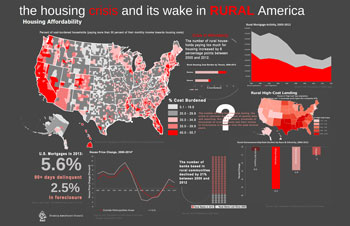
Quality data for rural areas can be limited and hard to find. To address this concern, HAC developed the Rural Data Portal this year to help communities better understand and document needs and conditions. The Rural Data Portal is an online resource that provides social, economic, and housing characteristics of communities across the United States using data from HAC tabulations of the 2010 Census of Population and Housing, the American Community Survey (ACS), and Home Mortgage Disclosure Act Data.

ima-best-in-class-award

The Rural Data Portal was awarded the “Best in Class” Interactive Media Award in the nonprofit websites category for 2013 by the Interactive Media Council.

rdp-screenshot

Access the Rural Data Portal

Looking to the Future: Youth and Housing in Rural America

thumb_rvmarch2014-coverThe March 2014 issue of Rural Voices, “Looking to the Future: Housing and Youth in Rural America” is now available for download from the Housing Assistance Council. This edition looks at the unique issues related to youth and housing in rural America. The edition also features several organizations that directly serve rural youth.

FEATURES

Children Growing up in Rural America
by Marybeth J. Mattingly and Cynthia M. Duncan, The Carsey Institute

Characteristics and challenges of a changing population.

Serving Families from Roots to the Moon
by Nadia Villagrán, Coachella Valley Housing Coalition

How California’s Coachella Valley Housing Coalition helped improve the lives of one rural farmworker family.

Young People Build Affordable Housing and Transform Their Lives
by Karen Jacobson, Randolph County Housing Authority

YouthBuild provides young rural Americans with the opportunity to build job skills, and homes, in their own communities.

Young Rural Housing Leaders Reflect

A group of graduates from the California Coalition for Rural Housing’s Youth Internship program discuss opportunities for youth in rural America.

Lead Poisoning: Not Just a Problem for Urban Youth
by Ron Rupp,

Lead paint is common in older rural housing and is considered to be the leading environmental health threat to young children.

VIEW FROM WASHINGTON

Congress Acts on Rural Housing
by Joe Belden and Leslie Strauss

A federal budget and extension of eligibility for rural communities are positive steps for affordable rural housing. The proposed 2015 budget? Not so much.

MAPS

thumb_childrenandyouthmapChildren & Youth in Rural America – (Interactive Prezi)

Add your Response

Rural Voices would like to hear what you have to say about one, or all, of these issues. Please feel free to comment on this story below, tweet #RuralVoicesMag, discuss on the Rural Affordable Housing Group on LinkedIn, or on our Facebook page.

HAC News: March 19, 2014

HAC News Formats. pdf

March 19, 2014
Vol. 43, No. 6

• Members of Congress question Vilsack about proposed cuts in Sections 502 and 523 • USDA publishes more details about budget requests, HAC responds to rental proposals • Senators propose housing finance reform deal • Deadlines coming up for Assets for Independence • USDA to hold conference calls on multifamily programs •Comments sought on Native Asset Building Initiative • USDA RD explains implementation of rural definition changes • New data on USDA tenants released • Report examines income inequality in states • HAC blogs on rural seniors

March 19, 2014
Vol. 43, No. 6

MEMBERS OF CONGRESS QUESTION VILSACK ABOUT PROPOSED CUTS IN SECTIONS 502 AND 523. USDA Secretary Tom Vilsack was the only witness at a March 13 House Appropriations Subcommittee on Agriculture hearing on the Administration’s FY15 budget request. House Appropriations Committee Chair Hal Rogers (R-KY) criticized the proposed cuts in Section 502 direct loans and Section 523 self-help grants, saying this approach “shows a disrespect for our rural communities.” Subcommittee Chair Robert Aderholt (R-AL) also asserted support for the rural housing programs. When Rep. David Valadao (R-CA) asked the Secretary why the reductions were proposed, Vilsack replied that “difficult choices” had to be made.

USDA PUBLISHES MORE DETAILS ABOUT BUDGET REQUESTS, HAC RESPONDS TO RENTAL PROPOSALS. In its Congressional Justification explaining the FY15 budget, USDA tells how it calculates the amount it would expect to collect if a $50 monthly minimum rent were imposed, and how it might use the discretion it wants with respect to renewals of Section 521 Rental Assistance contracts. HAC board and staff critique the ideas in posts on the Rooflines blog: “No, Minimum Rents Do Not ‘Encourage Financial Responsibility” and “Rural Rental Assistance Needs USDA’s Support to Survive.”

SENATORS PROPOSE HOUSING FINANCE REFORM DEAL. Senators Tim Johnson (D-SD) and Mike Crapo (R-ID), the Chair and Ranking Member of the Senate Committee on Banking, Housing, and Urban Affairs, have released a discussion draft of a bipartisan housing finance reform bill based on S. 1217, the Corker-Warner bill introduced in June 2013. Like the earlier bill, it would create a new Federal Mortgage Insurance Corporation to replace Fannie Mae and Freddie Mac and would eliminate affordable housing goals. It does include other mechanisms to encourage affordable housing development.

DEADLINES COMING UP FOR ASSETS FOR INDEPENDENCE. The next deadlines are May 7 and July 14, and applica-tions are accepted on a rolling basis. This program makes grants to nonprofits and government agencies that establish individual development accounts for low-income participants. Contact the AFI Resource Center, 1-866-778-6037.

USDA TO HOLD CONFERENCE CALLS ON MULTIFAMILY PROGRAMS. Calls with stakeholders will be scheduled at least quarterly during 2014. To register, contact Timothy James, RD, 919-873-2056. Those who have previously registered do not need to register again.

COMMENTS SOUGHT ON NATIVE ASSET BUILDING INITIATIVE. The Administration for Children and Families at the Department of Health and Human Services proposes policy changes to be used in the FY14 NOFA for NABI, which funds Individual Development Accounts and related services. Comments are due April 7. Contact Carmelia Strickland, HHS, 877-922-9262.

USDA RD EXPLAINS IMPLEMENTATION OF RURAL DEFINITION CHANGES. Administrative Notice 4748 explains that the grandfathering provisions adopted in the Farm Bill and the FY14 appropriations act will be implemented in two stages. The February 5, 2014 HAC News stated erroneously that the new 35,000 population limit for growing areas would not take effect until October 1; instead, RD expects to implement it around May 6. No currently eligible places will become ineligible until October 1, when currently eligible places will become ineligible if their populations exceed 35,000 or they are no longer rural in character.

NEW DATA ON USDA TENANTS RELEASED. The annual occupancy report shows that the total number of properties in USDA’s rental portfolio fell by 2.48% from April 2012 to September 2013, a decrease of 346 Section 515 properties and 34 Section 514 properties, representing about 5,092 apartments (1.14% of total units). This report is the first to include demographic data on Section 521 Rental Assistance households, and they appear generally similar to tenants in Section 515 properties. The average annual income of Section 515 residents has increased slightly to $11,747. For 515 tenants with RA, average income is $9,828.

REPORT EXAMINES INCOME INEQUALITY IN STATES. The Economic Analysis and Research Network calculated changes in income from 1917 to 2011 and found that in every state the incomes of the top 1% have grown faster than those of the other 99%, although the extent of the gap differs among states. The Increasingly Unequal States of America, published by the Economic Policy Institute, is accompanied by an interactive feature that provides figures and graphics for each state.

HAC BLOGS ON RURAL SENIORS.Keeping Rural Seniors in Their Homes” describes home and community based care as a way to allow rural seniors to age in place.

HAC News: March 5, 2014

HAC News Formats. pdf

March 5, 2014
Vol. 43, No. 5

• For USDA housing, budget proposes minimum rents and new limits on Rental Assistance • HUD budget proposes some cuts, some increases • FY14 HUD NOFAs’ general section issued, includes transportation emphasis • Section 811 Project Rental Assistance funds offered • Housing counseling funds available • RD implements Violence Against Women Act changes • Section 184 fee increased, regulations revised • EPA proposes expanded pesticide protection for farmworkers

March 5, 2014
Vol. 43, No. 5

FOR USDA HOUSING, BUDGET PROPOSES MINIMUM RENTS AND NEW LIMITS ON RENTAL ASSISTANCE. On March 4 the Obama Administration released its budget proposal for FY15. Many of the USDA rural housing programs would be funded at the same level as in FY14. Differences include decreases in Section 502 direct loans and Section 523 self-help housing; as it has in past budgets, the Administration states it would rely on the Section 502 and 538 guarantee programs to finance single- and multifamily housing. Significant changes are proposed for the Section 521 Rental Assistance program. RA recipients would be required to pay a minimum rent of $50 per month unless exempted because of hardship. RA contracts would not automatically be renewed, and USDA would determine whether projects needed renewed RA.

[tdborder][/tdborder]

USDA Rural Devel. Prog.
(dollars in millions)

FY13
Approp.a

FY14
Approp.

FY15
Admin. Budget

502 Single Fam. Direct
Self-Help setaside

$900
5

$900
5

$360
0

502 Single Family Guar.

24,000

24,000

24,000

504 VLI Repair Loans

28

26.3

26.3

504 VLI Repair Grants

29.5

28.7

25

515 Rental Hsg. Direct Loans

31.3

28.4

28.4

514 Farm Labor Hsg. Loans

20.8

23.9

23.9

516 Farm Labor Hsg. Grants

7.1

8.3

8.3

521 Rental Assistance
Preservation RA setaside
New Cnstr. 515 RA setaside
New Cnstr. 514/516 RA setaside

907.1
0
0
3

1,110
0
0
0

1,089
0
0
0

523 Self-Help TA

30

25

10

533 Hsg. Prsrv. Grants

3.6

3.5

0

538 Rental Hsg. Guar.

150

150

150

Rental Prsrv. Demo. (MPR)

17.8

20

20

Rental Prsrv. Revlg. Lns.

0

0

0

542 Rural Hsg. Vouchers

10

12.6

8

Rural Cmnty. Dev’t Init.

6.1

6

0

a Figures shown do not include 5% sequester or 2.5% across the board cut.

HUD BUDGET PROPOSES SOME CUTS, SOME INCREASES. HUD programs such as homeless assistance, public housing operating and capital funds, Section 202 housing for seniors, Section 811 housing for the disabled, tenant-based rental assistance, fair housing, housing counselling, and lead hazard control all have proposed increases. The Housing Trust Fund would receive $1.0 billion. Community Development Block Grants and HOME would be cut, and small rural programs are zeroed out. The Rural Innovation Fund and its predecessor, the Rural Housing and Economic Development program, are not mentioned at all. As was proposed for FY14, the SHOP program would receive an appropriation of $10 million, but only as a setaside within HOME (which would be cut).

HUD Program
(dollars in millions)

FY13
Approp.a

FY14
Approp.

FY15
Admin. Budget

Cmty. Devel. Fund
CDBG
Sustainable Commun. Init.
Rural Innovation Fund

3,308
2,948
0
0

3,100
3,030
0
0

2,870
2,800
0
0

HOME
SHOP setaside

1,000
b

1,000
b

950
10

Self-Help Homeownshp. (SHOP)

13.5

10

c

Tenant-Based Rental Asstnce.
VASH setaside

18,939.4
75

19,177.2
75

20,100
75

Project-Based Rental Asstnce.

9,339.7

9,516.6

9,346

Public Hsg. Capital Fund

1,886

1,875

1,925

Public Hsg. Operating Fund

4,262

4,400

4,600

Choice Neighbrhd. Initiative

120

90

120

Housing Trust Fund

d

d

1,000

Native Amer. Hsg. Block Grant

650

650

650

Homeless Assistance Grants

2,033

2,105

2,406.4

Rural Hsg. Stability Prog.

e

e

e

Hsg. Opps. for Persons w/ AIDS

334

330

332

202 Hsg. for Elderly

377

385.3

440

811 Hsg. for Disabled

165

126

160

Fair Housing

70.8

66

71

Healthy Homes & Lead Haz. Cntl.

120

110

120

Housing Counseling

45

45

60

a Figures shown do not include 5% sequester.
b Funded under separate Self-Help & Assisted Homeownership Opportunity Program.
c Funded as a setaside in HOME.
d National Housing Trust Fund is “mandatory” funding, not discretionary, so does not need to be funded through appropriations legislation, although the Administration did include it in the budget request.
e Funded under Homeless Assistance Grants.

FY14 HUD NOFAS’ GENERAL SECTION ISSUED, INCLUDES TRANSPORTATION EMPHASIS. As in past years, this document provides information that applies to all FY14 program NOFAs and does not itself offer funds. One of HUD’s crosscutting priorities is to reduce transportation costs by locating housing close to amenities such as grocery stores, medical facilities, and schools. A nonmetro site can receive a rating point if it is within one mile of amenities or within half a mile of public transportation to amenities. Contact HUD’s grants management office, 202-708-0667.

SECTION 811 PROJECT RENTAL ASSISTANCE FUNDS OFFERED. State, regional, and local housing agencies can apply for FY13 and FY14 monies to provide project-based rental assistance for Section 811 supportive housing for extremely low-income persons with disabilities. Deadline is May 5, 2014. Contact Lessie Powell Evans, HUD, PRAapplications@hud.gov.

HOUSING COUNSELING FUNDS AVAILABLE. Apply by April 7 for FY14 and FY15 funding. Contact HUD, housing.counseling@hud.gov.

RD IMPLEMENTS VIOLENCE AGAINST WOMEN ACT CHANGES. The March 2013 reauthorization of VAWA made USDA’s multifamily programs (Sections 515, 514/516, 533, and 538) subject to the law. Administrative Notice 4747 begins to implement it, notifying RD staff that victims are protected from eviction, offenders may be removed from leases, victims may be relocated to other units using RD’s LOPE process, and more. Contact Barbara Chism, USDA RD, 202-690-1436.

SECTION 184 FEE INCREASED, REGULATIONS REVISED. HUD issued a final rule implementing a provision in the FY13 appropriations law that allows it to increase the guarantee fee under the Section 184 Indian Housing Loan Guarantee program to as much as 3%. A separate notice increases the fee, effective April 4, to 1.5% from the current 1%. Contact Rodger Boyd, HUD, 202-401-7914.

EPA PROPOSES EXPANDED PESTICIDE PROTECTION FOR FARMWORKERS. A proposed rule is posted on EPA’s site. Comments will be due 90 days after publication in the Federal Register. Contact Kathy Davis, EPA, 703-308-7002.

HAC News: February 19, 2014

HAC News Formats. pdf

February 19, 2014
Vol. 43, No. 4

• Debt ceiling increased without other changes • FY15 Administration budget to be issued in two parts • President repeats environmental justice commitment • Updated income limits posted for USDA Section 502 direct and guarantee programs • HUD announces FY14 AAFs for Section 8 • USDA RD offers email information on Section 502 guarantee program • Frequently asked questions about HOME program updated • Resources available for community integration of people with disabilities • Wealth-building tax incentives go mostly to highest earners • Report explains use of surplus property program • HUD offers fair housing videos in American Sign Language • Upcoming HAC Events Cover Energy, 502, Seniors, and Veterans

February 19, 2014
Vol. 43, No. 4

DEBT CEILING INCREASED WITHOUT OTHER CHANGES. No spending reductions or other trade-offs were included in the measure, signed into law by President Obama on February 15.

FY15 ADMINISTRATION BUDGET TO BE ISSUED IN TWO PARTS. Initial reports stated that detailed figures would not be available until March 11. According to Bloomberg, however, an OMB spokesman said that on March 4 the Administration will release proposals, agency-level information, and the comprehensive appendix that provides figures for every program. Historical tables and supplemental analyses will be released on March 11.

PRESIDENT REPEATS ENVIRONMENTAL JUSTICE COMMITMENT. A proclamation by President Obama recognizes February 11 as the twentieth anniversary of President Bill Clinton’s Executive Order 12898 on Environmental Justice, renewing the federal pledge to address disproportionate environmental impacts on low-income and minority populations.

UPDATED INCOME LIMITS POSTED FOR USDA SECTION 502 DIRECT AND GUARANTEE PROGRAMS. Visit https://eligibility.sc.egov.usda.gov or contact a USDA RD office.

HUD ANNOUNCES FY14 AAFS FOR SECTION 8. Annual adjustment factors are used to calculate rent changes when Section 8 contracts are renewed. Contact information varies by program.

USDA RD OFFERS EMAIL INFORMATION ON SECTION 502 GUARANTEE PROGRAM. To receive Countdown: 7 CFR 3555, an email newsletter preparing for the September 1 effective date of the new interim final regulations (see HAC News, 12/18/13), and other email announcements, subscribe at https://www.rdlist.sc.egov.usda.gov.

FREQUENTLY ASKED QUESTIONS ABOUT HOME PROGRAM UPDATED. HUD’s HOME FAQs cover program requirements, CHDOs, homeownership, rental housing, and more.

RESOURCES AVAILABLE FOR COMMUNITY INTEGRATION OF PEOPLE WITH DISABILITIES. The Community Integration Center at the Technical Assistance Collaborative provides an online library and also offers technical assistance to government agencies and others. Contact Kevin Martone, CICTAC, 617-266-5657, ext. 122, or send email through the organization’s website.

WEALTH-BUILDING TAX INCENTIVES GO MOSTLY TO HIGHEST EARNERS. “Upside Down: Tax Incentives to Save & Build Wealth,” a policy brief from CFED, reports that in FY13 the bottom 40% of earners received less than 3% of tax incentives related to investment, homeownership, retirement, and college. The paper includes recommendations for improving the incentives that reach lower-income families.

REPORT EXPLAINS USE OF SURPLUS PROPERTY PROGRAM. This Land is Your Land: How Surplus Federal Property Can Prevent and End Homelessness, published by the National Law Center on Homelessness and Poverty, describes the impact of the McKinney-Vento Title V program, which allows vacant federal property to be used, free, by eligible groups to provide housing or services to homeless persons.

UPCOMING HAC EVENTS COVER ENERGY, 502, SENIORS, AND VETERANS

March 25-26: “Energy Efficiency and Renewable Energy Systems for Affordable Housing Development” in Memphis, TN, will cover energy efficient development practices and renewable energy technologies in rural affordable housing. The course will include site visits.
March 25-27: “Section 502 Packaging Training for Nonprofit Developers,” held in Memphis, TN, will be an advanced course teaching participants to assist potential borrowers and to work with RD staff, as well as other nonprofit organizations, to deliver successful Section 502 loan applications.
April 9: “Serving Veterans in Rural America: A Symposium,” held on Capitol Hill in Washington, DC, will draw attention to our rural veterans and showcase programs and initiatives that help with housing, health, and employment needs. Senior federal officials from HUD, USDA and VA are confirmed speakers.
April 22-23:Housing Seniors and Veterans in Rural America: Preservation, Development, and Services,” held in Phoenix, AZ, is targeted to rural housing providers. The agenda will feature discussions of federal and other housing programs for veterans and the aging, including home repair, rental housing, and services for the homeless. Successful best practices will be featured. Online registration.

Guaranteed Rural Housing Loans (Section 502)

Under the Section 502 Guaranteed Rural Housing Loan Program the government guarantees mortgage loans made by commercial lenders, enabling low- and moderate-income rural residents to purchase modestly priced homes.

Download this resource guide

Homeownership Direct Loan Program (Section 502)

rrg-rd502direct The Section 502 direct loan program offers mortgages for low-income homebuyers in rural areas. Section 502 direct is operated by the U.S. Department of Agriculture’s Rural Development Housing and Community Facilities Programs office (RD). There is also a separate Section 502 loan guarantee program.

Download this Resource Guide.

HAC News: February 5, 2014

HAC News Formats. pdf

February 5, 2014
Vol. 43, No. 3

• February is National African American History Month • Farm bill extends housing eligibility for rural places • FY15 Administration budget to be delayed • USDA Rural Development revamping environmental regulations • Liquid asset poverty disproportionate among low-income and people of color • Research finds location impacts upward mobility • Upcoming HAC Events Cover Energy, 502, Seniors, and Veterans

February, 2014
Vol. 43, No. 3

FEBRUARY IS NATIONAL AFRICAN AMERICAN HISTORY MONTH.

FARM BILL EXTENDS HOUSING ELIGIBILITY FOR RURAL PLACES. President Obama is expected to sign the farm bill into law; it passed the House on January 29 and the Senate on February 4. The bill includes language extending growing places’ eligibility for USDA rural housing programs. Communities that have been eligible, including about two dozen places that have been designated eligible under some provision of law, will continue to be “grandfathered in” – that is, they will remain eligible – until receipt of 2020 census data or until their populations reach 35,000. The farm bill increases the previous population limit from 25,000 to 35,000. The grandfathering provision of the FY14 omnibus appropriations bill, which maintains the 25,000 cap, will be in effect through September 30, and then the farm bill’s provisions will take effect. Contact HAC’s Mike Feinberg, 202-842-8600.

FY15 ADMINISTRATION BUDGET TO BE DELAYED. The Obama Administration has announced that its FY15 budget request to Congress will come out on March 4. By law the annual budget request is supposed to go to Congress by the first Monday in February. The congressional appropriations process begins after the budget submission, but even with the late start the process may move quickly because the budget agreement reached in late 2013 set discretionary spending caps for two fiscal years – 2014 and 2015 – rather than the usual one. In theory this will avoid a repeat of deadlocked or delayed budget negotiations, allowing Congress to complete FY15 appropriations bills in a more timely fashion. Appropriations are supposed to be, but seldom are, in place by October 1.

USDA RURAL DEVELOPMENT REVAMPING ENVIRONMENTAL REGULATIONS. RD has proposed to update the regulations on environmental policies and procedures that apply to all RD programs. It would also consolidate two separate rules into one. Comments are due April 7. Contact Mark S. Plank, RD, 202-720-1649.

LIQUID ASSET POVERTY DISPROPORTIONATE AMONG LOW-INCOME AND PEOPLE OF COLOR. CFED’s annual Assets and Opportunity Scorecard provides state level data for five issue areas, including housing. It reports that 44% of U.S. households have less than three months’ worth of savings. For low-income households the figure is 78%, and for households of color, 61%. All but one of the 10 states with the worst liquid asset poverty are in the South: Alabama, Arkansas, Georgia, Kentucky, Louisiana, Mississippi, Nevada, North Carolina, Tennessee, and Texas.

RESEARCH FINDS LOCATION IMPACTS UPWARD MOBILITY. Where is the Land of Opportunity? The Geography of Intergenerational Mobility in the United States, a National Bureau of Economic Research working paper by researchers at Harvard and UC-Berkeley, compares the incomes of parents when their children were teenagers to the incomes of the children when they were about 30. Places with high mobility have less residential segregation, less income inequality, better primary schools, greater social capital, and greater family stability. Regionally, upward mobility is lowest in the Southeast and highest in the Great Plains. There are variations within regions as well. Rural residents are more upwardly mobile than urban ones: while 44.6% of all children who grew up in rural areas lived in urban areas at age 30, 55.2% of those who rose from the bottom quintile of the national income distribution to the top quintile grew up in rural areas and lived in urban places at age 30. Email info@equality-of-opportunity.org.

UPCOMING HAC EVENTS COVER ENERGY, 502, SENIORS, AND VETERANS

March 25-26: “Energy Efficiency and Renewable Energy Systems for Affordable Housing Development” in Memphis, TN, will cover energy efficient development practices and renewable energy technologies in rural affordable housing. The course will include site visits.
March 25-27: “Section 502 Packaging Training for Nonprofit Developers,” held in Memphis, TN, will be an advanced course teaching participants to assist potential borrowers and to work with RD staff, as well as other nonprofit organizations, to deliver successful Section 502 loan applications.
April 9: “Serving Veterans in Rural America: A Symposium,” held on Capitol Hill in Washington, DC, will draw attention to our rural veterans and showcase programs and initiatives that help with housing, health, and employment needs. Senior federal officials from HUD, USDA and VA are confirmed speakers.
April 22-23:Housing Seniors and Veterans in Rural America: Preservation, Development, and Services,” held in Phoenix, AZ, is targeted to rural housing providers. The agenda will feature discussions of federal and other housing programs for veterans and the aging, including home repair, rental housing, and services for the homeless. Successful best practices will be featured.

Fiscal Year (FY) 2013 USDA Rural Housing Program Obligations Year End Report


In Fiscal Year 2013, USDA’s Rural Development (RD) Agency obligated approximately $23.4 billion in loans, grants, and loan guarantees which were used to build, purchase, repair, or support 177,387 units of affordable housing for low- and moderate-income families in rural areas.

The Housing Assistance Council tabulated data using the USDA Finance Office obligation reports (USDA/Rural Development report code 205c, d and e) and data from the USDA Single Family Housing and Multifamily Housing Divisions in the National Office. The comprehensive report includes tables and maps showing obligation data by program. In addition, data are compiled for each State’s program activity. The report also includes data by fiscal year for each of the programs since program inception.

This document is available by its individual chapters or as one large compiled document. The compilation document is formatted to print as double sided pages for printers that are able to print on both sides of the paper. Each chapter starts with a divider page which is intentionally blank to maintain consistency throughout the document.

2014, 151 pages

Contents

Introduction/Table of Contents

I. Summary of USDA Rural Housing Obligations
II. Single Family Housing Program Obligations
III. Multi-Family Housing Program Obligations
IV. Other Program Obligations
V. Rural Housing Program Historical Activity
VI. State Obligation Tables
VII. About the Data


All Files are in PDF format and require Adobe Acrobat Reader.

Questions about the data on this page? Contact Michael Feinberg, michael@ruralhome.org 202-842-8600

If you are having trouble connecting downloading any files on this page, contact Dan Stern, dan@ruralhome.org 202-842-8600.

Publications List

Back to HAC Home Page

HAC News: January 22, 2014

HAC News Formats. pdf

January 22, 2014
Vol. 43, No. 2

• Spending set for 2014 • Rural Housing Cuts Avoided • HUD programs have some cuts, some increases • Congress changes HUD’s definition of “extremely low-income” • First Promise Zones include two rural areas • HUD suggests owners warn tenants before mortgages mature • Poverty guidelines updated • Study examines high poverty neighborhoods • HAC reports on USDA housing programs in FY13

January 22, 2014
Vol. 43, No. 2

SPENDING SET FOR 2014. Both the House and Senate have passed, and President Obama has signed, the FY14 omnibus spending package, the first full federal appropriations law enacted in over a decade. Next year’s funding discussions will begin soon, though reports are that the President’s proposed FY15 budget may be late, coming out in March rather than early February.

RURAL HOUSING CUTS AVOIDED. USDA rural housing programs did not suffer the cuts originally proposed by the Obama budget. Section 502 direct loans received $900 million, Section 521 rental assistance got $1.11 billion, and Section 515 rental loans, $28 million. The bill also directs that communities currently eligible for USDA rural housing assistance will remain so through the end of the fiscal year. In addition, it expands the Section 502 packaging demonstration, directing USDA to contract with five intermediaries. [tdborder][/tdborder]

USDA Rural Devel. Prog.
(dollars in millions)

FY13
Finala

FY14
Admin. Budget

FY14
House Bill
H.R. 2410

FY14
Senate Bill
S. 1244

FY14
Final
H.R. 3547

502 Single Fam. Direct
(Self-Help Setaside)
(Teacher Setaside)

$900
(5)
0

$360
0
0

$820.2
0
0

$900
(5)
0

$900
(5)
0

502 Single Family Guar.

24,000

24,000

24,000

24,000

24,000

504 VLI Repair Loans

28

26.3

25.4

26.3

26.3

504 VLI Repair Grants

29.5

25

18.6

28.7

28.7

515 Rental Hsg. Direct Loans

31.3

28.4

28.4

28.4

28.4

514 Farm Labor Hsg. Loans

20.8

23.5

23.9

23.9

23.9

516 Farm Labor Hsg. Grants

7.1

14

8.2

8.3

8.3

521 Rental Assistance
(Preservation RA)
(New Cnstr. 515 RA)
(New Cnstr. 514/516 RA)

907.1
0
0
(3)

1,015
0
0
(3)

1,012
0
0
0

1,015
0
0
0

1,110
0
0
0

523 Self-Help TA

30

10

17.1

25

25

533 Hsg. Prsrv. Grants

3.6

0

0

3.5

3.5

538 Rental Hsg. Guar.

150

150

150

150

150

Rental Prsrv. Demo. (MPR)

17.8

20

17.3

20

20

Rental Prsrv. Revlg. Lns.

0

0

0

0

0

542 Rural Hsg. Vouchers

10

12.6

9.7

12.6

12.6

Rural Cmnty. Dev’t Init.

6.1

0

6

6

6

a. Figures shown do not include 5% sequester or 2.5% across the board cut.

HUD PROGRAMS HAVE SOME CUTS, SOME INCREASES. HUD’s programs received a mix of level funding, reductions, and increases for FY14. HOME is at $1 billion, the same as in 2013, and CDBG is increased slightly. Other programs with increases include tenant- and project-based rental assistance, homeless assistance, public housing operating, and Section 202 elderly housing. In addition to HOME, programs with level funding include Native American housing and housing counseling. Cuts are made to public housing capital, fair housing, AIDS housing, Section 811 for the disabled, SHOP, and healthy homes.

HUD Program
(dollars in millions)

FY13
Finala

FY14
Admin. Budget

FY14
House Bill

FY14
Senate Bill
S. 1243

FY14
Final
H.R. 3547

Cmty. Devel. Fund
CDBG
Sustainable Commun. Init.
Rural Innovation Fund

3,308
2,948
0
0

3,143
2,798
0
0

1,697
1,637
0
0

3,295
3,150
75
0

3,100
3,030
0
0

HOME

1,000

950

700

1,000

1,000

Tenant-Based Rental Asstnce.
(Vets. Affairs Spptve. Hsg. Vchrs.)

18,939.4
(75)

19,989.2
(75)

18,610.6
(75)

19,592.2
(78)

19,177.2
(75)

Project-Based Rental Asstnce.

9,339.7

9,872

9,450.7

10,772

9,516.6

Public Hsg. Capital Fund

1,886

2,000

1,500

2,000

1,875

Public Hsg. Operating Fund

4,262

4,600

4,262

4,600

4,400

Choice Neighbrhd. Initiative

120

400

0

250

90

Housing Trust Fund

c

1,000

c

c

c

Native Amer. Hsg. Block Grant

650

650

600

675

650

Homeless Assistance Grants

2,033

2,381

2,088

2,261

2,105

Rural Hsg. Stability Prog.

b

5

b

b

b

Hsg. Opps. for Persons w/ AIDS

334

332

300

332

330

202 Hsg. for Elderly

377

400

375

400

385.3

811 Hsg. for Disabled

165

126

126

126

126

Fair Housing

70.8

71

55.8

70

66

Healthy Homes & Lead Haz. Cntl.

120

120

50

120

110

Self-Help Homeownshp. (SHOP)

13.5

10

10

13.5

10

Housing Counseling

45

55

35

55

45

a. Figures shown do not include 5% sequester. b. Funded under Homeless Assistance Grants. c. National Housing Trust Fund is “mandatory” funding, not discretionary, so does not need to be funded through appropriations legislation, although the Admin-istration did include it in its budget request.

CONGRESS CHANGES HUD’S DEFINITION OF “EXTREMELY LOW-INCOME.” The FY14 omnibus spending law makes several policy changes in HUD programs, including one that will help residents of poor rural areas to qualify. For the Housing Choice Voucher, public housing, and Section 8 Project-based Rental Assistance programs, “extremely low-income” is defined as the higher of 30% of area median income (the current standard) or the federal poverty level. The statute directs HUD to put this change into effect quickly.

FIRST PROMISE ZONES INCLUDE TWO RURAL AREAS. On January 9 President Obama announced the first five places to win “Promise Zone” designations, giving them preference for a variety of federal programs. The rural grantees are the Choctaw Nation of Oklahoma and a group of counties in southeast Kentucky served by Kentucky Highlands Investment Corporation. The cities of Los Angeles, Philadelphia, and San Antonio were also selected.

HUD SUGGESTS OWNERS WARN TENANTS BEFORE MORTGAGES MATURE. A HUD letter encourages owners of HUD-subsidized Section 236 rental properties to notify tenants months before their mortgages mature, at which time owners are usually allowed to convert to market rate rents. HUD offers preservation resources to owners. Contact HUD, 236preservation@hud.gov.

POVERTY GUIDELINES UPDATED. The Department of Health and Human Services has issued its annual poverty guidelines, adjusted based on the Consumer Price Index. Contact Kendall Swenson, HHS, 202-690-7507.

STUDY EXAMINES HIGH POVERTY NEIGHBORHOODS. Concentration of Poverty in the New Millennium, published by The Century Foundation and the Rutgers Center for Urban Research and Education, finds that the number of high-poverty census tracts decreased from 1990 to 2000 but increased again from 2000 to 2010 and is now greater than ever. The largest increase in number of these tracts was in micropolitan areas (10,000-50,000 population). The report also has data by race/ethnicity, region, and state, and brief discussion of the problems known to be caused by concentrations of poverty.

HAC REPORTS ON USDA HOUSING PROGRAMS IN FY13. HAC’s annual review of USDA Rural Development’s performance summarizes USDA obligation data by program area and by state. In addition, the report includes historic activity for selected rural housing programs.

SECTION 502 TRAINING FROM HAC. Join the Housing Assistance Council on March 25-27, 2014 in Memphis, TN for the Section 502 Packaging Training for Nonprofit Developers, a valuable training for any organization that packages or intends to package USDA Rural Development Section 502 Loans.

GET THE HAC NEWS!

Sign-up for HAC information products

SIGN UP HERE

Housing Assistance Council   |  1828 L Street. N.W., Suite 505, Washington, D.C. 20036
(202) 842-8600 (202) 347-3441 hac@ruralhome.org |

Board Portal

HAC is an equal opportunity provider, employer, and lender. | Civil Rights | Privacy