
HAC CEO Responds to FY 2026 Budget Cuts

HAC CEO David Lipsetz warns that proposed federal housing program cuts could worsen the rural housing affordability crisis and undermine economic growth in small-town America.


The White House has released an initial “skinny” version of its Fiscal Year (FY) 2026 Discretionary Budget Request. A full version of the budget request is expected later this month. It is clear from the summary document that the Administration recognizes the unique and urgent needs of our nation’s rural communities. That said, the budget looks to wind down the federal government’s historic role in addressing those needs by dramatically reducing or eliminating most of the housing and community development programs currently in place. Once freed of these public programs, the Administration expects private sector investment and new programs at the state and local levels to drive rural prosperity.

“I am confident the Administration sees and appreciates America’s small towns and rural places. I am also confident that cutting rural housing programs in the middle of a housing shortage is going to drive rents and home prices higher,” said David Lipsetz, President & CEO of the Housing Assistance Council. “The landlords and developers we work with are already seeing prices spike on lumber, appliances and other goods. They can’t afford to lose the federal government as an investor and partner.”

“HAC was excited to see President Trump on his very first day in office direct federal agencies to find ways to reduce housing costs for American families. It is difficult to understand how eliminating the HOME program and reducing Native American housing support, dramatically cutting HUD’s tenant-based and project-based rental assistance, and eliminating USDA’s homeownership program can achieve the goal of cutting housing costs. Rural America is worthy of investment, and the investments made in housing today will return to us tenfold in the future as we spur vibrant rural economies.”

HAC is ready to work with the Administration to invest in rural communities and make good on the promises to build thriving rural economies with plenty of housing at a price rural families can afford.

Read HAC’s full analysis of the Administration’s FY 26 Budget.

HAC News: May 1, 2025

TOP STORIES

Rollins suggests USDA Rural Development is under scrutiny

“There’s seven agencies that deal with housing, including USDA,” Agriculture Secretary Brooke Rollins said in a recent interview with Agri-Pulse (subscription required), quoted in Farm Policy News. “There are 12 agencies that deal with rural prosperity and rural programming, and not that some of that won’t remain,” she said, “but this is the first time maybe that our country is taking a really hard look at how we organize our government.” Rollins told Agri-Pulse that the administration’s plan for downsizing and reorganizing USDA should be ready by mid-May. It is not clear whether the plan will be public at that time. HAC has long argued that, while the system of federal housing programs should be improved, rural housing needs the Rural Housing Service at USDA.

House committee votes to cut funds for CFPB and Green and Resilient Retrofit Program

Committees in the House are meeting this week and in May to develop pieces of the budget reconciliation bill. On April 30 the Financial Services Committee adopted provisions that would reduce the Consumer Financial Protection Bureau’s funding but would not eliminate the agency altogether. Their bill would also rescind unobligated funds from HUD’s Green and Resilient Retrofit Program. The House Agriculture Committee has not scheduled its markup or released draft text, and Senate committees have not yet begun their work on the bill.

HAC launches new data platform on (and for) rural America

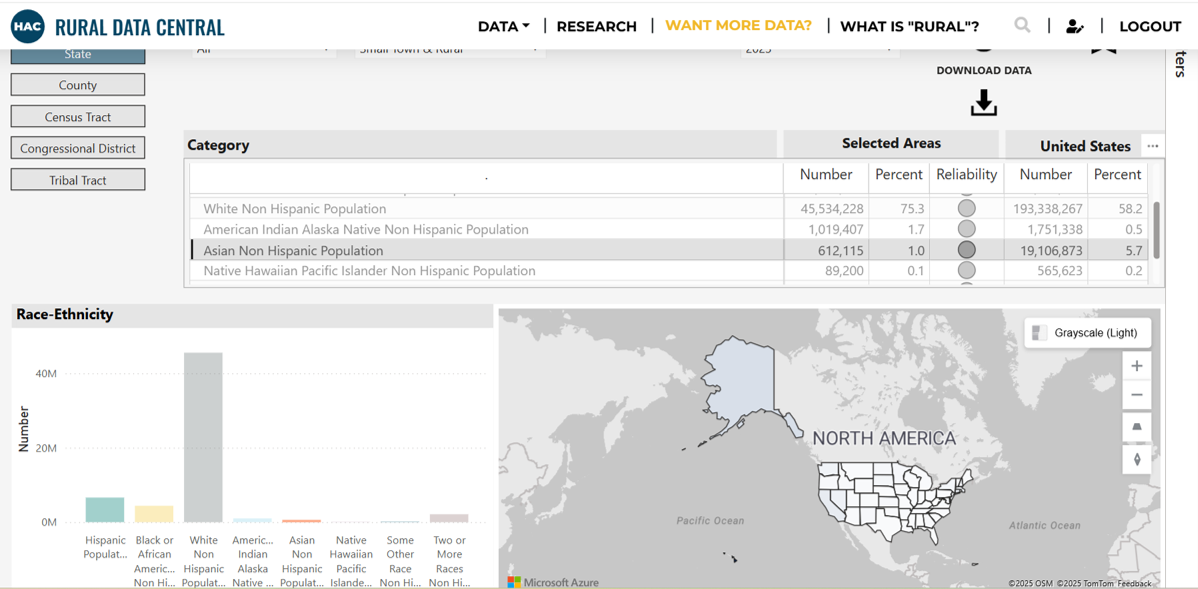
Rural Data Central is designed as a resource to help rural communities, organizations, and decisionmakers with data to inform strategies and solutions. Rural Data Central compiles over 275 million data points into one accessible and easy-to-use tool. Sign up for Rural Data Central today to get the data you need for your community.

DOGE team assigned to NeighborWorks

A Department of Government Efficiency team has been assigned to NeighborWorks America, according to news reports, although the team’s assignment is not known. NeighborWorks is a private, independent nonprofit chartered by Congress, not a part of the government. It provides grants, technical assistance, and training to almost 250 community development organizations around the country. The majority of its annual funding is appropriated by Congress. Its board is comprised of five members from federal agencies, but because of firings and resignations at those agencies there are currently only two board members.

May is Asian American and Pacific Islander Heritage Month

Several federal agencies and museums celebrate the month here.

RuralSTAT

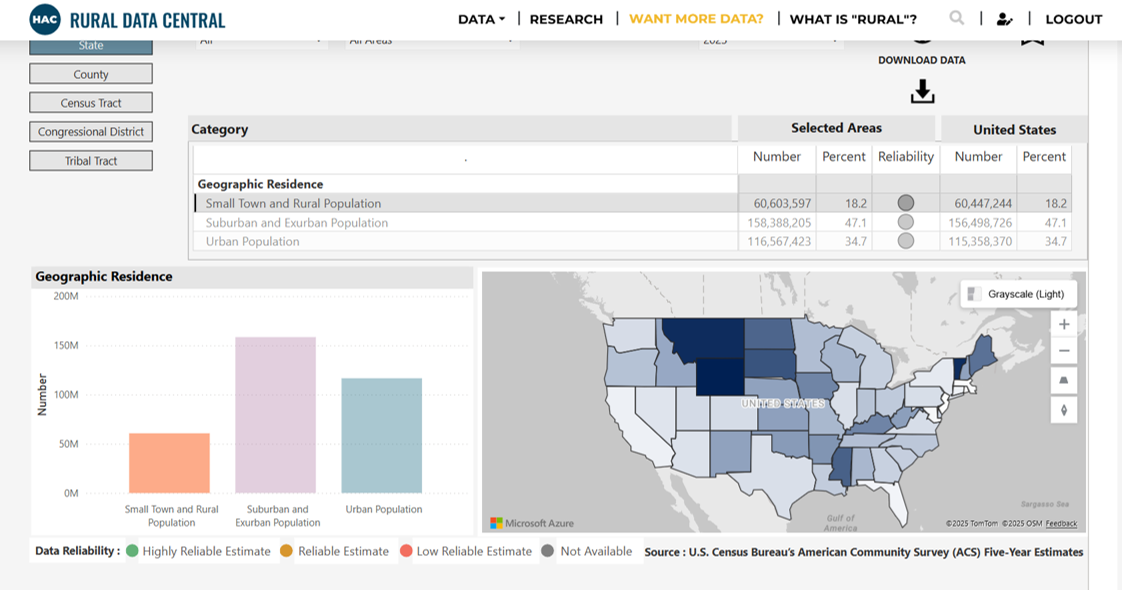
Approximately 60.6 million people live in rural and small town communities, making up 18% of the U.S. population. To better understand the social, economic, housing, and finance dynamics in your nation, state, county, census tract, congressional district, continuum of care, or tribal tract, visit Rural Data Central. Source: U.S. Census American Community Survey from HAC’s Rural Data Central.

OPPORTUNITIES

New funds available for tribal veterans’ housing vouchers

HUD is making available $2.2 million to provide rental assistance for Native American veterans through the Tribal HUD-Veterans Affairs Supportive Housing (VASH) program. Tribes and Tribally Designated Housing Entities can apply for funds by August 15.

Indian CDBG Imminent Threat grants offered

These grants from HUD are noncompetitive and can be used to eliminate or lessen problems that pose an imminent threat to public health or safety of Tribal residents. Tribes and Tribal organizations are eligible. Applications are due September 30.

REGULATIONS AND FEDERAL AGENCIES

AI reportedly being used to review HUD’s regulations

Artificial intelligence is reviewing regulations at HUD, comparing them to the statutes they implement, and suggesting revisions, according to Wired. HUD staff are reviewing the AI’s recommendations and HUD’s Office of General Counsel will make final decisions, Wired reports. A source told the publication that this method will be used throughout the government.

Administration to suggest eliminating a fair housing rule

HUD has filed a proposed regulation titled “Rescission of Affirmative Fair Housing Marketing Regulations.” No further details are available. The proposal is under review at the Office of Management and Budget, a required step in the rulemaking process. In March, HUD published an interim final rule that canceled a 2021 AFFH interim rule and returned the AFFH requirements to their pre-1994 version but did not rescind them.

HUD reinstates more technical assistance agreements

Enterprise Community Partners announced on April 24 that HUD has restored its agreements under the Community Compass and Distressed Cities programs, enabling it to continue providing technical assistance in a variety of communities. HUD previously reinstated Section 4 agreements with Enterprise and the Local Initiatives Support Corporation.

Energy Department proposes delaying energy standards for manufactured homes

Manufactured housing developers are currently required to meet energy standards for multi-section homes by July 1, 2025. The Department of Energy proposes to delay that date until after it publishes a final rule establishing enforcement procedures. Comments are due May 27.

EVENTS

HAC offers webinars on New Markets Tax Credits for affordable homeownership

Since 2008, New Markets Tax Credits have been used successfully for affordable homeownership projects. NMTCs generate flexible financing, including a portion that does not have to be repaid which can bring significant net benefit to homeownership projects and sponsors. This equity and subsidy generated can be used to address market gaps, create additional affordability, or increase the capacity of nonprofit developers. HAC will be applying to the CDFI Fund for NMTCs during the 2026 award round, which is expected to open this fall. HAC’s NMTC program will target rural affordable homeownership projects. We need your help to build a robust pipeline of projects. To learn more about NMTCs for homeownership and HAC’s planned 2026 NMTCs program, please join us for an online session on May 7 or May 13.

Upcoming convening to address rural economic development

The International Economic Development Council is hosting the 2025 Rural Retreat with the theme Rural Recharged: New Energy, New Possibilities. Taking place in Great Falls, MT from June 23 to 25, this cross-sector event will bring together diverse communities dedicated to creating new energy and opportunities for rural and tribal places across America.

PUBLICATIONS AND MEDIA

Use of federal land for affordable housing discussed

The administration’s hopes to build affordable housing on federal land are examined in a New York Times article. Housing on Federal Lands Aims to Ease Affordability Crisis points out that the idea has bipartisan support and that suitable property is available near existing cities and towns. The land is almost all in the western U.S. and would need infrastructure before housing could be placed there. The article, which is summarized in the Rural Blog, identifies more pros, cons, and open questions that will need to be addressed.

Policymakers look to ADUs to address rural housing shortages

A National Mortgage Professional article describes how states and rural communities are looking to expand access to accessory dwelling units (ADUs) to help increase housing supply. The article features a story of a New Hampshire man who turned his garage attic into an apartment for family members.

HAC

Need capital for your affordable housing project?

HAC’s loan fund provides low interest rate loans to support single- and multifamily affordable housing projects for low-income rural residents throughout the U.S. and territories. Capital is available for all types of affordable and mixed-income housing projects, including preservation, new development, farmworker, senior and veteran housing. HAC loan funds can be used for pre-development, site acquisition, site development, construction/rehabilitation and permanent financing. Contact HAC’s loan fund staff at hacloanfund@ruralhome.org, 202-842-8600.

Please note: HAC is not able to offer loans to individuals or families. Borrowers must be nonprofit or for-profit organizations or government entities (including Tribes).

Want to reprint a HAC News item?

Please credit the HAC News and provide a link to HAC’s website. Thank you!

HAC News: April 17, 2025

TOP STORIES

USDA will propose closing local offices, reducing and relocating staff, report says

Office of Management and Budget documents show the administration plans to suggest closing USDA local offices and consolidating staff into “state committees” covering Rural Development, the Farm Service Agency, and the National Resources Conservation Service, Government Executive reported on April 15. The publication, which reviewed OMB’s “passback” for the FY26 budget proposal, did not provide specifics but reported that OMB’s documents assume cuts in staff, offices, and program funding. The administration can still make changes before submitting its budget request to Congress, and Congress will then decide what dollar amounts and policy provisions to include in its final appropriations.

Politico recently reported that about 30,000 of USDA’s 100,000 employees will be removed through buyouts and reductions in force. Government Executive has also reported that 16,000 USDA staffers have accepted the government’s two deferred resignation offers. Remaining staff will be relocated from Washington, DC to three hubs in other, not yet identified, parts of the country, Government Executive wrote on April 7, anticipating about 9,000 jobs will be eliminated. Some field staff will also be relocated to the hubs, it reported, and parts of the department will be reorganized. Government Executive offers a regularly updated “RIF watch” page summarizing information about layoffs at many federal agencies and another page about firings of probationary employees.

Court proceedings continue in two cases challenging the legality of the administration’s large-scale firings of probationary employees. In one of them, the Supreme Court recently lifted a lower court’s order to reinstate thousands of workers, but that did not end the case, which is now pending in an appeals court.

Congress agrees on framework for tax and spending cuts

The House (on April 10) and the Senate (on April 5) passed a resolution setting parameters for a budget reconciliation package that will reduce federal spending and extend tax cuts. An earlier House version included deeper spending cuts, but the House supporters of that plan agreed to vote for the Senate’s version after Senate Majority Leader John Thune (R-SD) and House Speaker Mike Johnson (R-LA) made a public commitment to increase the savings achieved through the budget reconciliation process. Now that the two chambers have agreed on the topline figures, their committees will draft pieces of a final budget reconciliation bill with specific provisions – tax cuts and program changes – to reach those figures. The spending levels established by the just-passed resolution are likely to require cuts to Medicaid and SNAP. The final bill will not set appropriations for any particular fiscal year, but will establish dollar limits for future appropriations.

Administration budget request possible this month

The Trump administration’s budget proposal for FY26 is expected to be released in May. A “skinny budget,” without details, may be issued in April. House Appropriations Committee Chair Tom Cole (R-OK) has launched his committee’s FY26 work and announced the committee will accept House members’ requests for earmarks, known as Community Project Funding. A similar announcement from Senate Appropriations Committee Chair Susan Collins (R-ME) and Vice Chair Patty Murray (D-WA) also permits earmarks, calling them Congressionally Directed Spending.

Trump suggests some undocumented workers could get legal status

In comments during a Cabinet meeting on April 10, President Trump referred to a possible process for legalizing undocumented workers, including farmworkers. News reports indicate he suggested that employers could recommend specific people for legalization, who would continue to work in the U.S. briefly, then leave the country and return with legal status.

RuralSTAT

USDA’s Economic Research Service identified 453 High Farming Concentration Counties in 2025. This classification indicates that these counties have a high share of earnings or jobs in farming or agriculture industries. Over 90 percent of High Farming counties are located outside of metropolitan areas. Source: HAC tabulations of USDA ERS County Typology Codes.

OPPORTUNITIES

Deadline extended to April 18 for OneRural 2025 Technical Assistance

HAC is now accepting applications for OneRural Technical Assistance Services, offering customized support to rural nonprofits, Tribal housing entities, and local governments. This program helps organizations strengthen their housing and community development efforts through expert guidance and capacity building. Applications are open through April 18. Learn more and apply at OneRural 2025 – Housing Assistance Council.

CAPITOL HILL

Rural Housing Service Reform Act and other housing bills reintroduced

The RHS Reform Act of 2025, introduced as S. 1260 by Senators Tina Smith (D-MN) and Mike Rounds (R-SD) with several cosponsors, offers a slate of commonsense modernizations to the rural housing programs at USDA. HAC has endorsed the bill.

The Affordable Housing Credit Improvement Act, introduced by Rep. Darin LaHood (R-IL) and Rep. Suzan DelBene (D-WA) with several cosponsors, expands and strengthens the Low-Income Housing Tax Credit. HAC supports the bill.

The Neighborhood Homes Investment Act was introduced by Rep. Mike Kelly (R-PA) and Rep. John Larson (D-CT) with several cosponsors. It is supported by HAC and would create a tax credit for the production and preservation of homeownership housing in low-income areas.

REGULATIONS AND FEDERAL AGENCIES

Turner emphasizes restrictions on aid for undocumented residents and sanctuary cities

Secretary Scott Turner issued a public letter to HUD grantees and stakeholders reminding them that HUD funds cannot be used to provide “certain federal public benefits” to undocumented residents. Turner posted the letter on X with a comment that seemed to indicate HUD would also withhold funds from organizations that assist people without legal status, even if they do not use federal monies to do so: “I want to make it crystal clear – no taxpayer dollars will be given to organizations that support, house, shelter, or provide care to illegal aliens who broke the law.” Undocumented residents are legally eligible for some HUD and USDA housing aid, and “mixed status” families that include both legal residents and undocumented members are eligible for prorated housing assistance, as explained here by the National Housing Law Project.

HUD may move headquarters out of DC

HUD hopes to move out of its headquarters building in Washington, DC, according to Bloomberg News, which said HUD might relocate within the DC metro area or elsewhere in the country.

Technical assistance grants reinstated

HUD has restored at least some of the technical assistance contracts it cancelled in February. Enterprise Community Partners and the Local Initiatives Support Corporation issued press releases announcing their Section 4 contracts were reinstated. At least six other organizations had lost contracts from HUD’s Community Compass program but their current status has not been reported.

Judge renews ruling on Greenhouse Gas Reduction Fund

On April 15 a federal judge extended her previous freeze on EPA’s termination of grants to intermediaries under the Greenhouse Gas Reduction Fund program. This preliminary injunction applies to the three organizations that brought suit: Climate United Fund, Coalition for Green Capital, and Power Forward Communities, all of which were awarded grants from the GGRF’s National Clean Investment Fund. The injunction will last indefinitely while the court proceedings continue.

USDA announces, then retracts, pause on rental production and preservation funding

On April 7, USDA’s multifamily housing office informed funding recipients by email that it was “currently paused on executing obligations and issuing Conditional Commitments for all MFH Production & Preservation Programs until further notice.” The next day, a second email rescinded the first. It stated that “USDA is implementing an internal pre-obligation review process; however, Multifamily Housing programs are not paused on executing obligations or issuing Conditional Commitments. Multifamily Housing programs are operating normally for FY2025.”

Effective dates extended again for parts of HOME regulation

After an initial delay announced in February, HUD has further postponed the effective dates for some provisions of the HOME final rule. HUD will publish a separate notice requesting comments on the delayed provisions. The provisions that are not delayed are effective as of April 20, 2025, with a final compliance date of April 20, 2026.

White House orders faster repeal of regulations

A presidential memorandum, building on a February executive order, instructs federal agencies to repeal regulations without public notice or comment periods if they conflict with recent Supreme Court decisions.

OMB seeks deregulation ideas

OMB requests suggestions for deregulation relating to “any and all regulations currently in effect.” Commenters should identify rules to be rescinded and provide detailed reasons for their rescission. Comments are due May 12.

USDA announces senior staff appointments

Some recent appointments are potentially relevant for rural housing. Kelsey Barnes is now Senior Advisor to the Secretary for Rural Development, Biofuels, and Research, Education, and Economics. David Matthews serves as the Director of State Operations for Rural Development. T.W. Shannon has become the Senior Advisor to the Secretary for Rural Prosperity.

PUBLICATIONS AND MEDIA

HAC posts online guide for flood survivors

To assist our rural partners and communities affected by recent flooding, HAC’s Ohio River Valley and Mississippi Valley Floods Rural Response Guide provides information for people in the disaster area. Other disaster resources from HAC include Rural Resilience in the Face of Disaster and a Disaster Response for Rural Communities Guide.

Proposal to develop “Freedom Cities” on federal land may be gaining momentum

A proposal from the American Enterprise Institute calls for building up to 3 million homes on federally owned land in “Freedom Cities” – deregulated zones designed to address housing affordability and land scarcity. A Bloomberg Law article notes that, rooted in a concept floated by President Trump, the plan has gained new attention amid rising housing costs in the West. Supporters see potential in states like Nevada and Colorado, while critics raise concerns about environmental oversight and local governance.

HAC

Need capital for your affordable housing project?

HAC’s loan fund provides low interest rate loans to support single- and multifamily affordable housing projects for low-income rural residents throughout the U.S. and territories. Capital is available for all types of affordable and mixed-income housing projects, including preservation, new development, farmworker, senior and veteran housing. HAC loan funds can be used for pre-development, site acquisition, site development, construction/rehabilitation and permanent financing. Contact HAC’s loan fund staff at hacloanfund@ruralhome.org, 202-842-8600.

Please note: HAC is not able to offer loans to individuals or families. Borrowers must be nonprofit or for-profit organizations or government entities (including Tribes).

Want to reprint a HAC News item?

Please credit the HAC News and provide a link to HAC’s website. Thank you!

Ohio River Valley and Mississippi Valley Floods Rural Response Guide

Rural Response Guide

Ohio River Valley and Mississippi Valley Floods

Heavy rainfall led to extreme flooding throughout the states along the Ohio River Valley and the Mississippi Valley beginning on Wednesday, April 2, 2025. Flash flood emergency and tornado warnings were issued through the following Saturday in Arkansas, Mississippi, Tennessee, and Kentucky. In response to the storms, the governors of Arkansas and Kentucky declared a state of emergency. President Trump approved the governor of Kentucky’s request for an emergency disaster declaration which allowed for Federal Emergency Management Agency (FEMA) assistance to be made available in Kentucky. The Housing Assistance Council (HAC) offers the following resources with information for communities and organizations dealing with loss and damage from the recent flooding: Rural Resilience in the Face of Disaster site and Disaster Response for Rural Communities Guide.

In response to the flooding, the National Weather Service issued Flash Flood Emergencies in multiple states. The American Red Cross of Utah’s disaster team deployed to the affected states to provide recovery and rescue efforts.

If you or your family have been affected by the recent flooding, or wish to help victims, organizations like The American Red Cross, All Hands and Hearts, and The Salvation Army have resources available. If you are in need of emergency, transient housing, you can text SHELTER and your Zip Code to 43362 (4FEMA) to find where the shelter closest to you is located.

Apply for FEMA Assistance by registering online at www.DisasterAssistance.gov. FEMA Disaster Assistance Helpline answers questions about the help offered by FEMA, how to apply for assistance, or the information in your account.

Toll-free helpline: 1-800-621-FEMA (3362) For hearing impaired callers only: 1-800-462-7585 (TTY) 1-800-621-3362 (Video Relay Service) Operators are multilingual and calls are answered seven days a week from 7 a.m. to 11 p.m. ET

American Red Cross Disaster Service: For referrals and updates on Red Cross shelter services in your area, locate a local Red Cross office through: https://www.redcross.org/find-help or by calling 1-800-RED CROSS (1-800-733-2767) The Red Cross helps disaster victims by providing safe shelter, hot meals, essential relief supplies, emotional support and health services like first aid. Trained Red Cross workers often meet one-on-one with families to develop individual plans and identify available resources to help aid recovery.

EMERGENCY MANAGEMENT AGENCIES

Arkansas

Arkansas Division of Emergency Management

Phone: (501) 683-6700

https://dps.arkansas.gov/emergency-management/adem/

Kentucky

Kentucky Emergency Management

Phone: (800) 255-2587

https://kyem.ky.gov/Pages/contact.aspx

Mississippi

Mississippi Emergency Management Agency

Phone: (601) 993-6362

https://www.msema.org/

Ohio

Ohio Emergency Management Agency

Phone: (614) 889-7150

https://ema.ohio.gov/help-center/contact-us

Tennessee

TN Emergency Management Agency

Phone: (615) 741-0001

https://www.tn.gov/tema.html

Texas

Texas Department of Emergency Management

Phone: (512) 424-2208

https://www.tdem.texas.gov/about/contact

DEPARTMENT OF HOUSING AND URBAN DEVELOPMENT STATE FIELD OFFICES

Arkansas

Little Rock Field Office

600 West Capitol Ave

Richard Arnold Sheppard US Courthouse

Room A400

Little Rock, AR 72201

Phone: (501) 918-5700

Field Office Director: Reginald D. Marable, Sr.

https://www.hud.gov/states/arkansas

Kentucky

Louisville Field Office

601 W Broadway, Room 110

Louisville, KY 40202

Phone: (502) 582-5251

Field Office Director: Charles E. President Jr.

https://www.hud.gov/states/kentucky

Mississippi

Jackson Field Office

100 W. Capitol Street, Suite 910

Jackson, MS 39269

Phone: (601) 965-4757

Field Office Director: Adrenace Williams

https://www.hud.gov/states/mississippi

Ohio

Cleveland Field Office

1001 Lakeside Ave, Suite 350

Cleveland, OH 44114

Phone: (216) 357-7900

Field Office Director: Kevin Laviano

https://www.hud.gov/states/ohio

Tennessee

Knoxville Field Office

US Department of Housing and Urban Development
John J. Duncan Federal Building
710 Locust Street, Suite 300
Knoxville, TN 37902-2526

Phone: (865) 545-4370

Field Office Director: Walter N. Perry

https://www.hud.gov/states/tennessee

Texas

Houston Field Office

1331 Lamar Street, Suite 550
Houston, TX 77010

Phone: (713) 718-3199

Field Office Director: Eric R. Cobb

Fort Worth Regional Office

307 W 7th Street, Suite 1000

Fort Worth, TX 76102

Phone: (817) 978-5965

San Antonio Field Office

615 E Houston Street

San Antonio, TX 78205

Phone: (210) 475-6800

https://www.hud.gov/states/texas

USDA RURAL DEVELOPMENT STATE OFFICES

Arkansas

700 West Capitol, Room 3416
Little Rock, AR 72201-3225

Phone: (501) 301-3216

https://www.rd.usda.gov/ar

Kentucky

771 Corporate Drive, Suite 200

Lexington, KY 40503

Phone: (859) 224-7300

https://www.rd.usda.gov/ky

Mississippi

100 W. Capitol Street, Suite 831

Jackson, MS 39269

Phone: (601) 965-4316

https://www.rd.usda.gov/ms


Ohio

200 North High Street, Room 507

Columbus, OH 43215

Phone: (614) 255-2400

https://www.rd.usda.gov/oh


Tennessee

441 Donelson Pike, Suite 310
Nashville, TN 37214

Phone: (615) 783-1300

https://www.rd.usda.gov/tn

Texas

101 South Main Street, Suite 102

Temple, Texas 76501

Phone: (254) 742-9700

https://www.rd.usda.gov/tx

HAC News: April 3, 2025

TOP STORIES

Fair housing grants reinstated

A federal judge issued a temporary restraining order requiring HUD to reinstate the Fair Housing Initiative Program grants it terminated in February. The TRO restores the status quo while a lawsuit filed by fair housing organizations moves forward.

CDFI Fund says all its programs are statutorily required

The March 14 Executive Order that called for limiting the activities of the Community Development Financial Institutions Fund and other agencies instructed the agencies to report to OMB “confirming full compliance with this order and explaining which components or functions of the governmental entity, if any, are statutorily required and to what extent.” The CDFI Fund’s report to OMB lists all 11 of its programs and functions, along with the statutes that require them, concluding that the Fund “is performing its statutory functions as required by law.”

Bank regulators will rescind 2023 Community Reinvestment Act rule

The Office of the Comptroller of the Currency, Federal Deposit Insurance Corporation, and Federal Reserve Board announced on March 28 that they will propose to rescind the final CRA rule issued in October 2023 and reinstate the prior CRA framework.

April is National Fair Housing Month

Report housing discrimination to HUD online, by phone at 1-800-669-9777, or by mail.

RuralSTAT

Most (87%) of the recent population growth in places with moderate-to-high wildfire risk has been among people over the age of 60. In rural areas with the greatest wildfire risk, 35% of residents are over 60. Source: Economic Research Service, Aging and Wildfire Risk to Communities.

OPPORTUNITIES

Apply by April 15 for OneRural 2025 Technical Assistance

HAC is now accepting applications for OneRural Technical Assistance Services, offering customized support to rural nonprofits, Tribal housing entities, and local governments. This program helps organizations strengthen their housing and community development efforts through expert guidance and capacity building. Applications are open through April 15. Learn more and apply at OneRural 2025 – Housing Assistance Council.

USDA revises multifamily funding notices

The 2024 notices announcing funds for USDA’s multifamily preservation and Section 515 loan programs and for multifamily technical assistance provision offered points to applicants for addressing Biden administration priorities. The current administration has now amended the notices to remove those priorities and will not award points related to them. The agency will review applications accordingly. It is not reopening the funding opportunities and applicants do not need to make changes.

REGULATIONS AND FEDERAL AGENCIES

HUD, other agencies confirm DEI orders do not apply to programs for Tribes

An internal HUD memo confirms that President Trump’s executive orders ending diversity, equity, and inclusion programs do not apply to HUD’s programs for American Indians and Alaska Natives. The memo from HUD’s Acting General Counsel explains that “the Department’s legal obligation to provide housing for Indian Tribes and their citizens” and the government-to-government relationship with Tribes are distinct from the kind of DEI programs cancelled by the executive orders. The executive orders do apply, however, to DEI programs such as efforts to hire diverse staff by Native agencies that use HUD funding. The Departments of the Interior and Health and Human Services have issued similar clarifications.

No new Emergency Housing Vouchers to be issued after mid-April

HUD Notice PIH 2025-07 tells public housing agencies they must stop issuing Emergency Housing Vouchers. These vouchers were authorized by the American Rescue Plan Act of 2021. The notice also reminds PHAs that they are prohibited from reissuing turnover EHVs when families leave the program after September 30, 2023. HUD adds that it hopes to support families who currently have vouchers for as long as possible until the program runs out of funds by the end of calendar year 2026.

USDA and HUD limit mortgages for some non-citizens

USDA and HUD recently announced limitations on undocumented residents’ eligibility for mortgages guaranteed by USDA RD or insured by the Federal Housing Administration. They were already ineligible under Section 214 of the Housing and Community Development Act of 1980 (42 U.S.C. § 1436a), which prohibits housing assistance to noncitizens unless they meet specific requirements, such as having permanent residence status. The March 20 HAC News erroneously reported that all non-citizens are now ineligible for USDA guaranteed mortgages but, in fact, those with certain documentation remain eligible. HAC regrets the error. FHA Mortgagee Letter 2025-09 and Title I Letter TIL-490 explain that non-citizen FHA mortgage insurance recipients must be permanent residents.

Universal Notice for CDBG disaster funds revised

A March 19 HUD memo makes changes in the Universal Notice governing Community Development Block Grant Disaster Recovery funds, adjusting the previous version of the Notice, which was published on January 8, to fit recent executive orders. A version with all the changes incorporated into the text is posted on HUD’s CDBG-DR site.

HUD sets income limits, revises some Fair Market Rents

Income limits for HUD programs, effective April 1, are posted online. Separately, HUD has revised FMRs for several areas, based on new data and effective on April 28.

USDA delays energy efficiency requirements

Energy efficiency standards adopted by USDA and HUD last year will go into effect six months later than originally planned, USDA announced. The standards will apply to the Section 502 direct and guarantee programs and the Section 523 self-help program. HUD published a similar notice recently.

Preliminary injunction protects Consumer Financial Protection Bureau

Under a preliminary injunction and order issued March 28 by a federal district court judge, the administration must rehire CFPB staff and keep the agency functioning while the employees’ union’s suit moves forward. The administration announced it will appeal the decision.

Some Fannie Mae and Freddie Mac guidance canceled

Federal Housing Finance Agency Director Bill Pulte has been posting announcements to his X account of FHFA decisions canceling past directives regarding Fannie Mae, Freddie Mac, and the Federal Home Loan Banks. Topics include tenant protections, special purpose credit programs, unfair or deceptive acts or practices, solar energy, climate-related risk management, and more.

HUD revamps website, resources can still be found online

While HUD is revising its website, materials that cannot be located at their previous URLs may be available through the Internet Archive’s Wayback Machine, HUD’s official archives, HUD User’s archives, or the National Housing Conference’s collection of resources.

EVENTS

HAC offers Section 502 direct loan packaging course in Atlanta

HAC will hold a USDA Section 502 Direct Certified Loan Packaging Training in Atlanta, GA on April 22-24. This three-day advanced course prepares participants to become certified Section 502 loan packagers. It is designed for those experienced in using Section 502. A laptop is required for the class for each participant. Following the course, participants are encouraged to take the online certification exam. The registration fee is $825. For more information, contact HAC, registration@ruralhome.org, 202-842-8600.

PUBLICATIONS AND MEDIA

HAC analysis shows significant increases in rural homelessness

HUD’s 2024 Annual Homeless Assessment Report, released in January, shows that homelessness has reached an all-time high nationwide. A new HAC brief analyzes the data and finds that more than 126,000 people experienced homelessness in largely rural Continuums of Care, with a disproportionate rise in unsheltered families and chronically homeless individuals. The brief explores contributing factors such as the end of pandemic-era protections, economic pressures, and natural disasters. Despite these challenges, a notable decline in veteran homelessness highlights the impact of sustained, targeted interventions.

Farm laborers’ contributions highlighted during Farmworker Awareness Week

Organizations, schools, and communities across the country celebrated Farmworker Awareness Week March 24-31. Farmworker advocates, including Student Action with Farmworkers, put out a call to action to raise awareness of farmworker issues within their communities. HAC joined in these efforts by presenting on our recent farmworker research during the National Community Reinvestment Coalition’s Just Economy Conference 2025. To learn more about current farmworker trends and housing conditions, read HAC’s recent research brief, Creating A Better Understanding of Farmworker Communities and Their Housing Conditions.

Number of Hispanic homeowners hits record high

With 238,000 new owners added in the last year, Hispanic homeownership reached a record 9.8 million households, the largest increase of any racial or ethnic demographic for the second consecutive year, according to the annual State of Hispanic Homeownership Report published by the National Association of Hispanic Real Estate Professionals. The Hispanic homeownership rate declined, however, from 49.5% to 49.0%.

Articles highlight strategies to expand affordable housing

Axios and JPMorgan Chase identify four strategies to grow the affordable housing supply: zoning reform, better land acquisition tools, support for construction innovation, and stronger development capacity. A recent AP News story focuses on possibilities for innovation, highlighting how factory-built modular homes, 3D printing, and hempcrete are being explored to reduce housing construction costs and timelines. The article contends that these emerging methods could help expand affordable housing, especially in rural areas where labor shortages and high material costs often pose barriers.

HAC

Need capital for your affordable housing project?

HAC’s loan fund provides low interest rate loans to support single- and multifamily affordable housing projects for low-income rural residents throughout the U.S. and territories. Capital is available for all types of affordable and mixed-income housing projects, including preservation, new development, farmworker, senior and veteran housing. HAC loan funds can be used for pre-development, site acquisition, site development, construction/rehabilitation and permanent financing. Contact HAC’s loan fund staff at hacloanfund@ruralhome.org, 202-842-8600.

Please note: HAC is not able to offer loans to individuals or families. Borrowers must be nonprofit or for-profit organizations or government entities (including Tribes).

Want to reprint a HAC News item?

Please credit the HAC News and provide a link to HAC’s website. Thank you!

HAC News: March 20, 2025

TOP STORIES

Continuing resolution funds government through September 30

The continuing resolution signed into law on March 15 provides federal funding through September 30, the end of fiscal year 2025. Final funding levels for most USDA housing programs and HUD programs will not be known until late April because the CR gives agencies 45 days to submit plans to Congress showing how they will divide their appropriated funds among programs. It provides flexibility for USDA to move funds among Rural Development programs to make their funding levels as near as possible to the levels in FY24, and specifically instructs the department to transfer $34 million from other RD programs to Section 521 Rental Assistance. Democrats on the House Appropriations Committee calculated that the CR’s reductions or small increases in HUD funding could lead to evictions of 32,000 tenants as well as lower levels of aid for new construction and for people experiencing homelessness. The CR does not include any of the congressionally directed spending (earmarks) listed in the bills developed last year in the House and Senate.

Executive Order cuts several agencies, including CDFI Fund and homelessness council

A March 14 Executive Order requires that several agencies, including the Community Development Financial Institutions Fund and the U.S. Interagency Council on Homelessness, eliminate their non-statutory functions. The EO gives agency heads one week to report to OMB what parts of their agencies are required by statutes. Both the CDFI Fund and USICH have funding for FY25 under the continuing resolution. Among the many immediate reactions supporting the CDFI Fund was one from within the administration. A credit union news site reported that the Defense Credit Union Council wrote to Treasury Secretary Scott Bessent expressing concern and explaining the CDFI Fund programs’ importance in serving military base communities and veterans. Bessent’s response recognized the important role of the CDFI Fund and CDFIs, calling them “a key component of President Trump’s commitment to supporting Main Street America in the pursuit of job growth, wealth creation, and prosperity.” He also noted that the CDFI Fund’s programs were statutorily created. The co-chairs of the Senate’s CDFI Caucus, Mark Warner (D-VA) and Mike Crapo (R-ID), issued a statement “reaffirm[ing] our bipartisan commitment to support the CDFI Fund’s mission.”

HAC CEO David Lipsetz issued a statement describing the CDFI Fund’s positive impacts for rural housing and its historical bipartisan support. “The path forward must strengthen, not undermine, our ability to serve hardworking rural families,” Lipsetz concluded. “They deserve nothing less.”

Two judges order rehiring of federal workers

Federal judges hearing two separate cases on March 13 ordered the Trump administration to reverse its layoffs of thousands of government employees, at least temporarily while litigation continues. Judge William Alsup required the departments of Agriculture, Defense, Energy, Interior, Treasury, and Veterans Affairs to rehire probationary employees. The Justice Department has appealed the decision. A similar order from Judge James Bredar covered some of the same departments, as well as Commerce, Education, Health and Human Services, Homeland Security, Labor, State, Transportation, CFPB, EPA, and other agencies. The government has appealed this decision also.

RuralSTAT

A 60-year-old man living in a rural area can be expected to live an average of two fewer years than an urban man. For women, the rural-urban gap is six months. Source: Jack M. Chapel, Elizabeth Currid-Halkett, Bryan Tysinger, The Urban-Rural Gap in Older Americans’ Healthy Life Expectancy, Journal of Rural Health.

OPPORTUNITIES

Apply Now: OneRural 2025 Technical Assistance

HAC is now accepting applications for OneRural Technical Assistance Services, offering customized support to rural nonprofits, Tribal housing entities, and local governments. This program helps organizations strengthen their housing and community development efforts through expert guidance and capacity building. Applications are open through April 15. Learn more and apply at OneRural 2025 – Housing Assistance Council.

REGULATIONS AND FEDERAL AGENCIES

Judge freezes EPA termination of greenhouse gas reduction awards

On March 18 a federal judge blocked EPA’s attempt to terminate three of its Greenhouse Gas Reduction Fund awards. The 2022 Inflation Reduction Act provided $20 billion for the GGRF’s National Clean Investment Fund and Clean Communities Investment Accelerator. EPA announced eight awards in April 2024, then on March 11 this year said all eight were terminated. The three NCIF awardees sued EPA, resulting in the judge’s temporary restraining order. EPA Administrator Lee Zeldin has also asked EPA’s Inspector General to review the GGRF program for financial mismanagement and other irregularities. In addition, the Justice Department and the FBI are investigating the program. Sen. Sheldon Whitehouse (D-RI) has requested more information from Justice and the FBI.

Fair housing groups challenge HUD termination of funding

Fair housing organizations, represented by law firm Relman Colfax, have filed suit against HUD and DOGE for terminating their Fair Housing Initiatives Program grants. FHIP funds nonprofits to investigate housing discrimination complaints, assist individuals facing discrimination, and collaborate with local governments to expand fair and affordable housing opportunities.

HUD nominees announced

President Trump has nominated Andrew Hughes to be deputy secretary of HUD. Hughes is currently HUD Secretary Scott Turner’s chief of staff and held the same position under Secretary Ben Carson during the first Trump administration. David Woll, who was principal deputy assistant secretary for community planning and development under Carson, has been nominated to be HUD’s general counsel. Both positions require Senate confirmation.

HUD delays energy efficiency requirements

On April 26, 2024, HUD and USDA published a notice adopting energy efficiency standards for some housing programs and providing compliance dates for covered programs. A new notice from HUD delays compliance dates by six months for FHA-Insured Multifamily, FHA-Insured Single Family, Public Housing Capital Fund, Choice Neighborhoods, Section 202, and Section 811 properties. The compliance date for Section 8 Project-Based Vouchers is delayed until April 1, 2026. For HOME, the Housing Trust Fund, and RAD, the compliance dates have already passed and the requirements are already in effect. If a HOME or HTF project receives funding from any of the programs with a later compliance date, the later date applies. USDA has not delayed compliance dates for its programs.

Federal Housing Finance Agency increases control over Fannie Mae and Freddie Mac

On March 14, William J. Pulte was sworn in as director of the Federal Housing Finance Agency, which regulates Fannie Mae and Freddie Mac. On March 17, Fannie Mae and Freddie Mac filed documents removing several members of their boards of directors, naming new board members, and installing Pulte as chair of both. On March 18, one of the new appointees resigned from Fannie Mae’s board.

Some Nnon-citizens no longer eligible for USDA guaranteed mortgages

USDA  terminated a A waiver that allowed non-citizens with valid social security numbers and work authorizations to apply for Section 502 guaranteed mortgages was terminated by USDA, . The waiver, first announced on April 22, 2022, was ended effective March 18. Non-citizens with certain documentation remain eligible. 

NOTE: This item was incorrect as originally published in the March 20, 2025 HAC News. Corrections are indicated here, with additions in red and deletions struck through. HAC apologizes for any confusion and thanks USDA RD for the correction.

USDA single-family loan limits posted

FY25 area loan limits for the Section 502 direct mortgage program and Section 504 home repair loans are now available online.

HUD and Interior create joint task force to use federal lands for affordable housing

HUD Secretary Scott Turner and Interior Department Secretary Doug Burgum recently announced a Joint Task Force on Federal Land for Housing that will “identify underutilized federal lands suitable for residential development, streamline land transfer processes and promote policies that increase the availability of affordable housing.” The secretaries wrote that “overlooked rural and tribal communities will be a focus of this joint agreement.”

EVENTS

HAC offers Section 502 direct loan packaging course in Atlanta

HAC will hold a USDA Section 502 Direct Certified Loan Packaging Training in Atlanta, GA on April 22-24. This three-day advanced course prepares participants to become certified Section 502 loan packagers. It is designed for those experienced in using Section 502. A laptop is required for the class for each participant. Following the course, participants are encouraged to take the online certification exam. The registration fee is $825. For more information, contact HAC, registration@ruralhome.org, 202-842-8600.

PUBLICATIONS AND MEDIA

Lowest income renters face shortage of 7.1 million affordable homes 

The Gap 2025: A Shortage of Affordable Homes, published by the National Low Income Housing Coalition, shows there are only 35 affordable and available homes for every 100 extremely low-income renter households in the U.S. NLIHC presents data for states and for the 50 largest metro areas. North Dakota, which has the least severe shortage, has only 62 rental homes affordable and available for every 100 ELI renters.

Pennsylvania hopes to address factors limiting rural growth

A story from National Public Radio in Pittsburgh, Reviving Rural Pa. Should Start with Shoring up Local Governments, Says State Commission, describes recent proposals by the state’s Rural Population Revitalization Commission to improve growth and development. Many rural communities face challenges in accessing government funds, such as limited capacity to apply for and administer these resources. The commission is exploring ways the state government may be able to lower burdensome requirements and promote local communities working together to overcome resource limits. It may also consider merit- or needs-based requirements for programs, to ensure rural communities are not left out.

Study connects poor quality housing and poor health

Johns Hopkins Bloomberg School of Public Health developed the Housing Quality Metric, which integrates data on structural deficiencies, housing cost burden rates, and neighborhood perception to identify high-risk census tracts. In a new study, researchers report that communities with poorer housing conditions have higher proportions of adults reporting fair or poor health.

New research focuses on women farmworkers

A recent publication titled Experiences of Women Farmworkers in Michigan: Perspectives from the Michigan Farmworker Project explores the unique challenges that women farmworkers face. Both social and occupational hazards are highlighted including sexual harassment, reproductive health concerns, and work-life balance challenges. The findings show a need for policies that address common barriers for single female farmworkers.

HAC

Need capital for your affordable housing project?

HAC’s loan fund provides low interest rate loans to support single- and multifamily affordable housing projects for low-income rural residents throughout the U.S. and territories. Capital is available for all types of affordable and mixed-income housing projects, including preservation, new development, farmworker, senior and veteran housing. HAC loan funds can be used for pre-development, site acquisition, site development, construction/rehabilitation and permanent financing. Contact HAC’s loan fund staff at hacloanfund@ruralhome.org, 202-842-8600.

Please note: HAC is not able to offer loans to individuals or families. Borrowers must be nonprofit or for-profit organizations or government entities (including Tribes).

Want to reprint a HAC News item?

Please credit the HAC News and provide a link to HAC’s website. Thank you!

HAC CEO Responds to Executive Order Impacting Rural CDFIs

I’ve worked in enough small towns across America to know this: rural communities prosper when they have financial partners ready to invest in homeownership dreams and small business start-ups. A recent Executive Order targeting Community Development Financial Institutions has me concerned that rural America could lose access to the $6 billion in business CDFIs generate in their local economies.

For years, rural areas faced dwindling access to financial services. The number of rural headquartered banks fell by over 3,600 since 1995, an astounding 57% decline. Thankfully over that same 30-year period over 500 rural CDFIs have been created, filling gaps in the banking landscape of every State. And they do it effectively, leveraging $8 in private investment for every $1 in federal support. This has been especially helpful for local organizations with projects that are too small or specialized for the remaining banks or distant commercial lenders to finance.

HAC is one of those rural-serving CDFIs. Our work is supported by the resources the recent Executive Order is trying to undermine. We want to continue delivering real results for real people.

  • In Clearfield County, PA, where 45% of grandparents are raising grandchildren due to the opioid epidemic, HAC’s financing helped build the Village of Hope, a multigenerational affordable housing development designed for seniors and youth to live together.
  • In Pahokee, FL, our loan helped Diverse Housing Services breathe new life into Amaryllis Gardens, 44-units of workforce housing for employees of the surrounding farms.
  • In Visalia, CA, HAC’s $12 million in financing to Self-Help Enterprises has enabled over 300 low-income families to help construct their own homes as “sweat equity” downpayments.

The good news here is that the Executive Order is to be “implemented consistent with applicable law and subject to the availability of appropriations.” The CDFI Fund is not a discretionary policy—it’s embedded in federal statutes such as the Riegle Act, the Community Renewal Tax Relief Act, the Housing and Economic Recovery Act, and the Small Business Jobs Act. And funds for CDFI’s were included in this year’s appropriations and continuing resolutions.

It also helps that the CDFI Fund programs were created and supported by bipartisan consensus. Leaders across political lines and branches of government understand that rural America’s need for economic opportunity and stable housing is a shared national priority. We are encouraged by Treasury Secretary Bessent’s recent statement recognizing “the important role that the CDFI Fund and CDFIs play in expanding access to capital” and affirming that “CDFIs are a key component of President Trump’s commitment to supporting Main Street America.” For over 50 years, HAC has worked directly with rural policy-makers — Republican, Democrat, and Independent alike — to make affordable housing a reality. We hope that under the current Administration, the CDFI Fund will continue to be staffed and funded as Congress has legislated.

HAC stands ready to continue serving the millions of Americans who depend on the stability and opportunity CDFIs’ investments create. The path forward must strengthen, not undermine, our ability to serve hardworking rural families. They deserve nothing less.

HAC News: March 6, 2025

HAC News: February 20, 2025

TOP STORIES

HAC responds to USDA RD and HUD cuts

HAC has issued a statement in response to recent reports that at least 550 USDA Rural Development staff (subscription required) have been let go, leaving state office staffing levels at “half or less than half” of normal, and that 50% of HUD’s staff will be discharged. A group of senators has written to HUD Secretary Turner requesting more information by February 21. No details are available on the number of staff at either department who accepted a now-closed buyout offer extended to most federal workers. An executive order requires federal agencies to hire not more than one employee for every four employees that depart. That order does not apply to public safety, immigration enforcement, or law enforcement, and a freeze on IRS hiring remains in place. HAC’s statement concludes that “the affordable housing crisis in rural America requires more capacity and attention, not less.”

Administration begins announcing canceled spending

As the Trump administration reduces spending across federal agencies, DOGE is listing some of the canceled contracts and leases on its website. HUD Secretary Scott Turner announced on February 13 that HUD has “already identified over $260 million in savings and we have more to accomplish.” USDA reported on February 14 that it had “terminated 78 contracts, which totaled more than $132 million” and was reviewing more than 1,000 others. Additional details should be available eventually under a February 18 presidential memo telling agency heads to make public “the complete details of every terminated program, cancelled contract, terminated grant, or any other discontinued obligation of Federal funds” while complying with laws, regulations, and the terms of the contract or award.

Consumer Financial Protection Bureau’s future awaits court action

On February 8 Russell Vought, the director of the Office of Management and Budget and acting director of the Consumer Financial Protection Bureau, told CFPB employees to stop work. The National Treasury Employees Union and others filed suit on February 13 to keep the agency operating. A federal judge ordered the administration to keep the agency’s staff and funding in place while the lawsuit proceeds. She set a hearing for March 3. As of February 19, most parts of the agency’s website were online, although the home page was not. President Trump has nominated Jonathan McKernan to be CFPB director but he has not yet been confirmed by the Senate.

President tells agencies to review funding to nonprofits

A memo from President Trump says “many” nongovernmental organizations (NGOs) are actively undermining the national interest. He instructs the heads of all federal departments and agencies to review funding to NGOs and “align future funding decisions with the interests of the United States and with the goals and priorities of my Administration.” Nonprofit organizations involved in international work are often called NGOs, but the term can refer to those working domestically as well, and this memo applies to agencies that fund both domestic and international activities.

Federal spending freeze still blocked

Temporary restraining orders imposed by federal courts in D.C. and Rhode Island, both of which require the administration to keep spending funds as appropriated by Congress, remain in place while the suits continue. Responding to complaints that funds were still being withheld, the Rhode Island judge added another order to enforce the first. A federal appellate court denied the administration’s appeal of that order.

RuralSTAT

Manufactured home shipments increased by 15.8% in 2024 from 2023 levels. In 2024 manufacturers shipped more than 103,000 new manufactured homes to dealers, up from 89,000 shipments in 2023. Source: HAC tabulations of the U.S. Census Bureau’s Manufactured Home Survey. Shipments data not seasonally adjusted.

OPPORTUNITIES

HAC offers aid for resident service coordination in Section 515 properties

HAC has opened the application process for the first cohort of the Service Coordination Technical Assistance Program. Thanks to a generous grant from the AARP Foundation, HAC will provide technical assistance to an initial group of eight to ten owners of USDA Section 515 rental properties to build resident service coordination programs. Applications will be accepted through March 15. For more information, contact Seth Leonard, HAC.

Grants to be made for local data

The Urban Institute and Robert Wood Johnson Foundation’s Local Data for Equitable Communities grant program is accepting proposals from nonprofits seeking to collect, analyze, and use data to improve conditions of a place, focusing on activities such as housing, healthy food access, transportation, and others. Applications are open through March 18.

Funds offered for housing counseling agencies

The National Community Reinvestment Coalition’s Field Empowerment Fund will make grants to HUD-approved housing counseling agencies that are also NCRC members located in eligible geographies. Funds can be used to support housing counseling for first-time homebuyers and building agency knowledge on heirs’ property challenges. The deadline is March 14.

Support available for distressed farmers

The Distressed Borrowers and Financially Distressed Farmers Assistance Network of the 1980 Universities Foundation offers funding to community-based nonprofits, some institutions of higher education, and state or county governments that will provide tailored, one-on-one support and technical assistance to tackle the unique financial challenges of distressed borrowers, financially distressed farmers, and underserved farmers, ranchers, and foresters. DBAN aims to stabilize farmers financially and enhance their access to farm loan programs, USDA programs, and other services and resources. Apply by March 6.

CAPITOL HILL

Federal funding set to end March 14

The continuing resolution that currently funds the federal government runs through March 14. It is not yet clear whether Congress will adopt another short-term CR, a CR to cover the rest of FY25, or an omnibus appropriations bill, or will allow the government to shut down. Meanwhile, for future funding the House and Senate are developing separate versions of bills that would include program dollars as well as tax provisions and would be adopted through a “reconciliation” process that makes a bill easier to pass. The texts of the bills are not yet available from either house, but it is clear that both will propose cutting safety net programs, increasing funding for the military and border control, and extending tax cuts. Budget resolutions – essentially frameworks for bills – have passed the House and Senate Budget Committees. The Senate resolution covers spending and a second bill is expected to address tax provisions. The House resolution includes both spending and taxation.

REGULATIONS AND FEDERAL AGENCIES

For HOME, SHOP, homeless programs, and more, Buy America requirements apply only to projects with five or more units

Notice CPD-2025-01, issued by HUD’s Community Planning and Development office, provides a straightforward way to determine when the Build America, Buy America Act applies to housing financed under CPD programs. Projects with one to four units are considered to be private and are not subject to BABA. Those with five or more units are deemed “public infrastructure” and BABA applies. The notice also includes information on several other BABA topics. It encourages grantees to contact their assigned local field offices to discuss issues and concerns.

HUD moves to change Affirmatively Furthering Fair Housing rule

HUD has developed an interim final rule on Affirmatively Furthering Fair Housing to replace the 2023 proposed rule that was withdrawn in January 2025. The new rule has been submitted to OMB for review. Its text is not yet publicly available.

HUD to revise rule on gender identity

On February 7, HUD Secretary Scott Turner announced HUD would stop enforcing its 2016 rule requiring providers to treat individuals according to their gender identity and would instead require services to be based on sex at birth. On February 12, HUD submitted a proposed rule change for OMB review. The proposal itself is not yet publicly available.

Two USDA RD state directors named

Most USDA Rural Development state offices are being run by acting state directors, but the process of appointing new state directors is underway. Jesus Ortega has been named director for Illinois and Alida Ceballos has taken the position for Nevada.

Effective date delayed for changes to Section 502 guarantee program

In August 2024 USDA RD published a final rule for the Section 502 single-family mortgage guarantee program, making changes to the use of special servicing options for non-performing loans and adjusting the Mortgage Recovery Advance process. The rule was scheduled to take effect on February 11, 2025, but that date has been deferred to April 14, 2025.

EVENTS

Save the dates! HAC’s National Rural Housing Conference planned for November 3-7

HAC is excited to announce that the 2025 National Rural Housing Conference will take place November 4-7 in Washington, DC, with pre-conference activities on November 3. This biennial event is an unparalleled opportunity to connect, learn, and collaborate with fellow leaders in rural development. Whether you’re a long-time participant or joining us for the first time, you’ll find a welcoming space where challenges and solutions in rural housing come to the forefront. Sponsorship information is posted here. To receive more details as they become available, watch the HAC News or sign up for conference emails.

PUBLICATIONS AND MEDIA

New toolkit outlines strategies to improve LIHTC housing impacts

The Alliance for Housing Justice partnered with the Poverty & Race Research Action Council on a recent publication titled Moving LIHTC Towards Social Housing: A Toolkit. This guide is intended to help tenants, advocates, nonprofits, and state officials reform how Low-Income Housing Tax Credit dollars are used, ensuring permanent and deeper affordability, better tenant protections, and more community control.

Community Facilities program helps keep rural hospitals open

A report from USDA’s Economic Research Service, Federal Assistance and Rural Hospital Closings: The Impact of the USDA Community Facilities Program, notes that the CF program is one of the major federal resources providing financial assistance to rural hospitals. Severe financial stress is the primary cause of rural hospital closures, and ERS found that rural hospitals with CF program funding were less likely to close than those without such support.

Federal worker data compiled

There were just over 3 million federal government employees in November, or 1.87% of the civilian workforce, the Pew Research Center reports. Pew’s analysis of 2024 figures examines workers’ distribution across agencies and states, their salaries, their jobs, and more.

HAC

Online disaster guide supports survivors of Appalachian floods

To assist our rural partners and communities affected by the recent flooding in central Appalachia, HAC offers an online resource guide with information for individuals and families in the disaster area. Other disaster resources from HAC include Rural Resilience in the Face of Disaster and a Disaster Response for Rural Communities Guide.

Need capital for your affordable housing project?

HAC’s loan fund provides low interest rate loans to support single- and multifamily affordable housing projects for low-income rural residents throughout the U.S. and territories. Capital is available for all types of affordable and mixed-income housing projects, including preservation, new development, farmworker, senior and veteran housing. HAC loan funds can be used for pre-development, site acquisition, site development, construction/rehabilitation and permanent financing. Contact HAC’s loan fund staff at hacloanfund@ruralhome.org, 202-842-8600.

Please note: HAC is not able to offer loans to individuals or families. Borrowers must be nonprofit or for-profit organizations or government entities (including Tribes).

Want to reprint a HAC News item?

Please credit the HAC News and provide a link to HAC’s website. Thank you!

HAC CEO issues statement on cuts to housing programs and professionals

In response to reports of extensive cuts in federal programs and staff that serve rural and small town interests at the Department of Housing and Urban Development (HUD) and U.S. Department of Agriculture (USDA), Housing Assistance Council CEO David Lipsetz made the following statement.

After this fall’s election, I observed that urban and rural voters had come closer together, as their shared frustration with the economy put a new Administration in the White House.  It seemed this would lead to a rebalancing of public and private investment in housing—one where small towns finally get their fair shot at prosperity. One-quarter of all rural families—5.6 million rural households—are paying more than they can afford for housing. Rural communities are experiencing unprecedented levels of homelessness, with rents outpacing household income, and a housing market that puts the American Dream of homeownership out of reach for many young working families. I expressed hope that the outcome of the election would finally bring national attention to the severe housing crisis facing rural communities.

However, this glimmer of hope is now fading. The public frustration that I thought would drive positive changes to an imperfect system is instead fueling an indiscriminate effort to dismantle the very programs and professionals we need. Recent cuts at USDA and HUD are setting small towns back.

Millions of rural Americans can rent decent apartments and buy good homes in places that banks and builders do not serve because we the people believe everyone deserves a chance. Hundreds of thousands of rural families—many elderly and disabled—live in HUD’s publicly supported housing or rely on HUD and USDA rental programs to find a place they can call home. These public programs sustain rural communities as they cycle through tough times.

When the market doesn’t generate enough good housing in small towns, mortgages from USDA and rent vouchers from HUD fill the gap. Yet, these are not simple programs to run. For these programs to ensure that good housing is built and maintained, we need experienced professionals in the administration. Plans to terminate half of HUD’s workforce and dismiss employees at USDA threaten to severely disrupt these vital investments in rural housing. A bank would never tell its shareholders it plans to fire half its underwriters and still expects to make good quality loans.

We cannot afford this kind of disruption to programs that rural communities depend on. Congress has appropriated funding for these programs, rural families need them, and they cannot operate effectively without adequate, experienced staff to administer them.

HAC has been in small towns for 54 years and plans to be here for 54 more. We stand ready to work with the President and everyone else who wants to build up rural communities. We look forward to partnering with new leaders at HUD and USDA to make sure they have the resources to address rural America’s pressing housing challenges.  But one thing is clear: the affordable housing crisis in rural America requires more capacity and attention, not less.

GET THE HAC NEWS!

Sign-up for HAC information products

SIGN UP HERE

Housing Assistance Council   |  1828 L Street. N.W., Suite 505, Washington, D.C. 20036
(202) 842-8600 (202) 347-3441 hac@ruralhome.org |

Board Portal

HAC is an equal opportunity provider, employer, and lender. | Civil Rights | Privacy