Understanding the Colonias Investment Areas

Located along the U.S. and Mexico border, colonias communities lack a widely accepted definition and standardized boundaries, hindering investment. Fannie Mae and the Housing Assistance Council (HAC) have partnered to address this underserved market. Insights gained from our research are leading to greater understanding of the colonias region and potential investment opportunities.


Working Toward a Better Understanding of Colonia Communities for Mortgage Access and Finance

This research proposes an industry-standard, universal definition of colonias communities. The adoption of this definition can increase the effectiveness of future research and can help increase the understanding of potential investment opportunities. Learn more about this unique region and the 2.5 million people who call it home.


Colonias Mapping Tool


Find colonias communities and explore detailed tract and county data using our interactive mapping tool.

Download census tract level data that defines Colonias Investment Areas. The data also identifies how many communities in each Colonias Investment Area are associated with a federal, state, or local program.

USDA Rural Development Obligations FY 21 – January

USDA Rural Development Obligations Report Cover - FY 2021

The Housing Assistance Council (HAC) presents this month’s report on Fiscal Year 2021 USDA Rural Housing program obligations.

As of the end of January, USDA obligated 47,476 loans, loan guarantees, and grants totaling about $8.1 billion, an increase of more than $3.1 billion over this time last year. At that time, there were 32,361 loans, loan guarantees, and grants obligated totaling nearly $5 billion.

Federal agencies operated under a series of short-term continuing resolutions (CR) for most of the first quarter of FY 2021. A final CR was signed into law on December 27, 2020 which will provide funding for the remainder of the fiscal year. Since March 20, 2020, USDA offices have been operating from remote locations due to the COVID-19 virus.

Single Family Housing Program Highlights

The Section 502 Guaranteed loan program, the largest of the Single Family Housing programs, obligated nearly $7.8 billion (44,318 loan guarantees) an increase of nearly $4.8 billion (29,808 loan guarantees) over this time last year.

For the Section 502 Direct program, loan obligations totaled $292 million (1,623 loans), nearly double last year’s obligation level of $151 million (899 loans.) About 39 percent of the loan dollars went to Very Low-income (VLI) applicants. VLI loans represented almost 45 percent of the total number of Section 502 Direct loans.

The Section 504 Repair and Rehabilitation programs obligated 587 loans representing $3.4 million similar to last year’s 586 loans representing nearly $3.5 million. Section 504 grants were a bit lower than last year at $5.7 million (916 grants) compared to $6.3 million (1,029 grants) last year.

USDA’s Section 523 Self Help Housing Grant program funded 5 grants and contracts totaling nearly $3.5 million up from last year’s 2 grants and contracts totaling $1.9 million.

Multi-Family Housing Programs

USDA’s Section 538 Multifamily Housing obligated 20 loan guarantees totaling $64.6 million compared to last year’s 23 loan guarantees totaling nearly $34.1 million. No Section 515 Rural Rental Housing program have been funded so far this year, similar to last year at this time. No loans or grants have been obligated in the MPR program so far this year compared to 3 grants representing $988,734 last year.

So far this year, there have been no Farm Labor Housing loans or grants funded. Last year at this time, 7 loans and 4 grants were obligated ($12. 6 million and $3.9 million, respectively.)

USDA obligated funds for 38,592 rental assistance units under the Section 521 Rental Assistance program totaling $219.6 million, less than last year’s 46,336 units ($272.9 million) obligated same time last year. Section 542 Rural Housing Vouchers were up from last year at 1,675 vouchers totaling nearly $8.4 million compared to 913 vouchers representing nearly $4.7 million.

Download the combined document.

* The Rural Housing Service (RHS) monthly obligation reports are produced by the Housing Assistance Council (HAC) 1025 Vermont Ave., NW, Suite 606, Washington, DC 20005. The monthly figures derive from HAC tabulations of USDA –RHS 205c, d, and f report data. For questions or comments about the obligation reports, please contact Michael Feinberg at 202-842-8600 or michael@ruralhome.org.

HAC News: February 4, 2021

HAC News Formats. pdf

February 4, 2021

Vol. 50, No. 3

TOP STORIES

Jamal Habibi named Chief of Staff for the Rural Housing Service.

Habibi was most recently a Senior Associate at the Opportunity Finance Network. During the Obama Administration, he served as Outreach Director at the Department of Treasury and as a Special Assistant at USDA. The Biden administration has not yet named an Administrator for RHS or an Under Secretary for Rural Development.

Vilsack and Fudge nominations move forward.

On February 2 the Senate Agriculture Committee held a hearing on former USDA Secretary Tom Vilsack’s nomination to head the department again and then voted to send the nomination to the full Senate, which may hold its vote this week. Housing was not discussed during the hearing, but Vilsack and Sen. Michael Bennet (D-CO) agreed that capacity building is important for rural development, specifically mentioning areas of persistent poverty. The Senate Banking Committee is scheduled to vote February 4 on Rep. Marcia Fudge’s nomination to become Secretary of HUD, after a hearing on January 28.

PPP forgiveness rules revised.

A Treasury Department interim rule implementing changes to the forgiveness and review of Paycheck Protection Program loans will be published in the Federal Register on February 5. The rule is effective immediately, but public comments are invited and will be due in early March. For more information, contact the Small Business Administration’s call center, 833-572-0502, or an SBA field office.

Biden addresses fair housing, tribal consultation and immigration public charge restrictions.

Actions taken by the new administration since January 20 include the following.

Eviction moratorium official documentation published.

On January 29 the Centers for Disease Control moratorium on evictions was formally extended through the end of March. USDA implemented the longer moratorium and extended some other flexibilities for multifamily properties with USDA financing. HUD extended its moratorium for residents with assistance through its Public and Indian housing programs. Federal Housing Administration moratoriums on foreclosure and eviction of homeowners were also extended through March 31.

February is Black History Month.

RuralSTAT

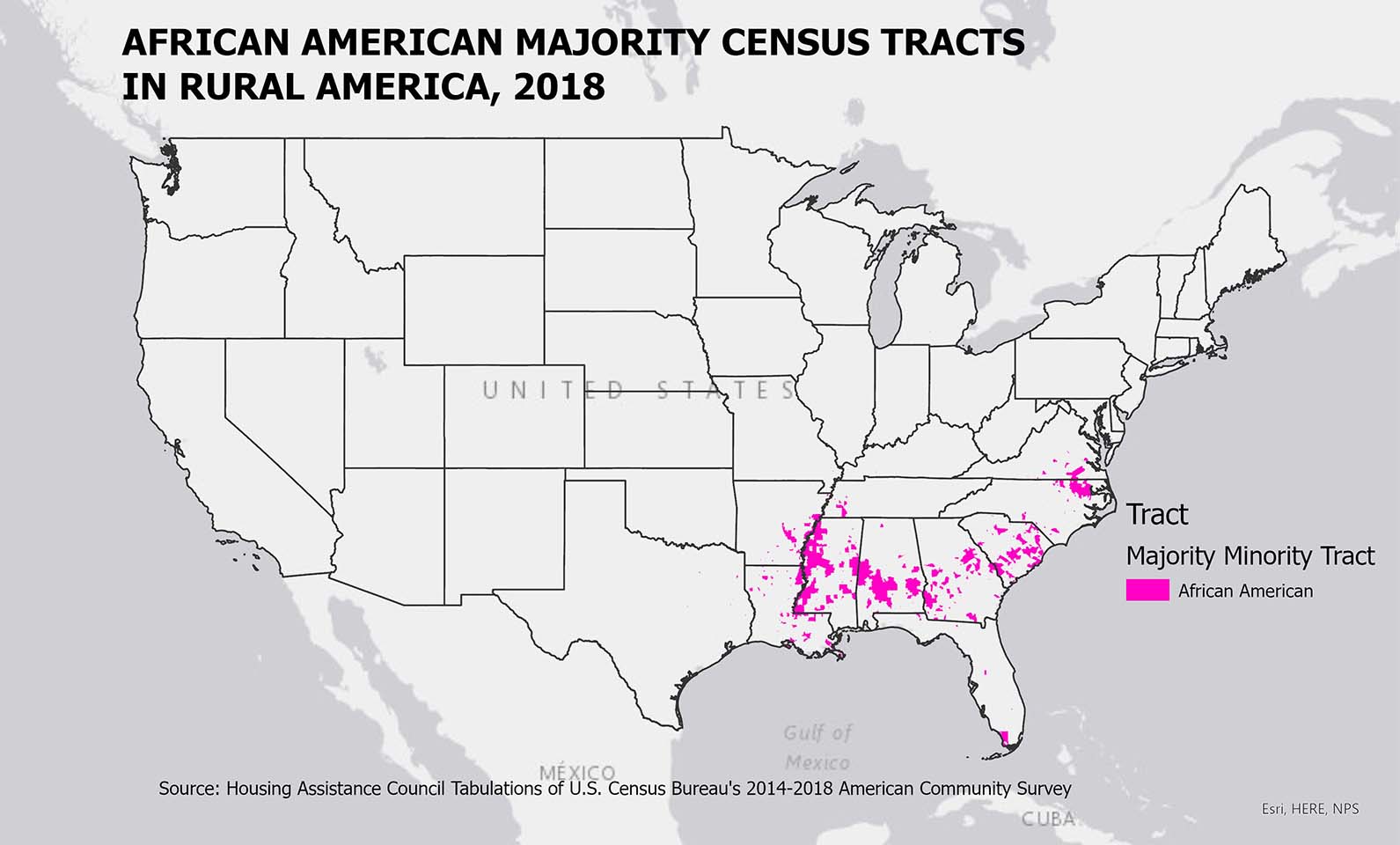
There are 647 rural and small-town census tracts where African Americans make up the majority of the population. Source: Housing Assistance Council tabulations of the U.S. Census Bureau’s 2014-2018 American Community Survey.

Majority African American Rural Tracts

OPPORTUNITIES

Section 514/516 farmworker housing funds available.

USDA’s funding notice provides the schedule for three application rounds in 2021 and 2022. Pre-applications are due April 1, 2021 for the first round and November 1, 2022 for the third round. For more information, contact Jonathan Bell, USDA, 254-742-9764.

Citizens’ Institute on Rural Design now open for applications! 

This year, the CIRD program is being led by the National Endowment for the Arts in partnership with HAC and the design lead, Omar Hakeem of TBD Studio. CIRD will offer four local Design Workshops that address specific community challenges, and an online Design Learning Cohort program that will allow up to 15 communities to engage in peer learning and expert-led sessions online. Communities of 50,000 or less are eligible to apply for the programs by March 12. CIRD encourages applications from nonprofits, tribal or municipal governments, regional planning organizations and other community partners. Click here to view the request for applications and register here for a February 9 informational webinar to learn more and ask questions.

Native homeownership development training offered.

Enterprise Community Partners’ Rural and Native American Program will select 25 participants for Enhancing and Implementing Homeownership Programs in Native Communities training. The curriculum consists of 12 online sessions beginning March 25, including nuts and bolts of homeownership and other topics. Tribes, tribally designated housing entities, community development organizations, and Native CDFIs are eligible to apply by the February 22 deadline.

Project engages youth in exploring their town’s past and thinking about its future.

Rural communities can apply by March 15 for Coming Home: Stories from Main Street, a new collaboration between the Rural Community Assistance Partnership and the Smithsonian Institution’s Museum on Main Street program. The program is flexible, to work with each organization’s existing resources with the goal of helping strengthen or develop new relationships, particularly with kids, youth groups, teachers or schools. For more information, contact the MoMS Youth Program Coordinator, 973-617-7485.

HAC job openings: Community Facilities Housing Specialist, Loan Officer, Senior Portfolio Manager.

For details, visit HAC’s website.

  • The Community Facilities Housing Specialist identifies and engages community stakeholders and provides direct technical assistance to rural organizations that are developing facilities such as parks, community centers, public libraries and childcare centers. This includes helping them identify, utilize and apply for financial resources such as USDA Community Facilities grants and loans. This a two-year position and is eligible for telecommuting.
  • The Loan Officer represents HAC in its lending activities – to include loan underwriting, marketing, and research and product development – and originates new loan transactions. This position is based in HAC’s Washington, DC headquarters and is eligible for telecommuting.
  • The Senior Portfolio Manager provides leadership and oversight to a team that performs a range of lending activities – closing, disbursement, monitoring, servicing and asset management of single-family and multifamily housing development loans. This position is based in HAC’s Washington, DC headquarters and is eligible for telecommuting.

CORONAVIRUS

Research and recommendations issued for emergency rental assistance programs.

In a January 25 letter to Treasury Secretary Janet Yellen, HAC provided suggestions to ensure that rural areas are equitably served in the Emergency Rental Assistance program. COVID-19 Emergency Rental Assistance: Analysis of a National Survey of Programs, a research brief from the University of Pennsylvania, the NYU Furman Center and the National Low Income Housing Coalition, presents the results of an in-depth survey of 220 COVID-19 rental assistance programs across the country and extracts lessons learned that should inform such programs in the future. Emerging Best Practices for COVID-19 Emergency Rental Assistance Programs, a slide deck produced by the Aspen Institute, lays out best practices for the design and administration of these programs.

“Additional Covid-19 vaccines bring choices – and complications – to the rollout.”

This article in STAT, produced by Boston Globe Media, explains that the Johnson and Johnson vaccine requires only one dose, is cheap, and is easier to store and transport than other approved vaccines, making it possible to vaccinate residents in hard-to-reach areas. There is concern of inequity if this less effective vaccine (66%) is the only option in rural areas, although experts advise that its effectiveness meets requirements.

REGULATIONS AND FEDERAL AGENCIES

Comments requested on changes that would redefine size of metropolitan areas.

The Office of Management and Budget requests public input on recommendations for changes to the standards it uses to delineate and update metropolitan and micropolitan statistical areas as new data becomes available. It would change the threshold size of metropolitan areas’ central cities from 50,000 to 100,000 so places with populations up to 100,000 would be considered outside metro areas. Comments are due March 19. For more information, contact James D. Fitzsimmons, OMB, 301-763-1465.

CORRECTION: USDA Strategic Economic and Community Development setasides apply to housing programs.

The January 21, 2021 HAC News incorrectly identified the USDA Rural Development programs in which funds will be set aside for projects that support multi-jurisdictional and multi-sectoral strategic community investment plans. The setaside has been expanded to include Section 514/516 farm labor housing, Section 523 self-help technical assistance, Section 523 and 524 site loans, Section 533 Housing Preservation Grants, Section 538 multifamily guarantees and RCDI. To apply for the setaside, applicants must include a specific form and other information with their program application. For more information, contact a USDA RD State Office.

USDA sets area loan limits for single-family direct programs.

Loan limits that will be used in fiscal year 2021 for the Section 502 direct homeownership loan program and the Section 504 home repair program are now available online. For more information, contact a USDA Rural Development service center.

PUBLICATIONS AND MEDIA

National poverty rate rising even as unemployment falls.

Using calculations that provide poverty data with a lag of only a few weeks, economists at Zhejiang University, the University of Chicago and the University of Notre Dame found that poverty declined in the first half of 2020, but rose sharply from 9.3% in June to 11.8% in December. At the same time, the unemployment rate fell from 11.1% in June to 6.7% in December. An interactive chart allows comparisons across categories such as race, age and education and a report with interim data explains the research.

Data suggests immigrants avoiding coronavirus assistance.

Immigrant Families Continued Avoiding the Safety Net during the COVID-19 Crisis, a fact sheet from the Urban Institute, reports that “the prior administration’s changes to the ‘public charge’ rule intensified immigrant families’ reluctance to participate in public benefit programs and supports that address basic health, nutrition, and housing needs. … The continued chilling effects experienced by immigrant families in 2020 are alarming in the context of the pandemic, during which people of color, many of whom are part of immigrant families, have disproportionately experienced economic and health hardships.”

HAC

Need capital for your affordable housing project?
HAC’s loan funds provide low interest rate loans to support single- and multifamily affordable housing projects for low-income rural residents throughout the U.S. and territories. Capital is available for all types of affordable and mixed-income housing projects, including preservation, farmworker, senior and veteran housing. HAC loan funds can be used for pre-development, site acquisition, site development and construction/rehabilitation. Contact HAC’s loan fund staff at hacloanfund@ruralhome.org, 202-842-8600.
Please note: HAC is not able to offer loans to individuals or families. Borrowers must be nonprofit or for-profit organizations or government entities (including tribes).
HAC News: January 21, 2021

HAC News Formats. pdf

January 21, 2021

Vol. 50, No. 2

TOP STORIES

Biden administration extends eviction and foreclosure moratoriums.

On January 20, the day President Joe Biden and Vice President Kamala Harris were inaugurated, the White House announced that protections for renters and homeowners will run through March 31. Centers for Disease Control director Dr. Rachel Walensky extended to March 31 the CDC’s ban on eviction of tenants for nonpayment of rent. USDA announced its moratoriums on foreclosure and eviction for homeowners with Section 502 single-family direct and guaranteed mortgages will last through March 31. It also set March 31 as the deadline for lenders making Section 502 guaranteed loans to offer forbearance of mortgage payments for up to 180 days, with a second 180-day period possible, and it will continue to provide the same opportunity for its Section 502 direct borrowers. The Federal Housing Administration extended the moratorium on foreclosure and eviction for single-family properties it insures. Similar changes are expected from the Department of Veterans Affairs and (for Fannie Mae and Freddie Mac) the Federal Housing Finance Agency.

Executive Orders change policies on equity, census, regulations.

Among the many actions taken by President Biden on January 20 were the following.

Biden will request more coronavirus relief.

President Biden’s coronavirus relief proposal, announced on January 14, commits to asking Congress for additional financial relief including $30 billion in rental and utility assistance and $5 billion for those at risk of or experiencing homelessness, as well as $20 billion for tribal governments, supplemental unemployment benefits, aid to states, support for small businesses, expansion of the Earned Income Tax Credit and a $15 federal minimum wage.

Citizenship path for farmworkers included in new administration’s immigration reform proposal.

Legislation sent to Congress by the Biden administration would make immigrant farmworkers eligible for green cards immediately and for citizenship after three years. An administration fact sheet about the proposal does not provide further details. The United Farm Workers reports that, to be eligible, workers would have to pass criminal background checks and show a five-year history of agricultural labor.

Nominees and hires announced for USDA, CFPB, HUD positions.

President Biden has nominated Dr. Jewel H. Bronaugh, currently the Virginia Commissioner of Agriculture and Consumer Services, to be Deputy Secretary of USDA and Rohit Chopra to direct the Consumer Financial Protection Bureau. Both will need to be confirmed by the Senate, as will the not-yet-named USDA Under Secretary for Rural Development. Justin Maxson, CEO of the Mary Reynolds Babcock Foundation, has been named Deputy Under Secretary for Rural Development. Katharine Ferguson, a Chief of Staff for Rural Development at USDA during the Obama Administration and most recently Associate Director of the Aspen Institute Community Strategies Group, is Chief of Staff in the office of the USDA Secretary. Numerous top staffers at HUD are listed on the department’s site.

117th Congress gets under way.

The 117th Congress convened in Washington, DC on January 3. Democrats maintain a slim majority in the House of Representatives, with Speaker Nancy Pelosi remaining in her leadership role. While full committee assignments are still forthcoming, it has been announced that Rep. David Scott (D-GA) will take over as chair of the House Agriculture Committee and Rep. Rose DeLauro (D-CT) will take over as head of the House Appropriations CommitteeRep. Maxine Waters (D-CA) will maintain control of the House Financial Services Committee (which has jurisdiction over housing). For the Senate, the January 5 runoff elections in Georgia led to a 50-50 split, with Vice President Kamala Harris as the tie-breaker vote – putting Democrats in control of the Senate for the first time since 2014. Senate committee assignments also have not been finalized, but Sen. Sherrod Brown (D-OH) is expected to take control of the Senate Banking Committee (which covers housing), Sen. Patrick Leahy (D-VT) to lead the Senate Appropriations Committee, and Sen. Debbie Stabenow (D-MI) to chair the Senate Agriculture Committee. Due to the retirement of Sen. Pat Roberts (R-KS), formerly the top Republican on the Senate Agriculture Committee, Sen. John Boozman (R-AR) will become its Ranking Member.

HAC awarded $2.7 million to build housing capacity across rural America.

The $2.7 million grant from HUD’s Rural Capacity-Building for Affordable Housing and Community Development program will enable HAC to significantly impact the capacity of 65 nonprofit housing organizations, municipalities and tribal entities in their efforts to undertake affordable housing and community development activities in some of the most challenging and overlooked communities in the nation.

RuralSTAT

The number of housing units in rural and small-town communities increased by nearly 865,000, or 3%, between 2010 and 2018. Source: HAC tabulations of 2006-2010 and 2014-2018 American Housing Survey Data. For more information on housing occupancy and vacancy in rural America visit http://ruralhome.org/wp-content/uploads/storage/documents/rrbriefs/rrb_occupancy_and_vacancy.pdf.

OPPORTUNITIES

Section 202 funds for elderly housing available.

Nonprofits and coops can apply by May 26 for Section 202 capital advances to finance construction, reconstruction, acquisition, or moderate or substantial rehabilitation of housing, as well as Project Rental Assistance Contracts, for very low-income residents age 62 or older. For more information, contact HUD staff, 202CapitalAdvanceNOFA@hud.gov.

Tribal HUD-VASH expansion announced.

HUD-VA Supportive Housing voucher funding for Native American veterans who are homeless or at risk of homelessness is available for tribes and Tribally Designated Housing Entities, whether or not they are already participating in the HUD-VASH program. Applications are due April 15. For more information, contact HUD staff, TribalHUDVASH@hud.gov.

HAC seeks proposals for Affordable Housing for Rural Veterans Initiative.

HAC’s Affordable Housing for Rural Veterans initiative supports local nonprofit housing development organizations that meet or help meet the affordable housing needs of veterans in rural places. Grants typically range up to $30,000 per organization and must support bricks-and-mortar projects that assist low-income, elderly and/or disabled veterans with home repair and rehab needs, support homeless veterans, help veterans become homeowners and/or secure affordable rental housing. AHRV is funded through the generous support of the Home Depot FoundationApplications are due by February 1. For more information, contact HAC staff, ahrv@ruralhome.org. No phone calls please.

HAC job openings: Community Facilities Housing Specialist, Loan Officer, Senior Portfolio Manager.

For details, visit HAC’s website.

  • The Community Facilities Housing Specialist identifies and engages community stakeholders and provides direct technical assistance to rural organizations that are developing facilities such as parks, community centers, public libraries and childcare centers. This includes helping them identify, utilize and apply for financial resources such as USDA Community Facilities grants and loans. This a two-year position and is eligible for telecommuting.
  • The Loan Officer represents HAC in its lending activities – to include loan underwriting, marketing, and research and product development – and originates new loan transactions. This position is based in HAC’s Washington, DC headquarters and is eligible for telecommuting.
  • The Senior Portfolio Manager provides leadership and oversight to a team that performs a range of lending activities – closing, disbursement, monitoring, servicing and asset management of single-family and multifamily housing development loans. This position is based in HAC’s Washington, DC headquarters and is eligible for telecommuting.

CORONAVIRUS

Treasury sets requirements for Emergency Rental Assistance.

On January 19 the Trump administration’s Treasury Department posted a new FAQ document, as well as new information for tribes, both relating to the Emergency Rental Assistance program created by the December coronavirus relief law. The FAQ adds a requirement that tenants requesting rental aid must document their coronavirus-related economic hardship and their risk of homelessness or housing instability. It also requires a state or local government to wait 21 days for a landlord’s response to a request to accept payment from the government entity before providing aid to a tenant directly.

IRS extends relief for Low Income Housing Tax Credit properties.

IRS Notice 2021-12 extends and adds to the provisions of Notice 2020-53, moving deadlines and providing flexibility for some requirements that apply to LIHTC properties.

Members of mixed-status families now eligible for direct relief payments.

Nearly 3 million U.S. citizens and legal immigrants initially excluded under the CARES Act are covered under the December 2020 COVID-19 stimulus,” a commentary by the Migration Policy Institute, reports that when they file their 2020 tax returns, approximately 2.9 million citizens and people with legal status who are the spouses or children of undocumented immigrants can apply for the $1,200 stimulus checks provided by the CARES Act in March. These members of mixed-status families were not originally eligible for the funds, but the December 2020 coronavirus relief law changed that, as well as making them eligible for its $600 payments. 2.2 million children who are U.S. citizens or have legal status remain ineligible because they have no parents with legal status.

“Tribal elders are dying from the pandemic, causing a cultural crisis for American Indians.”

The New York Times reports that, although there is no reliable data on the number of Native American elders killed by Covid-19, the virus has taken “an incalculable toll on bonds of language and tradition that flow from older generations to the young.”

News reports relate difficulties in vaccinating farmworkers.

The challenges are described by Politico in “Who is ‘essential’? Food and farm workers left in limbo in vaccine priorities” and by Yuma, Arizona TV stations KYMA/KECY in “Farmworkers trying to get COVID-19 vaccine face challenges.”

“Why West Virginia’s winning the race to get COVID-19 vaccine into arms.”

National Public Radio story explains how West Virginia has addressed the challenge of delivering coronavirus vaccinations in rural places where most pharmacies are not affiliated with the chains and networks being used to distribute vaccinations. The state chose to distribute doses itself to independent rural pharmacies that were already working with long-term care facilities.

REGULATIONS AND FEDERAL AGENCIES

USDA announces Strategic Economic and Community Development setasides in some RD programs.

USDA will set aside 3% to 10% of funds from some RD programs to prioritize projects that support multi-jurisdictional and multi-sectoral strategic community investment plans. The relevant programs are Community Facilities loans, grants and guaranteed loans; Water and Waste Disposal loans, grants and guaranteed loans; Business and Industry Guaranteed Loans; Rural Business Development Grants; and Community Connect broadband grants. To apply for these funds, applicants must include a specific form and other information with their program application. For more information, contact a USDA RD State Office.

Single set of quality standards proposed for HUD-assisted housing.

HUD is proposing to create National Standards for the Physical Inspection of Real Estate, a unified assessment of quality. Comments are due March 15 on its proposed rule, which includes provisions intended to reduce administrative burden on small rural PHAs. For more information, contact Timothy Weese or Samuel Franco, HUD, 202-708-1112.

HAC

Need capital for your affordable housing project?
HAC’s loan funds provide low interest rate loans to support single- and multifamily affordable housing projects for low-income rural residents throughout the U.S. and territories. Capital is available for all types of affordable and mixed-income housing projects, including preservation, farmworker, senior and veteran housing. HAC loan funds can be used for pre-development, site acquisition, site development and construction/rehabilitation. Contact HAC’s loan fund staff at hacloanfund@ruralhome.org, 202-842-8600.
Please note: HAC is not able to offer loans to individuals or families. Borrowers must be nonprofit or for-profit organizations or government entities (including tribes).
USDA Rural Development Obligations FY 21 – December

USDA Rural Development Obligations Report Cover - FY 2021

The Housing Assistance Council (HAC) presents this month’s report on Fiscal Year 2021 USDA Rural Housing program obligations.

As of the end of December, USDA obligated 35,111 loans, loan guarantees, and grants totaling about $5,972,304,527. This is nearly $1 billion higher than obligation levels from this time last year. At that time, there were 32,361 loans, loan guarantees, and grants obligated totaling $4,973,305,990.

The agency operated under several short-term continuing resolutions during the month of December. A final CR was signed into law on December 27, 2020 which will provide funding for the remainder of the fiscal year. Since March 20, 2020, USDA offices have been operating from remote locations due to the COVID-19 virus.

Single Family Housing Program Highlights

The Section 502 Guaranteed loan program, the largest of the Single Family Housing programs, obligated $5,746,294,375 (32,823 loan guarantees) up from $4,759,272,406 (29,808 loan guarantees) this time last year.

For the Section 502 Direct program, loan obligations totaled $179,758,120 (975 loans), similar to last year’s obligation level of $151,845,219 (899 loans.) Over 41 percent of the loan dollars went to Very Low-income (VLI) applicants. VLI loans represented over 47 percent of the total number of Section 502 Direct loans.

The Section 504 Repair and Rehabilitation programs obligated 498 loans representing $2,838,485 compared to 586 loans representing $3,462,472 at this time last year.) There were also about $4,863,579 (788 grants) obligated in the Section 504 grant program compared to $6,336,917 (1,029 grants) last year.

USDA’s Section 523 Self Help Housing Grant program funded 5 grants and contracts totaling $3,449,175 up from last year’s 2 grants and contracts totaling $1,870,512.

No credit sales have been funded yet this year, similar to last year at this time.

Multi-Family Housing Programs

USDA’s Section 538 Multifamily Housing obligated 17 loan guarantees totaling $35,082,487 compared to last year’s 23 loan guarantees ($34,064,126.) There have not yet been obligations this year in the Section 515 Rural Rental Housing, the Farm Labor Housing, or MPR programs yet this year. It should be noted that funding in these programs is more prominent later in the fiscal year for most MFH loan and grant programs.

USDA obligated funds for 38,592 rental assistance units under the Section 521 Rental Assistance program totaling $219,583,640 compared to 46,336 units ($272,857,393) obligated same time last year. There were also 1,277 Rural Housing Vouchers totaling $6,508,033 compared to 913 vouchers representing $4,664,688 this time last year.

Download the combined document.

* The Rural Housing Service (RHS) monthly obligation reports are produced by the Housing Assistance Council (HAC) 1025 Vermont Ave., NW, Suite 606, Washington, DC 20005. The monthly figures derive from HAC tabulations of USDA –RHS 205c, d, and f report data. For questions or comments about the obligation reports, please contact Michael Feinberg at 202-842-8600 or michael@ruralhome.org.

HAC News: January 7, 2021

HAC News Formats. pdf

January 7, 2021

Vol. 50, No. 1

TOP STORIES 

Eviction moratorium and rent aid included in final coronavirus relief package.

  • The coronavirus relief legislation enacted in late December extends through January 31 the Centers for Disease Control’s nationwide moratorium on evictions of tenants for non-payment of rent. CDC has updated its declaration for tenants and its Frequently Asked Questions document to reflect the new expiration date. The revised FAQ also now points out that state or local law may allow a landlord to challenge the truthfulness of a tenant’s declaration. USDA issued a reminder about the moratorium’s applicability to USDA-financed rentals.
  • The law also provides $25 billion for a new Emergency Rental Assistance program. The Treasury Department will distribute ERA funds to states, local governments with populations of at least 200,000 and tribes. Eligible government entities must submit information to Treasury by January 12 in order to receive funds.
  • Among its other provisions, the law extends the deadline for states, localities and tribes to use CARES Act Coronavirus Relief Funds to December 31, 2021; revives the Paycheck Protection Program and other aid for small businesses (more information under Opportunities below); and provides funding for broadband and for CDFIs.

Agencies extend housing relief into 2021.
Federal housing agencies are again extending special provisions that were put into effect early in 2020 to help people deal with the impacts of the coronavirus pandemic, including moratoriums on foreclosures and evictions, forbearance for owners of single-family or multifamily properties, and waivers of some requirements. HAC has posted a table showing the status of these extensions, and will update it as more are announced.

Most rural housing programs have level funding for FY21.
The final omnibus appropriations measure for fiscal year 2021, signed into law on December 27 as part of the package that also included coronavirus relief, holds most USDA rural housing programs at FY20 levels. It provides increases for Section 521 Rental Assistance and Section 542 vouchers. HUD’s HOME, CDBG, SHOP and Native American housing programs also receive the same funding as last year or small increases. Dollar levels for homeless assistance, HUD vouchers, Section 202, Section 811 and fair housing are increased.

Permanent floor set for 4% Low-Income Housing Tax Credit.
The legislative package that includes the coronavirus relief bill and omnibus appropriations also establishes 4% as the minimum rate for the 4% Low-Income Housing Tax Credit, effective immediately. LIHTC experts at Novogradac estimate this change could finance an additional 130,000 rental units in the next ten years.

RuralSTAT
In 2020, from February 20 – the first reported case of COVID-19 outside a metropolitan area – to December 31, there were 3 million reported cases and over 52,000 reported deaths from the coronavirus in rural America. Source: Housing Assistance Council tabulations of New York Times COVID-19 data.

OPPORTUNITIES

HAC seeks proposals for Affordable Housing for Rural Veterans Initiative.
HAC’s Affordable Housing for Rural Veterans initiative supports local nonprofit housing development organizations that meet or help meet the affordable housing needs of veterans in rural places. Grants typically range up to $30,000 per organization and must support bricks-and-mortar projects that assist low-income, elderly and/or disabled veterans with home repair and rehab needs, support homeless veterans, help veterans become homeowners and/or secure affordable rental housing. AHRV is funded through the generous support of the Home Depot FoundationApplications are due by February 1. For more information, contact HAC staff,  ahrv@ruralhome.org. No phone calls please.

Rural microenterprise loans offered by USDA.
USDA is seeking nonprofit entities, institutions of higher education and tribes to serve as partners for its Rural Microentrepreneur Assistance Program (RMAP). It will provide loans and technical assistance grants for applicants to support rural microenterprises. Deadlines are March 31 and June 30. For additional information, contact a USDA RD state office.

HAC job openings: Community Facilities Housing Specialist, Loan Officer, Senior Portfolio Manager.
For details, visit HAC’s website.

  • The Community Facilities Housing Specialist identifies and engages community stakeholders and provides direct technical assistance to rural organizations that are developing facilities such as parks, community centers, public libraries and childcare centers. This includes helping them identify, utilize and apply for financial resources such as USDA Community Facilities grants and loans. This a two-year position and is eligible for telecommuting.
  • The Loan Officer represents HAC in its lending activities – to include loan underwriting, marketing, and research and product development – and originates new loan transactions. This position is based in HAC’s Washington, DC headquarters and is eligible for telecommuting.
  • The Senior Portfolio Manager provides leadership and oversight to a team that performs a range of lending activities – closing, disbursement, monitoring, servicing and asset management of single-family and multifamily housing development loans. This position is based in HAC’s Washington, DC headquarters and is eligible for telecommuting.

Paycheck Protection Program to restart.
A summary of the new coronavirus relief bill’s Paycheck Protection Program provisions is available on HAC’s site. The maximum loan amount will be $2 million, down from $10 million for the first PPP. Loans will be available for businesses that qualified under the CARES Act but did not receive a PPP loan, those that did receive one but need additional funding, and those that returned all or part of one. The Treasury Department and Small Business Administration have developed two interim regulations (here and here) to govern the second PPP round. Comments will be due 30 days after the rules are published in the Federal Register. The two agencies also have a new PPP document titled “Guidance on Accessing Capital for Minority, Underserved, Veteran and Women-Owned Business Concerns.”

CORONAVIRUS

Delivering vaccinations through pharmacies disadvantages some rural places.
The U.S. Department of Health and Human Services plans to increase access to COVID-19 vaccinations through partnerships with large chain pharmacies and networks that represent independent pharmacies and regional chains. A recent Rural Policy Research Institute study found, however, that in 750 (out of a total of 1,962) counties outside metropolitan areas there are no pharmacies affiliated with one of HHS’s partnerships. In 110 counties there are no eligible pharmacies at all.

“Rural Downtowns Were on the Mend. Then Came Covid.”
This Bloomberg opinion piece explains that certain rural areas, particularly those involved in tourism, experienced considerable economic growth by investing in their downtown areas, but the coronavirus pandemic set them back. The author suggests that attracting people relocating from urban areas, along with well planned and targeted investment, can help them recover.

REGULATIONS AND FEDERAL AGENCIES

USDA releases annual tenant data.
Characteristics of tenants in USDA’s Section 515 rental and Section 514/516 farmworker housing properties changed very little from September 2019 to September 2020, according to USDA’s annual summary of tenant data. Average annual income of Section 515 tenants rose from $13,551 in September 2019 to $13,640 in September 2020, while the average income for Section 515 tenants receiving Section 521 Rental Assistance was $11,380 in 2020. About 10.6% of all tenants in USDA’s portfolio remain rent burdened and almost 70% of tenants continue to receive rental assistance of some sort. Elders and people with disabilities comprise 65.3% of Section 515 households.

Fannie Mae and Freddie Mac affordable housing goals and Duty to Serve plans set for 2021.
The Federal Housing Finance Agency has announced Fannie Mae’s and Freddie Mac’s 2021 goals for purchases of affordable housing mortgages. It has also published their Duty to Serve plans for this year, which address activities related to rural housing, rental housing preservation and manufactured housing. A third notice requests public comments by February 28 on potential changes to the housing goals regulation. FHFA asks a number of specific questions and invites comments on any other issues commenters think should be addressed. For more information, contact Ted Wartell, FHFA, 202-649-3157.

PUBLICATIONS AND MEDIA

Health data available for all geographies.
The PLACES Project from the CDC and the Robert Wood Johnson Foundation links health to place by providing census tract estimates for chronic disease risk factors, health outcomes and clinical preventative services. Access the data for a local area here.

HAC

Need capital for your affordable housing project?
HAC’s loan funds provide low interest rate loans to support single- and multifamily affordable housing projects for low-income rural residents throughout the U.S. and territories. Capital is available for all types of affordable and mixed-income housing projects, including preservation, farmworker, senior and veteran housing. HAC loan funds can be used for pre-development, site acquisition, site development and construction/rehabilitation. Contact HAC’s loan fund staff at  hacloanfund@ruralhome.org, 202-842-8600.
Please note: HAC is not able to offer loans to individuals or families. Borrowers must be nonprofit or for-profit organizations or government entities (including tribes).
HAC News: December 17, 2020

HAC News Formats. pdf

December 17, 2020

Vol. 49, No. 25

TOP STORIES

Coronavirus relief bill may include eviction moratorium extension, rent aid and unemployment relief.

On December 17, congressional leaders continued to negotiate the terms of legislation based on the Emergency Coronavirus Relief Act of 2020, which was proposed by a bipartisan group of senators and representatives. The proposal would extend the CDC eviction moratorium through January 31. It would not add funding for any HUD or USDA housing programs, but would provide $25 billion in rental aid to be distributed to state, local and tribal governments via the Coronavirus Relief Fund. The final agreement is also expected to provide another round of direct payments to individuals and revive the Paycheck Protection Program. It is likely to provide supplemental unemployment benefits as well, although there could be a delay before states can get the funds out later in January.

FY21 federal funding deal pending.

Action on a final omnibus appropriations bill covering the rest of fiscal year 2021 has been delayed pending resolution on a coronavirus relief measure. The omnibus bill’s text has not been released. Final funding levels for USDA and HUD housing programs will be similar to FY20 amounts, with compromises where the House and Senate proposals for FY21 differed. The current continuing resolution expires at midnight on December 18, so another short-term CR may be needed to keep the government open while discussions on the coronavirus bill extend over the weekend.

Biden names Vilsack as USDA Secretary, Fudge for HUD.

President-elect Joe Biden has selected Tom Vilsack, who was Secretary of Agriculture throughout the Obama Administration, to fill the same position again. He named Rep. Marcia Fudge (D-Ohio) to be Secretary of Housing and Urban Development. A HAC statement congratulates both nominees. HAC looks forward to working with them in their new roles to place a renewed focus on the needs of rural communities.

HAC’s virtual symposium highlighted rural resiliency.  

Hundreds of rural housing developers, government officials, community members and housing advocates attended HAC’s virtual Rural Housing Symposium: Recovery Through Resiliency on December 3, exploring how the communities we all serve can move forward together from this difficult year. Recordings of the entire day and of individual panels are posted on HAC’s YouTube channel.

OPPORTUNITIES

Rural Energy Savings Program loans offered.

USDA’s Rural Utilities Service is now accepting applications for the Rural Energy Savings Program, which makes loans to intermediaries that re-lend the funds to rural residents and small businesses to implement energy efficiency measures. The funds can also be used to replace a manufactured housing unit with another manufactured housing unit if the replacement would be more cost effective in saving energy. Letters of intent will be reviewed as received. For more information, contact Robert Coates, RUS, 202-260-5415.

RuralSTAT

According to the most recent data from the Bureau of Labor Statistics, 1.1 million workers outside metropolitan areas are unemployed. Source: HAC tabulations of Bureau of Labor Statistics LAUS data.

CORONAVIRUS

COVID-19 cases surpass 2.2 million in rural America.

As of December 3, there were more than 2.2 million reported cases of COVID-19 and approximately 38,000 associated deaths in communities outside metropolitan areas. HAC’s most recent data analysis found that between November 3 and December 3, communities outside metropolitan areas reported 859,000 new cases of COVID-19, a 63% increase in one month.

ERS examines coronavirus and recession.     

The USDA Economic Research Service released the 2020 edition of its Rural America at a Glance report on December 17, focusing on how the pandemic and the ensuing recession have impacted demographic and economic conditions in rural areas. ERS will host a webinar on December 18 presenting findings from the report.

Many families with children are struggling.

Kids, Families and COVID-19: Pandemic Pain Points and the Urgent Need to Respond, published by the Annie E. Casey Foundation, presents state-level data on financial stability, hunger, education, health insurance and mental health before and during the pandemic. It recommends immediate action by federal, state and local decision makers.

“‘The most lopsided economic event imaginable’: Wave of evictions threatens Black, Latino tenants.”

Politico article describes how evictions could further exacerbate health disparities and risks of COVID-19 infections by forcing families to move to doubled-up cramped quarters or out on the street. A relief package from Congress and eviction moratorium extension can prevent long-term negative consequences to economic and mental health.

REGULATIONS AND FEDERAL AGENCIES

USDA RD issues temporary appraisal authorization. 

An Unnumbered Letter dated December 7, 2020 provides temporary authorization regarding appraisals for Section 502 direct and Section 504 financing. Through September 30, 2021, self-help grantees, certified loan application packagers and USDA-approved intermediaries can order appraisals from local entities so long as they meet certain requirements. For more information, contact an RD office.

Final rules for faith-based organizations adopted by agencies including USDA and HUD.

Revisions to existing regulations for faith-based organizations’ participation in federal programs will take effect on January 19 under a final rule first proposed by USDA and others in January 2020 and by HUD in February. Among other changes, faith-based organizations will no longer be required to offer referrals to other providers and will be able to claim nonprofit status without obtaining a Section 501(c)(3) determination.

Flexibility for hiring H-2A farmworkers extended to June.

The Department of Homeland Security has revised its permission for farmworkers with H-2A visas to begin work for new employers without first leaving the U.S. The change, previously applicable when employers filed H-2A petitions by December 17, 2020, now applies through June 16, 2021. For more information, contact Charles L. Nimick, USCIS, 240-721-3000.

“SpaceX gets almost $900 million in federal subsidies to deliver broadband to rural America.”

The Federal Communications Commission has awarded SpaceX funding to explore providing broadband internet access to rural communities via satellites, CNN Business reports. SpaceX’s plan involves a yet unproven approach that will, if it works, rely on thousands of satellites to beam internet access back to households. This was just one of several grants, most going to more traditional internet providers, seeking to improve high speed internet access in rural areas.

PUBLICATIONS AND MEDIA

“LIHTC in Rural Persistent Poverty Counties.”

A Freddie Mac white paper highlights the importance of the Low-Income Housing Tax Credit program in developing affordable housing in lower-income rural areas. Over 40% of the multifamily stock in rural persistent poverty counties received assistance from LIHTC.

Coastal flooding risk to affordable housing is growing, report says.

Climate Central, a climate change research organization, calculates that the number of affordable units in the U.S. exposed to coastal flooding will more than triple by 2050. Sea Level Rise and Coastal Flooding Threaten Affordable Housing is a scientific report published in Environmental Research Letters, supplemented by interactive maps and a non-technical report that includes links to other online resources.

Fact sheet offers strategies on how community development can end homelessness.

Preventing and Ending Homelessness: Community Development’s Role,” a new publication by the Build Healthy Places Network and NeighborWorks America, highlights the convincing evidence that ending homelessness improves health outcomes. This publication offers information on permanent supportive housing, the intersection of housing and health, case studies and tools for community development practitioners.

HAC

HAC remembers Bill Powers.

The affordable housing community has lost a dear friend and advocate: Bill Powers, one of HAC’s first staff members and later board member and chair, passed away on Thanksgiving Day. You can read HAC’s tribute and share memories of Bill on HAC’s facebook page.

Happy holidays from HAC.

With the holiday season upon us, HAC would like to take a moment to reflect on 2020. We have mourned the loss of family and friends to COVID-19, celebrated the focus on racial justice and longed for a more civil society. We know every American needs a safe, stable and affordable home like never before and we thank our allies, local partners, sponsors and supporters for your support this year. Our full holiday message is posted here.

Need capital for your affordable housing project?

HAC’s loan funds provide low interest rate loans to support single- and multifamily affordable housing projects for low-income rural residents throughout the U.S. and territories. Capital is available for all types of affordable and mixed-income housing projects, including preservation, farmworker, senior and veteran housing. HAC loan funds can be used for pre-development, site acquisition, site development and construction/rehabilitation. Contact HAC’s loan fund staff at  hacloanfund@ruralhome.org, 202-842-8600.
Please note: HAC is not able to offer loans to individuals or families. Borrowers must be nonprofit or for-profit organizations or government entities (including tribes).
USDA Rural Development Obligations FY 21 – November

USDA Rural Development Obligations Report Cover - FY 2021

As of the end of November, USDA obligated 23,321 loans (direct and guaranteed) and grant representing $3,960,074,070. This is $622,009,470 higher than obligation levels from this time last year. At that time, there were 21,676 loans, loan guarantees, and grants obligated totaling $3,338,064,600.

The agency is operating under a continuing resolution providing funding through December 11, 2020 which provides limited funding. Since March 20, 2020, USDA offices have been operating from remote locations due to the COVID-19 virus.

Single Family Housing Program Highlights

The Section 502 Guaranteed loan program, the largest of the Single Family Housing programs, obligated $3,788,050,163 (21,758 loan guarantees) up from $3,216,244,331 (20,191 loan guarantees) this time last year.

For the Section 502 Direct program, loan obligations totaled $142,394,439 ( 756 loans), similar to last year’s obligation level of $89,013,254 ( 520 loans.) About 42 percent of the loan dollars went to Very Low-income (VLI) applicants. VLI loans represented over 47 percent of the total number of Section 502 Direct loans.

The Section 504 Repair and Rehabilitation programs obligated 317 loans representing $1,777,504, lower than obligations at the same time last year (349 loans representing $2,132,997.) The Section 504 grant program obligations totaled $2,955,589 (478 grants) compared to $3,678,139 (595 grants) at this time last year.

USDA’s Section 523 Self Help Housing Grant program funded 5 grants and contracts totaling $3,449,175. There were no program obligations this time last year for the Section 523 program.

Multi-Family Housing Programs

USDA’s Section 538 Multifamily Housing obligated 7 loan guarantees totaling $21,447,200. Last year at this time, there were 14 loan guarantees ($21,354,379.)

In the Section 521 Rental Assistance program, funds for  30 rental assistance units under the totaling $150,564 compared to 16,278 units ($92,494,098) obligated same time last year. There were also  953 Rural Housing Vouchers totaling $4,882,173 compared to 796 vouchers representing $4,035,675 this time last year.

There were no other obligations for Single or Multi-Family programs as of the end of November.

Download the combined document.

* The Rural Housing Service (RHS) monthly obligation reports are produced by the Housing Assistance Council (HAC) 1025 Vermont Ave., NW, Suite 606, Washington, DC 20005. The monthly figures derive from HAC tabulations of USDA –RHS 205c, d, and f report data. For questions or comments about the obligation reports, please contact Michael Feinberg at 202-842-8600 or michael@ruralhome.org.

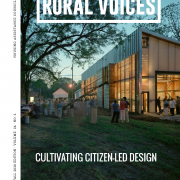
Rural Voices: Cultivating Citizen-led Design

Design for the public interest takes on many forms, from Main Street redevelopment to landscape architecture to historic preservation. In all the rural towns HAC has worked with and featured in this issue of Rural Voices, there is also an element of engaging the community to create a shared vision for all town residents. Partnering with local artists to paint a mural or build a coalition for a local creative economy not only brings more beauty into public spaces, it can draw economic investment to the town. Ultimately, local citizens are tapping design to create a sense of place-that’s what creative placemaking is all about.

HAC’s foray into rural design has only solidified our housing work, while broadening the horizons for us and for our partners. Moreover, HAC’s founding documents cite the need for thoughtful design that engages the low-income rural people and communities that we’ve long served. Support from the National Endowment for the Arts makes it possible to carry out this charge.

Cultivating Citizen-led Design (pdf)


VIEW FROM WASHINGTON

Boosting the Rural Creative Economy
by Rep. Chellie Pingree

Congressional Arts Caucus Chair weighs in on what works in her home state – and beyond.

FEATURES

Arts, Placemaking, and Design Help Imagine a Bright Future
by Mary Anne Carter

In an interview with Rural Voices, National Endowment for the Arts’ Chair, Mary Anne Carter offers an overview of rural design’s history and advice on how underserved communities can persevere through difficult times.

Linking Rural Needs with America’s Architects
by Stephen Sugg and Alejandra Hardin

New American Institute of Architects working group helps to elevate rural architecture.

Cheyenne River Youth Project Carries on Creative Placemaking
by Julie Garreau

In an interview with Rural Voices, Julie Garreau of Cheyenne River Youth Project explains how the tribal nonprofit continues to serve its youth through the arts despite challenges caused by the pandemic.

Rural Studio and the Front Porch Initiative: What Good Design Can Afford
by Rusty Smith and Michelle Sidler

A college architectural program in the South describes their innovative approach to making housing affordable to local residents.

Hard Times
by Stephen Sugg and Alejandra Hardin

The rural design community and CIRD look ahead by looking back.


INFOGRAPHIC


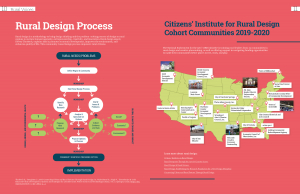
The Rural Design Process

Rural Design (JPG)

Rural Voices would like to hear what you have to say about one, or all, of these issues. Please comment on these stories by sending a tweet to #RuralVoices, discuss on the Rural Affordable Housing Group on LinkedIn, or on our Facebook page.


HAC News: December 3, 2020

HAC News Formats. pdf

December 3, 2020

Vol. 49, No. 24

TOP STORIES
Coronavirus relief discussions continue.
Media reports about negotiations change daily, but there is still at least some possibility that additional coronavirus relief measures will be passed before the CDC eviction moratorium and the remaining CARES Act provisions, such as added unemployment payments, expire at the end of this month. Coronavirus provisions could be included in a broader federal government funding bill or could be considered separately.

Federal funding ends December 11.
Before that date Congress and the Administration must agree on either another continuing resolution to extend government funding at FY20 levels or appropriations to cover the remainder of FY21.

2020’s challenges have exacerbated housing challenges, Harvard reports. 
The coronavirus pandemic, social unrest sparked by racial injustice and climate change have worsened affordability problems and highlighted inequities in housing, according to the 2020 State of the Nation’s Housing report by Harvard University’s Joint Center for Housing Studies. The study’s authors call for “a comprehensive re-envisioning of national housing policy.”

Attend HAC’s virtual symposium on December 3 or view it later.
HAC’s Virtual Rural Housing Symposium: Recovery Through Resiliency kicks off today, December 3, at 11 am Eastern and registration will remain open throughout the event. Join us online from wherever you are for a day filled with engaging speakers, invaluable rural practitioner perspectives and a vast array of information on rural issues. The event will be live-streamed on HAC’s YouTube channel and the recording will be available there afterwards. Questions? Contact  registration@ruralhome.org.

CORONAVIRUS
Extensions and update from Fannie Mae, Freddie Mac and HUD.
Residents of single-family homes backed by or owned by Fannie Mae or Freddie Mac are now protected through January 31, 2021. The secondary market entities will continue their moratorium on foreclosure through that date, as well as their moratorium on eviction of residents in single-family homes acquired by Fannie or Freddie through foreclosure or a deed-in-lieu of foreclosure transaction. In November,  HUD updated its guidance on the CDC moratorium for tenants using its voucher, public housing or Indian housing programs.

Links between eviction and COVID-19 examined in new studies.
“Expiring eviction moratoriums and COVID-19 incidence and mortality” and “Pandemic housing policy: examining the relationship among eviction, housing instability, health inequity, and COVID-19 transmission,” authored by teams of academic researchers, report how evictions harm renters during the pandemic, while eviction moratoriums and supportive measures help to prevent the spread of COVID-19.

Data highlighted online for “Latinos in the Time of Coronavirus.”
Using data from the Census Bureau’s biweekly Household Pulse Survey, this UnidosUS dashboard shows trends nationally and in six key states for the total population, Hispanic/Latinos and non-Hispanic whites. The data include missing a mortgage or rent payment, losing employment income, having food insecurity and more.

RuralSTAT
Between 2010 and 2018, the non-white and Hispanic population increased in 92% of all U.S. counties. Source: HAC Tabulations of the U.S Census Bureau’s 2006-2010 and 2014-2018 American Community Survey.

REGULATIONS AND FEDERAL AGENCIES
Domestic violence guidance for USDA rental housing updated.
An Unnumbered Letter dated November 23, 2020 provides guidance applicable to the Section 515 rental, 514/516 farmworker, 538 guaranteed rental and 533 Housing Preservation Grant programs. It explains property owners’ and managers’ responsibilities in implementing the Violence Against Women Act’s protections for victims of domestic violence, dating violence, sexual assault or stalking and members of their households. For more information, contact a USDA RD field office.

OCC asks for comments on CRA measurements.
The Office of the Comptroller of the Currency requests input on the approach it proposes to establish benchmarks and thresholds for measuring banks’ CRA performance under the revised Community Reinvestment Act regulations it issued earlier this yearComments are due in early February. For more information, contact Ioan Voicu, OCC, 202-649-5550.

USDA suggests requiring Section 502 guarantee lenders to use electronic systems.
Comments are due January 19, 2021 on a proposal to require lenders participating in the Section 502 Single-Family Housing Guaranteed Loan Program to use the Guaranteed Underwriting System and the Lender Loan Closing System. For more information, contact  Ana Placencia, USDA, 254-721-0770.

PUBLICATIONS AND MEDIA
Newest issue of Rural Voices magazine focuses on design.
HAC’s fall edition of Rural Voices, Cultivating Citizen-led Design, covers perspectives on design, architecture, and creative placemaking in rural America with contributions by Rural Studio, Cheyenne River Youth Project, the National Endowment for the Arts and others.

“The heavy toll of the Black Belt’s wastewater crisis.”
New Yorker article describes the dire consequences of inadequate sewage disposal for Black residents in Lowndes County, Alabama.

“A ‘public option’ for low-income homeownership?”
Shelterforce article by Joe Belden and Michael Feinberg, former and current HAC staff, looks at the USDA Section 502 direct loan program as a potential model for providing broader homeownership opportunities for lower-income borrowers.

New resources on creative placemaking available.
For communities interested in getting started with a creative placemaking project, the National Assembly of State Arts Agencies published a new guide to accessing state agency funding, project planning and more. Additionally, creativeplacemakingresources.org identifies federal public resources.

HAC
Need capital for your affordable housing project?
HAC’s loan funds provide low interest rate loans to support single- and multifamily affordable housing projects for low-income rural residents throughout the U.S. and territories. Capital is available for all types of affordable and mixed-income housing projects, including preservation, farmworker, senior and veteran housing. HAC loan funds can be used for pre-development, site acquisition, site development and construction/rehabilitation. Contact HAC’s loan fund staff at  hacloanfund@ruralhome.org, 202-842-8600.
Please note: HAC is not able to offer loans to individuals or families. Borrowers must be nonprofit or for-profit organizations or government entities (including tribes).
GET THE HAC NEWS!

Sign-up for HAC information products

SIGN UP HERE

Housing Assistance Council   |  1828 L Street. N.W., Suite 505, Washington, D.C. 20036
(202) 842-8600 (202) 347-3441 hac@ruralhome.org |

Board Portal

HAC is an equal opportunity provider, employer, and lender. | Civil Rights | Privacy