HAC News: September 16, 2021

Vol. 50, No. 19

TOP STORIES

Fiscal year 2022 will start with a continuing resolution.

Congress has not passed any of the appropriations bills to fund the government for the new fiscal year, which begins on October 1, so a continuing resolution will be needed. Its length has not yet been determined. Information about the appropriations levels proposed for USDA and HUD is posted on HAC’s site.

House bill includes over $5 billion for rural housing.

Substantial funding for USDA and HUD housing programs would be provided in the $3.5 trillion budget reconciliation bill now being developed by House committees. The full reconciliation package, which covers social services not included in Congress’s bipartisan infrastructure bill, is expected to pass the House but its fate in the Senate is uncertain.

  • On September 14 the Financial Services Committee passed its portion of the package, which includes funds for new construction, rehabilitation, and preservation of USDA-financed rental properties; Section 521 Rental Assistance; Section 502 direct loans; Section 504 repair grants, and Section 523 self-help housing. Details are posted on HAC’s site.
  • HUD’s Self-Help Homeownership Opportunity Program (SHOP) would receive an additional $50 million over 10 years.
  • The Agriculture Committee’s section of the package includes $3.87 billion over 10 years for a Rural Partnership Program to support rural development.
  • The Low Income Housing Tax Credit would get an increased allocation each year from 2022 through 2028 under the Ways and Means Committee’s section. Tax credit basis boosts would be provided for some properties, including those in rural or Native American areas. The bill would make several other changes in the program as well.

Census Bureau calculations show aid reduced poverty in 2020.

The Census Bureau’s annual report on income and poverty shows that the official poverty rate rose from 10.4% in 2019 to 11.4% in 2020, the first increase after five consecutive annual declines. When the calculation includes stimulus payments, poverty fell from 11.8% in 2019 to 9.4% in 2020. Using that measurement, poverty in places outside metro areas fell from 11.6% in 2019 to 8.3%. U.S. median household income fell from $69,560 in 2019 to $67,521 in 2020, the first statistically significant decline in median household income since 2011. For places outside metro areas, changes in median income and the official poverty measurement were not statistically significant.

OCC proposes to withdraw CRA regulation.

The Office of the Comptroller of the Currency has issued a notice requesting comment on a proposal to withdraw its controversial 2020 Community Reinvestment Act regulation. The 2020 rule would remain in effect while the banking regulatory agencies develop a new CRA regulation, with a transition period while some aspects of the 2020 rule are replaced. Comments are due October 29. For more information, contact Emily Boyes, OCC, 202-649-5490.

Registration for virtual National Rural Housing Conference coming soon.

HAC’s National Rural Housing Conference is scheduled to take place virtually on November 30-December 3, 2021. With an exciting and full schedule of workshops and new virtual gathering spaces, the conference offers attendees a premier opportunity to learn from experts and connect with the entire affordable housing industry. Be on the lookout for a registration announcement. We look forward to connecting with you this December!

Last chance to nominate individuals or organizations for rural housing awards – deadline extended to Sept. 24!

As part of the 2021 National Rural Housing Conference, HAC will recognize individuals and/or organizations that have, through their continued work and/or newly established initiatives, made a positive and lasting impact in rural America. HAC invites nominations by September 24 of those who have made outstanding and enduring contribution to affordable housing in rural America. This year, HAC will consider each nomination on its own merits, relative to the specified contributions. More details and a list of potential categories are posted on HAC’s site. For more information, contact Miguel Guevara, HAC.

September 15 – October 15 is National Hispanic Heritage Month.

September is National Preparedness Month.

USDA Rural Development published a guide to RD programs and services that can help with disaster preparedness and recovery, and offers a webpage with information for RD customers.

RuralSTAT

There are nearly 20 million workers in rural America. Source: HAC tabulations of Bureau of Labor Statistics LAUS data.

OPPORTUNITIES

“Scaling down” webinar set for September 28.

HAC presents the second in a series of webinars designed to share innovative solutions for affordable housing developers dealing with escalating prices and implementing additional regulations. “Scaling Down” to Address Rising Costs will share pilot programs to reduce square footage and overall costs while increasing energy efficiency, including partnerships with Auburn University Rural Studio to design small, energy-efficient affordable homes.

Webinars offer training to help residents enroll in Child Tax Credit program.

Free webinars to inform housing and service providers who are helping residents claim the enhanced Child Tax Credit will be offered by the National Housing and Rehabilitation Association on September 24; by HUD on September 24; and by the White House and Treasury Department on September 20.

Survey asks for lessons learned since 2008.

The NHP Foundation, in collaboration with Enterprise Community Partners, invites affordable housing stakeholders to respond to a survey intended to produce a comprehensive look at what has been learned as a result of housing challenges from the Great Recession through the pandemic. The survey should take approximately 15 minutes to complete.

HAC seeks Community Facilities Housing Specialist.

The Community Facilities Housing Specialist identifies and engages community stakeholders and provides direct technical assistance to rural organizations that are developing facilities such as parks, community centers, public libraries and childcare centers. This includes helping them identify, utilize, and apply for financial resources such as USDA Community Facilities grants and loans. This is a two-year position and is eligible for telecommuting.

REGULATIONS AND FEDERAL AGENCIES

Input requested on Equitable Housing Finance Plans for Fannie Mae and Freddie Mac.

The Federal Housing Finance Agency is requiring Fannie Mae and Freddie Mac to develop Equitable Housing Finance Plans that will identify and address barriers to sustainable housing opportunities, including goals and action plans to advance equity in housing finance for the next three years. Public comments are due October 25 and FHFA will hold a public listening session​ on September 28.

HUD sets requirements for American Rescue Plan Act’s HOME funds.

Notice CPD-21-10 establishes requirements for the use of HOME-ARP funds, which must primarily benefit people experiencing homelessness, at risk of homelessness, or in other vulnerable populations. Several waivers and alternative requirements apply. The setaside for Community Housing Development Organizations is waived, but participating jurisdictions can use up to 5% of their grants to provide capacity-building operating assistance to CHDOs and other nonprofits. HUD also published several fact sheets related to this notice.

FY22 Difficult Development Areas and Qualified Census Tracts listed.

HUD’s annual lists of designations for use in the Low Income Housing Tax Credit program have been posted online. For more information, contact Michael K. Hollar, HUD, 202-402-5878.

FEMA widens disaster aid access, including for homeowners without standard titles.

Several changes to FEMA policies are intended to reduce underserved populations’ access to disaster aid. The agency broadened the list of documents that can be used to verify occupancy and ownership. It will allow disaster survivors with heirship properties, travel trailers, and the like to self-certify ownership. Also, assistance will be available for disaster-caused damages even if they did not make a home uninhabitable, and survivors who incur disaster-related disabilities will be eligible for aid to adapt their damaged homes.

Hazard mitigation regulations revised.

FEMA has revised its Hazard Mitigation Assistance and mitigation planning regulations to reflect current statutory authority and agency practice. These regulations cover the Flood Mitigation Assistance grant program, the Hazard Mitigation Grant Program, financial assistance for property acquisition and relocation of open space, and mitigation planning. For more information, contact Katherine Fox, FEMA, 202-646-1046.

USDA requests comments on broadband rules changes.

USDA’s Rural Utilities Service adopted regulatory changes to implement provisions of the 2018 Farm Bill relating to broadband programs, effective immediately. Comments are due November 9. For more information, contact Laurel Leverrier, RUS, 202-720-9556.

PUBLICATIONS AND MEDIA

News consortium plans to expand coverage of rural America.

The Institute for Nonprofit News hopes to uncover the most pressing issues confronting rural communities, with a focus on solutions. Over 50 INN news outlets prioritize coverage of rural communities and will form the basis of this two-year collaboration. The Daily Yonder and Investigate Midwest will serve as hubs for the project. For more information, contact INN.

USDA Community Facilities programs may have reduced pandemic’s impact.

Counties where USDA’s CF programs invested in health care facilities between 2016 and 2020 had lower COVID-19 case and death rates than other counties, regardless of rurality or poverty level, according to USDA’s Community Facilities Program May Help Rural America Cope with COVID-19, published in the magazine of the Agricultural & Applied Economics Association. The impact was strongest in remote counties.

Documentaries focusing on rural environmental justice to be shown across five states.

Working Films Rural Cinema, in collaboration with five nonprofit organizations across the country, is showing a total of 20 documentaries in rural communities in Georgia, Missouri, Montana, Pennsylvania, and Utah.  These organizations intend to use the showings as a way to open a discussion about environmental topics.

Need capital for your affordable housing project?

HAC’s loan fund provides low interest rate loans to support single- and multifamily affordable housing projects for low-income rural residents throughout the U.S. and territories. Capital is available for all types of affordable and mixed-income housing projects, including preservation, new development, farmworker, senior and veteran housing. HAC loan funds can be used for pre-development, site acquisition, site development, construction/rehabilitation and permanent financing. Contact HAC’s loan fund staff at hacloanfund@ruralhome.org, 202-842-8600.

Please note: HAC is not able to offer loans to individuals or families. Borrowers must be nonprofit or for-profit organizations or government entities (including tribes).
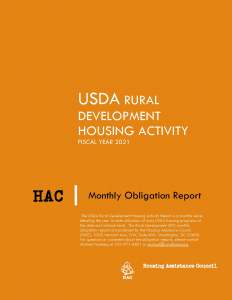
USDA Rural Development Obligations FY 21 – August

USDA Rural Development Obligations Report Cover - FY 2021

The Housing Assistance Council (HAC) presents this month’s report on Fiscal Year 2021 USDA Rural Housing program obligations.

As of the end of August, USDA obligated 127,867 loans, loan guarantees, and grants totaling about $22 billion. This is $417 million above obligation levels from this time last year. At that time, there were 134,422 loans, loan guarantees, and grants obligated totaling $21.6 billion.

Federal agencies operated under a series of short-term continuing resolutions (CR) for most of the first quarter of FY 2021. A final CR was signed into law on December 27, 2020 which provides funding for the remainder of the fiscal year. Since March 20, 2020, USDA offices have been operating from remote locations due to the COVID-19 virus.

Single Family Housing Program Highlights

The Section 502 Guaranteed loan program, the largest of the Single Family Housing programs, obligated $20.9 billion (117,579 loan guarantees) up from this time last year’s nearly $20.3 billion (121,671 loan guarantees).

For the Section 502 Direct program, loan obligations totaled $935 million (5,004 loans), a bit less than last year’s obligation level of $990 million (5,738 loans.) About 37 percent of the loan dollars went to Very Low-income (VLI) applicants. VLI loans represented nearly 44 percent of the total number of Section 502 Direct loans.

The Section 504 Repair and Rehabilitation programs obligated 1,961 loans representing $12.4 million. Loan volume was below this time last year (2,376 loans representing $14.4 million.) There were also about $21 million (3,189 grants) obligated in the Section 504 grant program compared to $27.7 million (4,248 grants) last year.

USDA’s Section 523 Self Help Housing Grant program funded 36 grants and contracts totaling over $24.9 million compared to last year’s 35 grants and contracts totaling $29.3 million.

Multi-Family Housing Program Highlights

USDA’s Section 538 Multifamily Housing program obligated 64 loan guarantees totaling $153.8 million compared to last year’s 136 loan guarantees ($216.9 million.) One Section 515 Rural Rental Housing loan has been funded so far this year compared to 29 loans representing $31.7 million last year. In the MPR program, no loans or grants have been obligated so far this year. Last year, there were 38 loans and 5 grants obligated representing $44 million and $251,778 respectively last year.

Two Farm Labor Housing loans totaling $3.1 million, and no grants have been obligated so far this year. Last year at this time, 14 loans and 6 grants were obligated ($19.8 million and $6.2 million, respectively.)

USDA obligated funds for 197,018 rental assistance units under the Section 521 Rental Assistance program totaling over $1.1 billion. This compares to about 186,940 units (almost $1.1 billion) obligated same time last year. There were also 6,671 Rural Housing Vouchers totaling $32 million compared to 6,693 vouchers representing $30.9 million this time last year.

Download the combined document.

* The Rural Housing Service (RHS) monthly obligation reports are produced by the Housing Assistance Council (HAC) 1025 Vermont Ave., NW, Suite 606, Washington, DC 20005. The monthly figures derive from HAC tabulations of USDA –RHS 205c, d, and f report data. For questions or comments about the obligation reports, please contact Michael Feinberg at 202-842-8600 or michael@ruralhome.org.

HAC News: September 2, 2021

Vol. 50, No. 18

TOP STORIES

Supreme Court invalidates eviction moratorium.

The Centers for Disease Control did not have sufficient authority to issue its August 3 eviction moratorium, the Supreme Court ruled on August 26. The court held that the administration cannot impose another moratorium on tenant evictions unless Congress specifically authorizes it. HAC expressed concern about the decision’s impact on rural residents, given that the pandemic and the unprecedented job loss it caused have exacerbated longstanding rural housing challenges. Some state and local eviction limitations remain in place. Resources for tenants, landlords, and homeowners are collected on HAC’s site.

Agencies take steps to assist renters.

Federal agencies have instituted new flexibilities and issued reminders to help tenants who have fallen behind on rent and utilities payments.

  • USDA will work with its multifamily property owners to mitigate evictions. USDA also announced permission for owners to access reserves for operating shortfalls while waiting to receive Emergency Rental Assistance, financial incentives to property management agents that tap ERA to clear arrearages, and increased support from USDA field staff.
  • The Treasury Department issued revised FAQs and an announcement about policy changes intended to help state and local governments and their partners to distribute Emergency Rental Assistance funds.
  • “Shallow Subsidy” rental assistance funds for veteran households are now available nationwide from VA’s Supportive Services for Veteran Families program.
  • HUD Secretary Marcia Fudge, Treasury Secretary Janet Yellen, and Attorney General Merrick Garland encouraged states and localities to act, including imposing eviction moratoriums and connecting eviction proceedings to rent aid applications.

Administration efforts to provide more affordable housing announced.

On September 1, the Biden administration announced a series of actions it intends to take to increase the supply of affordable homes for renters and owners. The provisions include raising the caps on Fannie Mae’s and Freddie Mac’s Low Income Housing Tax Credit investments and requiring a larger portion of those LIHTC investments be targeted to rural places; increasing financing for CDFIs; emphasizing sale of foreclosed single-family homes to families and nonprofits; and increasing state housing finance agencies’ ability to finance affordable rental housing by restarting the Federal Financing Bank’s support of FHA’s Risk-Sharing Program. The administration also asked state and local governments to remove regulatory barriers.

Budget resolution and infrastructure bill move in House.

The House passed the $3.5 trillion budget resolution on August 24. Next, committees in both the House and the Senate will draft legislative language, including specific amounts for specific programs. The House also moved forward on the bipartisan infrastructure bill, scheduling a vote for September 27. Annual appropriations bills for FY22, which begins on October 1, 2021, have not advanced; Congress will need to adopt a continuing resolution to keep the government functioning beyond September.

Save the date! 2021 National Rural Housing Conference scheduled.

HAC is pleased to announce plans to convene its 2021 National Rural Housing Conference and Training! The conference provides an excellent opportunity to network and improve connections to federal agencies, national intermediary organizations, and other stakeholders. The HAC News will announce when registration opens.

Nominate individuals or organizations for rural housing awards.

As part of the 2021 National Rural Housing Conference, HAC will recognize individuals and/or organizations that have, through their continued work and or newly established initiatives, made a positive and lasting impact in rural America. HAC invites nominations by September 17 of those who have made outstanding and enduring contribution to affordable housing in rural America. This year, HAC will consider each nomination on its own merits, relative to the specified contributions. More details and a list of potential categories are posted on HAC’s site. For more information, contact Miguel Guevara, HAC.

RuralSTAT

Between August 1 and August 31, communities outside of metropolitan areas reported nearly 700,000 new cases of COVID-19 – a 291% increase over the previous 30-day period. Source: HAC tabulations of public health data from the New York Times. A Rural Research Note updating the COVID-19 situation in rural America is available on HAC’s site.


OPPORTUNITIES

HUD offers funds for Native American housing.

  • The Indian Housing Block Grant competitive program helps tribes and Tribally Designated Housing Entities maintain, develop, and operate affordable housing. The deadline is December 1. For more information, contact HUD staff.
  • The Indian Community Development Block Grant program will finance tribes to develop community facilities, carry out public works projects, and provide economic development assistance. Apply by October 25. For more information, contact HUD staff.
  • HUD will accept applications for ICDBG funds appropriated by the American Rescue Plan Act in accordance with HUD Notice PIH-2021-22. For more information, contact HUD staff.

Webinar planned on rural community engagement.

CIRD: Models and Practices for Meaningful Community Engagement, scheduled for September 15, will ask what meaningful community engagement work looks like for rural communities. The webinar, sponsored by the Citizens’ Institute for Rural Design, will give participants a chance to share engagement strategies and learn new ways to strengthen community engaged design work. It will also cover engagement in the context of COVID-19 and building greater inclusivity with community members whose identities differ from our own.

HAC seeks Community Facilities Housing Specialist.

The Community Facilities Housing Specialist identifies and engages community stakeholders and provides direct technical assistance to rural organizations that are developing facilities such as parks, community centers, public libraries and childcare centers. This includes helping them identify, utilize, and apply for financial resources such as USDA Community Facilities grants and loans. This is a two-year position and is eligible for telecommuting.

REGULATIONS AND FEDERAL AGENCIES

“Public charge” comments sought.

U.S. Citizenship and Immigration Services is revising the regulation that bars immigrants considered likely to become “public charges” because of their use of government assistance. Comments are due October 22. USCIS will hold virtual listening sessions on September 14 (for the general public) and October 5 (for state, local, and tribal governments and nonprofits). For more information, contact Andrew Parker, USCIS, 240-721-3000.

Reimbursement for non-congregate shelters extended.

FEMA will provide 100% reimbursement for some emergency measures taken through December 31, 2021 by state, local, and tribal governments and nonprofits to protect against immediate threats to life, public health, or property. During the coronavirus disaster, this category includes non-congregate sheltering of people experiencing homelessness.

Input requested on federal homelessness plan.

The U.S. Interagency Council on Homelessness seeks public comments as it creates a new Federal Strategic Plan to Prevent and End Homelessness. USICH invites feedback from anyone, particularly people who have experienced or are currently experiencing homelessness; people who serve the LGBT, BIPOC, or veteran communities; and people whose work involves the justice system.

HAC agrees with HUD fair housing rule.

HAC has submitted a comment letter supporting HUD’s proposed cancellation of a fair housing regulation issued by the Trump administration in September 2020. This rule governs fair housing violation claims based on policies or actions with “disparate impacts” on categories of people protected by the Fair Housing Act.

PUBLICATIONS AND MEDIA

HAC offers information for survivors of Hurricane Ida and TN floods.

Disaster guides for areas hit by Hurricane Ida and for places in middle Tennessee that flooded on August 21 are posted on HAC’s website.

CDBG-CV Rural Economic Development Quick Guide published.

A new guide from HUD is intended to help states and rural places use Community Development Block Grant CARES Act (CDBG-CV) funding to support the local economic development infrastructure needed for pandemic recovery. The guide covers the economic development needs of rural communities, best practices, and duplication of benefits.

Housing helps Navajo Nation deal with pandemic.

For Navajo, Crowded Homes Have Always Been a Lifeline. The Pandemic Threatens That, an interactive video published by the Washington Post, illustrates both pre-pandemic housing inadequacies on the Navajo Nation and the cultural importance of multi-generational living. About 300 tiny homes have been built near existing residences to allow family members to isolate as necessary.

As federal pandemic relief ends, rural food insecurity is expected to rise.

The Daily Yonder reports in Experts: Food Insecurity in Rural Areas Likely to Increase in Months to Come that as federal benefits such as unemployment assistance expire in September, food insecurity will probably increase. Previous studies have indicated that rural areas have higher rates of food insecurity than the rest of the country.

Rural news providers try to bridge the information divide.

Nieman Reports provides an overview of six rural-based news outlets, including the Daily Yonder, Southerly, the News Reporter, High Country News, Ohio Valley ReSource, and Mountain State Spotlight. These outlets aim to provide culturally competent news that is important to local audiences.

Need capital for your affordable housing project?

HAC’s loan fund provides low interest rate loans to support single- and multifamily affordable housing projects for low-income rural residents throughout the U.S. and territories. Capital is available for all types of affordable and mixed-income housing projects, including preservation, new development, farmworker, senior and veteran housing. HAC loan funds can be used for pre-development, site acquisition, site development, construction/rehabilitation and permanent financing. Contact HAC’s loan fund staff at hacloanfund@ruralhome.org, 202-842-8600.

Please note: HAC is not able to offer loans to individuals or families. Borrowers must be nonprofit or for-profit organizations or government entities (including tribes).
Hurricane Ida Information

Hurricane Ida made landfall in Louisiana, as a Category 4 storm in the early morning of August 29, 2021. More than 1 million customers are experiencing power outages. Ida was downgraded to a tropical storm as it moved northeast, but it has caused major flooding in New York and New Jersey, where the governors have declared emergencies. Central Park received a record breaking three inches of water in one hour. HAC offers the following guide as a source of information for individuals and families dealing with direct housing loss and damage from the storm. For more information, please see HAC’s report: Picking up the Pieces: Restoring Rural Housing and Communities After a Disaster and Disaster Response for Rural Communities Guide.

If your house is inaccessible or currently uninhabitable, emergency, transient housing will likely be made available to provide immediate shelter for those in need. Organizations and resources available to assist with emergency transient housing in previous similar disasters include the Red Cross, Salvation Army, Church World Service, Mennonite Disaster Service, and state- and city-run emergency shelters aimed at housing victims of Hurricane. If you are in need of emergency, transient housing, you can text SHELTER and your Zip Code to 43362 (4FEMA) to find where the shelter closest to you is located.

FEMA makes available temporary assistance funding available for residents of counties affected by hurricanes. Temporary assistance can include grants for temporary housing and home repairs, low-cost loans to cover uninsured property losses, and other programs to help individuals and business owners recover from the effects of the disaster. To see if you are eligible for funding, you can apply online at https://www.disasterassistance.gov/ or call FEMA’s toll-free helpline at 1-800-621-FEMA(3362). When applying, make sure to have a pen and paper as well as the following information: your social security number, current and pre-disaster address, a telephone number where you can be contacted, insurance information, total household income, a routing and account number from your bank if you are interested in having disaster assistance funds transferred directly into your bank account, and a description of your losses that were caused by the disaster.

Tips

Please keep in mind the following safety protocols for hurricanes and flooding:

  • Only call 911 if you have an immediate need for medical attention or evacuation assistance.
  • If you can’t get through to 911 on first try, keep calling.
  • DO NOT DRIVE through high water and DO NOT DRIVE AROUND BARRICADES! Just 2 feet of water can sweep your vehicle away.
  • DO NOT WALK through flood waters. Just 6 inches of moving water can knock you down. 4
  • If your home floods, STAY THERE. You are safer at home than trying to navigate flooded streets on foot.
  • If floodwaters rise around your car but the water is NOT MOVING, abandon the car and move to higher ground. Do not leave the car and enter MOVING water.
  • STAY AWAY from streams, rivers, and creeks during heavy rainfall. These areas can flood quickly and with little warning.
  • MOVE important items – especially important documents like insurance policies – to the highest possible floor. This will help protect them from flood damage.
  • DISCONNECT electrical appliances and do not touch electrical equipment if you are wet or standing in water. You could be electrocuted.

This flooding event is a reminder that all residents in this area should carry flood insurance. Contact your insurance agent for more information about purchasing flood insurance or visit the National Flood Insurance Program at www.fema.gov/national-flood-insurance-program or call 1-888-379-9531. Please keep in mind that new insurance policies take 30 days to go into effect.

If your home has experienced damage, remember to check the outside of your home before you enter. Look for loose power lines, broken or damaged gas lines, foundations cracks, missing support beams, or other damage. It may be safest to ask a building inspector of contractor to check the structure before you enter. Do not force jammed doors open, as they may be providing needed support to the rest of the home. Sniff for gas to ensure there are no natural or propane gas leaks. If you do have a propane tank system, make sure to turn off all valves and contact a propane supplier to check the system before you use it again. Check floors and ceilings to ensure they are not sagging from water damage. This can be especially hazardous. Take photographs of any damage as you may need them for insurance claims or FEMA claims later on.

Resources

Apply for FEMA Assistance by registering online at www.DisasterAssistance.gov. FEMA Disaster Assistance Helpline answers questions about the help offered by FEMA, how to apply for assistance, or the information in your account.

Toll-free helpline: 1-800-621-FEMA (3362)
For hearing impaired callers only:
1-800-462-7585 (TTY)
1-800-621-3362 (Video Relay Service)
Operators are multilingual and calls are answered seven days a week from 7 a.m. to 11 p.m. ET

American Red Cross Disaster Service: For referrals and updates on Red Cross shelter services in your area, locate a local Red Cross office through: https://www.redcross.org/find-help or by calling 1-800-RED CROSS (1-800-733-2767)
The Red Cross helps disaster victims by providing safe shelter, hot meals, essential relief supplies, emotional support and health services like first aid. Trained Red Cross workers often meet one-on-one with families to develop individual plans and identify available resources to help aid recovery.

STATE HOUSING AGENCIES

Louisiana
Louisiana Housing Corporation
2415 Quail Drive
Baton Rouge, LA 70808
Phone: (225) 763-8700
Fax: (225) 763-8710
https://www.lhc.la.gov

Mississippi
Mississippi Home Corporation
735 Riverside Drive
Jackson, MS 39202-1166
Phone: (601) 718-4642
Fax: (601) 718-4643
https://www.mshomecorp.com

New Jersey
New Jersey Housing and Mortgage Finance Agency
637 S Clinton Avenue
Trenton, NJ 08611-1811
Phone: (609) 278-7400
Fax: (609) 278-1754
https://www.njhousing.gov

New York
New York State Homes and Community Renewal
641 Lexington Avenue, 5th Floor
New York, NY 10022-4503
Phone: (212) 688-4000
Fax: (212) 872-0789
http://www.nyshcr.org

DEPARTMENT OF HOUSING AND URBAN DEVELOPMENT STATE FIELD OFFICES

Louisiana
Hale Boggs Federal Building
500 Poydras Street
9th Floor
New Orleans, LA 70130
Phone: (504) 671-3001
Director: Tammy Fowler

Mississippi
Dr. A. H. McCoy Federal Building
100 West Capitol Street
Room 910
Jackson, MS 39269-1096
Phone: (601) 965-4757
Director: Jerrie G. Magruder

New Jersey
Newark Field Office
One Newark Center
1085 Raymond Boulevard
13th Floor
Newark, NJ 07102-5260
Phone: (973) 622-7900
Director: Justin Sheid

New York
Jacob K. Javits Federal Building
26 Federal Plaza
Suite 3541
New York, NY 10278-0068
Phone: (212) 264-8000
Director: Vacant

USDA RURAL DEVELOPMENT STATE OFFICES

Louisiana
Diana Smith, Acting State Director
3727 Government Street
Alexandria, LA 71302
Voice: (318) 473-7920
Fax: (844) 325-6949
www.rd.usda.gov/la

Mississippi
Douglas Simons, Acting State Director
Federal Building, Suite 831
100 West Capitol Street
Jackson, MS 39269
Voice: (601) 965-4316
Fax: (601) 965-4088
www.rd.usda.gov/ms

New Jersey
Brandon R. Pfeilmeier, Acting State Director
521 Fellowship Road, Suite 130
Mt. Laurel, NJ 08054
Voice: (856) 787-7700
Fax: (855) 305-7343
www.rd.usda.gov/nj

New York
Brian Murray, Acting State Director
The Galleries of Syracuse
441 South Salina Street, Suite 357
Syracuse, NY 13202-2541
Voice: (315) 477-6400
Fax: (315) 477-6438
www.rd.usda.gov/ny

STATE EMERGENCY MANAGEMENT AGENCIES

Mississippi Emergency Management Agency
Voice 601-933-MEMA
24 hour emergency line: 1-800-222-MEMA(6362)
https://www.msema.org/

Louisiana Governor’s Office of Homeland Security and Emergency Management
7667 Independence Boulevard
Baton Rouge, LA 70806
Voice: (225) 925-7500
Fax: (225) 925-7501
http://gohsep.la.gov/

New Jersey Office of Emergency Management
http://www.ready.nj.gov/

New York Homeland Security and  Emergency Services
http://www.dhses.ny.gov/oem/

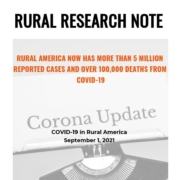
Rural America Now Has More Than 5 Million Reported Cases and Over 100,000 Deaths from Covid-19

COVID-19 in Rural America – September 1, 2021

As of August 31, there have been more than 5.6 million reported cases of COVID-19, and approximately 101,741 associated deaths in communities outside metropolitan areas. Between August 1 and August 31, communities outside of metropolitan areas reported nearly 700,000 new cases of COVID-19 – a 291 percent increase over the previous 30-day period. There were 5,122 reported deaths associated with COVID-19 in rural communities in August, which represented a 254 percent increase in deaths from July 2021. Communities outside of metropolitan areas accounted for over 19 percent of all COVID deaths and 16 percent of new cases in August. The dramatic increase in rural cases and deaths mimics national trends related to the ascendancy of the more contagious delta variant.

Middle Tennessee Flooding Disaster Guide

On August 21, 2021, record-breaking rain (17 inches in 24 hours) caused major flooding in Middle Tennessee and at least 22 fatalities in Humphreys County. Roads, telephone lines, cars, and home foundations were washed away. HAC offers the following guide as a source of information for individuals and families dealing with direct housing loss and damage from the storm. For more information, please see HAC’s report: Picking up the Pieces: Restoring Rural Housing and Communities After a Disaster and Disaster Response for Rural Communities Guide.

If your house is inaccessible or currently uninhabitable, emergency, transient housing will likely be made available to provide immediate shelter for those in need. Organizations and resources available to assist with emergency transient housing in previous similar disasters include the Red Cross, Salvation Army, Church World Service, Mennonite Disaster Service, and state- and city-run emergency shelters. If you are in need of emergency, transient housing, you can text SHELTER and your Zip Code to 43362 (4FEMA) to find where the shelter closest to you is located.

FEMA makes available temporary assistance funding available for residents of counties affected by natural disasters. Temporary assistance can include grants for temporary housing and home repairs, low-cost loans to cover uninsured property losses, and other programs to help individuals and business owners recover from the effects of the disaster. To see if you are eligible for funding, you can apply online at https://www.disasterassistance.gov/ or call FEMA’s toll-free helpline at 1-800-621-FEMA(3362). When applying, make sure to have a pen and paper as well as the following information: your social security number, current and pre-disaster address, a telephone number where you can be contacted, insurance information, total household income, a routing and account number from your bank if you are interested in having disaster assistance funds transferred directly into your bank account, and a description of your losses that were caused by the disaster.

Tips

Please keep in mind the following safety protocols for flooding:

  • Only call 911 if you have an immediate need for medical attention or evacuation assistance.
  • If you can’t get through to 911 on first try, keep calling.
  • DO NOT DRIVE through high water and DO NOT DRIVE AROUND BARRICADES! Just 2 feet of water can sweep your vehicle away.
  • DO NOT WALK through flood waters. Just 6 inches of moving water can knock you down. 4
  • If your home floods, STAY THERE. You are safer at home than trying to navigate flooded streets on foot.
  • If floodwaters rise around your car but the water is NOT MOVING, abandon the car and move to higher ground. Do not leave the car and enter MOVING water.
  • STAY AWAY from streams, rivers, and creeks during heavy rainfall. These areas can flood quickly and with little warning.
  • MOVE important items – especially important documents like insurance policies – to the highest possible floor. This will help protect them from flood damage.
  • DISCONNECT electrical appliances and do not touch electrical equipment if you are wet or standing in water. You could be electrocuted.

This flooding event is a reminder that all residents in this area should carry flood insurance. Contact your insurance agent for more information about purchasing flood insurance or visit the National Flood Insurance Program at www.fema.gov/national-flood-insurance-program or call 1-888-379-9531. Please keep in mind that new insurance policies take 30 days to go into effect.

If your home has experienced damage, remember to check the outside of your home before you enter. Look for loose power lines, broken or damaged gas lines, foundations cracks, missing support beams, or other damage. It may be safest to ask a building inspector of contractor to check the structure before you enter. Do not force jammed doors open, as they may be providing needed support to the rest of the home. Sniff for gas to ensure there are no natural or propane gas leaks. If you do have a propane tank system, make sure to turn off all valves and contact a propane supplier to check the system before you use it again. Check floors and ceilings to ensure they are not sagging from water damage. This can be especially hazardous. Take photographs of any damage as you may need them for insurance claims or FEMA claims later on.

Resources

Apply for FEMA Assistance by registering online at www.DisasterAssistance.gov. FEMA Disaster Assistance Helpline answers questions about the help offered by FEMA, how to apply for assistance, or the information in your account.

Toll-free helpline: 1-800-621-FEMA (3362)
For hearing impaired callers only:
1-800-462-7585 (TTY)
1-800-621-3362 (Video Relay Service)
Operators are multilingual and calls are answered seven days a week from 7 a.m. to 11 p.m. ET

American Red Cross Disaster Service: For referrals and updates on Red Cross shelter services in your area, locate a local Red Cross office through: https://www.redcross.org/find-help or by calling 1-800-RED CROSS (1-800-733-2767)
The Red Cross helps disaster victims by providing safe shelter, hot meals, essential relief supplies, emotional support and health services like first aid. Trained Red Cross workers often meet one-on-one with families to develop individual plans and identify available resources to help aid recovery.

STATE HOUSING AGENCIES

Tennessee
Tennessee Housing Development Agency
502 Deaderick Street, Third Floor
Nashville, TN 37243
Phone: (615) 815-2200
Fax: (615) 564-2700
https://www.thda.org

DEPARTMENT OF HOUSING AND URBAN DEVELOPMENT STATE FIELD OFFICES

Tennessee
John J. Duncan Federal Building
710 Locust Street, SW 3rd Floor
Knoxville, TN 37902-2526
Phone: (865) 545-4370

Nashville Field Office
235 Cumberland Bend
Suite 200
Nashville, TN 37228-1803
Phone: (615) 515-8510
Director: Sernorma L. Mitchell

USDA RURAL DEVELOPMENT STATE OFFICES

Tennessee
Jim Tracy, State Director
441 Donelson Pike, Suite 310
Nashville, TN  37214
Voice: (615) 783-1300
Fax: (855) 776-7057
www.rd.usda.gov/tn

STATE EMERGENCY MANAGEMENT AGENCIES

Region 4 (Mississippi and Tennessee)
Federal Emergency Management Agency
3003 Chamblee Tucker Road
Atlanta, GA 30341
Main Number: 770-220-5200
Fax Number: 770-220-5230


HAC News: August 19, 2021

Vol. 50, No. 17

TOP STORIES

Senate passes budget resolution and infrastructure bill.

On August 11, the Senate narrowly approved S.Con.Res. 14, the budget resolution that will serve as a vehicle for the $3.5 trillion economic recovery package. The resolution includes billions of dollars for housing programs, although details are not yet available. The bipartisan infrastructure bill, H.R. 3684, passed the Senate on August 10. The House is scheduled to return on August 23 to take up one or both of these measures, as well as a voting rights bill.

New eviction moratorium challenged in court.

A legal challenge to the moratorium issued August 3 by the Centers for Disease Control was filed by the Alabama and Georgia Associations of Realtors®, the plaintiffs that took a previous challenge to the U.S. Supreme Court. On August 13, the federal district court declined to halt implementation of the moratorium. The plaintiffs have appealed that decision. In a separate case, on August 12 the Supreme Court struck down a part of New York state’s eviction moratorium that protected tenants from eviction if they certified they were experiencing economic hardship, but did not provide a way for landlords to challenge those self-certifications.

Population growth in rural America was small – and uneven – between 2010 and 2020.

Using Census 2010 and 2020 data, combined with methodology from HAC’s Rural and Small-Town definition of location, HAC estimates that the rural population increased by approximately 164,000 residents over the last decade, a 0.3% growth rate. Overall, HAC estimates that approximately 60,551,165 people live in rural communities using the latest Census data. A HAC Rural Research Note analyzes recently released 2020 Census data and includes an interactive map showing population change for every county.

Committee sends Torres Small nomination to the full Senate.

After a July 29 hearing, on August 10 the Senate Agriculture Committee voted to approve the nomination of Xochitl Torres Small to become USDA Under Secretary for Rural Development. A vote by the full Senate is now the final step needed for her confirmation.

Save the date! 2021 National Rural Housing Conference scheduled.

The Housing Assistance Council is pleased to announce plans to convene its 2021 National Rural Housing Conference and Training! The conference provides an excellent opportunity to network and improve connections to federal agencies, national intermediary organizations, and other stakeholders. The HAC News will announce when registration opens.

RuralSTAT

Rural and small-town places in the U.S. experienced only 0.3% population growth from 2010 to 2020, while suburbs and exurbs grew by 11.8%. Source: HAC tabulations of the U.S. Census Bureau’s 2010 and 2020 Census of Population and Housing. A Rural Research Note on population growth over the past decade is available on HAC’s site.

OPPORTUNITIES

Emergency Rural Health Care Program offers grants.

Sub-state level governments, nonprofits, and tribes can apply to assist places with up to 20,000 population through the new Emergency Rural Health Care program. Track One will make recovery grants to support immediate financial relief needs. Track Two will provide impact grants to advance ideas and solutions to support the long-term sustainability of rural health care. The deadline for both is October 12. For more information, contact Jamie Davenport, USDA, 202-720-0002.

HAC seeks Community Facilities Housing Specialist.

The Community Facilities Housing Specialist identifies and engages community stakeholders and provides direct technical assistance to rural organizations that are developing facilities such as parks, community centers, public libraries and childcare centers. This includes helping them identify, utilize, and apply for financial resources such as USDA Community Facilities grants and loans. This is a two-year position and is eligible for telecommuting.

CORONAVIRUS

Online tool helps tenants use CDC eviction moratorium.

A2J Tech, which describes itself as a social enterprise that builds technology to improve access to justice, offers a free tool for renters to make sure they are eligible for protection under the CDC moratorium and then prepare the declaration they must give to their landlord.

REGULATIONS AND FEDERAL AGENCIES

HUD and FHFA to work together on fair housing and fair lending.

On August 12, HUD and the Federal Housing Finance Agency announced a new memorandum of understanding regarding fair housing and fair lending enforcement. The agencies say the MOU promotes information sharing, coordination on investigations, compliance reviews, and the ongoing monitoring of the Fannie Mae, Freddie Mac, and the Federal Home Loan Banks.

Housing goals proposed for Fannie Mae and Freddie Mac.

The Federal Housing Finance Agency has proposed goals for Fannie Mae’s and Freddie Mac’s purchases of mortgages for low-income and minority owners and renters in 2022-2024. Comments will be due 60 days after the goals are published in the Federal Register. For more information, contact Ted Wartell, FHFA, 202-649-3157.

Fannie Mae will consider rental payments by homebuyers.

Lenders that work with Fannie Mae will be permitted to take positive rental payment histories into account when underwriting first-time mortgage applications. Fannie Mae predicts that allowing homebuyers to demonstrate their credit history this way will enable more people of color to qualify for mortgages.

2021 compliance supplement for audits released.

The 2021 Compliance Supplement to OMB’s Uniform Administrative Requirements, Cost Principles, and Audit Requirements applies to audits of fiscal years beginning after June 30, 2020 for nonprofits, state and local governments and tribes receiving federal funds. Comments are due August 30. For more information, contact the relevant federal agency.

OMB recommends steps for federal agencies to advance racial equity.

Study to Identify Methods to Assess Equity: Report to the President, published by the Office of Management and Budget, responds to a provision in President Biden’s Executive Order 13985, Advancing Racial Equity and Support for Underserved Communities Through the Federal Government, which requested recommendations on ways to expand equity assessment in federal agencies. OMB found that equity assessment is still evolving, though a broad range of frameworks and tools have been developed. It suggested expanding opportunities for meaningful stakeholder engagement and instituting long-term change management. Agencies will need to include equity initiatives in their strategic, administrative, budget, and evaluation plans, the report says, and to make key investments in hiring and ongoing workforce training.

PUBLICATIONS AND MEDIA

Case studies describe hotel/motel conversions to housing.

During the pandemic, numerous states and localities have acquired hotels and motels and rapidly converted them into permanent housing. A set of case studies by the Alliance to End Homelessness describes several such efforts, including statewide programs in Oregon and Vermont that conducted conversions in rural areas as well as cities.

CFPB reports on mortgage servicers’ pandemic responses, will continue monitoring them.

Based on a data review, the Consumer Financial Protection Bureau reported the pandemic responses of 16 large mortgage servicers varied widely. CFPB told servicers to compare the report’s findings to their own internal metrics to identify opportunities for, and demonstrate concrete efforts toward, improvement.

Rural places may lose political power due to population changes.

A Pew Charitable Trusts analysis based on estimates of rural population decline predicts these communities will have less political clout once electoral redistricting occurs. The growing suburban/urban portions of states are likely to gain power.

86% of persistent poverty counties are outside metro areas.

USDA’s Economic Research Service reports 310 counties – 10% of all U.S. counties – had high and persistent levels of poverty in 2019. Of those, 267 counties were outside metropolitan areas and were concentrated in historically poor areas of the Mississippi Delta, Appalachia, the Black Belt, and the southern border regions, as well as on Native American lands.

Hispanics overrepresented in worker deaths from heat.

A National Public Radio report, Heat Is Killing Workers in the U.S. – and There are No Federal Rules to Protect Them, describes an increase in worker deaths due to environmental heat exposure. Hispanics, who are 17% of the U.S. workforce, account for a third of heat fatalities since 2010 because they are overrepresented in vulnerable jobs such as farm work and construction. Improved regulations may not be enough to protect workers, however; California is one of the few states with heat rules, but annual worker heat deaths there have remained steady over the past decade.

Guide addresses tenant issues in tax credit properties.

An Advocate’s Guide to Tenants’ Rights in the Low-Income Housing Tax Credit Program, published by the National Housing Law Project, covers evictions, rent calculations, and eligibility.

Need capital for your affordable housing project?

HAC’s loan fund provides low interest rate loans to support single- and multifamily affordable housing projects for low-income rural residents throughout the U.S. and territories. Capital is available for all types of affordable and mixed-income housing projects, including preservation, new development, farmworker, senior and veteran housing. HAC loan funds can be used for pre-development, site acquisition, site development, construction/rehabilitation and permanent financing. Contact HAC’s loan fund staff at hacloanfund@ruralhome.org, 202-842-8600.

Please note: HAC is not able to offer loans to individuals or families. Borrowers must be nonprofit or for-profit organizations or government entities (including tribes).

Population Growth in Rural America was Small – and Uneven – Between 2010 and 2020

A Census in Rural America 2020 Update

Using Census 2010 and 2020 data, combined with methodology from the Housing Assistance Council’s Rural and Small-Town definition of location, HAC estimates that the rural population only increased by approximately 164,000 residents over the last decade. This population growth accounted for a .3 percent increase in the rural and small-town population. Overall, HAC estimates that approximately 60,551,165 people live in rural communities using the latest Census data.

HAC News: August 5, 2021

Vol. 50, No. 16

TOP STORIES

Eviction moratorium for renters expires, new limited moratorium issued.

The federal moratorium on eviction of tenants facing pandemic-related economic issues, which had been in place since the Centers for Disease Control imposed it in September 2020, expired on July 31. On August 3, CDC issued a new moratorium that applies through October 3 in “U.S. counties experiencing substantial and high levels of community transmission” of the coronavirus, currently a large portion of the country. While this version is in effect, individual counties’ eligibility will change based on data tracked by the CDC, which categorizes the transmission rate in each county as high, substantial, moderate, or low. Resources for renters needing assistance to pay rent or utilities are compiled in many places online, including on HAC’s website.

Eviction moratoriums for defaulting homeowners extended to September 30.

Homeowners who have defaulted on federally backed mortgages are protected against evictions by moratoriums extended through September 30 by USDA for Section 502 direct borrowers and Section 502 guaranteed borrowers, VA, the Federal Housing Administration, and the Federal Housing Finance Administration (which oversees Fannie Mae and Freddie Mac). These agencies did not, however, extend their moratoriums on foreclosure: those expired on July 31. The extended eviction moratoriums are intended to give foreclosed homeowners enough time to find financial assistance or to move. Information about mortgage forbearance (delayed payments) and other options for homeowners is available from the Consumer Financial Protection Bureau, and each agency offers aid to its homeowners.

Save the date! 2021 National Rural Housing Conference scheduled.

The Housing Assistance Council is pleased to announce plans to convene its 2021 National Rural Housing Conference and Training! The conference provides an excellent opportunity to network and improve connections to federal agencies, national intermediary organizations, and other vested stakeholders. The HAC News will announce when registration opens.

Senate committee approves USDA funding bill, House passes USDA and HUD bills.

On August 4 the Senate Appropriations Committee approved a fiscal year 2022 funding bill for USDA. Details are posted on HAC’s site. Like the House bill, the Senate version would provide modest increases for some rural housing programs. It would take a different approach to rental housing preservation, increasing the Section 515 program from $40 million in FY21 to $92 million in FY22, while setting the Multifamily Preservation and Revitalization program at the $32 million figure requested in the administration’s budget. The House would keep Section 515 at $40 million and increase MPR to $60 million. The next step in the process will be full Senate consideration of the committee’s bill. The House passed H.R. 4502, a “minibus” package of seven appropriations bills, including USDA’s and HUD’s, on July 27.

Infrastructure deal moves forward without housing.

The bipartisan infrastructure bill under consideration in the Senate, H.R. 3684, does not provide any housing funding. It does include $2 billion for USDA’s rural broadband programs.

Confirmation hearing held for Torres Small.

The Senate Agriculture Committee held a hearing July 29 on the nominations of Xochitl Torres Small to be Under Secretary for Rural Development at USDA and Robert Bonnie to be Under Secretary for Farm Production and Conservation. The committee has not yet voted whether to send either nomination to the full Senate for consideration.

RuralSTAT

Between July 1 and July 31, communities outside of metropolitan areas reported 178,000 new cases of COVID-19 – a 171% increase over the previous 30-day period. Source: HAC tabulations of public health data from the New York Times. A Rural Research Brief updating the COVID-19 situation in rural America is available on HAC’s site.  

OPPORTUNITIES

USDA farm labor housing loans and grants available.

From September 1 to November 1, USDA will accept pre-applications for Section 514 loans and Section 516 grants for off-farm farmworker housing. The funding notice published on February 2 provides details. For more information, contact Abby Boggs, USDA, 615-490-1371.

HUD offers Healthy Homes Production grants.

Nonprofits and state, local, and tribal governments can apply by October 19 for the Healthy Homes Production Grant Program, which addresses housing-related hazards in a coordinated fashion, rather than a single hazard at a time. For more information, contact Yolanda Brown, HUD, 202-903-9576.

VA two-year rental assistance funds can be used nationwide.

The Supportive Services for Veteran Families program offers several kinds of aid, including rental assistance for low-income veterans who might otherwise be homeless. In a few high-cost counties (listed here, with additions listed here), grantees have been permitted to provide rental assistance for up to two years before recertification. Describing the lack of affordable housing as “a national crisis,” VA is now extending this two-year provision to all counties and county equivalents throughout the U.S. and territories, effective immediately. For more information, contact John Kuhn, VA, 202-632-8596.

Economic development funding offered.

The Commerce Department’s Economic Development Administration has opened several competitions, including one for Indigenous communities and one for coal communities, intended to assist economic recovery in previously underserved places impacted by the coronavirus pandemic. Application deadlines vary, with the earliest on October 19.

Green building webinar scheduled by HAC.

“Build Smart” Webinar Series Part 1: Green Building Case Studies, scheduled for August 12, will showcase several projects that are successfully implementing Green Building practices in their affordable housing developments and share their best practices for green building on a budget and constructing net zero energy homes for low-income buyers.

Investing in rural infrastructure webinar announced.

Investing in Infrastructure: Rural Strategies for Building and Maintaining Healthy Local Economies, scheduled for August 16, will explore why new federal funding presents a momentous opportunity to invest in rural physical infrastructure and how communities can effectively take advantage of this funding to build thriving rural places. This is the latest in the Rural Opportunity and Development (ROAD) Sessions, virtual exchanges co-designed and hosted by the Aspen Institute Community Strategies Group, HAC, the Rural Community Assistance Partnership, Rural LISC, and the Federal Reserve Board.

Broadband improvement campaign needs consumer input.

Let’s Broadband Together, a project of Consumer Reports and a coalition of other groups, invites people with internet access to contribute information for a campaign aimed at improving access quality and cost. The process, which CR estimates takes seven minutes, includes an online test of the consumer’s internet speed, sharing an internet bill, and answering a few questions.

HAC job openings: Portfolio Management Associate and Community Facilities Housing Specialist.

For details, visit HAC’s website.

  • The Portfolio Management Associate is an entry-level position and will assist in managing HAC’s portfolio of loans made to entities engaged in affordable housing activities in rural communities throughout the United States. This individual will assist in a range of lending activities – including closing, disbursement, monitoring, and servicing single- and multifamily housing development loans – in the Loan Fund Division.
  • The Community Facilities Housing Specialist identifies and engages community stakeholders and provides direct technical assistance to rural organizations that are developing facilities such as parks, community centers, public libraries and childcare centers. This includes helping them identify, utilize and apply for financial resources such as USDA Community Facilities grants and loans. This is a two-year position and is eligible for telecommuting.

CORONAVIRUS

COVID-19 infection rates have resurged in rural America.

COVID-19’s impact on rural America continues to evolve. After declining case rates and signs of optimism, infection rates have begun to increase again in rural communities with certain areas and regions experiencing distressing levels of new COVID-19 cases. HAC’s latest Rural Research Brief, COVID-19 in Rural America, July 31, 2021, examines the health, employment, and housing impacts over the entire course of the pandemic.

REGULATIONS AND FEDERAL AGENCIES

Heirs’ Property Relending Program nears launch.

USDA expects to open a two-month signup window in late August for Community Development Financial Institutions to apply for funds they will relend to agricultural producers and landowners facing heirs’ land ownership and succession issues. Heirs who inherited family land without a will or legal documentation of ownership may use the loans to resolve title issues by financing the purchase or consolidation of property interests and financing costs associated with a succession plan. Comments on the program’s final rule are due October 8. For more information, contact Md Mutaleb, Farm Service Agency, 202-720-3168.

HUD to release FY22 Fair Market Rents.

Fair Market Rents that take effect on October 1 will be available on August 6. Comments are due September 30.

PUBLICATIONS AND MEDIA

Rural U.S. economies will benefit from expanded Child Tax Credit, study concludes.

The effect of the one-year Child Tax Credit expansion will be proportionally greatest in places outside metropolitan areas, according to Measuring the Child Tax Credit’s Economic and Community Impact, a new report from the Niskanen Center. Researchers calculated the total dollar amounts the CTC expansion will generate and their impacts on household spending, state and local sales tax revenue, and jobs. Estimates are reported by state and congressional district.

Annual fair housing report shows increased harassment in 2020.

The National Fair Housing Alliance’s 2021 Fair Housing Trends Report provides an analysis of housing discrimination complaints filed last year at the local, state, and national levels. While the overall number of housing discrimination claims remained consistent in 2020, more than 1,000 harassment claims were reported, compared to 761 in 2019. Asian American and Pacific Islander communities reported a rise in harassment, and claims of sexual harassment also rose among tenants who were unable to pay their rent due to job loss or unemployment.

Lost rent means small landlords defer maintenance.

An Urban Institute analysis of May 2021 data found that 28% of “mom-and-pop” landlords deferred maintenance during the pandemic. Finances were the reason most commonly cited, and 41% of landlords who lost rental income deferred maintenance compared with 18% of those who did not lose rental income.

COVID-19 impact on farmers, farmworkers, and productivity estimated.

Researchers from Purdue University estimated the number of cases and deaths among farmers and farmworkers from March 1, 2020 to March 31, 2021 and concluded the pandemic reduced U.S. agricultural output by about $309 million over that period. Purdue’s Food and Agriculture Vulnerability Index Dashboard provides cumulative estimates, updated daily, for workers across every state and several commodities.

Data on Native American labor market available.

The Center for Indian Country Development at the Minneapolis Federal Reserve Bank has created a Native American Labor Market Dashboard to provide data on labor force participation, employment, and unemployment. The site allows users to compare American Indians and Alaska Natives to the entire U.S. population, and to compare residents of metropolitan areas with those outside metro areas.

Primer aims to help build healthy rural places.

The Build Healthy Places Network has published A Primer for Multi-Sector Health Partnerships in Rural Areas and Small Cities to provide guidance on cross-sector collaboration between the community development, finance, public health, and healthcare sectors.

Need capital for your affordable housing project?

HAC’s loan fund provides low interest rate loans to support single- and multifamily affordable housing projects for low-income rural residents throughout the U.S. and territories. Capital is available for all types of affordable and mixed-income housing projects, including preservation, new development, farmworker, senior and veteran housing. HAC loan funds can be used for pre-development, site acquisition, site development, construction/rehabilitation and permanent financing. Contact HAC’s loan fund staff at hacloanfund@ruralhome.org, 202-842-8600.

Please note: HAC is not able to offer loans to individuals or families. Borrowers must be nonprofit or for-profit organizations or government entities (including tribes).
USDA Rural Development Obligations FY 21 – July

USDA Rural Development Obligations Report Cover - FY 2021

The Housing Assistance Council (HAC) presents this month’s report on Fiscal Year 2021 USDA Rural Housing program obligations.

As of the end of July, USDA obligated 117,200 loans, loan guarantees, and grants totaling about $20.2 billion. This is nearly $3.9 billion more than obligation levels from this time last year. At that time, there were 103,122 loans, loan guarantees, and grants obligated totaling nearly $16.4 billion.

Federal agencies operated under a series of short-term continuing resolutions (CR) for most of the first quarter of FY 2021. A final CR was signed into law on December 27, 2020 which provides funding for the remainder of the fiscal year. Since March 20, 2020, USDA offices have been operating from remote locations due to the COVID-19 virus.

Single Family Housing Program Highlights

The Section 502 Guaranteed loan program, the largest of the Single Family Housing programs, obligated approximately $19.2 billion (108,193 loan guarantees) up from last year’s $15.3 billion ( 93,226 loan guarantees) this time.

For the Section 502 Direct program, loan obligations totaled $826.7 million (4,409 loans), a bit higher than last year’s obligation level of $742.2 million (4,310 loans.)

About 36 percent of the loan dollars went to Very Low-income (VLI) applicants. VLI loans represented over 42 percent of the total number of Section 502 Direct loans.

The Section 504 Repair and Rehabilitation programs obligated 1,700 loans representing almost $10.6 million. Loan volume was up from this time last year (1,912 loans representing about $11.6 million.) There were also about $18.3 million (2,784 grants) obligated in the Section 504 grant program compared to approximately $22.4 million (3,474 grants) last year.

USDA’s Section 523 Self Help Housing Grant program funded 30 grants and contracts totaling nearly $20.4 million compared to last year’s 19 grants and contracts totaling over $22.6 million.

Multi-Family Housing Program Highlights

USDA’s Section 538 Multifamily Housing program obligated 58 loan guarantees totaling almost $149.0 million compared to last year’s 96 loan guarantees ($156.7 million.) No Section 515 Rural Rental Housing program have been funded so far this year, similar to last year at this time. No loans or 5 grants have been obligated so far this year in the MPR program totaling $0 and $251,778 this year compared to 28 loans and 3 grants representing nearly $30.0 million and $988,734, respectively last year.

No Farm Labor Housing loans or grants have been funded so far this year. Last year at this time, 14 loans and 5 grants were obligated (about $19.8 million 794,577 and nearly $5.9 million, respectively.)

USDA obligated funds for 195,414 rental assistance units under the Section 521 Rental Assistance program totaling over $1.1 billion. This compares to about 178,225 units (over $1.0 billion) obligated same time last year. There were also 6,228 Rural Housing Vouchers totaling about $30.0 million compared to 5,700 vouchers representing over $26.4 million this time last year.

Download the combined document.

* The Rural Housing Service (RHS) monthly obligation reports are produced by the Housing Assistance Council (HAC) 1025 Vermont Ave., NW, Suite 606, Washington, DC 20005. The monthly figures derive from HAC tabulations of USDA –RHS 205c, d, and f report data. For questions or comments about the obligation reports, please contact Michael Feinberg at 202-842-8600 or michael@ruralhome.org.

GET THE HAC NEWS!

Sign-up for HAC information products

SIGN UP HERE

Housing Assistance Council   |  1828 L Street. N.W., Suite 505, Washington, D.C. 20036
(202) 842-8600 (202) 347-3441 hac@ruralhome.org |

Board Portal

HAC is an equal opportunity provider, employer, and lender. | Civil Rights | Privacy