Rural Unemployment Rate Declines, but 1.8 Million Rural Workers Still Unemployed


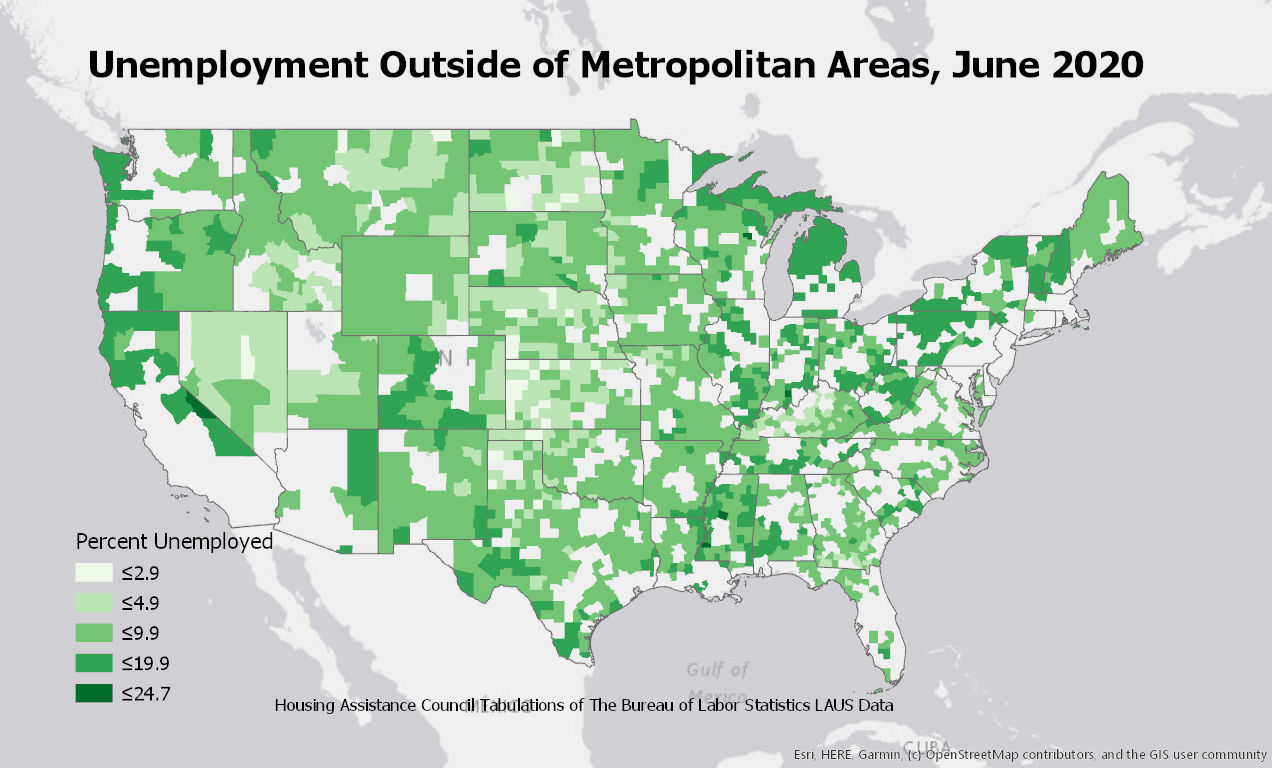
To access an interactive version of this map visit: https://arcg.is/Ov8bq 

The most recent data from the Bureau of Labor Statistics indicates that rural labor markets have rebounded somewhat from astronomical unemployment rates earlier this spring. Yet, over 1.8 million rural workers are still unemployed – many as a result of the economic fallout from the COVID-19 health crisis. The June jobs numbers revealed a seasonally unadjusted unemployment rate of 8.8 percent for counties outside of metropolitan areas, down from the revised rural unemployment rate for May of 11.3 percent. The number of rural jobless fell from 2.2 million in May to an estimated 1.8 million for the month of June. At its peak in April, the BLS estimated approximately 2.8 million rural jobless with an unemployment rate of 13.6 percent in rural America.

While the rebound in the number of rural workers to just over 19 million is a positive development, there are still substantial concerns in rural labor markets as the nation still grapples with the COVID 19 health crisis. The rural unemployment rate is still nearly double the rate for February 2020 prior to the COVID crisis. Furthermore, the June job numbers do not reflect potential economic backsliding from the dramatic rise in COVID 19 cases over the summer. In the month of July there were almost as many new reported rural cases of COVID-19 than had been reported for the prior 5 months in total.

POTENTIAL UNEMPLOYMENT RAMIFICATIONS FOR RURAL HOUSING

Jobs and employment conditions have traditionally been a bellwether and leading indicator for housing trends. While the unemployment caused by COVID-19 is unprecedented and unpredictable, the continued high jobless rates signal the potential for serious concerns across the housing spectrum. Many Americans have been buoyed by large scale federal unemployment benefits and economic stimulus which largely came to an abrupt end in August and has yet to be clearly reestablished. If rural unemployment rates continue at these elevated levels, the collateral impacts to almost all sectors of the housing market could be substantial – notably the ability of unemployed households to make rent and mortgage payments.

About the Data: Information for this Brief derives from HAC tabulations of data from the Bureau of Labor Statistics’ Local Area Unemployment Statistics (LAUS) reporting. https://www.bls.gov/lau/  In this Brief the terms “Outside Metropolitan Area” and “Rural” are used synonymously and refer to counties and population outside of the Office of Management and Budget (OMB) designated Metropolitan Areas. https://www.whitehouse.gov/wp-content/uploads/2018/09/Bulletin-18-04.pdf

Age and Aging in Rural America

Age and Aging in Rural America

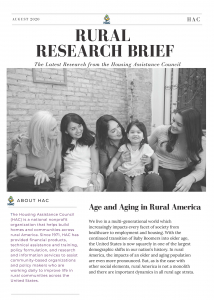
We live in a multi-generational world which increasingly impacts every facet of society from healthcare to employment and housing. With the continued transition of Baby Boomers into older age, the United States is now squarely in one of the largest demographic shifts in our nation’s history. In rural America, the impacts of an older and aging population are even more pronounced. But, as is the case with other social elements, rural America is not a monolith and there are important dynamics in all rural age strata.

HAC News: August 6, 2020

HAC News Formats. pdf

August 6, 2020
Vol. 49, No. 16

CONGRESS

Negotiations continue on more economic relief.

Federal eviction protections and increased unemployment assistance have expired, and congressional and White House leaders are still trying to agree on what to do next. On July 27, several Republican Senators released an eight-bill package collectively named the Health, Economic Assistance, Liability Protection and Schools (HEALS) Act. Its supplemental appropriations provisions include $113.4 million for USDA Section 521 Rental Assistance, $2.2 billion for HUD Tenant-Based Rental Assistance and $1 billion for the Public Housing Operating Fund. These figures and many other provisions in the bill differ from those in the HEROES Act that was passed by the House in May. The White House is reportedly considering reinstituting the eviction ban and unemployment payments, as well as suspending payroll tax collections, through executive orders, though it is not clear that such actions would have legal effect.

House passes FY21 funding bills for USDA, HUD, other agencies.

The House has approved two “minibus” bills, each of which combines appropriations measures for several federal departments and agencies. H.R. 7608, passed on July 24, includes USDA. H.R. 7617, passed on July 31, includes HUD. The Senate has not yet begun considering appropriations legislation for FY21, which begins on October 1, 2020.

OPPORTUNITIES

Lead hazard reduction grants available.

Local governments and some states and tribes are eligible for grants to control lead hazards, build local capacity, educate residents and more. Apply by August 24. For more information, contact  Yolanda Brown, HUD.

HUD offers healthy homes grants for tribes.

The Healthy Homes Production Program for Tribal Housing is intended to address housing-related hazards in a coordinated fashion, rather than addressing a single hazard at a time. The application deadline is August 24. For more information, contact  Aaron J. Salkoski, HUD.

HAC seeks photographers to document U.S. rural housing and development.

With support from the National Endowment for the Arts and honoring the legacy of photographer George Ballis (1925-2010) and his deep ties to rural housing and community development, HAC seeks photographers for an upcoming exhibition, “There Is More Work To Be Done.” Selected photographers will be offered a stipend to document the impact of rural housing and rural community development programs in areas across the country and the work that still needs to be done. Applications are due August 14. For more information, visit HAC’s website or email  ballisphoto@ruralhome.org.

RURALSTAT

90% of manufactured home borrowers whose loans were secured solely by their manufactured homes received high interest rate loans in 2018.

Source: HAC Tabulations of 2018 Home Mortgage Disclosure Act Data. For more information on manufactured housing in rural America, see HAC’s recently published Rural Research Brief.

CORONAVIRUS

Rural COVID-19 cases skyrocketed in July.

A new HAC analysis shows that from July 2 to August 2 there were almost as many new reported rural cases (225,553) of COVID-19 as had been reported for the prior five months in total (235,201). Rates of cases and deaths increased most dramatically in the rural Southeastern U.S.

Guidance updated on Paycheck Protection Program loan forgiveness.

The Small Business Administration has updated its Frequently Asked Questions on forgiveness of PPP loans, which are intended to help businesses keep their workforce employed during the pandemic.

Webinar to consider immigrants and rural economies.

Our Essential Work: Immigrants and Rural Economies, Weathering the Pandemic Together, will be offered on August 19 and will include an opportunity for peer exchange. This is the second event in the Rural Opportunity and Development (ROAD) series sponsored by the Aspen Institute Community Strategies Group, HAC, RCAP and Rural LISC. The first webinar, on minority-owned small businesses, is available online.

Court halts public charge rule during coronavirus emergency.

A federal judge has issued an injunction against USCIS implementation of its 2019 “public charge” regulation for as long as the coronavirus public health emergency is in effect. USCIS will not apply the regulation, which had taken effect in February, to immigration determinations on or after July 29.

Executive order supports rural health access.

President Trump’s “Executive Order on Improving Rural Health and Telehealth Access,” dated August 3,  calls for innovative payment models, investments in physical and communications infrastructure, steps to improve the physical and mental health of rural residents, and extension of telehealth flexibilities that have been instituted for Medicare patients and providers during the pandemic.

REGULATIONS AND FEDERAL AGENCIES

Decennial census to end a month early.

The Census Bureau will end its data collection, both by field workers and by self-response methods, on September 30, a month earlier than previously planned. After the pandemic delayed the launch of field operations, the change raises concerns about the response rates of traditionally undercounted populations, including rural residents, Native Americans and people of color. HAC encourages everyone in the U.S. to respond to the Census.

Lammers retires, new Rural Housing Service head named.

Elizabeth Green became Acting Administrator of RHS on August 3 after former Administrator Bruce Lammers retired. She was most recently USDA Rural Development State Director in Virginia.

New Duty to Serve plans delayed by coronavirus.

The Federal Housing Finance Authority has instructed Fannie Mae and Freddie Mac to structure their proposed Duty to Serve activities and objectives for 2021 as a one-year extension of their 2018-2020 plans, rather than as the first year in new three-year plans, because of market disruption caused by the pandemic. For more information, visit FHFA’s website and statement on this announcement.

Housing counseling certification deadline moved to 2021.

Because of the pandemic, HUD is extending the time period for housing counselors to comply with new certification requirements. The deadline is now August 1, 2021. Comments are due September 4. For more information, contact  Lorraine Griscavage-Frisbee, HUD, 702-366-2160.

PUBLICATIONS AND MEDIA

Interactive toolkit offers rural opioid resources.

The Rural Opioid Federal Interagency Working Group, in partnership with the University of North Dakota Center for Rural Health, developed an online toolkit to assist rural community leaders to assess the causes and impact of substance use disorder and find federal programs to help combat substance abuse disorder in their communities.

How do we change the narrative around housing?

Shelterforce examines recent research on messaging to advance housing justice. The article’s summary of the findings: “People want to have a conversation about housing, the opposition is weak, and moving away from commodity language toward basic human need language might offer a very powerful way to intensify support.”

How the Navajo Nation is flattening the coronavirus curve.

In May the Navajo Nation had one of the highest per capita rates of coronavirus infections in the U.S. NBC News examines how the tribe’s ongoing challenges of inadequate infrastructure and substandard housing have exacerbated the impacts of the virus.

Will the pandemic make it more difficult for rural students to attend college? 

A Daily Yonder article looks at the challenges for students in rural areas related to attending college and how the coronavirus pandemic complicates an already trying decision.

HAC

HAC is hiring an External Affairs Associate.

HAC is looking for a dynamic and creative writer to help build a culture of storytelling at HAC. The External Affairs Associate develops content and key messages for external audiences that highlight the incredible impacts of HAC’s work. To apply, email a resume and brief cover letter to  jobs@ruralhome.org with “External Affairs Associate” in the subject line. Applications will be considered as received, with interviews starting immediately.

Need capital for your affordable housing project?

HAC’s loan funds provide low interest rate loans to support single- and multifamily affordable housing projects for low-income rural residents throughout the U.S. and territories. Capital is available for all types of affordable and mixed-income housing projects, including preservation, farmworker, senior and veteran housing. HAC loan funds can be used for pre-development, site acquisition, site development and construction/rehabilitation. Contact HAC’s loan fund staff at  hacloanfund@ruralhome.org, 202-842-8600.

Please note: HAC is not able to offer loans to individuals or families. Borrowers must be nonprofit or for-profit organizations or government entities (including tribes).
Update: COVID-19 in Rural America – August 2, 2020

The COVID-19 pandemic is a global health crisis affecting nearly every community – including Rural America. While there are still many uncertainties, the health crisis changes daily and the pandemic’s impact on rural communities continues to grow and evolve. The Housing Assistance Council (HAC) presents summary findings of what we know about COVID-19 in rural America as of early August 2020.


Covid-19 Reported Cases in Rural America - August 2, 2020

TOTAL REPORTED COVID-19 CASES FEBRUARY 20- AUGUST 2, 2020

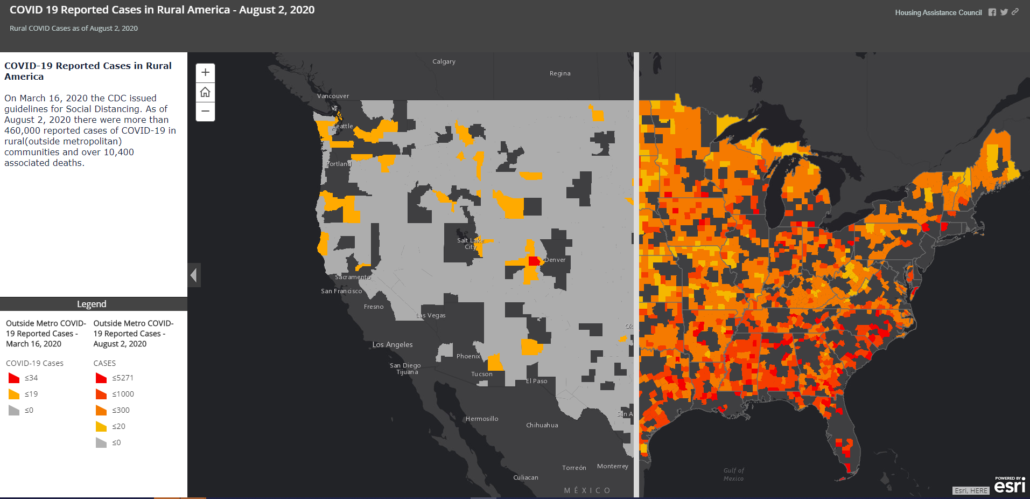
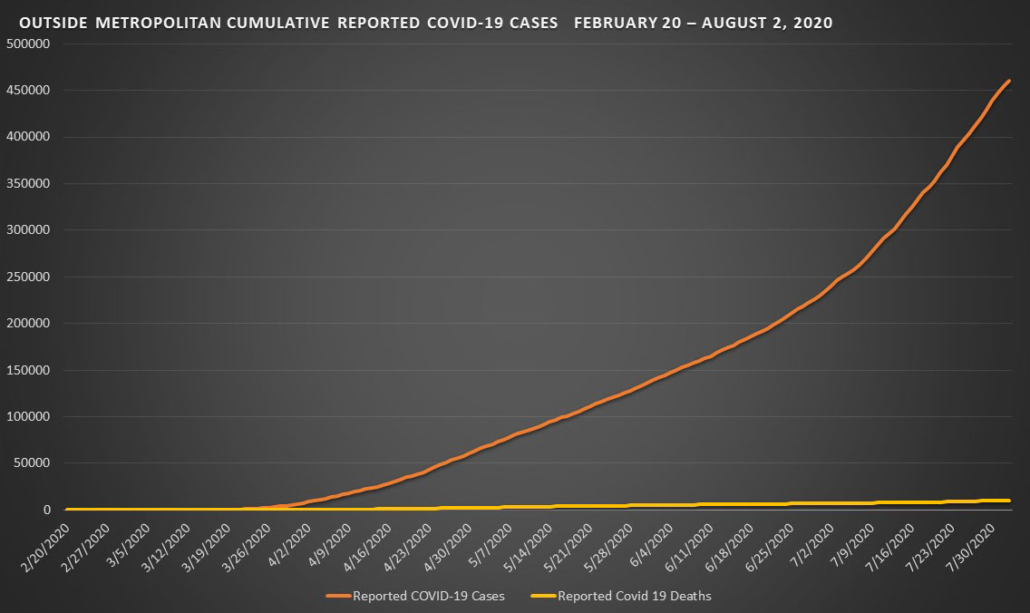
On March 16, 2020, the CDC issued guidelines for Social Distancing. As of August 2, 2020, there were more than 460,000 reported cases of COVID-19 and deaths from the virus have now surpassed 10,000 in communities outside of Metropolitan Areas. All but 32 counties outside of metropolitan areas have reported COVID-19 cases, and now over 60 percent of these counties have also reported associated deaths related to the virus.

Outside Metropolitan Cumulative Covid-19 Cases - August 2, 2020


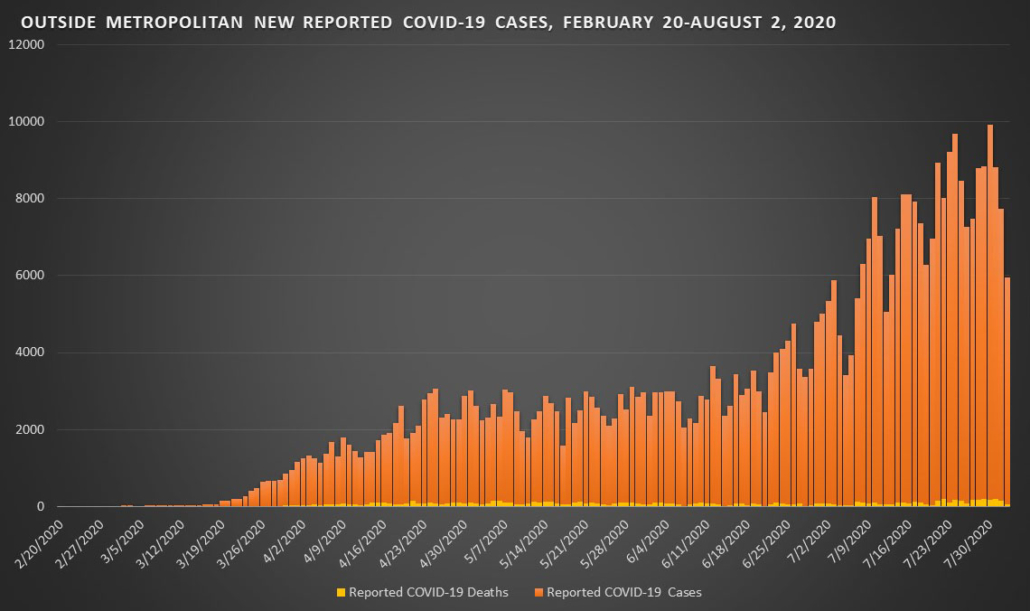
NEWLY REPORTED COVID-19 CASES FEBRUARY 20 – AUGUST 2, 2020

The level of new COVID-19 reported cases grew dramatically in July and the number of reported cases outside of metropolitan areas continued to skyrocket as well. From July 2 to August 2 there were almost as many new reported rural cases (225,553) than had been reported for the prior 5 months in total (235,201). There were a reported 3,381 rural deaths related to COVID-19 in the past month as well.

Covid-10 New Reported Cases - August 2, 2020

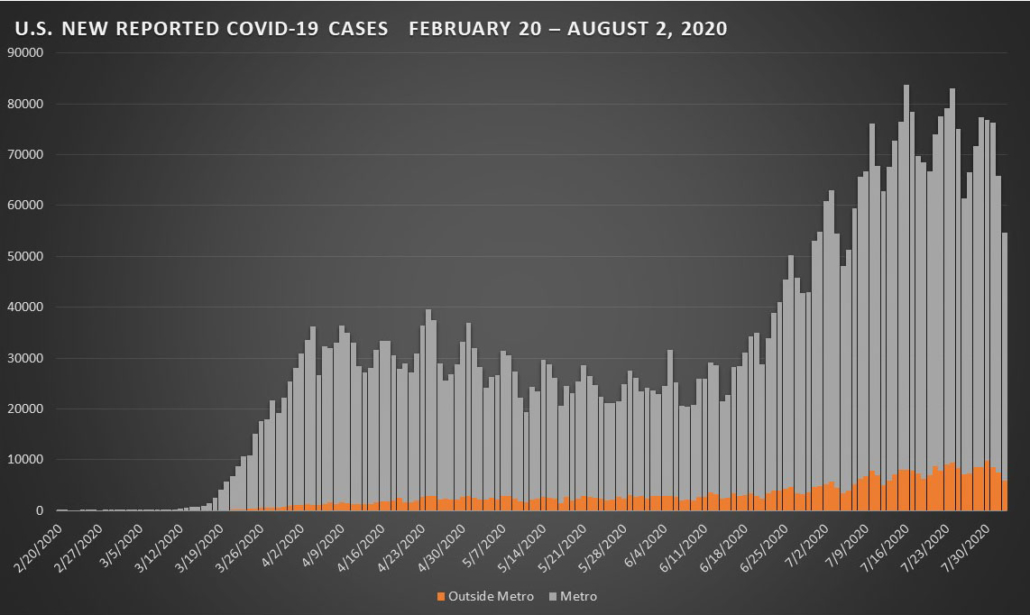
RURAL SHARE OF COVID-19 REPORTED CASES

Initial impacts of COVID-19 were greatest in urban communities and particularly devastating to some metropolitan areas. As of August 2, 2020, approximately 10 percent of COVID-19 cases and 7 percent of associated deaths have been reported in rural communities. But the rural share of COVID-19 cases continues to rise nationally.

Covid-19 New Reported Cases - August 2, 2020

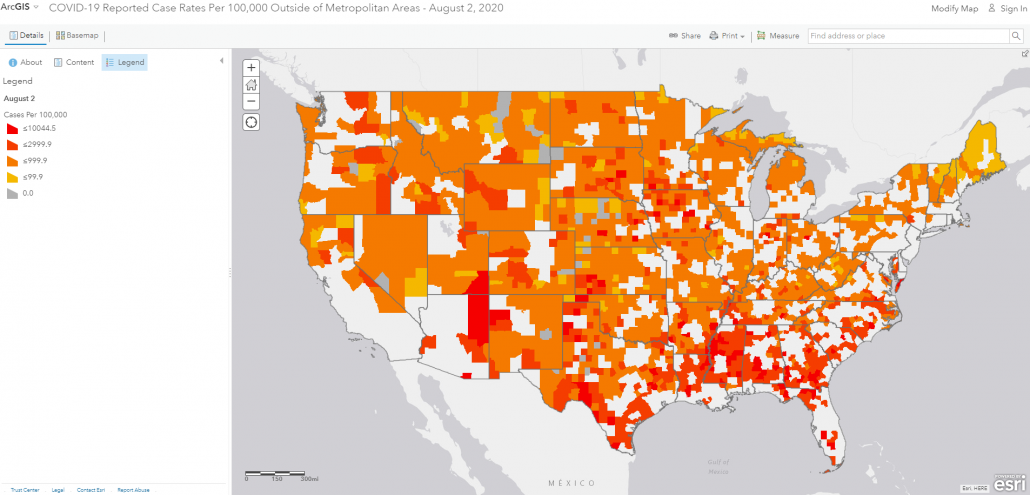
Reported Rural COVID-19 Rates per 100,000
Over 98 percent of rural communities have reported COVID-19 cases, but the virus’ impacts vary widely across the nation’s rural geography. There are several instances of extremely high per-capita infection rates in rural areas – notably on some Native American lands and communities with meat packing and correctional facilities.  From July 2- August 2, the case and death rates increased most dramatically in the rural Southeast.

Covid-19 Reported Cases per 100,000 population - August 2, 2020


To access all graphics and interactive maps visit: https://arcg.is/1HH0H4.

ABOUT THE DATA

The information in this brief derives from Housing Assistance Council tabulations of data from The New York Times, based on reports from state and local health agencies, and the U.S. Census Bureau’s 2014-2018 American Community Survey.
In these analyses, the terms “rural” and Outside Metropolitan Areas are synonymous and refer to counties and counts outside of OMB designated Metropolitan Areas. 

HAC News: July 23, 2020

HAC News Formats. pdf

July 23, 2020
Vol. 49, No. 15

Eviction protections expiring, lawmakers negotiating.

The Trump Administration and House and Senate leaders are negotiating the next coronavirus relief package, but it is not yet clear what types of aid it will provide, how much or when. HAC spearheaded a sign-on letter from over 100 rural housing stakeholders urging congressional leaders to provide targeted funding for rural communities. Among the reasons for urgency is the imminent expiration of eviction protections while large numbers of low-income tenants are still unemployed or working reduced hours and federal assistance that helped cover housing costs is ending. The CARES Act protects tenants in federally assisted housing from eviction through August 23 (July 24 is the last day of the moratorium and then property owners must give tenants at least 30 days’ notice) and an array of state and local moratoriums have protected some additional tenants for varying amounts of time. One estimate is that 19-23 million people – one in every five people who live in renter households – in the U.S. are at risk of eviction by September. Undocumented people, low-income people, and people of color are the most vulnerable.

USDA and HUD provide new guidance for rental housing as eviction protections end.

Updates to USDA RD’s FAQs for multifamily property owners and managers, HUD Notice H 20-07 and a HUD brochure titled Promoting Housing Stability During the Covid-19 National Emergency: Information for Multifamily Property Owners and Management Agents all address the status of tenant protections as the CARES eviction moratorium expires. A National Housing Law Project analysis compares USDA’s provisions to those of HUD Notice H 20-07.

Administration moving forward to eliminate fair housing processes and transgender shelter protections.

HUD will announce a new Affirmatively Furthering Fair Housing rule on July 23, according to Politico, which reports the department will “essentially rely … on local governments to self-certify that they are ‘furthering fair housing.’” The regulation will not be the one proposed in January and will be issued in final form with no further opportunity for public comment, the article states. A separate proposal to remove current protections for transgender individuals in HUD-supported facilities, such as single-sex shelters or shelters with separate facilities based on sex, will be published in the Federal Register on July 24 with a 60-day comment period. That rule change would allow shelter operators to decide whether to rely on gender assigned at birth or gender identity.

House continues work on FY21 funding for USDA and HUD.

The House of Representatives is scheduled to begin consideration on July 23 of a “minibus” (H.R. 7608) that combines four funding bills for the fiscal year that begins October 1, including USDA (H.R. 7610), State, Interior and Veterans Affairs. The Transportation-HUD bill, H.R. 7616, was approved by the House Appropriations Committee on July 14 and is expected to be part of a second minibus that will be taken up in the House during the week of July 27. The Senate has not yet begun considering appropriations legislation.

USDA requests input on new program for rural job accelerators.

The 2018 Farm Bill authorized a new Rural Innovation Stronger Economy (RISE) program that will make grants to rural job accelerator partnerships to help distressed rural communities create high-wage jobs, accelerate the formation of new businesses and identify and maximize local assets. Public input on the program can be provided in writing or at online listening sessions on July 28 and July 30. For more information, contact Will Dodson, RBCS, 202-762-0592.

RuralSTAT: 456 rural counties do not have a Medicare-registered hospital. Source: Housing Assistance Council tabulation of data from the Center for Medicaid and Medicare Services list of registered hospitals.

Main Street Lending program expands to nonprofits and aids tribal governments.

On July 23 the Federal Reserve expanded its Main Street Lending Program to provide greater access to nonprofit organizations. The program supports lending to small businesses to ensure access to capital during the coronavirus pandemic. In a less publicized change, on July 15 the Fed modified the program’s FAQs to allow tribal enterprises to provide capital distributions to their tribal government owners while participating in the program. They still cannot pay dividends or make distributions to other owners such as individuals. The waiver is important because tribal businesses are owned by tribal governments and distribute some of their income to tribal governments to pay for services to the tribe.

HAC seeks photographers to document U.S. rural housing and development.

With support from the National Endowment for the Arts and honoring the legacy of photographer George Ballis (1925-2010) and his deep ties to rural housing and community development, HAC seeks photographers for an upcoming exhibition, “There Is More Work To Be Done.” Selected photographers will be offered a stipend to document the impact of rural housing and rural community development programs in areas across the country and the work that still needs to be done. Applications are due August 14. For more information, visit HAC’s website or email ballisphoto@ruralhome.org.

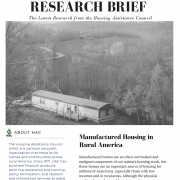
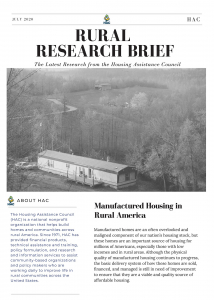
Manufactured homes covered in HAC’s newest Rural Research Brief.

Manufactured homes are an often overlooked and maligned component of our nation’s housing stock, but these homes are an important source of housing for millions of Americans, especially those with low incomes and in rural areas. A HAC Rural Research Brief presents data on these homes, their residents and the system through which they are sold, financed and managed.

No change in Fannie Mae and Freddie Mac housing goals proposed for 2021.

Because of the economic disruption resulting from the coronavirus pandemic, the Federal Housing Finance Agency is proposing to keep the benchmarks for Fannie Mae’s and Freddie Mac’s affordable housing goals the same in 2021 as in 2018-2020. Comments will be due 60 days after the proposal is published in the Federal Register. For more information, contact Ted Wartell, FHFA, 202-649-3157.

Housing costs were already out of reach before the pandemic.

The latest edition of the National Low Income Housing Coalition’s annual Out of Reach study compares minimum wages to housing wages – the amount needed to afford the HUD-determined Fair Market Rent for a one-bedroom or two-bedroom apartment. In no state can a person working full-time at the federal minimum wage afford a two-bedroom apartment at FMR. In only 145 of the more than 3,000 U.S. counties can a full-time worker earning the minimum wage afford a one-bedroom rental home at FMR. Data for all states and counties are available from the interactive map posted at https://reports.nlihc.org/oor.

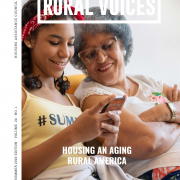
Housing an Aging Rural America.

HAC’s just-published summer 2020 issue of Rural Voices magazine covers the unique challenges – and opportunities – presented by housing for rural seniors. The coronavirus pandemic has also heightened the concern for older and potentially more vulnerable residents, who disproportionally reside in rural America, and makes this conversation more immediate.

Retirements lead to staff changes at USDA RD.

Roger Glendenning, Deputy Administrator of Single Family Housing, is retiring on July 31. Cathy Glover, who has most recently run the Section 502 guarantee program, has been selected to succeed Glendenning. Barry Ramsey, formerly the Director of the Single Family Housing Direct Loan Division and currently the Assistant to the Deputy Administrator, is also retiring on July 31. Brooke Baumann is now the Director of the SFH Direct Loan Division. 

Recent publications and media of interest

Need capital for your affordable housing project?

HAC’s loan funds provide low interest rate loans to support single- and multifamily affordable housing projects for low-income rural residents throughout the U.S. and territories. Capital is available for all types of affordable and mixed-income housing projects, including preservation, farmworker, senior and veteran housing. HAC loan funds can be used for pre-development, site acquisition, site development and construction/rehabilitation. Contact HAC’s loan fund staff at hacloanfund@ruralhome.org, 202-842-8600.

Please note: HAC is not able to offer loans to individuals or families. Borrowers must be nonprofit or for-profit organizations or government entities (including tribes).
Rural Voices: Housing an Aging Rural America

Download a pdf version of Rural Voices
rv-summer-2020 cover

All members of our communities, particularly older residents, should have access to safe and affordable housing, quality healthcare, and a nurturing support system, regardless of where they live. With the transition of baby boomers into older age, the United States is now squarely in one of the largest demographics shifts in our nation’s history that will impact every facet of our society – especially housing. Quality and affordable housing for seniors lies at the intersection of healthcare, social well-being, and intergenerational living. Addressing this comprehensive issue requires collaboration in each of these areas.

Housing for rural seniors presents unique challenges – and opportunities. In rural America, the impacts of an aging population are already being felt. Nearly one-fifth of the nation’s population calls rural and small towns home, yet our rural communities house almost a quarter of the country’s elderly, and this trend will only grow. The recent world-wide health pandemic has also heightened the concern and care for our older and potentially more vulnerable residents who disproportionally reside in rural America and makes this conversation more immediate.

HAC thanks AARP Foundation for their generous support of this edition of Rural Voices.

Manufactured Housing in Rural America


Manufactured homes are an often overlooked and maligned component of our nation’s housing stock, but these homes are an important source of housing for millions of Americans, especially those with low incomes and in rural areas. Although the physical quality of manufactured housing continues to progress, the basic delivery system of how these homes are sold, financed, and managed is still in need of improvement to ensure that they are a viable and quality source of affordable housing.

HAC News: July 9, 2020

HAC News Formats. pdf

July 9, 2020
Vol. 49, No. 14

FY21 funding process begins in the House, rural voucher expansion included.

The House Appropriations Committee is expected to consider a bill on July 9 to fund USDA for the fiscal year that begins October 1, and a bill for HUD funding soon. The Senate has not begun work on its bills yet. The House USDA bill would keep most rural housing programs at their FY20 funding levels, with increases for Section 521 Rental Assistance and Section 542 vouchers that were requested in the Administration’s budget. It would also make Section 542 vouchers available for tenants in properties where mortgages have matured as well as those where mortgages were prepaid. In addition, the measure would provide $5 million authorized in the 2018 Farm Bill to make loans to intermediaries to help resolve ownership issues for farmers with “heirs’ property” – land that has multiple legal owners after ownership passed through several generations without wills or clear titles. HAC will post updates online as the appropriations process continues.

Paycheck Protection Program application deadline extended to August 8.

The Paycheck Protection Program, created in the CARES coronavirus relief act, is intended to help small employers (including nonprofits) weather the pandemic. Employers can apply for forgivable loans from lenders approved by the Small Business Administration to keep paying their workers. The program was originally scheduled to end on June 30, but new legislation has now moved the deadline to August 8.

NEA offers creative placemaking grants.

The National Endowment for the Arts’ Our Town program support projects that integrate arts, culture and design activities into efforts that strengthen communities by advancing local economic, physical and/or social outcomes. Grants range from $25,000 to $150,000 and must be matched by recipients. Applications are due to grants.gov by August 6 and to NEA August 11-18. For more information, contact NEA staff, OT@arts.gov.

CFPB cancels requirement for payday lenders to evaluate repayment ability.

Adopting a regulatory change it proposed in February 2019, the Consumer Financial Protection Bureau is eliminating a requirement for payday lenders to determine whether a borrower can repay a loan. For more information, contact Joseph Baressi, Lawrence Lee or Adam Mayle, CFPB, 202-435-7700. In May other federal regulatory agencies took a very different approach, issuing lending principles to encourage banks and credit unions to make small-dollar loans that can be repaid without putting borrowers into cycles of debt.

Rural unemployment rate remains in double digits.

A HAC analysis of the most recent data from the Bureau of Labor Statistics indicates that rural labor markets are still suffering economic fallout from the COVID-19 health crisis. The May jobs numbers revealed a seasonally unadjusted unemployment rate of 11.0% for counties outside metropolitan areas. Across the nation over 2.8 million rural workers were unemployed in May. Like the health crisis itself, rates of unemployment varied by county, but most rural communities still have unprecedented unemployment rates. County data are available in an interactive map.

RuralSTAT: 48% of rural homeowners own their homes outright and do not have mortgage debt. Source: Housing Assistance Council tabulations of 2014-2018 American Community Survey data 

Homeownership in rural America examined in new HAC research brief.

A Rural Research Brief released by HAC in June looks at several aspects of rural homeownership. For example, while homeownership rates are higher in rural areas than in cities, they vary widely by age, race/ethnicity and other characteristics.

HUD updates income and rent limits.

The income limits, used in programs including HOME, CDBG, SHOP and others, and the rent limits for HOME and the Housing Trust Fund are available online. The new data took effect July 1.

CDC turns down coronavirus data requests from American Indian tribes.

Tribes and American Indian epidemiology centers battling coronavirus among their populations have reported that their requests for raw data were denied by the federal Centers for Disease Control and the states of Michigan and Massachusetts although the data is freely available to states. American Indians face serious health risks, and tribes are reporting that a lack of cooperation from data owners is making it more difficult for them to keep their communities safe. Several Senators and members of Congress have written to the CDC director urging the agency to be more transparent with data.

USDA Rural Development housing program data posted.

As of the end of June, nine months into fiscal year 2020, USDA has obligated 103,122 loans, loan guarantees and grants totaling over $16 billion. This is an increase of $5.7 million over this time last year. Most of the dollars obligated were for the Section 502 guaranteed loan program. Many of the loan programs seem to be on track to fully utilize this year’s funding.

Recent publications and media of interest

Webinar on minority-owned rural small businesses offered by HAC and partners.  

On July 22, HAC is partnering with Aspen CSG, Rural LISC, and RCAP to co-host a webinar on rural small business in the time of COVID-19. In this first Rural Opportunity and Development (ROAD) Session, rural minority business owners will detail their recent experiences, in partnered conversation with the regional intermediaries who have been helping them with technical assistance, funding and advocacy. Register here. 

Need capital for your affordable housing project?

HAC’s loan funds provide low interest rate loans to support single- and multifamily affordable housing projects for low-income rural residents throughout the U.S. and territories. Capital is available for all types of affordable and mixed-income housing projects, including preservation, farmworker, senior and veteran housing. HAC loan funds can be used for pre-development, site acquisition, site development and construction/rehabilitation. Contact HAC’s loan fund staff at hacloanfund@ruralhome.org, 202-842-8600.

Please note: HAC is not able to offer loans to individuals or families. Borrowers must be nonprofit or for-profit organizations or government entities (including tribes).
Homeownership in Rural America

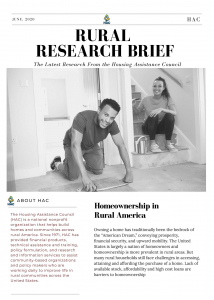
Homeownership in Rural America Research Brief Cover

Owning a home has traditionally been the bedrock of the “American Dream,” conveying prosperity, financial security, and upward mobility. The United States is largely a nation of homeowners and homeownership is more prevalent in rural areas. But many rural households still face challenges in accessing, attaining and affording the purchase of a home. Lack of available stock, affordability and high cost loans are barriers to homeownership.

This Rural Research Brief examines the state of homeownership in rural America.

HAC News: June 25, 2020

HAC News Formats. pdf

June 25, 2020
Vol. 49, No. 13

HAC 2020 National Rural Housing Conference postponed.

The decision to postpone the 2020 National Rural Housing Conference sets several pieces in motion, so HAC asks everyone for your patience while we work though the details. We continue to believe in the importance of gathering as a community to interact, share, inspire, celebrate and strengthen our work. We plan to provide opportunities to do so in 2021. We will share additional information, as it develops, on our website and in the HAC News.

 June is Pride Month.

Rural America is made up of a rich tapestry of people who call it home, including more than 3 million LGBTQ people. HAC believes that every person has a right to safe and affordable housing, no matter their orientation. We proudly celebrate Pride Month and stand by and fight for housing opportunities with the LGBTQ community.

House infrastructure bill includes housing, rural broadband and more.

H.R. 2, the Moving Forward Act, would authorize $1 billion for USDA’s MPR rental preservation program and $100 million for Section 504 home repair loans and grants. Native American housing would receive $1 billion, HOME $5 billion, the Housing Trust Fund $5 billion, CDBG $10 billion and the Public Housing Capital Fund $70 billion. The bill includes $2.5 billion each for Section 202, Section 811 rent assistance and the Capital Magnet Fund as well as $1 billion for flood mitigation grants. It would make several changes to the Low-Income Housing Tax Credit program, including providing incentives for properties in rural and Native American areas. The Senate is not expected to vote on the bill, however.

Federal agencies extend eviction and foreclosure moratoria through August.

Homeowners with mortgages through the USDA Section 502 direct and 502 guaranteed programs, backed by Fannie Mae or Freddie Mac, or insured by the Federal Housing Administration are now protected from foreclosure and eviction through August 31. Tenants in federally assisted housing have separate protection under the CARES Act, which prohibits evictions for non-payment of rent through July 24. ProPublica has developed a searchable database of covered rental properties (including those with direct or guaranteed USDA mortgages). Other eviction resources are compiled on HAC’s website.

Second “Rural Housing in the Time of COVID-19” conversation now available online.

The second livestream conversation in the “Rural Housing in the Time of COVID-19” series from the Rural Assembly and HAC focused on how government and philanthropy have responded to the pandemic and what more can be done. Panelists stressed the importance of government action as the needs of rural communities grow and the importance that those actions target aid at the most vulnerable people and places. The first conversation included perspectives from rural housing practitioners on the rural housing landscape before and during the coronavirus pandemic.

CFPB explains underserved counties determinations.

The Consumer Financial Protection Bureau produces an annual list of rural and underserved counties and areas that is used in applying some Truth in Lending Act provisions, such as the exemption from the requirement to establish an escrow account for a higher-priced mortgage loan. In the past, CFPB determined what counties met the rural and underserved criteria by using HMDA data that is no longer available. An interpretive rule explains how CFPB will now identify these areas. For more information, contact Waeiz Syed, CFPB, 202-435-7700 or submit a question online.

RuralSTAT: Nearly 75% of rural and small-town white, non-Hispanic households own their homes compared to only 55% of rural minority households. Source: HAC Tabulations of 2014-2018 American Community Survey Data. To access more data for your community visit HAC’s Rural Data Portal.  

Supreme Court victory for LGBTQ people could apply to Fair Housing Act as well.

The Bostock v. Clayton County employment law decision on June 15 effectively expanded workplace and other legal protections to LGBTQ people, concluding that discrimination against them constitutes discrimination on the basis of sex. Opinion writers in the Washington Post and other forums have suggested the decision’s logic should also apply to other laws that prohibit sex discrimination, including the Fair Housing Act.

Coronavirus education initiative for minority and rural communities to launch in July.

The U.S. Department of Health and Human Services and Morehouse School of Medicine announced on June 23 that Morehouse will work with community-based organizations to provide information to racial and ethnic minority, rural and socially vulnerable communities. The three-year project “will strengthen efforts to link communities to COVID-19 testing, healthcare and social services and to best share and implement effective response, recovery and resilience strategies.”

Recent publications and media of interest


Need capital for your affordable housing project?

HAC’s loan funds provide low interest rate loans to support single- and multifamily affordable housing projects for low-income rural residents throughout the U.S. and territories. Capital is available for all types of affordable and mixed-income housing projects, including preservation, farmworker, senior and veteran housing. HAC loan funds can be used for pre-development, site acquisition, site development and construction/rehabilitation. Contact HAC’s loan fund staff at  hacloanfund@ruralhome.org, 202-842-8600.

Please note: HAC is not able to offer loans to individuals or families. Borrowers must be nonprofit or for-profit organizations or government entities (including tribes).
GET THE HAC NEWS!

Sign-up for HAC information products

SIGN UP HERE

Housing Assistance Council   |  1828 L Street. N.W., Suite 505, Washington, D.C. 20036
(202) 842-8600  |  (202) 347-3441  |  hac@ruralhome.org |

Board Portal

HAC is an equal opportunity provider, employer, and lender. | Civil Rights | Privacy