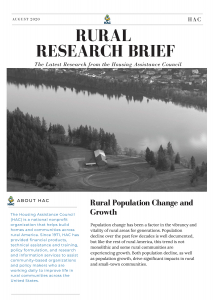
Homeownership in Rural America

Homeownership in Rural America Research Brief Cover

Owning a home has traditionally been the bedrock of the “American Dream,” conveying prosperity, financial security, and upward mobility. The United States is largely a nation of homeowners and homeownership is more prevalent in rural areas. But many rural households still face challenges in accessing, attaining and affording the purchase of a home. Lack of available stock, affordability and high cost loans are barriers to homeownership.

This Rural Research Brief examines the state of homeownership in rural America.

HAC News: June 25, 2020

HAC News Formats. pdf

June 25, 2020
Vol. 49, No. 13

HAC 2020 National Rural Housing Conference postponed.

The decision to postpone the 2020 National Rural Housing Conference sets several pieces in motion, so HAC asks everyone for your patience while we work though the details. We continue to believe in the importance of gathering as a community to interact, share, inspire, celebrate and strengthen our work. We plan to provide opportunities to do so in 2021. We will share additional information, as it develops, on our website and in the HAC News.

 June is Pride Month.

Rural America is made up of a rich tapestry of people who call it home, including more than 3 million LGBTQ people. HAC believes that every person has a right to safe and affordable housing, no matter their orientation. We proudly celebrate Pride Month and stand by and fight for housing opportunities with the LGBTQ community.

House infrastructure bill includes housing, rural broadband and more.

H.R. 2, the Moving Forward Act, would authorize $1 billion for USDA’s MPR rental preservation program and $100 million for Section 504 home repair loans and grants. Native American housing would receive $1 billion, HOME $5 billion, the Housing Trust Fund $5 billion, CDBG $10 billion and the Public Housing Capital Fund $70 billion. The bill includes $2.5 billion each for Section 202, Section 811 rent assistance and the Capital Magnet Fund as well as $1 billion for flood mitigation grants. It would make several changes to the Low-Income Housing Tax Credit program, including providing incentives for properties in rural and Native American areas. The Senate is not expected to vote on the bill, however.

Federal agencies extend eviction and foreclosure moratoria through August.

Homeowners with mortgages through the USDA Section 502 direct and 502 guaranteed programs, backed by Fannie Mae or Freddie Mac, or insured by the Federal Housing Administration are now protected from foreclosure and eviction through August 31. Tenants in federally assisted housing have separate protection under the CARES Act, which prohibits evictions for non-payment of rent through July 24. ProPublica has developed a searchable database of covered rental properties (including those with direct or guaranteed USDA mortgages). Other eviction resources are compiled on HAC’s website.

Second “Rural Housing in the Time of COVID-19” conversation now available online.

The second livestream conversation in the “Rural Housing in the Time of COVID-19” series from the Rural Assembly and HAC focused on how government and philanthropy have responded to the pandemic and what more can be done. Panelists stressed the importance of government action as the needs of rural communities grow and the importance that those actions target aid at the most vulnerable people and places. The first conversation included perspectives from rural housing practitioners on the rural housing landscape before and during the coronavirus pandemic.

CFPB explains underserved counties determinations.

The Consumer Financial Protection Bureau produces an annual list of rural and underserved counties and areas that is used in applying some Truth in Lending Act provisions, such as the exemption from the requirement to establish an escrow account for a higher-priced mortgage loan. In the past, CFPB determined what counties met the rural and underserved criteria by using HMDA data that is no longer available. An interpretive rule explains how CFPB will now identify these areas. For more information, contact Waeiz Syed, CFPB, 202-435-7700 or submit a question online.

RuralSTAT: Nearly 75% of rural and small-town white, non-Hispanic households own their homes compared to only 55% of rural minority households. Source: HAC Tabulations of 2014-2018 American Community Survey Data. To access more data for your community visit HAC’s Rural Data Portal.  

Supreme Court victory for LGBTQ people could apply to Fair Housing Act as well.

The Bostock v. Clayton County employment law decision on June 15 effectively expanded workplace and other legal protections to LGBTQ people, concluding that discrimination against them constitutes discrimination on the basis of sex. Opinion writers in the Washington Post and other forums have suggested the decision’s logic should also apply to other laws that prohibit sex discrimination, including the Fair Housing Act.

Coronavirus education initiative for minority and rural communities to launch in July.

The U.S. Department of Health and Human Services and Morehouse School of Medicine announced on June 23 that Morehouse will work with community-based organizations to provide information to racial and ethnic minority, rural and socially vulnerable communities. The three-year project “will strengthen efforts to link communities to COVID-19 testing, healthcare and social services and to best share and implement effective response, recovery and resilience strategies.”

Recent publications and media of interest


Need capital for your affordable housing project?

HAC’s loan funds provide low interest rate loans to support single- and multifamily affordable housing projects for low-income rural residents throughout the U.S. and territories. Capital is available for all types of affordable and mixed-income housing projects, including preservation, farmworker, senior and veteran housing. HAC loan funds can be used for pre-development, site acquisition, site development and construction/rehabilitation. Contact HAC’s loan fund staff at  hacloanfund@ruralhome.org, 202-842-8600.

Please note: HAC is not able to offer loans to individuals or families. Borrowers must be nonprofit or for-profit organizations or government entities (including tribes).
HAC News: June 11, 2020

HAC News Formats. pdf

June 11, 2020
Vol. 49, No. 12

Peace cannot be found where injustice also resides.” 

HAC is committed to doing our part to dismantle racism and racist housing policy in partnership with the rural communities where we live, work and invest our capital. Read our full statement here.  

June is National Homeownership Month.  

HAC is celebrating by sharing stories from across our network participating in HUD’s Self-Help Homeownership Opportunity ProgramPresident TrumpUSDA Rural Development and HUD issued statements recognizing the importance of homeownership.  

HAC and partners consider rural housing in the time of Covid-19. 

In partnership with the Rural Assembly, HAC presents two virtual conversations on the state of rural housing in the coronavirus era. The first conversation, “What was the rural housing landscape like before COVID-19 and where are we now?,” took place on June 9 and featured a panel of rural housing experts. The second conversation will be held on June 16, titled “Has the government’s response been adequate?” It will examine what more needs to be done to help rural housing respond to the pandemic. For more information and to register, visit the Rural Assembly’s website.  

Changes enacted to Paycheck Protection Plan. 

The Paycheck Protection Program Flexibility Act, signed into law on June 5, increases flexibility for PPP loans. These loans are available through June 30 from SBA-approved lenders to help small businesses and their employees weather the coronavirus pandemic. The new law extends several deadlines and time periods, including the time for businesses to disburse the PPP funds they borrow. It also reduces the amount that must be spent on payroll. More information about the program is available from the SBA and the Treasury Department 

Research examines characteristics, expertise and needs of rural community organizations. 

Local and regional rural-serving organizations shape and strengthen the fabric of their communities. But what expertise do they have – and what expertise do they need? Based on the findings from a survey of over 350 rural-serving organizations in 45 states, a research brief from HAC and the Aspen Institute Community Strategies Group offers information on the inner workings of rural-serving organizations. Ground Truth from Rural Practitioners includes recommendations for building these groups’ capacity. This brief is the third product of a partnership between HAC and CSG; previously published reports addressed the limitations of rural media coverage and the need for better data on rural communities.

FEMA offers guidance on preparation for hurricane season during pandemic. 

FEMA’s COVID-19 Pandemic Operational Guidance for the 2020 Hurricane Season suggests actions emergency managers and public officials can take to prepare for response and recovery operations during the pandemic.  

New goals set for Federal Home Loan Banks. 

To promote affordable homeownership, the Federal Housing Finance Administration sets goals for single-family mortgage purchases by the 11 regional FHLBs. FHFA is finalizing changes it proposed in 2018. The new rule, which takes effect in 2021, replaces four separate goals with one, adds a new goal for small institutions, and makes other changes. For more information, contact Ted Wartell, FHFA, 202-649-3157.

Lawsuit claims state farmworker housing rules inadequate for coronavirus protection.  

Familias Unidas por la Justicia, a farmworkers’ labor union, has filed suit over the Washington state government’s emergency housing rules for farmworkers coming to the area with H-2A visas. The union argues the rules do not provide adequate protection against the spread of the coronavirus in grower-provided housing. There are fears around the country that illnesses among farmworkers may increase as summer advances, Politico has reported. The Centers for Disease Control and U.S. Department of Labor have issued guidance for protecting farmworkers against infection, but employers are not obligated to follow it.  

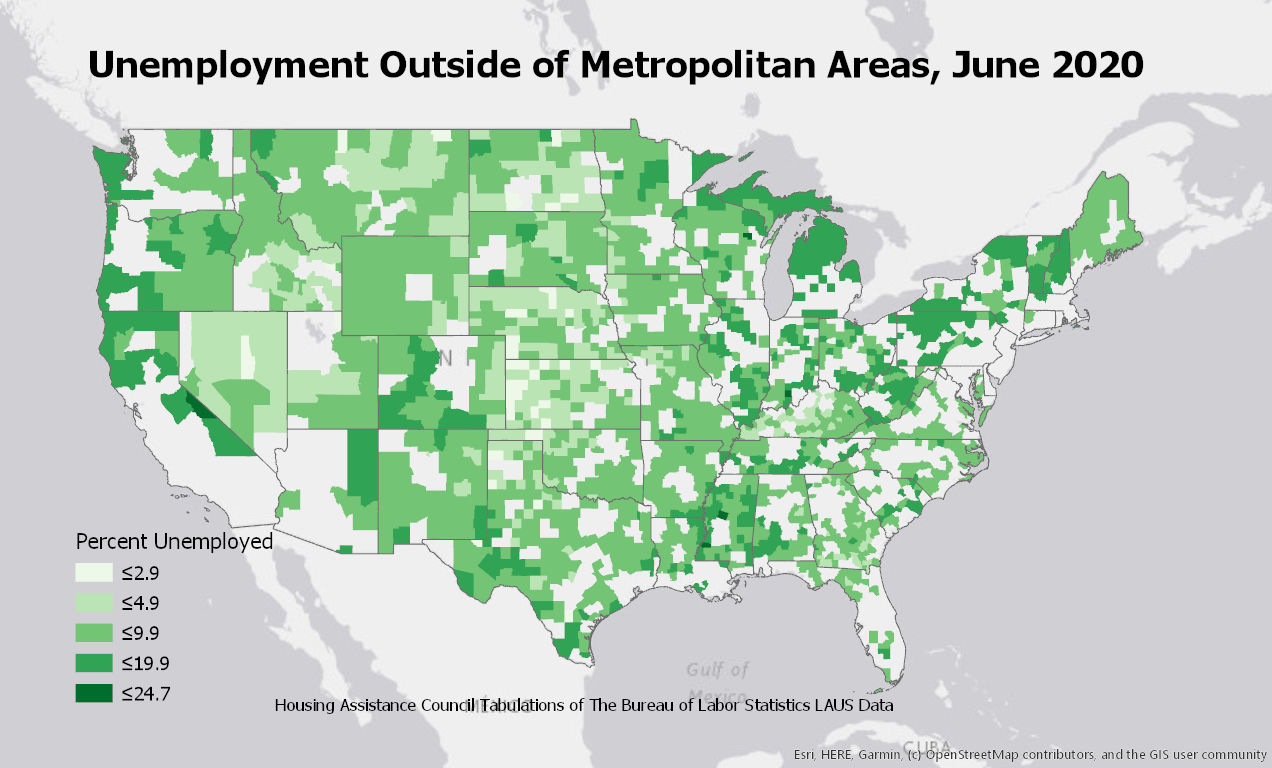
RuralSTAT: The unemployment rate outside metropolitan areas skyrocketed to 13.7% in April – up from 4.9% in March. While the unemployment caused by COVID-19 is unprecedented and unpredictable, such high jobless rates signal the potential for serious concerns across the housing spectrum. For more information and interactive maps on the recent rural employment data, visit HAC’s Mapping Rural America platform. 

USDA makes one temporary change to help use Section 502 direct funds. 

An Unnumbered Letter dated June 4, 2020 authorizes USDA RD to treat the purchase of a home from an owner with an existing Section 502 direct loan as if it were a new loan rather than an assumption of an existing loan. This is the only such step taken so far this year to help use all program funds before the fiscal year ends on September 30; last year and in previous years the agency issued several temporary authorizations 

May 28 HAC News revised to include Section 502 direct. 

USDA has extended to June 30 its moratorium on foreclosure and eviction of homeowners with mortgages under the Section 502 direct and guarantee programs. The email version of the May 28 HAC News referred to the guarantee program but not to Section 502 direct. 

Recent publications and media of interest 

Need capital for your affordable housing project?  HAC’s loan funds provide low interest rate loans to support single- and multifamily affordable housing projects for low-income rural residents throughout the U.S. and territories. Capital is available for all types of affordable and mixed-income housing projects, including preservation, farmworker, senior and veteran housing. HAC loan funds can be used for pre-development, site acquisition, site development and construction/rehabilitation. Contact HAC’s loan fund staff at hacloanfund@ruralhome.org, 202-842-8600. 

Please note: HAC is not able to offer loans to individuals or families. Borrowers must be nonprofit or for-profit organizations or government entities (including tribes). 
Ground Truth from Rural Practitioners

Ground Truth from Rural Practitioners Cover

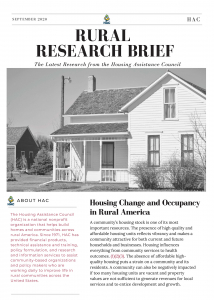
Local and regional rural-serving organizations shape and strengthen the fabric of their communities. But what kinds of organizations are these? What is of the range of topics they work on? What expertise do they have—and what expertise do they need? Based on the findings from a survey of over 350 different rural-serving organizations in 45 states, this research brief strives to provide policy makers, funders and other well-meaning folks who want to do right by rural with information on the inner workings of rural-serving organizations. The survey results highlight policy, investments and partnerships that are better tuned to rural realities and the self-identified strengths, expertise and needs of rural-serving organizations. It also demonstrates the resilience and strength of rural organizations despite great odds, while guiding national partners and philanthropy to build on and invest in their success.

HAC News: May 28, 2020

HAC News Formats. pdf

May 28, 2020
Vol. 49, No. 11

House passes another coronavirus relief bill.
On May 15 the House approved H.R. 6800, the Health and Economic Recovery Omnibus Emergency Solutions (HEROES) Act, which proposes substantial new housing assistance. The Senate is expected to work on a separate relief bill in June.

Agencies extend foreclosure moratoria and mortgage forbearance options.
In March a number of federal agencies imposed temporary bans on foreclosure for federally assisted homeowners and on evictions of both owners and renters in properties with federal aid. Some borrowers were also eligible to delay their mortgage payments. The agencies have now announced extensions through June 30, some including additional waivers or other provisions. The extensions cover mortgages backed by Fannie Mae and Freddie Mac as well as those made under USDA’s Section 502 direct program,* USDA’s Section 502 guarantee programUSDA’s Section 538 multifamily mortgage guarantee program, HUD’s Section 184 and 184A Native American and Native Hawaiian loan guarantee programs, the Department of Veterans Affairs’ loan guarantee program,and the Federal Housing Administration’s single-family loan guarantee programProPublica has developed a searchable database of rental properties covered by the CARES Act’s eviction ban (including those with direct or guaranteed USDA mortgages), which protects many tenants until late August. Other eviction resources are compiled on HAC’s website.

USDA offers coronavirus-related business and industry loan guarantees.
USDA’s Rural Business-Cooperative Service will guarantee almost $1 billion in loans to businesses in places with populations under 50,000. Loans must support business operations and facilities with working capital to cure problems caused by the coronavirus emergency.Eligible lenders include federal or state chartered financial institutions, Farm Credit lenders, S&Ls and others. Eligible borrowers include agricultural producers and a wide variety of entities operating rural businessesDifferences from the regular loan guarantee program include support for agricultural production, 90% guarantees, 10-year maximum terms and others. The application deadline is September 15, 2021 or whenever funds are all used. For more information, contact an RD state officeAn interim final rule for the CARES Act program is effective immediately with comments due on June 22. For more information on the rule, contact Mark Brodziski, RBCS, 202-205-0903.

OCC finalizes CRA regulationsFederal Reserve and FDIC decline to join.
The Office of the Comptroller of the Currency released final regulation to revise enforcement of the Community Reinvestment Act on May 20. The final rule retained much of the OCC’s controversial proposal, but several major elements of the initial proposal were not adopted. The rulemaking process received thousands of public comments, including a comment from HAC, which did not support the draftHistorically the three federal banking regulatory agencies have issued joint regulations but OCC’s final rule was not joined by the Federal Deposit Insurance Corporation, which had signed on to the proposal when it was released in JanuaryThe Federal Reserve Board did not join either the proposal or the final version. The National Community Reinvestment Coalition, the California Reinvestment Coalition and Democracy Forward intend to sue OCC to block its final ruleOn May 21, Comptroller Joseph M. Otting announced his resignation.

June 2 webinar to explore five good ideas for rural philanthropy.
The Aspen Institute Community Strategies Group, in partnership with HAC and others, will offer a webinar titled Ratcheting Up Rural Response, Recovery and Resilience: Five Good Ideas for Philanthropy Right Now on June 2 at 2:00 pm Eastern time. Funders and rural practitioners will explore ways to provide immediate relief for the coronavirus’s impacts and to improve prospects for recovery.

Half of rural households have responded to the census, HAC reports.
HAC analysis found that as of May 17 the rural response rate to the 2020 Census was 53%, lagging the 59.6% national rate. This Census is the first to rely primarily on online responses – a concern for rural communities given long-established internet deficiencies, household dynamics and poor connectivity in many rural markets.The coronavirus pandemic has also delayed in-person delivery of Census forms to the 5% of households, mostly rural, who do not receive them by mailHAC encourages everyone to respond.

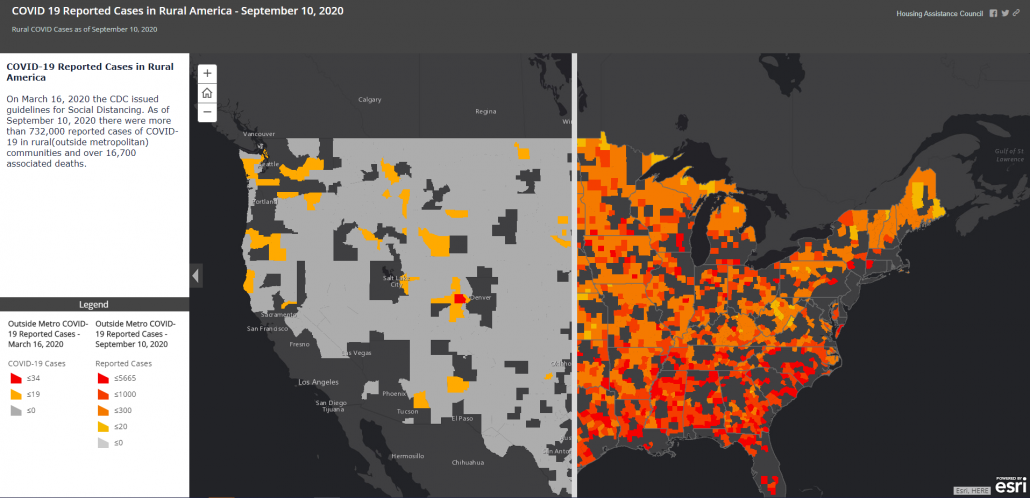
RuralSTAT: As of May 26, there were 121,274 reported cases of COVID-19 in counties outside of metropolitan areas, and an associated 4,600 deathsThe numbers of reported rural (outside metro) cases and deaths have more than doubled in the past 30 days. Source: Housing Assistance Council tabulations of data from the New York Times, based on reports from state and local health agencies.

President orders reducing regulations to aid economic recovery.
An Executive Order issued on May 19 directs federal agencies to temporarily or permanently rescind, modify or waive regulations in order to promote job creation and economic growth.It gives OMB the authority to oversee compliance and to issue further instructions to agencies.

SBA relief program needs changes to better aid underserved and rural businesses, say reviewers and users.
Reports by the Small Business Administration’s Inspector General and the Center for Responsible Lending have concluded that the Paycheck Protection Program created by the CARES Act did not serve disadvantaged businesses, including those in rural areas, as well as Congress intended. The IG found the SBA’s administration of the program mostly aligned with the statute but missed the mark in some ways, including not requiring lenders to prioritize underserved and rural borrowers. CRL’s analysis concluded that “structural inequities made it extremely difficult for small businesses – and particularly businesses owned by people of color – to qualify for assistance or receive it in time to save their businesses and the jobs of the employees that depend on them.” An article by Talk Poverty provides examples from California illustrating CRL’s findings. Rural participants in a recent online forum convened by a House subcommittee offered similar stories, saying the program has been helpful for rural businesses but could be even better.

H-2A farmworkers quadrupled from 2005 to 2019.
In 2005 just over 48,000 positions were certified for farmworkers with temporary H-2A visas. By 2019 more than 258,000 received certification, according to data posted by USDA’s Economic Research Service. Other farm labor data from ERS covers demographic characteristics, wages and more.

Tenants and owners of single-family homes and small buildings more likely to be economically affected by coronavirus downturn.
Noting that existing data and eviction protections tend to exclude single-family homes and small multifamily buildings, Harvard’s Joint Center for Housing Studies examined the characteristics of tenants in such homes and concluded that job losses related to the current economy could leave 20% unable to pay some or all of their rent. For larger apartment buildings the estimate is 12%. Smaller properties are also more likely to be owned by individuals who may be less able to weather a loss of rental income. JCHS did not analyze geographic differences, but HAC data tabulations show that 45% of rural renters live in single-family homes, compared to only 19% in cities and 34% in suburbs

Recent publications and media of interest

Need capital for your affordable housing project?  HAC’s loan funds provide low interest rate loans to support single- and multifamily affordable housing projects for low-income rural residents throughout the U.S. and territories. Capital is available for all types of affordable and mixed-income housing projects, including preservation, farmworker, senior and veteran housing. HAC loan funds can be used for pre-development, site acquisition, site development and construction/rehabilitation. Contact HAC’s loan fund staff at hacloanfund@ruralhome.org, 202-842-8600. 

Please note: HAC is not able to offer loans to individuals or families. Borrowers must be nonprofit or for-profit organizations or government entities (including tribes). 
 

* The reference to the Section 502 direct program was omitted when this issue of the HAC News was originally published. The extension is noted near the bottom of USDA’s announcement. HAC apologizes for any confusion.

HAC News: May 28, 2020

HAC News Formats. pdf

May 28, 2020
Vol. 49, No. 11

House passes another coronavirus relief bill.
On May 15 the House approved H.R. 6800, the Health and Economic Recovery Omnibus Emergency Solutions (HEROES) Act, which proposes substantial new housing assistance. The Senate is expected to work on a separate relief bill in June.

Agencies extend foreclosure moratoria and mortgage forbearance options.
In March a number of federal agencies imposed temporary bans on foreclosure for federally assisted homeowners and on evictions of both owners and renters in properties with federal aid. Some borrowers were also eligible to delay their mortgage payments. The agencies have now announced extensions through June 30, some including additional waivers or other provisions. The extensions cover mortgages backed by Fannie Mae and Freddie Mac as well as those made under USDA’s Section 502 direct program,* USDA’s Section 502 guarantee programUSDA’s Section 538 multifamily mortgage guarantee program, HUD’s Section 184 and 184A Native American and Native Hawaiian loan guarantee programs, the Department of Veterans Affairs’ loan guarantee program,and the Federal Housing Administration’s single-family loan guarantee programProPublica has developed a searchable database of rental properties covered by the CARES Act’s eviction ban (including those with direct or guaranteed USDA mortgages), which protects many tenants until late August. Other eviction resources are compiled on HAC’s website.

USDA offers coronavirus-related business and industry loan guarantees.
USDA’s Rural Business-Cooperative Service will guarantee almost $1 billion in loans to businesses in places with populations under 50,000. Loans must support business operations and facilities with working capital to cure problems caused by the coronavirus emergency.Eligible lenders include federal or state chartered financial institutions, Farm Credit lenders, S&Ls and others. Eligible borrowers include agricultural producers and a wide variety of entities operating rural businessesDifferences from the regular loan guarantee program include support for agricultural production, 90% guarantees, 10-year maximum terms and others. The application deadline is September 15, 2021 or whenever funds are all used. For more information, contact an RD state officeAn interim final rule for the CARES Act program is effective immediately with comments due on June 22. For more information on the rule, contact Mark Brodziski, RBCS, 202-205-0903.

OCC finalizes CRA regulationsFederal Reserve and FDIC decline to join.
The Office of the Comptroller of the Currency released final regulation to revise enforcement of the Community Reinvestment Act on May 20. The final rule retained much of the OCC’s controversial proposal, but several major elements of the initial proposal were not adopted. The rulemaking process received thousands of public comments, including a comment from HAC, which did not support the draftHistorically the three federal banking regulatory agencies have issued joint regulations but OCC’s final rule was not joined by the Federal Deposit Insurance Corporation, which had signed on to the proposal when it was released in JanuaryThe Federal Reserve Board did not join either the proposal or the final version. The National Community Reinvestment Coalition, the California Reinvestment Coalition and Democracy Forward intend to sue OCC to block its final ruleOn May 21, Comptroller Joseph M. Otting announced his resignation.

June 2 webinar to explore five good ideas for rural philanthropy.
The Aspen Institute Community Strategies Group, in partnership with HAC and others, will offer a webinar titled Ratcheting Up Rural Response, Recovery and Resilience: Five Good Ideas for Philanthropy Right Now on June 2 at 2:00 pm Eastern time. Funders and rural practitioners will explore ways to provide immediate relief for the coronavirus’s impacts and to improve prospects for recovery.

Half of rural households have responded to the census, HAC reports.
HAC analysis found that as of May 17 the rural response rate to the 2020 Census was 53%, lagging the 59.6% national rate. This Census is the first to rely primarily on online responses – a concern for rural communities given long-established internet deficiencies, household dynamics and poor connectivity in many rural markets.The coronavirus pandemic has also delayed in-person delivery of Census forms to the 5% of households, mostly rural, who do not receive them by mailHAC encourages everyone to respond.

RuralSTAT: As of May 26, there were 121,274 reported cases of COVID-19 in counties outside of metropolitan areas, and an associated 4,600 deathsThe numbers of reported rural (outside metro) cases and deaths have more than doubled in the past 30 days. Source: Housing Assistance Council tabulations of data from the New York Times, based on reports from state and local health agencies.

President orders reducing regulations to aid economic recovery.
An Executive Order issued on May 19 directs federal agencies to temporarily or permanently rescind, modify or waive regulations in order to promote job creation and economic growth.It gives OMB the authority to oversee compliance and to issue further instructions to agencies.

SBA relief program needs changes to better aid underserved and rural businesses, say reviewers and users.
Reports by the Small Business Administration’s Inspector General and the Center for Responsible Lending have concluded that the Paycheck Protection Program created by the CARES Act did not serve disadvantaged businesses, including those in rural areas, as well as Congress intended. The IG found the SBA’s administration of the program mostly aligned with the statute but missed the mark in some ways, including not requiring lenders to prioritize underserved and rural borrowers. CRL’s analysis concluded that “structural inequities made it extremely difficult for small businesses – and particularly businesses owned by people of color – to qualify for assistance or receive it in time to save their businesses and the jobs of the employees that depend on them.” An article by Talk Poverty provides examples from California illustrating CRL’s findings. Rural participants in a recent online forum convened by a House subcommittee offered similar stories, saying the program has been helpful for rural businesses but could be even better.

H-2A farmworkers quadrupled from 2005 to 2019.
In 2005 just over 48,000 positions were certified for farmworkers with temporary H-2A visas. By 2019 more than 258,000 received certification, according to data posted by USDA’s Economic Research Service. Other farm labor data from ERS covers demographic characteristics, wages and more.

Tenants and owners of single-family homes and small buildings more likely to be economically affected by coronavirus downturn.
Noting that existing data and eviction protections tend to exclude single-family homes and small multifamily buildings, Harvard’s Joint Center for Housing Studies examined the characteristics of tenants in such homes and concluded that job losses related to the current economy could leave 20% unable to pay some or all of their rent. For larger apartment buildings the estimate is 12%. Smaller properties are also more likely to be owned by individuals who may be less able to weather a loss of rental income. JCHS did not analyze geographic differences, but HAC data tabulations show that 45% of rural renters live in single-family homes, compared to only 19% in cities and 34% in suburbs

Recent publications and media of interest

Need capital for your affordable housing project?  HAC’s loan funds provide low interest rate loans to support single- and multifamily affordable housing projects for low-income rural residents throughout the U.S. and territories. Capital is available for all types of affordable and mixed-income housing projects, including preservation, farmworker, senior and veteran housing. HAC loan funds can be used for pre-development, site acquisition, site development and construction/rehabilitation. Contact HAC’s loan fund staff at hacloanfund@ruralhome.org, 202-842-8600. 

Please note: HAC is not able to offer loans to individuals or families. Borrowers must be nonprofit or for-profit organizations or government entities (including tribes). 
 

* The reference to the Section 502 direct program was omitted when this issue of the HAC News was originally published. The extension is noted near the bottom of USDA’s announcement. HAC apologizes for any confusion.

ConferenceSavetheDate

HAC News: May 14, 2020

HAC News Formats. pdf

May 14, 2020
Vol. 49, No. 10

May is Asian/Pacific American Heritage Month.  

New coronavirus relief bill introduced in House. 

H.R. 6800, the Health and Economic Recovery Omnibus Emergency Solutions (HEROES) Act, introduced on May 12, would provide substantial new housing assistance. The House is expected to pass the bill on May 15, but it is not expected to become law in its current form. 

  • The measure includes $309 million for additional USDA Section 521 Rental Assistance, which would be available for tenants who are not currently receiving RA as well as those who are. Up to $25 million of the total could be used for Section 542 vouchers.  
  • The bill would expand the CARES Act’s provisions, which protect only those with federal housing assistance or federally backed mortgages, by creating a 12-month prohibition on all evictions of renters or homeowners based on nonpayment and a 12-month forbearance period for all owners of multifamily rental properties.  
  • Funding would be added to numerous HUD programs including CDBG, public housing, vouchers, Sections 202 and 811, and McKinney-Vento homeless assistance programs. Another $100 billion would finance emergency aid to tenants through the Emergency Solutions Grant program.  
  • State housing finance agencies would administer a new $75 billion Homeowner Assistance Fund. 
  • Setasides for tribes would include $100 million for the Bureau of Indian Affairs’ Housing Improvement Program and $20 million for BIA to provide and deliver potable water.  
  • The bill would revise USDA’s authority to offer payment moratoria to Section 502 direct and Section 504 borrowers, requiring that determinations be based on individual borrowers’ circumstances.  

SBA taking Economic Injury Disaster Loan applications from agricultural businesses. 

Agricultural businesses with fewer than 500 employees are currently the only enterprises that can apply for the Small Business Administration’s coronavirus-related EIDL loans and advances(SBA is continuing to process applications submitted before April 15 by other businesses.) A USDA webcast about the program is available onlineFor more information, contact the SBA disaster assistance customer service center, 1-800-659-2955, disastercustomerservice@sba.gov 

Agencies offer information for tenants and homeowners. 

CFPB, FHFA and HUD launched a new website on May 12 that explains CARES Act protections for renters and homeowners, suggests resources for additional help and provides information on how to avoid COVID-19 related scams. It also includes explanations and links to help determine whether homes are federally backed, a requirement for relief under CARES. A detailed CFPB blog post offers even more material for renters. USDA Rural Development has also published new Frequently Asked Questions for tenants in USDA-financed rentals, available in English and Spanish.  

Census Bureau resumes some field operations.  

After suspending field operations for the 2020 decennial Census in mid-March because of the coronavirus pandemic, the Census Bureau has restarted them in some places to reach out to people who otherwise might not respond. HAC encourages everyone in the U.S. to respond to the Census.  

HAC examines data on coronavirus infections in rural America.  

As of May 3, there were more than 67,000 reported cases of COVID-19 and an estimated 2,500 associated deaths in rural communities. Maps and graphics presenting HAC’s analysis of this data are posted onlineRural areas with extremely high per capita infection rates include some communities with meat packing facilities in the Midwest, persistently poor African-American communities in the Southeast and Native American communities. Communities on, or near, the Navajo Nation have some of the highest reported infection rates in the entire U.S.

Reporting capacity may play a role in rural media coverage. 

According to a new report by the Housing Assistance Council and Aspen Institute Community Strategies Group, Revealing Rural Realities: What Fuels Inaccurate and Incomplete Coverage of Rural Issues?rural issues are likely to receive less attention in the media because of the lack of robust rural reporting capacity. The research, which included interviews of rural and non-rural journalists and a scan of media coverage, also found there is enormous interest on the part of journalists and their readers to learn about the issues that affect rural America, but resource and time limitations affect rural reporting efforts. 

Good rural data – including reliable sources of housing data – is essential. 

A new report, In Search of “Good” Rural Data: Measuring Rural Prosperity, shines light on the shortcomings of available data for rural communities. Published by the Urban Institute with the Housing Assistance Council and Aspen Institute Community Strategies Group, this research included interviews with rural data practitioners and a data scan of key sources. The report calls for increased sample size, partnerships between governments and data users and a re-evaluation of rural definitions to better reflect rural realities.  

All extreme poverty counties in 2018 were rural, ERS reports. 

Using the most recent available American Community Survey data to examine poverty rates by county, USDA’s Economic Research Service found that of the 664 counties with poverty rates above 20%, 524 were outside metropolitan areasFifteen of the 664 had extremely high poverty rates, above 40%, and all of those were outside metro areasThey were concentrated in South Dakota and Mississippi, where Native Americans and African Americans make up large portions of the population in poverty.  

Recent publications and media of interest 

  • Hotspots: Prisons and Slaughterhouses Hit Rural Communities Hard, a Nonprofit Quarterly article, details how COVID-19 has disproportionately affected rural areas with meat processing plants and correctional facilities. The article explains why these industries were wooed by struggling rural communities and how promises of improved economies have gone largely unfulfilled. It also explores other industry possibilities, such as health care centers, that would benefit the health and well-being of residents.  
  • Making Health Count: Monetizing the Health Benefits of In-Home Services Delivered by Energy Efficiency Programs, a report from the American Council for an Energy-Efficient Economy, notes that the large existing network of in-home energy efficiency programs could be modified to include measures that promote better health outcomes for residents. If existing weatherization programs targeted four common health risks – asthma, falls, and exposure to extreme heat or cold – they could save more than $228 million annually due to avoided health harms.  
  • Millions Stuck at Home with no Plumbing, Kitchen or Place to Stay Safe from Kaiser Health News points out that keeping healthy is complicated for the millions of Americans who live without complete plumbing or kitchens, or in overcrowded conditions. Homes in rural areas are more likely to lack these basic services than in other places of the country. The analysis relied in part on HAC data.  
  • Monterey County Ag Workers Comprise Nearly a Quarter of County COVID-19 Diagnoses, an article in The Californian, describes the health risks faced by farmworkers due to factors including their often crowded housing conditions.  

Need capital for your affordable housing project?  HAC’s loan funds provide low interest rate loans to support single- and multifamily affordable housing projects for low-income rural residents throughout the U.S. and territories. Capital is available for all types of affordable and mixed-income housing projects, including preservation, farmworker, senior and veteran housing. HAC loan funds can be used for pre-development, site acquisition, site development and construction/rehabilitation. Contact HAC’s loan fund staff at hacloanfund@ruralhome.org, 202-842-8600.

Please note: HAC is not able to offer loans to individuals or families. Borrowers must be nonprofit or for-profit organizations or government entities (including tribes). 
In Search of “Good” Rural Data

In Search of "Good" Rural Data Cover Image

The Housing Assistance Council has long been working to address the shortcomings of rural data for rural housing developers nationwide. The efforts of one organization alone, however, cannot address the significant issues with rural data collection, dissemination, and use. Data is essential to understanding demographics, housing costs, poverty, housing finance, and financial well-being. This report familiarizes us with the limitations of commonly used data sets and identifying shortcomings that could be addressed through new methods. Check out this new report, “In Search of Good Data: Measuring Rural Prosperity,” now.

Revealing Rural Realities: What Fuels Inaccurate and Incomplete Coverage of Rural Issues?

Rural Prosperity Report Cover

This report underscores and articulates how ongoing changes in the structure and business of media and journalism contribute to the gap between rural realities and public perception of rural America. It also highlights the outsized role that social media is playing in shaping public perceptions. Interviewees shared their recommendations for overcoming the challenges they identified and for making the most of emerging opportunities. Accordingly, this report provides a set of recommendations that could result in better rural-focused journalism.

HAC News: May 4, 2020

HAC News Formats. pdf

May 4, 2020
Vol. 49, No. 9 


Rural housing again deferred to future coronavirus legislation.
A fourth relief packagethe Paycheck Protection Program and Health Care Enhancement Act, became law on April 24, providing funds for businesses and health facilities. The measure does not include housing support. Advocates are again working to include housing assistance in the next bill, although its timing is uncertain. The Senate reconvened on May 4 but the House will not return until May 11 at the earliest.

Fewer lenders required to report home mortgage data.
The Consumer Financial Protection Bureau has issued a final rule raising the threshold for banks to report data under the Home Mortgage Disclosure Act. As of July 1, 2020, institutions originating fewer than 100 “closed-end” restrictive mortgage loans will not have to reportOn January 1, 2022, lenders issuing under 200 open-end lines of credit will be exempt from reporting. 

Servicing options explained for homeowners with USDA Section 502 and 504 direct loans.
A recent National Housing Law Project paper explains protections for homeowners who have USDA direct mortgages and who have been impacted by the coronavirus pandemic. Some were recently adopted in the CARES Act, while others are available through USDA’s other servicing authorities. NHLP is developing a similar summary on the obligations of USDA-financed rental property owners to their tenants.

H-2A farmworkers exempt from immigration ban.
President Trump’s order suspending immigration to the U.S. for 60 days does not apply to agricultural workers temporarily admitted to the U.S. with H-2A visas, consistent with the administration’s other recent efforts to help employers use these workers. Farmworker advocates have urged the federal and state administrations to provide better health and safety protections for H-2A workers and have compiled resources online in a variety of languages for workers and organizations serving them.

COVID-19 hits Rural America later, but harder.
Center for American Progress paper details how limited funding affects rural America’s ability to respond to and recover from the coronavirus. Existing structural barriers like a lack of infrastructure, shrinking health care resources, an aging population and local governments with little capacity also exacerbate the effects. Policy recommendations to help rural areas fight against the spread of the coronavirus include strengthening and expanding healthcare infrastructure, increasing the federal government’s share of Medicaid payments, implementing a national stay-at-home policy and creating dedicated funding streams for areas with populations under 50,000.

Webinars address Rural Broadband in the Time of COVID-19.”
On April 17 and 23, the Center for Rural Strategies and Rural Assembly held two webinars to address the needs of the thousands of Americans who have a greater need for broadband access than ever. The first covered community issues and the second focused on policy responses.

Recent publications and media of interest

Need capital for your affordable housing project?  HAC’s loan funds provide low interest rate loans to support single- and multifamily affordable housing projects for low-income rural residents throughout the U.S. and territories. Capital is available for all types of affordable and mixed-income housing projects, including preservation, farmworker, senior and veteran housing. HAC loan funds can be used for pre-development, site acquisition, site development and construction/rehabilitation. Contact HAC’s loan fund staff at hacloanfund@ruralhome.org, 202-842-8600.

Please note: HAC is not able to offer loans to individuals or families. Borrowers must be nonprofit or for-profit organizations or government entities (including tribes). 
 

ConferenceSavetheDate

GET THE HAC NEWS!

Sign-up for HAC information products

SIGN UP HERE

Housing Assistance Council   |  1828 L Street. N.W., Suite 505, Washington, D.C. 20036
(202) 842-8600 (202) 347-3441 hac@ruralhome.org |

Board Portal

HAC is an equal opportunity provider, employer, and lender. | Civil Rights | Privacy