Tag Archive for: HUD

HUD Spending Bill Creates New Manufactured Housing Program and Emphasizes New Construction

Final fiscal year 2023 funding levels for most HUD programs remain steady or receive slight increases in the omnibus spending bill congressional leaders released on December 20, 2022, which is expected to be enacted later this week. The measure also shifts some funds around in small programs that are important to rural areas, and creates new efforts to improve manufactured homes and to increase the supply of affordable housing.

— HAC’s analysis of appropriations for USDA’s rural housing programs for FY23 is available here. —

Rural Considerations

The explanatory statement that accompanies the bill “urges the Department to enhance its efforts to provide decent, affordable housing and to promote economic development for Americans living in rural areas. When designing programs and making funding decisions, the Department shall take into consideration the unique conditions, challenges, and scale of rural areas.”

Among the bill’s provisions, the Self-Help Homeownership Opportunity Program (SHOP) receives a small increase from $12.5 million in FY22 to $13.5 million in FY23. Similarly, the Rural Capacity Building (RCB) program inches up from $5 million last year to $6 million for the current year. The Veterans Housing Rehabilitation and Modification Pilot Program, however, which is funded in the same account as SHOP and RCB, drops to $1 million from its $4 million in FY22.

The bill doubles the Healthy Homes funding for home modifications and renovations to help low-income elderly homeowners remain in their homes. In FY22 this effort received $15 million, of which $5 million was set aside for rural areas. In FY23 the total is $30 million, with a $10 million rural setaside.

Manufactured Housing

A new Preservation and Reinvestment Initiative for Community Enhancement (PRICE) will receive $225 million to preserve and revitalize manufactured housing. The funds will be distributed over five years as competitive grants to states, local governments, resident-owned manufactured housing communities, cooperatives, nonprofits, community development financial institutions, Tribes, and other entities designated by HUD. Grantees must provide a 50 percent match for the federal funds.

These grants can be used for homes that are not in manufactured housing communities, or in manufactured housing communities that are owned by resident-controlled entities or are legally required to remain affordable for the long term. Eligible uses of funds include infrastructure, planning, resident and community services (including relocation assistance and eviction prevention), resiliency activities (defined as reconstruction, repair, or replacement to protect the health and safety of manufactured housing residents and to address weatherization and energy efficiency needs), and assistance for land and site acquisition. The funds can be used to replace pre-1976 mobile homes, but not to repair them. HUD must prioritize applications that primarily benefit low- or moderately low-income residents and preserve long-term housing affordability for residents of manufactured housing or a manufactured housing community.

Within the $225 million total, $25 million is set aside for a pilot program to provide grants to assist in the redevelopment of manufactured housing communities as affordable replacement housing. Eligible activities include relocation assistance or buy-outs for residents of a manufactured housing community or downpayment assistance for the residents.

New Construction

The bill establishes two new efforts to increase the supply of affordable housing. First, it provides $75 million under the Continuum of Care program for new construction, acquisition, or rehabilitation of new permanent supportive housing.

Second, it creates a new grant program – dubbed a “Yes In My Back Yard” program in the explanatory statement – to incentivize affordable housing production. HUD will receive $85 million for competitive grants to state and local governments, metropolitan planning organizations, and multijurisdictional entities to identify and remove barriers to affordable housing production and preservation.

Smoke Alarms

The bill imposes a new requirement for smoke alarms in units assisted by the public housing, Tenant-Based Rental Assistance, Project-Based Rental Assistance, Section 202, Section 811, and Housing Opportunities for Persons with AIDS programs. The same mandate is added for the USDA Section 515 and 514/516 rental programs. The requirement will take effect in December 2024.

The table below shows the dollar amounts provided for HUD programs in regular appropriations. A different title in the bill provides additional amounts to be used for disaster relief; for HUD, these are $2.66 billion for Tenant-Based Rental Assistance, $969,000 for Project-Based Rental Assistance, and $3 billion for CDBG Disaster Relief.

HUD Program (dollars in millions) FY22 Final Approp. FY23 Admin. Budget FY23 House Bill FY23 Senate Bill FY23 Final
CDBG $3,300* $3,770 $3,300 $3,525 $3,300
HOME 1,500 1,950 1,675 1,725 1,500
Self-Help Homeownshp. (SHOP) 12.5 10 12.5 17 13.5
Veterans Home Rehab 4 4 0 4 1
Tenant-Based Rental Asstnce. 27,370 32,130 31,043 30,182 27,600
      VASH setaside 50 0 50 85 50
      Tribal VASH 5 5 5 5 7.5
Project-Based Rental Asstnce. 13,940 15,000 14,940 14,687 13,938
Public Hsg. Capital Fund 3,388 3,720 3,670 3,405 3,200
Public Hsg. Operating Fund 5,064 5,060 5,063 5,064 5,109
Choice Neighbrhd. Initiative 350 250 450 250 350
Native Amer. Hsg. 1,002 1,000 1,000 1,052 1,020
Homeless Assistance Grants 3,213 3,576 3,604 3,545 3,633
Hsg. Opps. for Persons w/ AIDS 450 455 600 468 499
202 Hsg. for Elderly 1,033 966 1,200 1,033 1,075
811 Hsg. for Disabled 352 288 400 288 360
Fair Housing 85 86 86 85 86
Healthy Homes & Lead Haz. Cntl. 415 400 415 390 410
Housing Counseling 57.5 65.9 70 63 57.5

* A substantial increase in CDBG funding for FY22 was driven nearly entirely by the return, after a 10-year absence, of $1.5 billion for the Economic Development Initiative for the purpose of funding Community Projects/Congressionally Directed Spending (popularly known as “earmarks”). In FY23, just under $3 billion is added for earmarks. These figures are not included in the table.

Senate’s HUD Funding Bill Increases SHOP, Leaves Out New Manufactured Housing Proposal

Funding increases for many Department of Housing and Urban Development (HUD) programs would be provided by a just-released Senate Appropriations Committee bill, including a raise for the Self-Help Homeownership Opportunity Program (SHOP) to $17 million from its current $12.5 million level.

— HAC’s analysis of appropriations for USDA’s rural housing programs for FY23 is available here. —

The committee’s proposal for fiscal year 2023 HUD funding does not, however, include the new $500 million Manufactured Housing Improvement and Financing Program that was adopted by the House in its HUD appropriations bill (described in more detail below). Neither the Senate bill nor its House counterpart includes the new Housing Supply Fund proposed in the administration’s budget (also described below).

The Senate bill also does not match either the House’s proposal to create 140,000 new vouchers, or the HUD budget’s proposal to add 200,000 vouchers targeted to individuals fleeing domestic violence and persons experiencing homelessness.

Some other important measures are included in the Senate committee’s bill in addition to its funding provisions. One would reauthorize the Native American Housing Assistance and Self-Determination Act (NAHASDA). Another, the Reforming Disaster Recovery Act, would permanently authorize the CDBG Disaster Recovery program and make other changes intended to get disaster recovery aid to survivors more quickly.

The Senate Appropriations Committee released the HUD funding bill on July 28 along with other appropriations bills for fiscal 2023, which begins on October 1, 2022. The fate of these proposals is unclear. The Senate has not scheduled action on any of them. The House has passed a “minibus” bill that combines appropriations measures for several agencies, including HUD and the U.S. Department of Agriculture, but the fiscal year is expected to begin with a continuing resolution holding government spending at FY22 levels. Final appropriations are not likely to be completed until after the midterm elections in early November.

HUD Program (dollars in millions) FY21 Final Approp. FY22 Final Approp. FY23 Admin. Budget House Bill Senate Bill
CDBG $3,475 $4,841* $3,770 $3,300 $3,525
HOME 1,350 1,500 1,950 1,675 1,725
Self-Help Homeownshp. (SHOP) 10 12.5 10 12.5 17
Veterans Home Rehab 4 4 4 0 4
Tenant-Based Rental Asstnce. 25,778 27,370 32,130 31,043 30,182
VASH setaside 40 50 0 50 85
Tribal VASH 5 5 5 5 5
Project-Based Rental Asstnce. 13,465 13,940 15,000 14,940 14,687
Public Hsg. Capital Fund 2,942 3,388 3,720 3,670 3,405
Public Hsg. Operating Fund 4,864 5,064 5,060 5,063 5,064
Choice Neighbrhd. Initiative 200 350 250 450 250
Native Amer. Hsg. 825 1,002 1,000 1,000 1,052
Homeless Assistance Grants 3,000 3,213 3,576 3,604 3,545
Hsg. Opps. for Persons w/ AIDS 430 450 455 600 468
202 Hsg. for Elderly 855 1,033 966 1,200 1,033
811 Hsg. for Disabled 227 352 288 400 288
Fair Housing 72.6 85 86 86 85
Healthy Homes & Lead Haz. Cntl. 360 415 400 415 390
Housing Counseling 57.5 57.5 65.9 70 63

* The substantial increase in CDBG funding for FY22 was driven nearly entirely by the return, after a 10-year absence, of $1.5 billion for the Economic Development Initiative for the purpose of funding Community Projects/Congressionally Directed Spending (popularly known as “earmarks”).

House Passes HUD Appropriations

July 20, 2022 – The full House of Representatives passed the HUD appropriations bill as part of a “minibus” that combines several funding bills, including those for USDA and HUD. The Senate has not yet begun actions on FY23 appropriations, and a continuing resolution is expected to be needed to begin the fiscal year on October 1, 2022.

House HUD Appropriations Bill Proposes New Vouchers and New Manufactured Housing Program

The House’s draft FY23 appropriations bill for HUD would increase the department’s total funding above both the FY22 level and the amount requested in the administration’s budget. (See table below.) The House Appropriations Committee estimates the bill would fund more than 140,000 new housing vouchers targeted to individuals and families experiencing or at risk of homelessness and approximately 5,600 new units for seniors and persons with disabilities.

The House’s HUD bill would provide $500 million for a new Manufactured Housing Improvement and Financing Program to preserve and revitalize manufactured homes and their communities (including pre-1976 mobile homes). Grants would be distributed through a competition, with eligible applicants including states, local governments, Tribes, nonprofits, CDFIs, resident-owned manufactured housing communities or coops, and possibly other entities. Funds could be used for “infrastructure, planning, resident and community services (including relocation assistance and eviction prevention), resiliency activities, and providing other assistance to residents or owners of manufactured homes, which may include providing assistance for manufactured housing land and site acquisition.”

House appropriators propose to increase the total funding for HOME to $1.675 billion from FY22’s $1.5 billion and to set aside $50 million of it to provide down payment assistance for first-time, first-generation home buyers.

The SHOP program would remain at its FY22 level of $12.5 million. The bill does not include funding for the small $4 million Veterans Home Rehabilitation program.

The bill would not create the Housing Supply Fund proposed in the administration’s budget.

The House Transportation-HUD appropriations subcommittee will hold a markup on June 23 and the full House Appropriations Committee is scheduled to consider the bill on June 30.

HUD Budget Proposes New Housing Investments

The Biden Administration’s budget for fiscal year 2023 proposes substantial investments in existing Department of Housing and Urban Development (HUD) programs (details are in the table below) and new initiatives targeted to:

  • Increasing affordable housing supply;
  • Expanding rental assistance and increasing its impact on households experiencing homelessness and family mobility; and
  • Addressing climate change.

The March 28 budget release is only the first step in the process of developing federal appropriations for the fiscal year that begins on October 1, 2022. HAC held a webinar to review the budget’s contents and what to expect over the coming months; view the slides and recording here.

Increasing Affordable Housing Supply

The budget proposes $50 billion in mandatory spending to increase and streamline affordable housing production. HUD would administer $35 billion of this total as a Housing Supply Fund, consisting of two elements:

  • $25 billion in formula grants to be distributed to “State and local housing finance agencies and their partners, territories, and Tribes” to support streamlined financing tools for multifamily and single-family units, producing housing for both renters and homebuyers. The funding is intended to facilitate the production and preservation of smaller developments that struggle to obtain financing in the current housing finance system. The budget specifically notes that “many rural and midsize jurisdictions need a path to development that includes smaller building footprints to better integrate with existing communities.”
  • $10 billion in grants to: 1) support state and local jurisdictions that adopt policies that remove barriers to affordable housing and development; and 2) incentivize funding of housing-related infrastructure such as environmental planning, transportation, and water/sewer infrastructure.

The remaining $15 billion in mandatory funding is to be administered by the Department of the Treasury, divided into:

  • $10 billion in additional Low Income Housing Tax Credits (LIHTC); and
  • $5 billion in grants to Community Development Financial Institutions to support financing for construction, acquisition, rehab and preservation of rental and homeownership housing, with an emphasis on increasing the participation of small-scale developers and contractors. The grants will seek to:
    • increase the climate resiliency and energy efficiency of affordable housing;
    • focus on underserved markets, including single-family, small properties (1-4 units) and small multifamily properties with fewer than 100 units;
    • expand homeownership opportunities by targeting single-family properties for individuals and families with incomes up to 120 percent of the Area Median Income (AMI) and up to 150 percent of AMI in high cost areas (including acquisition and rehabilitation); and
    • preserve affordable housing that is at risk of conversion to market rate.

Additional investments in existing HUD programs designed to complement the Housing Supply Fund grants include $2 billion in funding for the HOME Investment Partnerships program ($150 million above the FY 2022 enacted level), $100 million in funding for 1,100 new units in the Section 202 Supportive Housing for the Elderly Program, and 900 new units in the 811 Permanent Supportive Housing Program for Persons with Disabilities.

Rental Assistance, Homelessness, and Family Mobility

In addition to renewing all existing project-based rental assistance (PBRA) contracts and Housing Choice Vouchers (HCV) currently in use, the budget proposes $1.6 billion in funding to expand the Housing Choice Voucher program by 200,000 subsidies – the largest one-year expansion since the program’s inception – with the incremental subsidies targeting individuals fleeing domestic violence and persons experiencing homelessness. This effort to combat homelessness is coupled with a $576 million increase in the Homeless Assistance Grants account to $3 billion. The budget also includes $445 million in mobility services connected to use of HCVs in a broad range of communities.

Addressing Climate Change

In addition to the sustainability and resilience incentives in the Housing Supply Fund, the HUD budget includes:

  • $300 million to increase energy efficiency and climate resilience in public housing;
  • $150 million in funding for housing initiatives on Native American lands to increase energy efficiency and climate resilience and improve water conservation; and
  • $250 million to rehabilitate HUD multifamily properties to be healthier, more energy efficient, and climate-resilient.


 

Rural Setaside Included in Major New HUD Homeless Funding Initiative – UPDATED 9/19/22

Webinar recording and slides posted

A webinar titled Funding Opportunities: Learn More About HUD’s Special NOFO to Address Rural Homelessness and New Stability Housing Voucher Program, cosponsored by HAC, the National Alliance to End Homelessness, and the National Association of Housing and Redevelopment Officials, was presented on September 15, 2022. The webinar recording and slide presentations are now available online.

Introduction

On June 22, 2022, HUD released a Notice of Funding Opportunity (NOFO) titled “Continuum of Care Supplemental to Address Unsheltered and Rural Homelessness.” A total of $322 million in recaptured Continuum of Care (CoC) funds is available, comprised of $267.5 million for an “Unsheltered Homelessness Set Aside” and $54.5 million for a “Rural Set Aside.”

Any CoC that registered for the FY 2022 CoC program competition may apply under this NOFO. Projects under the Unsheltered Homelessness Set Aside may serve any geographic area within the CoC. A CoC whose service area includes places that meet the rural definition (below) may apply for either the Unsheltered Homelessness Set Aside or the Rural Set Aside, or both.

Projects that will serve places where CoCs have not previously worked are targeted for special attention within the Rural Set Aside. When HUD scores applications, 10 points out of the total 100 available are specifically for “projects that serve individuals and families in geographic areas that have high levels of homelessness, housing distress, or poverty, and are located where CoC services have until now been entirely unavailable, such as, for example, Trust Lands and Reservations.”

This Competition

CoC applications are due to HUD on October 20, 2022. Each CoC must design its own “collaborative process” to develop its proposal, including a process for project applications. A local organizations or government entity must apply to its area CoC to be included in the CoC’s application to HUD.

This competition is separate from the FY 2022 CoC program competition, which has not yet opened. Applications and awards for this competition will not impact those for the FY 2022 competition.

Eligible Project Applicants

Nonprofit organizations, states, local governments, instrumentalities of state and local governments, Indian Tribes, TDHEs, and PHAs are eligible to apply for project funding under either set aside in this competition. For-profit entities are not eligible to apply or to be subrecipients of grant funds.

Rural Definition

Counties and county equivalents where the Rural Set Aside can be used are listed in the NOFO’s Appendix B.

The rural definition used for this competition was adopted in the HEARTH Act, which provides that a rural area is a county that meets one of three criteria:

  1. It is completely outside of OMB-designated standard metropolitan statistical areas (i.e., it is nonmetropolitan).
  2. It is in an OMB-designated metropolitan statistical area and at least 75% of its population lives in census blocks classified as non-urban.
  3. It is located in a state that has a population density of less than 30 persons per square mile (as reported in the most recent decennial census), and that has at least 1.25% of its total acreage under federal jurisdiction, provided that no metropolitan city in such state is the sole beneficiary of the grant amounts awarded under this NOFO.

Funds Available

The maximum amount that each CoC can request is listed in the NOFO’s Appendix A. These amounts are calculated differently for the two set asides. For the Unsheltered Set Aside, each CoC is eligible for its Preliminary Pro Rata Need (PPRN) for the FY 2022 CoC Program Competition or $60 million, whichever is less. For the Rural Set Aside, the maximum is set at 150% of the combined PPRNs for the FY 2022 CoC Program Competition of all of the CoC’s rural areas.

Grant Terms

Grants under this NOFO will be for three-year terms. Grants for hard costs are not renewable. HUD expects that others will be renewable under regular CoC competitions, though they caution that they cannot guarantee what will happen in the future.

Eligible Activities

The Rural Set Aside can be used to finance more activities than the Unsheltered Set Aside, as summarized in the table below.


Unsheltered Set Aside


Rural Set Aside


Eligible activities


Permanent housing

Supportive services only

HMIS

Joint transitional housing and permanent housing-rapid re-housing

Planning costs (capped at 3% of maximum award amount)

Unified Funding Agency costs (capped at 3% of maximum award amount)


Permanent housing

Supportive services only

HMIS

Joint transitional housing and permanent housing-rapid re-housing

Rent or utilities in some situations

Emergency shelter costs

Repairs to make housing habitable

Capacity building activities (capped at 20% of total funds a CoC requests)

Emergency food and clothing

Costs to use federal inventory property

Staff and overhead directly related to carrying out activities in this list


Ineligible activities


Acquisition

New construction

Rehabilitation


Planning costs

Unified Funding Agency costs


Eligible Participants/Definition of “Homeless”

Characteristics of people who will be eligible to participate in projects funded under each set aside in this NOFO – i.e., those who are considered to be “homeless” – are listed in the table below.


Unsheltered Set Aside


Rural Set Aside


Eligible participants


People who are literally homeless, “except that persons coming from transitional housing must have originally come from places not meant for human habitation, emergency shelters, safe havens, or institutions where they resided for 90 days or less and originally came from places not meant for human habitation, safe havens, or emergency shelters”

Domestic violence victims


People who are literally homeless

People who are precariously housed

Domestic violence victims

Youth or families considered homeless under other statutes, if CoC obtains HUD approval, limited to certain types of projects, and capped at 10% of award


Ineligible participants


People who are precariously housed

Youth or families considered homeless under other statutes


None


Plan for Severe Service Needs

Each CoC applying under this NOFO must develop a “Plan for Serving Individuals and Families Experiencing Homelessness with Severe Service Needs.” For both the Unsheltered and Rural Set Asides, large portions of the application and the potential scoring points are based on these plans.

The NOFO defines Severe Service Needs as

any combination of the following factors: facing significant challenges or functional impairments, including any physical, mental, developmental or behavioral health disabilities regardless of the type of disability, which require a significant level of support in order to maintain permanent housing (this factor focuses on the level of support needed and is not based on disability type); high utilization of crisis or emergency services to meet basic needs, including but not limited to emergency rooms, jails, and psychiatric facilities; currently living in an unsheltered situation or having a history of living in an unsheltered situation; experiencing a vulnerability to illness or death; having a risk of continued or repeated homelessness; and having a vulnerability to victimization, including physical assault, trafficking or sex work.

Most of the plans’ components must be provided in applications for either Unsheltered or Rural funds. The outline of plan contents is provided in the table below, along with indications of where the requirements differ for Rural Set Aside applications.


Plan Component


Required for Unsheltered Set Aside


Required for Rural Set Aside

a. Leveraging housing resources
1. Development of new units and creation of housing opportunities Y Y
2. Landlord recruitment Y Y
b. Leveraging healthcare resources Y Y
c. CoC’s current strategy to identify, shelter, and house individuals and families experiencing unsheltered homelessness
1. Current street outreach strategy Y Y
2. Current strategy to provide immediate access to low-barrier shelter and temporary housing for individuals and families experiencing unsheltered homelessness Y N
3. Current strategy to provide immediate access to low barrier permanent housing for individuals and families experiencing unsheltered homelessness Y Y
d. Updating the CoC’s strategy to identify, shelter, and house individuals experiencing unsheltered homelessness with data and performance Y N
e. Identify and prioritize households experiencing or with histories of unsheltered homelessness Y Y
f. Involving individuals with lived experience of homelessness in decision making Y Y
g. Supporting underserved communities and supporting community development Y Y

A different section of the NOFO contains a paragraph – which also appears in the FY 2021 CoC program NOFO – requiring applicants to identify steps they “will take” to ensure that traditionally marginalized populations (such as racial and ethnic minorities and persons with disabilities) will be able to meaningfully participate in “the planning process.” It is not clear whether, or how, this requirement would apply to the process of developing the severe needs plan, since this plan must be completed in order to be included in the application along with the proposal for steps applicants “will take” in developing future plans.

Application Scoring

For the Unsheltered Set Aside, HUD will select CoCs for awards based on the CoCs’ scores. All projects of the selected CoCs will be funded, up to the funding cap for those CoCs. For the Rural Set Aside, however, HUD will score the individual projects included in each application and select the highest scoring projects, up to the CoC’s maximum funding amount.

HUD will score the rural projects on a 100-point scale. Up to 50 points will correspond to HUD’s score for the CoC’s overall Rural Set Aside application. Up to 40 points will be based on the CoC’s ranking of the project (CoCs are required to rank all project applications for either set aside). Finally, another 10 points may be awarded to “projects that serve individuals and families in geographic areas that have high levels of homelessness, housing distress, or poverty, and are located where CoC services have until now been entirely unavailable, such as, for example, Trust Lands and Reservations.”

HUD may adjust its final project selections to ensure that at least one CoC in each HUD region is funded and that not more than 10 CoCs from a single state are funded.

Links for Additional Information

HUD email address for questions: SpecialCoCNOFO@hud.gov

HUD page where all information and supporting resources for this competition will be posted: https://www.hud.gov/program_offices/comm_planning/coc/specialCoCNOFO

HUD Continuum of Care program page: https://www.hud.gov/program_offices/comm_planning/coc

HUD page to locate a CoC serving a particular area: https://www.hudexchange.info/grantees/find-a-grantee/

HUD standard funding opportunity page for this NOFO: https://www.hud.gov/program_offices/spm/gmomgmt/grantsinfo/fundingopps/fy21coc_urh

Official grants.gov page for this NOFO: https://www.grants.gov/web/grants/view-opportunity.html?oppId=341301

Site where CoC applications will be entered: https://esnaps.hud.gov/


*   *   *

New HUD Rural Homelessness Initiative Announced

On June 22 HUD announced a $365 million Initiative for Unsheltered and Rural Homelessness that will be distributed through Continuums of Care (CoC) and public housing authorities (PHAs) by means of two Notices of Funding Opportunity. The application deadline for CoCs is October 20. HUD is using recaptured CoC and Housing Choice Voucher funding from prior fiscal years to support the initiative.

The initiative includes $322 million in CoC program grants to be distributed by HUD’s Community Planning and Development division:

  • $267.5 million to fund homeless outreach, permanent housing, supportive services, and other costs as part of a comprehensive community approach to solve unsheltered homelessness in 20-40 communities with high incidences of unsheltered homelessness; and
  • $54.5 million targeted to rural communities, prioritizing those with high need but a history of being unable to access CoC grants. HUD is utilizing congressionally granted authority to expand the eligible uses for these funds beyond normal restrictions to enable rural communities to apply for grants to support capacity-building, transportation, and other needs more acutely felt in rural areas.

The division of Public and Indian Housing will distribute $43 million — approximately 4,000 new incremental vouchers — which will be allocated to PHAs with a priority for those that are partners in comprehensive community approaches to solve homelessness.

HAC Concerned about Buy America Requirements

Build America, Buy America

The U.S. Department of Agriculture (USDA), the Department of Housing and Urban Development (HUD), and other federal agencies are subject to a “Build America, Buy America” (BABA) requirement in the Infrastructure Investment and Jobs Act of 2021, which mandates that iron, steel, manufactured products, and construction materials used in infrastructure projects be American made. The provision applies to most federally funded infrastructure projects; it is not limited to projects funded through the 2021 Act.

HAC Comments to USDA, July 2022

On July 29, 2022, the Housing Assistance Council (HAC) submitted comments to the U.S. Department of Agriculture (USDA), which proposed to establish waivers from Buy America requirements for purchases of de minimis, small grants, and minor components of infrastructure projects.

Key Takeaways

  • Housing and community facilities should not be considered public infrastructure under the Build America, Buy America Act.
  • If housing and community facilities are considered public infrastructure, it would be in the public interest to waive the Buy America preference for USDA’s programs to finance these construction projects so that scarce funds and staff resources can be devoted to addressing the current housing crisis.
  • Waivers for purchases of de minimis, small grants, and minor components of infrastructure projects would also be in the public interest.

HAC Comments to HUD, July 2022

HAC expressed concern about the impact of “Buy America” requirements on affordable housing in comments it submitted to the U.S. Department of Housing and Urban Development (HUD) on July 15, 2022.

Key Takeaways

  • Buy America preferences should not apply to assisted housing. HUD’s priority should be to address the affordable housing crisis. Furthermore, the law defines infrastructure as projects that benefit the general public, while assisted housing is available to only a subset of the general population.
  • HUD should not apply Buy America preferences to owner-occupied housing because the Office of Management and Budget has specifically stated that private homes are not considered to be infrastructure.
  • HUD should not apply Buy America preferences when HUD assistance is used for infrastructure that is built solely to support affordable housing, as is the case with the Self-Help Homeownership Opportunity Program (SHOP).
  • HUD should not apply Buy America preferences to housing that receives less than $250,000 in federal funding, to developments with fewer than eight units, or to situations when HUD funding covers only a small portion of the per unit development cost.
  • HUD should issue expedited waivers for materials that experience price spikes.
  • HUD should provide guidance to help reduce administrative burdens on entities that receive HUD funding.

Housing Assistance Council Statement on Proposed $54.5 Million Set Aside for Homelessness in Rural Communities

The Housing Assistance Council (HAC) applauds the new funding package announced by the U.S. Department of Housing and Urban Development (HUD) on June 22, 2022 to provide people experiencing homelessness in the nation’s cities and rural communities with the support they need. In total, HUD’s initiative includes $322 million targeted to addressing unsheltered and rural homelessness. Of this, $54.5 million is set aside for rural communities to help connect individuals and families experiencing homelessness to housing, healthcare and supportive services.

“This is a remarkable investment in terms of its size, targeting and design,” said HAC CEO David Lipsetz. “HUD recognizes that homelessness looks different in rural places than in large cities, and is customizing this initiative to address the unique capacity challenges that rural Continuums of Care face.” In particular, rural communities can apply for capacity-building support—which is not an eligible activity under the annual Continuum of Care competition or the unsheltered homelessness set aside. Funds can also support home repairs, outreach, supportive services and more. By specifically targeting rural communities that have historically not had access to HUD homeless assistance grants, this special funding announcement goes a long way toward ensuring an equitable approach for underserved communities.

HUD’s announcement reflects HAC’s longstanding efforts to educate policymakers on the unique needs of rural communities seeking to address homelessness. “HAC played an essential role informing the drafting and early implementation of the HEARTH Act of 2009, which overhauled HUD’s homeless assistance programs for the first time in two decades,” said Jonathan Harwitz, HAC’s Director of Public Policy, who worked on the HEARTH Act as a Congressional staffer and at HUD. “It is gratifying that HUD’s special funding announcement today reflects HAC’s feedback on HEARTH Act implementation over the past decade.”

HUD Programs Slated for Funding Increases

Information on FY22 USDA funding

UPDATE March 11, 2022 – Both the House and Senate have passed the omnibus bill and President Biden will sign it into law, avoiding a government shutdown and funding federal programs through fiscal year 2022, which ends on September 30, 2022.

March 9, 2022 – Many HUD programs will receive more funding in fiscal year 2022 than in 2021 under the provisions of the omnibus appropriations bill released overnight. Generally, however, the final figures fall below the highest increases proposed by the Biden administration, the House, or the Senate.

The SHOP program was increased from $10 million in FY21 to $12.5 million – the first increase in the program since FY15. The spending agreement also encourages HUD to consider increasing the per-unit cap for the combined cost of land acquisition and infrastructure improvements under the SHOP program, which is currently $15,000 per unit.

The bill includes funds for 25,000 new rental vouchers, a step towards the 300,000 new vouchers that would have been provided by the Build Back Better Act.

The substantial increase in CDBG funding was driven nearly entirely by the return, after a 10-year absence, of $1.5 billion for the Economic Development Initiative for the purpose of funding Community Projects/Congressionally Directed Spending (popularly known as “earmarks”).

The continuing resolution that currently funds the federal government ends at midnight on March 11. The House is expected to pass the omnibus bill on March 9. Another continuing resolution, lasting just a few days, may be needed to give the Senate enough time to act.


HUD Program

(dollars in millions)

FY20 Final Approp. FY21 Final Approp. FY22 Admin. Budget FY22 House Bill FY22 Senate Bill FY22 Final
CDBG $3,425 $3,475 $3,770 $4,688 $4,190 $4,841
HOME 1,350 1,350 1,850 1,850 1,450 1,500
Self-Help Homeownshp. (SHOP) 10 10 10 15 15 12.5
Veterans Home Rehab 4 4 4 4 4
Tenant-Based Rental Asstnce. 23,874 25,778 30,442 29,216 27,719 27,370
    VASH setaside 40 40 20 50 50
    Tribal VASH 1 5 5 5 5 5
Project-Based Rental Asstnce. 12,570 13,465 14,060 14,010 13,970 13,940
Public Hsg. Capital Fund 2,870 2,942 3,678 3,718 3,794 3,388
Public Hsg. Operating Fund 4,549 4,864 4,917 4,922 5,044 5,064
Choice Neighbrhd. Initiative 175 200 250 400 200 350
Native Amer. Hsg. 825 825 1,000 950 1,000 1,002
Homeless Assistance Grants 2,777 3,000 3,500 3,420 3,260 3,213
Hsg. Opps. for Persons w/ AIDS 410 430 450 600 450 450
202 Hsg. for Elderly 793 855 928 1,033 956 1,033
811 Hsg. for Disabled 202 227 272 352 227 352
Fair Housing 70.3 72.6 85 85 85 85
Healthy Homes & Lead Haz. Cntl. 290 360 400 460 400 415
Housing Counseling 53 57.5 85.9 100 57.5 57.5

October 20, 2021 – The Senate Appropriations Committee has released nine proposed appropriations bills, including the Transportation-HUD bill, for the fiscal year that began on October 1. The committee would increase many programs above their FY21 funding levels, though generally it would not raise them to the figures proposed in the House bill. The Self-Help Homeownership Opportunity Program (SHOP) is an exception, set in both the House and Senate bills at $15 million rather than the $10 million it received in FY21. Native American housing would also receive more under the Senate bill than from the House. Details are provided in the table below.

Federal programs are currently funded through a continuing resolution that keeps them at FY21 levels. It will expire on December 3, 2021.


July 29, 2021 – The full House passed H.R. 4502, a “minibus” containing several FY22 appropriations bills, including the bills for both HUD and USDA.


July 16, 2021 – The House Appropriations Committee has approved the Transportation-HUD funding bill. It is expected to be considered by the full House as part of a “minibus” package of several FY22 appropriations bills, which will also include the Agriculture bill.


July, 2021 – On July 16, 2021 the House Appropriations Committee will consider a fiscal year 2022 funding bill for the Departments of Transportation and Housing and Urban Development. The bill was approved on July 12 by the T-HUD Appropriations Subcommittee.

The House bill would set funding levels for many HUD programs at or above the amounts requested in the President’s budget and would provide substantial increases above FY21 levels for almost all programs. Details are provided in the table below.


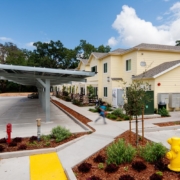
Solar panels covering parking spaces at Calistoga Family Apartmentshttps://flic.kr/p/CpXy7x The U.S. Department of Agriculture

“Worst Case” Rental Housing Needs Changed Little from 2017 to 2019

Only 62 affordable rental units were available for every 100 very low-income renters in 2019, according to Worst Case Housing Needs: 2021 Report to Congress, released on October 5 by the Department of Housing and Urban Development (HUD). While data on the impact of the coronavirus pandemic and economic recession that began in 2020 is not yet available, the report notes that they pose a “great risk of widespread housing problems.”

Households with worst case needs are defined as renters with very low incomes (at or below 50 percent of area median income) who do not receive government housing assistance and pay more than half their income for rent, live in severely inadequate conditions, or both. Cost burden – the mismatch between income and housing costs – is by far the most significant housing problem in all geographic areas. Inadequate housing quality caused only 3 percent of worst case needs nationwide.

In 2019 there were 7.77 million renter households with worst case needs in the U.S., 42.2 percent of all very low-income renters. This represents an improvement from the record high of 8.5 million (44 percent) in 2011 but it remains above the rate during the years preceding the 2007-2009 recession.

Almost three-quarters (74 percent) of worst case renters in 2019 had extremely low incomes (at or below 30 percent of area median), the highest proportion since 2005. Worst case needs were highest among American Indian or Alaskan Native households at 55 percent; 53 percent among Asian households, 45 percent among Hispanic households, 44 percent among non-Hispanic White households, and 36 percent among non-Hispanic Black households and Native Hawaiian or Other Pacific Islander households.

Worst case needs declined in the Midwest, Northeast, and South from 2017 to 2019, but those improvements were offset by an increase in worst case needs in the West.

HAC Agrees with HUD Fair Housing Rule

HAC has submitted a comment letter supporting HUD’s proposed cancellation of a fair housing regulation issued by the Trump administration in September 2020. This rule governs fair housing violation claims based on policies or actions with “disparate impacts” on categories of people protected by the Fair Housing Act.

The 2020 HUD rule, which would have made it more difficult to prove a disparate impact claim, never went into effect. A federal judge issued an injunction that left a 2013 disparate impact regulation in place while a lawsuit against the 2020 version was underway.

In June 2021, HUD proposed to reinstate the 2013 rule. HAC – along with thousands of others – supports that action.

As HAC’s comments pointed out:

Fair access to housing is essential. Research shows that decent, affordable housing improves residents’ physical and mental health, their ability to hold jobs, their children’s performance in school. Children’s life chances are deeply impacted by the neighborhoods where they grow up. Enforcing the Fair Housing Act against discrimination, both intended and incidental, helps our nation move towards inclusive and equitable rural, urban and suburban communities, where all residents can thrive.

HAC News: March 10, 2020

News Formats. pdf

March 10, 2020
Vol. 49, No. 5

USDA and HUD offer resources on coronavirus Household Water Well System Grants available HAC research brief tackles tax relief for sellers of affordable rental properties HUD guidance describes new provisions for small rural PHAs File information regarding a regional plan by June 30 to garner extra points for some USDA RD funding Housing legislation moves forward in the House CFPB provides FAQs for mortgage disclosure rule New RD Deputy Under Secretary named Census to replace American FactFinder Affordable Homes at Risk Many Living in Rural America Struggling with Housing as Cost of Living Outstrips Wages Toolkit for State and Local Government Officials Understanding Rural Attitudes Toward the Environment and Conservation in America • SAVE THE DATE FOR HAC’S 2020 RURAL HOUSING CONFERENCE!Need capital for your affordable housing project?

HAC News Formats. pdf

March 10, 2020
Vol. 49, No. 5

USDA and HUD offer resources on coronavirus.

Both departments provide basic resources and a link to the Centers for Disease Control and Prevention for the most up to date information. HUD suggests housing providers can share CDC fact sheets to help stakeholders understand the virus and steps to protect themselves. It also offers an infectious disease toolkit for Continuums of Care, noting that people experiencing homelessness are especially vulnerable. The National Health Care for the Homeless Council has collected other resources and information on the subject. USDA provides additional information about food safety and pet safety. Articles published by the Daily Yonder and the Center for American Progress present differing perspectives about rural risk: “Rural Areas at Less Risk of Coronavirus Currently” because people have contact with fewer others, or Rural Americans are Vulnerable to the Coronavirus” because they have larger proportions of vulnerable populations, residents often cannot work at home, and access to health care is limited.

Household Water Well System Grants available.

USDA offers grants to nonprofits to establish revolving loan funds that will make loans for household water well systems in places with populations under 50,000, tribal lands and colonias. Apply by May 31. For more information, contact Derek Jones, USDA RD, 202-720-9640.

HAC research brief tackles tax relief for sellers of affordable rental properties.

As the rural rental housing crisis builds, often the best way to preserve a property’s affordability is to sell it to an entity that will keep operating it as an affordable rental. Among the many issues involved in arranging such a sale is the need to cover the seller’s tax bill. A new HAC research brief, Tax Considerations for Rural Housing Preservation, looks at this issue and possible solutions.

HUD guidance describes new provisions for small rural PHAs.

While HUD is developing regulations to implement provisions of a 2018 law related to small PHAs in rural places, it has published initial guidance explaining how it is defining small and rural, and how it is currently implementing provisions that take effect without regulations. Just over 1,500 PHAs fit the definition; see the list of Section 209 Small Rural PHAs. They can inspect voucher units less often than other PHAs and are exempt from environmental review requirements for development or rehab projects costing under $100,000. For more information, contact Harold Katsura, HUD, 202-402-3042.

File information regarding a regional plan by June 30 to garner extra points for some USDA RD funding.

Applicants for community facilities, water and waste, or business programs may receive priority points if their projects support strategic economic and community investment plans. Applicants must submit a form by June 30 to be eligible. For more information, contact an RD state office.

Housing legislation moves forward in the House.

On March 2 the House of Representatives passed the Yes In My Backyard Act (H.R. 4351), which would require governments receiving CDBG funding to report on land use policies that support affordable housing production, and the Improving FHA Support for Small Dollar Mortgages Act (H.R. 5931), which would require the FHA to review its policies, practices and products to identify barriers to supporting mortgages under $70,000. Two other measures were approved by the House Financial Services Committee on February 28 but have not yet been considered by the full House. The Housing is Infrastructure Act (H.R. 5187) would authorize substantial funding increases for numerous housing programs, including USDA’s MPR and Section 504 programs. The Housing Fairness Act (H.R. 149) would fund nationwide housing discrimination testing as well as research and education and would increase appropriations for the Fair Housing Initiatives Program.

CFPB provides FAQs for mortgage disclosure rule.

The consumer agency’s questions and answers pertain to compliance with the TILA-RESPA Integrated Disclosure Rule (TRID) for home mortgage closing cost estimates. Specific topics include corrected closing disclosures and the three business-day waiting period, model forms, construction loans, loan estimates and lender credits.

New RD Deputy Under Secretary named.

Donald “DJ” LaVoy, who has served as Deputy Under Secretary for Rural Development at USDA since September, is retiring. Bette Brand will move into the deputy position. She has most recently been the Administrator of the Rural Business-Cooperative Service. The Under Secretary position, eliminated by USDA Secretary Sonny Perdue and reinstated by the 2018 Farm Bill, remains vacant.

Census to replace American FactFinder.

The U.S. Census Bureau will take its American FactFinder tool offline on March 31. The AFF tool will be replaced with the new data.census.gov utility. While the transition takes place, data and information on rural communities across the country will always be available at HAC’s Rural Data Portal. For more information on HAC’s data portal, contact dataportal@ruralhome.org.

Recent publications and media of interest

Need capital for your affordable housing project? HAC’s loan funds provide low interest rate loans to support single- and multifamily affordable housing projects for low-income rural residents throughout the U.S. and territories. Capital is available for all types of affordable and mixed-income housing projects, including preservation, farmworker, senior and veteran housing. HAC loan funds can be used for pre-development, site acquisition, site development and construction/rehabilitation. Contact HAC’s loan fund staff at hacloanfund@ruralhome.org, 202-842-8600.

Please note: HAC is not able to offer loans to individuals or families. Borrowers must be nonprofit or for-profit organizations or government entities (including tribes).

HAC 2020 Conference Footer

HAC News: February 20, 2020

News Formats. pdf

February 20, 2020
Vol. 49, No. 4

February is National African American History Month • Administration’s budget proposes cuts in many housing programs, but not rural rental preservation CRA comment period extended to April 8 VA offers per diem funds for veterans’ housing stabilization HUD joins in proposing rule changes for faith-based organization FCC launches fund to spread broadband in rural America, legislators concerned White House releases guide to help local communities tackle the rural opiod and drug crisis Comments requested on alternative measures of poverty HUD asks tribes for input on two-year funding notices CEOs and nonprofit leaders sought for Achieving Excellence program Appalachia Gets Special Funding. The Black Rural South Deserves It Too Colorado’s Housing Crisis has Gotten So Bad that Small Towns are Now Building People Homes The Rural Health Safety Net Under Pressure: Rural Housing Volunerability The Trump Administration’s Latest Attack on Fair Housing Where Light Pollution is Seeping into the Rural Night Sky • HAC Seeks is Hiring an Executive Assistant • SAVE THE DATE FOR HAC’S 2020 RURAL HOUSING CONFERENCE!Need capital for your affordable housing project?

HAC News Formats. pdf

February 20, 2020
Vol. 49, No. 4

February is National African American History Month.

Administration’s budget proposes cuts in many housing programs, but not rural rental preservation.

Like its past budgets, the Administration’s proposal for Fiscal Year 2021 proposes to eliminate many housing programs, including USDA’s Section 502 direct loans for homebuyers, Section 515 and 514/516 loans and grants for rental housing production, and HUD’s CDBG, HOME and SHOP, while supporting renewal of Section 521 Rental Assistance contracts and Section 542 vouchers. Unlike previous versions, the budget proposes to increase USDA’s MPR preservation program to $40 million from $28 million in FY20. It would also fund two repair programs, Section 504 grants for very low-income elderly homeowners and Section 533 Housing Preservation Grants. The House and Senate usually do not follow the budget closely when developing their appropriations legislation for the year.

CRA comment period extended to April 8.

The Federal Deposit Insurance Corporation and the Office of the Comptroller of the Currency have extended the deadline for input on their proposed changes to Community Reinvestment Act regulations. Comments will be due on April 8 rather than on March 9, as originally scheduled.

VA offers per diem funds for veterans’ housing stabilization.

The Department of Veterans Affairs’ Homeless Providers Grant and Per Diem Program will fund nonprofits, state and local governments and tribes to provide per diem payments to facilitate housing stabilization for veterans who are homeless or at risk of becoming homeless. Apply by April 22. For more information, contact Jeffery Quarles, VA, 813-979-3570.

HUD joins in proposing rule changes for faith-based organizations.

Like the proposed rules published by USDA and other agencies in January, HUD’s proposal would delete the requirement for faith-based social service providers to refer beneficiaries to an alternative provider if desired. Faith-based organizations would not be required to provide notices unless secular organizations have the same requirements. Comments to HUD are due April 13. (Comments on the USDA proposal are due February 18.) For more information, contact Richard Youngblood, HUD, 202-402-5958.

FCC launches fund to spread broadband in rural America, legislators concerned.

The Federal Communications Commission adopted rules on January 30 for its new Rural Digital Opportunity Fund. Up to $20.4 billion will be released in two phases. The first phase will begin later this year and target areas wholly without broadband, while the second phase will open to those partially served by broadband. The FCC’s report includes details and the final regulations. Members of the House have written to FCC Chairman Ajit Pai expressing concerns about the RDOF’s coordination with state-level broadband efforts.

White House releases guide to help local communities tackle the rural opioid and drug crisis.

The Rural Community Action Guide aims to educate the public by providing an overview of the challenges rural communities face when addressing prescription opioid misuse and the use of illicit substances. It also showcases localized efforts implemented to help mitigate the impact of substance use disorder. HAC provided the housing chapter for the guide.

Comments requested on alternative measures of poverty.

OMB invites the public to comment by April 14 on questions asked by the Interagency Technical Working Group on Evaluating Alternative Measures of Poverty to help inform its recommendations on producing additional measures of poverty. The Working Group has issued a consensus interim report but has not yet decided whether to recommend development of a new poverty measure. For more information, contact Kerrie Leslie, OMB, 202-395-1093.

HUD asks tribes for input on two-year funding notices.

For recent tribal funding competitions, HUD has experimented with offering two years of appropriations in a single Notice of Funding Availability. It requests comments from tribes by March 13 about this approach, sent to ONAP_ICDBG@hud.gov or by mail to the address provided in the request.

CEOs and nonprofit leaders sought for Achieving Excellence program.

The NeighborWorks Achieving Excellence program, in collaboration with Harvard University’s Kennedy School of Government, offers senior leaders of nonprofits a 16-month program that addresses an organizational challenge or opportunity defined by each participant. Applications are due April 15.

Recent publications and media of interest

HAC is hiring an Executive Assistant.

The Executive Assistant supports the work of HAC’s CEO and Board of Directors. Based in Washington, DC, the position is a blend of administrative work and project assignments for an earlycareer professional. The candidate will manage the CEO’s calendar, organize meetings, plan events and make travel arrangements while working on special initiatives and assignments as the candidate grows into a career in policy, program administration or nonprofit management. Email a resume and brief cover letter to jobs@ruralhome.org with “Executive Assistant” in the subject line. Applications will be considered as received. HAC is an equal opportunity employer and lender.


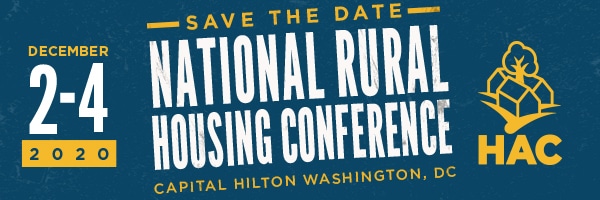
SAVE THE DATE FOR HAC’S 2020 RURAL HOUSING CONFERENCE!

The conference will be held in Washington, DC on December 2-4, 2020 with pre-conference meetings on December 1. The HAC News will announce more details, including registration, as they become available.


Need capital for your affordable housing project? HAC’s loan funds provide low interest rate loans to support single- and multifamily affordable housing projects for low-income rural residents throughout the U.S. and territories. Capital is available for all types of affordable and mixed-income housing projects, including preservation, farmworker, senior and veteran housing. HAC loan funds can be used for pre-development, site acquisition, site development and construction/rehabilitation. Contact HAC’s loan fund staff at hacloanfund@ruralhome.org, 202-842-8600.

Please note: HAC is not able to offer loans to individuals or families. Borrowers must be nonprofit or for-profit organizations or government entities (including tribes).

HAC News: January 27, 2020

News Formats. pdf

January 27, 2020
Vol. 49, No. 2

Administration’s FY21 budget to be released February 10 • Rural broadband funds available • USDA proposes rule changes related to faith-based organizations • Disaster funding for Puerto Rico moves forward • USDA offers advice on compliance with disability requirements • Updated guidance on lead-based paint offered by USDA and HUD • USDA annual tenant data released • 2020 Census launches • 2,500 Affordable Apartments in Rural Maine at Risk as Federal Program Ends • Alternative Drinking Water Systems: Use by Very Small Communities, Related Cost Savings, and Technical Assistance provided by EPA and USDA • Family Homelessness: Measuring Progress • How a Dozen Organizations are fighting Persistent Poverty Together • Research Shows Rental Assistance Reduces Hardship and Provides Platform to Expand Opportunity for Low-Income Families • Storytelling Toolkit: Lessons Learned from NHT’s “Where Will We Live?” • Two-thirds of Rural Counties Gain Jobs from November 2018 to 2019 • HAC Seeks Senior Portfolio Manager • SAVE THE DATE FOR HAC’S 2020 RURAL HOUSING CONFERENCE!HAC offers Section 512 packaging training for nonprofits, March 10-12 in Virginia • Need capital for your affordable housing project?

HAC News Formats. pdf

January 27, 2020
Vol. 49, No. 2

Administration’s FY21 budget to be released February 10.

The Trump Administration is expected to release its budget request for fiscal year 2021 on February 10, beginning the process of funding the federal government for the year that begins on October 1, 2020. Overall spending levels for the year are already in place, set by legislation adopted in July 2019.

Rural broadband funds available.

The application window opens January 31 for the Rural eConnectivity Pilot Program (ReConnect Program), which offers loans, grants and combinations to facilitate broadband deployment in rural areas. State and local governments, tribes, nonprofits, for-profits and coops can apply by March 16. RUS also requests comments on the program by March 16. For more information, visit https://reconnect.usda.gov or contact Chad Parker, RUS, 202-720-9554.

USDA proposes rule changes related to faith-based organizations.

Changes to rules on faith-based entities as federal program providers have been suggested by USDA and several other federal departments and agencies. USDA’s proposal includes eliminating a requirement for a faith-based service provider to refer beneficiaries to an alternative provider if they do not want to receive services from the faith-based provider. It would also ensure that faith-based organizations are not required to provide any assurances or notices unless similar requirements are imposed on non-faith-based organizations. Comments are due February 18. For more information, contact Emily Tasman, USDA Office of General Counsel, 202720-3351.

Disaster funding for Puerto Rico moves forward.

After missing a September 4 deadline, HUD has now published the conditions Puerto Rico must meet in order to access $8.25 billion in disaster mitigation (not recovery) funds appropriated in 2018. HUD announced it has prepared a grant agreement for another $8.2 billion in hurricane disaster recovery funds, though, according to the National Low Income Housing Coalition, the agreement’s terms are not publicly available and Puerto Rico has not yet signed it. HUD also recently named a Federal Financial Monitor who will oversee administration and disbursement of hurricane recovery funds for Puerto Rico and the U.S. Virgin Islands. Additional funding to help Puerto Rico recover from recent earthquakes has been proposed by some members of the House Appropriations Committee, who drafted a bill to provide $3.35 billion in FY20 emergency supplemental funding for the island, including $2 billion in CDBG disaster recovery monies.

USDA offers advice on compliance with disability requirements.

A January 10 Unnumbered Letter summarizes steps USDA staff and operators of USDA-financed rental housing should take to comply with Section 504 of the Rehabilitation Act of 1973, which requires accessibility for people with disabilities.

Updated guidance on lead-based paint offered by USDA and HUD.

Along with a table showing which HUD regulations on lead-based paint hazards apply to specific programs run by USDA RD agencies, Administrative Notice 4873 (December 5, 2019) lists exemptions, compliance funding sources, implementation responsibilities and details relevant to individual programs. HUD recently posted trainings and other resources online related to its lead safe housing rule.

USDA annual tenant data released.

USDA’s annual update of data on the tenants in Section 515 and 514/516 properties is now available online. Tenant characteristics as of September 2019 were similar to those in September 2018. Section 515 residents are still largely elderly or disabled (65.2%). The average income of all Section 515 residents is $13,551, an increase from $13,112 in 2018. During that one-year period, 214 Section 515 properties and 10 Section 514 properties – about 4,500 units, just over 1% of the total – left USDA’s portfolio. Past reports back to 2010 are posted on HAC’s website.

2020 Census launches.

On January 21 in Toksook Bay, Alaska the 2020 Census began counting U.S. residents to determine the number of seats each state will hold in the House of Representatives and how billions of dollars in federal funds will be allocated. Most U.S. households will receive information in March about responding. The Census is still recruiting temporary workers for positions across the country.

Recent publications and media of interest

HAC seeks Senior Portfolio Manager.

The Senior Portfolio Manager provides leadership and oversight to a team that performs a range of lending activities – closing, disbursement, monitoring, servicing and asset management of single-family and multifamily housing development loans – in HAC’s Loan Fund Division, based in Washington, DC. Email a resume and brief cover letter to jobs@ruralhome.org with “Senior Portfolio Manager” in the subject line. Applications will be considered as received.


SAVE THE DATE FOR HAC’S 2020 RURAL HOUSING CONFERENCE!

The conference will be held in Washington, DC on December 2-4, 2020 with pre-conference meetings on December 1. The HAC News will announce more details, including registration, as they become available.


HAC offers Section 502 packaging training for nonprofits, March 10-12 in Virginia. This three-day advanced course trains experienced participants to assist potential borrowers and work with RD staff, other nonprofits and regional intermediaries to deliver successful Section 502 loan packages. The training will be held in Glen Allen, VA on March 10-12. For more information, contact HAC staff, 404-892-4824.

Need capital for your affordable housing project? HAC’s loan funds provide low interest rate loans to support single- and multifamily affordable housing projects for low-income rural residents throughout the U.S. and territories. Capital is available for all types of affordable and mixed-income housing projects, including preservation, farmworker, senior and veteran housing. HAC loan funds can be used for pre-development, site acquisition, site development and construction/rehabilitation. Contact HAC’s loan fund staff at hacloanfund@ruralhome.org, 202-842-8600.

Please note: HAC is not able to offer loans to individuals or families. Borrowers must be nonprofit or for-profit organizations or government entities (including tribes).

GET THE HAC NEWS!

Sign-up for HAC information products

SIGN UP HERE

Housing Assistance Council   |  1828 L Street. N.W., Suite 505, Washington, D.C. 20036
(202) 842-8600 (202) 347-3441 hac@ruralhome.org |

Board Portal

HAC is an equal opportunity provider, employer, and lender. | Civil Rights | Privacy