
Updated data on USDA tenants released

February 26, 2019 – USDA has released its annual “fair housing occupancy report,” which provides data on the characteristics of tenants in its multifamily portfolio. The report, which uses September 2018 data, shows the average annual income of Section 515 tenant households is $13,112 with the average income of Section 515 residents who receive USDA Section 521 Rental Assistance at $10,911.

White non-Hispanics make up 67.8 percent of tenant households in Section 515 developments, while 79.8 percent of Section 514/516 farmworker households are Hispanic. Female-headed households (71.0 percent) and elderly/disabled households (62.8 percent in all properties and 64.4 percent in Section 515) also comprise large majorities of the tenant population.

Almost seven in ten households receive USDA Rental Assistance (68.4 percent), with an additional 13.1 percent getting some other form of rent aid. Just under 12 percent of tenant households are cost-burdened, paying more than 30 percent of their incomes for their housing. More than a third of the cost-burdened tenants pay over half their incomes for housing.

The report says the number of properties in USDA’s rental portfolio fell by 1.79 percent over the past year. The portfolio lost 227 Section 515 properties and 24 farmworker housing properties, with a total of 4,820 units. No additional information about these developments is provided.

Altogether, the report offers more than 40 pages of national and state-level data for tenants living in Section 515 rental housing, living in Section 514/516 farm labor housing, or receiving Section 521 Rental Assistance. Reports from past years are available on HAC’s website.

Father and son

HAC now accepting applications for rural veterans housing grants

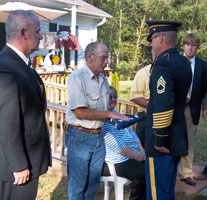
vets fin resourcesHAC’s Affordable Housing for Rural Veterans initiative supports local nonprofit housing development organizations that meet or help meet the affordable housing needs of veterans in rural areas. Grants may be up to $30,000 and must support bricks-and-mortar projects that assist low-income, elderly and/or disabled veterans with home repair and rehab needs, support homeless veterans, help veterans become homeowners, and/or secure affordable rental housing. This initiative is funded through the generous support of The Home Depot Foundation. Applications are due March 11.

Download the Application package: Application | Application Guidelines

For more information, contact HAC staff, ahrv@ruralhome.org.

Federal shutdown continues, impact on rural renters still unclear

As of January 8, 2019, parts of the federal government including USDA and HUD remain shut down. HAC has not been able to learn any additional information about the impact on USDA Section 521 Rental Assistance and Section 542 vouchers since our December post.

The National Rural Housing Coalition has compiled information about the shutdown’s early impacts on rural housing organizations around the country.

– Posted by Leslie Strauss

Materials Posted: Proposed Changes to CRA – What Does It Mean for Rural America?

Materials Posted

PowerPoint Presentation | Webinar Recording | HAC Reports on CRA in Rural America

The Office of the Comptroller of the Currency (OCC) recently issued a call for input on its regulations implementing the Community Reinvestment Act, which requires banks to help meet the credit needs of the communities they serve. OCC’s notice says it is building a new framework to transform and modernize its CRA rules.

Please Join the Housing Assistance Council (HAC) for an overview of the proposed changes and a discussion on how rural communities can weigh in on the proposal.

Materials Posted – Part 1 – Housing and Urban Development-Veterans Affairs Supportive Housing (HUD-VASH): An Overview

Materials Posted

PowerPoint Presentation | Webinar Recording

Permanent supportive housing has been identified in both the Federal Strategic Plan to Prevent and End Homelessness and the Ending Veteran Homelessness Initiative as a critical resource for ending homelessness. Within VA, HUD-VASH is the primary service that provides permanent supportive housing. Through collaboration with HUD, HUD-VASH provides Housing Choice Vouchers designated to participating Public Housing Authorities (PHA) to assist with rent payment. VA provides clinical case management and services to assist Veterans obtain and sustain permanent housing while also assisting Veterans with access to treatment and other supportive services that promote their quality of life and full reintegration back into their communities.

HUD-VASH operates on the Housing First principles and is intended to target and care for the chronic and most vulnerable homeless Veterans. Housing First is an evidence-based approach based on the premise that housing is a basic human right and does not have prerequisites such as sobriety or clean time. It prioritizes housing, then assists individuals with access to health care and other supports that promote stable housing and improved quality of life.

The primary goal of HUD-VASH is to move Veterans and their families out of homelessness into permanent supportive housing while promoting maximum Veteran recovery and independence in the community. A key component of the program is VA’s case management services. These services are designed to assist Veterans in obtaining and sustaining permanent housing and engage in needed treatment and other supportive services that improve the Veteran’s quality of life and end their homelessness. Because Veterans experience homelessness for a variety of reasons, case management is individually tailored to meet the needs of each HUD-VASH Veteran.

This webinar, the first in a two part series that will provide information to community providers on housing services available to Veterans who are homeless or at risk of becoming homeless. The webinar will provide an overview of the HUD-VASH program including who is eligible for services and how to make a referral for a Veteran to be assessed for admission. There will also be information on how HUD-VASH vouchers are allocated and the difference between tenant-based and project-based HUD-VASH vouchers.

There's Still Time to Nominate Someone for a Rural Housing Award

HAC is still accepting nominations for its 2018 Cochran/Collings National Service and Skip Jason Community Service Leadership Awards. Nominations are now due Friday, September 14, 2018. The awards will be presented at the 2018 Rural Housing Conference in December. Complete the online nomination form.

Questions? Contact HAC’s Lilla Sutton at (202) 842-8600 or lilla@ruralhome.org.

2018 California Wildfires Disaster Guide

August 1, 2018

HAC’s 2018 California Wildfires Disaster Guide provides resources for emergency preparedness and disaster recovery.

2018 California Wildfires Disaster Guide Supplement

2017 Southern California Wildfires Disaster Guide

December 22, 2017

HAC’s 2017 Southern California Wildfires Disaster Guide provides resources for emergency preparedness and disaster recovery.

2017 Southern California Wildfires Disaster Guide Supplement

Income Inequality in Rural America

HAC Executive Director Moises Loza submitted the following Letter to the Editor to the Washington Post on June 27, 2016.

“The rural reaches of income inequality” (June 26) raises issues that are too often ignored. As the Housing Assistance Council works to improve housing conditions for low-income rural Americans, we are well aware of the consequences of income inequality. In places with significant income differences, the wealthy depend on service workers but those who wait tables, work in retail, clean homes, and maintain lawns cannot afford decent homes near their jobs.

There are other costs as well. For example, USDA’s Economic Research Service has identified the growth in income inequality as the major factor increasing rural child poverty from 2003 to 2014. The Robert Wood Johnson Foundation and the University of Wisconsin Population Health Institute report that counties with high levels of child poverty and income inequality are often less healthy than those with lower levels. (Their study defined income inequality as the difference between the 20th and 80th percentiles rather than between the top 1 and bottom 99.)

Even without income inequality, of course, poverty can be dangerous. The Post’s interactive online map shows that in Oglala Lakota County, SD (formerly named Shannon County), the top 1 percent makes only 5.3 times as much as the bottom 99 percent. Income inequality is hardly a problem there, but deep, persistent poverty is. Oglala Lakota County, which lies entirely within the Pine Ridge Indian Reservation, has had a poverty rate well over 50 percent for decades. As a result, 51 percent of homes in the county are physically deficient and 26 percent are overcrowded.

Serious housing problems exist in other persistent poverty counties, as well. These areas, which tend to have low proportions of the extreme income inequality highlighted in the Post’s article, are concentrated in certain parts of the country: Native American lands, Appalachia, the Lower Mississippi Delta and the Southern Black Belt, and the colonias along the U.S.-Mexico border. Income and housing issues are common among farmworkers, as well, although those are not as visible on a map. Notably, minorities are the majority in five of these six regions and populations (Appalachia being the exception).

Thanks are due to the Post for its reporting and to the Economic Policy Institute for including rural places in its income inequality research. As income inequality, job opportunities, and race drive the politics of the day, we cannot continue to overlook their presence anywhere in the country.

Moises Loza
Executive Director
Housing Assistance Council

GET THE HAC NEWS!

Sign-up for HAC information products

SIGN UP HERE

Housing Assistance Council   |  1828 L Street. N.W., Suite 505, Washington, D.C. 20036
(202) 842-8600 (202) 347-3441 hac@ruralhome.org |

Board Portal

HAC is an equal opportunity provider, employer, and lender. | Civil Rights | Privacy