USDA Rural Development Obligations FY 17 – March

Download complete report (Through March FY 2017)

thumb usda-obs-cover

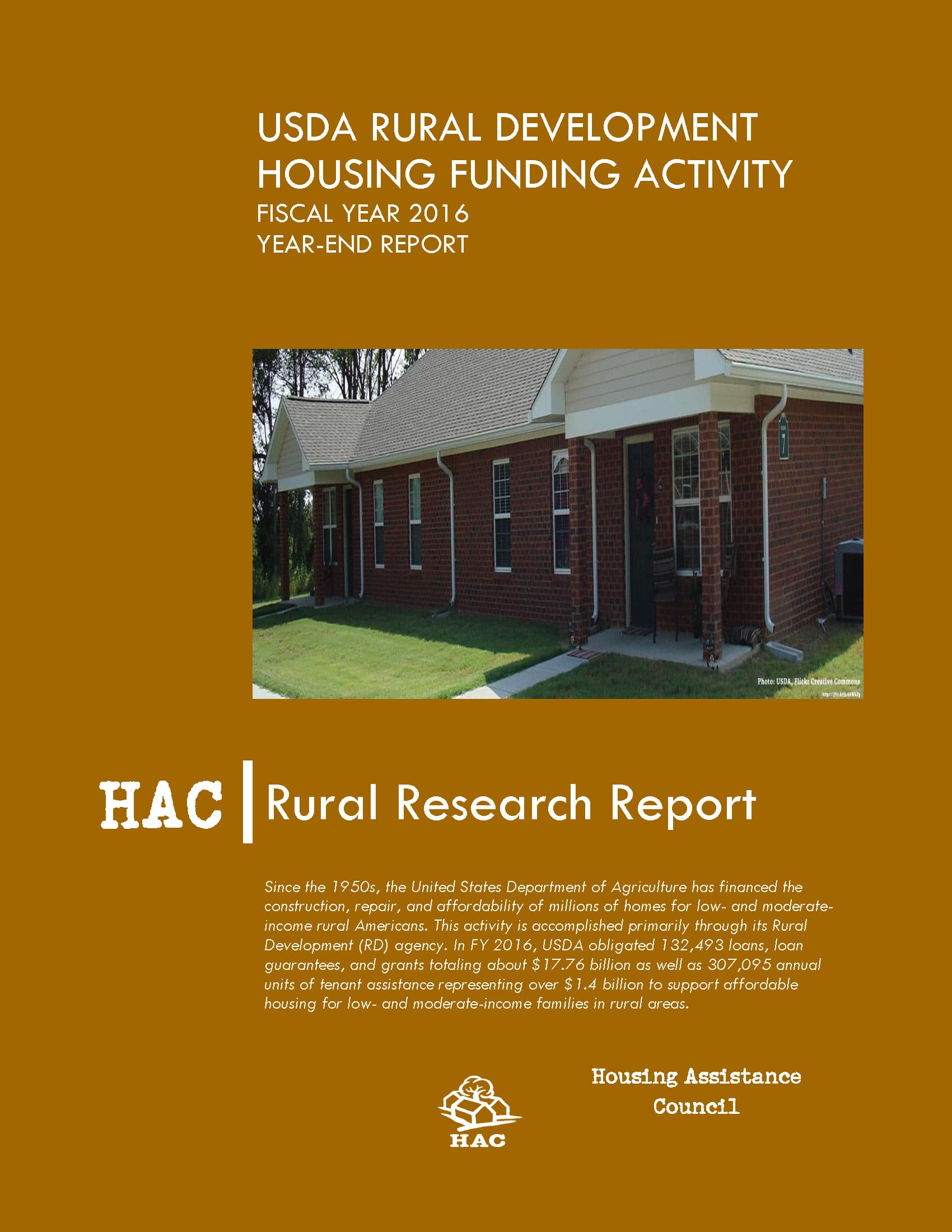
The Housing Assistance Council (HAC) presents this month’s report on Fiscal Year 2017 USDA Rural Housing program obligations.

USDA is operating under a Continuing Resolution (CR) which provides funding through April 28, 2017 based on last year’s appropriation levels. Congress will need to pass a final appropriations bill or another CR to keep the government operating after the CR expires.

As of the end of March, USDA obligated 69,689 loans, loan guarantees, and grants totaling about $9.51 billion. This is about $2.04 billion more than obligation levels from the same time last year when there were 56,760 loans, loan guarantees, and grants obligated totaling about $7.46 billion.

Single Family Housing Program Highlights

The Section 502 Guaranteed loan program, the largest of the Single Family Housing programs, obligated $8.95 billion (62,513 loan guarantees) up from $7.0 billion (50,513) at the same time last year.

For the Section 502 Direct program, there have been over $429 million (3,179 loans), also up from $354.8 million (2,699 loans) in loan obligations this time last year. Very low-income (VLI) loan obligations as a percentage of the total Section 502 Direct loan dollars was 37.5 percent, exceeding the 30.4 percent VLI obligation level at the same time last year.

The Section 504 Repair and Rehabilitation programs obligated 1,535 loans representing $8.4 million. As in the other single family housing programs, loan volume was up from this time last year (1,250 loans representing $6.8 million.) There were also $14.4 million (2,370 grants) obligated in the Section 504 grant program compared to $13.6 million (2,213 grants) at the same time last year.

There were also 4 credit sales of Single Family properties totaling $346,100.

Multi-Family Housing Programs

USDA’s Section 538 Multifamily Housing obligated 39 loan guarantees totaling $71.1 million. In the Section 515 Rural Rental Housing program, there were 10 loans totaling $10.5 million obligated. There were also 13 MPR loans and 2 grants totaling $10.9 million and $53,200 respectively.

USDA obligated funds for 174,967 rental assistance units under the Section 521 Rental Assistance program totaling $793.4 million. This compares to about 207,855 units ($977.7 million) obligated same time last year. There were also 2,712 Rural Housing Vouchers totaling $10.4 million compared to 2,751 vouchers representing $10.4 million this time last year.

Download the combined document.

* The Rural Housing Service (RHS) monthly obligation reports are produced by the Housing Assistance Council (HAC) 1025 Vermont Ave., NW, Suite 606, Washington, DC 20005. The monthly figures derive from HAC tabulations of USDA –RHS 205c, d, and f report data. For questions or comments about the obligation reports, please contact Michael Feinberg at 202-842-8600 or michael@ruralhome.org.

HAC News: April 13, 2017

HAC News Formats. pdf

April 13, 2017
Vol. 46, No. 8

April is National Fair Housing Month • Congress on recess, faces spending decisions • Housing will be in infrastructure proposal, Carson tells NLIHC group • Grants available for Lead and Healthy Homes Technical Studies • OMB issues second memo about cutting regulations • Funding cuts estimated for states, counties, and cities • Guidance issued for Section 523 self-help grants extensions, final evaluations, and applications • HUD offers technical assistance to CoCs seeking to end veteran homelessness • RD addresses documentation on credit availability for Community Facilities programs • Rural impact report illustrates nonprofits’ successes • Online USDA rural housing data described, updated • Housing Trust Fund state plans described and allocations revised • Report recommends ways to reduce racial/ethnic divide in homeownership • Web tool shows how green infrastructure protects against climate threats • Rural placemaking grantees announced

HAC News Formats. pdf

April 13, 2017
Vol. 46, No. 8

April is National Fair Housing Month. The National Fair Housing Alliance has posted a list of events around the country. People who believe they have experienced housing discrimination may file a complaint with HUD’s Office of Fair Housing and Equal Opportunity, 800-669-9777.

Congress on recess, faces spending decisions. When members of Congress return to work on April 24, they will have only a few days to agree on spending levels for the remainder of FY17 before the current Continuing Resolution expires on April 28. (See HAC News, 3/30/17.)

Housing will be in infrastructure proposal, Carson tells NLIHC group. The National Low Income Housing Coalition reports that in an address to its 2017 Housing Policy Forum, HUD Secretary Ben Carson said there is “a significant inclusion of housing” in the Administration’s forthcoming infrastructure bill. NLIHC President and CEO Diane Yentel noted that a one-time spending boost could not replace annual appropriations.

Grants available for Lead and Healthy Homes Technical Studies. Applications are due May 16 for these HUD programs, which fund technical studies to improve detection and control of key housing-related health and safety hazards, including lead-based paint hazards; to develop new methods to detect and control these hazards; and to improve knowledge of these hazards. For more information, contact Peter Ashley, HUD.

OMB issues second memo about cutting regulations. In memos dated April 5 and February 2, the Office of Management and Budget explains how federal agencies are expected to implement Executive Order 13771, which requires repealing two regulations for each new one and capping regulatory costs. (See HAC News, 2/2/17.)

Funding cuts estimated for states, counties, and cities. An interactive online tool calculates how the Trump Administration’s proposed FY18 budget cuts to major HUD programs (see HAC News, 3/16/17) would affect each state and county, as well as major cities. It compares the cuts to FY16 funding levels.

Guidance issued for Section 523 self-help grants extensions, final evaluations, and applications. Administrative Notice 4828 (March 27, 2017) provides guidance on RD processing of applications for self-help technical assistance grants. AN 4827 (March 29, 2017) offers information for RD evaluations of performance under Section 523 self-help grants and consideration of extensions or other revisions. For more information, contact a USDA RD state office.

HUD offers technical assistance to CoCs seeking to end veteran homelessness. Continuums of Care new to HUD’s Vets@Home effort can submit TA requests through the HUD Exchange to access technical assistance and additional resources.

RD addresses documentation on credit availability for Community Facilities programs. An Unnumbered Letter dated March 9, 2017 explains how to show that other financing is not available or feasible when a CF loan, grant, or guarantee is sought. For more information, contact a USDA RD state office.

Rural impact report illustrates nonprofits’ successes. The National Rural Housing Coalition surveyed local nonprofits about their activity in seven categories in FY16, including homeownership, rental housing, and clean water and sewer. Among the 104 responding organizations, 84 assisted 3,139 families in rural communities with rehabilitating, constructing, or purchasing their homes. There were 24,104 families on the waiting lists of 26 organizations. The report and presentations of some of its case studies are available online.

Online USDA rural housing data described, updated. “New Public Data Available on USDA Rural Housing Service’s Single-Family and Multifamily Programs,” an article in HUD’s Cityscape journal, discusses what data is available, its challenges and limitations, and its possible uses. Separately, USDA RD has updated its maturing mortgage data for Section 515 and 514/516 properties.

Housing Trust Fund state plans described and allocations revised. In Housing the Lowest Income People: An Analysis of National Housing Trust Fund Draft Allocation Plans, the National Low Income Housing Coalition reviews draft plans from each state indicating how they may use HTF funds when received. For more information, contact Ed Gramlich, NLIHC. HUD has also corrected errors in its initial allocation of FY16 funds among states and territories.

Report recommends ways to reduce racial/ethnic divide in homeownership. A Downpayment on the Divide: Steps to Ease Racial Inequality in Homeownership, published by CFED, reports that white families (71.9%) are much more likely to own a home than Black (41.3%) and Latino (47%) families. While 34% of white wealth is generated through homeownership, about 56% of Black and Latino wealth is. (There was not enough data to include other races in the study.) Helping to close these gaps would significantly help reduce wealth disparities, CFED says. Its suggestions include reforming the mortgage interest deduction, supporting the CFPB, enforcing the Fair Housing Act, and others.

Web tool shows how green infrastructure protects against climate threats. Naturally Resilient Communities is an interactive tool featuring 30 case studies of places that rely on nature-based solutions such as wetlands and floodplains to protect themselves against flooding. It was developed by the Nature Conservancy in partnership with the American Planning Association, American Society of Civil Engineers, National Association of Counties, and Association of State Floodplain Managers. To search the collection, users select scale, cost, region, and whether a community is urban, suburban, or rural.

Rural placemaking grantees announced. HAC and buildingcommunityWORKSHOP have selected two organizations for a Rural Placemaking Program. The smART Kinston City Project Foundation will partner artists with local stakeholders to address racial tensions and economic inequity in Kinston, NC. The Woodlands Development Group will work with an arts nonprofit to develop public art and wayfinding installations in Thomas, WV.

HAC News: March 30, 2017

HAC News Formats. pdf

March 30, 2017
Vol. 46, No. 7

Committee holds hearing, supports Perdue for USDA • Administration proposes FY17 cuts, targets include USDA RA • Senate committee requests proposals for economic growth legislation • RD continues two-tier income pilot for single-family programs • Impact of eliminating Delta and Appalachian regional bodies quantified • Nonmetro counties lost jobs in 2016 • 14% of U.S. children live in areas of concentrated poverty, rates highest for black and Native American kids • Nominations open for site manager and maintenance person recognitions • Housing events planned nationwide for Saturday, April 1

HAC News Formats. pdf

March 30, 2017
Vol. 46, No. 7

Committee holds hearing, supports Perdue for USDA. Former Georgia governor Sonny Perdue appeared before the Senate Agriculture Committee on March 23. He pointed out he had no role in developing the Administration’s budget, which proposes a 21% cut to USDA funding for FY18, and noted that President Trump received strong support in rural areas. The committee voted on March 30 to recommend Perdue be confirmed as Secretary of Agriculture. A vote in the full Senate has not yet been scheduled, but confirmation is expected.

Administration proposes FY17 cuts, targets include USDA RA. Early this week the Trump Administration circulated a list of spending cuts it proposes for FY17, many of them similar to those included in its FY18 budget outline. The FY17 list would reduce USDA Section 521 Rental Assistance by $50 million, saying that is excess funding not needed this year; would cut CDBG in half; and would eliminate funding for SHOP, Rural Capacity Building, the CDFI Fund, and more. Members of Congress are reportedly unwilling to consider new suggestions for the FY17 funding bills they have been negotiating for months. Appropriators in both houses are working to finish as many as possible of the 11 remaining individual appropriations bills before the current Continuing Resolution expires on April 28. Any incomplete bills are expected to be rolled together into another CR to finish the fiscal year.

Senate committee requests proposals for economic growth legislation. Submissions to the Senate Committee on Banking, Housing and Urban Affairs should “clearly identify” proposals that will “promote economic growth and/or enable consumers, market participants and financial companies to better participate in the economy,” and should include legislative language. Emails are due April 14.

RD continues two-tier income pilot for single-family programs. For a second year, income eligibility in 23 states and territories will be based on two income bands, using HUD’s four-person income level for households with one to four members and HUD’s eight-person income level for households with five to eight people. Contact an RD state office.

Impact of eliminating Delta and Appalachian regional bodies quantified. The Trump Administration’s budget outline for FY18 proposes to eliminate the Appalachian Regional Commission and the Delta Regional Authority (along with a number of other entities). The Center for American Progress Action Fund has posted data on dollars, jobs, and other factors showing the ARC’s and DRA’s achievements in each state they serve.

Nonmetro counties lost jobs in 2016. A Daily Yonder analysis of federal jobs data found U.S. employment growth was concentrated in large metropolitan areas. Some rural places, such as Appalachia, did gain some jobs, while others, like those where shale gas fracking had boomed relatively recently, lost employment during 2016. Job losses were proportionally highest in counties not adjacent to metro areas.

14% of U.S. children live in areas of concentrated poverty, rates highest for black and Native American kids. The Annie E. Casey Foundation’s Kids Count Data Center reports the incidence of children living in census tracts with poverty rates of 30% or higher increased by almost 30% from the 2006-2010 period to 2011-2015. The largest state-level increase over that time was in Nevada, though the states with the highest rates (20-27%) of children living in high poverty areas in 2011-2015 were Arizona, Louisiana, Mississippi, and New Mexico. Nationwide, African American (32%) and Native American (31%) children were six times more likely to live in neighborhoods with concentrated poverty compared to their white (5%) peers, and Hispanic children (23%) more than five times more likely. Data on race are also reported for each state.

Nominations open for site manager and maintenance person recognitions. USDA RD state offices can submit nominations by May 19 for the agency’s annual awards to site managers and maintenance workers at RD-financed rental properties. Contact an RD state office.

Housing events planned nationwide for Saturday, April 1. Activities include speakers and education sessions in more than 20 cities and towns.

HAC News: March 16, 2017

HAC News Formats. pdf

March 16, 2017
Vol. 46, No. 6

Administration’s FY18 budget outline released • Trump orders plan for reorganizing executive branch agencies • Indian CDBG funds available • Pilot to increase nonprofit preservation of Section 515 properties took effect March 1 • HUD withdraws comment requests for LGBTQ youth and gender nonconforming people • Congressional committee reviews National Flood Insurance Program • Report makes case for increased federal investments in affordable housing • Research finds large shifts in income for many, and associated financial strain • Upcoming Webinars on the Federal Budget

HAC News Formats. pdf

March 16, 2017
Vol. 46, No. 6

Administration’s FY18 budget outline released. The Trump Administration’s preliminary budget proposal, named America First: A Budget Blueprint to Make America Great Again, summarizes parts of a longer proposal to be issued in May. Final funding decisions will need to be passed by Congress and signed into law by the President. The outline does not specifically mention USDA’s Rural Housing Service or rural housing programs. It does, however, propose to reduce USDA’s overall funding by 21% and HUD’s by 13.2%. It would eliminate CDBG, HOME, SHOP, Weatherization Assistance, LIHEAP, CSBG, and most of the CDFI Fund’s monies. Rural water and wastewater loans and grants would be zeroed out, along with Rural Business-Cooperative Service discretionary activities, and USDA Service Centers would see staffing reductions. HUD’s lead hazard control funding would be increased from $110 million to $130 million. VA programs for homeless and at-risk veterans and their families would be supported, as would opioid treatment and prevention. Among the 19 independent agencies slated for elimination are the Corporation for National and Community Service (which runs AmeriCorps), the Legal Services Corporation, the Neighborhood Reinvestment Corporation (NeighborWorks® America), and the U.S. Interagency Council on Homelessness, as well as several regional entities: the Appalachian Regional Commission, the Delta Regional Authority, the Denali Commission, and the Northern Border Regional Commission. Rural areas would also be impacted by termination of federal support for Amtrak’s long distance train services and by the repercussions of numerous Administration policies.Visit HAC’s website for more information and a statement on the budget.

Trump orders plan for reorganizing executive branch agencies. An Executive Order dated March 13 requires agency heads to submit reorganization plans to OMB by mid-September 2017. OMB must publish a Federal Register notice inviting public comment. By mid-March 2018, OMB will compile a proposed plan including, “as appropriate, recommendations to eliminate unnecessary agencies, components of agencies, and agency programs, and to merge functions.”

Indian CDBG funds available. Tribal governments and other tribal organizations can apply by May 18. For more information, contact Frederick J. Griefer, HUD, 202-402-5186.

Pilot to increase nonprofit preservation of Section 515 properties took effect March 1. The pilot, announced in September 2016 (see HAC News, 11/3/16), will run for two years, allowing some incentives to recognize return on investment capital that have not been previously available to nonprofits. For more information, contact a USDA RD State Office.

HUD withdraws comment requests for LGBTQ youth and gender nonconforming people. Saying it will review the need for them, HUD has withdrawn two information collection notices. One is related to analyzing the effectiveness of the LGBTQ Youth Homelessness Prevention Initiative. The other accompanies a new regulation allowing people access to single-sex shelters in accordance with their gender identity (see HAC News, 9/22/16). For more information, contact Norm Suchar, HUD, 202-708-4300.

Congressional committee reviews National Flood Insurance Program. The House Financial Services Committee’s Housing and Insurance Subcommittee held hearings March 9 and March 14 on updating and reauthorizing the NFIP, which expires September 30.

Report makes case for increased federal investments in affordable housing. A Place to Call Home, published by the Campaign for Housing and Community Development Funding, highlights how federal investments in affordable housing and community development have a positive impact on low-income households and the U.S. economy. Some of the success stories in the report are from rural places.

Research finds large shifts in income for many, and associated financial strain. The Pew Charitable Trusts found 34% of U.S. families surveyed had income increases or decreases of at least 25% from 2014 to 2015. While incomes were volatile in all population segments, volatility was higher for some: 38% of families with incomes below $25,000 experienced a gain and 15% a loss, while 20% of Hispanic households, 18% of black households, and 20% of those with a high school diploma or less experienced an income loss. Families with volatile incomes, both gains and losses, reported lower financial well-being and less savings than those with stable income.

Upcoming Webinars on the Federal Budget

March 20, sponsored by the Campaign for Housing and Community Development Funding: Register here to learn more about the budget proposal and how to help address its proposed funding cuts.

March 30, the National Housing Conference’s annual budget forum: Register here for the National Housing Conference’s annual budget forum, a nonpartisan, interactive session.

USDA Rural Development Obligations FY 17 – February

Download complete report (Through February FY 2017)

thumb usda-obs-cover

The Housing Assistance Council (HAC) presents this month’s report on Fiscal Year 2017 USDA Rural Housing program obligations.

USDA is operating under a Continuing Resolution (CR) which provides funding through April 28, 2017 based on last year’s appropriation levels. Congress will need to pass a final appropriations bill or another CR to keep the government operating after the CR expires.

As of the end of February, USDA obligated 56,869 loans, loan guarantees, and grants totaling about $7.76 billion. This is about $1.19 billion more than obligation levels from the same time last year when there were 44,976 loans, loan guarantees, and grants obligated totaling about $6.0 billion.

Single Family Housing Program Highlights

The Section 502 Guaranteed loan program, the largest of the Single Family Housing programs, obligated $7.37 billion (51,519 loan guarantees) up from $5.68 billion (41,025 loan guarantees) at the same time last year.

For the Section 502 Direct program, there have been over $306.2 million (2,287 loans), also up from $283.2 million (2,163 loans) in loan obligations this time last year. Very low-income (VLI) loan obligations as a percentage of the total Section 502 Direct loan dollars was 38.3 percent, exceeding the 31.3 percent VLI obligation level at the same time last year.

The Section 504 Repair and Rehabilitation programs obligated 1,152 loans representing $6.2 million. As in the other single family housing programs, loan volume was up from this time last year (793 loans representing $4.4 million.) There were also $11.2 million (1,854 grants) obligated in the Section 504 grant program compared to $5.6 million (938 grants) at the same time last year.

So far this year, USDA obligated 4 Section 523 Self Help Housing Grants totaling $3.2 million and 4 contracts representing $1.5 million for a total of $4.7 million in Section 523 funding. There were also 3 credit sales of Single Family properties totaling $213,100.

Multi-Family Housing Programs

USDA’s Section 538 Multifamily Housing obligated 21 loan guarantees totaling $42.4 million. In the Section 515 Rural Rental Housing program, there were 6 loans totaling $4.63 million obligated. There were also 13 MPR loans and 2 grants totaling $10.9 million and $53,200 respectively.

USDA obligated funds for 174,858 rental assistance units under the Section 521 Rental Assistance program totaling $792.9 million. This compares to about 180,219 units ($861.8 million) obligated same time last year. There were also 2,333 Rural Housing Vouchers totaling $9.0 million compared to 2,210 vouchers representing $8.3 million this time last year.

Download the combined document.

* The Rural Housing Service (RHS) monthly obligation reports are produced by the Housing Assistance Council (HAC) 1025 Vermont Ave., NW, Suite 606, Washington, DC 20005. The monthly figures derive from HAC tabulations of USDA –RHS 205c, d, and f report data. For questions or comments about the obligation reports, please contact Michael Feinberg at 202-842-8600 or michael@ruralhome.org.

HAC News: March 2, 2017

HAC News Formats. pdf

February 2, 2017
Vol. 46, No. 5

Trump FY18 budget outline expected March 16 • Senate approves Ben Carson as HUD Secretary • Task forces forming to consider reducing regulations • CDFI funds offered, including for CDFIs serving Native American communities • Comments sought on standards for federal data on race and ethnicity • Research shows severity of affordable housing shortage for lowest-income renters • New data on U.S. farmworkers published • HUD offers Manufactured Home Dispute Resolution Program • Duty to Serve overview video posted • Webinar, March 6: “How President Trump’s First Budget Could Impact Affordable Housing”

HAC News Formats. pdf

March 2, 2017
Vol. 46, No. 5

Trump FY18 budget outline expected March 16. The Administration wants to keep the 2011 Budget Control Act spending caps, but change the requirement that cuts in defense and non-defense funding must be proportional. It will request a $54 billion (10%) increase in defense spending. To stay under the cap, the same amount would have to be cut from non-defense funding; that calculation does not take account of tax cuts, deficit reduction, and mandatory spending on programs like Social Security. A more detailed budget proposal will be released in May.

Senate approves Ben Carson as HUD Secretary. The Senate confirmed Carson on March 2 by a 58-41 vote. The Senate Agriculture Committee has not yet scheduled a hearing on Sonny Perdue’s nomination to be USDA Secretary.

Task forces forming to consider reducing regulations. In a February 24 Executive Order, President Trump expanded on his January 30 Executive Order requiring elimination of two existing regulations for each new one (see HAC News, 2/2/17). The head of each agency is required to designate a Regulatory Reform Officer and create a Regulatory Reform Task Force to evaluate existing regulations and recommend repeal, replacement, or change. Each task force must seek input from stakeholders. Each task force must report to its agency head within 90 days.

CDFI funds offered, including for CDFIs serving Native American communities. The CDFI Program makes Financial Assistance awards (in the form of loans, grants, equity investments, deposits, or credit union shares) to Certified CDFIs and Technical Assistance grants to Certified, Certifiable, and Emerging CDFIs to build their organizational capacity. The Native American CDFI Program offers the same to CDFIs serving Native communities. For each program, the application process has two steps with deadlines of March 24 and April 28. For more information, contact the CDFI Fund Help Desk, 202-653-0421.

Comments sought on standards for federal data on race and ethnicity. OMB requests comments by May 1 on a report drafted by a federal interagency working group suggesting revisions to OMB’s Standards for Maintaining, Collecting, and Presenting Federal Data on Race and Ethnicity. The standards are used in the decennial census, other surveys, forms such as mortgage applications, and more. This notice lists specific questions, including whether to add a “Middle Eastern or North African” classification and what sub-categories to use for American Indian or Alaska Native, Black or African American, Hispanic or Latino, and other major classifications. For more information, contact Jennifer Park, OMB.

Research shows severity of affordable housing shortage for lowest-income renters. The GAP: A Shortage of Affordable Homes, released March 2 by the National Low Income Housing Coalition, reports there are only 35 affordable and available units for every 100 extremely low-income renter households nationwide, and 71% of ELI renters are severely cost-burdened, spending more than half their income on rent and utilities. ELI renters are those with incomes below 30% of area median or below the poverty level, whichever is higher. The report includes recommendations for better targeting of federal housing expenditures, including reform of the mortgage interest deduction and Low Income Housing Tax Credit.

New data on U.S. farmworkers published. Findings from the National Agricultural Workers Survey (NAWS) 2013-2014: A Demographic and Employment Profile of United States Farmworkers, recently released by the Department of Labor, covers housing as well as other topics. Thirteen percent of all farmworkers surveyed lived free in employer-provided housing. Among all those who paid for housing, 74% paid less than $600 per month, but the report does not compare rent to income. Those without work authorization were less likely than authorized workers to live in single-family homes, and more likely to live in mobile homes (23% and 15% respectively) or apartments (23% and 11%). Migrant workers lived in crowded dwellings more often than settled workers (40% compared to 29%), and unauthorized workers were twice as likely as authorized workers to be overcrowded (41% and 21%). Nationwide, only 3.3% of homes are overcrowded.

HUD offers Manufactured Home Dispute Resolution Program. The program resolves disputes between manufacturers, retailers, and installers when the parties cannot agree on a solution to a construction and/or safety defect within the first year of the first installation of a manufactured home. HUD’s DRP functions in 24 states; the other 26 have state programs. For more information visit https://www.huddrp.net, email info@huddrp.net, or call 571-882-2928.

Duty to Serve overview video posted. The three-minute video covers the basics of Fannie Mae’s and Freddie Mac’s Duty to Serve program. Data and other tools from the Federal Housing Finance Agency are also available online.

Webinar, March 6: “How President Trump’s First Budget Could Impact Affordable Housing” The Campaign for Housing and Community Development Funding will hold a webinar on Monday, March 6 at 3-4:00 Eastern time, about the significant threats facing affordable housing and community development programs, including USDA rural housing, and how you can help protect them. At the webinar, CHCDF will also launch a new report and new information tools, including factsheets, sample op-eds, and statewide data on the economic impact of HUD and USDA rural housing investments

USDA Multi-Family Fair Housing Occupancy Report FY 2016

USDA’s yearly occupancy survey shows the total number of properties in USDA’s rural rental portfolio fell by 1.86% from September 2015 to September 2016, a decrease of 217 properties consisting of 253 Section 515 properties and 18 Section 514 properties. This represents a loss of 4,220 apartment units or 0.97 percent. The average annual income of Section 515 residents has increased to $12,588. For Section 515 tenants with RA, average income is $10,504.

HAC News: February 16, 2017

HAC News Formats. pdf

February 16, 2017
Vol. 46, No. 4

HUD and USDA nominations moving slowly • HAC offers rural creative placemaking funds • Administration and Congress begin changing Dodd-Frank • Pence economic advisor supports reforming mortgage interest deduction • House subcommittee considers “The Geography of Poverty • USDA RD encourages summer meal program again • Lead control funds offered • Climate and cultural resilience grants available • RD sets FY17 area loan limits for Sec. 502 direct, continues pilot alternative • ACF extends deadline for Native American input • USICH offers suggestions on opioid use and homelessness • Nominations open for HUD awards on healthy homes, historic preservation • Rural housing is infrastructure, says HAC blog post • Students and communities benefit from art, including creative placemaking

HAC News Formats. pdf

Februrary 16, 2017
Vol. 46, No. 4

HUD and USDA nominations moving slowly. The Senate unanimously confirmed David Shulkin as VA Secretary on February 13 and is expected to confirm Rep. Mick Mulvaney (R-SC) as OMB director on February 16. The time taken to approve Mulvaney may delay the administration budget request for FY18 beyond the February 28 date previously predicted (see HAC News, 2/2/17). The Senate has not yet voted on Dr. Ben Carson as HUD Secretary and the Senate Agriculture Committee has not scheduled a hearing on Sonny Perdue’s nomination to be USDA Secretary. Congress will be on President’s Day recess the week of February 20.

HAC offers rural creative placemaking funds. HAC is partnering with the buildingcommunityWORKSHOP ([bc]) to offer grants of up to $7,500 each for two short-term arts and community building projects in communities with populations under 50,000. Housing or community development organizations are eligible and may apply in partnership with an artist or arts organization. HAC and [bc] can also facilitate selection of a partner artist/organization. A recorded webinar about this initiative is available on HAC’s site, and a second webinar is tentatively scheduled for late March or early April. Apply by March 10. For more information, contact Michaela Accardi, [bc].

Administration and Congress begin changing Dodd-Frank. President Trump’s Executive Order 13772 sets out Core Principles for regulating the U.S. financial system, which include “rationalizing” the federal financial regulatory framework. It orders the Treasury Secretary and Financial Stability Oversight Council to report on laws, treaties, regulations, and policies that promote or inhibit the Core Principles. The EO has been described as a request for a review of the 2010 Dodd-Frank Wall Street Reform and Consumer Protection Act, which made changes to oversight of the U.S. financial system, including housing finance. Separately, on February 14 President Trump signed H.J.Res. 41 into law, canceling an SEC regulation required by the Dodd-Frank Act (not related to housing).

Pence economic advisor supports reforming mortgage interest deduction. Vice President Mike Pence has hired Mark Calabria, former Director of Financial Regulation Studies at the conservative Cato Institute, as his chief economist. A few days before changing jobs, Calabria co-authored an opinion piece titled “Time to reform the mortgage interest deduction” with Diane Yentel, President and CEO of the National Low Income Housing Coalition. They suggested that MID reform could “generate significant savings” which, “in turn, could provide some combination of tax cuts, deficit reduction, and reinvestment in critical affordable rental housing programs that serve people with the greatest needs.”

House subcommittee considers “The Geography of Poverty.” The Human Resources Subcommittee of the Ways and Means Committee held a hearing February 15, which included testimony and discussion of differences in rural, suburban, and urban poverty. Written testimony and the recorded hearing are available online.

USDA RD encourages summer meal program again. An Unnumbered Letter suggests that USDA-funded multifamily properties, community facilities, and self-help communities provide sites where meals can be served when school is out. Contact an RD state office.

Lead control funds offered. Local and state governments, tribes, and consortia of those entities can apply by March 23 for HUD Lead-Based Paint Hazard Control Grants to identify and remediate lead-based paint hazards in privately owned rental or owner-occupied housing. Those entities are also eligible for Lead Hazard Reduction Demonstration Grants, with the same deadline, if they have at least 3,500 pre-1940 occupied rental housing units. For more information, contact Shannon Steinbauer, HUD.

Climate and cultural resilience grants available. Enterprise Community Partners will make five $100,000 grants to CDCs, CHDOs, and tribal housing entities for projects in which residents, artists, and others collaborate to address a local climate resilience challenge. The deadline is March 31. An informational webinar will be held February 22. For more information, contact design@enterprisecommunity.org.

RD sets FY17 area loan limits for Sec. 502 direct, continues pilot alternative. An Unnumbered Letter dated February 3, 2017 explains how RD state offices can establish limits for Section 502 direct loans, and extends an FY15 pilot that uses an alternative method for a number of states. Georgia and Indiana are added to the pilot this year. For more information, contact an RD State Office.

ACF extends deadline for Native American input. The Administration for Children and Families will accept comments until May 9 rather than March 10 on issues, challenges, and recommendations related to American Indian and Alaska Native populations. (See HAC News, 1/19/17.) For more information, contact Camille Loya, ACF, 202-401-5964.

USICH offers suggestions on opioid use and homelessness. “Strategies to Address the Intersection of the Opioid Crisis and Homelessness,” published by the U.S. Interagency Council on Homelessness, describes five strategies for communities and provides links to other resources.

Nominations open for HUD awards on healthy homes, historic preservation. ♦ Submissions are due March 15 for the HUD Secretary’s Award for Healthy Homes, offered in partnership with the National Environmental Health Association to recognize excellence in healthy housing innovation. For more information, contact hudaward@neha.org. ♦ The HUD Secretary’s Award for Excellence in Historic Preservation is made in partnership with the Advisory Council on Historic Preservation. The deadline is March 27. For more information, contact helpdesk@huduser.gov.

Rural housing is infrastructure, says HAC blog post. Investment in rural affordable housing creates jobs, benefits states and localities, and aids families, as explained in a recent post written as part of a series for the Campaign for Housing and Community Development Funding.

Students and communities benefit from art, including creative placemaking. In a post on Rooflines, Shelterforce’s blog, HAC staffer Stephen Sugg describes his research on arts education and the importance of creative placemaking for low-income communities.

USDA Rural Development Obligations FY 17 – January

Download complete report (Through January FY 2017)

thumb usda-obs-cover

The Housing Assistance Council (HAC) presents this month’s report on Fiscal Year 2017 USDA Rural Housing program obligations.

USDA is operating under a Continuing Resolution (CR) which provides funding through April 28, 2017 based on last year’s appropriation levels. Congress will need to pass a final appropriations bill or another CR to keep the government operating after the CR expires.

As of the end of January, USDA obligated 47,874 loans, loan guarantees, and grants totaling about $6.56 billion. This is about $1.57 billion more than obligation levels from the same time last year when there were 37,391 loans, loan guarantees, and grants obligated totaling about $4.99 billion.

Single Family Housing Program Highlights

The Section 502 Guaranteed loan program, the largest of the Single Family Housing programs, obligated $6.25 billion (43,612 loan guarantees) up from $4.71 billion (34,009) at the same time last year.

For the Section 502 Direct program, there have been over $250 million (1,878 loans), also up from $224.5 million (1,714 loans) in loan obligations this time last year. Very low-income (VLI) loan obligations as a percentage of the total Section 502 Direct loan dollars was 38.6 percent, exceeding the 31.8 percent VLI obligation level at the same time last year.

The Section 504 Repair and Rehabilitation programs obligated 897 loans representing $4.9 million. As in the other single family housing programs, loan volume was up from this time last year (696 loans representing $3.8 million.) There were also $8.7 million (1,455 grants) obligated in the Section 504 grant program compared to $5.6 million (936 grants) at the same time last year.

There were also 3 credit sales of Single Family properties totaling $213,100.

Multi-Family Housing Programs

USDA’s Section 538 Multifamily Housing obligated 18 loan guarantees totaling $35.9 million. In the Section 515 Rural Rental Housing program, there were 5 loans totaling $3.44 million obligated. There were also 8 MPR loans and 2 grants totaling $6.2 million and $53,200 respectively.

USDA obligated funds for 128,653 rental assistance units under the Section 521 Rental Assistance program totaling $588.3 million. This compares to about 130,412 units ($629.6 million) obligated same time last year. There were also 1,593 Rural Housing Vouchers totaling $5.9 million compared to 1,627 vouchers representing $6 million this time last year.

Download the combined document.

Individual Program Files

Summary Files

Summary of Rural Development Obligations
Summary Data of Rural Development Obligations Compared to Previous Year
Summary Data of Rural Development Obligations Compared to Previous Month
Summary Chart of Rural Development Obligations
USDA Rural Development Eligible Areas

Single Family Housing Program Obligations

Section 502 Direct Homeownership Total Obligations
Section 502 Direct Homeownership Low and Very Low Obligations
Section 502 Guaranteed Homeownership Obligations
Section 504 Total Home Rehab Obligations
Section 523 Self-Help Technical Assistance Grant Obligations
Section 523 Site Loans Obligations
Section 524 Site Loans Obligations

Multi-Family Housing Program Obligations

Section 514/516 Farm Labor Housing Obligations
Section 515 Rental Housing Obligations
Section 521 Rental Assistance Obligations
Section 533 Housing Preservation Obligations
Section 538 Guaranteed Rental Obligations
Multifamily Housing Tenant Voucher Obligations
Multifamily Housing Revitalization Demonstration Program

Unallocated Program Obligations

Section 306 Water/Wastewater Grant Obligations
Section 509 Compensation for Construction Defects
Multifamily and Single-family Housing Credit Sales

* The Rural Housing Service (RHS) monthly obligation reports are produced by the Housing Assistance Council (HAC) 1025 Vermont Ave., NW, Suite 606, Washington, DC 20005. The monthly figures derive from HAC tabulations of USDA –RHS 205c, d, and f report data. For questions or comments about the obligation reports, please contact Michael Feinberg at 202-842-8600 or michael@ruralhome.org.

Thank you for Signing up for HAC News

Thank you for signing up to receive HAC News and information products via email. We look forward to providing you with information on rural affordable housing issues.


While you are visiting the website, please take the time to:

Icon of Hammer - The HAC Loan Fund Learn more about the HAC Loan Fund
calendar icon - link to HAC Calendar Register for upcoming trainings and events
Publication Icon - HAC Publication List Find a HAC publication

GET THE HAC NEWS!

Sign-up for HAC information products

SIGN UP HERE

Housing Assistance Council   |  1828 L Street. N.W., Suite 505, Washington, D.C. 20036
(202) 842-8600 (202) 347-3441 hac@ruralhome.org |

Board Portal

HAC is an equal opportunity provider, employer, and lender. | Civil Rights | Privacy