Section 502 direct – graduation (12/28/18)

Agency USDA RD RHS
Action Information Collection Request
Date 12/28/18
Link https://www.federalregister.gov/documents/2018/12/28/2018-28226/information-collection-activity-comment-request

RHS is requesting comments on revising its collection of information from Section 502 direct borrowers to determine whether they are able to graduate to other credit. This notice does not say what revisions are proposed.
Comments are due February 26, 2019.

Section 538 continuous loan guarantee (2/7/19)

Agency USDA RD RHS
Action Notice
Date 2/7/19
Link https://www.federalregister.gov/documents/2019/02/07/2019-01350/guaranteed-rural-rental-housing-low-loan-to-cost-ratio

USDA is increasing the low loan-to-cost ratio required for loans guaranteed under Option Three (Continuous Guarantee, i.e., a single guarantee for construction and permanent loans) of the Section 538 rental guarantee program. Previously the loan-to-cost ratio was required to be at least 50% for a loan to be eligible. As of Feb. 7, 2019 (the date this notice was published), the ratio must be at least 70%.

ReConnect rural broadband program (2/25/19)

Agency USDA RD Rural Utilities Service
Action NOFA
Date 2/25/19
Link https://www.federalregister.gov/documents/2019/02/25/2019-03163/broadband-pilot-program-reconnect-program

The NOFA for this program was published in the December 14, 2018, Federal Register Notice with tentative application deadlines. This notice establishes the final deadlines (three different dates because there are three funding categories): July 12, June 21, and May 31, 2019. Another notice will be published in March 2019 announcing the date when USDA will start accepting applications.

HAC News: March 8, 2019

News Formats. pdf

March 8, 2019
Vol. 48, No. 5

March is Women’s History Month • Apply by March 11 for grants to support housing aid to rural veterans • Senate committee recommends Calabria for FHFA • 200 ERS employees to move out of Washington • Child poverty could be cut in half within 10 years, report says • Deadlines set for ReConnect broadband program requests • House committee hearings address housing topics • USDA releases annual data on tenants • RuralSTAT • Hispanic poverty rate dropped in 2017, especially in nonmetro areas • Corporate investment in manufactured home communities is pricing out residents, report says • Rural America is losing nursing homes • HAC webinar to review Section 502 updates • HAC symposium on rural veterans’ housing and services scheduled for April in Arkansas

HAC News Formats. pdf

March 8, 2019
Vol. 48, No. 5

March is Women’s History Month.

Apply by March 11 for grants to support housing aid to rural veterans.
HAC’s Affordable Housing for Rural Veterans initiative supports local nonprofit housing development organizations that meet or help meet the affordable housing needs of veterans in rural areas. Grants may be up to $30,000 and must support bricks-and-mortar projects that assist low-income, elderly and/or disabled veterans with home repair and rehab needs, support homeless veterans, help veterans become homeowners and/or secure affordable rental housing. This initiative is funded through the generous support of the Home Depot Foundation. Applications are due March 11. For more information, contact HAC staff, ahrv@ruralhome.org.

Senate committee recommends Calabria for FHFA.
On February 26 the Senate Banking Committee voted to approve the nominations of Mark Calabria to become head of the Federal Housing Finance Agency, Robert Hunter Kurtz to be HUD’s Assistant Secretary for Public and Indian Housing and Seth Appleton to be HUD’s Assistant Secretary for Policy Development and Research. The selections will be considered by the full Senate next.

200 ERS employees to move out of Washington.
The planned relocation of USDA’s Economic Research Service will involve moving about 200 positions outside the Washington, DC area while about 76 remain in place, according to an exclusive report by Politico Pro (subscription required), which says employees have been informed whether their positions will be moved. Congress expressed concern about the move in the conference report accompanying the final omnibus FY19 appropriations bill. USDA Secretary Sonny Perdue reiterated his support at a recent House Agriculture Committee hearing on the rural economy.

Child poverty could be cut in half within 10 years, report says.
A Roadmap to Reducing Child Poverty, published by the National Academies of Sciences, Engineering, and Medicine, uses data on existing programs to identify ways to reduce child poverty and its serious impact on the U.S. economy. One of the successful models, a “means-tested supports and work package,” would include expanding HUD’s voucher program. The cost of cutting the child poverty rate would be far lower than the costs of continued child poverty. The report is available as a free download or a paperback book. Data tables and other resources are posted online.

Deadlines set for ReConnect broadband program requests.
The Rural Utility Service published a NOFA for the new Rural eConnectivity Pilot Program on December 14, 2018, with tentative application deadlines. The agency has now announced the final deadlines for the three funding categories are May 31, June 21 and July 12, 2019. It will announce this month when it will begin accepting applications. For more information, contact Chad Parker, RUS, 202-720-9554.

House committee hearings address housing topics.
New chairs of several House committees and subcommittees are pursuing subjects related to affordable housing. The Financial Services Appropriations Subcommittee looked into the role of Community Development Financial Institutions on February 26; witnesses and subcommittee members emphasized the importance of safe, reliable financial services options in rural areas and the role of capacity building for long-term success in rural economies. The House Transportation-HUD Appropriations Subcommittee has held hearings on fair housing, housing production and HUD’s management of housing contracts during the government shutdown. The House Financial Services Committee convened a hearing on homelessness on February 13.

USDA releases annual data on tenants.
USDA has released its annual fair housing occupancy report, providing data on the characteristics of tenants in its multifamily portfolio. The report, which uses September 2018 data, shows the average annual income of Section 515 tenant households is $13,112 with the average income of Section 515 residents who receive USDA Section 521 Rental Assistance at $10,911. The report says the number of properties in USDA’s rental portfolio fell by 1.79 percent over the past year. The portfolio lost 227 Section 515 properties and 24 farmworker housing properties, with a total of 4,820 units. For more national and state-level data for tenants living in Section 515 rental housing, living in Section 514/516 farm labor housing, or receiving Section 521 Rental Assistance, read this and past years’ reports on HAC’s website. sect-515-properties

RuralSTAT. The number of USDA Section 515 multifamily rental properties declined from 15,459 in 2008 to 13,231 in 2018. The number of available rental units in USDA Section properties now stands at just over 400,000 units. For more information on rural rental housing, see HAC’s report, Rental Housing for a 21st Century Rural America: A Platform for Preservation.

Hispanic poverty rate dropped in 2017, especially in nonmetro areas.
The national poverty rate dropped to 12.3% in 2017. Although most racial/ethnic groups saw no statistically significant change, the poverty rate for Hispanics fell 1.1 percentage points to 18.3%, the Census Bureau reports, and 5.7 percentage points for those living outside metro areas. Hispanics continue to be overrepresented among the population in poverty, however. In 2017 they were 18.3% of the total U.S. population, but 27.2% of the population in poverty.

Corporate investment in manufactured home communities is pricing out residents, report says.
There is a growing trend of investment companies purchasing manufactured housing communities, raising rents and reducing maintenance, according to a new report from the Private Equity Stakeholder Project, MHAction, and the Americans for Financial Reform Education Fund. Residents, many with low incomes, find it hard to move because they own their homes but not their lots, the cost of moving a home is prohibitive, and finding a new location is difficult.

Rural America is losing nursing homes.
According to reporting from the New York Times, more than 440 rural nursing homes have merged or closed down during the last decade. These closures have scattered residents, many of whom end up in different nursing homes located far from their families. The Times cites many reasons for nursing homes to close, including loss of funds, new care options, difficulty finding adequate staff and health code violations.

HAC webinar to review Section 502 updates.
“USDA Section 502 Loan Program Updates: USDA Handbook 1-3550 Updates from 2017-2019” is scheduled for March 27 at 2 pm eastern time. It will cover changes to the Section 502 direct loan program implemented during FY17 and 18, most of which relate to the determination and documentation of applicant assets, income and credit history. For more information, contact HAC staff, 404-892-4824.

HAC symposium on rural veterans’ housing and services scheduled for April in Arkansas.
HAC’s 5th Annual National Symposium on Veterans Housing Issues will be held April 18-19 at Arkansas State University in Jonesboro, sponsored by the Home Depot Foundation. This year’s theme centers on addressing the critical needs around housing, homelessness and aging solutions for rural veterans, within the context of the Delta Regional Authority’s eight-state service area. There is no fee to attend, but space is limited and advance registration is required. For more information, contact Cheryl Cobbler, HAC.

Need capital for your affordable housing project?
HAC’s loan funds provide low interest rate loans to support single- and multifamily affordable housing projects for low-income rural residents throughout the U.S. and territories. Capital is available for all types of affordable and mixed-income housing projects, including preservation, farmworker, senior and veteran housing. HAC loan funds can be used for pre-development, site acquisition, site development and construction/rehabilitation. Contact HAC’s loan fund staff at hacloanfund@ruralhome.org, 202-842-8600.
Please note: HAC is not able to offer loans to individuals or families. Borrowers must be nonprofit or for-profit organizations or government entities (including tribes).
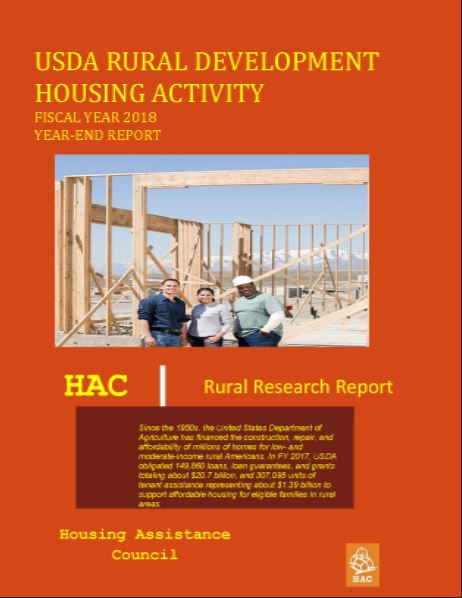
USDA Multi-Family Fair Housing Occupancy Report FY 2018

USDA’s yearly occupancy survey shows the total number of properties in USDA’s rural rental portfolio fell by 1.79 from September 2017 to September 2018, a decrease of 227 Section 515 properties and 24 farmworker housing properties, with a total of 4,820 units. The average annual income of Section 515 tenants is $13,112. For Section 515 tenants with Section 521 Rental Assistance, average annual income is $10,911.

HAC News: February 22, 2019

News Formats. pdf

February 22, 2019
Vol. 48, No. 4

FY19 appropriations agreement fully funds most housing programs • Consumer Financial Protection Bureau proposes to rescind parts of payday lending rule • USDA and HHS partner to create recovery housing in rural communities • Indian CDBG funding competition reopens • HUD requests comments on streamlined requirements for small rural PHAs • HAC webinar to review Section 502 updates • Confirmation hearing held for FHFA nominee Calabria • Senate Indian Affairs Committee passes bill to provide housing vouchers for Native veterans • Fed chair highlights economic prosperity gap • Study finds nearly 35% of rural counties experienced population loss • Rural housing hearing postponed • HAC offers grants for housing aid to rural veterans • HAC symposium on rural veterans’ housing and services scheduled for April in Arkansas

HAC News Formats. pdf

February 22, 2019
Vol. 48, No. 4

FY19 appropriations agreement fully funds most housing programs.
A final consolidated appropriations act, worked out by congressional negotiators and signed by President Trump on February 15, will fund numerous federal agencies, including USDA and HUD, through the end of fiscal year 2019 on September 30. The compromise keeps many USDA and HUD housing programs at FY18 levels, with a few increases and decreases. Tables showing funding levels are posted on HAC’s site.

USDA rural housing programs receiving added monies include Section 514 and 516 farmworker housing loans and grants, Section 533 Housing Preservation Grants, the Multifamily Preservation and Revitalization (MPR) program, and the Rural Community Development Initiative. The bill’s small increase in Section 542 vouchers and drop in Section 521 Rental Assistance are expected to accommodate changes in the level of usage of those programs. The measure renews technical assistance funding for rural rental preservation, again directs USDA to provide incentives for nonprofit organizations and public housing agencies to acquire and preserve rural rental properties, and continues the intermediary packaging program for Section 502 direct homeownership loans. It directs USDA to provide a report on maturing mortgages for rental properties, including a preservation strategy, within one year. The conference report on the bill expresses concern about the costs of moving the Economic Research Service and National Institute of Food and Agriculture out of Washington, DC, and supports “an indefinite delay” in shifting ERS to the Office of the Chief Economist.

HUD’s final appropriation includes enough funding to renew all existing rental assistance contracts, including contracts for Section 202 and Section 811 tenants. Funding for the HOME program drops by over $100 million. McKinney-Vento homeless assistance programs see an increase, as do Housing Opportunities for Persons with AIDS and healthy homes/lead hazard control. In addition to level-funding Native American Housing Block Grants at $655 million, the bill provides $100 million for grants to be awarded competitively. It also creates a new $28 million Housing Choice Voucher mobility demonstration to help families with children move to lower-poverty areas of opportunity.

Consumer Financial Protection Bureau proposes to rescind parts of payday lending rule.
Comments are due May 15 on a CFPB proposal to rescind parts of a 2017 regulation. CFPB suggests there was insufficient evidence and legal support for its requirement that before making a payday, single-payment vehicle title or longer-term balloon payment loan, a lender determine that a consumer has the ability to repay it. A separate notice proposes to delay the August 19, 2019 compliance date to November 19, 2020; comments on the possible delay are due March 18. For more information, contact Eliott C. Ponte, CFPB, 202-435-7700.

USDA and HHS partner to create recovery housing in rural communities.
USDA Rural Development and the Substance Abuse and Mental Health Services Administration of the Department of Health and Human Services will coordinate efforts to sell USDA’s REO single-family housing properties at a discount to nonprofits that provide housing, treatment, job training and other services for people in substance misuse treatment and recovery.

Indian CDBG funding competition reopens.
Tribal governments and tribal organizations have an additional 30 days, until March 20, to apply for the Community Development Block Grant Program for Indian Tribes and Alaska Native Villages.

HUD requests comments on streamlined requirements for small rural PHAs.
Legislation signed into law in May 2018 streamlines requirements related to program inspections and evaluations, corrective action requirements, environmental reviews, and energy conservation for small PHAs, which it defines as those that administer 550 or fewer combined public housing units and vouchers and predominantly operate in a rural area. HUD now seeks comments on its implementation of these provisions, including how it should interpret “predominantly operates” in a rural area. (The statute and CFPB regulations define “rural area.”) HUD also asks for input on requirements for new information systems for public housing consortia and on shared waiting list software. Comments are due April 15. For more information, contact Harold Katsura, HUD, 202-402-3042.

HAC webinar to review Section 502 updates.
“USDA Section 502 Loan Program Updates: USDA Handbook 1-3550 Updates from 2017-2019” is scheduled for March 27 at 2 pm eastern time. It will cover changes to the Section 502 direct loan program implemented during FY17 and 18, most of which relate to the determination and documentation of applicant assets, income and credit history. For more information, contact HAC staff, 404-892-4824.

Confirmation hearing held for FHFA nominee Calabria.
The Senate Banking Committee held a hearing February 14 on Mark Calabria’s nomination to direct the Federal Housing Finance Agency. Calabria, who has criticized the current housing finance system, said in his written statement that despite his “frustration with the current state of our mortgage system and the need for reform,” he wanted “to very clearly state to this Committee, that if confirmed, my role as Director of FHFA is to carry out the clear intent of Congress, not to impose my own vision.” He mentioned his commitment to rural and tribal affordable housing at several points during the hearing, including in response to a question from Senator Tina Smith (D-MN) about the future of Duty to Serve, which he committed to “keep in place as long as the existing regulatory structure is there.”

Senate Indian Affairs Committee passes bill to provide housing vouchers for Native veterans.
S. 257 would provide rental assistance to homeless or at-risk Native American veterans. It authorizes the existing tribal HUD-VASH program beyond the current pilot program, including provisions to have government agencies work cooperatively and ensure that case management is available and culturally appropriate.

Fed chair highlights economic prosperity gap.
Speaking at a Mississippi event titled “Rural Places, Rural Spaces: Closing Financial Service Gaps in Persistent Poverty America,” Federal Reserve Chair Jerome Powell noted that rural areas have not shared equally in overall economic prosperity. Powell stated that poverty, lack of access to credit and limited access to education resources hamper prosperity in rural areas, particularly in persistent poverty counties. His remarks expand on the message he delivered at HAC’s 2018 Rural Housing Conference in December.

Study finds nearly 35% of rural counties experienced population loss.
“Rural Depopulation in a Rapidly Urbanizing America,” published by the Carsey School of Public Policy, reports that nearly 35% of rural counties suffer from long-term population loss. A combination of young-adult outmigration, fewer births, and more deaths contributes to the decreasing populations. Not all rural areas are losing population: rural counties that are close to metropolitan areas or high-amenity areas are more likely to experience population growth. The brief offers policy changes to address the issue.

Rural housing hearing postponed.
The hearing titled “The Affordable Housing Crisis in Rural America: Assessing the Federal Response,” originally scheduled for February 14, was postponed by the Housing, Community Development, and Insurance Subcommittee of the House Financial Services Committee. A new date has not yet been announced. Drafts of several pieces of rural housing legislation are posted online.

HAC offers grants for housing aid to rural veterans.
HAC’s Affordable Housing for Rural Veterans initiative supports local nonprofit housing development organizations that meet or help meet the affordable housing needs of veterans in rural areas. Grants may be up to $30,000 and must support bricks-and-mortar projects that assist low-income, elderly and/or disabled veterans with home repair and rehab needs, support homeless veterans, help veterans become homeowners and/or secure affordable rental housing. This initiative is funded through the generous support of the Home Depot Foundation. Applications are due March 11. For more information, contact HAC staff, ahrv@ruralhome.org.

HAC symposium on rural veterans’ housing and services scheduled for April in Arkansas.
HAC’s 5th Annual National Symposium on Veterans Housing Issues will be held April 18-19 at Arkansas State University in Jonesboro, sponsored by the Home Depot Foundation. This year’s theme centers on addressing the critical needs around housing, homelessness and aging solutions for rural veterans, within the context of the Delta Regional Authority’s eight-state service area. There is no fee to attend, but space is limited and advance registration is required. For more information, contact Cheryl Cobbler, HAC.

Need capital for your affordable housing project?
HAC’s loan funds provide low interest rate loans to support single- and multifamily affordable housing projects for low-income rural residents throughout the U.S. and territories. Capital is available for all types of affordable and mixed-income housing projects, including preservation, farmworker, senior and veteran housing. HAC loan funds can be used for pre-development, site acquisition, site development and construction/rehabilitation. Contact HAC’s loan fund staff at hacloanfund@ruralhome.org, 202-842-8600.
Please note: HAC is not able to offer loans to individuals or families. Borrowers must be nonprofit or for-profit organizations or government entities (including tribes).
HAC News: February 11, 2019

News Formats. pdf

February 11, 2019
Vol. 48, No. 3

February is Black History Month • Government funded to February 15, another shutdown possible • Rural Rental Assistance payments obligated through April • USDA explains status of homeownership programs • HAC offers grants for housing aid to rural veterans • Puerto Rico disaster funds available • FY2020 budget process begins in March • Senator releases housing finance reform outline, White House developing a proposal • HAC symposium on rural veterans’ housing and services scheduled for April in Arkansas • Hazlett leaving USDA, Baxley to move to Secretary’s office • Rural broadband application deadlines to be extended • USDA raises loan-to-cost ratio for guaranteed rental housing loans

HAC News Formats. pdf

February 11, 2019
Vol. 48, No. 3

February is Black History Month.

House subcommittee to hold hearing on rural housing.
HAC will be one of several organizations testifying in a hearing titled “The Affordable Housing Crisis in Rural America: Assessing the Federal Response,” convened by the Housing, Community Development, and Insurance Subcommittee of the House Financial Services Committee. The hearing will be broadcast live online, February 14 at 10 a.m. eastern.

Government funded to February 15, another shutdown possible.
The partial government shutdown that began December 22 ended on January 25 with a short-term continuing resolution lasting through February 15. It is possible the same government agencies will close again if Congress and the President do not reach agreement on appropriations and border security.

Rural Rental Assistance payments obligated through April.
USDA RD shared with HAC a notice sent to owners and managers of USDA-financed properties with Section 521 Rental Assistance: “We are pleased to inform you that Rental Assistance for Section 514/515 properties has been obligated through April. The Management Interactive Network Connection (MINC) has been updated to reflect these obligations. We understand that the most recent lapse in appropriations created anxiety and uncertainty regarding the status of your contract obligations. We are hopeful that this communique and the fact that all contracts are obligated through April will provide you reassurance and operational predictability in your management of these critical low-income resources throughout rural America. Thank you for your partnership in delivering the Rural Housing Service affordable housing mission.”

USDA explains status of homeownership programs.
USDA’s single-family programs office says it will issue new Certificates of Eligibility to all Section 502 direct applicants who had valid COEs on December 21 before the government shut down. The agency does not have enough funding to obligate more Section 502 direct loans until it receives funding beyond February 15, however. Section 504 repair loans and grants are available; applicants with immediate health and safety hazards will receive priority. A funding plan for Section 523 self-help grantee organizations is being developed.

HAC offers grants for housing aid to rural veterans.
HAC’s Affordable Housing for Rural Veterans initiative supports local nonprofit housing development organizations that meet or help meet the affordable housing needs of veterans in rural areas. Grants may be up to $30,000 and must support bricks-and-mortar projects that assist low-income, elderly and/or disabled veterans with home repair and rehab needs, support homeless veterans, help veterans become homeowners, and/or secure affordable rental housing. This initiative is funded through the generous support of the Home Depot Foundation. Applications are due March 11. For more information, contact HAC staff, ahrv@ruralhome.org.

Puerto Rico disaster funds available.
HUD has released the initial $1.5 billion of CDBG-DR funds for Puerto Rico that were approved before the shutdown and then delayed.

FY2020 budget process begins in March.
Preparation of the Administration’s budget for the year that begins October 1, 2019 was delayed by the shutdown. Reportedly, summary budget information will be released the week of March 11 and details the week of March 18. Unless Congress and the President agree to raise the Budget Control Act caps on federal spending, as they have in recent years, the caps will come back into effect for FY20 and force significant cuts in appropriations.

Senator releases housing finance reform outline, White House developing a proposal.
Senate Banking Committee Chair Sen. Mike Crapo (R-ID) on February 1 released an outline for housing finance reform. The proposal would privatize Fannie Mae and Freddie Mac and would allow other mortgage guarantors as well. The current affordable housing goals and Duty to Serve requirements would be replaced by a new Market Access Fund. Funding for the Housing Trust Fund, Capital Magnet Fund, and Market Access Fund would be funded through an assessment on total annual loan volume. Joseph Otting, acting director of the Federal Housing Finance Agency, which regulates Fannie and Freddie, has reportedly told FHFA staff the Administration also plans to move forward on housing finance reform; a White House statement said their framework is still in development.

HAC symposium on rural veterans’ housing and services scheduled for April in Arkansas.
HAC’s 5th Annual National Symposium on Veterans Housing Issues will be held April 18-19 at Arkansas State University in Jonesboro, sponsored by the Home Depot Foundation. This year’s theme centers on addressing the critical needs around housing, homelessness and aging solutions for rural veterans, within the context of the Delta Regional Authority’s eight-state service area. There is no fee to attend, but space is limited and advance registration is required. For more information, contact Cheryl Cobbler, HAC.

Hazlett leaving USDA, Baxley to move to Secretary’s office.
Anne Hazlett is leaving her position as Assistant to the Secretary for Rural Development at USDA to go to the White House Office of National Drug Control Policy. Joel Baxley, currently RHS Administrator, will become the Acting Assistant to the Secretary for RD. USDA Secretary Sonny Perdue and the White House are working to find a nominee for the position of Under Secretary for Rural Development. That job was eliminated by Perdue but the recent Farm Bill required it to be filled. USDA’s announcement does not name an Acting RHS Administrator but Rich Davis, RHS Deputy Administrator for Community Facilities, is expected to serve in that role.

Rural broadband application deadlines to be extended.
The first application deadline for USDA RD’s new ReConnect Program was initially set for April, but the agency has announced it will shift that to May 31 or later. Specific deadlines will be posted in the Federal Register in late February.

USDA raises loan-to-cost ratio for guaranteed rental housing loans.
Effective February 7, 2019, the low loan-to-cost ratio required for a continuous guarantee (a single guarantee for construction and permanent loans) through the Section 538 rental guarantee program will be 70% rather than the previous 50%. For more information, contact Tammy Daniels, USDA, 202-720-0021.

Need capital for your affordable housing project?
HAC’s loan funds provide low interest rate loans to support single- and multifamily affordable housing projects for low-income rural residents throughout the U.S. and territories. Capital is available for all types of affordable and mixed-income housing projects, including preservation, farmworker, senior and veteran housing. HAC loan funds can be used for pre-development, site acquisition, site development and construction/rehabilitation. Contact HAC’s loan fund staff at hacloanfund@ruralhome.org, 202-842-8600.
Please note: HAC is not able to offer loans to individuals or families. Borrowers must be nonprofit or for-profit organizations or government entities (including tribes).
HAC News: January 25, 2019

News Formats. pdf

January 25, 2019
Vol. 48, No. 2

Deal reached to reopen federal government • HAC calls for shutdown to end, citing severe impact on rural towns and families, suggests ways to help • USDA working to resolve rental assistance shortfalls and inform landlords • USDA rural housing programs remain closed • USDA Secretary reopens Farm Service Administration, leaves Rural Development closed • Indian Country substantially impacted by shutdown • Shutdown delays Puerto Rico disaster funds • Legal impacts of shutdown on HUD and USDA tenants summarized • Tribal housing survey finds focus on HUD, new units and rehab • Unsheltered homelessness increasing • New infographic explains rapid re-housing • Federal Reserve examines link between millennial migration and student loan debt • Holistic Housing Podcast focuses on rural housing issues • Need capital for your affordable housing project?

HAC News Formats. pdf

January 25, 2019
Vol. 48, No. 2

Deal reached to reopen federal government. As HAC staff prepared to send this issue of the HAC News to subscribers, President Trump announced he had reached agreement with congressional leaders to reopen the government for three weeks. HAC will post updates on its website as information becomes available about the shutdown’s aftermath.
Note that the articles in this issue were written before the deal to reopen the government was announced.

HAC calls for shutdown to end, citing severe impact on rural towns and families, suggests ways to help.
“Every day,” HAC’s statement points out, “Americans are losing out on billions of dollars’ worth of affordable housing, clean drinking water, and community facilities, like town halls, fire stations and hospitals.” HAC has posted links to news articles covering rural housing impacts, and will keep updating the list. As the shutdown continues, HAC will be reaching out to stakeholders to help spread the word on the damage it is causing to communities across the country, pressure lawmakers to come to a resolution and share your own stories of hardship. Visit HAC’s website to sign up for information and resources.

USDA working to resolve rental assistance shortfalls and inform landlords.
USDA reports that all 521 Rental Assistance contracts that are expiring in January will be renewed. The Department acknowledges that there is no money left to renew further RA contracts, including the approximately 700 RA contracts expiring in February and 1,000 in March. USDA is considering short-term measures, such as allowing owners to use project reserves to cover costs, but has yet to finalize any plans or notify property owners. The need for such notification became clear when managers of USDA-financed properties in Arkansas and in Arkansas, Louisiana, Missouri and Mississippi sent notices to tenants telling them their RA was ending in January and they would be responsible for paying their full rent, then backpedaled when informed by USDA the RA will be paid.

USDA rural housing programs remain closed.
No new direct or guaranteed loans or grants have been made in over 30 days. When open and operating, USDA’s Rural Housing Service obligates an average of 28,927* transactions (loans, grants, assistance payments) per month. January 25 is the 35th day of the government shutdown. For more information on USDA’s rural housing activity, visit HAC’s website.
* HAC estimate from monthly USDA obligation data.

USDA Secretary reopens Farm Service Agency, leaves Rural Development closed.
USDA Secretary Sonny Perdue has ordered 9,700 field staff in local Farm Service Agency offices across the country to return to work without pay, although not all FSA services are available. FSA has reopened programs such as the Tree Assistance Program and Marketing Assistance Loans.

Indian Country substantially impacted by shutdown.
Calculating a dollar amount is not possible, reports the Center for Indian Country Development, but the effect is “substantial and unique” because government employment is disproportionately high in Indian Country, tribal staff such as those who plow reservation roads are furloughed, and education funds may be cut. Because of the unique relationship between the U.S. and tribes, tribal services are often closely tied to federal funding.

Shutdown delays Puerto Rico disaster funds.
In response to Hurricane Maria, which tore through Puerto Rico in 2017, Congress appropriated $20 billion in CDBG disaster relief funding. Only $1.5 billion of that money was approved before the shutdown, and HUD will not disburse it until the shutdown ends. HUD approval of disaster spending plans or amendments from California, Florida, Georgia, Missouri and the U.S. Virgin Islands is also on hold. Even before this delay, an analysis by scholars from the University of Michigan and University of Utah found the federal response in funding and staff was larger and faster after Hurricanes Harvey and Irma in Texas and Florida than after Hurricane Maria in Puerto Rico.

Legal impacts of shutdown on HUD and USDA tenants summarized.
A memo from the National Housing Law Project explains the rights of federally assisted tenants during the government shutdown.

Tribal housing survey finds focus on HUD, new units and rehab.
HUD is the primary source of housing development funding for tribes, according to results of a 2018 survey of Tribally Designated Housing Entities by the National American Indian Housing Council and the Center for Indian Country Development. Respondents expressed interest in other financing sources as well, including Low Income Housing Tax Credits and USDA RD housing programs. Although the low response means this survey may not represent Indian Country overall, a large majority of respondents were developing new rental and homeownership units, and all were maintaining and rehabilitating existing units.

Unsheltered homelessness increasing.
In its annual homeless assessment report to congress, HUD states homelessness has increased for the second year in a row. Rural Continuums of Care had the highest rates of unsheltered homeless persons (40%). Homeless individuals in largely rural areas were more likely to be women than those in other areas. Predominantly rural areas also had the highest rates of unsheltered homelessness among people in families with children.

New infographic explains rapid re-housing.
The National Alliance to End Homelessness has released an infographic based on data from the Urban Institute explaining what rapid re-housing is – an approach that ends people’s homelessness quickly by helping them to find and move into a home in their community, then to address other challenges – as well as who it helps and what effect it has.

Federal Reserve examines link between millennial migration and student loan debt.
“Rural Brain Drain”: Examining Millennial Migration Patterns and Student Loan Debt, an analysis by the Federal Reserve Board Division of Consumer and Community Affairs, shows that student loan borrowers are more likely to leave rural areas than non-borrowers. The study notes this does not show that loan balances cause borrowers to leave. It analyzes credit outcomes, economic conditions and migration patterns of rural student loan borrowers. The writers recommend further study to create community development models that could address the outmigration issue.

Holistic Housing Podcast focuses on rural housing issues.
HAC CEO David Lipsetz appeared on “Rock on, Rural America,” the 18th episode of NACCED’s Holistic Housing Podcast, discussing HAC’s work in rural areas, the inspiration he gets from working with local organizations across the country, why rural and urban America need not be at odds and how public policy could change to embrace more rural-focused development. Listen on iTunes, Stitcher, or TuneIn.

Need capital for your affordable housing project?
HAC’s loan funds provide low interest rate loans to support single- and multifamily affordable housing projects for low-income rural residents throughout the U.S. and territories. Capital is available for all types of affordable and mixed-income housing projects, including preservation, farmworker, senior and veteran housing. HAC loan funds can be used for pre-development, site acquisition, site development and construction/rehabilitation. Contact HAC’s loan fund staff at hacloanfund@ruralhome.org, 202-842-8600.
Please note: HAC is not able to offer loans to individuals or families. Borrowers must be nonprofit or for-profit organizations or government entities (including tribes).
HAC News: January 15, 2019

News Formats. pdf

January 15, 2019
Vol. 48, No. 1

Federal shutdown puts USDA loans on hold, tenants in limbo • National call about shutdown to include HAC • Some HUD Project-Based Rental Assistance contracts expiring during shutdown • House passes USDA and HUD funding bills • Regulators consider requiring evaluations for rural properties, raising appraisal threshold • Fannie Mae implements appraisal waiver in rural high need markets • RD plans to begin accepting Section 538 guarantee applications continuously • Podcast covering affordable housing and community development will feature HAC’s David Lipsetz • Site selection criteria issued for ERS and NIFA relocations • Patenaude resigns HUD position • Broadband access on tribal land lags national averages • White paper reports savings from energy and water efficiency for low- and middle-income renters • Rural Statistic: USDA Section 515 majority minority properties

HAC News Formats. pdf

January 15, 2019
Vol. 48, No. 1

Federal shutdown puts USDA loans on hold, some tenants’ future funding uncertain.
USDA and HUD are currently shut down. They are among the federal agencies permitted to conduct only essential business since their appropriations expired on December 22. Limited functions are continuing at USDA’s national office in Washington, DC and the Customer Service Center in St. Louis, but loan closings are not taking place and applications are not being processed. HAC will continue to post information about the shutdown on our website as it becomes available. To read accounts of the shutdown’s impact from local organizations around the country, visit the National Rural Housing Coalition’s website. The effect is being felt by homebuyers, self-help groups, farmworker housing construction, rental housing rehabilitation and organizational budgets. RD staff provided a great service by getting December’s Section 521 Rental Assistance payments made on schedule in early January, and have unofficially assured HAC and others that January’s RA payments will be made in early February. RA payments each month are for the RA contracts that expired during that month, and obligate a full year of RA funding. It is HAC’s understanding that if the shutdown continues into February, RA contracts expiring that month will not be paid. It is not clear whether Section 542 vouchers will be paid for February.

National call about shutdown to include HAC.
HAC CEO David Lipsetz will join a national call providing updates on the shutdown’s effects on affordable housing and community development programs. The call will be held Tuesday, January 15 at 4:00 Eastern, and is arranged by the National Low Income Housing Coalition. Register here.

Some HUD Project-Based Rental Assistance contracts expiring during shutdown.
About 21,500 households with average incomes under $13,000 per year are impacted by the expiration of 650 PBRA contracts that ended in December, and more are expiring in January and February. HUD will determine whether it has funds available to renew them. Property owners can use their reserves, if available, to cover shortfalls. Public housing capital funding is unavailable, and operating funds cannot carry public housing authorities beyond February.

House passes USDA and HUD funding bills.
Attempting to reopen the federal government, on January 10 the House passed H.R. 265, which would provide USDA appropriations for FY19, and H.R. 267 to fund the departments of Transportation and HUD. Senate Majority Leader Mitch McConnell (R-KY) reportedly does not plan to hold Senate votes on these or other measures that are not supported by President Trump.

Regulators consider requiring evaluations for rural properties, raising appraisal threshold.
The federal agencies that regulate banks and thrifts have proposed revising their appraisal rules to require evaluations (not appraisals) of property value for loans of less than $400,000 secured by rural real estate. Also, loans under $400,000 (rather than the current $250,000) for residential real estate with four or fewer units in any geographic area would receive evaluations rather than appraisals. Comments are due February 5. For more information, contact G. Kevin Lawton, OCC, 202-649-6670.

Fannie Mae implements appraisal waiver in rural high need markets.
For home purchase transactions meeting certain criteria and located in rural high-needs areas, Fannie Mae may waive an appraisal in exchange for a home property inspection. This waiver seeks to address appraisal complexities in remote rural markets and help low-income borrowers avoid unanticipated, potentially high-cost, post-purchase repairs.

RD plans to begin accepting Section 538 guarantee applications continuously.
Comments are due February 15 on a USDA proposal to stop issuing annual Notices of Funding Availability (NOFAs) for the Section 538 multifamily guarantee program. RD would accept applications at any time, using the standards from the most recent NOFA, which was published December 21, 2017. For more information (when USDA reopens), contact Monica Cole, RD, 202-720-1251.

Podcast covering affordable housing and community development will feature HAC’s David Lipsetz.
The Holistic Housing Podcast, hosted by NACCED, brings together thought leaders, policy makers and program implementers across the affordable housing, community development and economic development field. David Lipsetz, HAC’s CEO, will appear later in January discussing the unique nature of affordable housing and community development in rural communities. The podcast is available on iTunes, Stitcher, and TuneIn.

Site selection criteria issued for ERS and NIFA relocations.
In December, USDA Secretary Sonny Perdue announced the department will use criteria related to quality of life, costs, workforce and logistics/IT infrastructure in evaluating the proposals to house the relocated Economic Research Service and National Institute of Food and Agriculture. The Department announced its plan to move these vital agencies in August, basing the decision on “cost savings” despite having conducted no analysis or review of the cost. HAC has raised concerns that the move will further erode the voice of rural communities in federal policy.

Patenaude resigns HUD position.
On December 17, Deputy Secretary Pamela Hughes Patenaude announced she will leave HUD early in 2019. Media reports say FHA Commissioner Brian Montgomery will serve as Acting Deputy Secretary.

Broadband access on tribal land lags national averages.
On reservations, fewer than 55% of households have broadband access, compared to a 78% average for the nation and a 65% average for rural counties. Low rates of access are related to low incomes found on reservations, but lowered access also inhibits larger economic growth, reports the Center for Indian Country Development at the Minneapolis Federal Reserve. Tribes are working to increase access on reservations.

White paper reports savings from energy and water efficiency for low- and middle-income renters.
A new Freddie Mac paper, “Green Improvements in Workforce Housing,” examines the effects of the Green Advantage program, which finances water- and energy-saving upgrades in multifamily workforce housing. Borrowers focused on water-savings improvements, with a projected average cost of $470 per unit and projected average savings of $220 per unit per year.

Rural Statistic: USDA Section 515 majority minority properties. In approximately 2,447 USDA Section 515 rural rental housing properties (79,406 occupied units) the majority of the tenants are racial or ethnic minorities. For more information on resident characteristics in USDA’s rural rental housing see HAC’s recently published report, Rental Housing for A 21st Century Rural America.

515

Need capital for your affordable housing project?
HAC’s loan funds provide low interest rate loans to support single- and multifamily affordable housing projects for low-income rural residents throughout the U.S. and territories. Capital is available for all types of affordable and mixed-income housing projects, including preservation, farmworker, senior and veteran housing. HAC loan funds can be used for pre-development, site acquisition, site development and construction/rehabilitation. Contact HAC’s loan fund staff at hacloanfund@ruralhome.org, 202-842-8600.
Please note: HAC is not able to offer loans to individuals or families. Borrowers must be nonprofit or for-profit organizations or government entities (including tribes).

USDA Multi-Family Fair Housing Occupancy Report FY 2017

USDA’s yearly occupancy survey shows the total number of properties in USDA’s rural rental portfolio fell by 1.94% from September 2016 to September 2017, a decrease of 278 properties consisting of 246 Section 515 properties and 32 Section 514 properties. This represents a loss of 5,035 apartment units or 1.17 percent. The average annual income of Section 515 residents has increased to $12,776. For Section 515 tenants with RA, average income is $10,658.

GET THE HAC NEWS!

Sign-up for HAC information products

SIGN UP HERE

Housing Assistance Council   |  1828 L Street. N.W., Suite 505, Washington, D.C. 20036
(202) 842-8600 (202) 347-3441 hac@ruralhome.org |

Board Portal

HAC is an equal opportunity provider, employer, and lender. | Civil Rights | Privacy