Tag Archive for: Affordable Housing

Discussion Paper, Next Generation

RECRUITING AND RETAINING THE NEXT GENERATION OF RURAL HOUSERS

Continue the Discussion on LinkedInContinue the Discussionby Matt Huerta, Neighborhood Housing Services Silicon Valley, CA, and Karen Jacobson, Randolph County Housing Authority and Highland Community Builders, WV

Background

Public and private investment is increasingly being focused in urban or suburban neighborhoods while rural areas continue to have high needs for infrastructure support in housing and other basic services. It can be exceedingly challenging to compete for talent with our urban counterparts. Meanwhile, our current workforce is aging and many rural areas are experiencing a “brain drain” of college educated residents. The young professionals that we have been fortunate enough to recruit can be equally challenging to retain. Rural housing professionals typically work across many disciplines and program areas in order to develop their projects and programs. Within a few short years, rural housing professionals have acquired unique but transferrable skillsets. These could include developing financial pro formas, managing projects, navigating land use entitlements, leading community engagements, and many other highly specialized and valuable skills. It is important for rural housing organizations to retain these competencies for as long as possible. How do we recruit, nurture, and maintain rural housing professionals, particularly in an environment that seems hostile to our mission?

Issues and Challenges

Most, if not all, rural housing organizations aspire to have workforces that reflect the diverse populations within the communities they serve.

This is critical to maintain credibility and program impact. Many rural groups continue to experience challenges in recruiting and retaining talented staff who may be drawn to positions in urban areas because of the potential for higher earnings, a perception that “rural work” is less important or innovative, and better access to training programs or networking opportunities. Once young professionals acquire some initial work experience or complete their advanced degrees, what will incentivize them to stay at a community organization focused on rural housing?

Discussion Questions
  • What specific challenges is your organization experiencing with recruiting or retaining younger professionals?
  • What is your organization doing to address this critical issue?
  • What are some examples of model recruitment tactics or training programs that can be replicated?
  • Are there community-wide efforts that rural housing groups can join or initiate that would help address this challenge? Housing organizations are not the only employers that are affected by “rural brain drain.”
  • What role might a local college, community college, or university play in solving this issue?

Discussion Paper, Adaptation

CHANGE OR DIE? ADAPTATION FOR SURVIVAL

Continue the Discussion on LinkedInContinue the Discussionby Lenora Jarvis-Mackey, River City Community Development Corporation, NC

Background

In these tough economic times, rural housing nonprofits cannot simply continue to do what we have done in the past and hope things will get better. Nonprofit organizations, like for-profit companies, are facing a rapidly changing environment. Funders want more for less and private organizations are competing on what was traditionally seen as nonprofit territory. Sustainability is a constant worry.

Historically, nonprofits gauged our success by keeping good records on the number of people we served; the impact on poverty reduction; facilitating or building safe decent and affordable housing; and our advocacy for clean water, sanitary sewer, the provision of livable wage jobs and many other issues not properly addressed by the private sector or by state and federal government agencies. In today’s environment, however, cataloguing success is not enough to ensure continued funding for a nonprofit. Funders are more selective. Track records are important but are not ultimately determinative to long term funding and survival of a nonprofit.

Even with positive track records, nonprofits must remain keenly aware of the need for continued innovation and creativity to sustain our business models and to continue to provide services for our beneficiaries. “Operating like a nonprofit” has somehow evolved into a perception of being overworked, underfunded, and tax exempt. To stay alive and relevant we must operate more like traditional businesses and become more quantumly responsible to survive.

Harold Barnes, president of the Center for Quantum Leadership, defines “quantum responsibility in business” as:

The active process of the business, the leadership and employees holding themselves accountable to each other for the direction and success of the organization. This accountability will lead to the exponential positive growth of the organization and will encourage and facilitate innovation, creativity and productivity such that all segments of the organization will have the opportunity and tools to make a significant leap forward.

Issues and Challenges

Ensuring nonprofit survival and ongoing viability presents an array of issues and challenges. To keep nonprofits functional, nonprofit leaders must appreciate and value the best of what is, as well as envisioning what might be and how to get there. We must read the signs that predict imminent changes in economic trends and make decisions before circumstances are out of control. Useful techniques may come from many sources, including for-profit entities.

Discussion Questions
  • When and how often should we evaluate our organizations?
  • How do we systematically discover what gives life to a nonprofit?
  • When is a nonprofit most alive, most effective, and most constructively capable of serving its customers?
  • How can nonprofits best innovate, adapt, and create the kinds of organizations that are sustainable into the future?
  • How do we go about implementation of quantum responsibility?

Discussion Paper, Outreach and TA

OUTREACH AND TECHNICAL ASSISTANCE DELIVERY TO RURAL AND TRIBAL COMMUNITIES

Continue the Discussion on LinkedInContinue the Discussionby Stan Keasling, Rural Community Assistance Corporation, CA, and Blair Sebastian, New York State Rural Housing Coalition

Background

Nonprofits, local governments, and tribal governments are working individually and collectively to improve the quality of housing and community infrastructure in rural areas. The technical assistance (TA) needs of rural groups vary widely and often require very different approaches. Rural communities’ TA needs may also differ substantially from the TA needs found in more urbanized places. What are the needs, and where are opportunities and methods, or approaches, to improve the outreach to these entities and the effectiveness of TA delivery in rural America?

Issues, Challenges, and Opportunities

Over the past few years there have been significant changes to the resources available for the rural technical assistance delivery system. HUD has introduced the Community Compass (formerly OneCPD) system of technical assistance, and Congress has required new competitions for Rural Capacity Building and NAHASDA TA funding. In addition, USDA is still considering the utility of the intermediaries in the Section 502 packaging demonstration, and planning for a community facilities support system. These changes have meant that the intermediaries and other TA providers are often trying to suggest new strategies to the funding agencies in order to enhance their competitiveness, rather than pursuing outreach and TA practices that have been successful in the past.

While some federal initiatives have focused on providing technical assistance to rural and tribal communities, the approach has not been well synchronized. Rural and tribal communities generally must find and request TA themselves. Much of the available TA is provided through programs that are ‘siloed’, not coordinated. In addition – aside from the former Rural Housing and Economic Development and Rural Innovation Fund, Rural Capacity Building TA, and NAHASDA TA – HUD-funded TA is most often delivered to formula grantees. Assistance from USDA is also requested through specific programs such as Self-Help Technical and Management Assistance, and not all USDA programs have a TA component.

Given the vast number of rural and tribal entities and the lack of direct federal department/agency contact with many smaller communities, mechanisms are needed to allow them to identify and secure technical resources in the most appropriate manner for them. TA providers are interested in prioritizing the greatest needs of rural and tribal communities and identifying the best methods of delivering that assistance to ensure that the array of federal technical resources are directly available to the local jurisdictions, organizations, businesses, and families.

Discussion Questions
  • What technical assistance services do rural housing and community development organizations need to be more productive?
  • What are the best ways to inform local rural organizations about available TA?
  • What are the challenges facing local and tribal governments in trying to manage federal funds and design effective strategies for community development?
  • What support do the state grantees, including PJs, need to be more effective at administering federal pass through funds and coordinating with federal agencies to maximize impact?
  • What processes should be used to identify needs at the local level in rural America?
  • Are there changes federal departments/agencies should consider making to their system of identifying TA needs and allocating resources to local rural and tribal efforts?

Discussion Paper, USDA

REDUCED USDA PRESENCE AND RESOURCES – HOW CAN RURAL HOUSING ORGANIZATIONS ADAPT?

Continue the Discussion on LinkedInContinue the Discussionby Tom Collishaw, Self Help Enterprises, CA, and Selvin McGahee, Florida Non-Profit Housing, FL

Background

USDA budgets and allocations for major housing production programs have trended downward since the late 1970s. In recent years, even the agency’s physical presence in rural America has lessened dramatically. Historic core housing production programs have been cut so much that, for example, Section 515 Rural Rental Housing has been reduced to little more than a maintenance and repair effort. Single-family direct lending through the Section 502 mortgage program has likewise been a dwindling resource. It feels as if the current administration, given the choice, would focus entirely on mortgage insurance (502 guaranteed loans) and maintenance efforts (Rental Assistance) and call it “Rural Housing.” The current level of funding for USDA’s housing programs is due largely to the efforts of rural housing advocates from throughout the country and their lobbyists going directly to Congress.

Given this sobering reality, rural housing development organizations have adapted by accessing a broader range of assistance, ranging from Low Income Housing Tax Credits and federal HUD programs such as HOME, FHA and CDBG, to non-governmental resources such as LISC, Enterprise, and NeighborWorks®, and a variety of state and local programs. Many of these sources have also been cut or depleted, most notably HUD allocations, intensifying the resource-deprived and competitive environment for rural housing providers.

Issues, Challenges, and Opportunities

With dwindling resources as a backdrop, a central question is whether rural housing organizations should continue to focus their primary federal advocacy efforts on USDA or expand them to include other agencies. Are there opportunities being missed, for instance, with the Affordable Care Act? There is a growing movement around health (both individual and community environmental health) and its relationship to housing, which may create new avenues to resources and relationships. How would we preserve a dedicated slice of this pie for rural communities?

On the non-governmental front, there is increasing evidence that “impact investing” is a largely untapped resource for nonprofit housing organizations, who might benefit from favorable lending rates in return for providing investors with social impacts they believe in. Also, the world of social media and crowdsourcing has opened up new possibilities for fundraising.

Discussion Questions
  • Are USDA programs worth fighting for or are they a lost cause in the long run?
  • What other federal agencies or programs should rural housers pursue as partners?
  • Are there examples of collaboration with other community health or improvement efforts that have been useful in expanding resources for rural housing?
  • What other tactics have been successful?

Discussion Paper, Partnerships

PARTNERSHIPS AND COLLABORATION FOR RURAL HOUSING

Continue the Discussion on LinkedInContinue the Discussionby David Haney, Wyoming CD Authority, and Marcia Erickson, GROW South Dakota

Background

Resources for community and economic development – both human capital and dollars – continue to dwindle across rural America. As rural housing organizations seek ways to continue their work, one strategy that seems to have promise is creation of effective partnerships. Those engaged in rural housing development need to be appropriately partnering and aligning with those who focus on other elements such as telecommunications, transportation, education, and healthcare. When various parties can reach consensus about the most important priorities, the multiple voices of conflicting interests can speak more clearly and with greater impact.

Regionalization also has considerable merit. Gathering a number of small diverse rural communities together into a louder and more consistent voice can increase impact. Best practices can be shared or integrated.

Affiliated organizations may consider merging to reduce redundancy. For example, consolidation of core operating functions can cut costs.

Issues and Challenges

Partnerships may be very formal or informal or can be as simple as sharing, but they are not always easy. Numerous issues may arise. For example, frequently participants lay claim to their own specialty or territory, making it extremely difficult to create a successful consensus or collaboration. In addition, one partner may bring greater financial or leadership resources to a collaboration that creates an imbalance of power. It can be challenging to break down traditional silos that exist between organizations and to move beyond an “us vs. them” mentality. For partnerships to be effective, each partner organization must understand not only its own strengths, but the strengths of the associated organizations as well.

Regionalization can be an effective way to partner, although it requires significant effort on the part of all organizations involved. Effective partnerships must maintain mutual trust and respect. This requires any imbalances, including those in financial or leadership resources, to be addressed. Organizations must work together to effectively prioritize needs and goals so that they may share accountability, an effort that can be challenging if the partners do not share core missions and goals.

Discussion Questions
  • What capacity building is needed? What role can HAC play in furthering constructive partnerships?
  • How do we prioritize needs, while still maintaining an inventory of future issues, to avoid missing key priorities?
  • Can you identify best practices from your region or community?
  • Are there trends at the state or federal level that are promoting collaboration, partnerships, or mergers?

Discussion Paper, Policy

RURAL HOUSING AND PUBLIC POLICY

Continue the Discussion on LinkedInContinue the Discussionby Joe Myer, NCALL Research, DE

Background

Rural areas are often at a disadvantage when addressing housing and community development needs because they experience lower median incomes than cities and suburbs, more substandard housing, substantial affordability gaps, less housing infrastructure and capacity, and minimal access to resources, financing, and capital. Also, politically, rural areas can be viewed as less important because of their smaller, more dispersed populations. Yet their needs are often greater or different, and affordable housing can be more difficult and sometimes more costly to deliver because of the above conditions. USDA has been the primary source of rural housing assistance for decades; however, in recent years the agency has not made its housing programs a priority, and budgets and attention have suffered. Each year Congress has had to save Section 502 direct, self-help housing, farm labor housing, and other programs. Meanwhile financing for new rental construction and rental assistance has disappeared, at a time when affordable rentals are in demand. USDA’s fine, well-proven, and cost-effective housing programs are at risk from year to year. In addition, HUD pays attention to rural only sporadically.

Issues, Challenges, and Opportunities

Given the disparity between needs and resources, it has become increasingly difficult to ensure that adequate state and federal resources are allocated for rural housing and community development. Yet affordable housing, and particularly rural housing, competes with many varied interests for local, state, and national attention and resources.

To assure adequate, sustainable resources for ongoing program operations and housing financing, decision and lawmakers and federal and state agencies must understand the needs of rural communities, yet too often they do not.

The annual fight for funding of USDA’s housing programs does not address the need for longer-term stability for developers and service providers to deliver programs and products.

Discussion Questions
  • How can we as practitioners and advocates communicate better with policy makers?
  • What are the themes we should use to resonate with policymakers at state and national levels?
  • How can we invest sufficiently in advocacy and public policy to be sure rural housing has a voice that is heard at state and national levels?
  • Are there new models of advocacy and public policy that could be employed? If so, what?

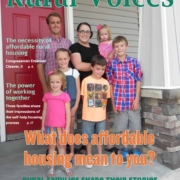
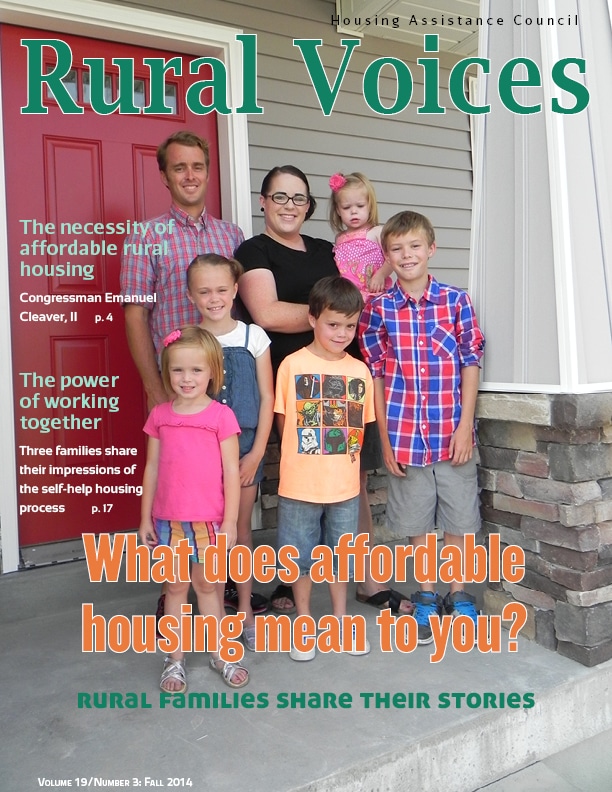
What does affordable housing mean to you? Rural families share their stories

The Fall 2014 issue of Rural Voices presents the perspectives of rural families, their challenges of living in unaffordable or substandard conditions, and how they ultimately utilized federal resources to obtain quality housing. These success stories almost always involve innovative community-based organizations that provide the vital link between housing resources and the families who need them.

What does affordable housing mean to you?The Fall 2014 issue of Rural Voices presents the perspectives of rural families, their challenges of living in unaffordable or substandard conditions, and how they ultimately utilized federal resources to obtain quality housing. These success stories almost always involve innovative community-based organizations that provide the vital link between housing resources and the families who need them.

VIEW FROM WASHINGTON

Affordable Rural Housing: It’s Not a Nicety But a Necessity
by Congressman Emanuel Cleaver, II, Missouri’s Fifth District

Congressman Emanuel Cleaver, II, shares his housing story and offers his views on housing across the country

FEATURES

The Balancing Act
by Joey Henderson, Florida Home Partnership, Inc.

A single mother’s self-help journey

“Our Home, Our Community”
by Lucero Cortez and Erika Parkinson, Catholic Charities of Yakima

Zaida Elena Lopez and Ivan Chavez

Making Almost Heaven a Reality in Rural West Virginia
by John David, Southern Appalchian Labor School (SALS)

Converting a log cabin to a modern home means this widow does not have to live in the cold

The Power of Working Together

Three families share their experiences with USDA’s Mutual Self-Help Program

“I’ve lived here my whole life.”

Leslie Robbins, Jr.

Self-Help, Sweat Equity and Success
by BC EchoHawk, National American Indian Housing Council (NAIHC)

“It made me feel good, it made me powerful and I’m looking forward to spending whatever days I have, God bless me, in that house.”

A Farmer’s Fight
byYuqi Wang, Bill Emerson National Hunger Fellow

Many Hmong farmers have recently experienced financial problems from faulty loans

Additional Content

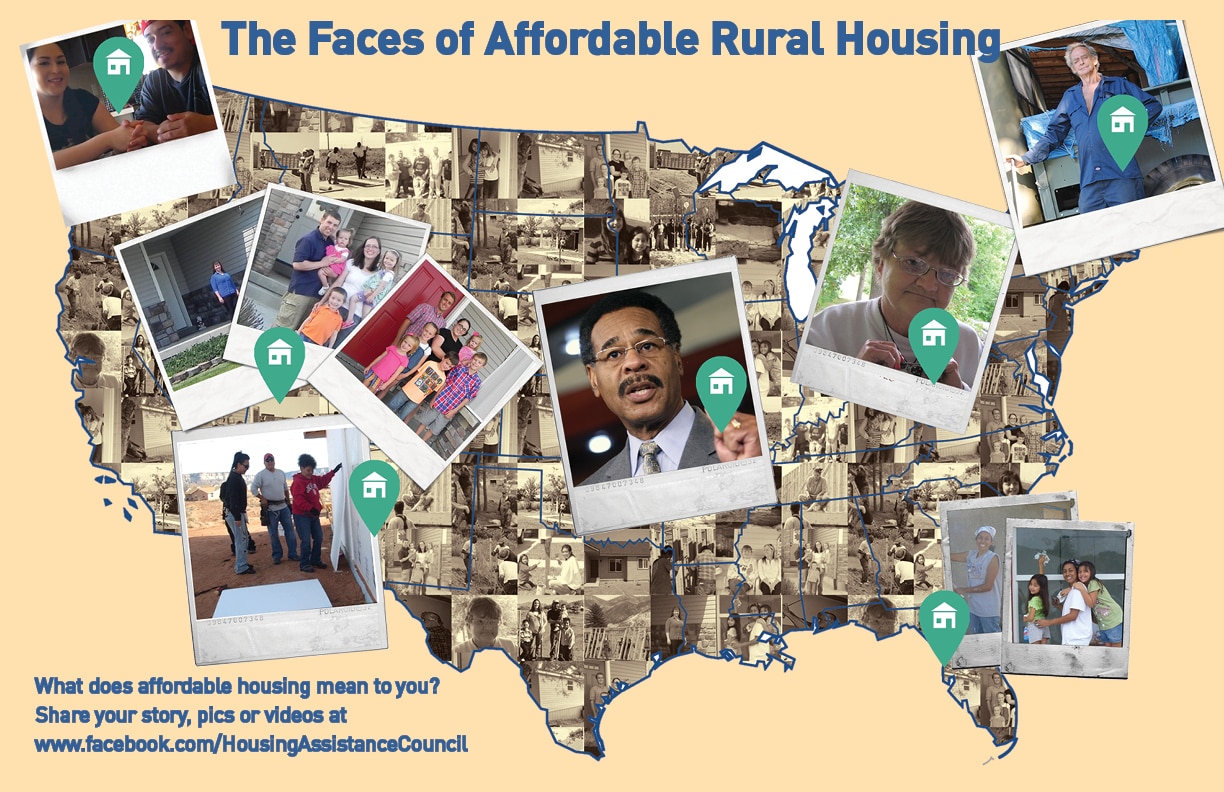
rv-fall-2014-mapThe Faces of Affordable Housing

What does Affordable Housing Mean to You?

“We wouldn’t want to live any place else”

The Davis Family (SALS, WV)

Rural Voices would like to hear what you have to say about one, or all, of these issues. Please feel free to comment on this story by sending a tweet to #RuralVoicesMag, discuss on the Rural Affordable Housing Group on LinkedIn, or on our Facebook page.

"Our Home, Our Community"

by Lucero Cortez and Erika Parkinson, Catholic Charities of Yakima

Rural Voices - Fall 2014This story appears in the Fall 2014 issue of Rural VoicesZaida Elena Lopez and Ivan Chavez moved to Washington State from Chicago four years ago in search of work. They moved into a one bedroom house that they rented in an orchard that was very far from the community. This is where they had been raising their four year-old son, Brandon. Zaida explained that this was a very lonely, solitary house to live in as there were no other children for her son to play with. She also explained that besides being very isolated and lonely the house had very poor living conditions. It was poorly insulated and the family was often cold in the winter as the house did not retain heat and their heater rarely worked properly. Furthermore, the bills they paid were very expensive. Zaida told us that her monthly electric bill totaled approximately $400 a month!

screenshot from video jpgZaida Elena Lopez and Ivan Chavez in their new home

Since their move from Chicago to Washington, Zaida is a stay at home mom and Ivan works as a Forklift Driver for an agricultural warehouse. Ivan works nights at the warehouse leaving his wife and son alone. He wanted a more secure living environment for his family, and a better house for them to live in as they think about expanding their family. These many factors made the family want to have their own home that would be safer, larger, and more integrated into the community.

Zaida’s aunt told her about Catholic Charities Housing Services (CCHS) and their Single-Family Home Ownership Program. Her aunt was filling out an application with CCHS, and this motivated Zaida to apply as well. Ivan and Zaida were surprised at how easy the process was, from the moment Lucero Cortez, Program Assistant with CCHS, helped them fill out the application.

“That is where everything started,” Zaida said. “At some point we thought that we were not going to qualify because of my husband’s income, but thank God that CCHS was able to help us and we were able to qualify for a home in the coommunity of Tieton.”

CCHS requires qualified homeowners to put 250 hours in “sweat equity,” which means they help with work on their house while it is being built. This may seem like a deterrent to some families, but Zaida said, “When you are interested in something it doesn’t matter what you have to do to accomplish your goal.” Zaida would come to the house with her son, Brandon, to clean, pick up garbage and debris the contractors left behind, and to weed. The family would often come once or even twice a week to help, and Ivan would sometimes leave work early to spend time helping his wife and son. “My son helped out a lot,” said Zaida. “He would come here and be very happy to clean the house. I told him from day one that this was going to be our house that this would be where we would move.” Brandon can often be heard at the house telling his mom proudly, “This is our little house.”

“We are very thankful to Catholic Charities Housing Services for their support. They made us feel calm through the entire process because whenever we had a problem they would be there,” Zaida said. This home will be a place for Zaida, Ivan, and Brandon to have a community with neighbors and children for Brandon to play with, and will be a great place for them to continue their family in a safer, friendlier environment.

Catholic Charities of the Diocese of Yakima provides help and creates hope for thousands of people each year regardless of religious, social or econimic backgrounds. Catholic Charities provides a myriad of vital services in communities through it’s network of agencies: Catholic Family & Child Service, Catholic Charities Housing Services and the St. Vincent Centers.


Affordable Rural Housing It’s Not a Nicety But a Necessity

View From Washington

Congressman Emanuel Cleaver, II, shares his housing story and offers his views on housing across the country

by The Honorable Emanuel Cleaver, II, Missouri’s Fifth District
Rural Voices - Fall 2014This story appears in the Fall 2014 issue of Rural VoicesOwning a home is part of the American dream. It’s a person’s private piece of paradise. The pride of home ownership often fosters not only a desire to take care of one’s personal property, but also an effort to protect the integrity and appearance of the surrounding neighborhood as well. Affordable housing is a key component to a vibrant, expanding, and prosperous community.

As a little boy, growing up in Waxahachie, Texas, my family and I didn’t have indoor plumbing until I was 7 years old. That’s when we moved up in the world, by moving into public housing. When a move into public housing is considered a monumental step up in the world, you can imagine the delirious euphoria that came years later, when we finally had a home of our own. My father worked three jobs, put my sisters, my mother, and I through college, and moved our family into the first home we ever owned. He still lives there today.

We all have our own personal stories, but the availability of, and access to, affordable housing for everyone, is a national concern as well. The buying and building of houses is a huge contributor to the vitality and viability of a community. Jobs are created or sustained as construction crews, real estate and other professionals, and business owners and employees are in high demand. The influx of tax dollars provides a solid foundation for public services including police, fire, and sanitation workers who help make a neighborhood safe, clean, and a quality place to live. Financial institutions make loans, restaurants sell food, and teachers begin educating our children. Affordable housing helps a community come alive. According to the United States Department of Agriculture (USDA), families and individuals living in Rural Development financed homes in the district I represent, Missouri’s Fifth District, see every dollar spent in the local economy multiply by six times.

So, I am asked all of the time, “What are elected officials doing in Washington to continue improving programs, increasing opportunities, and ensuring affordability for those in rural areas throughout our nation?” Sadly, a better question might be, “What are we doing in Washington at all?”

I say to you without hesitation – Not Enough! And some days, it seems, nothing is getting done at all. Except for arguing. The partisan back-biting, political bickering and agenda motivated maneuvering seem to go on forever. And it needs to stop. There are important issues on our plate. Issues that impact our families and our futures. Issues that need, and deserve, our serious attention right now.

Missouri’s Fifth District stretches all the way from the urban core of Kansas City east to the farms of Marshall. The distance is a whopping 90 miles, but the lifestyles seem even farther apart than that at times. My district truly represents a microcosm of this great nation, with not only urban and rural communities, but suburban ones as well. The needs of these residents vary greatly from region to region. Rural communities have different needs and different concerns than those in the other areas. And while it is my passionate belief that all residents of my district need access to affordable housing options, certainly my rural constituents have special and unique needs that need to be addressed as such.

As a Member of the House Financial Services Committee, and a Member of the Subcommittee on Housing and Insurance, I pay special attention to these issues and concerns. One important issue for rural communities, for instance, is flood insurance. Congress recently enacted the Homeowner Flood Insurance Affordability Act of 2013. This law protects people who have flood insurance from facing dramatic rate hikes. For constituents hit by premium increases they simply can’t afford, it provides relief in the form of a refund. The law also requires the Federal Emergency Management Agency (FEMA) to get the affordability study to Congress that was supposed to be finished almost a year ago.
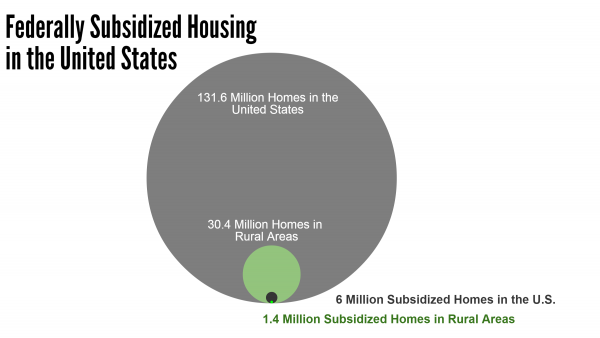
Federally Subsidized Housing Units BubbleSource: HAC Tabulations of HUD and USDA data; National Housing Preservation Database

Folks living in rural areas are particularly well served by their local USDA offices. That agency plays a critical role in bringing the dream of home ownership within reach. For people who choose to live, work, and raise their families in this country’s strong rural communities, many have not only found that the programs focusing on housing loans have helped them buy, but have also vastly improved their quality of life. Other available options provide loans and grants for everything from hospitals, fire stations, and nursing homes, to funding for apartments for those with low-income or the elderly, schools, and housing for farm laborers.

There are issues and complexities that occur in a rural landscape unique only to those communities. The USDA, through Rural Development, has worked for more than half a century to understand those nuances and provide housing options that don’t exist outside of rural America. For instance, USDA’s loan program offers borrowers an opportunity for homeownership with no money down, and allows rural families to stay right where they are. I continue to believe moving rural housing programs under a freestanding FHA is not a move toward efficiency, as many in Washington contend, but one that sets rural communities back and leaves them stuck in the past.

Right now, in Missouri’s Fifth Congressional District, the numbers and dollar amounts for 502 Guaranteed loans active and being serviced in Jackson, Lafayette, Ray, and Saline counties, show an impressive amount of families utilizing the program. There are 1,691 loans totaling more than $170 million.

Affordable housing in rural America is not just a nicety, it’s a necessity. It must be available, accessible, and affordable for those who need it. And, make no mistake, I will continue fighting to make sure it’s just that.
Repurposing Foreclosed Properties in Rural America

A consortium of nonprofits works at the local level to reverse the devastating effects of the foreclosure crisis

by Noel Poyo and Chrisopher W. Sanchez

NALCAB, the National Association for Latino Community Asset Builders, represents and serves a geographically and ethnically diverse group of more than 100 non-profit community development and asset-building organizations that are anchor institutions in our nation’s Latino communities. NALCAB members are experts in implementing responsible, market-based strategies for developing neighborhood assets, investing in small businesses and building family wealth.

More than 35 percent of NALCAB’s members serve rural communities. The dramatic dispersion of Latinos outside of traditional urban centers into small towns has been among the most striking population shifts in the U.S. over the past 50 years. This demographic trend has brought much needed labor and entrepreneurial vigor to many rural communities, just as it has presented new social and economic challenges. Among the strongest impulses of the NALCAB founders was to provide access to capital and culturally relevant asset building services for Latinos living and working in rural and colonia communities.

NALCAB members immediately observed the market-depressing effects of foreclosures in small towns

The foreclosure crisis that sparked the Great Recession was particularly brutal in many rural counties. Adam Wodka’s 2009 study (Landscapes of Foreclosure: The Foreclosure Crisis in Rural America) estimated that 15 of the 20 counties with the highest rates of foreclosure were rural or mixed rural. While the sheer number of foreclosures was certainly higher and more concentrated in urban areas, NALCAB members immediately observed the market-depressing effects of foreclosures in small towns. Once impacted, however, rural communities were at a disadvantage when competing with large cities for resources. NALCAB connected urban and rural-serving non-profit organizations in a consortium strategy that leveraged substantial federal funding to address the impacts of foreclosure. The strategic assembly of select NALCAB member organizations into a national collaborative effort enabled the consortium to tackle important economic issues to reverse the devastating effects brought forth by the foreclosure crisis.

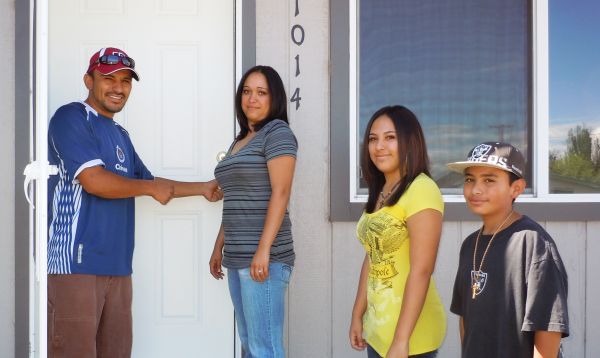
The Bolanos Family Opening The Door To Their New Home

In February 2010, a consortium of 13 nonprofits organized by NALCAB received $137 million from the U.S. Department of Housing and Urban Development (HUD) to stabilize communities impacted by home foreclosures and abandonment in 8 states and the District of Columbia. This HUD Neighborhood Stabilization Program 2 (NSP2) grant is the single largest federal award ever targeted to predominantly Latino communities.

The consortium included markets in California, Arizona, Colorado, New Mexico, Texas, Illinois, Pennsylvania and Maryland and our nation’s capital, Washington D.C. Many of the consortium partners were already doing housing development in rural communities. They had an existing housing delivery infrastructure, but they lacked resources to stabilize these rural communities. It was understood that a balanced approach of urban and rural strategy was essential. While a strategy targeting only rural communities may not have been competitive, mixing urban and rural target areas made it possible for rural communities to access funding. Combining urban and rural strategy into our NSP2 application made us a stronger applicant and paved the way for the NSP2 award of $137 Million.

The CPLC/NALCAB NSP2 Consortium has now deployed the entire grant, and has used the proceeds from the sales of rehabilitated properties, to surpass $200 million in direct investment. In other words, the consortium partners not only deployed the entire NSP2 award, but it was done in an economically prudent manner that allowed the consortium to generate over $70 Million in program income to date. This amount of program income will continue to increase as existing housing inventory is rehabilitated and sold. The following impacts have been accomplished to date:

  • 968 affordable single family units created
  • 986 affordable rental units created
  • 42 blighted properties demolished
  • 54 properties land banked for future development
  • 1,614 jobs created or retained

Erica-Cantu-Daughter-web

The following CPLC/NALCAB NSP2 Consortium Partners made a conscious decision to carve out funding to serve rural and colonia communities in their respective markets. Chicanos Por La Causa, Inc. (CPLC) of Arizona; Community Resources and Housing Development Corporation (CRHDC) of Colorado; Community Housing Improvement Systems and Planning Association, Inc. (CHISPA) of Salinas, California; and Tierra Del Sol Housing Development Corporation (TDS) of Southern New Mexico and West Texas were committed to serving the needs of their most vulnerable rural neighbors. The following are short summaries of the rural neighborhood investment strategies that the CPLC/NALCAB NSP2 Consortium implemented:

Chicanos Por La Causa, Inc. (CPLC) Arizona

CPLC invested over $3.2 million of its NSP2 funds in the rural markets of Rio Rico & Nogales, AZ. Both communities are located in Santa Cruz County, adjacent to the border with Mexico. CPLC has produced over 50 housing opportunities for rural families. Most of the activity has been focused on acquisition and rehabilitation; however, they also acquired a five acre tract of land that they will land bank. The tract of land is in close proximity to an existing CPLC multi-family apartment complex. The newly acquired land will allow CPLC to construct much needed affordable rentals in Santa Cruz County. The NSP2 award has allowed CPLC to expand and complement efforts that it had already begun in the area. CPLC’s NSP2 program has created an undeniable economic boost to the real estate market in Santa Cruz County.

Community Resources and Housing Development Corporation (CRHDC) Colorado

CRHDC had a broader program design that covered many rural markets. It acquired and rehabilitated 15 homes in rural Colorado; Alamosa, Del Norte, Walsenberg, and Monte Vista. These efforts led to increased home values, helped boost homebuyer confidence, recharged the local construction industry and revitalized homes that had become an eyesore in these neighborhoods.

CRHDC also produced 14 new units of site built and modular housing in Monte Vista and San Luis. Local residents welcomed this new development and it enhanced the appearance and vitality of these communities.

CRHDC engaged in multi-family housing; it acquired a 48 unit property in Sterling, CO with their NSP2 funds. It successfully leveraged additional funds from the State Division of Housing to cover the rehabilitation costs, plus it received a low cost loan from the State, to complete the project.

Additionally, CRHDC acquired land in Fort Morgan, CO, which will be the future site of a 50 unit farmworker housing community, to be named Sol Naciente.

Community Housing Improvement Systems and Planning Association, Inc. (CHISPA) California

CHISPA demonstrated how a highly targeted approach could renew a specific neighborhood. CHISPA has made a significant impact in Greenfield, CA, a rural community in Southern Monterey County. CHISPA used NSP 2 funds to acquire four homes in a single cul-de-sac, which is located adjacent to an existing CHISPA rental property. The homes were rehabilitated and either sold or rented. CHISPA’s total real estate portfolio was an anchor for this neighborhood. CHISPA also acquired a single family home and a duplex in Greenfield that are being rented to households with incomes at or below 50 percent of area median income.

CHISPA continues its revitalization efforts in Greenfield. CHISPA is now building three brand new homes using HUD NSP funding. The homes will be sold in order to generate additional program income and create more new homes in the City of Greenfield. The city leaders have been vested partners and have expressed particular excitement that new construction has started again in Greenfield.

Tierra Del Sol Housing Corporation (TDS) Southern New Mexico & West Texas

TDS launched its NSP2 program by acquiring four U.S. Department of Agriculture (USDA) foreclosures in Horizon City, TX. These units were in rough shape. Because of the isolation of this rural community, vacant properties were prime targets for theft and vandalism. TDS stepped in and ultimately acquired 16 homes in this rural market, revitalizing the homes and filling them with responsible and proud homeowners. The investment in this market definitely improved market conditions and helped put contractors and small business owners back in business.

In each case, these organizations were able to deploy funds rapidly and effectively because they had an existing track record of development in their target markets and well established relationships with local government and other partners. Furthermore, these organizations had already earned the trust of the community because of their past commitment to these rural communities. The NSP2 funds simply allowed them to complement their existing programs and services and allowed organizations of shared vision and mission to improve Latino communities – both urban and rural.

Noel Poyo is the Executive Director and Christopher W. Sanchez is the Program Director at the National Association for Latino Community Asset Builders – NALCAB. For more information please call the NALCAB Office at (210) 227-1010 or go to their websites: https://www.nalcab.org or https://www.nsp2nationalconsortium.org.

GET THE HAC NEWS!

Sign-up for HAC information products

SIGN UP HERE

Housing Assistance Council   |  1828 L Street. N.W., Suite 505, Washington, D.C. 20036
(202) 842-8600 (202) 347-3441 hac@ruralhome.org |

Board Portal

HAC is an equal opportunity provider, employer, and lender. | Civil Rights | Privacy