Federal government shuts down many functions

UPDATED as of 8:00 pm Eastern time on Tuesday, October 14.

The Office of Management and Budget (OMB) has posted an updated version of its Frequently Asked Questions During a Lapse in Appropriations, dated October 3, 2025. Several of the questions and answers relate to treatment of government contracts and awards during a shutdown.

……………..

October 1, 2025 — With Congress unable to agree on appropriations bills or a continuing resolution, many government activities stopped at the end of September 30, the last day of fiscal year 2025. The closure is likely to last for at least several days, because the House is not scheduled to be in session until October 6. The last time this occurred, the shutdown lasted a record 35 days, from December 22, 2018 to January 25, 2019.

What activities continue: The administration determines what federal agency functions must be continued during a shutdown. Staff who carry out those essential functions, as well as staff whose positions are not funded through annual appropriations and political appointees confirmed by the Senate, are required to work during the shutdown, but are not paid until the shutdown ends. Other staff are furloughed – they do not work during the shutdown but after it ends they are paid for the time they did not work. If a shutdown lasts more than a few days, determinations of crucial tasks and needed workers may shift.

Agency RIFs: In the last week of September there was significant concern that this shutdown would lead to many federal employees losing their jobs, based on an Office of Management and Budget memo telling agencies to “consider” issuing reduction in force (RIF) notices for employees whose job funding lapsed and whose work tasks were “not consistent with the President’s priorities.”

RIFs and furloughs are different things; a furlough is a temporary layoff with back pay later, whereas a RIF terminates a job, although a RIF’d employee receives a 60-day notice and may be transferred to a different position.

Only a few federal agencies incorporated RIF plans into their shutdown contingency plans, however, and USDA and HUD were not among them. Overall, the current furloughs reportedly impact around 550,000 federal workers, 23% of the current workforce.

USDA shutdown plan: USDA’s current plan has one page devoted to Rural Development. It shows that nearly 83% of RD’s staff are furloughed, compared to 49% of the department’s total staff. “Limited” RD activities will continue, including making Section 521 Rental Assistance payments for contracts already in effect, for as long as the funding is available. RD staff have told stakeholders that available RA funds will cover the program at least until the end of October.

RD does not have authority to renew RA contracts that expire during the shutdown.

According to the plan, the agency will continue servicing loans “only as necessary to protect RD’s interest in properties.” This seems to imply what past RD plans stated explicitly – no new loans, grants, or loan guarantees would be issued during a shutdown.

HUD shutdown plan: HUD’s plan seems to indicate that almost 94% of its employees are furloughed, with 16% of them to be recalled intermittently, but that many of its programs are functioning.

Programs such as HOME, CDBG, and Continuum of Care will continue to disburse funds when funds have been obligated and no further action by HUD employees is necessary. When HUD review or action is required, the department will recall employees “as necessary to avoid an imminent threat to the safety of human life or property.”

Monthly subsidy programs such as public housing, housing choice vouchers, and multifamily assistance contracts, will continue to operate while funding is available. Unlike USDA, HUD does have the authority to renew Project-Based Rental Assistance contracts that expire during the shutdown.

The plan notes that “nearly all of HUD’s fair housing activities will cease during a lapse” in appropriations.

National Flood Insurance Program expiration: The continuing resolution that funded the government from March 15 through September 30 authorized NFIP, so the program expired after September 30. FEMA can continue to pay claims so long as it has funds available, but it must stop issuing or renewing policies.

Long-term effects: At this point, it is difficult to determine how long the current closure may last and what its long-term impacts may be. The Congressional Budget Office estimated that around 750,000 workers could be furloughed every day of the shutdown, with the daily cost of their compensation totaling roughly $400 million.

……………

NOTE: As of mid-afternoon Eastern time on September 29, 2025, HAC could find no new information about what might happen to rural housing programs in the event of a federal government shutdown. If we receive any news we will post it here.

…………….

Follow HAC’s reporting on appropriations in the HAC News (subscribe here) and on our web pages for USDA and HUD funding.

Federal agencies are required to prepare contingency plans identifying which functions will continue during a government shutdown and which will not. The summary below is based on the most recent plans posted online for USDA, HUD, and the Treasury Department. All of them were prepared during the Biden administration. USDA’s January 2024 shutdown plans are still online, while HUD’s and Treasury’s plans have been removed and not replaced. OMB’s shutdown page refers readers to individual agencies. OMB’s September 2023 FAQs remain online.

A brief federal government shutdown probably would not impact most people who receive housing assistance but, at some point after the first few days, the housing effects would begin to be noticeable. In fiscal year 2019, a record 35-day shutdown from December 22, 2018 to  January 25, 2019 led some owners of USDA-financed rental properties, unaware that the agency had enough Section 521 Rental Assistance (RA) funding to last through January, to threaten to evict tenants who could not pay full rent on their own. Fortunately, Congress reached a funding agreement before any RA renewals were missed that February. (More details about the 2019 shutdown are included at the end of this post.)

KEY TAKEAWAYS

  • A brief federal government shutdown probably would not impact most people who receive housing assistance but, at some point after the first few days, the housing effects would begin to be noticeable.
  • Section 521 Rental Assistance disbursements would continue, but not until the 30th day of a shutdown, and only if funding is available, according to USDA Rural Development’s shutdown plan, dated January 2024.
  • No new rural housing loans, grants, or loan guarantees would be committed during a shutdown.
  • HUD’s monthly subsidy programs – including public housing operating subsidies, housing choice vouchers, and multifamily assistance contracts – would operate only while funding remained available, according to HUD’s September 2023 contingency plan. If they ran out of money during a shutdown, they would cease to operate.

WHAT SHUTS DOWN

USDA Rural Development

Rural Development’s contingency plan, dated January 2024, indicates that State Directors, their staff, and some employees in the Washington, DC national office and the Customer Servicing Center in St. Louis would continue working during a shutdown.

Rental Assistance

RD’s plan says that Section 521 Rental Assistance would continue “only … if a threat to RD’s property interests becomes imminent (day 30) …, and funding remains available under existing rental assistance agreements. … On and after the 30th calendar day of a funding lapse, RD will assign the minimum number of employees needed to disburse Rental Assistance payments, pursuant to the exception for the protection of property (RD’s security interest), on the presumption that, after 30 days, the threats to RD’s property will have become and will continue to be imminent.”

The amount needed for RA can vary considerably from month to month. The RA payments each month are for the RA contracts that expired during that month, and each payment obligates a full year of RA funding. For example, the RA contracts that expired during November 2024 and were renewed in late November or early December will not be impacted again until they expire in November 2025.

The contingency plan does not have a provision – which was included in a previous version – stating that, if the agency has used up all its RA funds, “additional servicing options” could be provided to rental properties. In 2019, for example, USDA was considering permitting owners to use project reserves to cover costs. That shutdown ended before the agency completely ran out of RA money, so they did not have to decide whether to allow the use of reserves.

Loans, grants, and servicing

According to USDA’s contingency plan, no new loans or grants would be committed during a shutdown. No new loan guarantees would be issued under any of the housing programs or the community facilities program. For Section 502 guaranteed loans only, lenders and borrowers could choose to proceed with closing if USDA had already issued a valid conditional commitment. The lender would be assuming the risk until the shutdown ended and a guarantee was issued.

RD activities that are considered necessary to preserve the government’s property would continue during a shutdown, and loans and escrow accounts are considered to be government property. Therefore RD would keep processing nightly updates for each RD financial system, making insurance and tax payments from borrowers’ escrow accounts, and “reconciling and submitting for initial processing” collection activity including amortized payments and payoff activity. Some foreclosure sales would go forward. Servicing of existing guaranteed loans would continue, including processing loss claims.

Disbursements of construction loans and grants would continue during a shutdown.

HUD

HUD’s plan is dated August 2023. It explains that, since 2019, appropriations language has allowed HUD’s salaries and expenses funding to be carried over into the next fiscal year. The plan explains that funds remaining from an expired continuing resolution – such as the CR that ends on December 20 – cannot be used for new obligations. The department’s senior leadership would decide how much of that funding to use and for what functions.

Programs operating with HUD funding that was obligated before a shutdown would continue to operate. Much of the Federal Housing Administration’s and Ginnie Mae’s work would continue during a shutdown. Monthly subsidy programs, however – including public housing operating subsidies, housing choice vouchers, and multifamily assistance contracts – would operate only while funding remained available. If they ran out of money during a shutdown, they would cease to operate.

Treasury

The Treasury Department’s plan, dated September 2023, states that the CDFI Fund’s programs would not operate during a shutdown, without providing any further details.

WHO KEEPS WORKING

Generally, during a shutdown, federal staff in the affected agencies do not work unless their functions are considered essential. Furloughed employees are also not allowed to do their jobs voluntarily while the government is closed. In the past, Congress and the President have usually agreed to pay furloughed employees retroactively after a shutdown ends, but they are not required to do so.

Presidential appointees (i.e., agency officials who were confirmed by the Senate) are not furloughed. They are not paid, however, unless funds for their salaries are appropriated after the shutdown ends. “Schedule C” employees, also known as political appointees (these jobs do not require Senate confirmation), are subject to the same rules as civil service employees to determine whether their roles are essential during a shutdown.

WHAT A SHUTDOWN MEANS FOR GOVERNMENT CONTRACTS

A 2023 Office of Management and Budget document explains that during a shutdown a federal contractor can proceed with work that is not impacted by the lapse in funding. For example, if an agency has already obligated funds representing the entire price under a contract or task order before the funding lapse began, the contractor can conduct the work. At the agency, however, routine operational and administrative activities relating to contract or grant administration cannot continue.

WHAT HAPPENED IN FY19

Fiscal year 2019 began on October 1, 2018 with parts of the federal government, including USDA and HUD, open under continuing resolutions. After a final CR expired, they did close down on December 22. The government reopened on January 25, 2019, under another CR that expired on February 15. A final consolidated appropriations act was signed into law by President Trump on February 15.

USDA Rural Development

The first HAC News issue after the shutdown began, published on January 15, 2019, reported that limited functions were continuing at USDA’s national office in Washington, DC and the Customer Service Center in St. Louis. Loan closings were not taking place and applications were not being processed.

Rental Assistance

USDA RD was able to renew Section 521 Rental Assistance contracts that expired in December and January. If the shutdown had continued, however, the agency would not have had enough money to renew the approximately 700 RA contracts that expired in February and 1,000 in March.

By January 25, 2019, when a deal was reached for a three-week CR, the HAC News reported that USDA was considering short-term measures, such as allowing owners to use project reserves to cover costs, but had not yet finalized any plans or notified property owners/managers. The need for providing information directly from USDA had become clear when managers of USDA-financed properties in Arkansas, Louisiana, Missouri, and Mississippi sent notices to tenants telling them their RA was ending in January and they would be responsible for paying their full rent, then backpedaled when informed by USDA the RA would be paid.

After the shutdown ended, the February 11, 2019 HAC News quoted a notice USDA sent to owners and managers of USDA-financed properties with Section 521 Rental Assistance: “We are pleased to inform you that Rental Assistance for Section 514/515 properties has been obligated through April. … We understand that the most recent lapse in appropriations created anxiety and uncertainty regarding the status of your contract obligations. We are hopeful that this communique and the fact that all contracts are obligated through April will provide you reassurance and operational predictability in your management of these critical low-income resources throughout rural America. Thank you for your partnership in delivering the Rural Housing Service affordable housing mission.”

A January 2019 memo from the National Housing Law Project explained the rights of federally assisted tenants during the government shutdown. NHLP is preparing an updated memo for a possible October 2023 shutdown.

Homeownership Programs

On February 1, 2019, after the shutdown ended, USDA’s single-family programs office announced it would issue new Certificates of Eligibility to all Section 502 direct applicants who had valid COEs on December 21 before the government shut down. The agency did not have enough money to obligate additional Section 502 direct loans until it received funding beyond February 15, however.

Section 504 repair loans and grants were available on February 1. USDA planned to prioritize applicants with immediate health and safety hazards.

Other Impacts

There were additional housing-related impacts from the FY19 shutdown, and only a few are summarized below.

Some HUD Project-Based Rental Assistance contracts expired early in the shutdown, as reported in the January 15, 2019 HAC News. About 21,500 households with average incomes under $13,000 per year were impacted by the expiration of 650 PBRA contracts that ended in December. More were expiring in January and February and HUD would need to determine whether it had funds available to renew them. Property owners could use their reserves, if available, to cover shortfalls. Public housing capital funding was unavailable, and operating funds would not be able to carry public housing authorities beyond February.

The shutdown’s effect in Indian Country was “substantial and unique,” the Center for Indian Country Development at the Minneapolis Federal Reserve reported, although calculating a dollar amount was not possible. Because of the unique relationship between the U.S. and Tribes, Tribal services are often closely tied to federal funding. Government employment is disproportionately high in Indian Country, Tribal staff such as those who plow reservation roads were furloughed, and Tribal education funds were in danger.

Disaster spending, particularly funding for Puerto Rico’s recovery from Hurricane Maria in 2017, was also delayed by the 2019 shutdown. Congress had appropriated $20 billion in CDBG-DR funds for Puerto Rico, but only $1.5 billion of that money was approved before the shutdown, and HUD did not disburse it during the shutdown. HUD approval of disaster spending plans or amendments from California, Florida, Georgia, Missouri and the U.S. Virgin Islands was also put on hold.

 

HAC News: October 2, 2025

TOP STORIES 

Federal government shuts down many functions

With Congress unable to agree on appropriations bills or a continuing resolution, many government activities stopped at the end of September 30, the last day of fiscal year 2025.

What activities continue: The administration determines what federal agency functions must be continued during a shutdown. Staff who carry out those essential functions, as well as staff whose positions are not funded through annual appropriations and political appointees confirmed by the Senate, are required to work during the shutdown, but are not paid until the shutdown ends. Other staff are furloughed – they do not work during the shutdown but after it ends they are paid for the time they did not work. If a shutdown lasts more than a few days, determinations of crucial tasks and needed workers may shift. Overall, the current furloughs reportedly impact around 550,000 federal workers, 23% of the current workforce.

USDA shutdown plan: USDA’s contingency plan has one page devoted to Rural Development. It shows that nearly 83% of RD’s staff are furloughed, compared to 49% of the department’s total staff. “Limited” RD activities will continue, including making Section 521 Rental Assistance payments for contracts already in effect, for as long as the funding is available. RD staff have told stakeholders that available RA funds will cover the program at least until the end of October. RD does not have authority to renew RA contracts that expire during the shutdown. According to the plan, the agency will continue servicing loans “only as necessary to protect RD’s interest in properties.” This seems to imply what past RD plans stated explicitly – no new loans, grants, or loan guarantees will be issued during the shutdown.

HUD shutdown plan: HUD’s plan seems to indicate that almost 94% of its employees are furloughed, with 16% of them to be recalled intermittently, but that many of its programs are functioning. Programs such as HOME, CDBG, and Continuum of Care will continue to disburse funds when funds have been obligated and no further action by HUD employees is necessary. When HUD review or action is required, the department will recall employees “as necessary to avoid an imminent threat to the safety of human life or property.” Monthly subsidy programs such as public housing, housing choice vouchers, and multifamily assistance contracts will continue to operate for as long as funding is available. Unlike USDA, HUD does have the authority to renew Project-Based Rental Assistance contracts that expire during the shutdown.

National Flood Insurance Program expiration: The continuing resolution that funded the government from March 15 through September 30 authorized NFIP, so the program expired after September 30. FEMA can continue to pay claims so long as it has funds available, but it will stop issuing new policies or renewing existing policies.

More information and updates: HAC has posted some additional details on our website and will add more information as it becomes available.

Guidance issued for new rural Opportunity Zones

The big reconciliation bill enacted in July included provisions supporting investments in underserved rural census tracts. Notice 2025-50 from the Treasury Department and Internal Revenue Service offers guidance on two of those provisions. First, it addresses the law’s definition of “rural area”: any area other than a city or town with a population greater than 50,000, and any urbanized area contiguous and adjacent to a city or town with a population greater than 50,000. Second, it explains that as of July 4, 2025, the substantial improvement threshold for property located in an Opportunity Zone comprised entirely of a rural area was reduced to 50%. The notice identifies 3,309 of the 8,764 current OZs where the new threshold now applies. Guidance on the new round of OZs to be designated under the revised law will be issued in the future.

RuralSTAT

There are an estimated 4.3 million government workers in rural communities, comprising 17% of the rural workforce. Nationally, government workers make up 14% of the overall workforce. Source: HAC tabulations of the U.S. Census Bureau’s 2019-2023 American Community Survey Data.

Missing Census data during the shutdown? Visit Rural Data Central. We have data for suburban and urban communities too!

OPPORTUNITIES

Small grants available

The Community Heart & Soul Seed Grant Program provides $10,000 and requires a $10,000 cash match from the participating municipality or a partnering organization. Local governments (Tribal, town, or county), nonprofit organizations, and informal resident-led groups are eligible. Communities must have populations under 30,000. “Community Heart & Soul is a four-phase, step-by-step process that brings residents together to identify and honor the unique character of their town and the emotional connection of the people who live there. For most communities, completing the four phases takes about two years. But the completion of the Community Heart & Soul model is really just the beginning. It launches a new way of doing business that nurtures a more vibrant community far into the future.”

Project for Public Spaces’ Community Placemaking Grants for fall 2025 will offer three nonprofits or public agencies $100,000 each in direct funding, as well as placemaking technical assistance and capacity building, to transform a street or mobility hub into a lively community gathering place that improves street safety and mobility. Sites must be located in Georgia, Indiana, Kansas, Kentucky, Michigan, Missouri, New York, Ohio, Tennessee, or Texas. Applications are due October 13.

The Rural Schools Collaborative’s Grants in Place provide up to $2,500 to rural educators to carry out place-based education projects in their local communities. Covering all subjects and ages, these place-based efforts increase student engagement, elevate teacher leadership, and promote rural school and community connections. Applications are due October 24.

CDFI Fund revises funding notice to fit administration priorities

The Community Development Financial Institutions Fund is notifying some applicants for the CDFI Financial Assistance program that they can amend their applications by October 27 in order to be considered for funding. The notice of fund availability, originally published in January, has been revised. “Climate-focused financing” was eliminated as an eligible activity, categories based on race and ethnicity (except for Native Americans, Native Hawaiians, and Alaska Natives) were eliminated as “eligible markets,” and the definition of “healthy foods” was refined. The CDFI Fund announced awards under the Technical Assistance programs for CDFIs and Native American CDFIs on September 30 and said it expects to make additional awards later this winter.

REGULATIONS AND FEDERAL AGENCIES

Fair housing developments at HUD

Whistleblowers sue HUD on fair housing enforcement: On September 22, five attorneys who had worked in HUD’s Office of Fair Housing filed a suit charging HUD with violating fair housing law by curtailing their work, pressuring them to resign, and assigning them to different offices, leaving the fair housing office with six attorneys rather than its previous 22.

Fair housing enforcement to focus on intentional discrimination: HUD’s Office of Fair Housing and Equal Opportunity intends to prioritize its resources, focusing on cases with the strongest evidence of intentional discrimination, according to a recent memo. The document indicates that HUD will not consider discrimination based on neighborhood characteristics, disparate impact, redlining or reverse redlining, appraisal bias, environmental justice, or gender identity.

Some fair housing guidance documents withdrawn: Citing compliance burdens, inconsistency with governing law, and other reasons, OFHEO has formally withdrawn several guidance documents. The canceled notices related to a variety of topics including limited English proficiency, service animals, special purpose credit programs, criminal records, source of income testing, and advertising on digital platforms.

Housing goals proposed for Fannie Mae and Freddie Mac

The Federal Housing Finance Agency requests input on its housing goals for Fannie Mae and Freddie Mac for 2026-2028. Comments are due November 3.

HUD seeks comments on reverse mortgages

Explaining that its Home Equity Conversion Mortgage program and the related mortgage-backed securities program have faced challenges, HUD asks for information about their functioning and suggestions for changes. Comments are due December 1.

USDA names more RD state directors and rural housing senior advisor

A September 19 announcement identifies new Rural Development State Directors for Georgia, Hawaii, Iowa, and Montana and indicates that Monica Mason is now Senior Advisor for the Rural Housing Service. Her background includes financial services, real estate, marketing, and media.

DDAs and QCTs announced

HUD has posted its FY26 lists of Difficult Development Areas and Qualified Census Tracts for the Low-Income Housing Tax Credit program.

NSPIRE inspection rule compliance dates extended once more

Compliance dates for HUD’s National Standards for the Physical Inspection of Real Estate final rule have been extended several times. October 1, 2026 is now the compliance date for the Emergency Solutions Grants, Continuum of Care, HOME, and Housing Trust Fund programs. January 31, 2027 is the new compliance date for the Housing Choice Voucher, Project-Based Voucher, and Section 8 Moderate Rehabilitation programs.

FEMA should address extreme heat, report advises

Noting that extreme heat is the leading weather-related cause of death in the U.S., the Government Accountability Office examined FEMA’s support for states and localities experiencing extreme heat events. GAO recommends that FEMA should identify evidence for Tribal, state, and local governments to use in cost-benefit analyses for projects addressing extreme heat; establish a plan to incorporate additional extreme heat activities into its own benefit-cost analysis processes; develop examples modeling mitigation projects focused on extreme heat; and identify gaps in its programs for assisting Tribal, state, and local governments to address extreme heat events.

PUBLICATIONS AND MEDIA

Federal workforce departures calculated

September 30 was the last day of work for more than 100,000 federal workers who accepted the government’s “deferred resignation” offer. A total of about 275,000 workers are expected to leave under the various departure plans implemented in 2025 (including some through attrition), the White House told The Guardian. Lawsuits related to at least some of the policies are ongoing.

Coastal flooding risk to increase in rural communities also impacted by heirs’ property issues

An article in the Daily Yonder highlights rural communities along the Southeast coast that are disproportionately at higher flood risk. With a spotlight on heirs’ property owners in the Gullah Geechee Cultural Heritage Corridor, reporter Sarah Melotte estimates that 58,500 residents across Georgia, Florida, North Carolina, and South Carolina will be at risk for coastal flooding by 2050. Rural counties are 30% of the counties in the geographic focus area for this analysis, but they comprise 70% of the counties with the highest risk of coastal flooding.

HAC

HAC is hiring

HAC job listings and application links are available on our website.

Need capital for your affordable housing project?

HAC’s loan fund provides low interest rate loans to support single- and multifamily affordable housing projects for low-income rural residents throughout the U.S. and territories. Capital is available for all types of affordable and mixed-income housing projects, including preservation, new development, farmworker, senior and veteran housing. HAC loan funds can be used for pre-development, site acquisition, site development, construction/rehabilitation and permanent financing. Contact HAC’s loan fund staff at hacloanfund@ruralhome.org, 202-842-8600.

Please note: HAC is not able to offer loans to individuals or families. Borrowers must be nonprofit or for-profit organizations or government entities (including Tribes).

Want to reprint a HAC News item?

Please credit the HAC News and provide a link to HAC’s website. Thank you!


Honoring HAC Directors Laura Buxbaum and Tom Manning-Beavin

For years, Laura Buxbaum and Tom Manning-Beavin helped steer HAC through change and growth—always with rural communities in mind. As they step off the board, we pause to thank them for their guidance and the example they set. “Both Tom and Laura are real leaders in rural community development. They bring big brains, big ideas, legitimacy and leadership to the movement,” says Nick Mitchell-Bennett, HAC board member. “It will be hard to replace them at HAC.” 

Buxbaum first encountered HAC while advocating to preserve USDA’s Section 515 rural rental housing. After moving to Maine in 2007 to join Coastal Enterprises, Inc., she deepened her focus on rural markets and the expiring-use risks facing 515 properties. Drawn to HAC’s mission and record, she joined the board and later served as chair.  

Laura Buxbaum. Photo by Chris Kleponis.

Her time in leadership coincided with important board work. The board set term limits, strengthened financial and HR systems, and managed an executive transition that could have unsettled any mission-driven nonprofit. “I am so proud that we were able to hire an excellent CEO to replace our respected and greatly loved leader of many years.” Buxbaum says. “It’s not easy to find someone willing and able to step into those shoes. Change can be hard, even when it’s ultimately positive.” Colleagues credit her with keeping meetings disciplined and inclusive. “Laura consistently brought insight and commitment to Board discussions,” says former director Peter Carey. “While serving as Board Chair, Laura effectively moved the business of each meeting forward, while fulfilling the role of Chair in a way that respected the voice of each member.” Theresa Singleton, HAC board member, adds: “Laura’s leadership and her friendship mean so much to so many people. She has led the board with humor, candor, grit, and focus. I am so very grateful to her for all that she has done for HAC and for rural communities. She should be proud of the legacy she leaves behind.” 

Under the new leadership she helped recruit—and with firm board backing—HAC expanded lending, strengthened its policy voice, and continued to produce research that clarifies rural housing needs. Buxbaum’s hope for the years ahead is straightforward: “It’s my hope that HAC will hold steadfast to its mission through challenging times. I expect HAC to continue to shine a light on the needs and opportunities in rural communities, and to advocate for what is right and important.” Her counsel to those who follow is just as direct: “Once a HACster, always a HACster! You are lucky to be part of this organization – if you bring your best self to the work, and persist, you will find it so rewarding. Know that this work truly makes a difference to so many people. Keep it up!” 

Tom Manning-Beavin. Photo by Chris Kleponis.

Manning-Beavin’s relationship with HAC stretches back nearly three decades—to a job posting in the paper HAC News that set him on a national path. After college, he coordinated emergency home repairs with the Appalachia Service Project in McDowell County, West Virginia. “That summer introduced me to work with tangible purpose,” he says. By 1997 he had joined HAC’s staff to help underwrite the organization’s first Self-Help Homeownership Opportunity Program (SHOP) award. 

He joined HAC’s board in 2015—just after, as he recalls, HAC’s congressional appropriation “went away,” forcing the organization to rethink how it sustained deep work with the lowest-capacity rural partners. “That was a watershed moment and forced a lot of soul searching,” he says. The outcome, in his telling, was a more entrepreneurial HAC: a loan fund that became “a tremendous vehicle for positive change,” a go-to role in preserving the Section 515 portfolio, evolving technical assistance, and research that opened doors to new partners.  

Colleagues describe him as patient and exacting in finance matters. “Tom is the whole package. With his experience as a developer of rural housing, his respected voice as advocate for Appalachia, and his background as a former HAC staffer, Tom brought a wide perspective to his role as Board member. His commitment to HAC’s mission and to the HAC team were always present. Exceptionally generous with his time and energy, Tom invested untold hours in his role as a board member and especially as Treasurer. He is a person of thoughtfulness and unquestioned integrity, and through the years I served alongside him, I often sought his perspective on issues that arose,” Carey says. Others underline the character behind the résumé. “Every interaction with Tom is defined by his genuine kindness, his sharp intellect, and his concern and caring for rural people and communities. You walk away feeling better about the world around us just knowing that people like Tom exist. He exemplifies every quality of a true HACster and will be missed,” says Theresa Singleton. 

Manning-Beavin highlights HAC’s Section 515 preservation push as emblematic of its purpose. The portfolio houses some of rural America’s most vulnerable residents, and nonprofit owners needed a lender willing to engage. “HAC stepped out of its comfort zone, and sought to share the burden of leading an effort to find solutions,” he says. He also points to internal entrepreneurship—like the R2 research initiative—as a path to new relevance, and he resists the idea of HAC morphing into a membership network. Rural America, he argues, needs a partner that works with anyone trying to improve housing conditions for people with low incomes. His parting advice is succinct: “Keep the faith. The work is hard, but absolutely vital to the organizations and communities we serve. If it were easy, then ‘the market’ would already be doing it.” 

Peers see both directors as leaders who paired judgment with initiative. Nick Mitchell-Bennett calls Buxbaum “Driven yet able to enjoy her life.” and Manning-Beavin “Pensive with lots of questions.” The imprint they leave is institutional and cultural; they helped set a tone for board service: ask precise questions, welcome debate, keep the mission in view. HAC today is better equipped to finance preservation and production, advise local practitioners, and publish research that informs policy and practice.  

HAC thanks Laura Buxbaum and Tom Manning-Beavin for their service and example. The next cohort of directors inherits their standard—and the same charge: keep faith with rural communities, and continue the work. 


HAC News: September 18, 2025

TOP STORIES 

FY26 funding outlook remains unclear

As October 1 – the beginning of fiscal year 2026 – approaches, it is not clear whether parts of the federal government will shut down. A continuing resolution that would last through November 21 has been introduced in the House. It would keep most housing programs at current funding levels, but it does incorporate an administration request giving HUD flexibility to use unobligated funds to make up shortfalls in tenant-based rental assistance.

Updated agency shutdown plans have not been posted. There is no new information to add to HAC’s web post from March summarizing what a shutdown could mean for rural housing. USDA’s January 2024 shutdown plans are still online, while HUD’s and Treasury’s plans have been removed and not replaced. OMB’s shutdown page is blank and its September 2023 FAQs remain online.

Income and poverty rate largely unchanged from 2023 to 2024, Census reports, and housing costs rose

The Census Bureau’s annual reports on income and poverty show there were few changes from 2023 to 2024. Median income did not change significantly for white or white non-Hispanic households from 2023 to 2024, but declined by 3.3 percentage points for Black households. Income for the wealthiest 10% of households increased 4.2% while it did not change for lower-earning groups. The official poverty rate fell 0.4 percentage points to 10.6% in 2024. The Supplemental Poverty Measure rate (which takes account of assistance provided to lower-income families as well as other variables not covered in the official poverty rate) was 12.9% in 2024, not statistically different from 2023’s rate. Nationwide, the SPM was 2.9 percentage points higher than the official poverty rate (13.1% SPM compared to 10.2% official), but outside metro areas the official poverty rate was higher (12.1% SPM compared to 13.7% official).

Separately, the Census Bureau released new data showing that median monthly housing costs for U.S. homeowners with a mortgage increased to $2,035 in 2024 from $1,960 (inflation-adjusted) in 2023. For renters, the median cost of rent plus utilities rose to $1,487 in 2024 from $1,448 in 2023 (adjusted for inflation).

Housing and financing bills not yet included in must-pass legislation

The ROAD to Housing Act and a package of provisions related to Community Development Financial Institutions have not yet been, but could still be, added to the Senate’s National Defense Authorization Act, which so far has not been considered on the Senate floor. The House passed its version of the NDAA on September 10 without housing-related amendments.

FEMA staff cuts and funding examined

The Government Accountability Office, an independent agency that works for Congress, recently issued two reports on the Federal Emergency Management Agency and says it is preparing more.

Disaster Assistance High-Risk Series: Federal Response Workforce Readiness, published September 2, notes that efforts are underway to review the federal role in disaster response but FEMA’s responsibilities have not yet changed. GAO reviewed 2024 and 2025 limitations on the agency’s workforce capacity and expressed concerns about FEMA’s ability to meet demands. GAO says that later this fall it will publish a second report looking closely at state and local disaster capabilities.

A September 15 GAO decision examines FEMA’s compliance with the Impoundment Control Act of 1974, which limits the circumstances under which the administration can withhold funds appropriated by Congress. GAO concludes that FEMA “has violated the ICA by improperly withholding or delaying the obligation or expenditure of budget authority” appropriated for FY25 to the Emergency Food and Shelter Program and the Shelter and Services Program. It found no violations for several other FEMA programs. It intends to issue other decisions addressing amounts appropriated in prior fiscal years, as well as amounts appropriated and set aside for the Building Resilient Infrastructure and Communities program.

September 15 to October 15 is National Hispanic Heritage Month

Marking the occasion, the Library of Congress, National Park Service, Smithsonian Institution, and others are “paying tribute to the generations of Hispanic Americans who have positively influenced and enriched our nation and society.”

RuralSTAT

Median income in the U.S. was estimated at $83,730 in 2024, not statistically different from the 2023 estimate of $82,690. Outside metropolitan areas the estimated median income was $63,750 in 2024, also not a statistically significant change from $64,140 in 2023. Source: Census Bureau, Income in the United States: 2024.

OPPORTUNITIES

Funds for Tribal housing available

Federally recognized Tribes and Tribally Designated Housing Entities are eligible for the Indian Housing Block Grant competitive program to increase housing opportunities for low-income Tribal communities. Apply by January 15, 2026. Tribes and Tribal organizations may apply for the Community Development Block Grant Program for Indian Tribes and Alaska Native Villages by November 24. These grants can be used for housing, community facilities, or economic development benefiting low- and moderate-income people. ICDBG-Imminent Threat grants, which have no application deadline, are to eliminate or lessen problems that pose an imminent threat to public health or safety of Tribal residents.

Grants offered for projects that foster local connections

The Hometown Grants program provides up to $50,000 for shovel-ready projects in towns with populations under 50,000. Offered by T-Mobile and administered with assistance from Main Street America, the program helps fund projects that foster local connections, like technology upgrades, outdoor spaces, the arts, and community centers. Elected officials, town managers/employees, Tribal leaders, and nonprofit community leaders can apply. Awards are made quarterly; deadlines are on the last days of March, June, September, and December.

CAPITOL HILL

Subcommittee hears testimony on USDA Rural Development

On September 18 the House Agriculture Committee’s Subcommittee on Commodity Markets, Digital Assets, and Rural Development held a hearing on USDA’s Rural Development: Delivering Vital Programs and Services to Rural America. Witness testimony focused on the essential roles played by RD’s community facilities and business programs, as well as the critical need for RD’s field offices. RD’s housing programs do not fall under the Agriculture Committee’s jurisdiction, but their importance was mentioned at the hearing.

REGULATIONS AND FEDERAL AGENCIES

USDA issues guidance on use of disaster monies

A September 4 memo from Rural Housing Service Administrator George Kelly provides instructions to field staff on the use of Disaster Assistance Funds through the Section 533 Housing Preservation Grant program, the Section 502 direct loan program, and the Rural Disaster Home Repair Grant program. Funds must be used for recovery from specific disasters, as detailed in the notice.

Comment period extended for Fair Market Rents

HUD has changed the deadline for comments on its FY26 Fair Market Rents to October 1 rather than September 22.

Suit filed over Continuum of Care Builds program

The National Alliance to End Homelessness and Women’s Development Corporation filed a lawsuit on September 11 regarding the Continuum of Care Builds program, which supports new permanent supportive housing. Funds were appropriated in 2022 and will expire if not obligated by September 30, 2025. The lawsuit charges that HUD’s third notice of funding opportunity for the program illegally imposed criteria related to ideology and created a last-minute application process even though HUD had issued two previous NOFOs for the same funds. On September 12, a federal judge issued a temporary restraining order prohibiting HUD from making awards under the September 5 NOFO and suspending the September 30 expiration date.

Mass firing of probationary employees was unlawful, court says

Issuing the most recent decision in American Federation of Government Employees v. U.S. Office of Personnel Management, a case that has traveled to the Supreme Court and back, a federal judge ruled that the administration illegally fired over 25,000 probationary federal employees early in 2025. Judge William Alsup determined he could not order agencies to rehire people because the Supreme Court held that they could be fired while the litigation proceeds. The decision applies to USDA and some other agencies but not to all the agencies involved in the suit. The government has filed notice that it will appeal the ruling.

HUD asks how survey data is used

HUD is “evaluating current needs for data from” the Rental Housing Finance Survey and the Survey of Market Absorption of New Multifamily Units. It requests information from the public on uses of the data and other comments or concerns about the two surveys. Comments are due November 10.

EVENTS

State and local housing solutions webinar planned

The New Housing Leadership: Unlocking State and Local Solutions to America’s Housing Crisis will be presented on October 1 by the National Housing Trust. The session is intended to provide new messaging strategies surrounding the role of local organizations in housing, lessons from unlikely allies and partnerships, and concrete pathways for local housing leadership.

Selection of new Opportunity Zones to be covered in webinar

On September 23, the Economic Innovation Group will offer a webinar titled OZs 2.0: What State and Local Leaders Need to Know. The session is intended to provide state and local policymakers and their staff with practical guidance on the reconciliation bill’s changes to the Opportunity Zones program, including state designations of a new round of OZs in 2026.

Bank regulators to hear statements on regulations

The three federal agencies that oversee banks and thrifts will hold a public outreach meeting on October 30 in Kansas City and online. The session is part of a periodic review to identify outdated or unneeded regulations. Members of the public can register to present oral comments. Additional sessions will be announced in the future.

PUBLICATIONS AND MEDIA

Priorities for Fannie Mae and Freddie Mac released

The Underserved Mortgage Markets Coalition, a group of 40 organizations including HAC, convened by the National Association of Affordable Housing Lenders, has released its guiding priorities for Fannie Mae and Freddie Mac. These imperatives ask Fannie Mae and Freddie Mac to maintain and expand nationwide access to affordable, sustainable mortgages and rental housing, and to serve rural places fairly. UMMC has also relaunched its website at underservedmortgagemarkets.org, which includes comprehensive resources for policymakers and the public about the critical role Fannie Mae and Freddie Mac play in providing access to long-term affordable mortgage credit throughout the country.

New toolkit aims to help develop citizen advisory groups after disasters

The Hispanic Federation and the National Low-Income Housing Coalition published a new toolkit highlighting lessons learned by the Citizen Advisory Committee carrying out the Community Development Block Grants-Disaster Recovery program in Puerto Rico. HUD now recommends all disaster-stricken jurisdictions create such advisory groups. From understanding the program and its funding flexibility to the creation of an operational guide in English and Spanish, this toolkit seeks to build on the success of local CACs.

Report focuses on rural place-based economic development

A new publication from the Washington Center for Equitable Growth, A Place-Based Economic Development Strategy to Foster Rural U.S. Prosperity, highlights the importance of centering rural racial diversity, cross-sector economies, and innovation when developing investment and policy strategies.

Local funding adds housing in rural Ohio

Rural Williams County, Ohio has a considerable manufacturing base and a substantial housing shortage. This Rural Ohio County is Building its Own Way Out of a Housing Shortage, an article from the Ohio Newsroom, describes how a local public-private partnership, Williams County Port Authority, has raised funds from the county and local businesses to develop market-rate workforce housing. It has now built and sold 16 single-family homes and is working on a duplex and a senior living community.

HAC

HAC is hiring

HAC job listings and application links are available on our website.

Need capital for your affordable housing project?

HAC’s loan fund provides low interest rate loans to support single- and multifamily affordable housing projects for low-income rural residents throughout the U.S. and territories. Capital is available for all types of affordable and mixed-income housing projects, including preservation, new development, farmworker, senior and veteran housing. HAC loan funds can be used for pre-development, site acquisition, site development, construction/rehabilitation and permanent financing. Contact HAC’s loan fund staff at hacloanfund@ruralhome.org, 202-842-8600.

Please note: HAC is not able to offer loans to individuals or families. Borrowers must be nonprofit or for-profit organizations or government entities (including Tribes).

Want to reprint a HAC News item?

Please credit the HAC News and provide a link to HAC’s website. Thank you!


HAC News: September 4, 2025

TOP STORIES 

Government funding is priority as Congress reconvenes

Congress returned to work this week, facing the start of fiscal year 2026 on October 1. Legislators are expected to consider passing a continuing resolution to keep the government open because they will not be able to finish the 13 annual appropriations bills this month. A CR could last for a few months or for the entire fiscal year.

It is also possible that all or part of the federal government could shut down. There seems to be no new information to add to HAC’s web post from March summarizing what a shutdown could mean for rural housing. USDA’s January 2024 shutdown plans are still online, while HUD’s and Treasury’s plans have been removed and not replaced. OMB’s shutdown page is blank and its September 2023 FAQs remain online.

The full Senate has approved its FY26 appropriations bill for USDA, while the House’s USDA bill has passed the Appropriations Committee but has not yet been considered by the House itself. Transportation-HUD funding measures have passed the Appropriations Committees in both houses but have not been taken up by either body. Details are posted on HAC’s site for both USDA and HUD.

Comment deadline extended for USDA reorganization

Comments on USDA’s reorganization plan, which was announced in late July, will now be accepted through September 30. Members of Congress and others had urged the department to provide more time for feedback, as well as to make comments public and to share a more detailed proposal when available.

September is National Preparedness Month

FEMA encourages using the month to prepare for emergencies. The 2025 theme is Preparedness Starts at Home. HAC’s Rural Resilience website offers tools for readiness, response, and recovery, including HAC’s detailed guide, Prepare Your Organization to Respond and Recover from Natural and Man-Made Disasters.

September is National Recovery Month

The observance focuses on mental health and addiction recovery. The Substance Abuse and Mental Health Services Administration explains that the month is intended to promote and support new evidence-based treatment and recovery practices, the nation’s strong and proud recovery community, and the dedication of service providers and communities who make recovery possible. SAMHSA offers a digital toolkit and other resources.

RuralSTAT

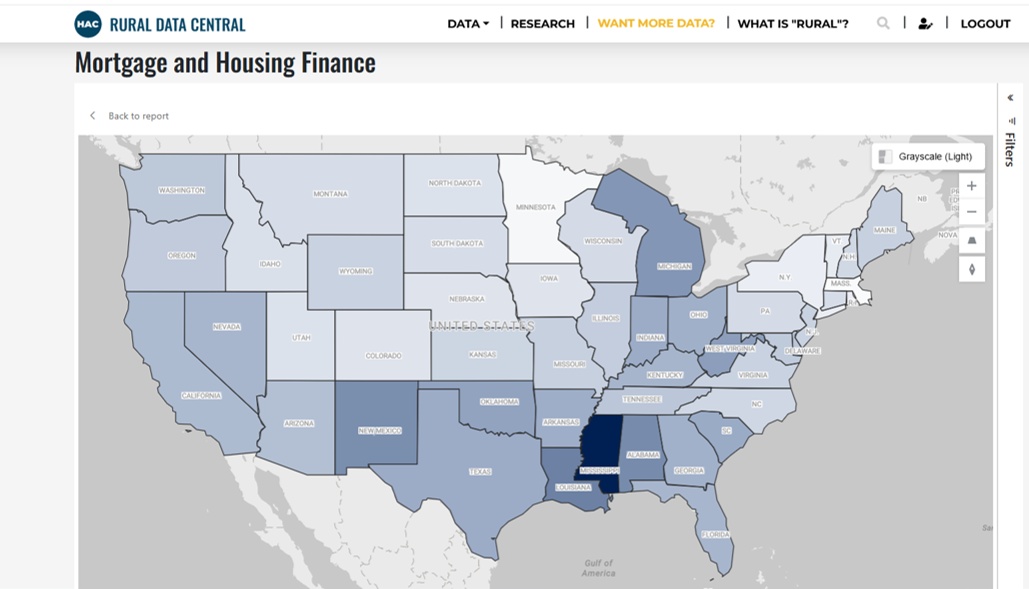
Approximately 8.5% of mortgage loans originated in rural and small-town areas in 2024 were considered “high cost” loans compared to 6% nationally. A mortgage loan is classified as “high cost” if its interest rate is 1.5% (or more) higher than the prime rate for first lien loans. Source: HAC tabulations of 2024 Home Mortgage Disclosure Act Data.

Data from the 2024 Home Mortgage Disclosure Act is now available on Rural Data Central! Visit Rural Data Central to learn more about housing finance in your community.

OPPORTUNITIES

Rural communities grants up to $30,000 offered

The Laura Jane Musser Fund Rural Initiative has grant funding available to encourage collaborative and participatory efforts among citizens in rural communities that will help to strengthen their towns and regions in civic areas such as economic development, business preservation, arts and humanities, public space improvements, and education.  Eligible applicants are nonprofits and local units of government working in rural communities of 10,000 or less in Colorado, Hawaii, Minnesota, Wyoming, and select counties in New York, North Carolina, and Texas. Applications will be available from September 2 through October 2.

CAPITOL HILL

Farm Bill on congressional agenda this month

The 2018 Farm Bill has been extended twice and is now set to expire September 30. Some topics that are usually addressed in the five-year Farm Bill, including the Supplemental Nutrition Assistance Program and farm subsidies, were covered in July’s big budget reconciliation measure. Therefore there may be a lower sense of urgency about passing a “skinny” Farm Bill this month, resulting in another one-year extension.

REGULATIONS AND FEDERAL AGENCIES

Comments requested on energy efficiency standards for manufactured housing

The Department of Energy establishes energy conservation standards for manufactured housing based on the International Energy Conservation Code. Standards set by DOE in 2022 have not yet gone into effect. The IECC was updated in 2024 and costs have changed since 2022, so DOE is considering revisiting its analysis. Comments are due December 2.

Eligibility for Section 184 Indian Housing Loan Guarantees revised

A 2024 final rule made “non-permanent resident aliens” eligible for Section 184 loan guarantees, as well as U.S. citizens and “lawful permanent resident aliens.” HUD is now making “non-permanent resident aliens” ineligible. Explaining that only enrolled Tribal members can receive these guarantees and are almost always citizens, HUD states the change will have little impact, so it is publishing an interim final rule without taking comments or holding Tribal consultations first. The rule will be effective on October 6. Comments are due November 3.

HUD will test portal for documenting spending

HUD requests input on a demonstration program “designed to increase understanding of how enhanced recipient reporting can help reduce the risk of fraud, waste, and abuse across grant programs.” Nine voluntary recipients of funds from the public housing, CDBG-Disaster Recovery, and Continuum of Care programs will justify grant expenditures by uploading supporting evidence such as receipts, invoices, or pay records. Comments are due November 3.

Data sought on HUD residents’ legal status

HUD Secretary Scott Turner posted on X a letter asking public housing agencies to review the citizenship status of all residents in HUD-assisted housing, threatening loss of funding or program eligibility for PHAs that do not comply. HUD’s press office posted that the effort was aimed at preventing undocumented residents from receiving aid. HUD programs are already restricted to citizens and to noncitizens with specific statuses such as green card holders and refugees. Undocumented people may live with eligible family members in HUD-assisted housing and assistance is prorated according to the number of eligible and ineligible people in the household. A fact sheet on eligibility and information sharing requirements is available in English and Spanish from the National Housing Law Project. Turner’s announcement does not apply to the rural housing programs at USDA, which issued a notice in July about ineligibility based on legal status.

FEMA disaster aid linked to immigration enforcement

FEMA contracts for fiscal year 2025 tell states and disaster assistance groups their programs cannot assist undocumented people and must cooperate with immigration enforcement efforts. The Washington Post reports that aid groups and disaster experts believe these new requirements will be difficult to fulfill and may violate state and local laws. The FY25 contract terms also forbid advancement of diversity, equity, and inclusion.

More USDA Rural Development state directors named

On August 21, Agriculture Secretary Brooke Rollins announced presidential appointees for Rural Development and Farm Service Agency state director positions in several states.

PUBLICATIONS AND MEDIA

Mapping tool shows tracts likely to be eligible as new Opportunity Zones

A new Novogradac Opportunity Zones 2.0 Mapping Tool shows what census tracts are likely or unlikely to be eligible for designation as Opportunity Zones under the newly permanent OZ program. The process for nominating and designating the next set of OZs officially begins July 1, 2026.

Model helps to estimate budgets for supportive housing services

The CSH Supportive Housing Services Staffing and Budget Tool is intended to support agencies, communities, and project planners to estimate comprehensive costs for supportive housing services. It allows the user to model out scattered site and project-based programs and input their average staffing costs, budget assumptions, and productivity expectations to determine rates needed for a fiscally sustainable program.

California agriculture faces challenges amid ICE raids

An opinion essay published by the New York Times, Wilted Lettuce. Rotten Strawberries. Here’s What Happens When You Round Up Farmworkers, describes how California’s $60 billion farm economy depends on immigrant labor but is struggling amidst recent ICE raids in fields and packing houses that are driving workers away, leaving strawberries, lettuce, and other crops to rot. With as many as 70% of farmworkers not showing up, the ripple effects include higher grocery prices, more food waste, and lost jobs across the food supply chain. The authors argue that treating longtime, law-abiding farmworkers as criminals threatens not just families but America’s food security itself.

HAC

HAC is hiring

HAC job listings and application links are available on our website.

Need capital for your affordable housing project?

HAC’s loan fund provides low interest rate loans to support single- and multifamily affordable housing projects for low-income rural residents throughout the U.S. and territories. Capital is available for all types of affordable and mixed-income housing projects, including preservation, new development, farmworker, senior and veteran housing. HAC loan funds can be used for pre-development, site acquisition, site development, construction/rehabilitation and permanent financing. Contact HAC’s loan fund staff at hacloanfund@ruralhome.org, 202-842-8600.

Please note: HAC is not able to offer loans to individuals or families. Borrowers must be nonprofit or for-profit organizations or government entities (including Tribes).

Want to reprint a HAC News item?

Please credit the HAC News and provide a link to HAC’s website. Thank you!


HAC News: August 21, 2025

TOP STORIES 

Funding awards must align with administration’s priorities, executive order says

President Trump issued an executive order on August 7 requiring federal agencies to ensure their grants fit the administration’s priorities, can be terminated at any time by the administration, and are controlled by senior political appointees. Existing awards must be revised “to permit immediate termination for convenience.” Awards may not support racial preferences, transgender people, illegal immigration, or “any other initiatives that compromise public safety or promote anti-American values.” The order instructs agencies to make grants “to a broad range of recipients rather than to a select group of repeat players.” It also requires OMB to “appropriately limit the use of discretionary grant funds for costs related to facilities and administration.”

HUD to offer services and materials in English only

HUD Secretary Scott Turner announced on X that “HUD will solely use English for all Departmental business and services. We are one people, united, and we will speak with one voice and one language to deliver on our mission.” HUD will continue to provide communications services to people with disabilities. The change to English-only aligns with an executive order President Trump issued in March, making English the official language of the U.S.

RuralSTAT

According to the Census Bureau’s most recent Community Resilience Estimates for Heat, approximately 82% of rural and small-town census tracts experienced “extreme” heat exposure in 2022. Source: HAC tabulations of U.S. Census Bureau Community Resilience Estimate for Heat data.

CAPITOL HILL

Housing provisions may be added to must-pass legislation

Several senators have proposed to attach housing-related bills as amendments to the National Defense Authorization Act, although they are not related to defense. NDAA is more likely to be passed by Congress than the housing provisions alone so, if these amendments are accepted, their chances of passage will increase. The ROAD to Housing Act, which incorporates the Rural Housing Service Reform Act and was approved by the Senate Banking Committee on July 29, is one of these amendments. Another is a package of provisions related to Community Development Financial Institutions, which includes authorization for USDA’s Section 502 Native CDFI relending program. The RHS Reform Act has also been recently reintroduced as a stand-alone measure in the House; it was reintroduced in the Senate in April.

REGULATIONS AND FEDERAL AGENCIES

FEMA now requires email addresses for disaster survivors

As of August 12, FEMA requires disaster survivors to have email addresses in order to register for aid, Wired reports. The agency will communicate through email and online accounts and will make payments electronically.

Appeals court allows CFPB layoffs

Reversing a lower court decision from several months ago, an appellate court held on August 15 that federal courts cannot yet consider challenges to Consumer Financial Protection Bureau staff cuts and other actions to halt the agency’s work. Staffing actions must go through the civil service review process, the court said. It decided that charges about other activities could be heard only if they were claimed to be unconstitutional or if harmful results had already occurred. Since the decision was made by a three-judge panel, the plaintiffs can now appeal the ruling to the full appeals court for the District of Columbia circuit. If layoffs proceed, they will impact about 90% of the agency’s staff.

Judge restores funds for FEMA resilience program

The administration ended FEMA’s Building Resilient Infrastructure and Communities program earlier this year, but several states filed suit challenging that decision. On August 5, the judge hearing State of Washington v. FEMA issued a preliminary injunction barring the agency from spending BRIC’s funding for other purposes while court proceedings continue.

Rollins announces more Rural Development appointments

Glen Smith, whose background is in farming and agri-business in Iowa, is nominated to serve as Under Secretary of Rural Development. He will need to be approved by the Senate. Neal Robbins will become Deputy Under Secretary for Rural Development, a position not requiring Senate review. He is from North Carolina with public and private sector experience in manufacturing, rural economic development, and financial transactions. Anthony Priest, appointed Chief of Staff for the Rural Housing Service, has worked in real estate development, product development, and education.

Fair Market Rents published

HUD has released Fair Market Rents for fiscal year 2026. Comments are due September 22.

Solar for All program ends

EPA Administrator Lee Zeldin announced on X and YouTube that his agency is ending the Solar for All program, one of three Greenhouse Gas Reduction Fund programs. The administration previously moved to terminate the GGRF’s National Clean Investment Fund and Clean Communities Investment Accelerator, and July’s big reconciliation bill repealed all three.

PUBLICATIONS AND MEDIA

High needs rural areas could be hit especially hard by reductions to Medicaid and SNAP

About 12 million households nationwide receive both Medicaid and Supplemental Nutrition Assistance Program benefits. The highest rates of dual enrollment are in Central Appalachia, the U.S.-Mexico border region, the Mississippi Delta, and parts of some large metropolitan areas, the Urban Institute reports. As a result, those areas are likely to be seriously impacted by the recently adopted budget reconciliation bill, which cuts both programs.

Brief advises funders on CDFIs’ role supporting affordable homeownership

The Asset Funders Network has released a new brief on the role of Community Development Financial Institutions in increasing homeownership. The brief and a related webinar provide an overview of the history and role of CDFIs in underserved communities, the ways in which CDFIs support clients through funding or other services, and a variety of strategies for philanthropy to help ensure the stability of CDFIs in the future as housing affordability continues to decrease and other funding streams become more limited. The materials include many rural examples.

Stories highlight the journey to retain property in rural Southeast

USA Today provides an in-depth look at the issue of heirs’ property and the challenges some families face in retaining and protecting their generational property. This two-part series describes Saul Blair’s efforts to preserve his family’s property in rural Georgia, purchased over 100 years ago by his great-grandfather following his emancipation from slavery.

Internet availability not enough without uptake

The Billion-Dollar Remote Work Opportunity that Rural America Can’t Reach, commentary published by Fortune, points out that internet usage/subscription rates are low in rural communities, even those where broadband is now available. Many residents – most often older – do not understand its value, although they could benefit from remote work and services like telemedicine. The author recommends a “social strategy,” perhaps including temporary free access, to overcome reluctance.

New research proposes Community Reinvestment Act reform

A new book, Ending Redlining Through a Community-Centered Reform of the Community Reinvestment Act, explains how financial institutions can invest in and respond to the needs of underserved neighborhoods. The publication includes case studies on CRA in rural America and Native American areas.

HAC

Rural Housing Service Awards nominations open

At the 2025 National Rural Housing Conference in November, HAC will present its prestigious Rural Housing Service Awards. These awards recognize individuals whose exceptional leadership, commitment, and lasting contributions have significantly advanced affordable housing and community development in rural America. Submit nominations here by August 29.

HAC is hiring

HAC job listings and application links are available on our website.

Need capital for your affordable housing project?

HAC’s loan fund provides low interest rate loans to support single- and multifamily affordable housing projects for low-income rural residents throughout the U.S. and territories. Capital is available for all types of affordable and mixed-income housing projects, including preservation, new development, farmworker, senior and veteran housing. HAC loan funds can be used for pre-development, site acquisition, site development, construction/rehabilitation and permanent financing. Contact HAC’s loan fund staff at hacloanfund@ruralhome.org, 202-842-8600.

Please note: HAC is not able to offer loans to individuals or families. Borrowers must be nonprofit or for-profit organizations or government entities (including Tribes).

Want to reprint a HAC News item?

Please credit the HAC News and provide a link to HAC’s website. Thank you!


HAC News: August 7, 2025

TOP STORIES 

Bipartisan housing bill gets unanimous committee approval 

The Renewing Opportunity in the American Dream (ROAD) to Housing Act, S. 2651, was approved unanimously by the Senate Banking Committee on July 29. The bill, which HAC supports, combines provisions from around 30 different housing bills, including the Rural Housing Service Reform Act (endorsed by HAC), the Streamlining Rural Housing Act, the HUD-USDA-VA Interagency Coordination Act, and the Whole-Home Repairs Act. It would reauthorize the HOME program, provide permanent authorization for the PRICE manufactured housing program and the CDBG-Disaster Recovery program, streamline FHA financing for modular/manufactured housing, and support affordable housing in numerous other ways. The ROAD to Housing Act does not include the RHS Reform Act’s provision to permanently authorize the Section 502 Native CDFI relending program, but in the committee markup Senator Tina Smith (D-MN) indicated that she and Senator Mike Rounds (R-SD) hope to prioritize moving that provision forward as a stand-alone bill. 

Senate passes USDA funding bill 

On August 1, the full Senate approved three FY26 appropriations bills, including the measure for USDA. It would hold many of the rural housing programs at their current funding levels while increasing Section 502 direct funding to $1 million from the current $880 million. Details are posted on HAC’s site. The House has not yet considered the USDA funding bill passed by its Appropriations Committee, which would provide lower amounts for several rural housing programs. Both houses are now in recess until after Labor Day. Fiscal year 2026 begins on October 1, 2025.  

HUD appropriations approved by Senate committee 

The FY26 Transportation-HUD funding bill approved by the Senate Appropriations Committee on July 24 would provide $1.25 billion for the HOME program, which would receive no funding under the House version of the bill. The Senate bill would also increase funding for housing vouchers, project-based rental assistance, homeless assistance grants, Section 202 elderly housing, and Section 811 housing for people with disabilities. SHOP would be set at $13 million, up from $12 million in FY25, and the Rural Capacity Building program would receive $8 million. It would provide $3.1 billion for CDBG compared to this year’s $3.3 billion. Details are available here. Neither the House nor the Senate would renew expiring Emergency Housing Program vouchers. The Center on Budget and Policy Priorities provides state-by-state and demographic estimates of the loss of Housing Choice Vouchers under the House and Senate THUD proposals.  

Executive order calls for changed approach to homelessness

President Trump issued an executive order on July 24 titled Ending Crime and Disorder on America’s Streets, calling for institutional treatment of people experiencing homelessness, prioritization of funding to states and cities that criminalize homelessness, and an end to Housing First policies and harm reduction approaches. Many of these policies are determined by state and local laws, however. The National Alliance to End Homelessness has published the first two of a series of blog posts explaining the order and its impacts.  

RuralSTAT 

Immigrants make up 14% of physicians and surgeons in rural areas, compared to 5% of the overall rural workforce. They are 28% of agricultural workers. Source: Kaiser Family Foundation, What Role Do Immigrants Play in the Rural Workforce?  

OPPORTUNITIES

Low Income Housing Tax Credit resources to increase

The Federal Housing Finance Agency has doubled the amounts Fannie Mae and Freddie Mac can invest per year in Low Income Housing Tax Credits from $1 billion each to $2 billion each. Half of the $4 billion total will be reserved for difficult to serve LIHTC markets and at least 20 percent of that half will be for Duty to Serve rural communities. HAC issued a statement applauding the move.  

USDA offers funds for housing repairs

Nonprofits, public agencies, and Tribes can apply by September 4 for the FY25 Section 533 Housing Preservation Grant program. The $13.1 million available includes $2.1 million for disaster assistance and $500,000 each for recovery from Hurricanes Fiona in Puerto Rico and Helene in Tennessee. Awardees can make grants or low-interest loans to repair or rehabilitate housing owned by or rented to low- or very low-income rural residents. A nonprofit cannot receive funds directly from USDA for a rental property it owns.  

HUD ordered to release fair housing funds, publishes new competition notices  

Applications are due August 21 for four Fair Housing Initiatives Program (FHIP) initiatives. A federal judge required HUD to reopen the competitions, issuing a temporary restraining order on July 28 in National Fair Housing Alliance v. HUD. The case, filed in June, challenges HUD’s failure to award FY24 FHIP funds under funding opportunity notices it published in September 2024 and its failure to disburse funds under previously awarded multi-year grants. The judge ordered HUD to explain its timeline and to file weekly reports on its progress in making the awards before September 30, when the funding expires. The reopened opportunities are: 

  • The FHIP Private Enforcement Initiative will enable experienced fair housing enforcement organizations to conduct testing, investigate violations, and enforce the Fair Housing Act and equivalent state and local laws.  
  • The FHIP Education and Outreach Initiative will fund fair housing organizations and other nonprofits that have, or partner with an entity that has, experience in media or public relations. Awardees will develop and implement media campaigns promoting fair housing. 

Green Communities Criteria comment period open  

Enterprise Community Partners has posted the first full draft of its 2026 Green Communities Criteria and requests public comment by August 27. It describes Green Communities as the only green building standard created with, and for, the affordable housing sector.  

CAPITOL HILL 

Senators ask OMB to release CDFI funding  

A bipartisan group of 26 senators has written to OMB director Russell Vought urging him to release monies appropriated for the Community Development Financial Institutions Fund in FY25. The letter points out that the CDFI Fund closed applications periods for five of its programs months ago but has not yet made awards, while applications for other programs have not yet been announced. The senators ask OMB to issue a spending plan outlining timelines for obligating its funds.  

REGULATIONS AND FEDERAL AGENCIES 

USDA accepting comments on reorganization plan 

On August 1, USDA announced it will accept comments on the reorganization plan it released on July 24. Input from “all stakeholders, including USDA employees, members of Congress, and agricultural and nutrition partners,” can be emailed to reorganization@usda.gov by August 26. Deputy Secretary Stephen Vaden told a congressional committee he believes a majority of employees who will be asked to relocate will accept transfers from Washington, DC to other parts of the country. He also said the reorganization will “leave the county-level footprint [which includes RD offices] alone.”   

Justice Department advises federal funding recipients on DEI discrimination 

A memo from the Attorney General offers guidance “to ensure that recipients of federal funding do not engage in unlawful discrimination,” including through diversity, equity, and inclusion programs. The memo’s examples of unlawful practices include prioritizing hiring candidates from “underrepresented groups,” establishing a Black Faculty Caucus, and favoring minority-owned or women-owned businesses. Recommended best practices include focusing on skills and qualifications in selection processes and including nondiscrimination clauses in contracts.  

Comments requested on ending Equitable Housing Finance Plans  

The Federal Housing Finance Agency proposes to repeal its Fair Lending, Fair Housing, and Equitable Housing Finance Plans regulation. The rule has required Fannie Mae and Freddie Mac to each adopt a plan every three years identifying barriers to sustainable housing opportunities faced by one or more underserved communities, goals and objectives with respect to the identified barriers, and meaningful actions to support accomplishment of the goals and objectives. Comments are due September 26.     

Funding stopped for technical assistance to address homelessness through SSI/SSDI 

The SSI/SSDI Outreach, Access, and Recovery (SOAR) model assists caseworkers to help clients who have a mental illness, medical impairment, or a substance use disorder and are experiencing or at risk of homelessness to access Supplemental Security Income and Social Security Disability Insurance. As of August 18, the Substance Abuse and Mental Health Services Administration is ending funding for technical assistance to SOAR caseworkers and the resource website at https://soarworks.samhsa.gov/ will become unavailable. Archived versions of the site should still be accessible through the Internet Archive. Policy Research Associates, which has run the SOAR TA Center since 2009, offers a recorded webinar explaining how organizations can continue using the SOAR model. 

Nominations open for USDA’s Tribal Advisory Committee 

USDA seeks nominations for four open positions on its Tribal Advisory Committee. Nominations can be submitted by representatives of Tribes, Tribal organizations, or national or regional organizations with relevant expertise such as national or regional Tribal serving organizations, land-grant institutions, and Native CDFIs. The deadline is September 22. 

Rural Development to begin using USDA’s environmental requirements 

On October 1, USDA RD will begin to evaluate compliance with the National Environmental Policy Act using a new interim final rule that applies throughout the department. RD’s announcement says that funding applications submitted before October 1 “will continue to be reviewed on a case-by-case basis under prior NEPA policies and procedures or [the interim final rule].”  

Guidance issued for HOPWA inspections 

A HUD notice offers guidance to grantees under the Housing Opportunities for Persons With AIDS program on implementing the National Standards for the Physical Inspection of Real Estate. It addresses how to inspect units for compliance with the NSPIRE rule and how to ensure corrections are made, as well as statutory requirements for carbon monoxide alarms or detectors and smoke alarms. The compliance date for these standards is February 2, 2026.  

EVENTS 

Webinar to consider disaster recovery for immigrants 

The National Low Income Housing Coalition, the Protecting Immigrant Families Coalition, and Just Solutions Collective will hold a webinar entitled Immigration & Disaster Recovery: Rights, Access, and Where We Go from Here, on August 12. This session, intended for advocates for immigrant communities and disaster recovery practitioners, will address protecting communities while navigating the disaster recovery system.  

PUBLICATIONS AND MEDIA 

New report shows home repair difficulties for lower-income homeowners 

A new report from the Harvard University Joint Center for Housing Studies, summarized in a blog posted titled Home Repairs Are Out of Reach for Many Lower-Income Homeowners, highlights the challenges of home repair and maintenance for lower-income households. In 2023, 2.9 million homeowners lived in homes classified as inadequate. Lower-income households, with less resources, spend more on maintenance of habitability rather than discretionary upgrades.  

HAC 

Rural Housing Service Awards nominations open 

At the 2025 National Rural Housing Conference in November, HAC will present its prestigious Rural Housing Service Awards. These awards recognize individuals whose exceptional leadership, commitment, and lasting contributions have significantly advanced affordable housing and community development in rural America. Submit nominations here by August 29.  

HAC is hiring

HAC job listings and application links are available on our website 

Need capital for your affordable housing project? 

HAC’s loan fund provides low interest rate loans to support single- and multifamily affordable housing projects for low-income rural residents throughout the U.S. and territories. Capital is available for all types of affordable and mixed-income housing projects, including preservation, new development, farmworker, senior and veteran housing. HAC loan funds can be used for pre-development, site acquisition, site development, construction/rehabilitation and permanent financing. Contact HAC’s loan fund staff at hacloanfund@ruralhome.org, 202-842-8600. 

Please note: HAC is not able to offer loans to individuals or families. Borrowers must be nonprofit or for-profit organizations or government entities (including Tribes). 

Want to reprint a HAC News item? 

Please credit the HAC News and provide a link to HAC’s website. Thank you! 


HAC CEO Applauds Rural LIHTC Equity Investment Announcement

On August 5, the Federal Housing Finance Agency (FHFA) announced that the government-sponsored enterprises (GSEs), Fannie Mae and Freddie Mac, can now each double their annual investment in Low Income Housing Tax Credits (LIHTC) to $2 billion. In addition, FHFA is requiring one-half of their total $4 billion annual investment be invested in difficult to serve housing markets and of that $2 billion 20 percent ($400 million) be for housing in rural markets. The Housing Assistance Council (HAC) applauds this move and the significant impact that it will have on driving affordable housing investment to otherwise underserved small town and rural America.

“LIHTC is the biggest driver of affordable housing development in the country, but rural communities often struggle to access a fair and equitably priced share of LIHTC equity,” said David Lipsetz, President and CEO of HAC. “Twenty percent of our country’s population lives in rural places, so we applaud FHFA Director Pulte for requiring that a proportionate amount of GSEs’ LIHTC equity investments in difficult to serve markets target small town and rural America.”

The Housing and Economic Recovery Act of 2008 imposed on the GSEs a Duty to Serve obligation to facilitate a secondary market for mortgages on housing for low- and moderate-income families in three underserved markets: rural housing, manufactured housing, and affordable housing preservation. Starting in 2017, FHFA permitted Fannie Mae and Freddie Mac to reenter the LIHTC market as equity investors, bringing LIHTC investments into their Duty to Serve activities. But until now, no specific set-aside existed for LIHTC investments in Duty to Serve rural markets.

“Over the past half century, federal housing policy—indeed federal policymaking writ large–has been designed with urban and suburban economies at its center,” noted Lipsetz. “Fannie and Freddie have played a positive role building wealth and opportunity through housing, but their business model falters with the low volumes and smaller loans that characterize most rural housing markets. Similarly, LIHTC works most seamlessly in multifamily projects of a size and income-mix that differ from the stock typical of rural communities. In this context, rural America only sees a fair share of investment when national leaders put a finger on the scale. HAC appreciates Director Pulte doing exactly that with regard to the GSEs’ Duty to Serve.”

“Today’s announcement comes on the heels of the passage of the One Big Beautiful Bill Act, which permanently expanded the 9 percent LIHTC allocation, but failed to include bipartisan priorities that would have leveled the playing field for rural and Tribal areas,” noted Lipsetz. “Adding a Difficult Development Area (DDA) designation to rural and Tribal would have provided a 30 percent basis boost that makes full the value of the credits in these underserved areas. Nor did the bill align Opportunity Zone (OZ) and LIHTC ‘substantial improvement’ standards to allow these programs to work well together to preserve and repair rural homes.”

“HAC hopes Congress will build on FHFA’s important action today and finish the job of making the nation’s largest housing and community development tax subsidies work just as well in small towns and rural places nationwide.”

Click here to see how HAC’s Loan Fund has helped our partners combine LIHTC equity and other resources to create and preserve rural affordable housing.

HAC CEO Applauds Markup of Bipartisan Senate Housing Legislation

Housing Assistance Council (HAC) CEO David Lipsetz Applauds Markup of Bipartisan Senate Housing Legislation

The Senate Banking, Housing, and Urban Affairs Committee announced a markup of a broad, bipartisan housing bill on July 29. The ROAD to Housing Act of 2025 includes legislation from members across the committee, including several rural priorities.

“HAC applauds Chairman Scott and Ranking Member Warren for their remarkable work on the ROAD to Housing Act,” said David Lipsetz, President and CEO of HAC. “Housing is the largest monthly expense for American families, and the housing affordability crisis is as urgent in small town and rural America as in the nation’s cities and suburbs. That’s why it’s so important that the Committee is moving legislation forward on a comprehensive and bipartisan basis.”

The ROAD to Housing Act includes several bills that HAC has been supportive of, most significantly the Rural Housing Service Reform Act, led by Senators Smith (D-MN) and Rounds (R-SD). This bill would provide the United States Department of Agriculture’s (USDA) Rural Housing Service (RHS) with new tools to address the preservation of its critical multifamily portfolio; authorize successful pilot programs; modernize the single-family housing programs; and improve USDA’s internal infrastructure, technology, and reporting.

“We are especially pleased that the bill centers the housing needs of rural communities and the essential role in addressing them played by the USDA’s rural housing programs,” noted Lipsetz. “In addition to the RHS Reform Act, the bill includes important provisions to improve program coordination and align regulatory action across USDA, Department of Housing and Urban Development (HUD), and Department of Veterans Affairs housing programs.”

Over the last several years, members of the Banking Committee have been crafting commonsense, bipartisan legislation to improve our federal affordable housing response, and many of these bills have been wrapped into the ROAD to Housing Act for this markup. HAC is glad to see the committee taking this action.

Bill text and a section-by-section summary can be seen here.

HAC News: July 24, 2025

TOP STORIES

House and Senate committees advance USDA and HUD FY26 appropriations bills

On July 10, the Senate Appropriations Committee unanimously approved S. 2256, a fiscal year 2026 funding bill for USDA that would hold rural housing programs close to current funding levels. Like the House version of the bill, H.R. 4121, the Senate’s measure rejects many of the cuts proposed by the administration’s budget. Details are posted on HAC’s site. The Senate would raise Section 502 direct funding to $1 million, higher than the House’s $880 million, and would set the Section 523 self-help program at $25 million, above the $20 million proposed by the House. The administration’s budget requested no support for either Section 502 direct or self-help. Like the House and the administration, the Senate would fund Section 521 Rental Assistance at $1.715 billion to support current tenants.

On July 17, the House Appropriations Committee passed a Transportation-HUD funding bill, H.R. 4552. It does not adopt the administration’s proposal to combine numerous programs into a block grant to states, but does include some of the significant cuts proposed in the administration’s budget: it would provide no funding for HOME or housing counseling, would reduce SHOP from $12 million this year to $9 million, and would drop fair housing from $86.4 million to $29.5 million. It would hold CDBG and Native American programs at current levels. It would also decrease HUD staffing by 26%. The Senate Appropriations Committee passed its T-HUD bill on July 24. The text of that bill is not yet available but a summary indicates it provides $1.2 billion for HOME.

The bills passed by the two Appropriations Committees will next be considered by the full House and the full Senate. The House and Senate should resolve any differences between their bills and send final versions to the President for signature by September 30. If they do not meet that deadline, a continuing resolution would be needed to keep the government running. The House began its August recess on July 23. The Senate is scheduled to start its recess August 4. Both will return to Washington after Labor Day.

USDA announces reorganization plan without RD details

On July 24, Agriculture Secretary Brooke Rollins announced a reorganization of USDA but did not provide details about possible impacts on the Rural Development mission area or its field offices. The document says that staff in the Washington, DC area will be reduced from 4,600 to 2,000. Positions will be moved to five hub locations: Fort Collins, CO; Indianapolis, IN; Kansas City, MO; Raleigh, NC; and Salt Lake City, UT. Service centers and laboratories will remain in locations including St. Louis, MO. The plan also indicates that USDA will “consolidate tribal relations functions within mission areas and ensure the Office of Tribal Relations delivers all statutorily required tribal relations functions.” Deputy Secretary Stephen Vaden is charged with implementing the plan.

Rural Housing Service Awards nominations open

At the 2025 National Rural Housing Conference in November, HAC will present its prestigious Rural Housing Service Awards. These awards recognize individuals whose exceptional leadership, commitment, and lasting contributions have significantly advanced affordable housing and community development in rural America. Submit nominations here by August 29.

RuralSTAT

Use of the Supplemental Nutrition Assistance Program (SNAP) has increased in 14 states over the past 10 years while falling or holding steady elsewhere. Some of the largest declines in SNAP usage have been in rural states, including Arkansas, Iowa, Mississippi, South Carolina, and Tennessee. Interactive graphics are available online. Source: Investigate Midwest analysis of USDA data.

OPPORTUNITIES

Grants available for shelter, housing, and aid to domestic violence survivors and animals

The Justice Department’s Office for Victims of Crime offers grants for shelter, transitional housing, and other assistance to victims of domestic violence and their pets, service animals, emotional support animals, and horses. State, local, and Tribal governments and nonprofit organizations are eligible. Apply by August 15.

USDA has homeownership funds for Native CDFI relending

USDA’s Rural Housing Service will make loans to qualified Native Community Development Financial Institutions, which will then relend funds to low- and very low-income residents to acquire, build, rehabilitate, improve, or relocate dwellings on Tribal Land in rural areas. Applications are due August 29.

Funds offered for public-facing arts projects and activities in Midwestern U.S.

Arts Midwest’s GIG Fund will make grants of $2,000-$15,000 to help Midwestern organizations bring professional artists into their community and host creative, engaging public activities. Eligible applicants are nonprofits, hospitals, clinics, and Tribal organizations in Illinois, Indiana, Iowa, Michigan, Minnesota, North Dakota, Ohio, South Dakota, Wisconsin, or the Native Nations that share this geography. Activities must take place between December 2025 and June 2026. Mandatory Intents to Apply are due September 15 and final applications are due September 29.

REGULATIONS AND FEDERAL AGENCIES

Banking regulators propose to rescind Community Reinvestment Act rule

The federal bank regulatory agencies have suggested rolling back their 2023 regulations for the Community Reinvestment Act. The Office of the Comptroller of the Currency, the Federal Reserve Board, and the Federal Deposit Insurance Corporation explain that the 2023 rule has not yet gone into effect, so they do not expect lenders to have difficulty continuing to use the 1995 regulations that preceded the significant changes adopted in 2023. Comments are due August 18.

Separately, the regulators issued the fourth in a series of requests for input on outdated or otherwise unnecessary regulatory requirements, this one focusing on banking operations, capital, and CRA. Comments are due October 23.

HUD ends some FHA appraisal policies

On July 10, HUD and OMB announced they have terminated Federal Housing Administration policies introduced under the former administration’s Property Appraisal and Valuation Equity (PAVE) initiative. A PAVE task force, consisting of 13 departments and agencies including HUD and USDA, was established in 2021 to “evaluate the causes, extent, and consequences of appraisal bias and to establish a transformative set of recommendations to root out racial and ethnic bias in home valuations.” The recent announcement covers three FHA policies, saying that HUD now considers them to be “unnecessary regulatory hurdles imposed on lenders, appraisers, and other program participants.” They were formally terminated on March 19.

Lawsuit challenges conditions on HUD and HHS funding

A coalition of housing, homelessness, and other service providers has filed suit challenging conditions placed on federal grant funding from HUD and the Department of Health and Human Services. The group charges that new grantee requirements for programs including HUD’s Continuum of Care, HOME, and others target diversity, equity, inclusion, and transgender rights, putting life-saving services for survivors of domestic violence and sexual assault, LGBTQI+ youth, and unhoused communities at risk.

EVENTS

Rural Housing Preservation Academy to be held in Knoxville

Enterprise Community Partners will host a two-day, in-person Rural Housing Preservation Academy in Knoxville, TN, August 6-7. The event will feature conversations about affordable housing development and preservation in rural communities, highlighting federal, state, and local policies and innovations designed to address rural housing affordability challenges. Register by August 4.

Workshop to uplift rural artists’ and activists’ stories

The Department of Public Transformation is hosting a virtual session, Activate Rural Workshop: From Creative Spaces to Creative Ecosystems, on July 30. Participants will hear from rural artists and activists on how creative spaces have uplifted and supported rural places and economies.

PUBLICATIONS AND MEDIA

Housing costs still out of reach nationwide

As has been the case for years, in 2025 there is no state, metropolitan area, or county in the U.S. where a full-time worker earning the federal minimum wage, or the prevailing state or local minimum wage, can afford a modest two-bedroom rental home at Fair Market Rent. The National Low Income Housing Coalition’s annual Out of Reach report shows that a full-time worker needs to earn an hourly wage of $33.63 to afford the average modest, two-bedroom rental home in the U.S. and $28.17 to afford a modest one-bedroom rental home. The wages needed to rent a modest home far exceed not just the $7.25 federal minimum wage but also the median wages of workers in many of the country’s most common occupations, such as home health aides, food service workers, and administrative assistants. Almost half of all U.S. workers earn less than the hourly wage required to afford a modest one-bedroom rental home.

Public broadcasting funds more important for rural and Tribal stations than urban ones

The Corporation for Public Broadcasting, which lost more than $1 billion of its appropriated funding under the rescission recently passed by Congress, reports that 245 of its total 544 radio and TV station grantees serve rural audiences. CPB grants provide 17% percent of an average rural station’s revenue, compared to 9% for non-rural stations. Almost half of all rural grantees rely on CPB for at least 25% of their revenue while 33 rural stations – many on Native American reservations – rely on CPB funding for at least half of their revenue. Rural stations also have a harder time raising money from individual donors. A Daily Yonder story provides examples of the importance of public radio stations in some specific rural places and a Politico article points out these stations can be essential in notifying the public about emergencies.

Vermont bans housing discrimination based on citizenship or immigration status

A new state statute adds citizenship and immigration status to categories protected by fair housing law in Vermont. The measure was supported by representatives of undocumented farmworkers, Civil Eats reports, because they are not eligible for assisted housing and it is hard for them to find places they can afford to rent in the state.

HAC

HAC comments on proposal to outsource USDA single-family loan servicing

HAC submitted comments in response to a USDA RD request for input on its plans to hire a vendor to take over a portion of the single-family loan servicing functions currently handled by the Servicing Office in St. Louis. HAC opposes this privatization. Our comments highlighted that servicing for this portfolio is unique due both to the structure of the loan products and the needs of the borrowers served. Any external vendor would have a steep and costly learning curve. Given these unique and complex servicing needs, HAC suggested cost savings from privatization are highly unlikely and asked that any anticipated cost savings be made public before this process moves forward. HAC believes that a better solution lies in adequately staffing the Servicing Office and upgrading its servicing technology.

Need capital for your affordable housing project?

HAC’s loan fund provides low interest rate loans to support single- and multifamily affordable housing projects for low-income rural residents throughout the U.S. and territories. Capital is available for all types of affordable and mixed-income housing projects, including preservation, new development, farmworker, senior and veteran housing. HAC loan funds can be used for pre-development, site acquisition, site development, construction/rehabilitation and permanent financing. Contact HAC’s loan fund staff at hacloanfund@ruralhome.org, 202-842-8600.

Please note: HAC is not able to offer loans to individuals or families. Borrowers must be nonprofit or for-profit organizations or government entities (including Tribes).

Want to reprint a HAC News item?

Please credit the HAC News and provide a link to HAC’s website. Thank you!

GET THE HAC NEWS!

Sign-up for HAC information products

SIGN UP HERE

Housing Assistance Council   |  1828 L Street. N.W., Suite 505, Washington, D.C. 20036
(202) 842-8600 (202) 347-3441 hac@ruralhome.org |

Board Portal

HAC is an equal opportunity provider, employer, and lender. | Civil Rights | Privacy