HAC News
November 19, 2026
Vol. 55, No. 23
TOP STORIES
Senate committee proposes USDA and HUD funding for FY27
The Senate Appropriations Committee recently released its versions of all 12 federal funding bills for fiscal year 2027, which began on October 1. The committee has not yet scheduled markups or votes on any of its bills. The House took action on its bills in June; the full House passed an agriculture appropriations bill and the House Appropriations Committee passed a Transportation-HUD bill. The government is currently operating under a continuing resolution, which keeps most programs at FY26 levels through December 11.
The Senate’s USDA bill would hold most of the rural housing programs at last year’s funding levels. It goes farther than the House’s bill in attempting to reverse the department’s February changes to the Section 502 direct program, instructing USDA to conduct a proposed regulation and comment process in order to make those revisions. It would also add $5 million to the self-help housing program to renew technical assistance contracts that expired March 31, and would increase staffing funds to fill vacancies in field offices. A more detailed summary is posted on HAC’s website.
The Senate’s HUD bill would provide slight funding increases for many programs and would keep others at their FY26 levels. The bill includes language instructing HUD to issue its notice of funding opportunity for the Continuum of Care program by June 1, 2007 and make CoC awards by December 1, 2027. It has a similar provision for fair housing, and would require the department to fully fund all parts of its fair housing programs. Both the Senate and House bills would exempt HOME, CDBG, SHOP, and public housing from Buy America, Build America requirements. The Senate bill would also exempt the Housing Trust Fund from BABA. More details are available on HAC’s website.
HUD ends prorated aid for mixed status households, tenants file suit
A final rule, scheduled to take effect on December 14, ends HUD’s practice of prorating tenant assistance for households whose members have mixed immigration statuses. Rather than providing proportional aid only to household members with legal status, HUD will not permit ineligible individuals to live in HUD-assisted housing. All current and future tenants will be required to provide documents proving their citizenship or legal status. Current mixed status families will have to separate or move. The National Housing Law Project has published a fact sheet for renters in English and Spanish. Tenants and advocacy groups have filed a suit in federal court challenging the rule. USDA properties are not covered by this HUD rule; USDA’s mixed status rule is under review at the Office of Management and Budget.
Homelessness fell by over 6%
A preliminary analysis of available point-in-time homelessness data, commissioned by the National Alliance to End Homelessness, shows that overall homelessness decreased by an estimated 6.7% during 2025. Chronic homelessness, however, remained roughly stable. HUD announced a nationwide drop of 6.3% in 2025 and did not include additional figures. NAEH and HUD disagreed on the reasons for increases earlier in the 2020s and the drop in 2025. NAEH, cautioning that its results could change when all data becomes available, also reported that changes varied considerably around the country. For example, largely rural Continuums of Care in the Southern U.S. showed a 17.7% drop in sheltered homelessness, while largely rural CoCs in the West saw a 5.5% increase in sheltered homelessness.
RuralSTAT
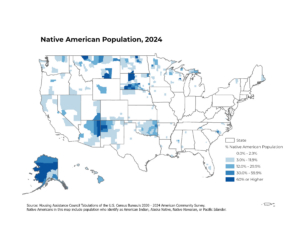
There are approximately 1.1 million Native Americans – persons who identify as American Indian, Alaska Native, Native Hawaiian, or Pacific Islander – residing in rural areas of the United States. Native Americans make up approximately 2% of the rural population, which is more than twice the proportion of Native Americans nationally. Source: Housing Assistance Council tabulations of the U.S. Census Bureau’s 2020-2024 American Community Survey.
OPPORTUNITIES
ROSS-Service Coordinator funds available
HUD’s Resident Opportunity and Self-Sufficiency Service Coordinator program provides grants to nonprofits, public housing agencies, Tribes, Tribal housing entities, resident associations, and owners of properties with project-based rental assistance. Grantees hire service coordinators to connect residents to local training and supportive services. Apply by December 7.
Support offered for community-led collaborations
A group of foundations is launching Together in Purpose to identify, celebrate, and support locally rooted collaborations, strengthening community life across the United States and U.S. territories. The initiative will provide flexible grants ranging from $500,000 to $1 million for a three-year term to support community-led collaborations. The funding is intended to help organizations build on existing relationships, create more opportunities for people to take action together on shared priorities, and strengthen the trust and connections that help communities thrive. Applicants must register by January 14, and applications are due February 9.
Rural Welcoming Initiative invites applications
Welcoming America will select ten nonprofits or local governments to build and strengthen inclusion in their rural communities. Welcoming America leads a movement of inclusive communities becoming more prosperous by ensuring everyone belongs. The application deadline is November 24.
REGULATIONS AND FEDERAL AGENCIES
HUD issues reorganization plan
A reorganization plan published on November 10 announces that HUD intends to make changes to its operational structure. No office closures or staff relocations are proposed. The plan indicates there will be changes in the way tasks are divided between offices, reductions in management layers, and name changes, but gives few specifics. It says the changes should be complete within 90 days.
GAO reports it received little information on USDA’s reorganization analysis
Responding to a request from members of Congress, on November 5 the Government Accountability Office issued a report titled Department of Agriculture: Little Transparency on Whether Key Issues Were Analyzed Before Reorganization Decision. The report takes no position on the reorganization decision, but conveys public information about USDA’s plans and staffing reductions and explains that USDA did not respond to requests for information on analyses it had conducted to inform the reorganization plan. GAO’s document includes a letter from Agriculture Secretary Brooke Rollins objecting to its findings. The reorganization plan remains on hold under an October ruling by a federal judge based on language in the continuing resolution that funds USDA through December 11.
Comments invited on implementing English as U.S. official language
A Justice Department memo titled “Guidance on Implementing English as the Official Language” was issued October 22, revising a September 1 memo with the same title. It instructs federal executive departments and agencies that they should “conduct official business, communicate with the public, develop forms and publications, administer programs, and provide services solely in English – unless … multilingual assistance is required by law or necessary to accomplish an agency’s mission.” The department requests public comments by January 11.
EVENTS
Rural Veterans housing symposium set for December
2026 Affordable Housing for Rural Veterans National Symposium: Building Opportunity in a Changing Landscape will be held December 16 in Atlanta, presented by HAC and sponsored by The Home Depot Foundation. The recently enacted 21st Century ROAD to Housing Act creates new opportunities, even as questions remain about the future scale and availability of federal housing investment. Discussions will focus on innovative approaches, emerging opportunities, and practical strategies for serving Veterans, particularly in rural communities. Admission is free, but advance registration is required. Questions? Email registration@ruralhome.org.
PUBLICATIONS AND MEDIA
Podcast addresses strengthening small cities and towns
The Community Roadmap, a podcast from Community Heart & Soul, is intended to offer inspiring stories from small cities and towns across America, told by people working to shape their futures. The debut episode covers how one small town is creating more opportunities for young people, bringing local organizations together, and finding new ways for residents to make a difference.
Study considers rural wealth building strategies
Recognizing that the economy poses different challenges for household finances in rural places than in cities, the Aspen Institute has published Innovations to Accelerate Rural Wealth Building. The report explores some specific ways to achieve the identified strategies, which include strengthening homeownership.
Issue brief raises Build America concerns
Build America, Buy America: What It Means for Housing, published by the Bipartisan Policy Center, outlines the requirements of the 2021 Build America, Buy America Act, its impact on HUD-financed housing development, and recent proposals for reform. Potential recommendations include providing clarifications, simplifying compliance, and improving the waiver process. The brief notes that HUD has taken a series of steps to gradually phase in BABA requirements but has not yet published a final rule on implementation.
Identify reliable information about extreme weather
Grist’s post How to Fact-Check During and After a Disaster is a “guide to finding trusted sources, debunking common extreme weather myths, and having conversations with loved ones about misinformation.” It includes links to specific websites, tips for identifying AI-generated content, and more.
State and local housing laws enacted
Several publications have recently posted information about 2026 changes in state and local housing laws. The Pew Charitable Trusts describes state legislative actions to encourage or enable production of new homes, such as allowing accessory dwelling units or revising building codes. A series of articles from the National Low Income Housing Coalition covers state legislative trends in four regions of the country, focusing on renters and including provisions that have not yet been adopted. Shelterforce explains which state and local efforts on midterm elections ballots passed and which did not.
HAC
Need capital for your affordable housing project?
HAC’s loan fund provides low interest rate loans to support single- and multifamily affordable housing projects for low-income rural residents throughout the U.S. and territories. Capital is available for all types of affordable and mixed-income housing projects, including preservation, new development, farmworker, senior and veteran housing. HAC loan funds can be used for pre-development, site acquisition, site development, construction/rehabilitation and permanent financing. Contact HAC’s loan fund staff at hacloanfund@ruralhome.org, 202-842-8600.
Please note: HAC is not able to offer loans to individuals or families. Borrowers must be nonprofit or for-profit organizations or government entities (including Tribes).
Want to reprint a HAC News item?
Please credit the HAC News and provide a link to HAC’s website. Thank you!
