Tag Archive for: HUD

HAC Awards Over $1 Million for Local Self-Help Homeownership Programs

Contact: Dan Stern
202-842-8600
dan@ruralhome.org

Washington, DC, May 22, 2019 – The Housing Assistance Council (HAC) is partnering with five organizations to build 75 self-help homes for low and moderate-income families. HAC finances these projects using $1.125 million in funds from the federal Self-Help Homeownership Opportunity Program (SHOP), which is administered by the U.S. Department of Housing and Urban Development (HUD).

Through the SHOP program, families create sweat-equity by participating in the home construction process, which lowers the overall construction costs and increases the affordability of their homes. “HAC has been an enthusiastic supporter of the SHOP program since its beginnings,” said David Lipsetz, HAC’s Chief Executive Officer. “It has been a valuable resource for creating safe, affordable housing and stable communities for low-income rural Americans. HAC is thrilled to work with local organizations across the nation and help families reach their dreams of homeownership.”

Local housing organizations leverage resources from a variety of private and public sources to provide this affordable housing opportunity to low- and moderate-income homebuyers. Many of the families participating in HAC-funded SHOP projects obtain low-interest mortgage loans from the U.S. Department of Agriculture’s Single-Family Housing Direct Home Loans program. By leveraging critical resources, including use of volunteer labor, self-help housing producers are able to create affordable, sustainable homeownership opportunities for low-income homebuyers.

SHOP funds cover costs associated with land acquisition and infrastructure improvements. Community-based organizations will train and supervise homebuying families who work together in groups to construct their own homes and their neighbors’. HAC’s local SHOP affiliates can use up to $15,000 per unit for eligible acquisition and site development costs. They are responsible for all construction activities, including securing additional funding, preparing sites, training families, and managing the self-help process.

Since the inception of the SHOP program, HAC has been awarded funding to produce 9,833 units of affordable housing for families. To date, HAC’s local partners have completed 9,608 homes. [tdborder][/tdborder]

About the Housing Assistance Council
HAC, founded in 1971, is a nonprofit corporation that supports the development of rural low-income housing nationwide. HAC provides technical housing services, loans from a revolving fund, housing program and policy assistance, research and demonstration projects, and training and information services. HAC is an equal opportunity lender.

###

ORGANIZATION

STATE

TOTAL UNITS

Coachella Valley Housing Coalition

CA

26

Community Concepts, Inc.

ME

16

Neighborhood Nonprofit Housing Corporation

UT

24

Northwest Regional Housing Authority

AR

5

Rural Alaska Community Action Program

AK

4

Grand Total

75

HAC News: January 25, 2019

News Formats. pdf

January 25, 2019
Vol. 48, No. 2

Deal reached to reopen federal government • HAC calls for shutdown to end, citing severe impact on rural towns and families, suggests ways to help • USDA working to resolve rental assistance shortfalls and inform landlords • USDA rural housing programs remain closed • USDA Secretary reopens Farm Service Administration, leaves Rural Development closed • Indian Country substantially impacted by shutdown • Shutdown delays Puerto Rico disaster funds • Legal impacts of shutdown on HUD and USDA tenants summarized • Tribal housing survey finds focus on HUD, new units and rehab • Unsheltered homelessness increasing • New infographic explains rapid re-housing • Federal Reserve examines link between millennial migration and student loan debt • Holistic Housing Podcast focuses on rural housing issues • Need capital for your affordable housing project?

HAC News Formats. pdf

January 25, 2019
Vol. 48, No. 2

Deal reached to reopen federal government. As HAC staff prepared to send this issue of the HAC News to subscribers, President Trump announced he had reached agreement with congressional leaders to reopen the government for three weeks. HAC will post updates on its website as information becomes available about the shutdown’s aftermath.
Note that the articles in this issue were written before the deal to reopen the government was announced.

HAC calls for shutdown to end, citing severe impact on rural towns and families, suggests ways to help.
“Every day,” HAC’s statement points out, “Americans are losing out on billions of dollars’ worth of affordable housing, clean drinking water, and community facilities, like town halls, fire stations and hospitals.” HAC has posted links to news articles covering rural housing impacts, and will keep updating the list. As the shutdown continues, HAC will be reaching out to stakeholders to help spread the word on the damage it is causing to communities across the country, pressure lawmakers to come to a resolution and share your own stories of hardship. Visit HAC’s website to sign up for information and resources.

USDA working to resolve rental assistance shortfalls and inform landlords.
USDA reports that all 521 Rental Assistance contracts that are expiring in January will be renewed. The Department acknowledges that there is no money left to renew further RA contracts, including the approximately 700 RA contracts expiring in February and 1,000 in March. USDA is considering short-term measures, such as allowing owners to use project reserves to cover costs, but has yet to finalize any plans or notify property owners. The need for such notification became clear when managers of USDA-financed properties in Arkansas and in Arkansas, Louisiana, Missouri and Mississippi sent notices to tenants telling them their RA was ending in January and they would be responsible for paying their full rent, then backpedaled when informed by USDA the RA will be paid.

USDA rural housing programs remain closed.
No new direct or guaranteed loans or grants have been made in over 30 days. When open and operating, USDA’s Rural Housing Service obligates an average of 28,927* transactions (loans, grants, assistance payments) per month. January 25 is the 35th day of the government shutdown. For more information on USDA’s rural housing activity, visit HAC’s website.
* HAC estimate from monthly USDA obligation data.

USDA Secretary reopens Farm Service Agency, leaves Rural Development closed.
USDA Secretary Sonny Perdue has ordered 9,700 field staff in local Farm Service Agency offices across the country to return to work without pay, although not all FSA services are available. FSA has reopened programs such as the Tree Assistance Program and Marketing Assistance Loans.

Indian Country substantially impacted by shutdown.
Calculating a dollar amount is not possible, reports the Center for Indian Country Development, but the effect is “substantial and unique” because government employment is disproportionately high in Indian Country, tribal staff such as those who plow reservation roads are furloughed, and education funds may be cut. Because of the unique relationship between the U.S. and tribes, tribal services are often closely tied to federal funding.

Shutdown delays Puerto Rico disaster funds.
In response to Hurricane Maria, which tore through Puerto Rico in 2017, Congress appropriated $20 billion in CDBG disaster relief funding. Only $1.5 billion of that money was approved before the shutdown, and HUD will not disburse it until the shutdown ends. HUD approval of disaster spending plans or amendments from California, Florida, Georgia, Missouri and the U.S. Virgin Islands is also on hold. Even before this delay, an analysis by scholars from the University of Michigan and University of Utah found the federal response in funding and staff was larger and faster after Hurricanes Harvey and Irma in Texas and Florida than after Hurricane Maria in Puerto Rico.

Legal impacts of shutdown on HUD and USDA tenants summarized.
A memo from the National Housing Law Project explains the rights of federally assisted tenants during the government shutdown.

Tribal housing survey finds focus on HUD, new units and rehab.
HUD is the primary source of housing development funding for tribes, according to results of a 2018 survey of Tribally Designated Housing Entities by the National American Indian Housing Council and the Center for Indian Country Development. Respondents expressed interest in other financing sources as well, including Low Income Housing Tax Credits and USDA RD housing programs. Although the low response means this survey may not represent Indian Country overall, a large majority of respondents were developing new rental and homeownership units, and all were maintaining and rehabilitating existing units.

Unsheltered homelessness increasing.
In its annual homeless assessment report to congress, HUD states homelessness has increased for the second year in a row. Rural Continuums of Care had the highest rates of unsheltered homeless persons (40%). Homeless individuals in largely rural areas were more likely to be women than those in other areas. Predominantly rural areas also had the highest rates of unsheltered homelessness among people in families with children.

New infographic explains rapid re-housing.
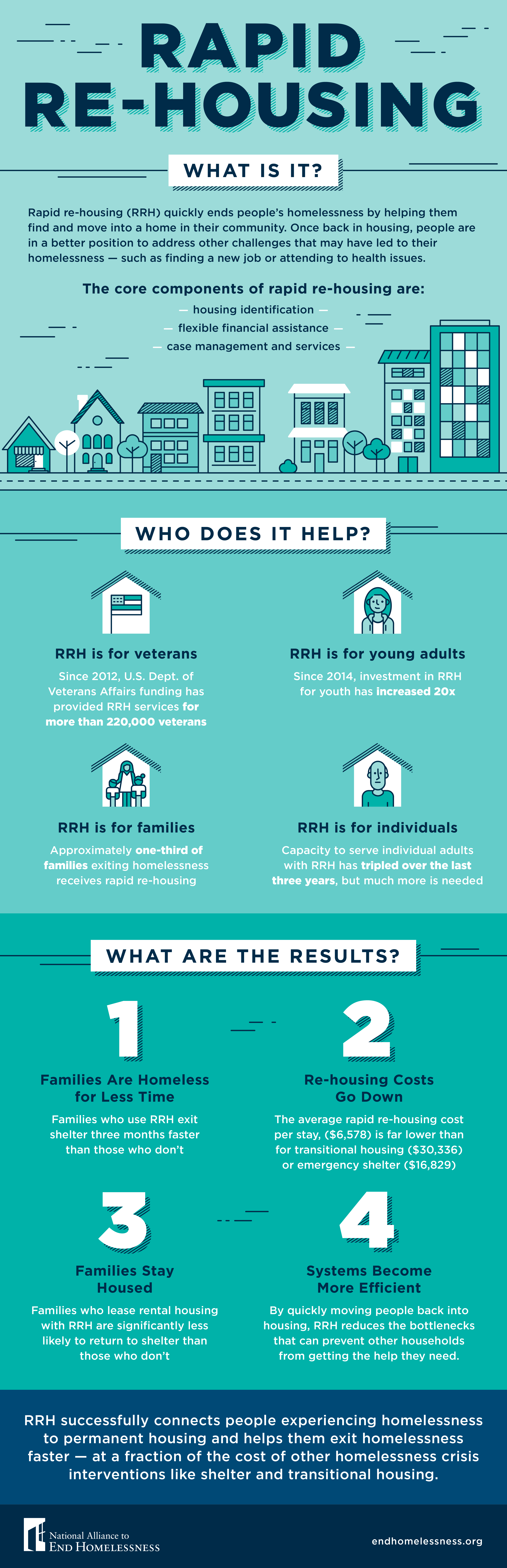
The National Alliance to End Homelessness has released an infographic based on data from the Urban Institute explaining what rapid re-housing is – an approach that ends people’s homelessness quickly by helping them to find and move into a home in their community, then to address other challenges – as well as who it helps and what effect it has.

Federal Reserve examines link between millennial migration and student loan debt.
“Rural Brain Drain”: Examining Millennial Migration Patterns and Student Loan Debt, an analysis by the Federal Reserve Board Division of Consumer and Community Affairs, shows that student loan borrowers are more likely to leave rural areas than non-borrowers. The study notes this does not show that loan balances cause borrowers to leave. It analyzes credit outcomes, economic conditions and migration patterns of rural student loan borrowers. The writers recommend further study to create community development models that could address the outmigration issue.

Holistic Housing Podcast focuses on rural housing issues.
HAC CEO David Lipsetz appeared on “Rock on, Rural America,” the 18th episode of NACCED’s Holistic Housing Podcast, discussing HAC’s work in rural areas, the inspiration he gets from working with local organizations across the country, why rural and urban America need not be at odds and how public policy could change to embrace more rural-focused development. Listen on iTunes, Stitcher, or TuneIn.

Need capital for your affordable housing project?
HAC’s loan funds provide low interest rate loans to support single- and multifamily affordable housing projects for low-income rural residents throughout the U.S. and territories. Capital is available for all types of affordable and mixed-income housing projects, including preservation, farmworker, senior and veteran housing. HAC loan funds can be used for pre-development, site acquisition, site development and construction/rehabilitation. Contact HAC’s loan fund staff at hacloanfund@ruralhome.org, 202-842-8600.
Please note: HAC is not able to offer loans to individuals or families. Borrowers must be nonprofit or for-profit organizations or government entities (including tribes).

HUD Secretary Ben Carson to speak at HAC Conference

HUD Secretary Ben CarsonThe Housing Assistance Council is pleased to announce that Ben Carson, Secretary of the US Department of Housing and Urban Development, will provide remarks at the upcoming HAC Rural Housing Conference.

On March 2nd, 2017, Dr. Benjamin S. Carson, Sr., M.D., was sworn in as the 17th Secretary of the U.S. Department of Housing and Urban Development.

For nearly 30 years, Secretary Carson served as Director of Pediatric Neurosurgery at the Johns Hopkins Children’s Center, a position he assumed when he was just 33 years old, becoming the youngest major division director in the hospital’s history. In 1987, he successfully performed the first separation of craniopagus twins conjoined at the back of the head. He also performed the first fully successful separation of type-2 vertical craniopagus twins in 1997 in South Africa. Read more

For more information on the conference or to register, visit https://www.cvent.com/d/rgqxcd.

HAC News: April 12, 2018

HAC News Formats. pdf

April 12, 2018
Vol. 47, No. 8

Executive Order addresses work requirements • Draft Farm Bill includes SNAP work requirements • CRA recommendations released by Treasury Department • Opportunity Zones designated in 18 states and territories • HUD invites Choice Neighborhood Planning Grants applications • Stakeholders suggest Rural Development provisions for Farm Bill • RD clarifies asset management fee for nonprofits • Section 538 industry calls planned • HUD income limits set • CFPB requests comments on its guidance and its consumer financial education • Appraisal threshold increased • Comments requested to improve FHFA regulations • Wage gap for rural women quantified • Disaster survivors’ stories sought

HAC News Formats. pdf

April 12, 2018
Vol. 47, No. 8

Executive Order addresses work requirements.
On April 10 President Trump issued an “Executive Order Reducing Poverty in America by Promoting Opportunity and Economic Mobility.” It establishes “Principles of Economic Mobility” that include strengthening or imposing work requirements for those receiving means-tested federal aid; increasing state and local flexibility in administering aid; combining or eliminating “duplicative or ineffective” programs; and involving the private sector in poverty solutions. Cabinet departments that run assistance programs, including USDA and HUD, must submit reports within 90 days recommending changes consistent with these principles. They must also list which programs restrict benefits to lawful U.S. residents and which do not.

Draft Farm Bill includes SNAP work requirements.
The House Agriculture Committee released the text of H.R. 2, the 2018 Farm Bill, on April 12. It proposes new requirements for SNAP participants to work or enroll in work training. The only housing provision updates the definition of rural areas eligible for the RHS housing programs so that it refers to the 2020 Census as well as 2010. The bill reauthorizes several RUS and RBS programs. It also reauthorizes the Delta Regional Authority and the Northern Great Plains Regional Authority, but cuts the authorized funding for the DRA from the current $30 million per year to $12 million and for the NGPRA from $30 million to $2 million. (The DRA’s FY18 appropriation is $25 million. The NGPRA has never received an appropriation.)

CRA recommendations released by Treasury Department.
Treasury published a report on April 3 identifying regulatory and administrative improvements for the Community Reinvestment Act. The suggestions would broaden bank assessment areas to account for technological access in places without physical branches, expand the range of eligible CRA activities, clarify rating criteria and subjective terms such as “excellent,” require timely examinations, and strengthen incentives for banks to avoid low performance ratings.

Opportunity Zones designated in 18 states and territories.
The first round of Opportunity Zones were announced by the Treasury Department and the IRS for the states and territories that nominated areas by March 21. Other states requested 30-day extensions and must make their submissions by April 20. The IRS invites comments as it develops guidance for the program on topics including the certification of Qualified Opportunity Funds and eligible investments in Qualified Opportunity Zones. It does not provide a deadline.

HUD invites Choice Neighborhood Planning Grants applications.
Nonprofits, PHAs, local governments, and tribal entities are eligible for planning grants or planning and action grants focusing on transforming a neighborhood by redeveloping at least one severely distressed public or HUD-assisted housing project. Applications are due June 12.

Stakeholders suggest Rural Development provisions for Farm Bill.
HAC and other interested organizations sent a letter to the chairs and ranking members of the House and Senate Agriculture Committees listing recommendations for provisions related to USDA Rural Development that could be included in this year’s Farm Bill. Among the suggestions are incentives for investing in the rural communities with the greatest need, including those with populations under 10,000; authorization for the multifamily housing preservation technical assistance program; and support for infrastructure, including broadband.

RD clarifies asset management fee for nonprofits.
An Unnumbered Letter dated March 30, 2018 explains that nonprofit and cooperative owners of Section 515 and 514/516 properties are eligible for a $7,500 asset management fee per property, rather than per owner. For more information, contact a USDA RD state office.

Section 538 industry calls planned.
During 2018 and 2019, USDA will hold a series of teleconference and/or web conference meetings regarding the Section 538 guaranteed rental housing program. To register to receive information when calls are scheduled, contact Monica Cole, USDA, 202-720-1251.

HUD income limits set.
FY18 median area incomes and income limits for metro areas and nonmetro counties are available online.

CFPB requests comments on its guidance and its consumer financial education.
Comments to help CFPB assess the overall effectiveness and accessibility of its guidance materials and activities (including implementation support) to members of the general public, including regulated entities, are due July 2. For more information, contact Kristin Switzer, CFPB, 202-435-7700. Comments on CFPB’s consumer financial education programs are due July 9. For more information, contact Davida Farrar, CFPB, 202-435-9523.

Appraisal threshold increased.
Effective on April 9, the federal agencies that regulate banks and savings and loans require appraisals for lenders’ real estate transactions above $500,000. The previous threshold was $250,000. Loans secured by residential properties with one to four units are exempt from the appraisal requirement; for those, lenders must instead obtain evaluations that are consistent with safe and sound banking practices. Contacts for further information vary by regulatory agency.

Comments requested to improve FHFA regulations.
The Federal Housing Finance Agency invites comments by June 4 on how its regulations can be made more effective and less burdensome, except for rules of agency organization, procedure, or practice, or regulations adopted or substantially amended since April 2016. For more information, contact Ellen S. Bailey, FHFA, 202-649-3056.

Wage gap for rural women quantified.
The Center for American Progress reports that rural women who work full time, year round, make 76 cents for every dollar that rural men make. Rural African-American and Hispanic women make 56 cents for every dollar made by rural white, non-Hispanic men, while Rural Native American women make 69 cents and rural Asian American and Pacific Islander women make 75 cents.

Disaster survivors’ stories sought.
The Disaster Housing Recovery Coalition developed an online tool to capture disaster survivors’ individual stories. These accounts of unmet need will be used to illustrate the unique housing challenges low-income survivors face after a disaster and to build support for solutions. The coalition asks organizations serving disaster survivors from the hurricanes and wildfires of 2017 to fill out the online questionnaire for any client/individual with a compelling need for direct rental assistance.

NEED CAPITAL FOR YOUR AFFORDABLE HOUSING PROJECT?
HAC’s loan funds provide low interest rate loans to support single- and multifamily affordable housing projects for low-income rural residents throughout the U.S. and territories. Capital is available for all types of affordable and mixed-income housing projects, including preservation, farmworker, senior, and veteran housing. HAC loan funds can be used for pre-development, site acquisition, site development, and construction/rehabilitation. Contact HAC’s loan fund staff at hacloanfund@ruralhome.org, 202-842-8600.
Please note: HAC is not able to offer loans to individuals or families. Borrowers must be nonprofit or for-profit organizations or government entities (including tribes).

Community Development Marketplace (CDM) Project Intake Survey

The U.S. Department of Housing and Urban Development (HUD) has requested feedback from organizations engaged in community development and affordable housing projects in the development of a survey tool. The Community Development Marketplace (CDM) Project Intake Survey is intended to provide HUD with a database of projects which will help them target relevant information and technical assistance to organizations actively working on different types of projects. It is also intended to allow respondents to find other organizations across the country working on similar issues and solutions, by joining peer groups through the survey process. Respondents will not have to be actively applying for federal assistance at the time they respond, or be part of larger consortia using or applying for federal assistance.

On November 28, 2016, Federal Register Notice FR-5909-N-81 was published, announcing a 30-day Public Notice of Proposed Information Collection. Specifically we are asking the public to review the questions in the survey, and the list of the Peer Cohorts attached to the survey, and answer questions listed below and on the survey’s web page.

Submit any comments and/or your answers to Anna.P.Guido@hud.gov and copy CDM@hud.gov by December 28, 2016. Also feel free to submit user questions or information on any technical issues via CDM@hud.gov.

HAC News: May 13, 2015

HAC News Formats. pdf

May 13, 2015
Vol. 44, No. 10

• House committee approves THUD spending bill • Senate passes budget agreement • HUD offers lead-paint grants • New version of USDA’s multifamily Preliminary Assessment Tool available • HUD and USDA determine new energy efficiency standards will apply • Guidance released to extend CDBG disaster grants from Hurricane Sandy • Dates set for Section 538 calls • FHFA announces extension of HARP • Worst Case Housing Needs 2015 Report to Congress released • Limits on GSE lending for multifamily mortgages eased • Federal rental assistance and Housing Choice voucher fact sheets released • Webinar recording on Native American housing available • HAC conference on “Serving Veterans in Rural America” set for May 20

HAC News Formats. pdf

May 13, 2015
Vol. 44, No. 10

HOUSE COMMITTEE APPROVES THUD SPENDING BILL. On May 13, the House Appropriations Committee passed the Transportation-HUD subcommittee’s FY16 appropriations bill without changes to HUD spending levels (see HAC News, 4/29/15). The committee rejected an amendment to provide $1.06 million for HOME without diverting money from the National Housing Trust Fund, offered by Rep. Barbara Lee (D-CA).

SENATE PASSES BUDGET AGREEMENT. On May 5, the Senate voted 51 to 48 to approve the House budget, which adds military spending while keeping cuts affecting social programs in place (see HAC News, 4/3/15). The budget is not binding and does not require presidential signature, but it does impose overall caps on federal spending.

HUD OFFERS LEAD-PAINT GRANTS. Local, county, state, and tribal governments can apply for the Lead Hazard Reduction Demonstration and Lead-Based Paint Hazard Control grant programs by June 23. Contact Eric Hornbuckle, HUD, 202-402-7599.

NEW VERSION OF USDA’S MULTIFAMILY PRELIMINARY ASSESSMENT TOOL AVAILABLE. Version 4.0 of the tool for Section 515 or 514 borrowers (see HAC News, 12/22/14) should be used when applying to transfer ownership or for the Multi-Family Housing Revitalization Demonstration Program (at the links, click the “Forms & Resources” tabs). Borrowers that used older PAT guidelines and submitted transactions after December 16, 2014 must use the new version. Contact an RD State Office.

HUD AND USDA DETERMINE NEW ENERGY EFFICIENCY STANDARDS WILL APPLY. New standards will be required for newly constructed homes with USDA Section 502 direct and guaranteed loans and for FHA-insured multifamily and single-family properties. For the HOME program, the standards will apply after publication of guidance by HUD. For more information contact Meghan Walsh, USDA, 202-205-9590.

GUIDANCE RELEASED TO EXTEND CDBG DISASTER GRANTS FROM HURRICANE SANDY. Expenditure extensions can be made for 24 months. For more information, contact Stanley Gimont, HUD, 202-708-3587.

DATES SET FOR SECTION 538 CALLS. To receive emails announcing dates for calls or web meetings in 2015 and 2016, contact Monica Cole at 202-720-1251. Topics will include program activities, perspectives on the current state of debt financing and its impact on the Section 538 program, enhancing the use of program financing with the transfer or preservation of Section 515 units, and the impact of LIHTC program changes on Section 538 program financing.

FHFA ANNOUNCES EXTENSION OF HARP. The Home Affordable Refinance Program will continue through the end of 2016. Launched in 2009 to provide relief to borrowers through lowering monthly payments, HARP was originally set to expire December 31, 2013.

WORST CASE HOUSING NEEDS 2015 REPORT TO CONGRESS RELEASED. HUD reports that although very low-income renters with worst case needs (those who do not receive government housing aid and paid more than half their income for rent, lived in severely inadequate conditions, or both) decreased slightly from 2011 to 2013, need remains high. Nonmetro areas experience less worst case need overall, but face other challenges including high utility costs.

LIMITS ON GSE LENDING FOR MULTIFAMILY MORTGAGES EASED. Fannie Mae and Freddie Mac can increase their financing of multifamily mortgages this year in order to avoid tighter multifamily credit and borrowing costs. Caps will remain at $30 billion each; however, multifamily loans that meet certain qualifications can be excluded. Qualifications are based on the percentage of units priced under a certain area median income, whether the property is in a high cost market, if the units target seniors, and if the property is mixed-income targeted affordable housing.

FEDERAL RENTAL ASSISTANCE AND HOUSING CHOICE VOUCHER FACT SHEETS RELEASED. The Center on Budget and Policy Priorities fact sheets provide state level data on the impacts of HUD rental assistance, the Housing Choice Voucher Program, Housing Choice Voucher utilization data, and sequestration cuts in Housing Choice Vouchers.

WEBINAR RECORDING ON NATIVE AMERICAN HOUSING AVAILABLE. On March 24, HUD hosted a panel discussion and webcast entitled “Native American Housing: Obstacles and Opportunities.” Speakers provided data and described best practices.

HAC CONFERENCE ON “SERVING VETERANS IN RURAL AMERICA” SET FOR MAY 20. Cosponsored by HAC and The Home Depot Foundation, this event in Washington, DC will provide information on housing, health, and employment needs and programs for rural veterans, with a special focus on successful local projects. There is no charge, but registration is requested. To register or for more information, email janice@ruralhome.org.

HUD Secretary Julián Castro Discusses Rural Housing
HUD Secretary Julián Castro Discusses Rural Housing

Rural Voices - Spring 2015This story appears in the 2015 Spring Edition of Rural Voices

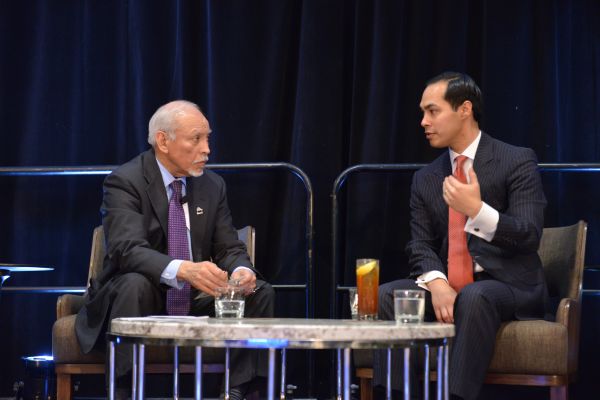
At the recent 2014 HAC Rural Housing Conference, HUD Secretary Julián Castro sat down with HAC’s Executive Director, Moises Loza, to discuss HUD’s role in rural America, his passion for public service, and how he thinks HUD can better serve rural communities across the country.

Moises Loza: How is HUD working in rural America, and what should HUD’s role be in rural places?

Secretary Castro: We’re getting ready to celebrate 50 years of HUD, and of course the title of our department is Housing and Urban Development. But the more accurate description would be Housing and Community Development, because HUD is charged with making investments and working with communities that include not only your typical urban city, but also tribal communities and rural communities. So, even in our bread and butter investments, for instance, the Community Development Block Grant (CDBG), about 30 percent, or or $800 million, of CDBG funding annually goes to states for use in non-entitlement communities, which usually are communities of less than 50,000 people. Another example is HOME. About 40 percent of HUD HOME money goes to states for use in smaller localities.
Best Castro2

In my four months as HUD Secretary, I’ve visited more than 20 different communities including places in Alaska, South Dakota, and North Dakota. I had a chance to see the breadth of what HUD is doing out there and I can say that we’re very committed to, and very interested in lifting up America’s rural communities, just like we’re investing in urban communities.

Secretary Castro: It was an eye-opening experience. The most poignant moment that I had in these last four months was at the Pine Ridge reservation in South Dakota. I visited two homes there and one of the homes had thirteen people living in one four-bedroom house. The other home had seventeen people, including two different families living in the basement. To the extent that we call ourselves at HUD, “the department of opportunity,” we want to help spark opportunity by realizing that housing is just one part of the equation. Somebody needs to have a roof over their head, but we also need to make sure that they have access to good education and employment or job training, so that they can become employable.

Loza: I know you have visited Native American reservations in North and South Dakota, the Turtle Mountain Chippewa among others. What kind of lessons have you taken from having seen those situations that’s going to help as Secretary of HUD?

The feeling that I got at Pine Ridge was just how distant all of that seems. The connections among those things and just in general opportunities seemed distant from the folks there. The unemployment rate on the Pine Ridge is something like
68 percent. So you have these inveterate challenges, but the needs out there are much greater than the resources that have been dedicated to them. At the federal agency level, how do we get better
at working together? The Department of Housing and Urban Development, Department of Education, USDA, Small Business Administration are all institu tions of opportunity working to empower rural and tribal communities. So we need to get on the ball at HUD about figuring out how do our CDBG program, Indian Housing Grant, and other HUD programs interact with the other departments? How are we intersecting with those tribal communities and the private sector as well to help spark that opportunity in those places? Because after my visit, I could understand how some folks would feel like they were so far away from opportunity.

Loza: Besides this collaboration, because they want to positively impact people’s are there any thoughts or plans about how HUD might be able to address some of these very difficult problems?

Secretary Castro: Sure, I’ll give you a very concrete example of something that the President has pushed for and we’re glad to see get through Congress – the reauthorization of the Native American Housing and Self-Determination Act (NAHASDA). We’re also very happy that NAHASDA now includes the ability for HUD and the VA to allow the use of HUD VASH (Veterans Affairs Supportive Housing) vouchers for use in tribal communities. These HUD VASH vouchers have helped reduce the rate of homelessness among veterans by 33 percent. One of the things that I learned when I visited Pine Ridge and Turtle Mountain was that you have a higher than average percentage of residents in tribal communities that are veterans than in the normal everyday population. However, these HUD VASH vouchers could not be used for housing in tribal communities because of a quirk in the statute. There have been folks on both sides of the aisle, as well as the President, who advocated for changing that. So that is one practical thing that we believe would allow us to dedicate more resources to a needy group in these tribal communities that would make a difference.

Loza: The theme of our conference is in part about the need for a new generation of leaders in affordable housing and community development. You of course are one of those young emerging leaders. How do you think we can motivate more young people to enter and stay in this field?

Secretary Castro: One of our big challenges at HUD is getting people over this hump of three years. You have to find ways to satisfy the mission-driven aspect of our work. It’s been my experience that the people who get into this work are doing it because they care, and because they want to positively impact people’s lives. So we have to create a greater connection between what people are doing on an everyday basis, and the outcomes of their work – the good things, the benefits that happen in people’s lives.

It’s important to note that there are measures that have been taken since we went through the housing crisis to help ensure that we’re not going to fall back to where we were before.

What does that mean at a practical level? That means you structure your employment so that folks who are often times sitting behind a desk get a chance to actually interact with the people that we serve. Ideally, staff should have a chance to visit projects so that they make that connection with their passion of helping people. We want them to see the benefits to what they actually do on a daily basis, which let’s face it, is often not glamorous work and is typically done behind a desk. I think if those of us in housing, or any of the departments that
depend on mission-driven people, can improve making that connection, we will attract more folks. That, and more money. That always helps. But I know that people are not doing it for the money. I believe that feeding the mission-driven aspect is the key.

Photo: Jay Mallin PhotographyLoza: The Rural Housing and Economic Development program is something that I think is very dear to the hearts of many people working in rural communities. Any thoughts about whether that initiative could be reinstated or brought back?

Secretary Castro: I think that the work and the investments ought to be continued, whether it’s made under that line item or not. One of the things that has stuck most in my mind as I’ve done this travelling as HUD Secretary are the needs out there in our rural communities and our tribal communities. We’re very open to discussion about how to help ensure that sufficient resources are going to those communities. There is a lot of work to do. Whether there is a line item or not, we should make sure that those investments are made in these communities, and I want people to know that I’m going to be very vigilant about that.

Loza: I have heard you speak about your interest in credit enhancement, making credit more available, and the tightness of credit at this time. Can you talk a bit about that?

Secretary Castro: Because of risky market products and other practices a few years ago we had a housing crisis. It was probably too easy, in some instances, to get a home loan. But now the pendulum has swung completely in the other direction. I’m sure you see in your communities where it is too difficult for folks to get a home loan. We’re talking about folks who are respon- sible, who may not have a credit score of 750, but they have a decent credit score and they’re responsible folks. They’re ready to own, ready to buy a home, and they can’t get credit. I’ve said that there should not be a stigma these days to promoting homeownership. It seems like, understandably, for the last few years people were hesitant about saying we need to promote homeownership. We’re promoting homeowner- ship in a responsible way. It’s important to note that there are measures that have been taken since we went through the housing crisis to help ensure that we’re not going to fall back to where we were before.

At HUD we’re happy that FHA’s mutual mortgage insurance fund recently got back into the black. I believe that will allow the FHA to continue to ful- fill its traditional role of ensuring that first time homebuyers and people of modest means can get access to credit. We also are encouraging the lenders to open up that credit box and to lend to folks that have credit scores that are 600 – 620. Right now it’s very difficult if you have a credit score underneath 680 to get a home loan. There are millions of Americans that are not able to access credit because of that. We want to change that in a responsible, constructive way.

Loza: Thank you very much Mr. Secretary.

Secretary Castro: Thank y’all.

youtubecastro

[youtube]IVF0CiMZ-Eo[/youtube]


Julián Castro was sworn in as the 16th Secretary of the United States Department of Housing and Urban Development in July of 2014. In this role, Mr. Castro oversees 8,000 employees and a budget of 46 billion dollars. Before HUD, Mr. Castro served as the mayor of the city of San Antonio, Texas. During this tenure he became known as a national leader in urban development. In 2010 the city launched the “Decade of Downtown,” an initiative to spark investment in San Antonio’s center city and older neighborhoods. This effort has attracted $350 million in private sector investment with a goal of developing 7,500 new homes by 2020. Previously, Mr. Castro served as a member of the San Antonio city council. He is also an attorney who worked at Akin Gump Strauss Hauer & Feld LLP before starting his own practice. Secretary Castro received a B.A. from Stanford University, and a J.D. from Harvard Law School.

HAC News: April 29, 2015

HAC News Formats. pdf

April 29, 2015
Vol. 44, No. 9

• House acts on HUD funding • USDA RD issues final 502 packaging rule • RD revises UL on tenant notifications for loan payoffs • HUD offers ICDBG funds to address mold • HUD has tenant protection vouchers for low-vacancy areas • Continuum of Care registration opens • VA requests comments on Veterans Choice Program • HUD changes Distressed Asset Stabilization Program • Broadband comments requested • HUD revising tribal consultation policy • HUD required to use procurement contracts for Section 8 funding • Administration adds new Promise Zones • GAO recommends changes in HOPWA funding formula • HUD releases Rental Market Dynamics 2009-2011 report • HAC blogs on ending rural veteran homelessness • Veterans and LIHTC subjects of HAC webinars • HAC conference on “Serving Veterans in Rural America” set for May 20

HAC News Formats. pdf

April 29, 2015
Vol. 44, No. 9

HOUSE ACTS ON HUD FUNDING. The House Appropriations Transportation-HUD Subcommittee on April 29 approved a bill to fund HUD and other programs in fiscal year 2016, beginning October 1. The bill would reduce appropriations for HOME from $900 million in 2015 to $767 million in 2016, but would make up the difference by channeling receipts from Fannie Mae and Freddie Mac to HOME rather than to the National Housing Trust Fund, where current law requires them to go. The bill has level funding for CDBG, Native American housing, public housing operating funds, fair housing, and housing counseling. Some other reductions and increases would also occur, as the table below indicates. A full committee mark-up is the next step in the process and will probably occur soon. The Senate committee has not yet scheduled its action on a T-HUD bill. Also not yet clear is when a final appropriations act will pass and what the impact of a required budget sequester could be. [tdborder][/tdborder]

HUD Program
(dollars in millions)

FY13
Approp.a

FY14
Approp.

FY15
Approp.

FY16 Admin. Budget
Proposal

FY16
House Subcmte. Bill

Cmty. Devel. Fund
CDBG

3,308
2,948

3,100
3,030

3,066
3,000

2,880
2,800

3,060
3,000

HOME
SHOP setaside

1,000
b

1,000
b

900
b

1,060
10

767

Self-Help Homeownshp. (SHOP)

13.5

10

10

b

10

Tenant-Based Rental Assistance
VASH setaside

18,939.4
75

19,177.2
75

19,304
75

21,123
c

19,919

Project-Based Rental Asstnce.

9,339.7

9,516.6

9,330

10,360

10,254

Public Hsg. Capital Fund

1,886

1,875

1,875

1,970

1,681

Public Hsg. Operating Fund

4,262

4,400

4,440

4,600

4,440

Choice Neighbrhd. Initiative

120

90

80

250

20

Native Amer. Hsg. Block Grant

650

650

650

660

650

Homeless Assistance Grantsd

2,033

2,105

2,135

2,480

2,185

Hsg. Opps. for Persons w/ AIDS

334

330

330

332

332

202 Hsg. for Elderly

377

385.3

436

455

414

811 Hsg. for Disabled

165

126

135

177

152

Fair Housing

70.8

66

65.3

71

65.3

Healthy Homes & Lead Haz. Cntl.

120

110

110

120

75

Housing Counseling

45

45

47

60

47

Local Housing Policy Grants

300

a. Figures shown do not include 5% sequester.
b. Recent Obama budgets have proposed making the SHOP program a setaside in HOME. Congress has rejected that proposal.
c. VASH vouchers for homeless veterans are not funded. The President’s budget proposed making VASH part of a new account of incremental rental vouchers for families, veterans, and tribal families experiencing homelessness and for victims of domestic violence.
d. Includes the Rural Housing Stability Program, which is not yet operational.

USDA RD ISSUES FINAL 502 PACKAGING RULE. Revisions to the rule proposed on August 23, 2013 (see HAC News, 8/28/13) will strengthen qualification requirements for intermediaries, require all loans to go through intermediaries unless a packaging organization gets a USDA waiver, cap fees at $1,500 initially, exempt self-help loans from packaging, and make other changes. The final rule is effective July 28. Contact Brooke Baumann, RD, 202-690-4250.

RD REVISES UL ON TENANT NOTIFICATIONS FOR LOAN PAYOFFS. An Unnumbered Letter dated April 28, 2015 supersedes one issued on January 15, 2015 (see HAC News, 2/4/15) and includes sample notifications for borrowers and tenants. Contact a USDA RD state office.

HUD OFFERS ICDBG FUNDS TO ADDRESS MOLD. Tribes and tribal organizations can apply by June 22 for Mold Remediation and Prevention grants to be used for housing units owned or operated by tribes and TDHEs or previously assisted with HUD funding. Contact Roberta Youmans, HUD, 202-402-3316.

HUD HAS TENANT PROTECTION VOUCHERS FOR LOW-VACANCY AREAS. Property owners can apply on a rolling basis for either enhanced vouchers or project-based vouchers for tenants in listed low-vacancy counties whose rents rise when a HUD-insured, HUD-held or Section 202 loan matures; a rental assistance contract expires; or HUD affordability restrictions expire. Contact HUD’s Housing Voucher Management and Operations Division, 202-708-0477.

CONTINUUM OF CARE REGISTRATION OPENS. CoC Collaborative Applicants (not project applicants) must register by May 18 in order to compete for FY15 funds. Contact a HUD CPD field office.

VA REQUESTS COMMENTS ON VETERANS CHOICE PROGRAM. Comments are due May 26 for the Veterans Choice Program interim final rule, which uses driving distance rather than straight lines to measure the distance from a veteran’s residence to the nearest VA medical facility. Contact Kristin Cunningham, VA, 202-382-2508.

HUD CHANGES DISTRESSED ASSET STABILIZATION PROGRAM. Loan servicers must now delay foreclosure for a year and evaluate borrowers for loss mitigation programs. Other changes are intended to increase HUD’s first 2015 sale is planned for June.

BROADBAND COMMENTS REQUESTED. The Rural Utilities Service and National Telecommunications and Information Administration seek input by June 10 about federal actions to promote broadband deployment, adoption, and competition, including by identifying and removing regulatory barriers. Contact Denise Scott, RUS, 202-720-1910.

HUD REVISING TRIBAL CONSULTATION POLICY. Comments are due June 8 on changes to HUD’s government-to-government policy, which intended to enhance communication and coordination between HUD and federally recognized Indian tribes, and to outline guiding principles and procedures under which all HUD employees are to operate with regard to federally recognized tribes. Contact Rodger Boyd, HUD, 202-401-7914.

HUD REQUIRED TO USE PROCUREMENT CONTRACTS FOR SECTION 8 FUNDING. On April 20 the Supreme Court denied an appeal petition, leaving standing a lower court’s ruling that HUD cannot continue to use cooperative agreements with states and PHAs to run the Project-Based Rental Assistance (voucher) program. HUD must now use the federal procurement process, and has said it will need 18-24 months to implement the decision.

ADMINISTRATION ADDS NEW PROMISE ZONES. As PZs, the Pine Ridge Indian Reservation in South Dakota and the South Carolina Low Country, along with six cities, will receive technical assistance and some funding preferences.

GAO RECOMMENDS CHANGES IN HOPWA FUNDING FORMULA. Persons with HIV: Funding Formula for Housing Assistance Could Be Better Targeted, and Performance Data Could Be Improved recommends revising the funding formula to letter reflect the number of living persons with HIV.

HUD RELEASES RENTAL MARKET DYNAMICS 2009-2011 REPORT. The report finds that while the number of afford-able units increased nationally, their percentage of the overall rental stock decreased.

HAC BLOGS ON ENDING RURAL VETERAN HOMELESSNESS. Accounting for Our Sometimes Hidden Homeless Veterans” highlights strategies to ensure rural veterans are included in VA efforts to end veteran homelessness in 2015.

VETERANS AND LIHTC SUBJECTS OF HAC WEBINARS. “Access to Health and Homeless Services for Rural Veterans” is set for May 6. “Utilizing Low Income Housing Tax Credits: An Introduction” will be on May 13; follow the discussion online at #ruralLIHTC. Both will be at 2:00 eastern time and are free; registration is required. Contact Shonterria Charleston, 404-892-4824.

HAC CONFERENCE ON “SERVING VETERANS IN RURAL AMERICA” SET FOR MAY 20. Cosponsored by HAC and The Home Depot Foundation, this event in Washington, DC will provide information on housing, health, and employment needs and programs for rural veterans, with a special focus on successful local projects. There is no charge, but registration is requested. To register or for more information, email janice@ruralhome.org.

HAC News: April 15, 2015

HAC News Formats. pdf

April 15, 2015
Vol. 44, No. 8

• House approves bills on QM and manufactured housing • USDA expanding Section 502 direct loan intermediary pilot • CDFI Fund offers bond guarantees, eases applications for some • RHS encourages processing Section 502 direct applications • RD’s Capital Needs Assessment guidance reissued • FHFA adopts rule prohibiting pass-through of NHTF and CMF costs • Study finds administrative fees for HUD vouchers do not cover costs • Report documents innovative financing for permanent supportive housing • GAO report on government programs’ overlap includes NMTC recommendations • HUD offers healthy housing awards • Upcoming HAC webinars cover HVAC, veterans

HAC News Formats. pdf

April 15, 2015
Vol. 44, No. 8

HOUSE APPROVES BILLS ON QM AND MANUFACTURED HOUSING. On April 14 the House passed H.R. 685, the Mortgage Choice Act of 2015, and H.R. 650, the Preserving Access to Manufactured Housing Act. Supporters say the bills would clarify provisions of the Dodd-Frank Wall Street Reform and Consumer Protection Act and increase consumer options. The Obama Administration has threatened to veto both H.R. 685 and H.R. 650, saying both “would weaken key consumer protections and provisions” of Dodd-Frank.

USDA EXPANDING SECTION 502 DIRECT LOAN INTERMEDIARY PILOT. Nonprofits and public agencies can apply by May 13 to become intermediaries, which train and assist other nonprofits to package Section 502 direct loan applications. New intermediaries must work in specific states not covered by current intermediaries. For further information, contact Brooke Baumann, RD, 202-690-4250.

CDFI FUND OFFERS BOND GUARANTEES, EASES APPLICATIONS FOR SOME. Certified CDFIs or entities designated by certified CDFIs can apply by June 5 to become qualified issuers, and qualified issuers can apply by June 12 for guarantees under the CDFI Bond Guarantee Program. Contact CDFI Fund staff, 202-653-0421, option 5. Comments are due June 9 on an interim rule that would give the CDFI Fund more flexibility to approve a CDFI that is an affiliate of another CDFI for the Bond Guarantee Program only. Contact CDFI Fund staff.

RHS ENCOURAGES PROCESSING SECTION 502 DIRECT APPLICATIONS. RHS has told stakeholders, including HAC, that Administrator Tony Hernandez and USDA Under Secretary Lisa Mensah recently encouraged field staff to allocate adequate resources to process applications for Section 502 direct loans. The National Office has provided states with new tools for data analysis and management, and states are encouraged to partner with others as needed to speed loan processing and fully utilize FY 2015 allocations.

RD’S CAPITAL NEEDS ASSESSMENT GUIDANCE REISSUED. An Unnumbered Letter dated March 16, 2015 is substantially the same as a 2013 UL. It provides detail on developing a CNA, required for transactions involving USDA financed multifamily properties. Contact a USDA RD state office.

FHFA ADOPTS RULE PROHIBITING PASS-THROUGH OF NHTF AND CMF COSTS. No changes were made in the interim rule issued in December (see HAC News, 12/22/14) stating that Fannie Mae and Freddie Mac cannot pass to loan originators the costs of their National Housing Trust Fund and Capital Magnet Fund allocations.

STUDY FINDS ADMINISTRATIVE FEES FOR HUD VOUCHERS DO NOT COVER COSTS. Conducted byAbt Associates for HUD, the research included public housing authorities of all sizes in urban, rural, and suburban places. A draft report, Housing Choice Voucher Program Administrative Fee Study, says in 2013 the average cost of administering a voucher was $70.03 per month and the average fee from HUD was $51.64. Costs in the smallest PHAs (fewer than 50 vouchers) were 91% higher than in the largest PHAs (200 to 249 vouchers), even though rural labor costs were lower. Only 52% of the costs in those smallest PHAs were covered by fees. The report recommends a new formula for calculating fees.

REPORT DOCUMENTS INNOVATIVE FINANCING FOR PERMANENT SUPPORTIVE HOUSING. Creating New Integrated Permanent Supportive Housing Opportunities for ELI Households: A Vision for the Future of the National Housing Trust Fund, released by the Technical Assistance Collaborative and the National Low Income Housing Coalition, highlights state innovations in financing for permanent supportive housing for extremely low-income (30% of area median) households, consistent with recommendations in NLIHC’s report, Aligning Federal Low Income Housing Programs with Housing Need.

GAO REPORT ON GOVERNMENT PROGRAMS’ OVERLAP INCLUDES NMTC RECOMMENDATIONS. The Government Accountability Office’s 2015 Annual Report: Additional Opportunities to Reduce Fragmentation, Overlap, and Duplication and Achieve Other Financial Benefits(GAO-15-404SP) makes no new recommendations on housing programs. It suggests the CDFI Fund issue further guidance on how other government programs can be combined with New Markets Tax Credits; ensure adequate controls to limit the risks of unnecessary duplication and above-market rates of return; and ensure that more complete and accurate data are collected.

HUD OFFERS HEALTHY HOUSING AWARDS. Applications are due April 30 for awards in three categories: public housing/multifamily supported housing, public policy, and cross-program coordination.

UPCOMING HAC WEBINARS COVER HVAC, VETERANS. “A Practitioner’s Guide to Energy Star 3.0: HVAC (Part A)” will be on April 22 at 2:00 eastern (registration available soon) and “Access to Health and Homeless Services for Rural Veterans” on May 6 at 2:00 eastern. Both are free; registration is required. Contact HAC staff, 404-892-4824.

HAC News: April 3, 2015

HAC News Formats. pdf

April 3, 2015
Vol. 44, No. 7

• April is National Fair Housing Month • House and Senate approve nonbinding budget resolutions • NAHASDA reauthorization passes House • USDA offers farmworker housing loans and grants • Housing counseling grants available • HUD requests comment on VAWA rule changes • Broadband demonstration in HUD housing considered • USDA approval for restructuring senior loans explained • Ways to speed agency processing of Section 502 guaranteed loans suggested • HUD sets requirements for rental assistance transfers • Update for Section 3 regulations proposed • Rural housing tenant data for 2014 now available • Homelessness has decreased, change varies widely among states, report says • CFPB updates homebuying toolkit • HAC sets Energy Star webinar for April 8

HAC News Formats. pdf

April 3, 2015
Vol. 44, No. 7

APRIL IS NATIONAL FAIR HOUSING MONTH. HUD issued a press release describing a new media campaign.

HOUSE AND SENATE APPROVE NONBINDING BUDGET RESOLUTIONS. The House passed H.Con.Res.27 on March 25 and the Senate approved S.Con.Res. 11 on March 27. Both houses would retain sequester spending caps for FY16 and make deeper cuts beginning in FY17. Differences between the two mean there may not be agreement on a joint resolution, which would not have the force of law but would guide development of appropriations bills for FY16.

NAHASDA REAUTHORIZATION PASSES HOUSE. The House passed H.R. 360, the Native American Housing Assistance and Self Determination Reauthorization Act, on March 23. The Senate Indian Affairs Committee held a hearing March 18 on its bill, S. 710.

USDA OFFERS FARMWORKER HOUSING LOANS AND GRANTS. Pre-applications for construction or purchase and sub-stantial rehab of off-farm housing are due June 23. Rental Assistance and operating assistance are available. Projects serving high poverty census tracts will receive additional points. Contact an RD state office for an application package.

HOUSING COUNSELING GRANTS AVAILABLE. HUD-approved housing counseling agencies can apply by May 7. Contact HUD staff.

HUD REQUESTS COMMENT ON VAWA RULE CHANGES. A proposed rule implementing the 2013 Violence Against Women Reauthorization Act would increase protections for survivors of domestic and dating violence, stalking, and sexual assault who live in rental housing assisted by HUD. Comments are due June 1. HAC’s website provides a brief summary of the proposal. Separate contacts for HUD programs are listed in the proposed rule. HUD’s proposal covers USDA-funded rental units that have HUD Section 8 assistance, but not other USDA rentals. USDA has implemented the 2013 VAWA through Administrative Notices 4747 (February 10, 2014) and 4778 (January 5, 2015).

BROADBAND DEMONSTRATION IN HUD HOUSING CONSIDERED. HUD requests comments by May 1 on a proposed demonstration aimed at narrowing the digital divide for students in HUD-assisted housing. It wants to partner with local governments, business, and nonprofits “to accelerate broadband adoption and use in HUD-assisted homes.” HUD intends to conduct the initial demonstration in about 20 HUD-assisted communities across the country, both urban and rural, and hopes to expand it nationwide eventually. Contact Camille E. Acevedo, HUD, 202-402-5132.

USDA APPROVAL FOR RESTRUCTURING SENIOR LOANS EXPLAINED. An Unnumbered Letter dated February 27, 2015 is intended to clarify the process for obtaining official RD prior approval and permission to restructure a third-party loan to which a Section 515 loan is subordinate. Contact an RD state office.

WAYS TO SPEED AGENCY PROCESSING OF SECTION 502 GUARANTEED LOANS SUGGESTED. An Unnumbered Letter dated March 13, 2015 lists “tips and best practices for increasing operational efficiencies and to eliminate unnecessary unproductive processes.” Contact the Rural Housing Service’s National Office, 202-720-1452.

HUD SETS REQUIREMENTS FOR RENTAL ASSISTANCE TRANSFERS. A notice describes the conditions for HUD approval of requests to transfer project-based rental assistance, debt held or insured by HUD, and use restrictions from one or more multifamily housing project to another or others. Contact Nancie-Ann Bodell, HUD, 202-708-2495.

UPDATE FOR SECTION 3 REGULATIONS PROPOSED. HUD suggests strengthening its oversight of Section 3, which requires giving jobs and other economic opportunities generated by HUD assistance to low- and very low-income persons to the extent possible.Comments are due May 26. Contact Staci Gilliam, HUD, 202-402-3468.

RURAL HOUSING TENANT DATA FOR 2014 NOW AVAILABLE. USDA RD’s annual issuance provides figures at the national and state levels for the agency’s multifamily portfolio as a whole and separately for Section 515, Section 514/516, and Rental Assistance. There were 1,645 fewer units in 2014 than in 2013. The average income for Section 515 tenants is now $12,022 and for Rental Assistance recipients $10,258. Elderly and disabled households remain a majority in Section 515 units, at 61.65%, and the proportion of households with disabilities increased.

HOMELESSNESS HAS DECREASED, CHANGE VARIES WIDELY AMONG STATES, REPORT SAYS. The State of Homelessness in America 2015, by the National Alliance to End Homelessness, reports data for states and for subpopulations.

CFPB UPDATES HOMEBUYING TOOLKIT. The Consumer Financial Protection Bureau has revised its information booklet, “Your Home Loan Toolkit: A Step-by-Step Guide.” Contact Julie Vore, CFPB, 202-435-7700.

HAC SETS ENERGY STAR WEBINAR FOR APRIL 8. Register online for HAC’s upcoming webinar, “A Practitioner’s Guide to Energy Star 3.0,” to be held on April 8 at 2 pm Eastern time. Contact HAC staff, 404-892-4824.

GET THE HAC NEWS!

Sign-up for HAC information products

SIGN UP HERE

Housing Assistance Council   |  1828 L Street. N.W., Suite 505, Washington, D.C. 20036
(202) 842-8600 (202) 347-3441 hac@ruralhome.org |

Board Portal

HAC is an equal opportunity provider, employer, and lender. | Civil Rights | Privacy