
Rural Veterans and Local Nonprofits Receive Critical Housing Support

Contact: Shonterria Charleston
terria@ruralhome.org
(202) 842-8600

Rural Veterans and Local Nonprofits Receive Critical Housing Support

Funded by The Home Depot Foundation

Washington, DC, August 16, 2021 – Veterans and their families in 10 rural communities will have better lives, thanks to The Home Depot Foundation and the Housing Assistance Council. The Foundation is awarding grants totaling $295,000 to 10 local nonprofit housing agencies around the country to preserve housing for veterans in rural America.

The grant is part of The Home Depot Foundation’s mission to improve the homes and lives of U.S. veterans and invest $500 million in veteran causes by 2025. Many veterans and their families face major housing challenges, often exacerbated by issues related to unemployment, age and service-related disabilities. The Home Depot Foundation and the Housing Assistance Council (HAC) are dedicated to giving back to those who have answered the highest call of service to our nation.

As part of its Affordable Housing for Rural Veterans (AHRV) Initiative, HAC works with The Home Depot Foundation to administer grants that bolster and support the work of rural nonprofit housing agencies to deliver critical housing support to veterans.

“HAC’s continued partnership with The Home Depot Foundation is now even more critical in strengthening the capacity of local rural organizations to build and preserve veteran housing units across rural America,” said David Lipsetz, HAC’s CEO. “Together we’ve been able to support a nimble response to the housing challenges exacerbated by the COVID-19 pandemic.”

As rural America is home to a disproportionately high number of service women and men, HAC remains deeply committed to supporting our nation’s service women and men by uplifting local nonprofits and their work to house and ensure the safe habitability of their homes and rural communities.

The grantee organizations – described below – provide a range of programs. With the grants, veterans who own homes in Alabama, Arizona, North Carolina, Louisiana, Ohio, South Carolina and Tennessee will obtain critical repair assistance. Altogether, 55 veterans and their families will benefit from these grants.

About The Home Depot Foundation 

The Home Depot Foundation works to improve the homes and lives of U.S. veterans, train skilled tradespeople to fill the labor gap, and support communities impacted by natural disasters. Since 2011, the Foundation has invested more than $375 million in veteran causes and improved more than 50,000 veteran homes and facilities. The Foundation has pledged to invest half of a billion dollars in veteran causes by 2025 and $50 million in training the next generation of skilled tradespeople through the Path to Pro program.

To learn more about The Home Depot Foundation visit HomeDepotFoundation.org and follow the Foundation on Twitter @HomeDepotFound and on Facebook and Instagram @HomeDepotFoundation.

About the Housing Assistance Council
The Housing Assistance Council (HAC) is a national nonprofit that supports affordable housing efforts throughout rural America. Since 1971, HAC has provided below-market financing for affordable housing and community development, technical assistance and training, research and information, and policy formulation to enable solution for rural communities.

About the Grantees

  • Bogalusa Rebirth, Bogalusa, LA will utilize $30,000 to provide critically needed rehabilitation for three (3) veteran homes, prioritizing women veterans and those needing wheelchair accessibility features. For additional information on Bogalusa Rebirth, visit their website at http://bogalusarebirth.com.
  • Community Action Commission of Fayette County, Washington Court House, OH will utilize $30,000 to rehabilitate ten (10) veteran-owned homes with health, safety, accessibility, and critical roof repairs or replacements. For additional information on Community Action Commission of Fayette County, visit their website at https://www.cacfayettecounty.org.
  • Community Service Programs of West Alabama, Inc., Tuscaloosa, AL will utilize $30,000 to rehabilitate six (6) veteran homes from Bibb, Dallas, Fayette, Hale, Green, Lamar, Perry, Pickens, or Sumter counties. For additional information on Community Service Programs of West Alabama, Inc., visit their website at https://www.cspwal.com.
  • Creative Compassion, Inc., Crossville, TN will utilize $30,000 to provide critically needed home repairs for five (5) veterans through partnerships with local Department of Veteran Affairs assistance offices and veteran-focused nonprofits in Cumberland and Fentress counties. For additional information on Creative Compassion, Inc., visit their website at https://ccihomes.org.
  • Appalachia Service Project, Johnson City, TN will utilize $30,000 to provide four (4) veterans with critical repairs and/or assist in constructing new homes for homeless veterans in Central Appalachia. For additional information on Grants and Strategic Corporate Partnerships Appalachia Service Project, visit their website at https://asphome.org.
  • Habitat for Humanity Orange County, Chapel Hill, NC will utilize $25,000 to support the repair of four (4) rural veteran homes in Orange County, NC. For additional information on Habitat for Humanity Orange County, visit their website at https://www.orangehabitat.org.
  • Home Works of America, Columbia, SC will utilize $30,000 to assist ten (10) veteran homeowners with critical roof replacements. For additional information on Home Works of America, visit their website at https://homeworksofamerica.org.
  • White Mountain Apache Housing Authority, Whiteriver, AZ, will utilize $30,000 to support the rehabilitation of three (3) veteran owned units on the Fort Apache Reservation. For additional information on White Mountain Apache Housing Authority, visit their website at https://www.wmaha.us.
  • Wilmington Area Rebuilding Ministry, Inc., Wilmington, NC, will utilize $30,000 to support the repair of five (5) veteran owned homes in their service area. For additional information on Wilmington Area Rebuilding Ministry, Inc., visit their website at https://www.warmnc.org.
 

Population Growth in Rural America was Small – and Uneven – Between 2010 and 2020

A Census in Rural America 2020 Update

Using Census 2010 and 2020 data, combined with methodology from the Housing Assistance Council’s Rural and Small-Town definition of location, HAC estimates that the rural population only increased by approximately 164,000 residents over the last decade. This population growth accounted for a .3 percent increase in the rural and small-town population. Overall, HAC estimates that approximately 60,551,165 people live in rural communities using the latest Census data.

HAC News: August 5, 2021

Vol. 50, No. 16

TOP STORIES

Eviction moratorium for renters expires, new limited moratorium issued.

The federal moratorium on eviction of tenants facing pandemic-related economic issues, which had been in place since the Centers for Disease Control imposed it in September 2020, expired on July 31. On August 3, CDC issued a new moratorium that applies through October 3 in “U.S. counties experiencing substantial and high levels of community transmission” of the coronavirus, currently a large portion of the country. While this version is in effect, individual counties’ eligibility will change based on data tracked by the CDC, which categorizes the transmission rate in each county as high, substantial, moderate, or low. Resources for renters needing assistance to pay rent or utilities are compiled in many places online, including on HAC’s website.

Eviction moratoriums for defaulting homeowners extended to September 30.

Homeowners who have defaulted on federally backed mortgages are protected against evictions by moratoriums extended through September 30 by USDA for Section 502 direct borrowers and Section 502 guaranteed borrowers, VA, the Federal Housing Administration, and the Federal Housing Finance Administration (which oversees Fannie Mae and Freddie Mac). These agencies did not, however, extend their moratoriums on foreclosure: those expired on July 31. The extended eviction moratoriums are intended to give foreclosed homeowners enough time to find financial assistance or to move. Information about mortgage forbearance (delayed payments) and other options for homeowners is available from the Consumer Financial Protection Bureau, and each agency offers aid to its homeowners.

Save the date! 2021 National Rural Housing Conference scheduled.

The Housing Assistance Council is pleased to announce plans to convene its 2021 National Rural Housing Conference and Training! The conference provides an excellent opportunity to network and improve connections to federal agencies, national intermediary organizations, and other vested stakeholders. The HAC News will announce when registration opens.

Senate committee approves USDA funding bill, House passes USDA and HUD bills.

On August 4 the Senate Appropriations Committee approved a fiscal year 2022 funding bill for USDA. Details are posted on HAC’s site. Like the House bill, the Senate version would provide modest increases for some rural housing programs. It would take a different approach to rental housing preservation, increasing the Section 515 program from $40 million in FY21 to $92 million in FY22, while setting the Multifamily Preservation and Revitalization program at the $32 million figure requested in the administration’s budget. The House would keep Section 515 at $40 million and increase MPR to $60 million. The next step in the process will be full Senate consideration of the committee’s bill. The House passed H.R. 4502, a “minibus” package of seven appropriations bills, including USDA’s and HUD’s, on July 27.

Infrastructure deal moves forward without housing.

The bipartisan infrastructure bill under consideration in the Senate, H.R. 3684, does not provide any housing funding. It does include $2 billion for USDA’s rural broadband programs.

Confirmation hearing held for Torres Small.

The Senate Agriculture Committee held a hearing July 29 on the nominations of Xochitl Torres Small to be Under Secretary for Rural Development at USDA and Robert Bonnie to be Under Secretary for Farm Production and Conservation. The committee has not yet voted whether to send either nomination to the full Senate for consideration.

RuralSTAT

Between July 1 and July 31, communities outside of metropolitan areas reported 178,000 new cases of COVID-19 – a 171% increase over the previous 30-day period. Source: HAC tabulations of public health data from the New York Times. A Rural Research Brief updating the COVID-19 situation in rural America is available on HAC’s site.  

OPPORTUNITIES

USDA farm labor housing loans and grants available.

From September 1 to November 1, USDA will accept pre-applications for Section 514 loans and Section 516 grants for off-farm farmworker housing. The funding notice published on February 2 provides details. For more information, contact Abby Boggs, USDA, 615-490-1371.

HUD offers Healthy Homes Production grants.

Nonprofits and state, local, and tribal governments can apply by October 19 for the Healthy Homes Production Grant Program, which addresses housing-related hazards in a coordinated fashion, rather than a single hazard at a time. For more information, contact Yolanda Brown, HUD, 202-903-9576.

VA two-year rental assistance funds can be used nationwide.

The Supportive Services for Veteran Families program offers several kinds of aid, including rental assistance for low-income veterans who might otherwise be homeless. In a few high-cost counties (listed here, with additions listed here), grantees have been permitted to provide rental assistance for up to two years before recertification. Describing the lack of affordable housing as “a national crisis,” VA is now extending this two-year provision to all counties and county equivalents throughout the U.S. and territories, effective immediately. For more information, contact John Kuhn, VA, 202-632-8596.

Economic development funding offered.

The Commerce Department’s Economic Development Administration has opened several competitions, including one for Indigenous communities and one for coal communities, intended to assist economic recovery in previously underserved places impacted by the coronavirus pandemic. Application deadlines vary, with the earliest on October 19.

Green building webinar scheduled by HAC.

“Build Smart” Webinar Series Part 1: Green Building Case Studies, scheduled for August 12, will showcase several projects that are successfully implementing Green Building practices in their affordable housing developments and share their best practices for green building on a budget and constructing net zero energy homes for low-income buyers.

Investing in rural infrastructure webinar announced.

Investing in Infrastructure: Rural Strategies for Building and Maintaining Healthy Local Economies, scheduled for August 16, will explore why new federal funding presents a momentous opportunity to invest in rural physical infrastructure and how communities can effectively take advantage of this funding to build thriving rural places. This is the latest in the Rural Opportunity and Development (ROAD) Sessions, virtual exchanges co-designed and hosted by the Aspen Institute Community Strategies Group, HAC, the Rural Community Assistance Partnership, Rural LISC, and the Federal Reserve Board.

Broadband improvement campaign needs consumer input.

Let’s Broadband Together, a project of Consumer Reports and a coalition of other groups, invites people with internet access to contribute information for a campaign aimed at improving access quality and cost. The process, which CR estimates takes seven minutes, includes an online test of the consumer’s internet speed, sharing an internet bill, and answering a few questions.

HAC job openings: Portfolio Management Associate and Community Facilities Housing Specialist.

For details, visit HAC’s website.

  • The Portfolio Management Associate is an entry-level position and will assist in managing HAC’s portfolio of loans made to entities engaged in affordable housing activities in rural communities throughout the United States. This individual will assist in a range of lending activities – including closing, disbursement, monitoring, and servicing single- and multifamily housing development loans – in the Loan Fund Division.
  • The Community Facilities Housing Specialist identifies and engages community stakeholders and provides direct technical assistance to rural organizations that are developing facilities such as parks, community centers, public libraries and childcare centers. This includes helping them identify, utilize and apply for financial resources such as USDA Community Facilities grants and loans. This is a two-year position and is eligible for telecommuting.

CORONAVIRUS

COVID-19 infection rates have resurged in rural America.

COVID-19’s impact on rural America continues to evolve. After declining case rates and signs of optimism, infection rates have begun to increase again in rural communities with certain areas and regions experiencing distressing levels of new COVID-19 cases. HAC’s latest Rural Research Brief, COVID-19 in Rural America, July 31, 2021, examines the health, employment, and housing impacts over the entire course of the pandemic.

REGULATIONS AND FEDERAL AGENCIES

Heirs’ Property Relending Program nears launch.

USDA expects to open a two-month signup window in late August for Community Development Financial Institutions to apply for funds they will relend to agricultural producers and landowners facing heirs’ land ownership and succession issues. Heirs who inherited family land without a will or legal documentation of ownership may use the loans to resolve title issues by financing the purchase or consolidation of property interests and financing costs associated with a succession plan. Comments on the program’s final rule are due October 8. For more information, contact Md Mutaleb, Farm Service Agency, 202-720-3168.

HUD to release FY22 Fair Market Rents.

Fair Market Rents that take effect on October 1 will be available on August 6. Comments are due September 30.

PUBLICATIONS AND MEDIA

Rural U.S. economies will benefit from expanded Child Tax Credit, study concludes.

The effect of the one-year Child Tax Credit expansion will be proportionally greatest in places outside metropolitan areas, according to Measuring the Child Tax Credit’s Economic and Community Impact, a new report from the Niskanen Center. Researchers calculated the total dollar amounts the CTC expansion will generate and their impacts on household spending, state and local sales tax revenue, and jobs. Estimates are reported by state and congressional district.

Annual fair housing report shows increased harassment in 2020.

The National Fair Housing Alliance’s 2021 Fair Housing Trends Report provides an analysis of housing discrimination complaints filed last year at the local, state, and national levels. While the overall number of housing discrimination claims remained consistent in 2020, more than 1,000 harassment claims were reported, compared to 761 in 2019. Asian American and Pacific Islander communities reported a rise in harassment, and claims of sexual harassment also rose among tenants who were unable to pay their rent due to job loss or unemployment.

Lost rent means small landlords defer maintenance.

An Urban Institute analysis of May 2021 data found that 28% of “mom-and-pop” landlords deferred maintenance during the pandemic. Finances were the reason most commonly cited, and 41% of landlords who lost rental income deferred maintenance compared with 18% of those who did not lose rental income.

COVID-19 impact on farmers, farmworkers, and productivity estimated.

Researchers from Purdue University estimated the number of cases and deaths among farmers and farmworkers from March 1, 2020 to March 31, 2021 and concluded the pandemic reduced U.S. agricultural output by about $309 million over that period. Purdue’s Food and Agriculture Vulnerability Index Dashboard provides cumulative estimates, updated daily, for workers across every state and several commodities.

Data on Native American labor market available.

The Center for Indian Country Development at the Minneapolis Federal Reserve Bank has created a Native American Labor Market Dashboard to provide data on labor force participation, employment, and unemployment. The site allows users to compare American Indians and Alaska Natives to the entire U.S. population, and to compare residents of metropolitan areas with those outside metro areas.

Primer aims to help build healthy rural places.

The Build Healthy Places Network has published A Primer for Multi-Sector Health Partnerships in Rural Areas and Small Cities to provide guidance on cross-sector collaboration between the community development, finance, public health, and healthcare sectors.

Need capital for your affordable housing project?

HAC’s loan fund provides low interest rate loans to support single- and multifamily affordable housing projects for low-income rural residents throughout the U.S. and territories. Capital is available for all types of affordable and mixed-income housing projects, including preservation, new development, farmworker, senior and veteran housing. HAC loan funds can be used for pre-development, site acquisition, site development, construction/rehabilitation and permanent financing. Contact HAC’s loan fund staff at hacloanfund@ruralhome.org, 202-842-8600.

Please note: HAC is not able to offer loans to individuals or families. Borrowers must be nonprofit or for-profit organizations or government entities (including tribes).

COVID-19 in Rural America: Updated July 31, 2021

The Housing Assistance Council (HAC) presents summary findings of COVID-19 and its larger impacts 528 days after the first identified case in rural America.

HAC News: July 22, 2021

Vol. 50, No. 15

TOP STORIES

FY22 housing funding to be considered in House before end of July.

The House of Representatives has rolled several appropriations bills, including the USDA and HUD bills, into a “minibus” for consideration during the week of July 26. The measures, as approved by the House Appropriations Committee, would increase some USDA rural housing programs and most HUD programs above their FY21 funding levels. The committee’s draft report on the USDA bill urges attention to farmworkers’ needs, while the draft report on HUD funding encourages support for Central Appalachian communities impacted by the downturn in the coal industry and gives HUD some specific instructions on its FY22 funding competition for Native American housing grants.

OCC will propose rescinding 2020 Community Reinvestment Act rule.

Acting Comptroller of the Currency Michael Hsu announced on July 20 that his office will propose reversing the CRA regulation it issued in June 2020, which has not yet gone into effect. He pledged to work with the Federal Reserve Board and Federal Deposit Insurance Corporation, which did not join the OCC’s 2020 rule, to develop a new proposal based on a Fed notice published in October 2020. HAC’s comments on the Fed’s notice and on an earlier draft of the OCC’s 2020 rule are posted online.

Bills outline House Democrats’ housing infrastructure priorities.

Three bills introduced by Rep. Maxine Waters (D-CA), chair of the House Financial Services Committee, would provide new support for housing programs, including rural housing. Although the administration included housing funds in its American Jobs Plan infrastructure proposal, housing is not covered in the Senate’s $1.2 trillion bipartisan infrastructure bill and it is not yet clear what housing provisions will be in the Senate Democrats’ $3.5 trillion reconciliation bill, which will also address healthcare, climate change, and more. The three Waters bills are intended to mark the Chairwoman’s housing priorities for the reconciliation package, with negotiations not expected to begin in earnest until this fall after the bipartisan package is completed.

Waters’s Housing is Infrastructure Act would invest over $600 billion in housing infrastructure, including vouchers, public housing capital needs, the National Housing Trust Fund, HOME, and other HUD programs. Many of the HUD provisions include a 10% setaside for areas of persistent poverty. Additionally, the bill would provide $5 billion to fully address the capital needs backlog of the Section 515 and 514 rural housing programs, $500 million for Section 504 homeowner repair grants (not restricted to elderly owners, as the grant program usually is), $2 billion for Native American and Native Hawaiian Housing Block Grants, and setasides of $2 billion and $250 million in CDBG funds to address the housing and community infrastructure needs of colonias and resident-owned manufactured housing communities, respectively. A $10 billion program for neighborhood revitalization would include $250 million for SHOP and a $500 million setaside for communities outside metropolitan areas.

The Ending Homelessness Act would transform the Housing Choice Voucher program into a federal entitlement and the Downpayment Toward Equity Act would provide $100 billion to help first-generation homebuyers.

Housing costs remain out of reach throughout the country.

There is no state, county, or metropolitan area in the U.S. where a full-time minimum-wage worker can afford a modest two-bedroom rental home, according to the National Low Income Housing Coalition’s Out of Reach: The High Cost of Housing 2021 report. Data is available by county, zip code, state, and metro area on NLIHC’s site.

OMB will not raise population threshold for metro areas.

On January 19, 2021, OMB published a proposal to change its definition of metropolitan statistical areas so that an area would need a population of at least 100,000 rather than 50,000 to be considered metropolitan. After receiving more than 800 comments, the vast majority of them – including HAC’s – opposing the change, OMB has decided to keep the metro area threshold at 50,000 and to conduct further research on the subject. Delineations of areas based on the 2020 standards and 2020 Census data will be published in 2023. For more information, contact Bob Sivinski, OMB, 202-395-1205.

House committee advances rural broadband bill.

On July 14 the House Agriculture Committee approved H.R. 4374, the Broadband Internet Connections for Rural America Act, which would revise USDA’s broadband programs and increase available funding.

OPPORTUNITIES

Self-Sufficiency Service Coordinator funds available.

Resident Opportunity and Self-Sufficiency Service Coordinator funding enables nonprofits, PHAs, TDHEs, tribes, and resident associations to assess HUD-assisted residents’ needs and link them to training and services. Applications are due September 17. For more information, contact HUD staff, ROSS-PIH@hud.gov.

Pandemic-related fair housing enforcement opportunity opens.

The Fair Housing Initiatives Program – Private Enforcement Initiative American Rescue Plan will fund experienced fair housing enforcement organizations to conduct new projects relating to discrimination arising in connection with the pandemic or to sustain core fair housing enforcement and education activities. Apply by August 18. For more information, contact Kimberly Harley, HUD, 202-402-4753.

HAC seeks Community Facilities Housing Specialist.

The Community Facilities Housing Specialist identifies and engages community stakeholders and provides direct technical assistance to rural organizations that are developing facilities such as parks, community centers, public libraries and childcare centers. This includes helping them identify, utilize, and apply for financial resources such as USDA Community Facilities grants and loans. This is a two-year position and is eligible for telecommuting.

RuralSTAT – UPDATE AND RETRACTION.

HAC has received several questions and comments regarding the RuralSTAT on ‘USDA Exited Properties’ published in the July 22 edition of the HAC News. While we believe the analysis is substantively accurate, there have been some concerns and discrepancies identified with the underlying data used for that RuralSTAT analysis. Therefore, HAC is retracting this item and we will work to provide an updated analysis as soon as possible.  We greatly thank the robust body of experts and practitioners who alerted HAC to these issues. HAC strives to provide the most accurate data and information, and we thank you for assisting us in this effort. If you have questions or need any assistance, please contact Lance George at lance@ruralhome.org.

CORONAVIRUS

Rent aid to tenants increased in June, researchers suggest ways to improve distribution.

As the July 31 end of the federal eviction moratorium approaches, the Treasury Department reports that over $1.5 billion in federal assistance was delivered to 290,000 households in June, about 85% more households than in May. Census Bureau data shows that in late June and early July 3.6 million households believed they were “somewhat likely” or “very likely” to be evicted in the next two months. Resources discussing ways to improve distribution of these funds and prevent evictions include:

GAO reports on effectiveness of pandemic protections for homeowners.

A new Government Accountability Office report, COVID-19 Housing Protections: Mortgage Forbearance and Other Federal Efforts Have Reduced Default and Foreclosure Risks, details the impact of pandemic housing protections on federally backed mortgages. The report, accompanying podcast, and summary blog post highlight that foreclosures declined significantly during the pandemic because of federal moratoriums.

REGULATIONS AND FEDERAL AGENCIES

USDA extends comment period on advancing racial justice and equity.

Responses are now due August 14 to USDA’s request for comments to help identify barriers that people of color and underserved communities and individuals may face in accessing, enrolling in, and participating in any of USDA’s programs and services, and engaging with USDA staff. USDA has also scheduled online listening sessions on July 28 and 29. For more information, contact Liz Archuleta, USDA, 202-720-7095. HAC has submitted comments addressing actions needed to build capacity, improve access to capital, increase flexibility, and engage with stakeholders.

HAC supports fair housing regulation.

HAC recently submitted comments strongly supporting HUD’s proposal to restore part of a previous affirmatively furthering fair housing regulation.

Timeline set for Section 538 final inspections.

Effective immediately, USDA Rural Development requires lenders using the Section 538 rental housing guarantee program to notify RD staff at least 30 days before the final inspection date. Contact information and details are included in RD’s notice.

PUBLICATIONS AND MEDIA

Farmworker wage gap persisted in 2020.

Although farmworkers were deemed essential to sustain food supply chains during the pandemic, their average hourly wage in 2020 was only $14.62, the Economic Policy Institute reports. That is just under 60% of what comparable non-agricultural workers made, a wage gap that was virtually unchanged since the previous year. The average nationwide wage for farmworkers with H-2A visas was $13.68 per hour. In Florida and Georgia, where a quarter of all H-2A jobs were located in 2020, they were paid $11.71 per hour.

Lack of clear title to heirs property leads to disaster aid denials.

A Washington Post story, ‘The Real Damage’: Why FEMA is Denying Disaster Aid to Black Families That Have Lived for Generations in the Deep South, reports that FEMA has rejected up to one-quarter of applicants for disaster aid in rural counties in the deep South because survivors cannot prove they own their land. Their ownership passes informally from one generation to another without deeds or wills.

Wealth gap and other structural inequities addressed in State of Black America report.

The 2021 edition of the National Urban League’s State of Black America report looks at “three pandemics”: economic collapse, health inequities, and structural racism. Increasing homeownership to build wealth is one of many strategies proposed in the report, titled “The New Normal: Diverse, Equitable & Inclusive.”

Hispanic homeownership rate rose in 2020.

Latinos are the only demographic in the U.S. to increase their rate of homeownership for each of the past six years, according to the 2020 State of Hispanic Homeownership Report, just released by the National Association of Hispanic Real Estate Professionals and the Hispanic Wealth Project. Latino homeownership rates vary widely from state to state and are lower in places with higher home prices. Almost 70% of Latino homebuyers have an annual household income below $100,000. Financing designed to serve first-time homebuyers and low wealth borrowers is important for this population, the report notes.

Need capital for your affordable housing project?

HAC’s loan fund provides low interest rate loans to support single- and multifamily affordable housing projects for low-income rural residents throughout the U.S. and territories. Capital is available for all types of affordable and mixed-income housing projects, including preservation, new development, farmworker, senior and veteran housing. HAC loan funds can be used for pre-development, site acquisition, site development, construction/rehabilitation and permanent financing. Contact HAC’s loan fund staff at hacloanfund@ruralhome.org, 202-842-8600.

Please note: HAC is not able to offer loans to individuals or families. Borrowers must be nonprofit or for-profit organizations or government entities (including tribes).

HAC Supports Fair Housing Rule

HAC has submitted comments strongly supporting HUD’s decision to replace a fair housing regulation it issued in 2020. The new interim final rule is a positive step in a years-long process to require states, localities, and public housing agencies that receive HUD funds to “affirmatively further fair housing” (AFFH). As HAC’s comments note, working towards equality is essential. It is inherently the right thing to do – and it is crucial because research shows children’s life chances are deeply impacted by the neighborhoods where they grow up. Taking active steps to eliminate discrimination and segregation in homes and neighborhoods through enforcement of the Affirmatively Furthering Fair Housing requirement leads to inclusive and equitable rural, urban and suburban communities, where all residents can thrive.

The interim final rule does not mandate any specific fair housing planning mechanism for recipients of HUD funds. HUD plans to request comments on that subject through a separate notice.

HAC News: July 8, 2021

Vol. 50, No. 14

TOP STORIES

Federal agencies extend many housing protections to July 31.

The Centers for Disease Control eviction moratorium for renters was extended through July 31. USDA, VA, FHA, and Fannie Mae and Freddie Mac have extended their foreclosure moratoriums for homeowners through July 31. Homeowners with loans made, insured, or guaranteed by those agencies can also request forbearance (a delay in making mortgage payments) at least through July 31 and in some cases after that. The administration has stated that it does not expect to issue further extensions.

State, local, and tribal agencies have funds available to cover rent and other housing needs from two rounds of the Emergency Rental Assistance Program, as well as other federal relief. The Treasury Department updated its ERA guidance on June 24.

Information is available from many sources, including these:

Supreme Court leaves eviction moratorium in effect.

On June 29 the Supreme Court issued an opinion keeping the CDC moratorium operational while a federal appeals court considers a challenge to its constitutionality.

House committee approves USDA FY22 appropriations bill.

On June 30 the House Appropriations Committee approved its USDA funding bill, making no changes to the rural housing figures supported by a subcommittee on June 25. The bill proposes to increase funding levels above FY21 levels, and in some cases above the amounts proposed in the administration’s budget, for Section 502 direct and guaranteed mortgage loans, Rental Assistance, self-help housing, the Multifamily Preservation and Revitalization program, and others. Details are posted on HAC’s website, along with language from the committee’s draft report urging USDA to pay particular attention to the needs of farmworkers.

RuralSTAT

In counties outside metropolitan areas, the unemployment rate continued a declining trend to 4.7%. Source: HAC Tabulations of May 2021 Bureau of Labor Statistics LAUS data.

OPPORTUNITIES

Arts organizations from rural areas and Indian Country encouraged to apply for NEA grants.

The National Endowment for the Arts is actively seeking first-time applicants that work in rural America and Indian Country to apply for American Rescue Plan grants to cover salaries, stipends, and general operating costs. Nonprofit arts and culture organizations, local governments, federally recognized tribal communities or tribes, and local arts agencies are eligible, regardless of whether they have received NEA funding in the past. The NEA offers a webinar on July 8 for rural and Indian Country applicants. The deadline for most applicants is August 12. The deadline for arts agencies that will make subgrants is July 22.

Online training will cover energy efficient, affordable housing.

Strategies for Achieving Energy Efficient, Affordable Housing, a HAC webinar scheduled for July 14, will provide insight into energy efficient construction practices, including how to maximize energy efficiency while keeping costs in check. Learn the role of Home Energy Raters in the design and construction process and see the specifications for homes that are achieving varying levels of energy efficiency. Finally, you will see what it takes to achieve a net-zero home – one that produces as much energy as it uses on an annual basis.

Webinar to highlight rural climate-smart solutions.

On July 16, Pathfinders: Climate-Smart Solutions from Rural America and Native Nations will address innovations, including ways rural organizations build and retrofit more energy-efficient homes and offer new community energy options intentionally designed to build more financial stability for low-wealth people. This is the latest in the Rural Opportunity and Development (ROAD) Sessions, virtual exchanges co-designed and hosted by the Aspen Institute Community Strategies Group, HAC, the Rural Community Assistance Partnership, Rural LISC, and the Federal Reserve Board.

HAC seeks Community Facilities Housing Specialist.

The Community Facilities Housing Specialist identifies and engages community stakeholders and provides direct technical assistance to rural organizations that are developing facilities such as parks, community centers, public libraries and childcare centers. This includes helping them identify, utilize, and apply for financial resources such as USDA Community Facilities grants and loans. This is a two-year position and is eligible for telecommuting.

REGULATIONS AND FEDERAL AGENCIES

Comments requested on fair lending policy statement.

The Federal Housing Finance Agency seeks input on a policy statement that is intended to guide the entities it regulates – Fannie Mae, Freddie Mac, and the Federal Home Loan Banks – on their compliance with fair lending laws and regulations. Comments are due September 7. For more information, contact Annalyce Shufelt, FHFA, 202-649-3416.

Administration pledges to address housing for people returning from prisons and jails.

HUD Secretary Marcia Fudge recently clarified that people who are at risk of homelessness after leaving incarceration are eligible for temporary Emergency Housing Vouchers. She noted that recent incarceration and homelessness are often connected and that, because of the racial disparities in the criminal justice system, addressing reentry housing needs helps advance equity. HUD also plans to review regulations, develop new tools, and publish best practices on reentry housing. These actions are part of an administration strategy to address gun crime and ensure public safety.

USDA and others to coordinate broadband funds.

USDA, the Federal Communications Commission, and the National Telecommunications and Information Administration have signed an interagency agreement to share information and coordinate the distribution of broadband deployment funds.

HAC recommends federal actions for rural equity.

HAC recently submitted comments in response to an Office of Management and Budget request for input on whether federal agency policies and actions equitably serve all eligible individuals and communities, including rural residents. Noting that rural and persistently poor places have historically been and continue to be underserved by federal programs, HAC recommended a focus on capacity building, access to capital, and proactive and deliberate tailoring of federal programs to produce lasting rural equity.

PUBLICATIONS AND MEDIA

Guide covers affordable housing providers’ role in addressing natural disasters.

Affordable Housing and Natural Disasters: A Practitioner’s Guidebook, published by the California Coalition for Rural Housing, is intended as a primer on the current state of disaster issues for affordable housing practitioners and a means of familiarizing disaster planners with innovations from the affordable housing sector. It covers the four major phases of the disaster cycle – mitigation, preparedness, response, and recovery – and includes case studies from rural California.

Researchers skeptical about remote work’s economic impact on heartland.

Secondary tech centers and metropolitan areas away from the coasts, rather than distressed smaller places, seem to be benefitting from recent corporate relocations out of major cities, Brookings Institution researchers suggest in an article titled Remote Work Won’t Save the Heartland. Their analysis of data on individual moves shows also that only a fraction of people who moved out of the largest metro areas in 2020 moved to Heartland or Mountain West states.

Hot housing market changes rural community.

The Daily Yonder reports on the positive and negative impacts of the booming demand for market-rate housing in Short-Term Rentals and High-End Buyers Wipe Out Affordable Housing in Joshua Tree, Say Residents.

Need-tested benefits cut child poverty in half, research concludes.

To examine the likely situation after temporary pandemic-related supports end, the Congressional Research Service used data from 2017, a year of economic growth, to estimate the impact of assistance such as housing and food aid that are provided to recipients based on their incomes. Need-Tested Benefits: Impact of Assistance on Poverty Experienced by Low-Income Families and Individuals reports that this aid improves family economic wellbeing by reducing both the prevalence and degree of poverty, particularly for families with children.

Survey finds homeownership disparities largely unchanged over the past year.

NeighborWorks America’s 2021 Housing and Financial Capability Survey, conducted in April, found more Americans said they need guidance on building credit and reducing debt than one year earlier, and more were interested in financial planning classes. Among those who were financially challenged by the coronavirus pandemic, 73% said it would take six months or more to recover, and 46% said it would take a year or more. Socioeconomic disparities in homeownership rates were unchanged over the year, as were obstacles to homeownership.

32% of federally assisted housing at high risk from natural hazards.

In a new report, the Public and Affordable Housing Research Corporation and the National Low Income Housing Coalition examine the risk of harm to project-based federally assisted properties from climate-related events. A larger proportion of these households than of those without housing aid are at high risk of the negative impacts of these hazards and are less likely to have the supplies and resources to evacuate or prepare. The danger is greatest for households of color in assisted housing.

Low-income disaster survivors get less help from FEMA.

Why FEMA Aid is Unavailable to Many Who Need it the Most, a story from National Public Radio, covers FEMA’s failure to equitably serve marginalized racial groups and low-income people after disasters. An internal FEMA analysis of aid requests between 2014 and 2018 found that the poorest renters were 23% less likely than higher-income renters to get housing help. The poorest homeowners received about half as much as higher-income homeowners to rebuild their homes, a disparity greater than the difference in repair costs.

Lack of affordable housing leaves Latinx residents vulnerable to wildfires.

The shortage of affordable housing forces a disproportionate number of Latinx residents in the western U.S. to live in places seriously threatened by wildfire, according to a data analysis summarized by Politico in Wildfires Threaten All of the West – And One Group More Than Others. Latinx people are about 18% of the U.S. population but 37% of those who live in the areas identified as facing the most extreme wildfire risks.

Need capital for your affordable housing project?

HAC’s loan fund provides low interest rate loans to support single- and multifamily affordable housing projects for low-income rural residents throughout the U.S. and territories. Capital is available for all types of affordable and mixed-income housing projects, including preservation, new development, farmworker, senior and veteran housing. HAC loan funds can be used for pre-development, site acquisition, site development, construction/rehabilitation and permanent financing. Contact HAC’s loan fund staff at hacloanfund@ruralhome.org, 202-842-8600.

Please note: HAC is not able to offer loans to individuals or families. Borrowers must be nonprofit or for-profit organizations or government entities (including tribes).


The State of The Nation’s Housing – 2021

Joint Center for Housing Studies of Harvard University
Harvard Joint Center for Housing Studies - 2021 Cover
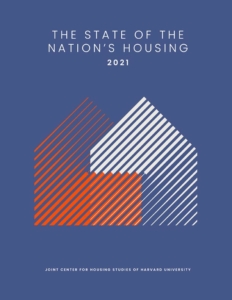
Even as the US economy continues to recover, the inequalities amplified by the COVID-19 pandemic remain front and center. Households that weathered the crisis without financial distress are snapping up the limited supply of homes for sale, pushing up prices and further excluding less affluent buyers from homeownership. At the same time, millions of households that lost income during the shutdowns are behind on their housing payments and on the brink of eviction or foreclosure. A disproportionately large share of these at-risk households are renters with low incomes and people of color. While policymakers have taken bold steps to prop up consumers and the economy, additional government support will be necessary to ensure that all households benefit from the expanding economy.

HAC is a proud sponsor of Harvard’s State of the Nation’s Housing report.

HAC and rural CDFIs receive “massive” $353 million investment

The US Treasury announced it is investing $1.25 billion of COVID-19 relief funds in Community Development Financial Institutions (CDFIs). We are excited to announce that the Housing Assistance Council (HAC) has received the maximum award: $1,826,265.

HAC will invest our $1.8 million award through our Loan Fund to support affordable housing organizations across rural America. As Eileen Neely, director of HAC’s Loan Fund explains, “$1.8 million means we can invest in more rural communities and help more low-income Americans get housed.”

Overall, the US Treasury is awarding $353 million to rural CDFIs. “This massive investment in rural CDFIs will help unlock the potential of rural communities,” said David Lipsetz, President & CEO of the Housing Assistance Council. “We are thrilled for the opportunity to expand our work for disinvested rural communities.”

Everyone deserves a safe, decent, and affordable place to call home. This award strengthens HAC’s work to make that vision a reality for rural America.

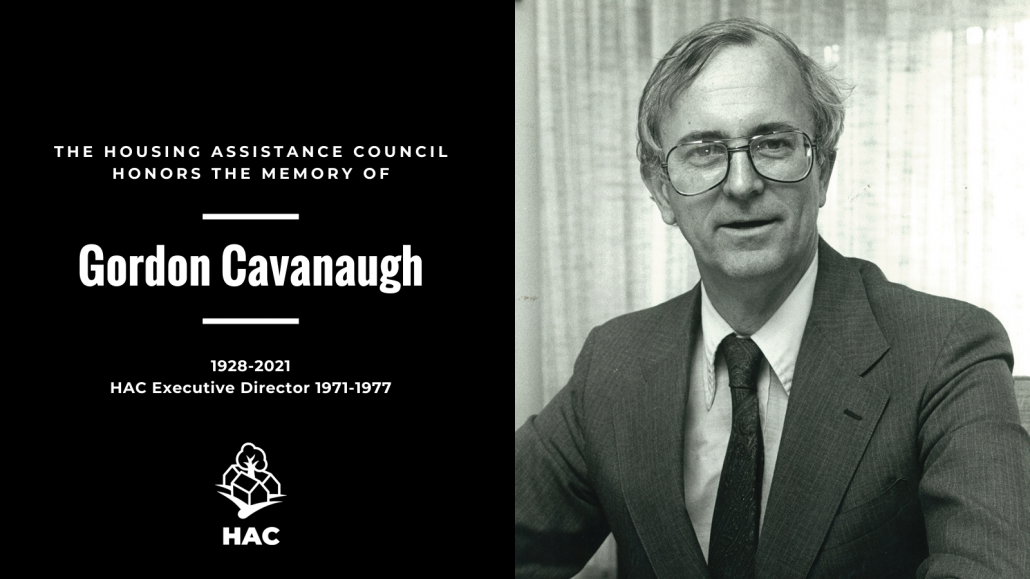
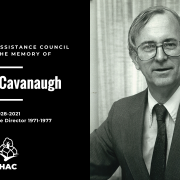
HAC Honors the Memory of Gordon Cavanaugh

Last week, the affordable housing community lost a luminary. Gordon Cavanaugh was an inspiring leader and a fierce advocate, committed to serving the poorest of the poor. Throughout his long career in affordable housing, he served as Philadelphia’s housing director, head of the Farmers Home Administration, chairman of Global Communities (formerly CHFInternational) and a Partner at the leading affordable housing law firm Reno & Cavanaugh. Here at the Housing Assistance Council, we will also remember him as our first Executive Director.

Gordon came to HAC in 1971, quickly assembling a diverse and experienced staff of housing experts and advocates. He created our Southwest and Southeast regional offices, marshalled federal investment in rural housing, and laid the foundation for programs that continue to build homes and community in rural America today.

HAC stands on the shoulders of giants —Gordon’s commitment to serving the poorest of the poor still lies at the heart of our work. Every loan we close, every wall we raise, and every family we help house is a part of his legacy.

The entire HAC family sends our sincere condolences to Joan—Gordon’s wife of 61 years—and their children and grandchildren.

In memory of Gordone Cavanaugh


GET THE HAC NEWS!

Sign-up for HAC information products

SIGN UP HERE

Housing Assistance Council   |  1828 L Street. N.W., Suite 505, Washington, D.C. 20036
(202) 842-8600 (202) 347-3441 hac@ruralhome.org |

Board Portal

HAC is an equal opportunity provider, employer, and lender. | Civil Rights | Privacy