HAC News: November 16, 2011

HAC News Formats. pdf

November 16, 2011
Vol. 40, No. 223

• November is National Native American Heritage Month •Conference committee sets FY12 funding levels for USDA and HUD • CDFI Fund accepting applications • Changes proposed to NAHASDA regulations • HUD offers fair housing rule on discriminatory effect • HUD clarifies duplication of benefits for CDBG disaster grants • Deadline extended for HUD’s environmental justice strategy • Changes to Federal Home Loan Banks’ responsibilities suggested • Comments on New Markets Tax Credit sought • Materials posted from rural senior housing training

November 16, 2011
Vol. 40, No. 23

NOVEMBER IS NATIONAL NATIVE AMERICAN HERITAGE MONTH. President Obama’s proclamation is at https://www.whitehouse.gov/briefing-room/ presidential-actions.

CONFERENCE COMMITTEE SETS FY12 FUNDING LEVELS FOR USDA AND HUD. By November 18 the House and Senate are expected to pass, and President Obama to sign, a “minibus” that will fund USDA, HUD, and several other federal departments and agencies for the current fiscal year. It also includes a Continuing Resolution to carry the rest of the government through December 16. The funding levels in the bill could still be affected by deficit reduction actions of the Super Committee and Congress (see HAC News, 8/18/11). The conference report is posted at https://www.rules.house.gov/.

For USDA’s housing programs, the bill adopts most of the Senate’s amounts, higher than the House’s.

USDA Rural Devel. Program
(dollars in millions)

FY11
Approp.a

FY12 Admin. Budget

FY12 Hse. (H.R. 2112)c

FY 12 Sen. App. Cmte. (H.R. 2112)

FY 12 Final Approp.
(H.R. 2112)

502 Single Fam. Direct

$1,121

$211.4

$845.6

$900

$900

502 Single Family Guar.

24,000

24,000

24,000

24,000

24,000

504 VLI Repair Loans

23.4

0

0

10

10

504 VLI Repair Grants

34

11.5

32

27

29.5

515 Rental Hsg. Direct

69.5

95.2

58.6

64.5

64.5

514 Farm Labor Hsg.

25.7b

27

18.3

23.4

20.8

516 Farm Labor Hsg.

9.8b

9.8

6.2

8

7.1

521 Rental Assistance
Preservation RA
New Constr. 515 RA
New Constr. 514/516 RA

955.6
0
(2.03)
(3)

906.7
0
(3)
(3)

890
0
(1.5)
(2.5)

904.7
0
(2)
(2)

904.7
0
(1.5)
(2.5)

523 Self-Help TA

37

0

22

30

30

533 Hsg. Prsrv. Grants

10

0

0

7.3

3.6

538 Rental Hsg. Guar.

30.9

0

0

130

130

Rental Prsrv. Demo. (MPR)

15

0

0

2

2

Rental Prsrv. Revlg. Lns.

1

0

0

0

0

542 Rural Hsg. Vouchers

14

16

11

11

11

Rural Cmnty. Dev’t Init.

5

8.4

3

4.2

3.6

a. Figures shown do not include 0.2% across the board reduction.
b. Figures shown for Section 514 and 516 farm labor housing are the amounts offered in the FY11 NOFA.
c. Figures shown do not include 0.78% across the board reduction.

HUD programs underwent cuts in most areas, compared to 2011 levels, and some smaller programs were eliminated, including the Sustainable Communities Initiative and the Rural Innovation Fund. HOME, public housing, and SHOP suffered steep reductions.The bill provides funding for renewals of current Section 202 contracts, but eliminates funding for development of new Section 202 senior housing.

HUD Program
(dollars in millions)

FY11
Approp.

FY12
Admin.
Budget

FY12
House Bill

FY12
Senate Bill
(S. 1596)

FY 12 Final Approp.
(H.R. 2112)

Cmty. Devel. Block Grants
Sustainable Commun. Init.
Rural Innovation Fund

3,508
(100)
0

3,781
150
(25)

3,500
0
0

3,001
(90)
0

3,308.1
0
0

HOME

1,610

1,650

1,200

1,000

1,000

Tenant-Based Rental Asstnce.
Vets. Affairs Spptve Hsg. Vchrs

18,408
(50)

19,223
(75)

18,467.9
(75)

18,872.4
(75)

18,914.4
(75)

Project-Based Rental Asstnce.

9,257.4

9,429

9,428.7

9,418.7

9,339.7

Transforming Rental Asstnce.

0

200

0

0

0

Public Hsg. Capital Fund

2,044

2,405

1,532.1

1,875

1,875

Public Hsg. Operating Fund

4,626

3,962

3,861.9

3,961.9

3,961.9

Public Hsg. Revtlztn. (HOPE VI)

100

0

0

0

0

Choice Neighbrhd. Initiative

0

250

0

120

120

Housing Trust Fund

0

1,000

0

0

0

Native Amer. Hsg. Block Grant

650

700

648.7

650

650

Homeless Assistance Grants

1,905

2,372

1,901.2

1,901.2

1,901.2

Hsg. Opps. for Persons w/ AIDS

335

335

334.3

330

332

202 Hsg. for Elderly

400

757

600

369.7

374.6

811 Hsg. for Disabled

150

196

196

150

165

Fair Housing

72

72

71.9

64.3

70.8

Healthy Homes & Ld. Haz. Cntl.

120

140

119.8

120

120

Self-Help Homeownshp. (SHOP)

27

0

15.9

17

13.5

Housing Counseling

0

88

0

60

45

a. New program proposed by the Administration.
c. Figures shown do not include 0.2% across the board reduction.

CDFI FUND ACCEPTING APPLICATIONS. Flexible Financial Assistance awards and capacity building Technical Assistance awards are available to certified and certifiable CDFIs (apply by January 11) and to Native American certified and certifiable CDFIs (apply by January 18). Visit https://www.cdfifund.gov or https://www.grants.gov. Contact CDFI Fund staff, 202-622-6355, cdfihelp@cdfi.treas.gov.

CHANGES PROPOSED TO NAHASDA REGULATIONS. The amendments would implement provisions of the 2008 NAHASDA reauthorization law for the Indian Housing Block Grant and Title VI Loan Guarantee programs. The proposed rule will be published in the Federal Register and at https://www.regulations.gov on November 18. Contact Rodger Boyd, HUD, 202-401-7914.

HUD OFFERS FAIR HOUSING RULE ON DISCRIMINATORY EFFECT. A proposed rule would establish uniform standards for determining when a housing practice with a discriminatory effect violates the Fair Housing Act, even without discriminatory intent. Comments are due January 17. See Federal Register, 11/16/11 or https://www.regulations.gov. Contact Jeanine Worden, HUD, 202-402-5188.

HUD CLARIFIES DUPLICATION OF BENEFITS FOR CDBG DISASTER GRANTS. See Federal Register, 11/16/11. Contact Scott Davis, HUD, 202-708-3587.

DEADLINE EXTENDED FOR HUD’S ENVIRONMENTAL JUSTICE STRATEGY. Comments are now due November 23. See HAC News, 10/12/11 and https://tinyurl.com/77rcxpz.

CHANGES TO FEDERAL HOME LOAN BANKS’ RESPONSIBILITIES SUGGESTED The Federal Housing Finance Agency proposes to require FHLBs to monitor their members’ compliance with CRA and first-time homebuyer requirements. Comments are due February 8. See Federal Register, 11/10/11 or https://www.regulations.gov. Contact Charles E. McLean, FHFA, 202-408-2537.

COMMENTS ON NEW MARKETS TAX CREDIT SOUGHT. The CDFI Fund invites comments and suggestions by February 6 about the mission, purpose and implementation of the NMTC program, including how low-income census tracts are identified and whether points should be awarded for serving rural markets. Visit https://www.cdfifund.gov. Contact CDFI Fund staff, cdfihelp@cdfi.treas.gov.

MATERIALS POSTED FROM RURAL SENIOR HOUSING TRAINING. Presentation materials from HAC’s November training, Housing Seniors in Rural America: Aging in Place in a Shifting Landscape, are available on HAC’s website, http://ruralhome.org.

HAC News: November 1, 2011

HAC News Formats. pdf, ePub, mobi

November 1, 2011
Vol. 40, No. 22

• Senate rejects efforts to further reduce rural housing and SHOP funds • House subcommittees set hearing on HOME fraud • Tenant Resource Network funds offered for specified HUD properties • USDA proposes FY12 fee for Section 502 guaranteed loans • HUD announces FY12 Difficult Development Areas and asks what FMRs to use • Proposed rule aims to increase Native American access to rural utilities programs • HUD revises handbook guidance on displacement caused by CDBG or HOME funds • Housing policy commission launched • 26% of rural children live in persistent poverty counties • Indian housing needs study updates online

November 1, 2011
Vol. 40, No. 22


SENATE REJECTS EFFORTS TO FURTHER REDUCE RURAL HOUSING AND SHOP FUNDS. On November 1 the Senate passed H.R. 2112, combining the USDA, Commerce/Justice, and Transportation/HUD FY12 appropriations bills, with the funding levels reported in HAC News, 9/28/11 (HUD) and 9/14/11 (USDA). There was no vote on an amendment from Sen. John McCain (R-AZ) that would have eliminated funding for HUD’s SHOP program. An amendment offered by Sen. Tom Coburn (R-OK) to cut USDA RD funding by 40% was defeated 85-13. The Senate did not consider a statement from the Obama Administration that requested increases in some HUD programs but asked that USDA rural housing programs be reduced to the Administration’s budget levels (see HAC News, 2/16/11), which would have reduced Section 502 direct loans by 80% and eliminated the Section 523 self-help program and rental preservation programs. The bill does cut CDBG, HOME, and other HUD programs, and eliminates HUD’s Rural Innovation Fund. It is expected to be considered soon by a House-Senate conference committee. Details and the Administration’s statement are on HAC’s site, http://ruralhome.org.

HOUSE SUBCOMMITTEES SET HEARING ON HOME FRAUD. Witnesses appearing on November 2 include people convicted of defrauding the HOME program, as well as HUD officials. Read testimony and watch the hearing live at https://financialservices.house.gov/Calendar/EventSingle.aspx?EventID=266369. HAC will post a summary afterwards at http://ruralhome.org.

TENANT RESOURCE NETWORK FUNDS OFFERED FOR SPECIFIED HUD PROPERTIES. Nonprofits with at least five years of tenant organizing experience can apply by December 6 to educate tenants and involve them in preservation of affordable units in specific properties listed in the NOFA. Visit https://www.hud.gov/offices/adm/grants/fundsavail.cfm or https://www.grants.gov. Contact Claire Trivedi, HUD, 202-708-3000.

USDA PROPOSES FY12 FEE FOR SECTION 502 GUARANTEED LOANS. To make the program self-supporting, RHS proposes to charge an annual fee of 0.3% of the outstanding principal balance, beginning with all loans obligated on or after October 1, 2011. (Legislation authorizes an annual fee of up to 0.5%.) The one-time guarantee fee is 2% for purchases and 1% for refinances. Deadline for comments is December 27. See Federal Register, 10/28/11 or https://www.regulations.gov. Contact Cathy Glover, RD, 202-720-1452, cathy.glover@wdc.usda.gov.

HUD ANNOUNCES FY12 DIFFICULT DEVELOPMENT AREAS AND ASKS WHAT FMRS TO USE. Designations of Qualified Census Tracts published October 6, 2009 remain in effect. HUD requests comments, due December 27, on whether it should use Small Area Fair Market Rents, rather than metropolitan-area FMRs, in future designations of metropolitan DDAs. See Federal Register, 10/27/11 or https://www.regulations.gov. Contact Michael K. Hollar, HUD, 202-402-5878, Michael.K.Hollar@hud.gov.

PROPOSED RULE AIMS TO INCREASE NATIVE AMERICAN ACCESS TO RURAL UTILITIES PROGRAMS. Substantially Underserved Trust Areas would be eligible for more flexible terms and waivers of requirements in USDA’s rural utilities programs. Comments are due 12/13/11. See Federal Register, 11/1/11 or https://www.regulations.gov. Contact Michele Brooks, Rural Utilities Service, 202-720-9542.

HUD REVISES HANDBOOK GUIDANCE ON DISPLACEMENT CAUSED BY CDBG OR HOME FUNDS. See Change 11 and Chapter 7 at https://www.hud.gov/offices/adm/hudclips/handbooks/cpdh/1378.0/index.cfm. The National Low Income Housing Coalition analyzes improvements and changes at https://www.nlihc.org/doc/Memo16-38.pdf. Contact a HUD office.

HOUSING POLICY COMMISSION LAUNCHED. The Bipartisan Policy Center’s Housing Commission is chaired by Christopher Bond, Henry Cisneros, Mel Martinez, and George Mitchell. It plans to study the entire housing sector and to issue “realistic and actionable policy recommendations” early in 2013. Visit https://www.bipartisanpolicy.org/projects/housing. Contact the Center, bipartisaninfo@bipartisanpolicy.org, 202-204-2400.

26% OF RURAL CHILDREN LIVE IN PERSISTENT POVERTY COUNTIES. A Carsey Institute research brief reports that 81% of counties with persistent child poverty are nonmetro, clustered in Appalachia, the Mississippi Delta, the Southeast, parts of the Southwest, and the Great Plains, and that policy often overlooks needy rural families. More Poor Kids in More Poor Places: Children Increasingly Live Where Poverty Persists is at https://carseyinstitute.unh.edu/CarseySearch/search.php?id=176. Contact carsey.communications@unh.edu, 603-862-2821.

INDIAN HOUSING NEEDS STUDY UPDATES ONLINE. Visit https://tinyurl.com/3ly2bpx for news about HUD’s Assessment of Native American, Alaska Native and Native Hawaiian Housing Needs, currently underway. Contact Jennifer Stoloff, HUD, jennifer.a.stoloff@hud.gov, 202-402-5723.

Fall 2011: Housing and Water: The Critical Connection

Access a pdf version of Rural Voices.

A joint issue of HAC’s Rural Voices and the Rural Community Assistance Partnership’s (RCAP) Rural Matters

View From Washington

USDA and the Obama Administration: Working to meet the needs of rural homeowners
by USDA Rural Development Undersecretary Dallas Tonsager

FEATURES

Figuring It Out: Bringing Infrastructure to Affordable Housing Development Projects
Infrastructure improvements can rapidly increase the cost of an affordable housing development. HOPE shares strategies that have worked for them to fund these improvements.

Former Pineapple Plantation Continues to Bear Fruit
A Hawaii nonprofit partners with RCAP to save the affordable housing in Kunia after a pineapple producer leaves the town.

A Housing and Water Project that is ‘A Gift From God’
The community of Hobson Bay, Va. improved its infrastructure and housing stock dramatically with the help of Southeast RCAP.

Persistence and Perseverance: Tackling Infrastructure Challenges in Northwest, North Carolina
Comprehensive infrastructure development plans must take into account political and financial challenges that may impact even the most well thought-out project.

Location, Location, Location: Developing the Morley Meadows Subdivision in Santaquin, Utah
As with all housing development, location is key; however, when infrastructure is taken into account, location can be both an asset and a challenge.

Creating Comfortable Housing for a Growing Population of Seniors
How RCAP Solutions assembled the Townsend Woods project, the first LEED-certified HUD 202 senior development in Massachusetts.

Keeping the Water Flowing in Rural America for 35 Years
For 35 years, Community Resource Group has been working to insure access to clean, safe water for all rural Americans.

USDA Rural Development Obligations FY 11

Back to USDA RD Obligations

USDA Rural Development Obligations – Fiscal Year 2011

(Through September FY 2011)


Single Family Housing Program Obligations

Multi-Family Housing Program Obligations

Unallocated Program Obligations

Download Complete File of all Data

About the Data

The USDA Rural Development (RD) Year-End Report presents fiscal year utilization and activity of most USDA housing programs at the state and national level. These figures derive from HAC tabulations of USDA-RD 205c,d, and f report data. Additional data and information for the year end report were also provided by USDA’s Single Family and Multifamily Housing Divisions in the National Office.

Contact Information

The USDA Rural Development Year-End Report is produced by the Housing Assistance Council (HAC), 1025 Vermont Ave., NW, Suite 606, Washington, DC 20005. For questions or comments about the report, please contact Lance George at 202-842-8600 or lance@ruralhome.org. For additional information about USDA Rural Housing programs, contact the Rural Development National Office USDA Rural Development, Room 5014-S Mail Stop 0701, 1400 Independence Avenue SW, Washington, DC 20250-0701, Phone: 1-800-670-6553 or (202) 690-1533, TTY: (800) 877-8339 (Federal Information Relay Service), Fax: (202) 690-0500. or https://www.rurdev.usda.gov/.

HAC News: October 13, 2011

HAC News Formats. pdf, ePub, mobi

October 13, 2011
Vol. 40, No. 21

• Government funded through November 18 • HUD offers two grant programs for Indian Country • AmeriCorps support available • HAC announces grant funding for rural senior housing • RD to conduct rent comparability studies for vouchers • Income calculations changed for Section 502 direct loans • Final 2012 Fair Market Rents published • HUD requests comments on environmental justice strategy • Comments invited on new interim PHAS scoring • Federal homelessness update published • Utility-funded energy efficiency programs can help multifamily housing • Affordability issues for seniors increasing, AARP reports

October 13, 2011
Vol. 40, No. 21

GOVERNMENT FUNDED THROUGH NOVEMBER 18. A continuing resolution keeps USDA and HUD housing programs at FY11 levels with a 1.5% across the board cut. The Senate may begin considering the USDA and Transportation-HUD FY12 appropriations bills this week. The full House has passed a USDA spending bill, but HUD’s bill has not moved beyond the subcommittee level there. See HAC News, 9/28/11 and 9/14/11. Bills are available at https://thomas.loc.gov/home/approp/app12.html.

HUD OFFERS TWO GRANT PROGRAMS FOR INDIAN COUNTRY.Tribes and tribal organizations can apply by January 4, 2012 for FY12 Indian Community Development Block Grants. Contact Roberta Youmans, HUD, 202-402-3316. A variety of entities can apply by November 15 for FY10 Sustainable Construction in Indian Country Small Grants to collect and disseminate information. Contact Mike Blanford, 202-402-5728. Visit https://www.grants.gov or https://www.hud.gov/offices/adm/grants/fundsavail.cfm.

AMERICORPS SUPPORT AVAILABLE.Nonprofits, institutions of higher education, sub-state government entities, tribes, labor organizations, partnerships, and intermediaries may apply and are encouraged to submit letters of intent by December 15; deadline is January 18. Visit https://www.americorps.gov/for_organizations/funding. Contact agency staff at americorpsgrants@cns.gov or 202-606-7508.

HAC ANNOUNCES GRANT FUNDING FOR RURAL SENIOR HOUSING.With support from The Atlantic Philanthropies, Rural Senior Housing Fund grants are available to build, preserve, or advocate for housing for low-income seniors (62 and older) living in rural areas. Deadline is December 15. A webinar for applicants will be held October 20. Visit http://ruralhome.org. Contact Janice Clark, HAC, janice@ruralhome.org, 202-842-8600 ext. 131.

RD TO CONDUCT RENT COMPARABILITY STUDIES FOR VOUCHERS. RD appraisers, rather than a contractor, will determine current market rents, which are used to calculate the value of vouchers offered to tenants in Section 515 properties when loans are prepaid or foreclosed. See Unnumbered Letter dated September 9, https://www.rurdev.usda.gov/SupportDocuments/ulseptember11.pdf. Contact Joan Atkinson, RD, 202-720-1609.

INCOME CALCULATIONS CHANGED FOR SECTION 502 DIRECT LOANS.A new RD notice makes numerous changes. Find Procedure Notice 415 at https://www.rurdev.usda.gov/regs/pn/pn451.html. Contact an RD office.

FINAL 2012 FAIR MARKET RENTS PUBLISHED. See Federal Register, 9/30/11, or https://www.huduser.org/portal/datasets/fmr.html.

HUD REQUESTS COMMENTS ON ENVIRONMENTAL JUSTICE STRATEGY. A draft four-year plan is intended to address environmental justice concerns and increase access to environmental benefits through HUD activities, as part of a larger executive branch effort (see HAC News, 8/18/11). Comments are due November 14. Visit https://portal.hud.gov/hudportal/HUD?src=/program_offices/sustainable_housing_communities/HUD_Draft_Environmental_Justice_Strategy. Contact Kathryn Dykgraaf, HUD, 202-402-6731. Stakeholder listening sessions are scheduled in several places between October 24 and December 2. Visit https://www.epa.gov/compliance/ej/interagency/schedule.html. Contact Sherri White, EPA, white.sherri@epa.gov.

COMMENTS INVITED ON NEW INTERIM PHAS SCORING.A February interim rule (see HAC News, 3/2/11) for HUD’s Public Housing Assessment System is superseded by a notice implementing a point loss cap, changing some definitions, and describing inspection software. See Federal Register, 10/13/11, or https://www.regulations.gov. Contact Claudia Yarus, HUD, 202-475-8830.

FEDERAL HOMELESSNESS UPDATE PUBLISHED.The U.S. Interagency Council on Homelessness’s 2011 Annual Update to Opening Doors: The Federal Strategic Plan to Prevent and End Homelessness reports that progress has been made in the first year of the Opening Doors effort. Visit https://www.usich.gov.

UTILITY-FUNDED ENERGY EFFICIENCY PROGRAMS CAN HELP MULTIFAMILY HOUSING.Noting that most states require such programs but the focus is typically on large commercial facilities or single-family homes, a National Housing Trust factsheet encourages their use for energy retrofits of multifamily properties. Visit https://www.nhtinc.org. Contact NHT, 202-333-8931.

AFFORDABILITY ISSUES FOR SENIORS INCREASING, AARP REPORTS.State Housing Profiles 2011 describes housing and demographic conditions for homeowners and renters age 50 and older. All data is for entire states, with no urban/rural breakdown. Nationally, among those age 50+ with incomes under $23,000, 96% of homeowners with mortgages pay more than 30% of their incomes for housing, as do 49% of homeowners without mortgages and 78% of renters. Visit https://www.aarp.org/statehousingprofiles. Contact Rodney Harrell, rharrell@aarp.org.


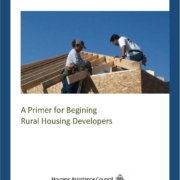
Primer for Beginning Rural Housing Developers

Download the Primer

Rural organizations play an important role in combating the effects of the recession by working to provide affordable housing for an increased number of people. Due to high need, many rural organizations without prior housing development experience may now be interested in exploring the development process. This manual is intended to serve as a starting point for those groups by providing a basic overview of the housing development process and the understanding necessary to move on to more detailed and more complete guides to housing development. This guide does not cover every step of the development process; instead it highlights those parts that HAC considers especially critical to an overall comprehension of housing development. This manual should not be used as an organization’s only guide to developing affordable housing.

Housing development can mean many different things. It can mean new construction or rehabilitation of existing structures. It can involve development of single-family homes or multifamily housing, rental units or homeownership projects. Yet all types of affordable housing development share the same basic process. Whether a proposed project is simple or complex, failure to understand that process or to successfully complete the requisite development and housing counseling steps can seriously jeopardize project success.

This guide is specifically geared to development of affordable housing in rural areas, since rural housing developers face unique obstacles, such as fewer housing development professionals from which to choose, fewer commercial banks to approach for funding, and limited public water and sewer infrastructure. However, the rural development organization also enjoys certain benefits, including U.S. Department of Agriculture (USDA) Rural Housing Service (RHS) programs that provide funding only to projects in rural areas.

HAC News: September 28, 2011

HAC News Formats. PDF, Epub, Kindle

September 28, 2011
Vol. 40, No. 20

• September 15-October 15 is National Hispanic Heritage Month • House to consider continuing resolution options on Sept. 29 • Senate committee acts on HUD spending • Budget Control Act’s impact on HUD predicted • HUD posts general section for FY12 NOFAs • HUD offers multifamily energy innovation funds • HUD seeks feedback on healthy homes designation • Housing GSE regulations under review • Information available on Section 502 guarantee program fees • 500 places may lose eligibility for USDA housing programs, HAC estimates • Register for HAC’s senior housing symposium, Nov. 9-10, Seattle

September 28, 2011
Vol. 40, No. 20

SEPTEMBER 15-OCTOBER 15 IS NATIONAL HISPANIC HERITAGE MONTH. President Obama’s declaration is posted at https://www.whitehouse.gov/briefing-room/presidential-actions/proclamations.

HOUSE TO CONSIDER CONTINUING RESOLUTION OPTIONS ON SEPT. 29. The House will choose between two bills passed by the Senate to provide federal funding for the beginning of FY12. H.R. 2017 would fund the government through October 4 and H.R. 2608 through November 18. Both would fund USDA and HUD housing programs at FY11 levels with a 1.5% across the board cut. The bills are at https://thomas.loc.gov (search by bill number).

SENATE COMMITTEE ACTS ON HUD SPENDING. On September 21 the Senate Appropriations Committee approved a FY12 Transportation-HUD spending bill with substantial differences from the House subcommittee bill (see HAC News, 9/14/11). The Senate funded and the House did not fund housing counseling, Sustainable Communities, and Choice Neighborhoods. The Senate provided less funding for CDBG, HOME, Section 202, Section 811, fair housing, and HOPWA – but more for rental assistance vouchers, public housing capital and operating funds, and SHOP. The Rural Innovation Fund did not receive any funding in either bill. Further action on this and other appropriations bills is unclear. An omnibus package combining most of the bills is a likely possibility, with no further action taken on individual measures. The Senate report on S. 1596 is at https://frwebgate.access.gpo.gov/cgi-bin/getdoc.cgi?dbname=112_cong_bills&docid=f:s1596pcs.txt.pdf.

HUD Program

(dollars in millions)

FY10 Approp.

FY11

Approp.b

FY12

Admin. Bdgt.

FY12

House Bill

FY12

Senate Bill

Cmty. Devel. Block Grants

Sustainable Commun. Initiative

Rural Innovation Fund

$4,450

(150)

(25)

3,508

(100)

0

3,781

150

(25)

3,500

0

0

3,001

(90)

0

HOME

1,825

1,610

1,650

1,200

1,000

Tenant-Based Rental Asstnce.

Vets. Affairs Spptve Hsg. Vchrs

18,184

(75)

18,408

(50)

19,223

(75)

18,467.9

(75)

18,872.4

(75)

Project-Based Rental Asstnce.

8,551.5

8,882

9,429

9,028.7

9,018.7

Transforming Rental Asstnce. a

0

200

0

0

Public Hsg. Capital Fund

2,500

2,044

2,405

1,532.1

1,875

Public Hsg. Operating Fund

4,775

4,626

3,962

3,861.9

3,961.9

Public Hsg. Revtlztn. (HOPE VI)

135

100

0

0

0

Choice Neighbrhd. Initiative

65

0

250

0

120

Housing Trust Fund

0

1,000

0

0

Native Amer. Hsg. Block Grant

700

650

700

648.7

650

Homeless Assistance Grants

1,865

1,905

2,372

1,901.2

1,901.2

Hsg. Opps. for Persons w/ AIDS

335

335

335

334.3

330

202 Hsg. for Elderly

825

400

757

600

369.7

811 Hsg. for Disabled

300

150

196

196

150

Fair Housing

72

72

72

71.9

64.3

Healthy Homes & Lead Haz. Cntl.

140

120

140

119.8

120

Self-Help Homeownshp. (SHOP)

27

27

0

15.9

17

Housing Counseling

87.5

0

88

0

60

a. New program proposed by the Administration. b. Figures shown do not include 0.2% across the board reduction.

BUDGET CONTROL ACT’S IMPACT ON HUD PREDICTED. Materials from a September 27 webinar by the Center on Budget and Policy Priorities show future funding reductions for discretionary federal programs, including HUD housing, likely to occur under the recent deficit reduction legislation; visit https://www.cbpp.org/research/index.cfm?fa=topic&id=143. The Joint Select Committee on Deficit Reduction (“Super Committee”; see HAC News 8/18/11) now has a website at https://deficitreduction.senate.gov.

HUD POSTS GENERAL SECTION FOR FY12 NOFAs. NOFAs for individual funding programs will be published later. The general section applies to all. Visit https://www.hud.gov/offices/adm/grants/fundsavail.cfm or https://www.grants.gov. Contact HUD’s grants management office, 202-708-0667.

HUD OFFERS MULTIFAMILY ENERGY INNOVATION FUNDS. Applications are due October 20 for Multifamily Energy Pilot grants from an FY10 Energy Innovation Fund, intended to stimulate innovative, replicable approaches for increasing the energy efficiency of existing multifamily properties. Both categories – financing and applied research – require matching funds. Eligible applicants include nonprofits and for-profits with portfolios over 1,000 units, special purpose financing entities like housing trust funds, and CDFIs. Visit https://www.hud.gov/offices/adm/grants/nofa10/grpeif.cfm. Contact Theodore Toon, HUD, 202-708-0001.

HUD SEEKS FEEDBACK ON HEALTHY HOMES DESIGNATION. Comments are due October 14 on a proposal to designate communities as Safe and Healthy Homes Investment Partnerships providing multiple housing-based interventions and leveraging non-federal resources. These places would not receive direct funding, but might receive bonus points in future HUD NOFAs. See Federal Register, 9/14/11 or https://www.regulations.gov. Contact Jon L. Gant, HUD, 202-708-0310.

HOUSING GSE REGULATIONS UNDER REVIEW. The Federal Housing Finance Agency requests comments by November 22 on its plan to review regulations promulgated by its predecessors (HUD’s Office of Federal Housing Enterprise Oversight, HUD’s GSE oversight team, and the Federal Housing Finance Board). Individual regulations will be published for comment as well. Visit https://www.fhfa.gov or https://www.regulations.gov. Contact Alfred M. Pollard, FHFA, alfred.pollard@fhfa.gov, 202-414-3788.

INFORMATION AVAILABLE ON SECTION 502 GUARANTEE PROGRAM FEES. New fees for the program begin October 1. Visit https://www.rdlist.sc.egov.usda.gov to sign up for emails and https://usdalinc.sc.egov.usda.gov/USDALincTrainingResourceLib.do to access documents, including frequently asked questions. Contact the national office guarantee division, 202-720-1452.

500 PLACES MAY LOSE ELIGIBILITY FOR USDA HOUSING PROGRAMS, HAC ESTIMATES. Analyzing recently released 2010 Census data, HAC calculated that 500 cities, towns, and villages could be reclassified as ineligible because their populations have grown. Future research will identify places that have lost population and could become newly eligible. Over 9 million people live in the potentially ineligible places (the report notes that not all would be eligible for housing aid, based on income or other program requirements). After the 1990 and 2000 censuses, legislation “grandfathered in” such places so they remained eligible; it is not known whether Congress will pass such a measure this year. The report, titled Estimating Potential Changes to USDA-RD’s Eligible Area Designations, lists of places, and an archived webinar presentation are available at http://ruralhome.org. Contact Lance George, HAC, lance@ruralhome.org, 202-842-8600.

REGISTER FOR HAC’S SENIOR HOUSING SYMPOSIUM, NOV. 9-10, SEATTLE. Housing Seniors in Rural America: Aging in Place in a Shifting Landscape will feature discussions on aging in place; resources for repairing, developing, and preserving rental and homeownership units; and examples of successful practices in the field of affordable senior rural housing. Register online at http://ruralhome.org or contact Dan Stern, HAC, registration@ruralhome.org.
HAC News: September 14, 2011

HAC News Formats. pdf, ePub, Kindle

September 14, 2011
Vol. 40, No. 19

• President’s job plan includes possible housing aid • Continuing Resolution expected to start FY12 • Senate committee’s FY12 rural housing spending levels higher than House’s • House subcommittee proposes HUD spending cuts • USDA and HUD testify against moving RHS to HUD • USDA offers RA and equity loans for preservation • Guidance issued on using Section 538 for Section 515 preservation • National poverty rate worsened in 2010

September 14, 2011
Vol. 40, No. 19

PRESIDENT’S JOB PLAN INCLUDES POSSIBLE HOUSING AID. Project Rebuild, part of the American Jobs Act described in President Obama’s September 8 speech and sent to Congress September 12, would hire unemployed workers to repair distressed properties, emphasizing commercial properties. Visit https://www.whitehouse.gov.

CONTINUING RESOLUTION EXPECTED TO START FY12. Funding bills, including those for USDA and HUD, are not likely to be complete by the beginning of fiscal year 2012 on October 1. Visit http://ruralhome.org for updates and https://thomas.loc.gov/home/approp/app12.html for bill texts.

SENATE COMMITTEE’S FY12 RURAL HOUSING SPENDING LEVELS HIGHER THAN HOUSE’S. The Senate Ap-propriations Committee passed a bill September 7 that provides more funding for almost all USDA housing programs than the House, though less than FY11 appropriations. The Section 502 guarantee and Section 538 programs would remain at FY11 levels. The bill includes $30 million for Section 523 self-help, $2 million for multifamily preservation, and $904.7 million for Section 521 Rental Assistance. The $900 million for RA contract renewals is the amount pro-posed in the Administration’s budget, which assumed 300 properties (HAC estimates about 8,100 units) will leave the Section 515 and 514/516 programs in FY12.

USDA Rural Development Program
(dollars in millions)

FY10 Approp.

FY11
Approp. (a)

FY12 Admin. Budget

FY12
Hse. Bill (H.R. 2112) (e)

FY12
Sen. Bill
(H.R. 2112)

Loans and Payments

502 Single Fam. Direct

$1,121

$1,121

$211.4

$845.6

$900

502 Single Family Guar.

12,000

24,000

24,000

24,000

24,000

504 Very Low-inc. Rpr.

34.4

23.4

0

0

10

514 Farm Labor Hsg.

27.3

(b)

27

(d)

23.4

515 Rental Hsg. Direct

69.5

69.5

95.2

58.6

64.5

538 Rental Hsg. Guar.

129.1

30.9

0

0

130

Rental Prsrv. Revlg. Lns.

1.8

1

0

0

0

Grants

504 Very Low-inc. Rpr.

31.6

(c)

11.5

32

27

516 Farm Labor Hsg.

9.9

(b)

9.8

(d)

8

523 Self-Help TA

41.9

37

0

22

30

533 Hsg. Prsrv. Grants

9.4

(c)

0

0

7.3

521 Rental Assistance
Preservation RA
New Constr. 515 RA
New Constr. 514/516 RA

980
(6)
(2.03)
(3.4)

955.6
0
(2.03)
(3)

906.7
0
(3)
(3)

890
0
(1.5)
(2.5)

904.7
0
(2)
(2)

542 Rural Hsg. Vouchers

16.4

14

16

11

11

Rental Prsrv. Demo. (MPR)

25

15

0

0

2

Rural Cmnty. Dev’t Init.

6.3

5

8.4

3

4.2

a. Figures shown do not include 0.2% across the board reduction. b. Budget authority (the cost to the government) in the farm labor housing account remains at FY10 levels, but loan costs have risen as interest rates have risen, so the 514/516 program levels could be somewhat lower. c. The Rural Housing Assistance Grants pool, which funds Section 504 loans, Section 533, and some other smaller programs, is reduced by $1.1 million from FY10 levels. d. The BA for Section 514 and 516 would fall from $9.7 million in FY11 to $2.5 million for FY12, but the House bill does not allocate amounts specifically for loans or grants. e. Figures shown do not include 0.78% across the board reduction.

HOUSE SUBCOMMITTEE PROPOSES HUD SPENDING CUTS. On September 8 a House appropriations sub-committee passed an FY12 spending bill for HUD that would reduce funding for most programs and provide no funding for the Rural Innovation Fund or housing counseling. Dates have not been scheduled for consideration by the full House committee or by Senate appropriators.

HUD Program
(dollars in millions)

FY10 Approp.

FY11 Admin. Budget

FY11 Proposed CR
(H.R. 1)

FY12 Admin. Budget

Cmty. Devel. Block Grants

$4,450

4,380.1

1,500

3,781

Sustainable Commun. Initiative

(150)

(150)

0

(b)

Rural Innovation Fund (a)

(25)

0

25

25

Catalytic Investment Grants

(150)

0

HOME

1,825

1,650

1,650

1,650

Tenant-Based Rental Asstnce.

16,339

17,310

14,080

15,223

Project-Based Rental Asstnce.

8,551.5

9,382.3

8,882

9,035

Transforming Rental Asstnce.

350

200

Vets. Affairs Spptve Hsg. Vouchers

75

0

75

75

Public Hsg. Capital Fund

2,500

2,044

1,428

2,405

Public Hsg. Operating Fund

4,775

4,829

4,626

3,962

Public Hsg. Revtlztn. (HOPE VI)

135

0

0

0

Choice Neighbrhd. Initiative

65

250

65

250

Housing Trust Fund

1,000

Native Amer. Hsg. Block Grant

700

580

500

700

Homeless Assistance Grants

1,865

2,055

1,865

2,372

Hsg. Opps. for Persons w/ AIDS

335

340

335

335

202 Hsg. for Elderly

825

273

238

757

811 Hsg. for Disabled

300

90

90

196

Fair Housing

72

61

72

72

Rural Hsg. & Econ. Dev. (RHED) (a)

0

0

0

0

Healthy Homes & Lead Haz. Cntl.

140

140

120

140

Sustainable Housing & Communities (b)

0

150

Self-Help Homeownshp. (SHOP)

27

0

27

0

Brownfields Redevelopment

17.5

0

0

0

Housing Counseling

87.5

88

0

88

a. The Rural Innovation Fund replaced RHED. b. Funded as part of CDBG in 2010 and separately in the FY12 budget

USDA AND HUD TESTIFY AGAINST MOVING RHS TO HUD. Their statements were made at the House Financial Services Committee’s housing subcommittee’s second hearing, held September 8, on a draft bill that would move USDA’s Rural Housing Service to HUD (see HAC News, 5/25/11) and also change FHA and Ginnie Mae. At a September 13 House agriculture subcommittee hearing, RHS Administrator Tammye Treviño again made clear that the Administration opposes the idea. Visit http://ruralhome.org for a summary and links.

USDA OFFERS RA AND EQUITY LOANS FOR PRESERVATION. $3 million in Section 521 Rental Assistance and $10 million in equity loans are available to owners or nonprofit purchasers of Section 515 properties already on RD’s incentives waiting list. See August 8 Unnumbered Letter at https://www.rurdev.usda.gov/RD_UnnumberedList.html. Contact Cynthia L. Johnson, RD, 202-720-1940, cynthial.johnson@wdc.usda.gov.

GUIDANCE ISSUED ON USING SECTION 538 FOR SECTION 515 PRESERVATION. See August 16 Unnumbered Letter at https://www.rurdev.usda.gov/RD_UnnumberedList.html. Contact Tammy Daniels, RD, 202-720-0021, tammy.daniels@wdc.usda.gov.

NATIONAL POVERTY RATE WORSENED IN 2010. Visit http://ruralhome.org for a rural perspective on new poverty, income, and health insurance data from the Census Bureau, https://www.census.gov.

HAC News: August 31, 2011

HAC News Formats. pdf, EPUB, Kindle

August 31, 2011
Vol. 40, No. 18

• OMB asks agencies to suggest spending cuts • Section 514/516 deadline extended • USDA reissues Preservation Revolving Loan Fund NOFA • HUD offers Energy Innovation Fund Multifamily Pilot Program Grants • Continuum of Care NOFA published • Emergency Homeowners’ Loan Program reopens in some states • HUD proposes to open FHA mortgage insurance to Farm Credit System direct lenders • HUD announces FY10 Rural Innovation Fund grantees • Proposed FMRs released • Handbook explains clean-up after flooding • HAC launches senior housing initiative • HAC offers training on senior housing and 502 packaging, Nov. 8-10, Seattle

August 31, 2011
Vol. 40, No. 18

OMB ASKS AGENCIES TO SUGGEST SPENDING CUTS. The Office of Management and Budget told federal agencies to prepare 2013 budget proposals based on 5% and 10% cuts from FY11 appropriations. An OMB blog post says the Administration will not make across-the-board cuts but will cut spending that is “wasteful or not essential.” Visit https://www.whitehouse.gov/blog/2011/08/18/2013-budget-guidance. There will be further communications between agencies and OMB as the Administration’s official budget is developed; these are not usually made public.

SECTION 514/516 DEADLINE EXTENDED (see HAC News, 7/6/11 and 8/18/11). Preapplications are now due September 6 rather than August 22, and the points for energy conservation are revised. See Federal Register, 8/30/11, https://www.grants.gov/, or https://www.rurdev.usda.gov/RD_NOFAs.html. Contact an RD state office.

USDA REISSUES PRESERVATION REVOLVING LOAN FUND NOFA.
USDA will make loans to intermediaries that will lend for Section 515 and 514/516 preservation. Deadline is September 21. See Federal Register, 8/22/11, or https://www.rurdev.usda.gov/RD_NOFAs.html. Contact Sherry Engel, sherry.engel@wdc.usda.gov, 715-345-7677.

HUD OFFERS ENERGY INNOVATION FUND MULTIFAMILY PILOT PROGRAM GRANTS. CDFIs, for-profits, nonprofits, and special purpose financing entities are eligible for grants to demonstrate financing or applied research showing innovative and replicable approaches to increase energy efficiency at existing multifamily properties. Matching funds are required. Deadline is October 20. Visit https://www.hud.gov/offices/adm/grants/fundsavail.cfm. Contact Theodore K. Toon, HUD, 202-708-0001.

CONTINUUM OF CARE NOFA PUBLISHED. Continuums of Care with approved registrations can apply by October 28 through HUD’s e-snaps system. Visit https://www.hudhre.info/.

EMERGENCY HOMEOWNERS’ LOAN PROGRAM REOPENS IN SOME STATES. Applications for interest-free loans are now due September 15 from homeowners in AK, AR, CO, HI, IA, KS, LA, ME, MA, MN, MO, MT, NE, NH, NM, NY, ND, OK, SD, TX, UT, VT, VA, WA, WV, WI, WY, and PR who are at risk of foreclosure due to involuntary unemployment or underemployment, economic conditions, or medical conditions. Visit https://www.findehlp.org/ or call 855-FIND-EHLP (855-346-3345).

HUD PROPOSES TO OPEN FHA MORTGAGE INSURANCE TO FARM CREDIT SYSTEM DIRECT LENDERS. To make more housing credit available in rural areas, a proposed regulation would enable these lenders to seek FHA approval. Comments are due October 25. See Federal Register, 8/26/11, or https://www.regulations.gov/. Contact HUD’s Office of Lender Activities and Program Compliance, 202-708-1515.

HUD ANNOUNCES FY10 RURAL INNOVATION FUND GRANTEES. More than half the 46 awardees serve Native American/Native Alaskan populations. HUD says grantees will create 789 housing units and 655 jobs. Visit the Press Room at https://www.hud.gov/.

PROPOSED FMRS RELEASED. Comments are due September 19 on FY 2012 Fair Market Rents listed in the Federal Register, 8/19/11. Visit https://www.regulations.gov or https://www.huduser.org/portal/datasets/fmr.html. Contact HUD User, 800-245-2691 or HUD program staff.

HANDBOOK EXPLAINS CLEAN-UP AFTER FLOODING. Intended to help residents and contractors remove mold and other contamination, Creating a Healthy Home: A Field Guide for Clean-up of Flooded Homes is free at https://www.nchh.org/. Agencies working directly with individuals impacted by floods can order printed booklets for distribution from the National Center for Healthy Housing, 877-312-3046.

HAC LAUNCHES SENIOR HOUSING INITIATIVE. Support from The Atlantic Philanthropies will be used to increase the capacity of organizations providing affordable housing for low-income rural seniors and to advocate for better and better-funded programs. To receive announcements about events and resources, contact Janice Clark, HAC, janice@ruralhome.org, 202-842-8600 ext. 131.

HAC OFFERS TRAINING ON SENIOR HOUSING AND 502 PACKAGING, NOV. 8-10, SEATTLE

Section 502 Packaging Certification Training for Nonprofit Organizations, Nov. 8-10, is for those who are familiar with the 502 direct loan program and anticipate seeking certification as loan packagers. Participants in this track are expected to attend the complete course and to take the online certification exam afterwards.

Housing Seniors in Rural America: Aging in Place in a Shifting Landscape, Nov. 9-10, is a symposium featuring discussions, resources, and examples of successful practices.

For more, check http://ruralhome.org/ later this week or contact Dan Stern, HAC, dan@ruralhome.org.

HAC News: August 18, 2011

HAC News Formats. pdf, EPUB, Kindle

August 18, 2011
Vol. 40, No. 17

• New spending reduction process begins • White House Rural Council report and forum focus on jobsSection 514/516 Farm Labor Housing NOFA corrected • Multifamily exception authority requests must be complete, RD reminds field staff • Agencies request input on disposition of REO properties • Federal agencies renew commitment to environmental justice • RD to clarify calculation of student income • Farm loan claims packages available for Hispanic and women farmers • September 16 deadline for Native American trust account holders to file Cobell claims • African-American farmers being notified of Pigford II eligibility • Low-income families and children struggling, annual Kids Count data show • Energy efficiency finance options summarized in report

August 18, 2011
Vol. 40, No. 17

NEW SPENDING REDUCTION PROCESS BEGINS. The first stage of deficit reduction required by the Budget Control Act of 2011 allows more total domestic discretionary spending for FY12 than House appropriations bills had anticipated. The House is not expected to reconsider its USDA spending bill, passed June 16 (see HAC News, 6/22/11). The House has not yet acted on FY12 HUD funding, and the Senate must address both USDA and HUD. The second deficit reduction stage requires proposals from the new Joint Select Committee on Deficit Reduction by November 23. The 12 committee members include three Democrats and three Republicans from each house: co-chairs Sen. Patty Murray (D-WA) and Rep. Jeb Hensarling (R-TX); Senators Max Baucus (D-MT), John Kerry (D-MA), Jon Kyl (R-AZ), Rob Portman (R-OH), and Pat Toomey (R-PA); Reps. Xavier Becerra (D-CA), Dave Camp (R-MI), James Clyburn (D-SC), Fred Upton (R-MI), and Chris Van Hollen (D-MD).

WHITE HOUSE RURAL COUNCIL REPORT AND FORUM FOCUS ON JOBS. A new Jobs and Economic Security for Rural America report cites several HUD and foreclosure avoidance programs, mentions USDA housing programs, and acknowledges housing need in Indian Country. President Obama’s recent trip to Iowa included an August 16 White House Rural Economic Forum. Visit https://www.whitehouse.gov/administration/eop/rural-council.

SECTION 514/516 FARM LABOR HOUSING NOFA CORRECTED (see HAC News, 7/6/11). The maximum points for energy conservation for purchase and substantial rehab for an existing non-FLH property are increased from 16 to 32. The deadline remains August 22. See Federal Register, 8/18/11, https://www.grants.gov, or https://www.rurdev.usda.gov/RD_NOFAs.html. Contact an RD state office.

MULTIFAMILY EXCEPTION AUTHORITY REQUESTS MUST BE COMPLETE, RD REMINDS FIELD STAFF. An Unnumbered Letter dated July 19 emphasizes elements that must be included in a request for the housing administrator to grant an exception to regulations. Visit https://www.rurdev.usda.gov/RD_UnnumberedList.html. Contact Melinda Price, 614-255-2403, melinda.price@wdc.usda.gov.

AGENCIES REQUEST INPUT ON DISPOSITION OF REO PROPERTIES. The Federal Housing Finance Agency, Treasury Department, and HUD are exploring alternatives for selling single-family real estate owned properties held by Fannie Mae, Freddie Mac, and FHA, including approaches that support rental and affordable housing needs. Visit https://www.fhfa.gov/Default.aspx?Page=360 or email reo.rfi@fha.gov.

FEDERAL AGENCIES RENEW COMMITMENT TO ENVIRONMENTAL JUSTICE. USDA, HUD, and 15 others signed a Memorandum of Understanding on August 4 related to the 1994 Executive Order that established the Federal Interagency Working Group on Environmental Justice. They will prepare strategies, release annual reports, and more to ensure equal treatment for all in environmental matters. Visit https://epa.gov/environmentaljustice/interagency.

RD TO CLARIFY CALCULATION OF STUDENT INCOME. The National Housing Law Project reports that RD will issue an Unnumbered Letter making clear that student income should be treated differently for those receiving USDA Rental Assistance than those with HUD Section 8. NHLP’s summary is posted at http://ruralhome.org.

FARM LOAN CLAIMS PACKAGES AVAILABLE FOR HISPANIC AND WOMEN FARMERS. Those who believe USDA improperly denied farm loan benefits to them between 1981 and 2000 because they are Hispanic or female can request claims packages at 1-888-508-4429 or https://www.farmerclaims.gov. No deadline is given.

SEPTEMBER 16 DEADLINE FOR NATIVE AMERICAN TRUST ACCOUNT HOLDERS TO FILE COBELL CLAIMS. A court-approved settlement in July resolved the Cobell case regarding federal government mismanagement of Native American trust funds. Visit https://www.indiantrust.com. Contact 1-800-961-6109, info@indiantrust.com.

AFRICAN-AMERICAN FARMERS BEING NOTIFIED OF PIGFORD II ELIGIBILITY. Notices are being sent to those who missed the claim deadline of October 12, 1999 in the original Pigford discrimination case against USDA. Claims packages are not yet available. Updates are posted at https://sustainableagriculture.net/blog/pigford-ii-settlement-update and https://www.blackfarmercase.com. Call 1-877-810-8110.

LOW-INCOME FAMILIES AND CHILDREN STRUGGLING, ANNUAL KIDS COUNT DATA SHOW. The 2011 data book from the Annie E. Casey Foundation provides state-level figures. Visit https://www.kidscount.org for interactive data or to print or order the book. Contact webmail@aecf.org.

Energy efficiency finance options summarized in report. A new white paper from the American Council for an Energy-Efficient Economy describes the types of initiatives offering financing for the residential and commercial sectors. Energy Efficiency Finance 101: Understanding the Marketplace is free at https://www.aceee.org. Contact ACEEE, 202-507-4000, aceeeinfo@aceee.org.

GET THE HAC NEWS!

Sign-up for HAC information products

SIGN UP HERE

Housing Assistance Council   |  1828 L Street. N.W., Suite 505, Washington, D.C. 20036
(202) 842-8600 (202) 347-3441 hac@ruralhome.org |

Board Portal

HAC is an equal opportunity provider, employer, and lender. | Civil Rights | Privacy