HAC News: August 22, 2012

HAC News Formats. pdf

August 22, 2012
Vol. 41, No. 17

• USDA to use FY12 Section 515 funds for prepayment incentives • CBS News airs story on Section 502 guarantee foreclosures • Grants offered for senior volunteers in specific places • HUD releases general section for FY13 NOFAs • Funds exhausted for Section 502 guarantee program refinances • FHFA requests comments about eminent domain for foreclosures • Public Housing Assessment System scoring process explained • CFPB proposes regulations on high cost mortgages and homeownership counseling • Some mortgage disclosures to be combined • Blueprint for better farmworker housing published • HAC Seeks Nominations for Rural Housing Awards • Register Now for the National Rural Housing Conference!


August 22,2012
Vol. 41, No. 17

USDA TO USE FY12 SECTION 515 FUNDS FOR PREPAYMENT INCENTIVES. An email message from USDA to congressional offices explains that the department has canceled its NOFA for new construction funding. A Supreme Court ruling in a different context (Salazar v. Ramah Navajo Chapter) required the government to pay amounts to fulfill contractual obligations even if Congress did not appropriate enough funds. Owners of over 100 Section 515 properties have been on a waiting list for incentives (equity loans and/or Rental Assistance) from USDA to keep these properties in the program, so the FY12 funds will be used for those incentives.

CBS NEWS AIRS STORY ON SECTION 502 GUARANTEE FORECLOSURES. Like a May 25 Wall Street Journal article, the August 16 CBS story criticizes USDA’s collection tactics when a borrower with high medical bills fell behind on mortgage payments.

GRANTS OFFERED FOR SENIOR VOLUNTEERS IN SPECIFIC PLACES. The Corporation for National and Community Service requests letters of intent by September 10 from public agencies, tribes, nonprofits, and institutions of higher education interested in Retired and Senior Volunteer Program funding. RSVP grants can be used to cover expenses such as volunteer recruitment, training, and travel for purposes including low-income housing. Partial matching funds are required. Applications are due October 11. A draft NOFA, list of program areas, information about technical assistance calls, and more are posted on CNCS’s site.

HUD RELEASES GENERAL SECTION FOR FY13 NOFAS. The general section’s information applies to next year’s NOFAs and does not itself offer funding. Contact HUD’s grants management office, 202-402-4802.

FUNDS EXHAUSTED FOR SECTION 502 GUARANTEE PROGRAM REFINANCES. USDA has used all its FY12 money for this program. Lenders can submit loan applications reflecting FY13 fees (upfront guarantee fee of 2% and annual fee of 0.4%) to USDA, which will hold them until FY13 funding becomes available. Contact an RD office.

FHFA REQUESTS COMMENTS ABOUT EMINENT DOMAIN FOR FORECLOSURES. The Federal Housing Finance Agency, which oversees Fannie Mae, Freddie Mac, and the Federal Home Loan Bank system, is considering taking action on its “significant concerns” about the impact on lenders when local governments use eminent domain powers to seize properties before foreclosure in order to provide affordable housing. Comments are due September 7. See Federal Register, 8/9/12. Contact FHFA, eminentdomainOGC@fhfa.gov.

PUBLIC HOUSING ASSESSMENT SYSTEM SCORING PROCESS EXPLAINED. HUD provides additional information about the process for issuing scores under the Physical Condition Indicator of the PHAS under a February 23, 2011 notice, applicable to HUD-assisted multifamily and public housing properties. See Federal Register, 8/9/12 or HUD’s site. Contact Claudia J. Yarus, HUD, 202-475-8830.

CFPB PROPOSES REGULATIONS ON HIGH COST MORTGAGES AND HOMEOWNERSHIP COUNSELING.Comments are due September 7 on Consumer Financial Protection Bureau changes to implement provisions of the Dodd-Frank Act that expand the types of mortgage loans subject to the Home Ownership and Equity Protection Act of 1994, revise triggers for HOEPA coverage, impose other restrictions on HOEPA mortgages, including a counseling re-quirement, and impose homeownership counseling requirements in connection with the Truth in Lending Act and the Real Estate Settlement Procedures Act. See CFPB’s site or regulations.gov. Contact Paul Seja, CFPB, 202-435-7700.

SOME MORTGAGE DISCLOSURES TO BE COMBINED. To implement another Dodd-Frank provision, the Consumer Financial Protection Bureau proposes to combine some of the disclosures and forms required by the Truth in Lending Act and RESPA. Comments are due November 6. See CFPB’s site or regulations.gov. Contact David Friend, CFPB, 202-435-7700.

BLUEPRINT FOR BETTER FARMWORKER HOUSING PUBLISHED. The report summarizes policy and research changes identified at a California Rural Legal Assistance forum, and a working group on health and housing will continue the effort. Contact spodesta@crla.org.

HAC SEEKS NOMINATIONS FOR RURAL HOUSING AWARDS. Nominations are due September 28 for the Cochran/Collings Award for national rural housing service and the Skip Jason Community Service Award. The honors will be presented at the National Rural Housing Conference in December. Complete the online form to submit a nomination or contact Lilla Sutton, HAC, 202-842-8600, lilla@ruralhome.org to request a paper form.

REGISTER NOW FOR THE NATIONAL RURAL HOUSING CONFERENCE!
HAC has opened registration for the 2012 National Rural Housing Conference, which will take place December 6-7, with pre-conference activities on December 5, at the Hyatt Regency Washington on Capitol Hill in Washington, DC. Register now to take advantage of the special early bird discount! Start networking in advance – join the conference LinkedIn group. Questions? Contact Dan Stern, HAC, dan@ruralhome.org or 202-842-8600.

HAC News: August 8, 2012

HAC News Formats. pdf

August 8, 2012
Vol. 41, No. 16

• Leaders agree on continuing resolution, Congress recesses • House members plan letter requesting rural definition extension in CR • OMB tells agencies to continue spending, advises Congress to change sequestration • Fees for some Section 502 loan guarantees to increase October 1 • FEMA requests comments on emergency housing assistance • Interim Continuum of Care rule issued • IRS proposes rule on submetered utilities in LIHTC properties • Circular A-133 Compliance Supplement for 2012 available • Federal regulators release 2012 list of distressed or underserved tracts for CRA • Senate subcommittee considers changes to HUD’s rental assistance programs • Job growth slower in rural places than urban ones • Different skills result in different wages in rural and urban places, study concludes • Study examines potential for increasing energy efficiency in manufactured homes

August 8, 2012
Vol. 41, No. 16

LEADERS AGREE ON CONTINUING RESOLUTION, CONGRESS RECESSES. In late July Republicans and Democrats in Congress, along with the White House, announced they will develop a continuing resolution to fund the government for the first six months of FY13, starting October 1, 2012. Most programs will remain at FY12 funding levels. Congress has recessed until September 10, so the CR will be considered in September.

HOUSE MEMBERS PLAN LETTER REQUESTING RURAL DEFINITION EXTENSION IN CR. The National Rural Housing Coalition reports Rep. Jeff Fortenberry (R-NE) and others will send a letter to House leadership asking that the FY13 CR include an extension of language keeping growing rural communities eligible for USDA rural housing programs. Background information on this issue is posted on HAC’s website.

OMB TELLS AGENCIES TO CONTINUE SPENDING, ADVISES CONGRESS TO CHANGE SEQUESTRATION. A July 31 memo from OMB’s Acting Director tells heads of federal departments and agencies to continue normal spending and operations since Congress has over five months to change the January 1 spending cuts required by the Budget Control Act. On August 7 President Obama signed into law the Sequestration Transparency Act of 2012, which requires an Administration report within 30 days estimating sequestration’s impact on programs.

FEES FOR SOME SECTION 502 LOAN GUARANTEES TO INCREASE OCTOBER 1. An email has notified stakeholders that, while the upfront fee for purchase transactions will remain at 2%, the upfront fee for refinances will rise from 1.5% in FY12 to 2% in FY13. Annual fees for both purchases and refinances will rise from 0.30% in FY12 to 0.40% next year. Contact Debbie Terrell, RD, 918-534-3254.

FEMA REQUESTS COMMENTS ON EMERGENCY HOUSING ASSISTANCE. Comments are due September 28 on proposed revisions to regulations on FEMA’s housing repair, replacement, and construction assistance. The changes are intended to clarify eligibility criteria and implement legislative changes enacted in 2006, not to create new eligibility requirements or add burdens for applicants. Contact Lumumba T. Yancey, FEMA, 202-212-1000.

INTERIM CONTINUUM OF CARE RULE ISSUED. The regulation takes effect August 30 and comments are due October 1. Contact Ann Marie Oliva, HUD, 202-708-4300.

IRS PROPOSES RULE ON SUBMETERED UTILITIES IN LIHTC PROPERTIES. The change would clarify that utility costs paid by a tenant based on actual consumption in a submetered rent-restricted unit are treated as paid by the tenant directly to the utility company. IRS will hold a public hearing on November 27 in Washington, DC. Comments are due October 9. Contact David Selig, IRS, 202-622-3040.

CIRCULAR A-133 COMPLIANCE SUPPLEMENT FOR 2012 AVAILABLE. The supplement provides guidance on audits of federally funded nonprofits and government entities. Comments are due October 31.

FAIR MARKET RENTS PROPOSED FOR FY13. Comments are due September 4 on FMRs that will take effect October 1. Contact local HUD program staff or HUD User, 1-800-245-2691.

FEDERAL REGULATORS RELEASE 2012 LIST OF DISTRESSED OR UNDERSERVED TRACTS FOR CRA. Lender activities in these distressed or underserved nonmetropolitan middle-income geographies can receive credit in Community Reinvestment Act evaluations.

SENATE SUBCOMMITTEE CONSIDERS CHANGES TO HUD’S RENTAL ASSISTANCE PROGRAMS. On August 1 the Banking Committee’s Housing Subcommittee held a hearing titled “Streamlining and Strengthening HUD’s Rental Housing Assistance Programs.” Witnesses discussed provisions of several reform bills introduced in Congress.

JOB GROWTH SLOWER IN RURAL PLACES THAN URBAN ONES. The Daily Yonder examined changes in counties’ numbers of jobs from June 2011 to June 2012. Jobs increased by 1.77% in urban counties and by 0.86% in rural counties. One-third of rural and exurban counties lost jobs during this 12-month period.

DIFFERENT SKILLS RESULT IN DIFFERENT WAGES IN RURAL AND URBAN PLACES, STUDY CONCLUDES. “Workforce Skills across the Urban-Rural Hierarchy,” by New York Federal Reserve Bank staff and others, is a preliminary report on research that examined job skills and income levels across a spectrum of places from urban to rural. Researchers found that jobs clustered in urban areas require higher levels of skills than those clustered in rural areas, and that these differences help explain the higher wages in urban areas. Contact Kevin Stolarick

STUDY EXAMINES POTENTIAL FOR INCREASING ENERGY EFFICIENCY IN MANUFACTURED HOMES. Noting that energy efficiency in manufactured homes lags behind that of site-built homes, the American Council for an Energy-Efficient Economy reports that improvements can be made in new construction and existing homes. Contact Patrick Kiker, ACEEE, 202-507-4043.

Rural Economies and Industry

Rural Economies and Industry

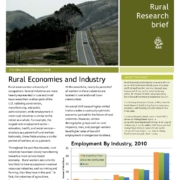
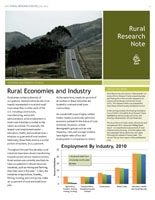
rrn-econ-cover-thbHAC’s seventh Rural Research Note takes a brief look into rural America’s economies and industries. Rural economies, and people in general, are often perceived as being heavily reliant on farming and other natural resource industries. While it is true that the majority of these industries are located in rural places, they employ only 5.5% of rural and small town workers. Overall, the sector-by-sector employment profile of rural America is surprisingly similar to that of suburban and urban America.

This Rural Research Note presents employment data and maps that highlight the similarities, and differences, between rural America and more densely populated regions. Additionally, the effects of large agribusiness are explored within the context of small family farming.

July 2012

Homeownership in Rural America

Homeownership in Rural America

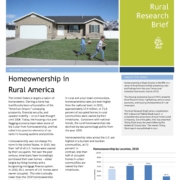
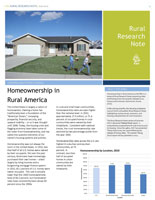
rrn-ho-thumbIn its fifth Rural Research Note, HAC examines Homeownership in Rural America . In rural and small town communities, homeownership rates are even higher than the national level. In 2010, approximately 17.9 million, or 71.6 percent of occupied homes in rural communities were owned by their inhabitants. Consistent with national trends, the rural homeownership rate declined by two percentage points from the year 2000.

This research note includes analysis of:

  • Homeownership across the rural spectrum;
  • True homeownership rates in rural America; and
  • Homeownership rates decline between 2000 and 2010.

HAC News: July 11, 2012

HAC News Formats. pdf

July 11, 2012
Vol. 41, No. 14

• Ag spending bill up next • House committee considering Farm Bill • Reserve account regulation revised for new USDA multifamily developments • USDA RD rule confirms annual fees for Section 502 guarantees • CFPB requests public comment about reverse mortgages • CFPB study on reverse mortgages identifies risks to consumers • Data access could help USDA monitor Rental Assistance payments, GAO says • Report highlights uses of American Community Survey data • Guide describes programs of Administration for Children and Families • HAC provides more rural poverty resources • SAVE THE DATE! 2012 National Rural Housing Conference! Promises to Keep in Challenging Times


July 11, 2012
Vol. 41, No. 14

AG SPENDING BILL UP NEXT. Following a July 4 recess at home, the House may take up 2013 appropriations for USDA soon. Rep. Jeff Fortenberry (R-NE) is expected to offer an amendment to keep growing rural communities eligible for RD housing programs. Similar amendments passed in the Senate as part of the Farm Bill in June and its USDA appropriations bill in April. There will be a continuing resolution to begin FY13 on October 1, 2012. Final budget decisions for 2013 will come in a post-election session, or in the new Congress next year.

HOUSE COMMITTEE CONSIDERING FARM BILL. The House Agriculture Committee began marking up its Farm Bill on July 11. The bill differs from S. 3240, approved by the Senate, and does not include housing provisions.

RESERVE ACCOUNT REGULATION REVISED FOR NEW USDA MULTIFAMILY DEVELOPMENTS. A final rule published in the Federal Register, 7/9/12, applies only to new construction Section 515 or 514/516 properties. Their reserve account deposits must be based on life-cycle analyses or Capital Needs Assessments prepared by third parties, rather than on the total development cost, as required in the past. Contact Michael Steininger, RD, 202-720-1610.

USDA RD RULE CONFIRMS ANNUAL FEES FOR SECTION 502 GUARANTEES. Implementing a provision of USDA’s FY12 appropriations act, a final regulation in the Federal Register, 7/11/12, enables RD to charge an annual fee as well as an up-front guarantee fee, in order to make the program self-supporting (see HAC News, 11/1/11). The fee amount will be announced each fiscal year. Contact an RD office or Cathy Glover, RD, 202-720-1460.

CFPB REQUESTS PUBLIC COMMENT ABOUT REVERSE MORTGAGES. The Consumer Financial Protection Bureau, which regulates reverse mortgage transactions, seeks “detailed information from the public on the factors that influence reverse mortgage consumers’ decision-making, consumers’ use of reverse mortgage loan proceeds, longer-term consumer outcomes of a decision to obtain a reverse mortgage, and differences in market dynamics and business practices among the broker, correspondent, and retail channels for reverse mortgages.” Comments are due August 31. Contact Monica Jackson, CFPB, 202-435-7275.

CFPB STUDY ON REVERSE MORTGAGES IDENTIFIES RISKS TO CONSUMERS. In a report required by Congress, the Consumer Financial Protection Bureau surveys the reverse mortgage market, identifies consumer protection concerns, and describes new challenges. It concludes that reverse mortgages are complex and hard for consumers to understand, misleading advertising and other scams occur, and the currently available consumer counseling may not be sufficient. It identifies roles for itself including regulation, education, and complaint resolution. Complaints on reverse mortgages can be submitted through CFPB’s website or by phone, 1-855-411-CFPB (2372).

DATA ACCESS COULD HELP USDA MONITOR RENTAL ASSISTANCE PAYMENTS, GAO SAYS. To identify RA payment errors due to unreported tenant income, legislation is needed to allow USDA to match tenant data with federal income data collected by other departments, according to a new GAO report, Rural Housing Service: Efforts to Identify and Reduce Improper Rental Assistance Payments Could Be Enhanced (GAO-12-624). GAO also suggests internal improvements that do not require legislation. For print copies, contact GAO, 866-801-7077 (toll free).

REPORT HIGHLIGHTS USES OF AMERICAN COMMUNITY SURVEY DATA. The Census Project compiled “Eliminating America’s Playbook,” a collection of case studies and comments from a range of organizations about the ACS’s importance to both government and business. The House voted in May to eliminate ACS funding from the Commerce Department’s FY13 appropriations bill (see HAC News, 5/16/12); the Senate has not yet voted on its bill.

GUIDE DESCRIBES PROGRAMS OF ADMINISTRATION FOR CHILDREN AND FAMILIES. ACF is part of the federal Department of Health and Human Services. It offers Assets for Opportunity IDA grants and resources for economic development, health care, refugee assistance, and other needs. Its program guide also includes basics for those new to requesting federal funding from any agency as well as links to capacity building resources.

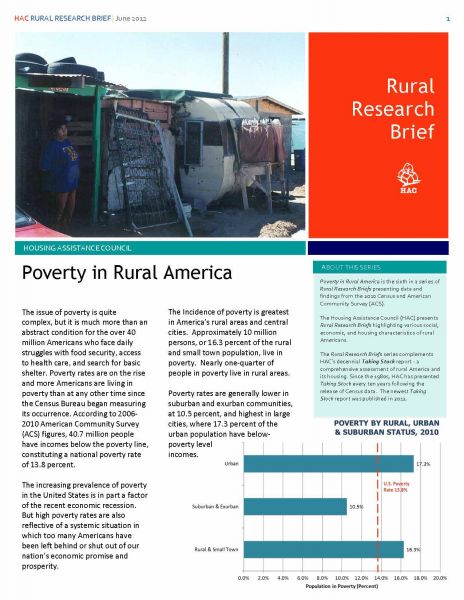
HAC PROVIDES MORE RURAL POVERTY RESOURCES. In addition to its decennial rural poverty map (see HAC News, 6/27/12) HAC has issued a Rural Research Note on “Poverty in Rural America” and posted a recording of a recent webinar on the subject.

SAVE THE DATE! 2012 NATIONAL RURAL HOUSING CONFERENCE!
PROMISES TO KEEP IN CHALLENGING TIMES

December 6-7 with pre-conference activities December 5
Hyatt Regency Washington on Capitol Hill, Washington, DC
Registration information will be announced here and at www.ruralhome.org when available.

HAC News: July 25, 2012

HAC News Formats. pdf

July 25, 2012
Vol. 41, No. 15

• Congress enacts bill giving Native American tribes more control over land use • Section 514/516 Farm Labor Housing funds offered • Reserve account regulation revised for new USDA multifamily developments • Preservation Revolving Loan Fund monies available • USDA emphasizes colonias for Section 306C water and waste disposal funds • HUD implements full Rental Assistance Demonstration • List of exclusions from income published by HUD • Senate hearing highlights housing development partnerships in native and rural regions • White House hosts session on tribal housing • Uniform Manufactured Housing Act approved by commission • HAC releases “Rural Economies and Industry” research brief • “Why Keep Rural Housing Programs at USDA?” • HAC seeks nominations for rural housing awards


July 25, 2012
Vol. 41, No. 15

CONGRESS ENACTS BILL GIVING NATIVE AMERICAN TRIBES MORE CONTROL OVER LAND USE. The Senate passed H.R. 205, the Helping Expedite and Advance Responsible Tribal Home Ownership (HEARTH) Act of 2012 (not related to the Homeless Emergency Assistance and Rapid Transition to Housing Act of 2009), on July 17. The House passed the bill in May, and President Obama will sign it into law. The act allows tribes to lease restricted lands for housing or economic development without Bureau of Indian Affairs approval.

SECTION 514/516 FARM LABOR HOUSING FUNDS OFFERED. Preapplications for off-farm loans and grants are due to USDA RD state offices on September 17. Rental Assistance and operating assistance are also available. Contact an RD state office for an application package.

PRESERVATION REVOLVING LOAN FUND MONIES AVAILABLE. Intermediaries can apply by August 17 for PRLF funds to relend for Section 514/516 or 515 preservation. Contact Sherry Engel, RD, 715-345-7677.

USDA EMPHASIZES COLONIAS FOR SECTION 306C WATER AND WASTE DISPOSAL FUNDS. Colonias that lack access to water or waste disposal systems and face significant health problems will receive additional priority points in the program’s funding competition. Contact Jacqueline M. Ponti-Lazaruk, Rural Utilities Service, 202-720-2670.

HUD IMPLEMENTS FULL RENTAL ASSISTANCE DEMONSTRATION. RAD will test conversion of public housing and other HUD-assisted properties to project-based Section 8. Partial implementation was announced in March (see HAC News, 3/7/12). Contact rad@hud.gov.

LIST OF EXCLUSIONS FROM INCOME PUBLISHED BY HUD. A July 24 Federal Register noticelists amounts specifically excluded by any federal statute from consideration as income for purposes of determining eligibility or benefits, and lists federal statutes that require certain income sources to be disregarded for specific HUD programs. Contacts vary by program and are listed in the notice.

SENATE HEARING HIGHLIGHTS HOUSING DEVELOPMENT PARTNERSHIPS IN NATIVE AND RURAL REGIONS. On July 24, witnesses before the Senate Committee on Banking, Housing & Urban Affairs described successful housing development projects on tribal lands and stressed the importance of flexibility and coordination in federal programs to promote additional development. A recording and written testimony are available at the Banking Committee website.

WHITE HOUSE HOSTS SESSION ON TRIBAL HOUSING. A White House Forum on Tribal Housing on July 26 discussed Administration initiatives and federal resources available from HUD, USDA, the Interior Department and others to tribal entities for housing creation. A draft of discussion topics is available from the National American Indian Housing Council. Contact April Hale, NAIHC, 202-454-0946, ahale@naihc.net.

UNIFORM MANUFACTURED HOUSING ACT APPROVED BY COMMISSION. The Uniform Law Commission approved the UMHA earlier this month. The commission’s press release says UMHA “provides an efficient and effective method” for an owner to choose to have a manufactured home classified as real property (rather than personal property) at the time of the first retail sale. State legislatures may consider adopting the UMHA. Contact ULC, 312-450-6600.

HAC RELEASES “RURAL ECONOMIES AND INDUSTRY” RESEARCH BRIEF. Employment data analyzed by HAC show that, while rural economies are often perceived as relying heavily on farming and other natural resource industries, these industries employ only 5.5% of rural and small town workers. Overall, the sector-by-sector employment profile of rural America is surprisingly similar to that of suburban and urban America, according to this new Rural Research Note.

“WHY KEEP RURAL HOUSING PROGRAMS AT USDA?” HAC’s most recent contribution to Shelterforce’s Rooflines blog explains why rural housing professionals believe USDA’s rural housing programs should not be moved to HUD. (See HAC News, 5/25/11 and 9/14/11).

HAC SEEKS NOMINATIONS FOR RURAL HOUSING AWARDS.
Nominations are due September 28 for the Cochran/Collings Award for national rural housing service and the Skip Jason Community Service Award. The honors will be presented at the National Rural Housing Conference in December. Details will be available soon at www.ruralhome.org or from Lilla Sutton, HAC, 202-842-8600, lilla@ruralhome.org.

HAC News: June 27, 2012

HAC News Formats. pdf

June 27, 2012
Vol. 41, No. 13

• House considering FY13 HUD funding bill • House committee approves USDA funding bill • Administration rejects House funding bills, including Rental Assistance level • House may consider grandfathering rural housing eligibility, Senate supports it again • Proposed guidelines would help make temporary emergency housing units accessible • HUD updates guidance on consulting tribes regarding historical properties • General housing outlook positive but cost burdens rising, Joint Center reports • Materials available on changing manufactured home titling policy • HUD offers many email lists • HAC releases “Poverty in the United States” map • Follow rural housing issues and HAC on social media


June 27, 2012
Vol. 41, No. 13

HOUSE CONSIDERING FY13 HUD FUNDING BILL. At press time, the House was still debating the 2013 T-HUD spending bill (H.R. 5972). Passage is expected this week. The bill passed the House Appropriations Committee June 19 without changes to the numbers reported in the HAC News, 6/13/12. The committee and the full House both rejected amendments that would have cut HOME funding by $200 million, and the House also rejected cuts to CDBG. The committee’s report (H.Rept. 112-541) included strong language supporting SHOP. Watch for an update on the results of the House vote on HAC’s website.

HOUSE COMMITTEE APPROVES USDA FUNDING BILL. On June 19 the full House Appropriations Committee approved H.R. 5973, the FY13 USDA bill passed by the Agriculture Appropriations Subcommittee (see HAC News, 6/13/12), with only one change in rural housing funding levels. The committee adopted an amendment offered by Rep. Mike Simpson (R-ID) adding $1.5 million to the subcommittee’s $886.6 million for Section 521 Rental Assistance. Like its Senate counterpart, the House committee’s report (H.Rept. 112-542) admonished the Administration for inconsistent rental housing policies. The full House is not expected to take up the bill until at least the week of July 9. Correction: The table in the printed HAC News of 6/13/12 incorrectly stated the House subcommittee’s Rental Assistance level as $866.6 million; it should have said $886.6 million. HAC apologizes for any confusion.

ADMINISTRATION REJECTS HOUSE FUNDING BILLS, INCLUDING RENTAL ASSISTANCE LEVEL. In separate Statements of Administration Policy issued June 21, OMB criticizes the funding reductions in the House bills for USDA and T-HUD. It notes that the House’s $888.1 million for Rental Assistance would eliminate 4,600 units of RA.

HOUSE MAY CONSIDER GRANDFATHERING RURAL HOUSING ELIGIBILITY, SENATE SUPPORTS IT AGAIN. When the USDA appropriations bill is considered on the House floor, Rep. Jeff Fortenberry (R-NE) is expected to offer an amendment that would extend eligibility for places that have gained population and would no longer fit the definition of “rural” for USDA housing programs, but are still under 35,000 population. Fortenberry’s provision would apply in FY13 only. The Senate’s USDA appropriations bill, S. 2375, includes a similar provision (see HAC News, 5/2/12). The Senate also approved an amendment sponsored by Sen. Ben Nelson (D-NE) to S. 3240, the Farm Bill, to apply grandfathering until 2020 Census data are available. The Farm Bill, which passed the Senate June 21, does not include other housing provisions.

PROPOSED GUIDELINES WOULD HELP MAKE TEMPORARY EMERGENCY HOUSING UNITS ACCESSIBLE. New guidelines for federal agencies would address accessibility for people with disabilities in newly constructed emergency transportable housing units. Comments are due August 17. Visit www.access-board.gov/eth/. Contact Marsha Mazz, Architectural and Transportation Barriers Compliance Board, 202-272-0020, mazz@access-board.gov.

HUD UPDATES GUIDANCE ON CONSULTING TRIBES REGARDING HISTORIC PROPERTIES. Consultation is required if a HUD-assisted project may affect historic properties of significance to federally recognized tribes. A Notice on Tribal Consultation, an updated Tribal Directory Assessment Tool, and other materials are posted on HUD’s site. Contact atec@hud.gov or a local HUD environmental officer.

GENERAL HOUSING OUTLOOK POSITIVE BUT COST BURDENS RISING, JOINT CENTER REPORTS. The State of the Nation’s Housing 2012 reviews signs of recovery in market rate for-sale and rental housing, and says serious cost burdens have increased for both owners and renters. The gap between the number of low-income renters and the supply of affordable, available, and adequate units continues to widen (Figure 30).

MATERIALS AVAILABLE ON CHANGING MANUFACTURED HOME TITLING POLICY. The Corporation for Enterprise Development offers a variety of items about the draft Uniform Manufactured Housing Act. If adopted by individual states, the act could change the process for converting a manufactured home to real property and, CFED says, could give manufactured home owners easier access to real estate mortgages.

HUD OFFERS MANY EMAIL LISTS. To subscribe to lists covering specific topics or geographic areas, visit https://portal.hud.gov/hudportal/HUD?src=/subscribe.

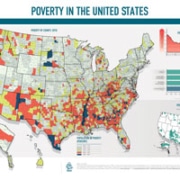
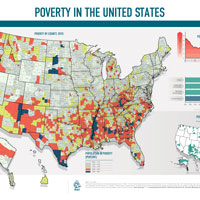
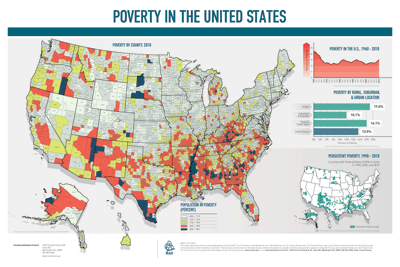
HAC RELEASES “POVERTY IN THE UNITED STATES” MAP. This popular map, illustrating poverty rates by county, is updated with Census data every 10 years. Printable versions in several sizes can be downloaded from HAC’s website. Order a 24″x36″ version for $5 online with a credit card or mail a check to HAC.

FOLLOW RURAL HOUSING ISSUES AND HAC ON SOCIAL MEDIA. Like HAC on Facebook, follow HAC on Twitter and LinkedIn, and read blog posts by HAC staff at Shelterforce’s blog Rooflines. HAC’s most recent blog post reports on seniors’ dire housing conditions in Yazoo City, MS.

Poverty in Rural America


HAC has conducted extensive research on poverty in rural America, including:

Poverty in the United States – 2012 Map

poverty-map-web-small

poverty-map-web-400w

Poverty in the United States Map

Download a PDF of the “Poverty in the United States” map (HAC recommends using Adobe Reader X or higher for optimal printing)

buy-button-amazon

Taking Stock: Rural People, Poverty and Housing in the 21st Century

The increasing prevalence of poverty in the United States is an inexcusable shame on this great nation. More Americans are living in poverty today than at any other time since the Census Bureau began measuring its occurrence. The issue of poverty has many complexities, but it is much more than an abstract condition for the over 40 million Americans who face daily struggles with food security, access to health care, and lack of basic shelter.

Forty years ago the Housing Assistance Council (HAC) was created to address poverty and housing inadequacies in rural America. In 1984, HAC published Taking Stock, one of the first comprehensive assessments of rural poverty and housing conditions in the United States. A key component of that seminal report was HAC’s national poverty map detailing poverty rates for every U.S. county in 1980. As a companion to 2012 edition of Taking Stock: Rual People, Poverty, and Housing in the 21st Century, HAC presents our newly updated poverty map, entitled “Poverty in the United States.” The map shows county-level poverty data from 2010 Census counts.

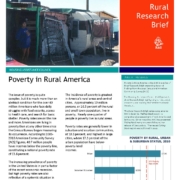
>rrn_poverty_covertmb
Download HAC’s Rural
Research Note: Poverty
in Rural America.

While some gains have been made in reducing poverty over the past several decades, poverty rates are still shockingly high for certain populations in rural America, namely minorities and children. HAC’s research also illustrates the continued persistence of high poverty within several predominantly rural regions and populations such as Central Appalachia, the Lower Mississippi Delta, the southern Black Belt, the Colonias region along the U.S.-Mexico border, Native American lands, and migrant and seasonal farmworkers. Often forgotten or hidden from mainstream America, these areas and
populations had poverty rates of 20 percent or higher in 1990, 2000, and 2010.

HAC’s poverty map presents the stark reality that too many Americans have been left behind or shut out of our nation’s economic promise and prosperity.

In the coming months, HAC will present additional research products highlighting social, economic, and housing characteristics of rural Americans.

Mapping Poverty in
Rural America Webinar

pov-webinar-covertmb
Download Powerpoint |

Download a PDF of the “Poverty in the United States” map

USDA Multi-Family Fair Housing Occupancy Report FY 2011

USDA’s annual occupancy report for Section 515 and 514/516 rentals states that from April 2010 to May 2011 the total number of Section 515 properties dropped by 270 (about 3,600 apartments) and the number of farmworker properties increased by six.

GET THE HAC NEWS!

Sign-up for HAC information products

SIGN UP HERE

Housing Assistance Council   |  1828 L Street. N.W., Suite 505, Washington, D.C. 20036
(202) 842-8600  |  (202) 347-3441  |  hac@ruralhome.org |

Board Portal

HAC is an equal opportunity provider, employer, and lender. | Civil Rights | Privacy