HUD Proposes Regs for New Rural Housing Stability Assistance Program

March 27, 2013 – HUD has proposed regulations for its new Rural Housing Stability Assistance Program (RHSP), as well as a new definition of “chronically homeless.” Comments are due May 28, 2013.

The Trail of Hope for Indian Housing

The Housing Assistance Council has received the following information from the Trail of Hope for Indian Housing and would like to offer its support for decent, safe affordable housing and increased housing development resources on Native American Lands.

When: April 17, 2013
Where: Union Square, Washington, DC
Details: The Reservation house facade will be erected and displayed for the public from 10:00 am to 6:00 pm. The event will include a rally which is tentatively scheduled for midday.

The Trail of Hope House (actually two facades) will be placed at Union Square (3rd St. NW) near the Capitol and the site is open to the public from 10:00 am to 6:00 pm. We need everyone to come out to help us show Congress the extreme housing conditions on Northern Plains reservations. Let’s show Congress what “overcrowded Indian housing” looks like on their front doorstep!

Reuters Rural Housing Article Draws Wrong Conclusions

Reuters Rural Housing Article Draws Wrong Conclusions

by Leslie Strauss

“Special Report: A rural housing program city slickers just love,” published by Reuters on March 18, 2013, relies on some questionable methodology and draws dubious conclusions.

The article focuses on USDA’s mortgage guarantee program, one of many administered by USDA. The department also makes mortgage loans itself, and assists homeowners who cannot afford to repair serious housing problems, homebuyers who help build their own homes, and tenants who cannot afford to rent decent apartments.

Read complete Blog post at Rooflines.org

USDA RD Recommends 50,000 Population Threshold for Non-Housing Programs

On February 22, 2013 USDA Rural Development submitted a Report on the Definition of “Rural” to the House and Senate Agriculture Committees. The report makes recommendations only for Rural Development programs that are authorized in the Consolidated Farm and Rural Development Act – that is, the Rural Business, Rural Utilities, and Community Facilities programs. The report recommends defining “rural areas” for those programs as places with less than 50,000 population. In other words, those places would be eligible for the non-housing Rural Development programs. The report suggests that RD could use a number of factors such as population density and economic conditions to target funding to the most rural places and the places with the greatest need.

The report does not address the rural housing programs, nor the changes to rural housing program eligibility scheduled for March 28, 2013.

The Chair and Ranking Member of the House Agriculture Committee issued a joint statement expressing concern that implementation of the report’s recommendations would shift resources away from the most rural areas.

The report lists five addenda, but none of them are attached to the version posted on USDA’s website. The Daily Yonder has obtained copies of them and posted them on its site.

Posted: February 26, 2013
Updated: February 28, 2013

Bipartisan Policy Center Report Includes Major Recommendations for Rural Housing

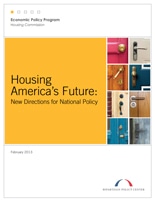
Housing America's Future: New Directions for National Policy

February 25, 2013. The Housing Commission of the Bipartisan Policy Center (BPC) today released its much anticipated report entitled Housing America’s Future: A New Direction for a National Policy. In addition to major recommendations on mortgage finance reform, homeownership, rental housing, and demographic drivers, the BPC’s report devoted substantial attention to rural housing issues and priorities. Championed largely by Commission Co-Chair Kit Bond, former U.S. Senator and Governor from Missouri, the report presents four major recommendations on rural housing:

1. Support and strengthen USDA’s role in rural housing. The report specifically states that Congress should not pursue proposals to shift USDA programs to other government agencies where they will be absorbed by other federal programs, noting that USDA is well-positioned to leverage the existing resources and infrastructure of rural service providers that understand the unique conditions of local markets.

2. Extend the current definition of rural areas through the year 2020. Any area currently classified as rural for the purposes of USDA housing programs should remain so at least until after the receipt of data from the decennial census in 2020, provided the area’s population does not exceed 25,000.

3. Increase budget allocations to serve more households. The report states that additional funding for the Section 502 Direct Loan program would enable more rural households to become homeowners at relatively low cost to the federal government.

4. Dedicate resources for capacity-building and technology to strengthen USDA providers. The BPC recommends that local agencies receiving USDA funds should be incentivized to operate on compatible software to ease data and information sharing. These improvements could help USDA monitor and improve the performance of its rural housing programs.

Read the Rural Housing chapter of the report at:

https://bipartisanpolicy.org/sites/default/files/BPC_Housing%20Report_web.pdf#page=110

Download the full BPC report at:

https://bipartisanpolicy.org/sites/default/files/BPC_Housing%20Report_web.pdf

Founded in 2007 by former Senate Majority Leaders Howard Baker, Tom Daschle, Bob Dole and George Mitchell, the Bipartisan Policy Center (BPC) is a non-profit organization that drives principled solutions through rigorous analysis, reasoned negotiation and respectful dialogue. With projects in multiple issue areas, BPC combines politically balanced policymaking with strong, proactive advocacy and outreach.

#RuralFacts – Rural Data from Taking Stock

Follow HAC for Data from Taking Stock

[addthis2][/addthis2]

The Housing Assistance Council (HAC) published Taking Stock: Rural People, Poverty and Housing in the 21st Century in December, 2012. This 160 page report features analysis of over of 6,000 data points from the 2010 Census and other sources about rural communities. To highlight the findings from this research as well as issues facing rural communities, HAC will be sharing factoids, images and data from Taking Stock through social media.

This information will be posted on twitter, using the hashtag #ruralfacts (bookmark this link so you can always access this information). If you do not already, follow HAC @RuralHome.

You can also share your comments with HAC on Facebook, LinkedIn or on the Rural Affordable Housing Group.

[twitter link=” https://twitter.com/search?q=%23RuralFacts” id=”304994872023203840″ title=” “Tweets about #RuralFacts””][/twitter]

USDA Explains Funding for Section 523 Self-Help Grantees

The National Rural Self Help Housing Association reports that the following notice regarding funding for Section 523 has been distributed by the USDA national office.

February 8, 2013

Good Morning –

With appropriations still uncertain for the remainder of Fiscal Year (FY) 2013, it is critical that we be proactive as possible in planning and funding Section 523 Technical Assistance grants. We currently have $14.2 million available for Section 523 grants ($8.3 from the Continuing Resolution and $5.9 carryover). Since there is an immediate need to process applications, we will be taking the following steps to fund grant applications for renewal of existing grantees that are performing satisfactorily:

Existing performing grantees will be limited to a grant amount not to exceed their current grant. Funding of the grant application amount will be at 40% of the total amount. The balance will be obligated when additional funding becomes available. No increases in their grant will be considered. Because this is a partial funding and future funding is uncertain the following guidelines must be utilized:

  • The grant agreement should be for two years and state the full amount of the grant request. Budgets, schedules and all other documents related to the grant should be considered as in the usual two year grant cycle.
  • The grant agreement must be modified on the first page under the terms of the agreement, item (a) with the following two conditions:
    1. (a)(1) “This is partial funding in the amount of $_____________, with the $___________balance of the grant being subject to the future availability of funds through the Section 523 Mutual Self-Help Program and grantee remaining in full compliance with the terms of this agreement.”
    2. (a)(2) “The grantee will not start more than forty percent of the homes proposed under this grant during the first year of the grant. No other starts are authorized until additional funds have been obtained. This is intended to ensure that the homes constructed under this partial funding (40%), will be completed.”

At this time we will not be funding subsequent grant requests, pre-development grants or new grant organizations.

USDA Allows More Debt for Energy Efficient Homes

USDA Rural Development is giving agency staff the authority to approve larger loans than usual for homebuyers purchasing new energy efficient homes. This process replaces the Rural Energy Plus program, which was discontinued in September 2012 for Section 502 direct loans. Rural Energy Plus remains in place for Section 502 guaranteed loans.

The new notice, an Unnumbered Letter dated February 14, 2013, allows USDA staff to give special consideration for newly constructed homes that meet any one of five sets of energy standards. Because energy efficiency lowers utility costs, it may be treated as a “compensating factor” that indicates a homebuyer can safely assume more debt than USDA’s standard amount.

Posted: February 15, 2013

Comments to CFPB's Proposed Amendments to Repay Standards under TLA


HAC Comments on the Consumer Financial Protection Bureau’s (CFPB’s) Proposed Amendments to the Ability to Repay Standards under the Truth in Lending Act

On January 30, 2013, the Consumer Financial Protection Bureau (the Bureau) published a Final Rule implementing certain provisions of the Dodd-Frank Wall Street Reform and Consumer Protection Act (Dodd Frank Act) intended to restore confidence in the mortgage market.  This regulation requires lenders to obtain and verify information to determine whether a consumer can afford to repay the proposed mortgage. It also sets forth the criteria for a Qualified Mortgage loan.  Lenders will be presumed to have complied with the rule if they issue Qualified Mortgages.  

Concurrent with the Final Rule, the Bureau is proposing amendments to exempt certain nonprofit creditors and certain homeownership stabilization programs from meeting the Qualified Mortgage requirements.  The Bureau also proposes an additional definition to consider certain loans made and held in portfolio by small creditors as Qualified Mortgages. 

HAC’s comments have been revised to remove a reference to the Qualified Residential Mortgage rule, which is a separate rule packageDownload a copy of the Housing Assistance Council’s (HAC’s) comments (PDF).  Please feel free to adopt or consider HAC’s letter (Word Doc) for your own comments.  HAC’s comments address certain provisions in the Final Rule and the Proposed Rule.  Please contact Michael Feinberg (Michael@ruralhome.org) with any questions or comments. 

Comments are due to the Bureau by February 25, 2013. 


What Does the Push for Transit Oriented Development Mean For Rural Areas?

What Does the Push for Transit Oriented Development Mean For Rural Areas?
by Leslie Strauss, HAC
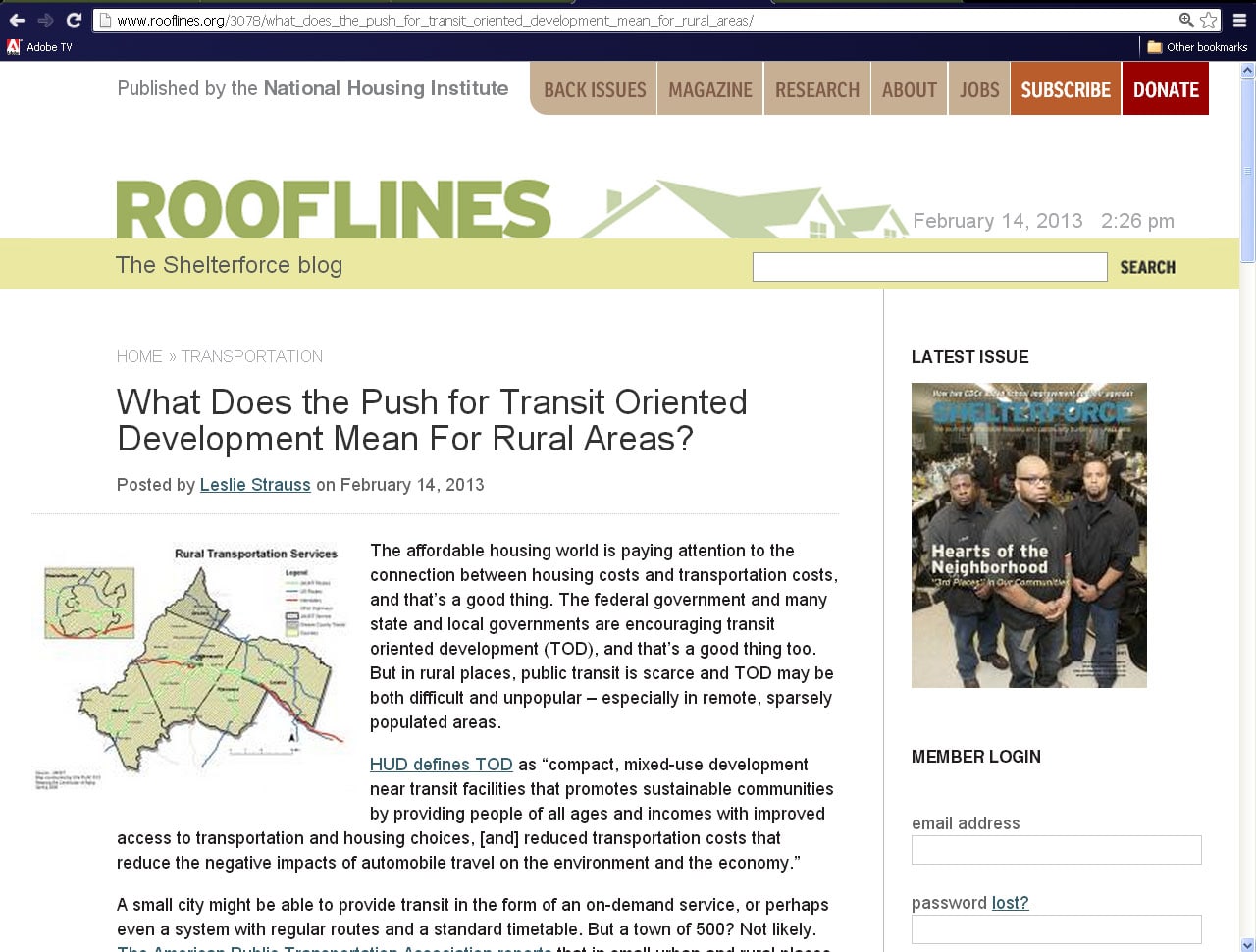
rflns_transit_postThe affordable housing world is paying attention to the connection between housing costs and transportation costs, and that’s a good thing. The federal government and many state and local governments are encouraging transit oriented development (TOD), and that’s a good thing too. But in rural places, public transit is scarce and TOD may be both difficult and unpopular – especially in remote, sparsely populated areas.

HUD defines TOD as “compact, mixed-use development near transit facilities that promotes sustainable communities by providing people of all ages and incomes with improved access to transportation and housing choices, [and] reduced transportation costs that reduce the negative impacts of automobile travel on the environment and the economy.”

A small city might be able to provide transit in the form of an on-demand service, or perhaps even a system with regular routes and a standard timetable. But a town of 500? Not likely.The American Public Transportation Association reports that in small urban and rural places, 41 percent of residents have no access to transit and another 25 percent live in areas with below-average transit services. To provide transit oriented affordable housing development in those places, new transit systems could be created – if funding could be found. Alternatively, residents would have a choice: move to affordable housing created near transit, or live where they prefer to live but without housing assistance.

Fortunately the creators of TOD initiatives are finding ways to avoid disadvantaging rural residents. An applicant for Low Income Housing Tax Credits from the Minnesota Housing Finance Agency can score three points for a development that is near public transit, is in a designated transit improvement area, is within a specified distance from employment opportunities and has dial-a-ride services available, or is within a specified distance from employment opportunities and is close to public services like a post office, a medical or dental office, a supermarket, or others.

The Illinois Housing Development Authority takes a more restrictive approach in providing a different standard for rural areas. A tax credit applicant can score two points if its development is within six blocks of fixed-route public transportation in the city of Chicago, one mile in the Chicago metropolitan area, 1.5 miles in another metro area, and two miles in a nonmetro area. In some other states, setasides for rural areas allow tax credit allocators to avoid the TOD discrimination issue.

Outside the tax credit arena, advocates in California have developed a proposal to direct a specific pool of state funding toward investments in housing and transportation. California rural housing interests are developing language that could be added to take account of the transit differences in rural places.

The National Housing Trust – which graciously provided the Minnesota and Illinois examples above – is conducting research on the connections between tax credits and transit and will release a report later this year. Has anyone conducted research on the application of TOD requirements in rural places under other programs? Are there other examples of best practices – or worst practices?

What do you think? Has the TOD focus had a positive, negative, or no effect on rural affordable housing development? Please comment on the Rooflines website.
GET THE HAC NEWS!

Sign-up for HAC information products

SIGN UP HERE

Housing Assistance Council   |  1828 L Street. N.W., Suite 505, Washington, D.C. 20036
(202) 842-8600 (202) 347-3441 hac@ruralhome.org |

Board Portal

HAC is an equal opportunity provider, employer, and lender. | Civil Rights | Privacy