HAC Comments on Proposal to Outsource USDA Single-Family Loan Servicing

USDA is collecting comments from stakeholders and potential vendors to take over a portion of the single-family loan servicing functions currently handled by the Servicing Office in St. Louis. The Servicing Office was established in 1996 in St. Louis, Missouri as part of USDA Rural Development’s national restructuring effort to centralize loan servicing functions. Over the last three decades, the office has become the core operational center for the single-family programs, managing more than 185,000 active loans and approximately $14.5 billion in outstanding debt. Comments and vendor proposals were due on July 16. HAC submitted comments opposing this privatization of single-family loan servicing. Our comments highlighted that:
  • Servicing for this portfolio is unique due both to the structure of the loan products and the needs of the borrowers served. Any external vendor would have a steep and costly learning curve.
  • Given these unique and complex servicing needs, cost savings of privatization are highly unlikely. Any anticipated cost savings need to be made public before this process moves forward.
  • A better solution lies in adequately staffing the Servicing Office and upgrading its servicing technology.
HAC’s full comment can be viewed here:

HAC News: July 10, 2025

TOP STORIES

Big budget reconciliation bill becomes law, HAC issues statement

The House approved the Senate’s version of the budget reconciliation bill that cuts both taxes and spending and President Trump signed it into law on July 4. (The final is no longer officially named the One Big Beautiful Bill Act.) The law cuts taxes, cancels a number of energy-related programs including the Greenhouse Gas Reduction Fund and HUD’s Green and Resilient Retrofit Program, and will lead to large-scale losses of Medicaid and SNAP as well as closure of some rural hospitals. It does have tax provisions that will benefit affordable housing, including a permanent expansion of the Low Income Housing Tax Credit, continuation and refinement of Opportunity Zones, and continuation of New Markets Tax Credits. A National Low Income Housing Coalition factsheet explains the difference between reconciliation and appropriations. HAC has posted a summary of the reconciliation bill’s provisions and our recommendations for further improvements, as well as a statement.

Federal staff cuts can move forward after Supreme Court ruling

On July 8, the Supreme Court invalidated a preliminary injunction imposed by a lower court that had blocked the administration’s reductions in force (RIFs) and agency reorganizations. The decision allows many federal agencies including USDA, HUD, VA, and the Treasury Department to proceed with their plans while the court case, Trump v. American Federation of Government Employees, continues. The administration reportedly intends to resume layoffs immediately at many agencies. The VA, however, announced on the day before the Court’s ruling that it will not conduct RIFs but will instead reduce staff through attrition and voluntary departures. President Trump has also extended a hiring freeze for most of the government.

HUD and USDA funding bills expected soon

The House Appropriations Committee will mark up its proposed FY26 appropriations bills for HUD on July 17 but has not scheduled a subcommittee markup first. The Senate Appropriations Committee is also expected to release and mark up a HUD bill later this month. HAC will post details when they are available.

The Senate Appropriations Committee will mark up its FY26 USDA funding bill on July 10 without holding a subcommittee markup first. When the bill’s text becomes available, HAC will post a summary online. The House Appropriations Committee has already approved its USDA bill.

RuralSTAT

According to the most recent data, there were approximately 588,000 home purchase mortgage originations in rural and small-town areas in 2024. These rural loans accounted for 17% of all U.S. home purchase mortgages that year.  Source: Housing Assistance Council tabulations of the Consumer Financial Protection Bureau and FFIEC Home Mortgage Disclosure Act Data (HMDA).

To learn more about mortgage and housing finance activity in your community, visit Rural Data Central.

!function(e,n,i,s){var d=”InfogramEmbeds”;var o=e.getElementsByTagName(n)[0];if(window[d]&&window[d].initialized)window[d].process&&window[d].process();else if(!e.getElementById(i)){var r=e.createElement(n);r.async=1,r.id=i,r.src=s,o.parentNode.insertBefore(r,o)}}(document,”script”,”infogram-async”,”https://e.infogram.com/js/dist/embed-loader-min.js”);

OPPORTUNITIES

Lead Hazard Reduction and Healthy Homes grants available

These HUD programs fund states, local governments, and Tribes to undertake comprehensive programs to identify and control lead-based paint hazards in rental or owner-occupied housing, and to identify and address other health-related hazards in the same homes. Applications are due August 14.

Economic development funding available for recovery from 2023 and 2024 disasters

The Economic Development Administration offers grants to support economic recovery activities in areas that received major disaster declarations because of natural disasters that occurred in calendar years 2023 and 2024. Eligible applicants are district organizations of an Economic Development District, Tribes, state and local governments, institutions of higher education, nonprofits working with local governments, economic development organizations, and public-private partnerships for public infrastructure. A variety of construction and non-construction projects related to economic development are eligible for funding, though housing is not eligible. Applications for readiness or implementation projects are accepted on a rolling basis. Applications for industry transformation grants are due March 3, 2026.

USDA not accepting Rural Energy for America applications

USDA had announced the first FY26 grant application window for the Rural Energy for America Program (REAP) would be July 1 through September 30, 2025, but because of a backlog of applications it is not accepting new requests. USDA anticipates taking applications again starting on October 1.

REGULATIONS AND FEDERAL AGENCIES

More USDA programs unavailable to some non-citizens

Two different laws intersect to govern non-citizens’ eligibility for federal housing aid: the Personal Responsibility and Work Opportunity Reconciliation Act of 1996 (PRWORA) and Section 214 of the Housing and Community Development Act of 1980. Section 214 limits eligibility to citizens and “qualified immigrants” in a number of USDA housing programs. Section 514/516 farm labor housing, Section 515 housing without Section 521 rental assistance, and Section 538 multifamily guaranteed housing have been available to non-citizens because Section 214 does not apply to those programs. Until recently, USDA had not provided guidance on PRWORA’s applicability to many of its programs, allowing them to be used by non-citizens with certain kinds of legal status. On July 10 USDA announced it has concluded that many of its programs, including Rural Development loans, loan guarantees, and grants, do fall under PRWORA. USDA’s press release about the change focused on SNAP, but this new interpretation also seems to mean that the department will consider certain non-citizens ineligible under PRWORA for housing supported by Sections 514/516, 515, and 538.

USDA proposes aligning tenant and income calculations with HUD and HOTMA

A proposed regulation would make changes required by the Housing Opportunity Through Modernization Act related to income calculation and net family assets for properties with Section 515 rental housing or Section 514/516 farm labor housing funding. The revisions are intended to align USDA’s regulations with HUD’s. Comments are due August 29.

Market studies could be required for Section 538 guarantees on new rental housing construction

USDA requires that a lender applying for a Section 538 guarantee on new construction must document market feasibility for new affordable rental housing. The agency is proposing to require that documentation to be in the form of a market study. Comments are due August 29.

USDA and HUD seek input on previously adopted energy efficiency standards

HUD and USDA are requesting comments to inform a new review of their 2024 finding that adopting minimum energy codes for some new housing construction would have no negative impact on the housing’s affordability and availability. The covered programs include USDA’s Section 502 direct and guaranteed loans, Section 523 self-help loans, and HUD’s Section 202, Section 811, HOME, and Housing Trust Fund programs. Both departments recently delayed implementation of the efficiency standards for some programs. Comments are due August 6.

Energy standards for manufactured homes delayed

The Department of Energy is postponing the deadline for multi-section manufactured homes to comply with new energy conservation standards. Rather than complying by July 1, 2025, manufacturers of these homes will now need to meet the standards 180 days after DOE publishes its final enforcement procedures. Compliance for single-section homes will be required 60 days after enforcement procedures are published.

USDA suggests changes to environmental protection requirements

On February 25 the Council on Environmental Quality rescinded its regulations implementing the National Environmental Policy Act. Several USDA agencies, including Rural Development, had their own sets of NEPA regulations. Now USDA has issued an interim final rule removing the agencies’ provisions, including RD’s regulations in 7 CFR 1970, and setting uniform procedures for the department. Comments are due July 30.

Changes proposed to rule protecting H-2A farmworkers

After announcing on June 20 that it would pause enforcement of a 2024 rule that strengthened protections for farmworkers with H-2A visas, the Department of Labor now proposes to amend the regulations. Comments are due September 2.

USDA agencies remove race- and sex-based provisions in regulations

USDA issued a final rule on July 10, effective immediately, to remove “unconstitutional preferences based on race and sex” from a number of programs. Rural Development’s Rural Economic Development Loan and Grant Program, the Rural Energy for America Program, the Rural Microentrepreneur Assistance Program, and Rural Business Development Grants are included, as are business loan guarantee programs and farm direct loans and guarantees.

EVENTS

HUD offers webinars on environmental streamlining for Tribes

HUD will present a series of four webinars for Tribes beginning on July 24 with Simplified and Streamlined Environmental Reviews, which will provide training on PIH Notice 2024-24: Programmatic Part 50. Log in online here or dial in by phone at 1-202-735-3323 with access code 5126150#. Additional webinars on related topics will be held August 5, August 12, and August 14. Details and links are posted online here.

Housing industry webinar will discuss impacts of shifting FEMA support

From Risk to Return: FEMA’s Policy Shift and the Real Estate Opportunity, a July 15 webinar from First Street, will cover the impact on the real estate, insurance, and financial markets of shifting disaster recovery responsibilities from FEMA to states, local governments, property owners, and lenders.

Webinar to highlight reducing flood risk

Central Appalachian Network and ReImagine Appalachia are hosting a webinar on July 17 titled Nature Based Hazard Mitigation: How Nature-based Approaches Can Reduce Flood Risk. The event’s goal is to help communities understand the region’s vulnerability to disaster, the importance of disaster readiness, and the overall resilience of these communities. It is part of a webinar series on disaster resiliency in Central Appalachia.

PUBLICATIONS AND MEDIA

Survey shows impact of USDA housing staff reductions

To gauge the effect of layoffs and departures among USDA Rural Development field staff, the National Rural Housing Coalition and partner organizations, including HAC, surveyed local rural housing organizations around the country in early May. The survey found that, in the 27 states covered by the responses, RD staff was reduced by an average of 41%. Section 502 loan processing times have slowed significantly, respondents reported. Long-term staff with institutional knowledge were lost, impairing program functioning. When local offices were closed, increased travel time posed a serious barrier to meeting rural needs.

Report discusses asset-based development for community well-being

Aspen Institute’s New Report, Four Principles for Fostering Community Well-Being with Asset-Based Development, highlights the importance of rural development hubs in maintaining trusted cross-sector alignment and collaboration, discusses addressing the community capacity gap for leaders, provides steps towards sustainable individual and community wealth building through homeownership and business development, and the emphasizes the use of holistic measures of well-being and success.

Family homesteads affect rural housing conditions

Family Homesteads with Tangled Titles are Contributing to Rural America’s Housing Crisis, a recent article written by Auburn University faculty including HAC board member Rusty Smith, explains the precarious nature of heirs’ property, which can be a barrier to conventional housing finance, disaster relief, and insurance policies. There are also potential benefits of shared land ownership in the Black Belt region of the U.S., and a “housing-first” approach can help mitigate the rural housing crisis while supporting families who choose to live collectively.

HAC

Need capital for your affordable housing project?

HAC’s loan fund provides low interest rate loans to support single- and multifamily affordable housing projects for low-income rural residents throughout the U.S. and territories. Capital is available for all types of affordable and mixed-income housing projects, including preservation, new development, farmworker, senior and veteran housing. HAC loan funds can be used for pre-development, site acquisition, site development, construction/rehabilitation and permanent financing. Contact HAC’s loan fund staff at hacloanfund@ruralhome.org, 202-842-8600.

Please note: HAC is not able to offer loans to individuals or families. Borrowers must be nonprofit or for-profit organizations or government entities (including Tribes).

Want to reprint a HAC News item?

Please credit the HAC News and provide a link to HAC’s website. Thank you!
Housing Assistance Council Statement on Reconciliation Legislation

On July 4, President Trump signed into law a sweeping reconciliation package that includes several important tax and housing provisions—some that mark long-sought progress for affordable housing in rural communities, and others that fail to address persistent gaps in federal support.

“The most positive provisions of this broad and complex bill are the tax incentives that aid community development and housing, including several that recognize the unique housing market dynamics and capital needs of rural communities,” said David Lipsetz, President & CEO of the Housing Assistance Council (HAC). “Unfortunately, these are coupled with measures that will dramatically increase the cost of food and doctor visits for poor, small town families while giving tax cuts to wealthy people living in high income areas and corporations headquartered in far off cities. That hardly seems like a good deal for people living in rural and Tribal areas.”

The reconciliation act’s improvements to the rural housing and community development landscape include:

  • Low-Income Housing Tax Credit (LIHTC) Improvements: The package makes permanent the 12 percent allocation increase for 9 percent LIHTC credits and lowers the private activity bond threshold from 50 percent to 25 percent. These are major wins for housing developers, helping to unlock more financing and expand project feasibility in high-cost or low-income regions, including in rural and Native communities.
  • Targeted Opportunity Zones (OZ) Reform: The bill revises the Opportunity Zones program by increasing basis percentages and reducing the substantial improvement test requirements to 50 percent. It also adds a marginal incentive to invest in small cities, exurban areas, and places with fewer than 50,000 people. Presumably this is to address the failure of the original OZ program to generate activity in rural communities.
  • Permanent Extension of New Market Tax Credit (NMTC): The bill makes the New Markets Tax Credit permanent, providing long-term certainty for lenders and investors in underserved rural areas. NMTCs have played an essential role in bringing grocery stores, health centers, and community facilities to areas where traditional financing does not reach.


The affordable housing and community development sector hoped several other broadly supported, bipartisan proposals would be adopted in the bill, but they were left out of the final version. These remaining gaps and challenges include:

  • No Rural Difficult Development Areas (DDAs) Provision: Although contained in the initial House-passed reconciliation bill, the final legislation failed to include a longstanding provision of the bipartisan Affordable Housing Credit Improvement Act that would designate rural and Native communities as Difficult Development Areas for LIHTC purposes. This denied a 30 percent basis boost that would have helped projects in these communities overcome historically lower credit pricing and tighter capital margins. This omission is significant and jeopardizes growth in rural areas.
  • Neighborhood Homes Investment Act (NHIA) Excluded: The Neighborhood Homes Investment Act, which would have supported rehab and construction of owner-occupied homes in distressed rural neighborhoods, was not incorporated into the final reconciliation act. This omission is a particularly painful loss for communities with aging housing stock and no clear source of gap financing.
  • Misaligned OZ and LIHTC Standards: While the Opportunity Zones reforms for rural areas are a step forward, the continued disconnect between the OZ and LIHTC substantial improvement tests leaves many rural revitalization efforts out of reach.
  • Food and Healthcare Made More Scarce and Expensive: Provisions in the bill restrict eligibility for SNAP and Medicaid while reducing resources to veterans and decimating access to rural These cuts will hurt rural families who earn less than is needed to buy food and go to the doctor while still paying their mortgage or rent. Some of these cuts are set to phase in over the course of several years.

“We are grateful to the Members of Congress who championed the housing and community development tax incentives in this massive, fast-moving legislation,” said David Lipsetz. “Hopefully Congress finishes the job on a bipartisan basis later this session, leveling the playing field for all Americans by identifying rural areas as DDAs, adopting NHIA, and aligning OZs with LIHTC.”

Read a more detailed HAC analysis of the final reconciliation act.

Reconciliation Law Supports Some Tax Provisions for Affordable Housing, But Broadly Damages the Safety Net

The budget reconciliation bill, formerly known as the One Big Beautiful Bill Act, became law on July 4 with President Trump’s signature after a lengthy voting process in Congress. HAC’s review below focuses primarily on the bill’s positives for affordable housing and community development and offers some recommendations for improving them further in future legislation.

Major Non-Housing Provisions Will Impact Affordable Housing

Estimates indicate the law will have significant impacts on federal taxes, deficits, and spending. The nonpartisan Congressional Budget Office calculated that it will add $3.4 trillion to the federal debt over the next ten years. Analyses by the Penn Wharton Business Model, CNN, the Tax Policy Center, the Economic Policy Institute, and others show that the law will provide significant tax cuts for the highest income Americans, fewer benefits for middle-income households, and some negative impacts for those with the lowest incomes. Revisions to Medicaid and the Affordable Care Act mean millions will lose health insurance. Changes to the Supplemental Nutrition Assistance Program (SNAP) will remove food support for millions.

The law increases funding for immigration enforcement. It reduces funding for the Consumer Financial Protection Bureau (CFPB) but does not go as far as an earlier version of the bill passed by the House, which would have eliminated the CFPB entirely. It does not require that public lands be sold to create space for development of new housing, another provision that was in the House bill.

The law also repeals the Greenhouse Gas Reduction Fund and rescinds unobligated funds remaining for the program. It cancels funding for a number of other energy-related programs created in the 2022 Inflation Reduction Act, including HUD’s Green and Resilient Retrofit Program, and cancels a number of energy-efficiency tax credits. Last-minute changes temporarily reduced, but did not eliminate, some of the law’s negative impacts on wind and solar projects. Taken as a whole, these provisions are likely to increase energy costs, with a disproportionately high impact on the lowest-income families because they pay the largest proportion of their incomes for energy.

Some of the law’s negative impacts will be especially significant for rural Americans. For example, while it increases funding for the Rural Health Transformation Program from $25 billion to $50 billion, that will not replace the $87 billion cut from rural hospital funding under the law’s other provisions. Rural communities already face unique health challenges including limited access to care, and closing hospitals can only add to their difficulties.

While HUD and USDA housing assistance programs are not directly affected by the law, the people they serve will feel its effects. States were authorized to use Medicaid for health-related needs, including housing (although the current administration may be rethinking that flexibility). When the proportion of income needed for food and medical care rises, the amount remaining for housing is reduced. People who need Medicaid and SNAP assistance may also qualify for housing aid, so any reduction in support will increase the number of low-income people juggling insufficient dollars to cover basic expenses.

Research has also found that high proportions of people experiencing homelessness rely on Medicaid, that use of Medicaid to provide supportive housing helps people leave homelessness, and that a large-scale loss of Medicaid in Tennessee led to a 24.5 percent increase in completed evictions. Homelessness in rural places has already been growing, with HUD data showing a 12 percent increase in total rural homelessness and a 36 percent increase in unsheltered rural family homelessness from 2023 to 2024.

Low Income Housing Tax Credit Permanently Expanded

The positive news for housing begins with an expansion of the Low Income Housing Tax Credit, which incentivizes private investment in affordable rental housing. The reconciliation law increases the annual allocation for 9 percent tax credits by 12 percent. And it permanently reduces the financed-by test, which requires tax exempt private activity bonds to finance a certain portion of a project in order for that property to be fully eligible to generate 4 percent tax credits. The project proportion, formerly 50 percent, will now be 25 percent. Together, these provisions will expand the impact of the limited 9 percent credits and allow states to support more affordable housing developments within their maximum cap of Private Activity Bonds.

Unfortunately, the final law does not include a provision passed by the House that would have designated rural and Native American areas as Difficult Development Areas, providing projects there with a 30 percent basis boost from 2026 through 2029. HAC strongly supports adoption of this provision in future legislation.

Opportunity Zones are Permanent, With Mixed Results for Rural Places and Absence of Benefits that Target Affordable Housing

While the LIHTC program applies to financing for affordable housing developments, the Opportunity Zone (OZ) incentive is based on geography, offering support for both businesses and housing in underdeveloped census tracts. The OZ program has been successful in producing rental housing, but the units have not necessarily been affordable for low-income residents. OZs have also been used far more widely in urban and suburban areas than in rural places.

The law turns the program from a temporary investment incentive to a permanent one, with OZs to be redesignated every ten years. It establishes revised criteria for tracts to be eligible for designation. It takes steps to increase OZ financing in rural areas, including by providing investments in those tracts with a 30 percent step-up in basis after five years, but does not provide added incentives to support affordable housing. Unlike the Rural Opportunity Zone and Investment Act, a bill proposed in 2023, the reconciliation law does not incorporate persistent poverty measurements into the definition of rural OZs.

The program requires properties being rehabilitated with OZ investments to be “substantially improved.” That has been defined to require the improved value of the property to be 100 percent greater than its pre-rehab value. The reconciliation law drops the threshold to 50 percent. Notably, this is one of the few OZ provisions that is effective immediately.

Further improvements to the OZ program can be made through legislation in Congress next year. HAC recommends that such a bill should:

  • Add enhanced benefits for investments in rural affordable housing developments. While the new OZ legislation provides an enhanced benefit for all rural projects, further enhancements to basis, deferral, and timing benefits should be extended to projects that meet affordability levels similar to those required by the Low-Income Housing Tax Credit program.
  • Require that one-third of the OZs designated in each new round be rural. The first version of the law passed by the House would have included this provision.
  • Reduce the amount of added value in a rehabilitated property that is needed to qualify for OZ investments. While the reduction from 100 percent substantial improvement to 50 percent is significant, the LIHTC program’s requirement is only 20 percent. Rural areas would be well served by making the LIHTC and OZ programs consistent on this point so they could be used together for affordable rental housing preservation. A lower threshold in rural places could also help attract investments there.
  • Adopt a more precise definition of rural OZs than the one provided in the bill. The law’s definition of rural areas includes places with populations up to 50,000, does not take population density into account, and relies partly on a definition of “urbanized area” that is no longer used by the U.S. Census Bureau. HAC recommends use of the rural definition adopted in the Duty to Serve regulations of the Federal Housing Finance Administration (FHFA). FHFA’s rural definition is well suited to the OZ context for several reasons. Like the OZ program, FHFA’s definition is based on census tracts. It was crafted specifically to include rural residents living in outlying counties of metropolitan areas, to remain stable over time, and to be easy to implement and operationalize. Also, it has been adopted by other financing programs such as the Capital Magnet Fund administered by the Treasury Department’s CDFI Fund.
  • Create a State and Community Dynamism Fund to build the “last rural mile” of OZ delivery infrastructure. Recognizing the insufficient OZ activity in rural areas, states have leveraged federal programs, such as those from USDA and HUD, to attract and stimulate investments. These preexisting community development programs are already oversubscribed, however, and likely to be even more stressed if their funding is cut in fiscal year 2026 and beyond. To fill the gap, the bipartisan, bicameral Opportunity Zones Transparency, Extension, and Improvement Act proposes a new and specific $1 billion “Dynamism Fund” to promote OZ funds and projects in lower-income and rural communities. Funding would be distributed by formula to states to support technical and capacity-building assistance, outreach to investors, and other field building activities.
  • Make mission-driven intermediaries as well as state governments eligible for Dynamism Fund grants. The New Markets Tax Credit, which utilizes Community Development Entities (CDEs) to access the program, could provide a model. The Treasury Department’s Community Development Financial Institutions (CDFI) Fund could certify community-based OZ investment intermediaries through a process similar to CDE/CDFI certification. These efforts would strengthen the ecosystem for rural Opportunity Zone investments, ensuring more effective deployment in areas that need it the most.
  • Allow for investments through CDFI and similar mission-driven intermediaries as qualified investments, and remove barriers that would allow those entities to aggregate multi-project investments. Allowing for the placement of investment in CDFIs and CDEs would open the door for mission-focused funds to be developed. These funds could meet the needs of rural projects while offsetting the limiting characteristics of rural projects: scattered, smaller projects, with desperate timelines.

New Markets Tax Credit Gets Permanent Extension

The bill makes the New Markets Tax Credit (NMTC) permanent, providing long-term certainty for lenders and investors in underserved rural areas. NMTCs have played an essential role in bringing grocery stores, health centers, and community facilities to areas that traditional financing does not reach.

Neighborhood Homes Investment Act is Not Included

The final law did not include provisions from the Neighborhood Homes Investment Act (NHIA), which would create a federal tax credit to build and rehabilitate affordable homes. NHIA was introduced earlier in 2025 in both the House and Senate. HAC supports its enactment as a stand-alone bill.

HAC News: June 26, 2025

TOP STORIES

Rural Housing Service administrator and other appointments announced

USDA Secretary Brooke Rollins on June 25 announced that George Kelly has been selected as administrator of the Rural Housing Service. Kelly has spent the majority of his career as a commercial real estate developer with Hines Interests Limited Partnership. J.R. Claeys has been appointed head of the Rural Business-Cooperative Service and Karl Elmshaeuser is the Rural Utilities Service’s administrator. Joe Gilson is joining USDA as Chief of Staff at Rural Development after working at the American Farm Bureau Federation and the office of Senator Chuck Grassley (R-IA). These positions do not require Senate confirmation.

Senate continues work on budget reconciliation bill

Senate committees are developing their versions of sections of the Big Beautiful Bill Act. The House passed H.R. 1, its version of the measure to cut taxes and spending, in May. Each portion of the Senate draft must be reviewed by the parliamentarian for compliance with Senate rules. Provisions that do not comply with the rules can be deleted, adopted separately, or rewritten and re-reviewed. So far, pieces flagged by the Senate parliamentarian include zeroing out the Consumer Financial Protection Bureau’s funding and selling public lands for housing and other uses. The Wilderness Society has analyzed and mapped the proposed land sale provisions.

Like the House bill, the Senate version would cut Medicaid and SNAP coverage. It would expand the Low Income Housing Tax Credit program but it does not include basis boosts that are in the House bill for rural and Native American LIHTC properties. It would make the New Markets Tax Credit and Opportunity Zones permanent but would not require a specific proportion of OZs to be in rural places. It would eliminate the Greenhouse Gas Reduction Fund and rescind unobligated funds from that program. It would also authorize the President to reorganize and cut federal agencies.

House committee approves FY26 USDA funding measure

The House Appropriations Committee has passed its fiscal year 2026 appropriations bill for USDA, which will next be considered by the full House. For the rural housing programs, the measure provides funding close to FY24/25 levels. The Senate committee has not yet released a draft bill or scheduled a markup. Neither house has issued a HUD appropriations bill yet.

Housing market “shrouded in uncertainty,” says State of the Nation’s Housing report

The State of the Nation’s Housing 2025 analysis, published by Harvard’s Joint Center for Housing Studies, points to record-high cost burdens for renters, rising costs for homeowners including insurance and property taxes, record-high homelessness, reduced federal support, and uncertainties created by tariffs and reduced numbers of immigrant workers. The report summarizes a variety of efforts to overcome these challenges and concludes, “Proven solutions exist. The question is whether we will enact them.”

Stay connected: update your HAC email subscription today!

The Housing Assistance Council is moving to a new email system. To continue receiving the HAC News, funding opportunities, policy updates, training notices, and more, please take a moment to opt in now. After completing the form, you’ll receive an email asking you to confirm your address. If your subscription is not current in the new system, you may stop receiving HAC communications after June 30. Please reach out to Dan Stern if you have any questions.

RuralSTAT

Home prices nationally have risen 60% from 2019 to 2025. Source: The Joint Center for Housing Studies of Harvard University, The State of the Nation’s Housing 2025.

CAPITOL HILL

Funding bill would restore FEMA resilience program

On June 24 the House Appropriations Committee adopted an amendment to its FY26 funding bill for the Department of Homeland Security requiring FEMA to reactivate the Building Resilient Infrastructure and Communities (BRIC) program. FEMA announced in April that it was canceling BRIC and reclaiming funds that had been committed but not yet distributed. The program, which provides hazard mitigation funding to state, local, Tribal, and territorial governments, has been particularly useful for Tribes and in rural places. The bill will now go to the full House. The Senate has not released its version yet.

REGULATIONS AND FEDERAL AGENCIES

HUD headquarters to move to Alexandria, VA

HUD Secretary Scott Turner announced the move to the Washington, DC suburbs on June 25, saying the department “will implement a staggered employee relocation plan.” The move will displace the National Science Foundation, an independent federal agency, which currently occupies the building.

USDA posts FY25 income limits

New income limits took effect June 18 for the Section 502 direct and Section 504 loan and grant programs, the Section 502 guaranteed program, and the multifamily housing programs.

Grace period set for HOTMA changes at USDA multifamily properties

Changes to income certifications for tenants in USDA multifamily housing required under the Housing Opportunity Through Modernization Act (HOTMA) are effective July 1. USDA announced it expects that all MFH tenant certifications effective on or after July 1, 2025, will comply with HOTMA requirements. Between July 1, 2025, and January 1, 2026, however, USDA will not penalize property owners for HOTMA-related tenant file errors during supervisory reviews.

Income definitions revised for USDA single-family direct program

For USDA’s Section 502 direct loan program, the definitions of “income” and “adjusted income” rely on the definitions used by HUD’s rental housing programs. HUD’s definitions were revised by the Housing Opportunity Through Modernization Act and HUD’s implementing regulations. USDA has issued guidance and an Administrator’s Exception that will implement HOTMA’s changes and govern Section 502 direct income determinations until regulatory changes can be made.

Environmental justice removed from USDA RD reviews

New guidance from USDA Rural Development states that, to comply with recent executive orders, RD is removing requirements related to environmental justice in its environmental reviews, effective retroactively to January 21, 2025.

FEMA Review Council accepts written comments

The Department of Homeland Security’s FEMA Review Council, which President Trump created by executive order, will meet on July 9. Members of the public can submit comments in writing by July 8 and can attend the meeting virtually.

CRA distressed or underserved nonmetropolitan geographies list published

The federal bank regulators have released their 2025 list of “distressed or underserved nonmetropolitan middle-income geographies” where banks’ revitalization or stabilization activities are eligible for Community Reinvestment Act credit.

Rule with protections for H-2A farmworkers suspended

The Department of Labor announced on June 20 it is pausing enforcement of a 2024 rule that strengthened protections for farmworkers with H-2A visas. Parts of the rule were already suspended in certain states as a result of legal challenges, some of which are still in litigation.

Suit claims HUD improperly withheld fair housing funds

An action filed on June 24 by the National Fair Housing Alliance and the Tennessee Fair Housing Council challenges HUD’s decision to withhold Fair Housing Initiatives Program funds. A related suit on FHIP funding, filed in February, is ongoing.

EVENTS

Public policy institutes announce commission on U.S. rural prosperity

The Brookings Institution and the American Enterprise Institute will soon launch a “high-level, bipartisan commission focused on broadening equitable rural prosperity and resilience.” The effort will be co-chaired by former U.S. Senator Heidi Heitkamp of North Dakota and former New Hampshire Governor Chris Sununu. It “aims to elevate the national policy discourse on rural development and offer practical, cross-partisan solutions grounded in local realities.” Brookings will host a public online launch event on July 1.

PUBLICATIONS AND MEDIA

Map shows homeowners insurance nonrenewals

The Brookings Institution mapped zip code level data on homeowners insurance nonrenewals from 2018 through 2022. The U.S. Treasury Department’s Federal Insurance Office collected and posted this data as well as figures on claim frequency, average claim payments, and average premiums. Treasury found that over this five-year period average homeowners’ insurance costs rose 8.7% faster than the rate of inflation across the country. The highest nonrenewal rates from private insurers were in areas with the highest expected losses.

Town pilots community-based flood insurance

Isleton, CA, a town of about 800 people, has launched a pilot program to provide flood insurance to all residents. The city worked with the state government, a nearby university, and a special purpose district entity to plan for and purchase insurance. The policy will support all residents and will provide rapid, flexible payouts after a flood occurs.

Survey results highlight crucial role of Native CDFIs

The Native CDFI Network surveyed Native Community Development Financial Institutions who currently receive financial assistance or technical assistance awards from the CDFI Fund’s Native American CDFI Assistance Program to learn about the impact of the administration’s plans to withhold appropriated FY25 funds and to eliminate the programs in FY26. A summary of the survey results describes the devastation these financial institutions anticipate for their work and their communities’ wellbeing, including the following.

  • “The reduction in FA funding would drastically shrink our lending capacity … preventing us from meeting projected demand for mortgage loans in 2025 and result in delayed or canceled homeownership opportunities for tribal families who are otherwise ready and qualified to purchase homes.”
  • “Native Agricultural producers and businesses confront a lack of access to capital. Without the NACA program, these producers and businesses will not be able to start or expand their businesses.”
  • “If this core funding is eliminated, we will be forced to scale back lending, reduce services, and halt planned expansion efforts. This would turn back the clock on economic development in Indian Country by 30 years. The harm wouldn’t just be financial – it would break trust.”
  • “NACA funding is not simply a grant – it is the foundation upon which Native CDFIs build equitable access to capital and financial empowerment.”

Broadband program revised, delaying improvements to rural telehealth

The Commerce Department issued a Policy Notice in early June revising requirements that were announced in 2022 for the Broadband Equity, Access, and Deployment Program. BEAD supports states and territories providing broadband access. KFF Health News reports that by March 2025 the majority of those recipients had completed initial steps and were in the process of selecting broadband service providers. Almost 3 million people live in the more than 200 counties that lack both broadband and also primary care and behavioral health care providers who serve Medicaid patients, according to KFF Health News. Most of these counties are rural.

Communities foster civic relations through the arts

In their latest publication, Forecast Public Art underscores how thoughtfully designed public art enriches civic health by fostering stronger, more inclusive communities. Including Spring Grove, MN – a former Citizens’ Institute for Rural Design workshop community – the article highlights projects utilizing the arts to bring communities together, empowering local voices, showcasing community identity, and driving social impact.

HAC

Report examines resiliency in Central Appalachia

Rural Research Brief: Natural Disasters and Resiliency in Central Appalachia, a new HAC publication, considers the region’s vulnerability to increasingly erratic and intense weather patterns. The report leverages secondary data from journal articles, reports, and analyses investigating the region’s resiliency, recovery efforts, the effects of natural disasters on the region, and their intersection with ongoing challenges.

Need capital for your affordable housing project?

HAC’s loan fund provides low interest rate loans to support single- and multifamily affordable housing projects for low-income rural residents throughout the U.S. and territories. Capital is available for all types of affordable and mixed-income housing projects, including preservation, new development, farmworker, senior and veteran housing. HAC loan funds can be used for pre-development, site acquisition, site development, construction/rehabilitation and permanent financing. Contact HAC’s loan fund staff at hacloanfund@ruralhome.org, 202-842-8600.

Please note: HAC is not able to offer loans to individuals or families. Borrowers must be nonprofit or for-profit organizations or government entities (including Tribes).

Want to reprint a HAC News item?

Please credit the HAC News and provide a link to HAC’s website. Thank you!
HAC News: June 12, 2025

TOP STORIES

Funding proposals released by administration and House

On May 30 the White House released a more detailed budget request than the “skinny budget” published in early May. The House Appropriations Committee issued its draft fiscal year 2026 funding bill for USDA on June 5 and began marking it up on June 11 but did not finish. The House draft bill proposes funding levels very similar to those in FY24/25, whereas the administration’s budget requests significant funding cuts. The administration would support the Section 502 guarantee program but not the direct program or self-help housing. Both would increase funds for Section 521 rental assistance, but the administration would eliminate USDA rental vouchers and reduce support for the Section 515 and Multifamily Preservation and Revitalization programs. Details are posted on HAC’s website here. At the House committee mark-up on June 11, Ranking Member Sanford Bishop (D-GA) offered an amendment to increase funding levels for several housing programs, but the change was not adopted. In the House bill, the Community Facilities Grant program would provide dozens of earmarks for specific projects, as has been the case for the last few years. The Senate Appropriations Committee has not yet released a draft bill or announced a markup schedule.

Neither the House nor the Senate has issued a proposed bill for HUD’s FY26 funding, although they held hearings on HUD’s budget request on June 10 and June 11, respectively. The administration’s budget request would zero out the HOME and CDBG programs, along with the competitive programs that serve Native Americans, SHOP, Rural Capacity Building, and others. Several other HUD programs – Tenant-Based Rental Assistance, Project-Based Rental Assistance, Public Housing, Section 202 elderly housing, and Section 811 housing for people with disabilities – would be combined into a block grant to states with reduced funding. Details are posted on HAC’s website here.

The budget proposes a new $100 million Rural Financial Assistance Program run by the CDFI Fund. It would also, however, eliminate funding for most of the existing CDFI programs, including Native CDFI programs.

HAC to testify before House subcommittee

The House Financial Services Committee’s Subcommittee on Housing and Insurance is holding a hearing on June 12 titled Housing in the Heartland: Addressing Our Rural Housing Needs. HAC President and CEO David Lipsetz will be one of four witnesses.

Big Beautiful Bill’s cost estimated

While the Senate works on developing its version of the reconciliation bill, the Congressional Budget Office has estimated the cost of the House version, named the One Big Beautiful Bill Act, at $3 trillion. CBO and the Joint Committee on Taxation calculated that enacting the bill would increase deficits over the 2025-2034 period by $2.4 trillion, excluding any macroeconomic or debt‑service effects, and the additional debt-service costs would total $551 billion, increasing the cumulative effect on the deficit to $3 trillion. The bill’s impact on the economy could reduce that total cost somewhat; CBO is expected to release that calculation when it is available. CBO also estimated that 10.9 million people would lose health insurance under the bill and an additional 5.1 million would lose it under other policy changes.

Call for workshop proposals: 2025 National Rural Housing Conference

The Housing Assistance Council is seeking engaging, hands-on workshop proposals for the National Rural Housing Conference to be held November 4-7 in Washington, DC. The deadline to submit your proposal is June 15. If your work advances housing or community development in rural America, we want to hear from you! Learn more about HAC workshops and how to submit a proposal here.

June is National Homeownership Month

The Federal Housing Administration has posted information and a social media toolkit.

RuralSTAT

June officially begins hurricane season in the United States. According to the most recent FEMA Risk Index, an estimated 3,193 rural and small town census tracts are at relatively high or very high risk for natural disasters. Approximately 17.6% of rural and small-town tracts have high-risk FEMA scores compared to 14.5% of tracts nationally. Source: HAC tabulations of FEMA’s National Risk Index for Natural Hazards.

!function(e,n,i,s){var d=”InfogramEmbeds”;var o=e.getElementsByTagName(n)[0];if(window[d]&&window[d].initialized)window[d].process&&window[d].process();else if(!e.getElementById(i)){var r=e.createElement(n);r.async=1,r.id=i,r.src=s,o.parentNode.insertBefore(r,o)}}(document,”script”,”infogram-async”,”https://e.infogram.com/js/dist/embed-loader-min.js”);

OPPORTUNITIES

Capacity building grants available for opioid responses

The Foundation for Opioid Response Efforts is accepting pre-applications for Community-Driven Reponses to Opioid Use Disorder and Overdose Mortality 2025 grants through July 2. Funding, up to $75,000 per year for up to two years, is available for community-based organizations and can be used for capacity building activities including enhancing operational effectiveness, strengthening communication, program evaluation, and fostering collaboration.

REGULATIONS AND FEDERAL AGENCIES

HUD suggests eliminating Affirmative Fair Housing Marketing requirements

HUD’s current Affirmative Fair Housing Marketing regulation requires property owners with FHA insurance or assistance from one of HUD’s Multifamily Housing programs to market their housing to people in protected categories (race, color, religion, sex, familial status, national origin, and disability) who otherwise might not know about the housing. A proposed rule would eliminate all AFHM obligations. Comments are due July 3. In March, HUD proposed to reduce non-marketing requirements related to affirmatively furthering fair housing.

Media reports indicate strains at HUD

According to the Washington Post, HUD is redeploying workers to fill gaps created by staff departures, particularly in its Community Planning and Development offices, which administer programs such as CDBG and HOME. A Bloomberg piece says HUD’s Office of General Counsel has warned that the loss of large proportions of the department’s managers and lawyers may have raised the department’s risks of litigation as well as waste, fraud, and abuse.

Census Bureau advisory committees terminated

The Commerce Department terminated 14 advisory committees, including the 2030 Census Advisory Committee, the Census Bureau’s Scientific Advisory Committee, and the Census Bureau’s National Advisory Committee on Racial, Ethnic, and Other Populations. A coalition led by the Leadership Conference on Civil and Human Rights wrote to the Secretary of Commerce in May expressing concerns about the terminations.

Deputy secretaries confirmed for USDA and HUD, USDA RD Under Secretary nominee announced

On June 10, the Senate confirmed Stephen Vaden as Deputy Secretary of USDA and Andrew Hughes as Deputy Secretary of HUD. President Trump has nominated Glen Smith to serve as Under Secretary for Rural Development. Smith is an agricultural businessman and farmer from Iowa. He serves on the boards of directors of the Farm Credit Administration and the Farm Credit System Insurance Corporation.

HUD extends HOTMA deadline for project-based rental assistance

HUD Notice H-2025-03 extends the date for some properties to comply with the Housing Opportunity Through Modernization Act. Properties receiving aid from the Section 8 Project-Based Rental Assistance, Section 202 elderly housing, and Section 811 housing for people with disabilities programs, as well as several FHA multifamily programs, will not be required to comply with new income and asset rules until January 1, 2026, rather than July 1, 2025.

PUBLICATIONS AND MEDIA

Disaster information resources available

Is your organization prepared for summer disasters? A few of the many resources with information about readiness are listed here.

Study examines financing for rural businesses

Rural business success is essential for thriving communities, but lower access to financial capital is helping to widen the rural-urban economic divide, according to the Center on Rural Innovation. A new report, Rural America’s Struggle to Access Private Capital, considers reasons for the disparities in access and suggests ways to overcome it. An interactive county-level map is also available online.

Rural housing conditions contribute to heat vulnerability

Headwaters Economics and the Federation of American Scientists collaborated on an analysis of the risk that extreme heat poses to rural residents, 11.5 million of whom live with high vulnerability to extreme heat. Housing, along with other factors such as infrastructure, age, and outdoor work, contributes to this vulnerability. Rural housing stock tends to be older, less weatherized, and less likely to have adequate cooling. Manufactured homes, which are far more common in rural places than in cities, tend to be among the most heat-vulnerable housing types. The report also identifies policy solutions that will protect people from rising temperatures and save lives. It cautions that strategies to address extreme heat should be designed with the infrastructure and capacity of rural communities in mind.

HAC

Case study describes success in preserving a Section 515 rental property

HAC worked with Northwest Coastal Housing, Partners for Rural Transformation, Rural Community Assistance Corporation, and others to ensure that a Section 515 rental complex in Tillamook, OR remained affordable for its residents, who had an average annual income of just $15,257. A new case study explains the process, the financing, and the many entities involved in preserving the property, Golden Eagle II.

Need capital for your affordable housing project?

HAC’s loan fund provides low interest rate loans to support single- and multifamily affordable housing projects for low-income rural residents throughout the U.S. and territories. Capital is available for all types of affordable and mixed-income housing projects, including preservation, new development, farmworker, senior and veteran housing. HAC loan funds can be used for pre-development, site acquisition, site development, construction/rehabilitation and permanent financing. Contact HAC’s loan fund staff at hacloanfund@ruralhome.org, 202-842-8600.

Please note: HAC is not able to offer loans to individuals or families. Borrowers must be nonprofit or for-profit organizations or government entities (including Tribes).

Want to reprint a HAC News item?

Please credit the HAC News and provide a link to HAC’s website. Thank you!

HAC News: May 29, 2025

TOP STORIES

Budget reconciliation bill passes House, moves to Senate

The House of Representatives passed the One Big Beautiful Bill Act (H.R. 1) on May 22. The Senate will now consider the bill and is expected to make changes. The House version includes some tax provisions that are favorable for rural housing and development. Other parts of the bill, however, would require cuts to domestic discretionary programs such as Medicaid, the Affordable Care Act, and SNAP (food stamps); limit the Child Tax Credit and the Earned Income Tax Credit; reduce the Consumer Financial Protection Bureau’s annual funding; and eliminate clean energy programs and tax provisions including HUD’s Green and Resilient Retrofit Program. The Congressional Budget Office estimates the bill’s net impact would reduce resources for people in the lowest 10% of income distribution and increase them for people in the highest 10%, and that about 3.2 million people would lose SNAP benefits.

Judge pauses some federal layoffs

On May 22, a federal judge in California indefinitely extended her freeze of the administration’s “reductions in force” (RIFs) and accompanying reorganizations of agencies. Her preliminary injunction applies to many federal agencies including USDA, HUD, VA, and the Treasury Department, but does not cover the Federal Housing Finance Agency or the Consumer Financial Protection Bureau. (CFPB is the subject of separate litigation.) The judge also took a step towards rescinding the RIFs and ordering staff to return to work at the agencies covered by the suit. The administration has appealed the preliminary injunction.

Rural housing needs federal support, fact sheet says

Rural America Cannot Address Housing Needs Without Federal Investments summarizes data and barriers to rural housing development, including persistent poverty, higher infrastructure costs, a history of economic disinvestment in rural communities, and chronically declining federal investments in USDA’s Rural Housing Service. Published jointly by HAC, the National Low Income Housing Coalition, and the National Alliance to End Homelessness, the fact sheet also suggests federal policy solutions.

Call for workshop proposals: 2025 National Rural Housing Conference

The Housing Assistance Council is seeking engaging, hands-on workshop proposals for the National Rural Housing Conference to be held November 4-7 in Washington, DC. The deadline to submit your proposal is June 15. If your work advances housing or community development in rural America, we want to hear from you! Learn more about HAC workshops and how to submit a proposal here.

RuralSTAT

The unemployment rate outside of metropolitan areas currently stands at 3.8%. Approximately 798,000 rural workers were unemployed as of the most recent estimates in April (not seasonally adjusted). Source: Housing Assistance Council tabulations of the Bureau of Labor Statistics Local Area Unemployment Statistics data.

To learn more about economic conditions in your community, visit Rural Data Central.


OPPORTUNITIES

HUD offers CoCBuilds grants for permanent supportive housing

The Continuum of Care Builds program will make grants to nonprofits, state and local governments, Tribes and Tribal organizations, and PHAs to add new units of permanent supportive housing through new construction, acquisition, and rehabilitation. Apply by June 26.

REGULATIONS AND FEDERAL AGENCIES

Input requested on federal collaboration with other governments

The Administrative Conference of the United States describes itself as “an independent federal agency within the executive branch whose statutory mission is to identify ways to improve the procedures by which federal agencies protect the public interest and determine the rights, privileges, and obligations of private persons.” It is requesting public comments on federal agency approaches and processes for collaborating with state, local, Tribal, and territorial governments when administering federal programs. The information gathered may be used to generate recommendations of best practices for federal agencies to use. Comments are due July 28.

More USDA RD state directors named

Adding to the list announced earlier this month, USDA Secretary Brooke Rollins has identified several more state directors for USDA Rural Development and other agencies.

Digital equity programs serving rural residents are canceled

On May 9, the administration canceled three digital equity programs created in the Infrastructure Investment and Jobs Act, charging that they were illegally based on race. The programs were intended to make information technology available to rural residents as well as to people who are elderly, incarcerated, veterans, individuals with disabilities, those with a language barrier, and members of racial or ethnic minority groups.

GAO rules Impoundment Control Act violated

In a non-binding legal opinion with implications for numerous administration actions, the Government Accountability Office concluded that the administration’s suspension of a grant program at the Department of Transportation violated the Impoundment Control Act. The ICA, enacted in 1974, limits the president’s authority to refuse to spend monies appropriated by Congress.

EVENTS

Rural fundraising webinar offered

Fundraising for Rural Nonprofits will be held on June 11 by GrantStation. There is a $69 registration fee.

Rural rental preservation training sessions set

Enterprise Community Partners’ Rural Housing Preservation Academy is a series of no-cost training and peer learning sessions designed to help rural housing providers acquire and/or preserve USDA RD, HUD, and LIHTC financed housing. Two webinars are scheduled in June. Cost of Doing Repairs/Construction Items, to be held on June 4, will cover the hard-cost items in the development budget and what construction-related items RD requires in a Section 515 transfer application. Understanding the Simple Transfer and Chapter 7, planned for June 18, will go over USDA’s simple transfer process and take a deeper look into what forms are required for this process through case studies. Recordings and materials from past sessions are also available.

Webinar to consider future of historic Black towns

PolicyLink will hold a webinar on June 10 grounded in Repairing Roots: Historic Black Towns and Spatial Reclamation, a publication that centers the legacy and leadership of historic Black towns and settlements. This conversation will emphasize descendant-led strategies and partnerships as essential to securing the future of these cultural and historical spaces, creating the conditions for justice and repair.

PUBLICATIONS AND MEDIA

Brief provides state and local fair housing examples

Affirming Belonging: Expanding State and Local AFFH Efforts, a brief from PolicyLink and the Policy and Race Research Action Council, asserts that state and local governments can play a central role in ensuring fair, inclusive housing for all. It offers recommendations, best practices, and examples of existing state and local policies aimed at affirmatively furthering fair housing.

Annual advocates’ guide released

Advocates’ Guide 2025, published by the National Low Income Housing Coalition, provides an overview of federal housing programs and policies.

Climate is a risk component for mortgage lenders, research concludes

Climate, the Sixth “C” of Credit, a new First Street report, analyzes the relationship between physical climate risk and mortgage defaults. With shifts in the insurance industry and the rising incidence of disasters, homeowners’ insurance is less likely to protect lenders against disaster-related losses. First Street concludes that physical climate risk has become the sixth “C” of credit assessment, a critical factor to be evaluated alongside the traditional metrics of character, capacity, capital, collateral, and conditions.

HAC

The Home Depot Foundation and HAC award grants for veterans’ housing

The Home Depot Foundation is awarding grants totaling $450,000 to 15 local nonprofit housing agencies around the country to preserve housing for veterans in rural America. The grants are part of the foundation’s mission to provide affordable and accessible housing solutions to U.S. veterans and invest $750 million in veteran causes by 2030. As part of its Affordable Housing for Rural Veterans Initiative, HAC works with The Home Depot Foundation to administer grants that bolster and support the work of rural nonprofit housing agencies to deliver critical housing support to veterans.

Placemaking project begins to take shape

Heart of Ellsworth has taken a significant step forward in the revitalization of the Riverwalk North trail in Ellsworth, Maine. The organization participated in the 2023-2024 Design Learning Cohort of the Citizens’ Institute for Rural Design, a leadership initiative of the National Endowment for the Arts in partnership with HAC. In collaboration with the Ellsworth Public Library, Frenchman Bay Conservancy, and the Schoodic International Sculpture Symposium, Heart of Ellsworth recently installed the trail’s first three sculptures at Ellsworth Public Library. This installation marks the beginning of a broader vision to transform Riverwalk North into a vibrant cultural corridor – one that seamlessly blends art, culture, and outdoor recreation along Ellsworth’s scenic waterfront.

Need capital for your affordable housing project?

HAC’s loan fund provides low interest rate loans to support single- and multifamily affordable housing projects for low-income rural residents throughout the U.S. and territories. Capital is available for all types of affordable and mixed-income housing projects, including preservation, new development, farmworker, senior and veteran housing. HAC loan funds can be used for pre-development, site acquisition, site development, construction/rehabilitation and permanent financing. Contact HAC’s loan fund staff at hacloanfund@ruralhome.org, 202-842-8600.

Please note: HAC is not able to offer loans to individuals or families. Borrowers must be nonprofit or for-profit organizations or government entities (including Tribes).

Want to reprint a HAC News item?

Please credit the HAC News and provide a link to HAC’s website. Thank you!

Rural Veterans and Nonprofits Gain Critical Housing Support Through Partnership with The Home Depot Foundation

Contacts: AHRV Team, ahrv@ruralhome.org
(202) 842-8600

Washington, DC, May 27, 2025 – Veterans and their families in fifteen rural communities will have better lives, thanks to The Home Depot Foundation and the Housing Assistance Council (HAC). The Foundation is awarding grants totaling $450,000 to fifteen local nonprofit housing agencies around the country to preserve housing for veterans in rural America.

The grants are part of The Home Depot Foundation’s mission to provide affordable and accessible housing solutions to U.S. veterans and invest $750 million in veteran causes by 2030. Many veterans and their families face major housing challenges, often exacerbated by issues related to unemployment, age, and service-related disabilities. The Home Depot Foundation and HAC are dedicated to giving back to those who have answered the highest call of service to our nation.

As part of its Affordable Housing for Rural Veterans (AHRV) Initiative, HAC works with The Home Depot Foundation to administer grants that bolster and support the work of rural nonprofit housing agencies to deliver critical housing support to veterans. “The Home Depot Foundation’s support is crucial to HAC’s efforts to ensure rural veterans aren’t left behind. It fuels local action to combat housing insecurity and deliver the safe, affordable homes they deserve,” said David Lipsetz, HAC’s President and CEO. As rural America is home to a disproportionately high number of service women and men, HAC remains deeply committed to supporting our nation’s service women and men by uplifting local nonprofits and their work to house veterans and ensure the habitability of their homes and rural communities.

The grantee organizations – described below – provide a range of programs. With the grants, veterans who own homes in California, Florida, Illinois, Iowa, Kansas, Maryland, Maine, Michigan, New Mexico, New York, North Carolina, and South Carolina will obtain critical repair assistance. Altogether, 98 veterans and their families will benefit from these grants.

About The Home Depot Foundation 

The Home Depot FoundationThe Home Depot Foundation, a nonprofit supported by The Home Depot (NYSE: HD), works to improve the homes and lives of U.S. veterans, support communities impacted by natural disasters and train skilled tradespeople to fill the labor gap. Since 2011, the Foundation has invested more than $550 million in veteran causes and improved more than 65,000 veteran homes and facilities. The Foundation has pledged to invest $750 million in veteran causes by 2030 and $50 million in training the next generation of skilled tradespeople through the Path to Pro program by 2028. To learn more about The Home Depot Foundation visit HomeDepotFoundation.org and follow us

on Twitter @HomeDepotFound and on Facebook and Instagram @HomeDepotFoundation.

About the Housing Assistance Council

The Housing Assistance Council (HAC) is a national nonprofit that supports affordable housing efforts throughout rural America. Since 1971, HAC has provided below-market financing for affordable housing and community development, technical assistance and training, research and information, and policy formulation to enable solutions for rural communities. To learn more about the Housing Assistance Council, visit www.ruralhome.org and follow us on LinkedIn and Facebook.

About the Grantees


  • Anderson Interfaith Ministries, Anderson, SC, will utilize $30,000 to provide critical repairs for seven (7) low-income For additional information on Anderson Interfaith Ministries, visit their website at https://www.aimcharity.org/.
  • Chesapeake Health Education Program, Inc., Perryville, MD, will utilize $30,000 to complete repairs on two (2) transitional housing units serving eight (8) male veterans in Perry Point, MD. For additional information on Chesapeake Health Education Program, Inc., visit their website at https://chepinc.org/.
  • Embarras River Basin Agency, Inc., Greenup, IL, will utilize $30,000 to provide critical home repairs for three (3) rural, low-income veterans. For additional information on Embarras River Basin Agency, Inc., visit their website at https://erbainc.org/.
  • Goodwill Industries of Northern Michigan, Traverse City, MI, will utilize $30,000 to provide critical repairs to nine (9) group homes and one (1) single-family home assisting a combined twenty-eight (28) low-income rural veterans. For additional information on Goodwill Industries of Northern Michigan, visit their website at https://www.goodwillnmi.org/.
  • Habitat for Humanity Calaveras, Angels Camp, CA, will utilize $30,000 to assist four (4) women veteran households with critical repairs. For additional information on Habitat for Humanity Calaveras, visit their website at https://habitatcalaveras.org/.
  • Habitat for Humanity Lake Sumter, Eustis, FL, will utilize $30,000 to provide critical home repairs for three (3) rural, low-income veterans. For additional information on Habitat for Humanity Lake Sumter, visit their website at https://habitatls.org/.
  • Rebuilding Together Muscatine County, Muscatine, IA, will utilize $30,000 to assist five (5) rural low-income veterans with critical repairs and accessibility modifications. For additional information on Rebuilding Together Muscatine County, visit their website at https://rebuildingtogethermuscatine.org/.
  • Rebuilding Together Sandoval County, Bernalillo, NM, will utilize $30,000 to provide two (2) veterans with critical home repairs in rural Bernalillo County. For additional information on Rebuilding Together Sandoval County, visit their website at https://www.rebuildingtogethersandoval.org/.
  • Rebuilding Together Saratoga County, Ballston Spa, NY, will utilize $30,000 to provide critical repairs and accessibility modifications for four (4) low-income rural veterans. For additional information on Rebuilding Together Saratoga County, visit their website at https://www.rtsaratoga.org/.
  • Rebuilding Together Southwest Illinois, Edwardsville, IL, will utilize $30,000 to assist five (5) rural low-income veterans with critical repairs and accessibility modifications. For additional information on Rebuilding Together Southwest Illinois, visit their website at https://rebuildswi.org/.
  • Servants, Inc., Red Lion, PA, will utilize $30,000 to provide critical repairs and accessibility modifications for ten (10) low-income veteran homeowners. For additional information on Servants, Inc., visit their website at https://www.servants.org/.
  • Thrive Allen County, Inc., Iola, KS, will utilize $30,000 to provide critical repairs and accessibility modifications for at least seven (7) low-income rural veteran homeowners. For additional information on Thrive Allen County, Inc., visit their website at https://thriveallencounty.org.
  • Upper Peninsula Commission for Area Progress, Escanaba, MI, will utilize $30,000 to assist one (1) rural low-income veteran with major critical repairs and structural integrity modifications. For additional information on UPCAP Services, Inc., visit their website at https://upcap.org/.
  • Western Maine Community Action, East Wilton, ME, will utilize $30,000 to provide critical home repairs on six (6) low-income veteran owner-occupied homes. For additional information on Western Maine Community Action, visit their website at https://www.wmca.org/.
  • Wilmington Area Rebuilding Ministry, Inc., Wilmington, NC, will utilize $30,000 to provide critical repairs and modifications, including roof replacement and HVAC systems replacement, for five (5) low-income rural veteran homeowners. For additional information on Wilmington Area Rebuilding Ministry, Inc., visit their website at https://www.warmnc.org/.

HAC News: May 15, 2025

TOP STORIES

Preliminary FY26 budget supports rural renters, requests housing cuts

The FY26 budget outline released by the Trump administration on May 2 proposes no funding for some key USDA housing programs, including USDA Section 502 direct home loans, the self-help housing program, and Section 542 vouchers. It does request $1.7 billion for Section 521 Rental Assistance and says that is enough to renew all current RA contracts. It also proposes a new $100 million Rural Financial Award Program that would require 60% of CDFIs’ loans and investments to go to rural areas. The budget also targets key HUD programs, suggesting elimination of HOME and CDBG, competitive Indian housing programs, and others. It would combine HUD’s rental assistance programs into a block grant to states with reduced funding. Rent aid and homeless assistance would be limited to two years. The administration is expected to provide a complete budget request by the end of May. Congress will develop spending bills, which may or may not resemble the proposed budget. Responding to the “skinny budget,” HAC President and CEO David Lipsetz issued a statement emphasizing the federal government’s essential role as an investor and partner for rural America. HAC also posted a summary.

Call for workshop proposals: 2025 National Rural Housing Conference

The Housing Assistance Council is seeking engaging, hands-on workshop proposals for the National Rural Housing Conference to be held November 4-7 in Washington, DC. The deadline to submit your proposal is June 15. If your work advances housing or community development in rural America, we want to hear from you! Learn more about HAC workshops and how to submit a proposal here.

RuralSTAT

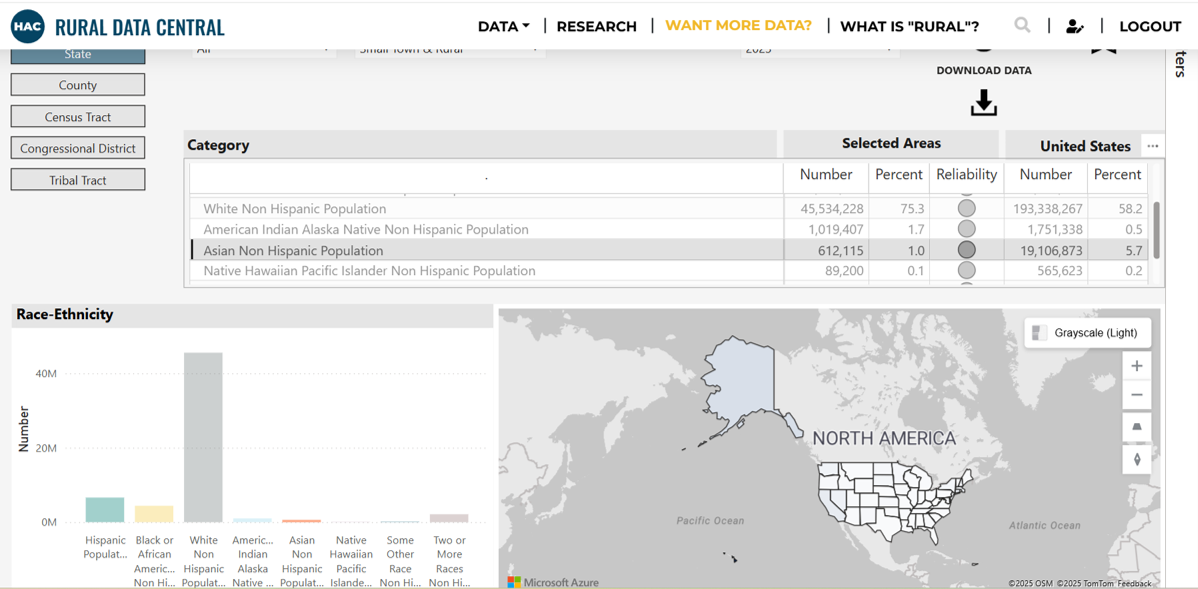
May is Asian American and Pacific Islander Heritage Month. Over 700,000 Asian and Pacific Islanders live in rural and small-town communities across the United States. Hawaii has the largest number and percentage of rural Asian and Pacific Islanders among the states with nearly one-third of Hawaiians identifying as Asian, Hawaiian Homelander, or Pacific Islander. Source: Rural Data Central – HAC tabulations of the U.S Census Bureau’s 2019-2023 American Community Survey.

Data is Central. To learn more about the demographic, economic, and housing composition of your community, visit Rural Data Central.

OPPORTUNITIES

Justice Department will fund services to domestic violence survivors

Transitional housing assistance funding is available for nonprofits and state, local, or Tribal governments to provide six to 24 months of transitional housing and support services for victims of domestic violence, dating violence, sexual assault, or stalking. Apply by June 9. The Rural Domestic Violence, Dating Violence, Sexual Assault, and Stalking Program supports cooperative efforts among law enforcement officers, prosecutors, victim service providers, and other related parties to investigate and prosecute sexual assault, domestic violence, dating violence, and stalking; treatment, advocacy, counseling, legal assistance, or other victim services for victims in rural communities; or programs addressing sexual assault. Apply by July 8. Information about other open grant programs is available from the Justice Department’s Office on Violence Against Women and on grants.gov.

Grants offered for resident-driven community planning

The Community Heart & Soul Seed Grant Program serves U.S. cities and towns with populations under 30,000, including in U.S. territories. The program provides $10,000 grants and requires a $10,000 cash match for a resident-driven process that engages the entire population of a town in identifying what they love most about their community, what future they want for it, and how to achieve that. Applications are reviewed monthly.

Rural disaster home repair program guidance renewed

Updated guidance from USDA RD confirms that the agency still has funds available for repairs to owner-occupied homes in Section 504-eligible places where presidentially declared disasters occurred in calendar year 2022. The document explains how the Rural Disaster Home Repair Grant Program differs from the Section 504 Home Repair Grant Program.

CAPITOL HILL

House reconciliation bill would boost rural Opportunity Zones and LIHTC

House committees have now approved all the sections of a budget reconciliation bill, which is becoming known as “the one big beautiful bill.” Some of the last pieces revealed were the provisions to extend or refine tax cuts. They were approved by the Ways and Means Committee on May 14 and include changes in the Opportunity Zones and Low Income Housing Tax Credit programs. The bill would set current OZ designations to expire in 2026 rather than 2028, the date in existing law. A new round of OZs would be identified. In an effort to improve the program’s performance in rural areas, about one-third of the new OZs would have to be rural and incentives would be offered for rural OZ investments. The bill’s revisions to the Low Income Housing Tax Credit include a 30% basis boost for properties in rural and Native communities. The bill would repeal or phase out clean energy tax credits created by the Inflation Reduction Act. It would allow the New Markets Tax Credit to expire. It does not include the homeownership tax credit provisions of the Neighborhood Homes Investment Act. The full budget reconciliation package will now be considered by the House Budget Committee, then the full House. The Senate will craft its own version. HAC issued a statement on the House’s tax provisions.

Bill introduced to protect farmworkers after disasters

On May 7, the Disaster Relief for Farmworkers Act was introduced in both the Senate and the House. The bill would provide crucial financial assistance to farmworkers who lose income due to natural disasters or public health emergencies and also offer support to farmers facing crop losses during such events.

REGULATIONS AND FEDERAL AGENCIES

Many federal layoffs paused, agencies told to make plans public

In one of the many lawsuits filed challenging the administration’s firing of federal workers, a federal judge issued a May 9 temporary restraining order halting the layoffs at 21 agencies, including USDA and HUD, through May 23. The judge also ordered the administration to release agency reduction in force and reorganization plans on May 13, but then postponed that deadline. According to the administration, publicly releasing those plans would reveal management strategies and hurt employee recruiting and retention. While the lower court is still considering whether to require release of the plans, the government has appealed the temporary restraining order. A Government Executive article describes some of the differing actions taken by agencies subject to the temporary restraining order.

Staff terminations expected at HUD

Government Executive reports that HUD has issued reduction in force (RIF) notices to all employees in the Office of Field Policy and Management at the General Schedule-13 level and below, effective May 18. The article adds that HUD is expected to issue RIFs to staff in other offices in the near future.

USDA now hiring

Over 15,000 USDA employees – about 15% of the department’s workforce – have signed up for deferred resignations, which allow them to leave their jobs immediately and be paid through September, Politico reports. These departures are in addition to previous layoffs of probationary staff, some of whom have been rehired. More staff will be let go through reductions in force carried out by the administration. Questioned about the departures at a Senate subcommittee hearing on May 6, Secretary Brooke Rollins said USDA is actively recruiting to fill some jobs. She noted that the department loses 8,000-10,000 employees every year and hires to fill their positions.

Some USDA RD housing officials depart, state directors are appointed

At least two high-level staff in the Rural Housing Service’s headquarters have left: Jacki Ponti-Lazaruk, who was the Acting Deputy Under Secretary for Rural Development, and Angilla Denton, who was the RHS Deputy Administrator for Multifamily Housing and then the Acting Administrator. Christine Mechtly, who became Deputy Administrator for Single-Family Housing in 2024, is now the RHS Acting Administrator.

USDA Secretary Brooke Rollins recently announced the appointments of new state directors for the Farm Service Agency and Rural Development.

Tribal feedback requested on environmental rules

HUD asks Tribal leaders to provide comments by May 25 on improvements to the environmental review process.

Consumer Financial Protection Bureau withdraws some guidance

CFPB is withdrawing a number of documents that were issued to provide non-binding policy guidance. The agency explains that the cancellation is not necessarily final, but these documents will not be enforced or otherwise relied upon by the Bureau while it continues reviewing them. They cover a variety of topics including mortgage lending rules for surviving family members, consumer protections for home sales financed under contracts for deed, and enforcement priorities related to housing insecurity.

CFPB director nominee shifted to Treasury

Jonathan McKernan’s nomination to become Consumer Financial Protection Bureau director has been cancelled and President Trump has nominated him instead to be Undersecretary of Domestic Finance at the Treasury Department. No new CFPB nominee has been announced.

PUBLICATIONS AND MEDIA

Podcast looks at rural economic development

Seeding Economic Development in Rural America, with Ann Eisenberg is an episode of Resources for the Future’s podcast. Eisenberg, a professor and research director at the West Virginia University College of Law, explains how rural economies become vulnerable to decline when macroeconomic and societal changes weaken or displace local industries. She provides examples of successful economic diversification and revitalization; strategies to support rural communities that are facing economic hardship; and explanations about ways policies that have strengthened rural economies have also bolstered broader national economic stability.

Report contrasts colonias living conditions with border security spending

“Although billions of state and federal dollars flow into the majority-Latino communities along the nearly 2,000-mile U.S.-Mexico border, many remain among the poorest places in the nation,” observes a report by ProPublica and the Texas Tribune. The article describes the depths of the region’s need for water and hospital access.

HAC

Need capital for your affordable housing project?

HAC’s loan fund provides low interest rate loans to support single- and multifamily affordable housing projects for low-income rural residents throughout the U.S. and territories. Capital is available for all types of affordable and mixed-income housing projects, including preservation, new development, farmworker, senior and veteran housing. HAC loan funds can be used for pre-development, site acquisition, site development, construction/rehabilitation and permanent financing. Contact HAC’s loan fund staff at hacloanfund@ruralhome.org, 202-842-8600.

Please note: HAC is not able to offer loans to individuals or families. Borrowers must be nonprofit or for-profit organizations or government entities (including Tribes).

Want to reprint a HAC News item?

Please credit the HAC News and provide a link to HAC’s website. Thank you!
HAC CEO Responds to Tax Proposals

HAC CEO David Lipsetz supports proposed rural improvements in the House Ways and Means Committee’s proposed budget reconciliation bill.


Earlier this week, the House Ways and Means Committee released and marked up an expansive tax reform package, which includes several significant rural housing priorities. 

“While this tax reform effort is extensive and covers an enormous number of complex issues, we were thrilled to see some long-supported rural improvements to the Low-Income Housing Tax Credit (LIHTC) included in the proposal,” said David Lipsetz, President & CEO of the Housing Assistance Council. “We were also glad to see the focus on improving outcomes in rural communities in the renewal of the Opportunity Zones tax incentive. We look forward to working with the Senate to refine those Opportunity Zone provisions as this process moves forward.” 

For LIHTC, the House tax bill would make the following critical improvements (which had been previously introduced as part of the Affordable Housing Credit Improvement Act): 

  • Designating rural and Native communities as Difficult Development Areas, which would allow them a 30 percent basis boost for buildings placed in service after December 31, 2025 and before January 1, 2030. Rural LIHTC credit pricing is often lower and projects are working within tighter capital constraints due to low tenant incomes and other geographic factors. LIHTC developments in rural and Native areas would be more financially feasible with the introduction of this targeted basis boost. 
  • Extending the 12.5 percent allocation increase for 2026-2029. Congress has not permanently increased 9 Percent Housing Credit authority since 2000. However, Congress provided a modest temporary 12.5 percent cap increase in 2018, which subsequently expired in 2021. This bill would restore into baseline the 12.5 percent cap increase. 
  • Lowering the 50 percent private-activity bond threshold test to 25 percent for obligations made after December 31, 2025, and before January 1, 2030. In order for a multifamily Housing Bond financed development to receive the full amount of 4 Percent Housing Credits it is eligible to receive, at least 50 percent of development costs must be initially financed with tax-exempt multifamily bond authority from the state’s Private Activity Bond (PAB) volume cap. The 50 percent requirement is an arbitrary threshold and lowering that threshold to 25 percent would allow states to produce and preserve more bond-financed developments. 

Together, these LIHTC changes would help improve LIHTC’s impact in rural areas and HAC strongly supports their inclusion in this bill.  

“As this tax reform effort moves over to the Senate, we also hope to see the Neighborhood Homes Investment Act (NHIA) included in the package,” said Lipsetz. “The ‘value gap’ can often be a barrier to home repair in rural places, which have a disproportionately high rate of aging and substandard housing. NHIA would bring private investment to the table to rehabilitate owner-occupied homes through a new and innovative tax credit.” 

GET THE HAC NEWS!

Sign-up for HAC information products

SIGN UP HERE

Housing Assistance Council   |  1828 L Street. N.W., Suite 505, Washington, D.C. 20036
(202) 842-8600 (202) 347-3441 hac@ruralhome.org |

Board Portal

HAC is an equal opportunity provider, employer, and lender. | Civil Rights | Privacy