HAC News: February 3, 2022

Vol. 51, No. 3

TOP STORIES

Congress must address federal funding this month.

The continuing resolution that maintains government spending at fiscal year 2021 levels will end on February 18. Congress may pass an omnibus appropriations bill, possibly using another brief CR to obtain more time to negotiate, or may decide to adopt a full-year CR. FY22 appropriations bills proposing increased resources for some USDA and HUD housing programs passed the House in July and were introduced in the Senate. The FY23 funding process will begin soon as well, with the Biden administration’s budget proposal expected to be released sometime in March.

Bill introduced to target funds to neediest places.

On February 1, House Majority Whip James E. Clyburn (D-S.C.), Rep. Hal Rogers (R-Ky.), Sen. Cory Booker (D-N.J.), and Sen. Rob Portman (R-Ohio) introduced the Targeting Resources to Communities in Need Act of 2022, H.R. 6531, which would direct federal funding to persistent poverty areas throughout the country. The bill is based on the 10-20-30 formula that has been applied to require at least 10% of funds from some USDA Rural Development programs be spent in persistent poverty counties (those where the poverty rate has been at least 20% for at least 30 years). It instructs OMB to work government-wide, program by program, to increase the share of funds going to high and persistent poverty areas.

Rental housing study finds growing inequities by income and race.

America’s Rental Housing 2022, published by Harvard’s Joint Center for Housing Studies, reports that in 2020 the rental vacancy rate fell to its lowest level since the mid-1980s, rents rose, and ownership of rental properties continued to shift from individuals to businesses – including a record high share of single-family homes. Lower-income renters were especially hard hit by pandemic-related income losses and likely to fall behind on rent, with Black, Hispanic, and Asian renters suffering far higher rates of rent arrearages than whites.

COVID-19 cases explode as Omicron variant hits rural America.

HAC’s most recent analysis of data on the coronavirus pandemic shows a dramatic rise in rural cases. Since the emergence of the Delta variant in summer 2021, the COVID-19 death rate has been substantially higher outside metropolitan areas than within them.

February is Black History Month.

President Biden proclaimed February 2022 as National Black History Month.

RuralSTAT

Between December 20, 2021 and January 20, 2022 communities outside metropolitan areas reported more than 1.8 million new cases of COVID-19 – a 223% increase over the previous month. Source: HAC tabulations of public health data from the New York Times.

OPPORTUNITIES

Grants offered for rural arts.

The Rural Arts Initiative of the Laura Jane Musser Fund offers grants of up to $10,000 to assist small nonprofit arts organizations in rural communities to develop, implement, or sustain exceptional artistic opportunities for adults and children in the areas of literary, visual, music, and performing arts. Applicants must be located in communities with under 20,000 population in Colorado, Hawaii, Wyoming, or specified parts of Minnesota, New York, or Texas. Applications must be submitted online between February 9 and March 9. For more information, contact the Musser Fund, 612-825-2024.

Webinar to cover “Building Momentum for Your Long-Term Vision.”

Join the Citizens’ Institute on Rural Design on February 16 for a webinar about approaches and tactics to build support for design projects across rural America. The session will be led by Jun-Li Wang, Associate Director for Programs at Springboard for the Arts, and Emily Schmidt, award winning journalist and communications consultant.

REGULATIONS AND FEDERAL AGENCIES

CFPB updates lists of rural and underserved areas.

The Consumer Financial Protection Bureau has posted its annual lists of areas determined to be “rural or underserved” and counties determined to be “rural” for purposes of mortgage lending regulations, and has updated the accompanying website tool.

CDBG disaster funds allocated and requirements explained.

A HUD notice describes the allocation of Community Development Block Grant Disaster Recovery funds for some jurisdictions where major disasters occurred in 2020, along with waivers and alternative requirements, relevant regulatory requirements, the grant award process, criteria for action plan approval, and eligible activities. These CDBG-DR funds will be used for disaster relief, long-term recovery, restoration of infrastructure and housing, economic revitalization, and mitigation.

U.S. Interagency Council on Homelessness has new director.

Jeff Olivet, a founder of Racial Equity Partners and the former CEO of the Center for Social Innovation, has been appointed Executive Director of USICH.

HAC suggests ways to strengthen mortgage reporting.

HAC submitted comments to the Consumer Financial Protection Bureau regarding its assessment of the Home Mortgage Disclosure Act rule. HAC strongly urges the CFPB to return to requiring HMDA reporting by lenders originating as few as 25 loans, rather than its new 100-origination threshold, to more accurately capture rural markets that are disproportionately served by small financial institutions. HAC also supports development of a HMDA reliability index and addition of data points on topics such as manufactured housing to improve understanding of certain underserved markets.

USDA RD clarifies use of 2020 Census data.

Because Census Bureau release of new data has been delayed, USDA Rural Development programs will continue to use population data from the 2010 decennial census. Until October 1, 2022, RD programs will use state nonmetro median household incomes calculated from the 2006-2010 American Community Survey and then will switch to median incomes based on the 2015-2019 five-year ACS. For more information, contact an RD State Office.

Time periods for some youth vouchers extended.

A HUD notice explains newly extended time periods for vouchers provided to youth through the Family Unification Program. Some of these Fostering Stable Housing Opportunities amendments are already in effect. Comments are due March 25. For more information, contact Ryan E. Jones, HUD, 202-402-2677.

PUBLICATIONS AND MEDIA

Tribal implementation of Emergency Rental Assistance examined.

Emergency Rental Assistance among Indigenous Tribes: Findings from Tribal Grantees, a new report from the National Low Income Housing Coalition, explains that tribal grantees face unique challenges and barriers to implementing Emergency Rental Assistance programs: they serve households across jurisdictional boundaries and also have different housing needs and rental markets, administrative infrastructures, and ERA grant allocations. The research examines these key characteristics as well as lessons learned from tribal experience with the programs.

Development and population growth intensify flood risks, analysis shows.

In an academic paper and an article more accessible for non-scientists, researchers report that over the next 30 years, the cost of flood damage in the U.S. is on pace to rise 26% due to climate change alone. Factoring in population growth, however, makes the increase in flood losses four times higher than the climate-only effect. The study also found that the current flood risk is predominantly concentrated in white, impoverished communities, many of them on the coasts or in Appalachian valleys, whereas the 30-year increase in risk falls disproportionately on urban and rural communities with large Black populations on the Atlantic and Gulf coasts. New Flood Maps Show US Damage Rising 26% in Next 30 Years Due to Climate Change Alone, and the Inequity is Stark includes an interactive map providing risk estimates by county.

HAC

Vision 2071 site celebrates history and looks to the future.

To celebrate its 50th anniversary and look toward the next 50 years, HAC has launched vision2071, a website covering stories about the communities HAC serves, milestones over HAC’s history, and an opportunity to consider what rural American will be in 2071. A recent post describes the visions of eight housing and community development leaders for their communities. You can donate to HAC’s anniversary campaign here or by contacting Jennifer McAllister at HAC. Together, we can make this vision of rural America a reality by 2071.

HAC seeks Community Development Specialist, Loan Processor Associate, and Housing Specialist.

  • The Community Development Specialist works with nonprofits and local governments on all facets of developing community resources such as parks, community centers, public libraries, childcare centers, health care facilities, or other public spaces. Requirements include four years of relevant work experience. This position is eligible for telecommuting.
  • The Loan Processor Associate is an entry-level position and will assist in managing HAC’s portfolio of loans made to entities engaged in affordable housing activities throughout the rural U.S. This position is eligible for telecommuting.
  • The Housing Specialist is primarily based in either the Southwest or Western states (within two hours of a major airport) and works with local partner organizations to identify financial resources and funding opportunities to support the preservation and development of affordable housing and community and economic development strategies specifically throughout expanses of Southwest and/or Western rural America. This position is remote location eligible

Need capital for your affordable housing project?

HAC’s loan fund provides low interest rate loans to support single- and multifamily affordable housing projects for low-income rural residents throughout the U.S. and territories. Capital is available for all types of affordable and mixed-income housing projects, including preservation, new development, farmworker, senior and veteran housing. HAC loan funds can be used for pre-development, site acquisition, site development, construction/rehabilitation and permanent financing. Contact HAC’s loan fund staff at hacloanfund@ruralhome.org, 202-842-8600.

Please note: HAC is not able to offer loans to individuals or families. Borrowers must be nonprofit or for-profit organizations or government entities (including tribes).
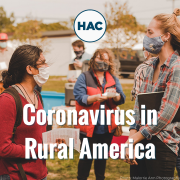
Covid-19 Cases Explode as Omicron Variant Hits Rural America

The first reported case of COVID-19 in rural America was on February 20, 2020. As of January 20, 2022 there have been more than 9.6 million reported cases of COVID-19 and more than 152,000 associated deaths in communities outside metropolitan areas. Between December 20, 2021 and January 20, 2022 communities outside of metropolitan areas reported more than 1.8 million new cases of COVID-19 – a 223 percent increase over the previous month.

HAC News: January 20, 2022

Vol. 51, No. 2

TOP STORIES

Over $1.1 billion in pandemic rental aid reallocated.

On January 7 the Treasury Department announced the first reallocation of Emergency Rental Assistance from jurisdictions that had not used it. Voluntary reallocations between jurisdictions within the same state accounted for a large portion of the shift. Treasury did take about $91 million from states and localities that did not voluntarily relinquish it. The National Low Income Housing Coalition’s analysis of Treasury’s data notes that it is not clear how Treasury is prioritizing recipients of reallocated funds.

As homeowner assistance plans are approved, states begin taking applications.

The Treasury Department has now approved plans for distribution of Homeowner Assistance Fund monies in 30 jurisdictions. States, territories, and tribes or tribal entities will use the funds for homeowners with incomes under 150% of area median or 100% of the U.S. median who experienced financial hardship and need help to prevent mortgage delinquency, default, foreclosure, loss of utilities or home energy services, or displacement. The National Council of State Housing Agencies provides links for more information from each state.

HAC sets 2022 policy priorities.

HAC’s policy priorities for 2022 call for building the capacity of local affordable housing and community development organizations deeply rooted in rural places; expanding access to credit and safe, affordable lending in underserved rural communities; improving the overall quality, availability, and affordability of housing to buy and rent in small towns and rural places; and preserving, increasing, and tailoring resources for federal affordable housing programs serving rural populations.

RuralSTAT

In the rural parts of Texas’s border with Mexico, there were 35 loans for every 1,000 owner-occupied units in Colonias Investment Areas from 2015 through 2017, compared with 73 loans per 1,000 outside Colonias Investment Areas. Source: Colonias Investment Areas: A More Focused Approach, Cityscape.

OPPORTUNITIES

NEW! HAC seeks Community Development Specialist, Loan Processor Associate, and Housing Specialist.

  • NEW! The Community Development Specialist works with nonprofits and local governments on all facets of developing community resources such as parks, community centers, public libraries, childcare centers, health care facilities, or other public spaces. Requirements include four years of relevant work experience. This position is eligible for telecommuting. The job description and application instructions will be posted on HAC’s site when available.
  • The Loan Processor Associate is an entry-level position and will assist in managing HAC’s portfolio of loans made to entities engaged in affordable housing activities throughout the rural U.S. This position is eligible for telecommuting.
  • The Housing Specialist is primarily based in either the Southwest or Western states (within two hours of a major airport) and works with local partner organizations to identify financial resources and funding opportunities to support the preservation and development of affordable housing and community and economic development strategies specifically throughout expanses of Southwest and/or Western rural America. This position is remote location eligible.

REGULATIONS AND FEDERAL AGENCIES

Comments sought on broadband funding distribution.

The Commerce Department’s National Telecommunications and Information Administration, which will distribute billions of dollars for broadband provided in the recent infrastructure bill, requests public input on a set of broad questions, including some on access, digital equity, geography, and affordability. Written comments are due February 4. NTIA will also hold virtual public listening sessions and plans to conduct a tribal consultation. For more information, contact NTIA, 202-482-2048.

USDA offers guidance on accessibility for rental properties.

Recently released guidance for complying with Section 504 of the Rehabilitation Act of 1973 and other federal requirements applies to properties with financing from USDA RD multifamily programs (Sections 515, 514/516, 521, or 538/515). For more information, contact a USDA multifamily housing regional director.

IRS pandemic relief for housing tax credits extended.

Internal Revenue Service Notice 2022-05 extends several deadlines and flexibilities for Low Income Housing Tax Credit developers that were initiated earlier in the coronavirus pandemic but had expired.

Committee reviews Thompson for FHFA.

Sandra Thompson’s nomination to be Director of the Federal Housing Finance Agency was considered by the Senate Banking Committee on January 13. Thompson’s opening statement noted FHFA’s important role in supporting underserved markets like rural and tribal areas, manufactured housing, and preservation of affordable housing. The committee has not yet voted whether to recommend her for approval by the Senate.

Final regulations set for state and local fiscal recovery funds.

The State and Local Fiscal Recovery Funds program, enacted as a part of the American Rescue Plan, supports state, local, and tribal governments’ response to the coronavirus pandemic across a variety of activities including affordable housing. Recipients have already spent much of the funds and the Treasury Department has issued a final rule, effective April 22, intended to increase the program’s flexibility.

Three more Rural Development State Directors named.

Appointees for Florida and the Virgin Islands, Idaho, and Washington were recently announced. A list of all USDA RD State Directors named by President Biden to date is now available on HAC’s website. These positions do not require Senate confirmation.

PUBLICATIONS AND MEDIA

HAC and Fannie Mae identify Colonias Investment Areas.

Colonias Investment Areas: A More Focused Approach, an article in HUD’s Cityscape journal, considers ways to target Fannie Mae’s Duty to Serve efforts in colonias by identifying Colonias Investment Areas. Written by Keith Wiley and Lance George from HAC and Sam Lipshutz, formerly of Fannie Mae, the analysis shows the need for more affordable home lending options in areas with substandard housing and considers possible solutions.

Harvard to release rental housing report January 21.

The Joint Center for Housing Studies’ announcement of the pending release of America’s Rental Housing 2022 states that, “While unprecedented levels of federal assistance have helped keep evictions down, the need for a permanent, fully funded housing safety net is more urgent than ever, and a key element of that support must be to protect existing rental housing from the threat of climate change.”

Research yields proposals to combat appraiser bias.

Reviewing the appraisal industry and evidence on appraisal bias, Identifying Bias and Barriers, Promoting Equity presents recommendations regarding the industry’s governance, training and education on fair housing, barriers to entry to the profession, and compliance and enforcement. The study was prepared by the National Fair Housing Alliance and two law firms for the Federal Financial Institutions Examination Council.

Factors leading to housing losses examined.

More than half of all U.S. counties lost housing units during the 2010s. Housing Losses in the 2010s, a white paper published by Enterprise Community Partners, reports that almost two-thirds of these housing loss counties were outside metropolitan areas and had small and shrinking populations. Stagnant economies and aging housing supply were also common among these counties, while some had recently suffered major natural disasters.

Study in Ohio finds different rurals attract different populations.

Researchers at Ohio State University have outlined five types of rural communities, three near metropolitan areas that have attracted more residents and two farther away from cities that experienced loss or only minor gains in population. An analysis of migration between Ohio census tracts found that each rural type is attracting a specific kind of residents and thus becoming less diverse internally.

Varying rural definitions challenge small towns.

What Counts as Rural? The Qualifications are Keeping Grants from Some Small Towns, a National Public Radio story, explains that varying definitions of rural can impact which communities receive federal funding. More information about rural definitions, including the definition used in HAC’s data analyses, is available here.

Despite investments in California’s farmworker housing, crisis persists.

Farmworkers Bear the Brunt of California’s Housing Crisis, a recent article on the digital news site Civil Eats, discusses the continuing affordable housing shortage for farmworkers throughout California. Even with $100 million in recent investments for the construction and rehabilitation of permanent farmworker housing, unsafe and cramped housing conditions remain.

Modeling examines impact of increased earnings on benefits and other factors.

Balancing at the Edge of the Cliff: Experiences and Calculations of Benefit Cliffs, Plateaus, and Trade-Offs reports on the combined effects when increased earnings lead to declines in public assistance benefits, growth in taxes owed and other expenses, and availability of refundable tax credits. Overall, most families with a $2,300 increase in income would be better off, especially those with starting incomes below the poverty level, Urban Institute researchers found. Because tax refunds and benefit reductions often happen on different timelines, however, families might not feel the full payoff from work in their monthly budgets. Interviews with TANF recipients identified housing, and the impact of earnings changes on housing benefits, as one of their biggest financial concerns.

Need capital for your affordable housing project?

HAC’s loan fund provides low interest rate loans to support single- and multifamily affordable housing projects for low-income rural residents throughout the U.S. and territories. Capital is available for all types of affordable and mixed-income housing projects, including preservation, new development, farmworker, senior and veteran housing. HAC loan funds can be used for pre-development, site acquisition, site development, construction/rehabilitation and permanent financing. Contact HAC’s loan fund staff at hacloanfund@ruralhome.org, 202-842-8600.

Please note: HAC is not able to offer loans to individuals or families. Borrowers must be nonprofit or for-profit organizations or government entities (including tribes).

HAC’s Recommendations to the CFPB on HMDA Rule Assessment

HAC submitted comments in response to the Consumer Financial Protection Bureau’s (CFPB) Request for Information regarding the Home Mortgage Disclosure Act (HMDA) Rule Assessment. HAC and our rural stakeholders have relied on HMDA data for decades to improve our understanding of rural mortgage markets. The CFPB will use these stakeholder comments to help better evaluate the effectiveness of these changes in meeting the purposes and objectives of Title X of the Dodd-Frank Act.

Key takeaways:

  • Reporting Threshold

    HAC strongly urges the CFPB to return to the 25-origination reporting threshold, for closed-end loans, as opposed to the new 100-origination threshold, in order to more accurately capture rural markets that are disproportionately served by small financial institutions.

  • Reliability Index

    HAC Recommends that the CFPB resource and publish a HMDA “Reliability Index.” While not a fix for overly limited reporting thresholds, the development of an indicator would be helpful for the CFPB, data users, and consumers.

  • Additional Data

    HAC applauds increased HMDA data reporting, but additional data and reporting are still needed. While the new housing data points – specifically those on manufactured housing – enhance the HMDA data usefulness, more data could improve an understanding of certain underserved markets. This is particularly true when it comes to tribal lands and specific loan programs.

  • Data Browser

    HAC applauds CFPB’s HMDA data browser, which offers improved access to HMDA data over previous interfaces.

HAC News: January 6, 2022

Vol. 51, No. 1

TOP STORIES

Congress faces funding deadline.

Having reconvened after the holidays, Congress must act again on appropriations for fiscal year 2022, which started October 1, 2021. The current continuing resolution that holds programs at FY21 funding levels will expire February 18.

HAC to hold online forum on rural veterans’ housing grants.

Register now for a January 12 briefing by HAC program staff on the Affordable Housing for Rural Veterans initiative, which helps local nonprofit housing development organizations to meet the affordable housing needs of veterans in rural places. Grants typically range up to $30,000 per organization and must support bricks-and-mortar projects that assist low-income, elderly, and/or disabled veterans with home repair and rehab needs, support homeless veterans, help veterans become homeowners, and/or secure affordable rental housing. This initiative is funded through the generous support of The Home Depot Foundation. Applications are due January 21. For more information, contact HAC staff. No phone calls please.

RuralSTAT

The average purchase price of a new manufactured home (without land) is now estimated at $118,700* – up 41% from July 2020 to July 2021. Source: U.S. Census Bureau’s Manufactured Housing Survey. *Includes both single and multi-sections.

OPPORTUNITIES

HAC seeks Loan Processor Associate, Housing Specialist, and Community Facilities Housing Specialist.

  • The Loan Processor Associate is an entry-level position and will assist in managing HAC’s portfolio of loans made to entities engaged in affordable housing activities throughout the rural U.S. This position is eligible for telecommuting.
  • The Housing Specialist is primarily based in either the Southwest or Western states (within two hours of a major airport) and works with local partner organizations to identify financial resources and funding opportunities to support the preservation and development of affordable housing and community and economic development strategies specifically throughout expanses of Southwest and/or Western rural America. This position is remote location eligible.
  • The Community Facilities Housing Specialist identifies and engages community stakeholders and provides direct technical assistance to rural organizations that are developing facilities such as parks, community centers, public libraries and childcare centers. This is a two-year position and is eligible for telecommuting.

REGULATIONS AND FEDERAL AGENCIES

USDA offers guidance on community facilities funding priorities.

A guidance document explains how RD State Directors and the RHS Administrator can allocate discretionary points to support RD’s FY22 priorities when scoring applications for community facilities direct loans and grants. (Discretionary points are not available for CF guaranteed loans.) The three priorities are to help rural communities recover economically from the pandemic’s impacts; ensure all rural residents have equitable access to RD programs and benefits from RD-funded projects; and reduce climate pollution and increase resilience to the impacts of climate change. CF applications are accepted year-round. For more information, contact an RD State Office.

Duty to Serve proposals need revisions.

The Federal Housing Finance Agency announced on January 5 that it has reviewed Fannie Mae’s and Freddie Mac’s revised Duty to Serve Proposed Plans for 2022-24 and has directed both of them to submit additional revisions to improve the plans’ impact on all three DTS underserved markets (manufactured housing, affordable housing preservation, and rural housing). In the meantime, FHFA states, DTS implementation will continue without interruption based on objectives in the current proposed plans.

Input requested on rural minority businesses.

The Commerce Department’s Minority Business Development Agency seeks information on rural minority businesses as it establishes a new Rural Business Center Program authorized by the November 2021 infrastructure act. It asks a variety of questions, including what are the financial, operational, and logistical needs of rural business enterprises; do rural and remote minority businesses face unique challenges; and how can community-based organizations be involved? Comments are due January 25. For more information, contact Danae Pauli, MBDA, 202-482-2332.

HUD announces regulatory waivers for Native American programs in disaster areas.

HUD has published a list of waivers and flexibilities from HUD requirements that can be used during calendar years 2022 and 2023 by Indian Housing Block Grant, Indian CDBG, and Native Hawaiian Housing Block Grant grantees in areas covered by presidentially declared disasters. Separate notices were issued previously for HUD’s Native American coronavirus relief programs. For more information, contact Hilary Atkin, HUD.

Expedited waiver process set for public housing and Section 8 in disaster areas.

During presidentially declared disasters in calendar years 2022 and 2023, HUD will use an expedited process to consider PHA requests for waivers and flexibilities from regulatory and administrative requirements applicable to the public housing and Section 8 programs. For more information, contact Tesia Irinyenikan, 202-402-7026.

Two Rural Development State Directors appointed.

President Biden has named USDA RD State Directors for Montana and for New Hampshire and Vermont. The administration previously announced the State Directors for Alabama, Colorado, Delaware and Maryland, Georgia, Illinois, Iowa, Maine, Michigan, Missouri, Nebraska, New York, Pennsylvania, New Mexico, North Carolina, South Carolina, and Tennessee.

PUBLICATIONS AND MEDIA

News stories describe 3D printing as an affordable housing solution.

How 3D Printing Can be the Solution to the Nation’s Affordable Housing Crisis, from NBC News, reports that building a home with wood costs approximately $150,000 but constructing homes with a 3D printer using concrete can reduce costs up to 15% and complete construction in half the time. ISU Project Hopes to Create a New Solution for the State’s Affordable Housing Crisis, an Iowa Public Radio story, explains that Iowa State University received $1.4 million from the Iowa Economic Development Authority and will purchase a 3D printer to print the vertical framing for homes. It will help fill the gap of Iowa’s workforce shortage and help speed construction of affordable housing.

Housing insecurity high for older renters of color.

Older Renters of Color Have Experienced High Rates of Housing Insecurity During the Pandemic, a Joint Center for Housing Studies blog post, reports the Census Bureau’s Household Pulse Survey data shows that in the last year older households of color struggled to pay rent or mortgages at higher rates than white, non-Hispanic households. Disparities based on race, ethnicity, and tenure type are particularly apparent among older renters. During the last year, Black households were twice as likely as white households to be behind on rent. In addition, over a quarter of older Asian renters reported being behind on housing payments.

Hotel/motel conversions studied.

Addressing Homelessness Through Hotel Conversions presents an analysis of 13 hotel/motel acquisition projects from towns and cities of varying sizes, focusing on conversions aimed at providing housing for people experiencing homelessness. The report was published by the Terner Center for Housing Innovation as part of the Housing Crisis Research Collaborative.

Podcasts cover rural issues and housing.

  • UCLA Housing Voice features interviews with housing researchers, intended to help make sense of their work and how it can be applied in the real world. Topics have included the legacy of redlining, state housing mandates, and fair housing.
  • The Home Front from the National Low Income Housing Coalition focuses on housing policy priorities and advocacy.
  • The Yonder Report is a short roundup of rural news released weekly, featuring a variety of rural voices.

Solar farm to be constructed on former coal mine site.

The New York Times, in Coming Soon to this Coal County: Solar in a Big Way, describes the development of a large solar power project on a former mountain top coal site in Martin County, KY. In this economically distressed county coal jobs, which once helped fuel the area’s economy, are nearly gone. While about half of the project’s 300 jobs would be temporary, they would pay an average of $25 to $30 per hour.

Pharmacists retiring in rural America.

Seeking Refills: Aging Pharmacists Leave Drugstores Vacant in Rural America, published by Kaiser Health News, discusses the shortage of candidates available to fill vacancies created by retiring pharmacists and associated impacts for rural communities.

Need capital for your affordable housing project?

HAC’s loan fund provides low interest rate loans to support single- and multifamily affordable housing projects for low-income rural residents throughout the U.S. and territories. Capital is available for all types of affordable and mixed-income housing projects, including preservation, new development, farmworker, senior and veteran housing. HAC loan funds can be used for pre-development, site acquisition, site development, construction/rehabilitation and permanent financing. Contact HAC’s loan fund staff at hacloanfund@ruralhome.org, 202-842-8600.

Please note: HAC is not able to offer loans to individuals or families. Borrowers must be nonprofit or for-profit organizations or government entities (including tribes).
COVID in Rural America in 5 Charts

The pandemic continues to impact rural America. The slides below provide data on the progression of the pandemic since February 2020  and offer an overview of cases and death rates.

HAC News: December 22, 2021

Vol. 50, No. 26

TOP STORIES

As social spending bill negotiations go on, refundable Child Tax Credit ends.

The Senate will not vote until at least January on the Build Back Better social infrastructure bill, H.R. 5376, though the House passed its version of the bill in November including $2 billion for USDA rural housing programs and substantial investments in many other housing programs. The bill would also continue the expanded Child Tax Credit, restructured in the American Rescue Plan Act to provide monthly payments to low-income families. That version of the tax credit was in place only from July through December 2021 and was particularly beneficial for rural children, according to research by the Daily Yonder and the Niskanen Center.

Response and recovery continue for South and Midwest tornadoes.

A 200-mile line of devastating storms on December 10-11 left scores dead and resulted in massive property damage estimated to be in the billions of dollars across six states in the South and Midwest. President Biden signed federal disaster declarations for affected communities in Kentucky, Illinois, and Tennessee, HUD announced aid for Kentucky, and USDA provided guidance for owners and managers of its rental housing properties. For more information about preparing for and recovering from natural disasters, visit HAC’s new resource Rural Resilience. For those wishing to help with recovery efforts, FEMA provides general guidance and numerous national and local organizations seek support for their work, including:

CRA rule rescinded and replaced.

The Office of the Comptroller of the Currency is finalizing the Community Reinvestment Act regulation it proposed in September, making few changes. The new rule rescinds the June 2020 regulation adopted under the Trump administration and replaces it with rules based on the regulations that were in effect before 2020. OCC notes that it continues to work with the Federal Reserve Board and FDIC to modernize the rule. OCC is also requesting public comment by February 14 on proposed revisions to the form that banks and others can use to confirm whether an activity qualifies under CRA. For more information, contact OCC’s Chief Counsel’s Office, 202-649-5490.

Happy Holidays from HAC!

“Home” takes on even more meaning during the holiday season. HAC wishes everyone a safe, healthy, and affordable place to call home.

RuralSTAT

Between November 20 and December 20, 2021, the average rate of daily deaths from COVID-19 was more than twice as high outside metropolitan areas as in metropolitan areas of the United States (cases per 100,000 population – 14 day average). Source: Housing Assistance Council tabulations of public health data from the New York Times.

OPPORTUNITIES

HAC offers aid for rural veterans’ housing.

HAC’s Affordable Housing for Rural Veterans initiative helps local nonprofit housing development organizations to meet the affordable housing needs of veterans in rural places. Grants typically range up to $30,000 per organization and must support bricks-and-mortar projects that assist low-income, elderly, and/or disabled veterans with home repair and rehab needs, support homeless veterans, help veterans become homeowners, and/or secure affordable rental housing. This initiative is funded through the generous support of The Home Depot Foundation. Applications are due January 21. For more information, contact HAC staff. No phone calls please.

Rural job accelerator funding available.

The Rural Innovation Stronger Economy program makes grants of up to $2 million to consortiums of local governments, nonprofits, industry, and other entities to support innovation centers and job accelerator programs that improve the ability of distressed rural communities to create high-wage jobs, form new businesses, and identify and maximize local assets. Apply by April 19. For more information, contact a USDA RD State Office.

HAC seeks Loan Processor Associate, Housing Specialist, and Community Facilities Housing Specialist.

  • The Loan Processor Associate is an entry-level position and will assist in managing HAC’s portfolio of loans made to entities engaged in affordable housing activities throughout the rural U.S. This position is eligible for telecommuting.
  • The Housing Specialist is primarily based in either the Southwest or Western states (within two hours of a major airport) and works with local partner organizations to identify financial resources and funding opportunities to support the preservation and development of affordable housing and community and economic development strategies specifically throughout expanses of Southwest and/or Western rural America. This position is remote location eligible.
  • The Community Facilities Housing Specialist identifies and engages community stakeholders and provides direct technical assistance to rural organizations that are developing facilities such as parks, community centers, public libraries and childcare centers. This is a two-year position and is eligible for telecommuting.

REGULATIONS AND FEDERAL AGENCIES

USDA addresses cost concerns for new single-family homes.

Because of cost increases and construction delays in the current economic climate, USDA has announced some temporary authorizations for new construction financed under its Section 502 and 504 direct loan programs. It has increased the permissible construction contingency in these loans and eased some of the requirements for borrowers to obtain subsequent loans at the end of construction to cover cost overruns. For more information, contact a USDA RD State Office.

Thompson nominated as head of Federal Housing Finance Agency.

President Biden has nominated Sandra L. Thompson, who has served as FHFA’s acting director since June, to become the agency’s director. She will need to be confirmed by the Senate.

More Rural Development State Directors named.

President Biden has appointed USDA RD State Directors for Maine and Missouri, as well as for Delaware and Maryland, Illinois, Nebraska, New York, and Tennessee. The administration had previously announced the State Directors for Alabama, Colorado, Georgia, Iowa, Michigan, Pennsylvania, New Mexico, North Carolina, and South Carolina.

HUD seeks input on strategic plan.

HUD requests feedback on the four proposed focus areas in its draft FY22-26 Strategic Plan: support underserved communities, ensure access to and increase the production of affordable housing, promote homeownership, and advance sustainable communities. Comments are due January 28.

Housing goals set for Fannie Mae and Freddie Mac.

The Federal Housing Finance Agency has established benchmarks for Fannie Mae’s and Freddie Mac’s single-family housing goals and subgoals for 2022-2024 and multifamily housing goals for 2022. FHFA also recently announced that in 2020 Fannie Mae met all of its single-family and multifamily housing goals, while Freddie Mac met all except its single-family low-income refinance goal.

PUBLICATIONS AND MEDIA

Lack of regulations contributes to affordability problems.

A segment on the Marketplace Morning Report titled For Unincorporated Communities, Limited Ways to Regulate Housing examines the challenges high amenity communities like Joshua Tree, CA have with rental housing affordability. Lance George, HAC’s Director of Research and Information, offered a national perspective on factors that contribute to these challenges.

Communities observe Homeless Persons’ Memorial Day.

December 21, the first day of winter and the longest night of the year, is recognized by the National Consumer Advisory Board, the National Coalition for the Homeless, and the National Health Care for the Homeless Council as an opportunity to remember people experiencing homelessness who have died and to strengthen the resolve to work for change. The U.S. Interagency Council on Homelessness acknowledged the event with recommendations for actions to address homelessness.

Emergency Rental Assistance programs and needs examined.

Recent reports consider the use of the Treasury Department’s Emergency Rental Assistance funding and ways to estimate need.

Rural workforce shrinking.

A recent Daily Yonder analysis of county-level data from the U.S. Bureau of Labor Statistics indicates that rural counties have gained jobs in the last year but have not reached the same number of jobs as before the beginning of the pandemic. The data reflects fewer people in rural America available to work, though the data do not show whether this is because working-age people are leaving rural counties, retiring, or just not looking for work.

Need capital for your affordable housing project?

HAC’s loan fund provides low interest rate loans to support single- and multifamily affordable housing projects for low-income rural residents throughout the U.S. and territories. Capital is available for all types of affordable and mixed-income housing projects, including preservation, new development, farmworker, senior and veteran housing. HAC loan funds can be used for pre-development, site acquisition, site development, construction/rehabilitation and permanent financing. Contact HAC’s loan fund staff at hacloanfund@ruralhome.org, 202-842-8600.

Please note: HAC is not able to offer loans to individuals or families. Borrowers must be nonprofit or for-profit organizations or government entities (including tribes).
South and Midwest December 2021 Tornadoes

On Friday night, December 10th, 2021, tornadoes up to 80 mph swept across six states in the Midwest and South, leaving more than 70 dead. Several states are experiencing power outages. President Biden approved an emergency declaration for Kentucky, which was hit by four tornadoes, one of which stayed on the ground for more than 200 miles. Michael Dossett, director of the Kentucky Division of Emergency Management, said the agency is already working to start cleaning up the debris and rebuild. For more information about preparing for and recovering from natural disasters, visit Rural Resilience.

Resources

Apply for FEMA Assistance by registering online at www.DisasterAssistance.gov. FEMA Disaster Assistance Helpline answers questions about the help offered by FEMA, how to apply for assistance, or the information in your account.

Toll-free helpline: 1-800-621-FEMA (3362)

For hearing impaired callers only:

1-800-462-7585 (TTY)

1-800-621-3362 (Video Relay Service)

Operators are multilingual and calls are answered seven days a week from 7 a.m. to 11 p.m. ET

American Red Cross Disaster Service: For referrals and updates on Red Cross shelter services in your area, locate a local Red Cross office through: https://www.redcross.org/find-help or by calling 1-800-RED CROSS (1-800-733-2767)

The Red Cross helps disaster victims by providing safe shelter, hot meals, essential relief supplies, emotional support and health services like first aid. Trained Red Cross workers often meet one-on-one with families to develop individual plans and identify available resources to help aid recovery.

STATE HOUSING AGENCIES


Arkansas

Arkansas Development Finance Authority
P.O. Box 8023
Little Rock, AR 72203-8023
Phone: (501) 682-5900
Fax: (501) 682-5939

http://www.arkansas.gov/adfa

Illinois

Illinois Housing Development Authority
111 E Wacker Drive, Suite 1000
Chicago, IL 60601
Phone: (312) 836-5200
Fax: (312) 832-2170

http://www.ihda.org

Kentucky

Kentucky Housing Corporation
1231 Louisville Road
Frankfort, KY 40601-6156
Phone: (502) 564-7630
Fax: (502) 564-7322

http://www.kyhousing.org

Mississippi

Mississippi Home Corporation
735 Riverside Drive
Jackson, MS 39202-1166
Phone: (601) 718-4642
Fax: (601) 718-4643

http://www.mshomecorp.com

Missouri

Missouri Housing Development Commission
920 Main Street, Suite 1400
Kansas City, MO 64105-2017
Phone: (816) 759-6600
Fax: (816) 301-7000

http://www.mhdc.com

Tennessee

Tennessee Housing Development Agency
502 Deaderick Street, Third Floor
Nashville, TN 37243
Phone: (615) 815-2200
Fax: (615) 564-2700

https://www.thda.org


HUD STATE FIELD OFFICES

Arkansas

Little Rock Field Office
425 West Capitol Avenue
Suite 1000
Little Rock, AR 72201-3488

(501) 918-5700

Director: Wanda C. Merritt

Illinois

Chicago Regional Office
Ralph Metcalfe Federal Building
77 West Jackson Boulevard
Chicago, IL 60604-3507

(312) 353-6236

Kentucky

Louisville Field Office
Gene Snyder Courthouse
601 West Broadway
Room 110
Louisville, KY 40202

(502) 582-5251

Director: Ahsaki Thurman

Mississippi

Dr. A. H. McCoy Federal Building
100 West Capitol Street
Room 910
Jackson, MS 39269-1096

(601) 965-4757

Director: Jerrie G. Magruder

Missouri

St. Louis Field Office
1222 Spruce Street
Suite 3.203
St. Louis, MO 63103-2836

(314) 418-5400

Director: James Heard

Tennessee

200 Jefferson Suite 300
Memphis, TN 38103

(901) 544-3367

Director: Sernorma Mitchell

USDA RURAL DEVELOPMENT STATE OFFICES

Arkansas

Karen Petrus, Acting State Director
Federal Building
700 West Capitol Avenue, Room 3416
Little Rock, AR 72201-3225

Voice: (501) 301-3216

https://www.rd.usda.gov/ar

Illinois

Molly K. Hammond, Acting State Director
2118 West Park Court, Suite A
Champaign, IL 61821

(217) 403-6200

https://www.rd.usda.gov/il

Kentucky

Louisville Field Office
Gene Snyder Courthouse
601 West Broadway
Room 110
Louisville, KY 40202

(502) 582-5251

https://www.rd.usda.gov/ky

Mississippi

Douglas Simons, Acting State Director
Federal Building, Suite 831
100 West Capitol Street
Jackson, MS 39269

(601) 965-4316

www.rd.usda.gov/ms

Missouri

D Clark Thomas, Acting State Director
601 Business Loop 70 West
Parkade Center, Suite 235
Columbia, MO 65203

(573) 876-0976

www.rd.usda.gov/mo

Tennessee

Dan Beasley, Acting State Director
441 Donelson Pike, Suite 310
Nashville, TN  37214

(615) 783-1300

www.rd.usda.gov/tn


STATE EMERGENCY MANAGEMENT AGENCIES

Arkansas

Building 9501
Camp Joseph T. Robinson
North Little Rock, AR 72199

(501) 683-6700

https://www.dps.arkansas.gov/emergency-management/adem/

Illinois

2200 South Dirksen Parkway
Springfield, Illinois 62703

IEMA Main Office (217) 782-2700

24-hour Response (217) 782-7860

TTY 888-614-2381​​

https://www2.illinois.gov/iema/Pages/default.aspx

Mississippi

P.O. Box 5644
Pearl, Mississippi

(601) 933-MEMA

24 hour emergency line: 1-800-222-MEMA(6362)

https://www.msema.org/

Missouri

St. Charles Co.
Capt. Chris Hunt
1400 T.R. Hughes Blvd., Suite 230
O’Fallon, MO 63366
(636) 949-3023

Pemiscot Co.
Jess Cagle
PO Box 1031
Caruthersville, MO 63830
(573) 333-4101

https://sema.dps.mo.gov/

Tennessee

Tennessee Emergency Management Agency
Patrick C. Sheehan, Director
3041 Sidco Dr.
Nashville, TN 37204

(615) 741-0001

https://www.tn.gov/tema.html


HAC Celebrates Rural Housing at the 2021 National Rural Housing Conference

As part of the 2021 National Rural Housing Conference, the Housing Assistance Council (HAC) recognized individuals and/or organizations that have, through their continued work and or newly established initiatives, made a positive and lasting impact to affordable housing in rural America.
The Covid pandemic was a paradigm shift that tested the strength, and temerity of communities across the country and one that centered housing, not just as a critical human need, but as a human right. Acknowledging the difficulty of the past year and the many associated inequities revealed, HAC seeks to honor those that leaned into the challenges to create positive impacts in rural America. In doing so, HAC has invited nominations for both individuals and/or organizations who have made outstanding and enduring contribution to affordable housing in rural America. Having faced a number of impediments from a common enemy, and all working towards the betterment of society, HAC seeks to recognize positive contributions from the smallest grassroots and on-the-ground housers and practitioners, to the highest elected offices in the US.
Out of long list of nominees, the Housing Assistance Council is proud to announce the following selectees for a 2021 Rural Housing Service Award:
This award is in recognition of your distinguished service in housing for the rural poor, steadfast commitment to rural communities, and outstanding contributions to those in greatest need in the most rural of places. Please join us in recognizing these esteemed friends of rural America!

Watch the Awards

Past Recipients of Rural Housing Awards


HAC News: December 9, 2021

Vol. 50, No. 25

TOP STORIES

Federal funding extended to February 18.

Hours before a temporary spending measure was set to expire on December 3, Congress passed and President Biden signed another continuing resolution that will fund the government through February 18, 2022. The new CR holds most government programs, including housing programs at USDA and HUD, at their fiscal 2021 funding levels; fiscal year 2022 began on October 1, 2021. FY22 appropriations bills proposing increased resources for some USDA and HUD housing programs passed the House in July and have been introduced in the Senate.

HAC holds National Rural Housing Conference, sessions now available online.

Rev. Dr. William Barber issued an inspiring call to action on Poverty and Equity in Rural America at HAC’s Virtual 2021 National Rural Housing Conference, held November 30-December 3. His address is available on HAC’s YouTube channel along with other plenary sessions featuring USDA Secretary Tom Vilsack, HUD Secretary Marcia Fudge, Rep. James Clyburn (D-S.C.), Rep. Bennie Thompson (D-Miss.), Rep. Maxine Waters (D-Calif.), and others. The more than 550 registrants from 44 states, DC, and the Virgin Islands can access workshop recordings on the conference app. HAC thanks our many sponsors, scholarship contributors, and partners for helping to make the event possible.

RuralSTAT

Between 2019 and 2020 the number of home purchase mortgage loans in rural America increased by 13.7% – a rate higher than in suburban or urban areas for the same time period. Source: Housing Assistance Council Tabulations of 2019 and 2020 FFIEC Home Mortgage Disclosure Act data.

OPPORTUNITIES

USDA offers support for farmworkers and food workers.

The new Farm and Food Worker Relief Grant Program will make grants to state agencies, tribal entities, and nonprofits with experience in providing support or relief services. Grant recipients will then distribute relief payments to frontline farmworkers, meatpacking, and grocery workers who incurred expenses preparing for, preventing exposure to, and responding to the coronavirus pandemic. Applications are due February 8. For more information, contact USDA staff.

Indian housing competitive grants deadline extended.

Tribes and tribally designated housing entities now have until January 4 to apply for the Indian Housing Block Grant Competitive Grant Program. HUD has posted updated Frequently Asked Questions. For more information, contact HUD staff.

HAC seeks Loan Processor Associate, Housing Specialist, and Community Facilities Housing Specialist.

  • The Loan Processor Associate is an entry-level position and will assist in managing HAC’s portfolio of loans made to entities engaged in affordable housing activities throughout the rural U.S. This position is eligible for telecommuting.
  • The Housing Specialist is primarily based in either the Southwest or Western states (within two hours of a major airport) and works with local partner organizations to identify financial resources and funding opportunities to support the preservation and development of affordable housing and community and economic development strategies specifically throughout expanses of Southwest and/or Western rural America. This position is remote location eligible.
  • The Community Facilities Housing Specialist identifies and engages community stakeholders and provides direct technical assistance to rural organizations that are developing facilities such as parks, community centers, public libraries and childcare centers. This is a two-year position and is eligible for telecommuting.

REGULATIONS AND FEDERAL AGENCIES

USDA continues temporary authorization for appraisals.

For single-family direct loans, USDA will accept appraisals obtained by self-help grantees, certified loan application packagers, approved intermediaries, and leveraged or other participating lenders. This temporary authorization is effective through September 30, 2022.

Toolkit aims to help practitioners comply with federal lead rules.

HUD’s Office of Lead Hazard Control and Healthy Homes has developed a Lead Safe Housing Rule Toolkit with sample forms, checklists, and flowcharts to aid compliance with HUD’s rules on lead safe housing for units both with and without federal assistance.

Regulations revised for oneRD Guarantee Loan Program.

Based on comments and experience since a final rule was adopted in 2020, USDA has revised its regulations for oneRD, which applies to the Community Facilities, Water and Waste Disposal, Business and Industry, and Rural Energy for America guarantee programs. The changes are effective immediately but comments can be submitted until February 8. For more information, contact Thomas P. Dickson, USDA, 202-690-4492.

Change proposed for H-2A farmworker wages.

The Department of Labor is proposing to change the way wages are determined for many farmworkers with temporary H-2A visas. Comments are due January 31. For more information, contact Brian Pasternak, DOL, 202-693-8200.

Worker heat standards comment deadline extended.

OSHA has extended the deadline for responses to its request for information about protecting outdoor and indoor workers from hazardous heat. Comments are now due January 26. For more information, contact Andrew Levinson, OSHA, 202-693-1950.

PUBLICATIONS AND MEDIA

State and local use of Emergency Rental Assistance funds remains uneven.

Treasury Department data show that in October some states and localities began using the second round of Emergency Rental Assistance funds, while efforts to use the first round continue. Treasury estimates at least 80% of ERA 1 funds will be spent or obligated by the end of 2021. A National Low Income Housing Coalition analysis shows that states – which provide this rental aid for many rural areas – spent 48% of their ERA 1 funds by October 31, while localities spent 68%. Treasury has not yet announced how much ERA 1 funding it will reallocate, or what jurisdictions will gain or lose dollars.

Legal aid attorneys report eviction law violations continue.

A National Housing Law Project survey of legal aid and civil rights attorneys found that despite the availability of Emergency Rental Assistance and other aid, eviction filings rose, even for federally subsidized tenants, after the federal eviction moratorium ended on August 26. Survey respondents also saw more landlords lying in court to evict tenants; more illegal evictions, lockouts, and other harassment of tenants; evictions even after landlords collected rental assistance funds; and judges ignoring or inconsistently applying federal and state law. NHLP’s survey report includes recommendations to resolve these violations.

“Lost local news” includes stories on housing, prairie conservation, other rural topics.

The Lost Local News Issue of the Washington Post Magazine provides stories from local journalists living and working in news deserts, many of them in rural places and small towns. A Long-Deferred Hope for Better Housing, a photo essay, shows part of the process of remodeling the home of a low-income resident of Leflore County, Mississippi. (The author and photographer, Rory Doyle, also contributed to HAC’s There is More Work to Be Done exhibition.) How to Save the Prairie, Acre by Acre tells the story of Bob and Lorna Harder, who have preserved a portion of their farm in Kansas for Great Plains native plant species.

Article highlights rural use of housing tax credits.

Creating Affordable Housing in Rural America, an article in Affordable Housing Finance magazine, describes how developers around the country use Low Income Housing Tax Credits to address homelessness and the need for rental housing in rural America.

New docuseries explores perceptions of rural life.

Rural By Choice is filmed in Otter Tail County in central Minnesota. It shares stories from residents about “diversity, the rural vs. urban divide, and why people choose to live in rural areas.”

Almost all states criminalize homelessness.

A new study identifies laws in 48 states that prohibit or restrict conduct of people experiencing homelessness such as sleeping in public or in vehicles. Housing Not Handcuffs 2021, a National Homelessness Law Center study of state laws, supplements 2019 research on municipal laws. The law center notes that local laws and variations in enforcement can lead to penalties for activities even when they are not restricted by a state-level statute.

Need capital for your affordable housing project?

HAC’s loan fund provides low interest rate loans to support single- and multifamily affordable housing projects for low-income rural residents throughout the U.S. and territories. Capital is available for all types of affordable and mixed-income housing projects, including preservation, new development, farmworker, senior and veteran housing. HAC loan funds can be used for pre-development, site acquisition, site development, construction/rehabilitation and permanent financing. Contact HAC’s loan fund staff at hacloanfund@ruralhome.org, 202-842-8600.

Please note: HAC is not able to offer loans to individuals or families. Borrowers must be nonprofit or for-profit organizations or government entities (including tribes).

GET THE HAC NEWS!

Sign-up for HAC information products

SIGN UP HERE

Housing Assistance Council   |  1828 L Street. N.W., Suite 505, Washington, D.C. 20036
(202) 842-8600 (202) 347-3441 hac@ruralhome.org |

Board Portal

HAC is an equal opportunity provider, employer, and lender. | Civil Rights | Privacy