Rural Voices: Making Choices
by Nick Mitchell-Bennett and Dr. Daniel Elkin
Innovations behind factory-built housing and the politics behind rural survival. Read the entire Rural Voices edition.
by Nick Mitchell-Bennett and Dr. Daniel Elkin
Innovations behind factory-built housing and the politics behind rural survival. Read the entire Rural Voices edition.
Text of a final appropriations bill for several agencies including HUD has been released by the House Appropriations Committee. House and Senate appropriators agreed to keep many HUD programs at the dollar levels they received in FY24 and FY25. Homeless assistance grants, Section 202 elderly housing, Section 811 housing for persons with disabilities, and housing for persons with AIDS all receive increases. The measure includes enough funding to renew Emergency Housing Vouchers created during the Covid pandemic. Provisions also instruct HUD to change some of its 2025 processes; for example, the bill requires 60-day comment periods for regulatory proposals. The bill extends the National Flood Insurance Program through September 30, 2026. Before the current continuing resolution expires on January 30, both houses of Congress will need to pass the bill and President Trump will need to sign it. Details are posted on HAC’s site.
On January 8, HUD announced it was reopening the original July 2024 notice offering FY25 funds for the Continuum of Care program, with applications for renewal funding due on February 9. Some entities that previously filed applications under that notice will not need to file new applications. Under the preliminary injunction issued by a judge in December and a HUD implementation plan, HUD must process the applications but will not award funds, pending further court action regarding HUD’s proposed changes to the program.
The final HUD appropriations bill protects Continuum of Care operations while the litigation continues. The bill directs HUD to provide one-year non-competitive renewals of Continuum of Care grants that expire in the first quarter of calendar year 2026 and then to continue the same process for each quarter in which it does not make new funding awards.
In an executive order issued January 20, President Trump told USDA, HUD, VA, the Treasury Department, and other agencies to make changes that would reduce the ability of large institutional investors to purchase and own single-family homes. The order also asked White House staff to draft legislation to the same end. The president did not release a broader housing affordability plan on January 21, as had been expected.
HUD proposes to change its regulations to eliminate disparate impact – the principle that actions with discriminatory effects can violate the Fair Housing Act even if there was no proven intent to discriminate – as a basis for fair housing claims. HUD argues that courts, not the agency itself, should make determinations interpreting disparate impact liability. Comments are due February 13.
To help inform federal policymaker and stakeholder conversations in the coming year, HAC has released our updated rural housing policy priorities for 2026. This publication and its executive summary are updated annually to reflect new and evolving policy challenges and opportunities in rural housing. HAC’s priorities include improving housing supply and affordability in small towns and rural places, building the capacity of local organizations, expanding access to credit, preserving rental homes, and preserving, increasing, and tailoring federal resources.
According to the 2023 American Housing Survey, over 2 million rural households reported being “uncomfortably cold” for 24 hours or more in the previous winter. In an estimated 474,000 of those rural homes, heating deficiencies were due to equipment breakdowns. Another 646,000 were in the cold because of inadequate heating equipment, inadequate insulation, or the cost of heating. Source: HAC tabulations of the U.S. Department of Housing and Urban Development’s 2023 American Housing Survey.
HUD will make Lead Hazard Reduction Capacity Building Grants to states, Tribes, and local governments that either have not received direct HUD lead hazard control grants or are previous grantees that have demonstrated needs to rebuild capacity within their jurisdictions. Apply by February 25.
With support from the AARP Foundation, HAC is offering free technical assistance to Section 515 property owners and managers. HAC will help a cohort of eight to ten owners and managers to build service coordination programs in elderly-designated 515 properties by utilizing the normal RD budget process. More information is posted on HAC’s website here and here. Anyone interested in attending an informational session in the coming weeks should contact Angela Shuckahosee, HAC, angela@ruralhome.org, 216-815-0114. For questions about the program, contact Seth Leonard, seth@ruralhome.org.
The Consumer Financial Protection Bureau has released its annual rural and underserved counties lists for 2026. Some CFPB regulations have provisions specifically applicable to these locations.
USDA has sent guidance to Rural Development State Offices on the use of disaster assistance funding for Community Facilities Grants in places impacted by specific disasters.
The Department of Veterans Affairs has withdrawn an advance notice of proposed rulemaking it published in the Federal Register in 2022 that requested public comment on expanding VA’s incentivized loss-mitigation options for veterans whose VA-guaranteed loans are in default. VA says it will continue to explore opportunities to assist veterans who face home loan default.
In August, USDA announced that on October 1, Rural Development would begin to evaluate compliance with the National Environmental Policy Act using a new interim final rule that applies throughout the department. The effective date has been delayed, and a new notice says the new regulations will apply to RD when a final rule is issued.
A Doors to Housing for Older Adults Virtual Summit will be offered on February 20 by the National Alliance to End Homelessness and USAging. Presenters will focus on how to address the growing rates of homelessness among older adults.
New Medicaid work requirements were created by H.R. 1, the 2025 legislation sometimes called the One Big Beautiful Bill Act, and may impact supportive housing tenants who rely on Medicaid for their healthcare and supportive services, especially people with disabilities and older adults. A webinar titled Getting Ready for Medicaid Work Requirements: Strategies for Supportive Housing Providers will be offered on February 26 by the Corporation for Supportive Housing.
The National Alliance to End Homelessness and USAging have developed new resources. The Partnership Action Guide, Doors to Housing for Older Adults is intended to offer practical guidance for aging and homelessness networks to build cross-sector partnerships. Key Concepts and Resource List, Doors to Housing for Older Adults provides a starting point for Area Agencies on Aging and Continuums of Care to learn about each other, explore partnership strategies, and address homelessness among older adults.
In an episode of its podcast After the Fact, the Pew Charitable Trusts considers the financial challenges for states resulting from changes in federal financing. In fiscal year 2023, federal dollars made up 36% of state revenue.
A guide from the National Homeless Law Center is intended to help homeless shelter organizations prepare for and respond to immigration enforcement.
HAC job listings and application links are available on our website.
· Housing Specialist | Community Builder
HAC’s loan fund provides low interest rate loans to support single- and multifamily affordable housing projects for low-income rural residents throughout the U.S. and territories. Capital is available for all types of affordable and mixed-income housing projects, including preservation, new development, farmworker, senior and veteran housing. HAC loan funds can be used for pre-development, site acquisition, site development, construction/rehabilitation and permanent financing. Contact HAC’s loan fund staff at hacloanfund@ruralhome.org, 202-842-8600.
Please note: HAC is not able to offer loans to individuals or families. Borrowers must be nonprofit or for-profit organizations or government entities (including Tribes).
Please credit the HAC News and provide a link to HAC’s website. Thank you!
Although USDA and some other parts of the government received final FY26 appropriations in the November law that ended the government shutdown, other agencies including HUD did not. Those agencies’ funding will end on January 30 unless Congress enacts another continuing resolution or full-year measures. Appropriations committees in both the House and the Senate approved HUD bills in July, but neither bill has moved further. In all, nine of the standard 12 appropriations bills remain unresolved beyond the end of this month.
HUD faces two lawsuits related to the significant changes in its Notice of Funding Opportunity for the Continuum of Care program. Just before a December 8 court hearing covering both cases, HUD withdrew the contested version of the NOFO. After another hearing on December 19, the judge issued a preliminary injunction requiring HUD to process applications under the original NOFO (but not to make funding awards) while the cases continue. HUD has posted a revised NOFO with a notice saying it will not implement the new version until a court allows it to do so.
An analysis by USDA’s Office of Inspector General shows that 1,745 USDA RD staff left the department for various reasons between January 1 and June 14, 2025, amounting to 36% of the agency’s staff. The data is also presented by state and by pay period, but does not indicate how many RD employees departed in each state or at what point in time. Attrition rates at other USDA agencies ranged from 7% to 67%.
According to recently released Labor Department data, rural consumers spent an average of $22,600 on housing in 2024. Source: HAC tabulations of the Bureau of Labor Statistics Consumer Expenditure Survey.
The Department of Veterans Affairs Supportive Services for Veteran Families program funds private nonprofits and consumer cooperatives to assist very low-income veteran families residing in or transitioning to permanent housing. SSVF provides case management and supportive services to prevent the imminent loss of a veteran’s home or identify a new, more suitable housing situation for the individual and his or her family; or to rapidly re-house veterans and their families who are homeless and might remain homeless without this assistance. Priorities this year include renewal of existing grants that were awarded to expand services to rural communities. Applications are due February 19.
Local nonprofit housing development organizations can apply by January 19 for grants to meet or help meet the affordable housing needs of veterans with low incomes in rural places. Grants typically range up to $30,000 per organization and must support bricks-and-mortar projects that assist low-income, elderly, and/or disabled veterans with critical home repair or accessibility modifications, support homeless veterans, help veterans become homeowners, and/or secure affordable rental housing. HAC’s AHRV Initiative is funded through the generous support of The Home Depot Foundation. A recorded webinar provides an overview of the RFP. For more information, contact HAC staff, ahrv@ruralhome.org. No phone calls please.
Teams of creative entrepreneurs, artists, community activators, elected leaders, and small business owners in rural Minnesota, Montana, North Dakota, and South Dakota are eligible for funding and technical assistance to cultivate creative third places in rural communities. The 2026-2028 Activate Rural Learning Lab, offered by the Department of Public Transformation, will support 10 building activation projects in communities with populations under 20,000. An informational webinar is scheduled for January 21.
The National Endowment for the Arts’ Grants for Arts Program is now accepting applications for arts projects across many disciplines. Nonprofits, state and local governments, and federally recognized Tribes or Tribal communities are eligible if they have five years of arts programming and an operating budget of $20,000 or more. Applications are due February 12.
Education Design Lab is accepting applications for its Rural Workforce Collaborative design challenge, an initiative focused on helping rural communities in the Southeastern U.S. build more equitable workforce pathways. The program supports cross-sector collaboratives as they work together to design and test solutions aligned with local employer and worker needs. Selected groups will receive funding and participate in a multi-year, human-centered design process to strengthen regional talent pipelines. The challenge aims to foster innovation and long-term economic mobility in rural areas.
The Senate unanimously approved the Tribal Trust Land Homeownership Act (S. 723) on December 11. The bill would set timelines for Bureau of Indian Affairs actions in the process of approving mortgages on trust land. It must now be considered by the House.
In February 2025 the Council on Environmental Quality issued an interim final rule rescinding the regulations that have directed other federal agencies in implementing environmental protection requirements under the National Environmental Policy Act. CEQ has now adopted that rule without changes and effective immediately. CEQ guidance for other agencies remains in effect.
The Federal Housing Finance Agency established revised 2026-28 housing goals for Fannie Mae and Freddie Mac, reducing some of the goals related to housing for low-income and very low-income residents.
In a lawsuit brought by an employees’ union and a number of other organizations, a judge has ruled against the administration’s reasons for refusing to request funding for the Consumer Financial Protection Bureau. Another case challenging the administration’s actions with respect to the CFPB was filed recently and is now also pending.
Compliance with HUD’s final rule entitled “Strengthening the Section 184 Indian Housing Loan Guarantee Program,” previously scheduled for December 31, 2025, is now indefinitely delayed until HUD completes necessary updates to the handbook that will provide necessary guidance for implementing the final rule.
HUD has changed the date to January 1, 2027 for required compliance with the Housing Opportunity Through Modernization Act’s provisions on tenant income and assets. A Federal Register notice establishes this date for Community Planning and Development programs such as HOME and CDBG. Notice H 2025-07 applies to properties using HUD’s multifamily programs.
The committee includes both new and returning members. It supplements the Tribal consultation process and is intended to facilitate intergovernmental communication between HUD and Tribal leaders, to make recommendations regarding HUD regulations, and to advise in the development of HUD’s American Indian and Alaska Native housing priorities.
A Harvard Joint Center for Housing Studies report entitled Rural Housing Shift: Vacation Area Home Prices Surge Post-Pandemic explores the rapid increase in home prices outside metro areas that occurred during the Covid pandemic and early post-pandemic period (2020-2023). Rural counties with significant shares of vacation and second homes experienced the largest home price increases, but others did see appreciation also.
HAC job listings and application links are available on our website.
HAC’s loan fund provides low interest rate loans to support single- and multifamily affordable housing projects for low-income rural residents throughout the U.S. and territories. Capital is available for all types of affordable and mixed-income housing projects, including preservation, new development, farmworker, senior and veteran housing. HAC loan funds can be used for pre-development, site acquisition, site development, construction/rehabilitation and permanent financing. Contact HAC’s loan fund staff at hacloanfund@ruralhome.org, 202-842-8600.
Please note: HAC is not able to offer loans to individuals or families. Borrowers must be nonprofit or for-profit organizations or government entities (including Tribes).
Please credit the HAC News and provide a link to HAC’s website. Thank you!
The ROAD to Housing Act, which had been attached to the National Defense Authorization Act, was not included in the final NDAA, which has now passed both the House and the Senate. A new effort to enact housing changes is underway in the House. H.R. 6644, the Housing for the 21st Century Act, has been approved by the House Financial Services Committee. For USDA, the House bill would allow up to 40% of Section 504 home repair loan funds to be used for low-income homeowners rather than very low-income and would raise to $15,000 the dollar limit for which a lien is required. It would also require faster processing of Section 502 and 504 applications, require USDA to provide an annual report on its housing programs, and ask the Government Accountability Office for a report on the Rural Housing Service’s technology. HAC issued a statement supporting the House bill and calling for passage of important rental preservation parts of the RHS Reform Act.
HUD has cancelled its recent Notice of Funding Opportunity for the Continuum of Care program. The withdrawal was announced just before a December 8 hearing on two lawsuits that seek to block this NOFO, which proposed significant changes in the CoC program. A hearing covering both suits is now scheduled for December 19. HUD’s website says it will “make appropriate revisions to the NOFO … to account for new priorities” and will issue a modified version “well in advance of the deadline for obligation of available Fiscal Year 2025 funds.”
USDA’s analysis of public comments on the department’s reorganization proposal reports “overwhelmingly negative” responses. Almost 47,000 responses were received, of which 14,000 were not form letters or spam, and 82% of those “expressed negative sentiment.” Commenters’ top recommendations included ensuring offices in every county, increasing stakeholder involvement in the reorganization, and protecting agriculture research and the Forest Service. Housing is not mentioned in the summary.
The Housing Assistance Council wishes everyone a safe, healthy, and affordable place to call home! HAC will be closed from December 24 through January 1.
The homeownership rate in rural America (73.2%) is 8 percentage points higher than the overall national rate (65%). But from 2010 to 2023, rural homeownership levels declined for every age group except the youngest and oldest households. Source: Housing Assistance Council tabulations of the U.S. Census Bureau’s American Community Survey data.
Want to learn more about housing conditions and trends in your community? Visit Rural Data Central.
Local nonprofit housing development organizations can apply by January 19 for grants to meet or help meet the affordable housing needs of veterans with low incomes in rural places. Grants typically range up to $30,000 per organization and must support bricks-and-mortar projects that assist low-income, elderly, and/or disabled veterans with critical home repair or accessibility modifications, support homeless veterans, help veterans become homeowners, and/or secure affordable rental housing. HAC’s AHRV Initiative is funded through the generous support of The Home Depot Foundation. For more information, contact HAC staff, ahrv@ruralhome.org. No phone calls please. Program staff will be available to answer questions during the AHRV RFP overview webinar on January 7.
The Rural Communities Opioid Response Program-Planning, which funds planning activities only, is intended to be a critical first step to creating substance abuse disorder service systems in rural places. Public and private nonprofit and for-profit entities are eligible. Apply by April 6.
The Department of Veterans Affairs is offering funding for four of its Grant and Per Diem Program components. Nonprofits and consumer cooperatives that provide supportive services to very low-income veteran families residing in or transitioning to permanent housing can apply by February 19 for the Supportive Services for Veteran Families Program. Nonprofits, state and local governments, Tribes, and public/Indian housing authorities are eligible for three other programs. The Transition In Place program provides supportive housing services to facilitate veteran engagement in permanent housing. The deadline is February 17. The Per Diem Only program makes resources available for transitional supportive housing beds or service centers. The deadline is February 18. The Special Need Renewal program allows current SN grantees to continue their work. The deadline is February 17.
Local governments and public or Indian housing authorities that previously received Choice Neighborhoods Planning Grants are eligible to apply for Choice Neighborhood Implementation Grants to support implementation of the plans they developed. Applications are due March 9.
The Justice Department has issued a final rule, without first making a proposal and obtaining public comment, that removes disparate impact – the legal concept that conduct is discriminatory if it has inequitable effects, even if there was no intent to discriminate – from its regulations that apply the 1964 Civil Rights Act to recipients of federal funding. At least two national housing organizations issued statements opposing the change: the National Fair Housing Alliance and the National Housing Conference.
The Consumer Financial Protection Bureau proposed a similar change to its Equal Credit Opportunity Act rules, along with some other revisions. HAC submitted a comment arguing that disparate impact is a necessary tool to identify discrimination in mortgage lending, including discrimination against rural residents.
USDA Rural Development is modernizing the reserve request process for multifamily housing. Starting in January and February 2026 (exact dates differ by region), borrowers must submit requests by email with standardized forms and attachments. Attend virtual info sessions on January 15 or February 5 to learn more.
The Office of the Comptroller of the Currency proposes to issue guidance on a simplified process for the community banks it regulates – those with under $30 billion in assets – to use when developing and implementing strategic plans for their Community Reinvestment Act performance. OCC intends to make the strategic plan option a more viable alternative for more community banks and to reduce their regulatory burden. Comments will be due 60 days after the proposal is published in the Federal Register.
The national Housing Trust Fund received $223 million for FY25 based on Fannie Mae and Freddie Mac’s business volume. HUD announced the amount it is allocating to each state.
The annual adjustment factors that are applied to rents for some HUD Section 8 units have been established and are effective December 9, 2025.
On December 11, the administration’s FEMA Review Council was expected to vote on a report providing recommendations for the agency, but the council’s meeting was cancelled. CNN reported exclusively that the plan suggested “dramatically reducing the federal agency’s role in disaster response by cutting its workforce in half and rolling out a new block grant system,” placing more responsibility for disaster response on state, local, and Tribal governments.
In October HUD requested input on the market for senior homeowners to access equity in their homes and possible improvements to the Home Equity Conversion Mortgage and HECM mortgage-backed securities programs. The comment period ended on December 1, but has now been reopened until January 5.
Inside Philanthropy’s new article, Heirs’ Property Issues are Causing Black Wealth Loss. Just One Major Funder is on the Case, highlights the impacts of heirs’ property on families and actions taken by the only private foundation investing in the space, the Robert Wood Johnson Foundation. RWJF supports the movement to address issues associated with heirs’ property and encourages other philanthropic entities to engage in this essential work.
A profile published by Civil Eats covers the life story and continued activism of Eva Clayton, a former member of HAC’s board of directors. Among other achievements, she was North Carolina’s first Black congresswoman.
Rural areas are lagging in production of new housing units, HAC pointed out in comments submitted to the House Financial Services Committee in connection with a hearing on housing supply issues. HAC also reminded lawmakers that preservation of the current housing stock is essential to provide an adequate supply.
HAC job listings and application links are available on our website.
HAC’s loan fund provides low interest rate loans to support single- and multifamily affordable housing projects for low-income rural residents throughout the U.S. and territories. Capital is available for all types of affordable and mixed-income housing projects, including preservation, new development, farmworker, senior and veteran housing. HAC loan funds can be used for pre-development, site acquisition, site development, construction/rehabilitation and permanent financing. Contact HAC’s loan fund staff at hacloanfund@ruralhome.org, 202-842-8600.
Please note: HAC is not able to offer loans to individuals or families. Borrowers must be nonprofit or for-profit organizations or government entities (including Tribes).
Please credit the HAC News and provide a link to HAC’s website. Thank you!
Under the Personal Responsibility and Work Opportunity Reconciliation Act of 1996, only some non-citizens such as permanent residents, asylees, and refugees can receive “federal public benefits.” A recent notice announces that HUD will interpret “federal public benefits” to cover any grants it administers that are not explicitly governed by another statute. These include HOME, HOME-ARP, National Housing Trust Fund, CDBG, CDBG-DR, Housing Opportunities for Persons with AIDS formula and competitive programs, Emergency Solutions Grants, Pathways to Removing Obstacles to Housing (PRO Housing), the PRICE manufactured housing program, Continuum of Care, congressional earmarks, and SHOP. Nonprofits that administer these programs are not required to conduct eligibility verification, but states and other governmental entities must ensure compliance, HUD’s notice says. The department plans to issue new guidelines related to verification, including for benefits distributed by nonprofits, and will rely on guidance issued by the Department of Homeland Security once that is published.
Members of Congress are still negotiating the final National Defense Authorization Act, which must pass Congress and be signed by the president by December 31. The Senate passed a version of the NDAA that included the ROAD to Housing Act and several CDFI provisions as amendments, but the House NDAA did not incorporate those.
Two lawsuits challenge HUD’s changes to the funding notice for the Continuum of Care program. A group of states and governors launched one suit on November 25. Then the National Alliance to End Homelessness, the National Low Income Housing Coalition, two Rhode Island nonprofits, and several city and county governments filed suit on December 1. Both actions seek remedies including reinstatement of the original version of the CoC funding notice.
The National Coalition for the Homeless offers an organizing manual for communities that wish to host public events on or near December 21 to remember their neighbors who have died homeless in the past year.
Mortgage companies made up approximately 17% of rural lenders in 2024, but they originated 58% of all rural home-purchase mortgages that year. Source: Housing Assistance Council tabulations of the CFPB’s 2024 Home Mortgage Disclosure Act Data.
To learn more about mortgage lending and financing in your community, visit Rural Data Central.
The House Financial Services Committee held a hearing December 3 titled Building Capacity: Reducing Government Roadblocks to Housing Supply. The event covered dozens of legislative proposals, including several provisions of the Rural Housing Service Reform Act, which HAC supports: expanding the Section 504 home repair loan program, making accessory dwelling units eligible for Section 502 loan guarantees, requiring an annual rural housing report from USDA, studying technology modernization needs, and establishing an expectation for timely application review. Committee chair French Hill (R-AR) said during the hearing that the committee will develop a legislative package during markups to be held later this month.
In a November 26 letter, HUD Secretary Scott Turner “strongly recommend[ed]” that public housing agencies and owners of HUD-assisted rental properties “take advantage of all available tools to improve safety for communities and residents.” He rescinded guidance issued in 2015, 2016, and 2022 related to the use of criminal records for screening prospective tenants.
In March President Trump ordered several agencies, including the U.S. Interagency Council on Homelessness and the CDFI Fund, to be reduced to the bare minimum functions required by law. Twenty-one states filed suit to protect four of the agencies. (The CDFI Fund is not included in this litigation.) On November 21, a federal judge, concluding that the agencies had cut their staffs and activities below the levels needed to comply with the law, vacated the downsizing carried out so far and prohibited such actions in the future. The administration could appeal this decision.
Under U.S. immigration law, when a non-citizen applies for permanent resident status, officials can consider the likelihood that the person may become a “public charge,” someone who uses certain kinds of federal assistance including housing aid. The Department of Homeland Security proposes to rescind a 2022 regulation interpreting the public charge provision and will give its staff “broader discretion” on applying it. DHS says it will develop replacement policy and guidance in the future. Comments are due December 19.
The 2025 Compliance Supplement for the Office of Management and Budget’s guidance on uniform administrative requirements, cost principles, and audit requirements for federal awards is now available. It applies to fiscal year audits for any period beginning after June 30, 2024. Comments are due January 26.
Several recent proposals would reduce regulatory requirements for some lenders.
· Effective immediately, the Office of the Comptroller of the Currency, the Federal Reserve Board, and the Federal Deposit Insurance Corporation have rescinded the interagency Principles for Climate-Related Financial Risk Management for large financial institutions – those with over $100 billion in assets.
· OCC is considering rescinding its Fair Housing Home Loan Data System regulation, saying it is obsolete and duplicates or is inconsistent with other requirements. Comments are due December 18.
· OCC proposes to rescind its Guidelines Establishing Standards for Recovery Planning by Certain Large Insured National Banks, Insured Federal Savings, and Insured Federal Branches. Comments are due December 18.
· OCC wants to give community banks – those with less than $30 billion in total assets – “all currently available expedited or reduced filing procedures.” Comments are due January 20.
Stuart Levenbach, an official at the Office of Management and Budget, has been nominated to become the Director of the Consumer Financial Protection Bureau. CFPB’s current Acting Director is Russell Vought, who is also the Director of OMB.
The total number of U.S. households with the most significant housing needs dropped slightly from 2021 to 2023, but increased by 2% in counties outside metropolitan areas, according to HUD’s 2025 Worst Case Housing Needs report. Households with worst case housing needs are defined as renters with very low incomes who do not receive government housing assistance and pay more than one-half of their incomes toward rent, live in severely inadequate conditions, or both. There were 8.46 million renter households with worst case needs nationwide in 2023, close to the 8.53 million record high in 2021.
The National Rural Housing Coalition’s new Stories portal is built to elevate the voices, experiences, and successes of its members – rural housing and community development providers across the country. The Coalition plans to continue adding to the collection.
A recent Redfin analysis found that in many rural areas, housing costs are rising faster than incomes, intensifying affordability challenges. Rural homebuyers need to earn $74,500 to afford a typical home, up from $36,200 before the pandemic. The median home sale price in rural areas is up 61% from before the pandemic, compared with a 49% increase in suburban areas and 46% in urban counties. Meanwhile, the rural median household income has climbed 33%, less than the 37% in suburbs and 39% in urban areas.
A study by the Opportunity Finance Network, CDFI Fund Financial Assistance Awards and OFN Member Loan Funds, examined the impact on OFN members of receiving a first award from the CDFI Fund’s Financial Assistance programs for CDFIs or for Native American CDFIs. Members’ financial strength improved significantly, they were able to attract more additional capital, and their lending volume increased. Those that received larger awards relative to their total assets experienced the greatest proportional growth. Similarly, the Local Initiatives Support Corporation revealed in CDFI Impacts on Wealth and Assets that CDFI financing measurably strengthened the financial health of its borrowers.
A part of a series on innovations in community ownership, Shelterforce’s What Would it Take to Make Community Ownership the Rule, Not the Exception? explores models of community real estate ownership across the country and presents recommendations for steps that may make communal ownership more common and feasible.
The Legal Services Corporation’s Rural Justice Task Force was created to identify the unique challenges faced by rural Americans in accessing the legal system. Justice Where We Live: Promising Practices from Rural Communities reports on the Task Force’s findings. It includes recommendations and successful strategies for practitioners, policymakers, legal service providers, and others to make the legal system more accessible in rural areas.
HAC job listings and application links are available on our website.
· Housing Specialist | Community Builder
HAC’s loan fund provides low interest rate loans to support single- and multifamily affordable housing projects for low-income rural residents throughout the U.S. and territories. Capital is available for all types of affordable and mixed-income housing projects, including preservation, new development, farmworker, senior and veteran housing. HAC loan funds can be used for pre-development, site acquisition, site development, construction/rehabilitation and permanent financing. Contact HAC’s loan fund staff at hacloanfund@ruralhome.org, 202-842-8600.
Please note: HAC is not able to offer loans to individuals or families. Borrowers must be nonprofit or for-profit organizations or government entities (including Tribes).
Please credit the HAC News and provide a link to HAC’s website. Thank you!
A compromise funding measure has ended the federal government shutdown after a record 43 days. Most agencies, including HUD, will continue to be funded at fiscal year 2025 levels through January 30, 2026, and then will need another continuing resolution or full-year appropriations. USDA (along with VA, military construction, and the legislative branch) receives appropriations for the entire fiscal year, through September 30. The bill provides full back pay for federal workers who were not paid during the shutdown. It also cancels layoffs the administration announced during the shutdown, including the RIFs of all CDFI Fund staff and over 400 HUD employees, and prohibits further RIFs until after January 30. In addition, it extends the Farm Bill through September 30 and the National Flood Insurance Program through January 30.
USDA’s final FY26 funding includes $1 billion for Section 502 direct homeownership loans, $25 million for Section 523 self-help grants, $50 million for Section 515 and $30 million for the Multifamily Preservation and Revitalization program, $1.715 billion for Section 521 Rental Assistance, and $48 million for Section 542 vouchers. Up to 5,000 RA units will be permitted to be decoupled from maturing mortgages. Details are posted on HAC’s website.
HUD’s funding notice for the Continuum of Care program, released on November 13 with a January 14 application deadline, limits each CoC to spending 30% of its award on permanent supportive housing, rather than the previous 90%. It emphasizes transitional housing and supportive services-only programs. It also adds new conditions, including recognition of strictly binary genders, and a ban on providing harm reduction programs such as needle exchanges. The revised conditions will apply to new awards and to renewal funding for existing grants, including those funded under the 2022-23 special NOFO for unsheltered and rural homelessness. Politico reports that internal HUD documents estimate the reduction in support to permanent housing will leave 170,000 currently housed people at risk of homelessness. In addition, the National Alliance to End Homelessness estimates that one-third of CoCs will run out of funding between the January 14 deadline and the anticipated May or June award date.
Rural America needs – and deserves – more housing. In a new edition of HAC’s Rural Voices magazine, Time to Build: How Do We Develop More (Affordable) Rural Housing?, experts in the field articulate how access to resources and innovations can better enable solid decisions, strategies, and solutions for adding housing in rural communities across the nation. From the debate around using public lands to the evolving dynamics of factory-built housing, the authors share tools, processes, and advice about how to build in today’s housing landscape.
Nearly 600 rural housing practitioners and policymakers came together in Washington, DC on November 4-7 for the 2025 National Rural Housing Conference. Recordings of the plenary sessions are available online, including a discussion with the CEOs of Enterprise Community Partners, Habitat for Humanity International, and NeighborWorks America. Anyone who registered for the conference can access workshop materials and other resources through the conference app or by logging into the Attendee Hub. HAC thanks our many sponsors, scholarship contributors, and partners for helping to make the event possible.
Marking National Veterans and Military Families Month, HAC’s Veterans Data Central website has been updated with the most recent information and data. Veterans Data Central is a simple, easy to use, on-line resource that provides essential information on the social, economic, and housing characteristics of veterans in the United States. This data and information can help support sound strategies and policies to help veterans.
Information and resources are posted at https://nativeamericanheritagemonth.gov/.
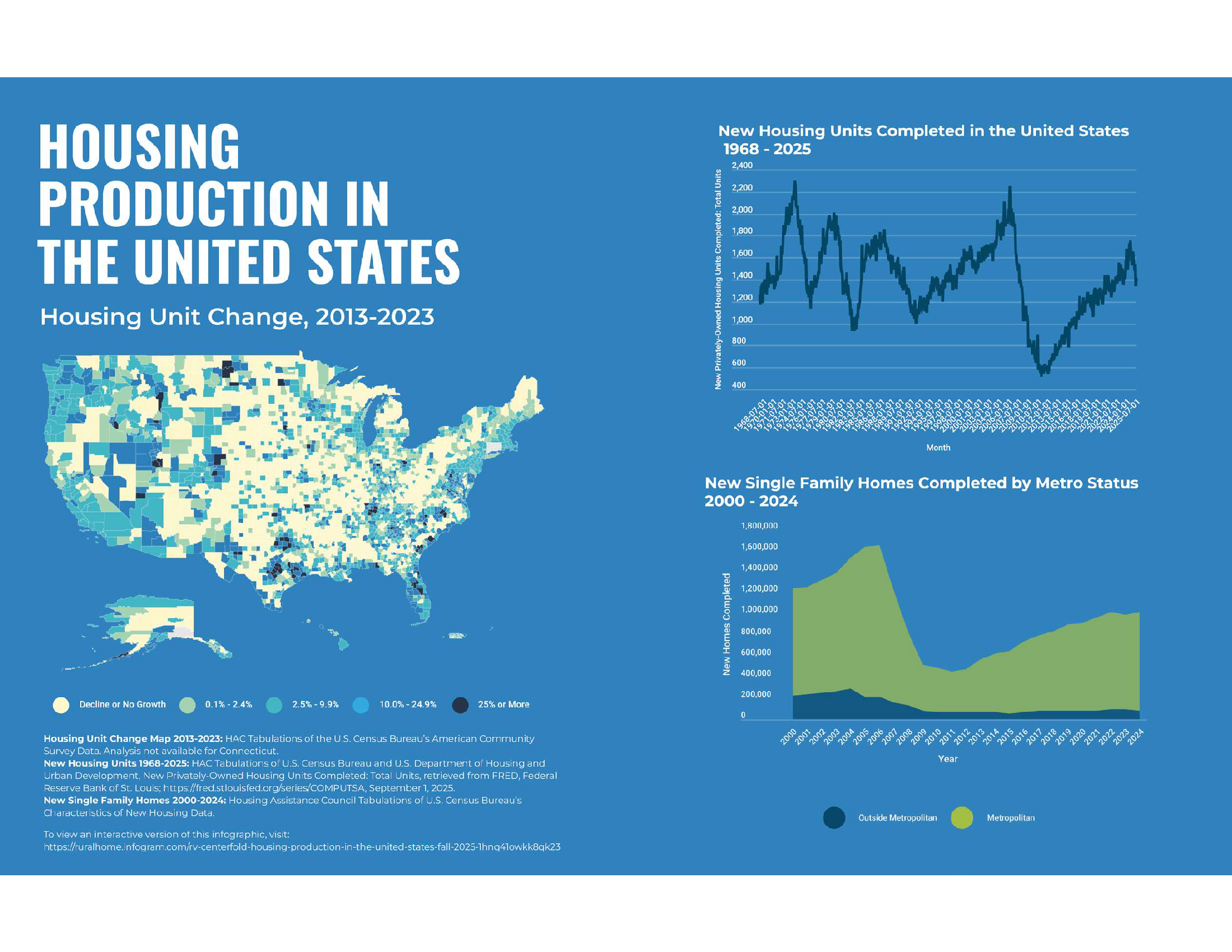
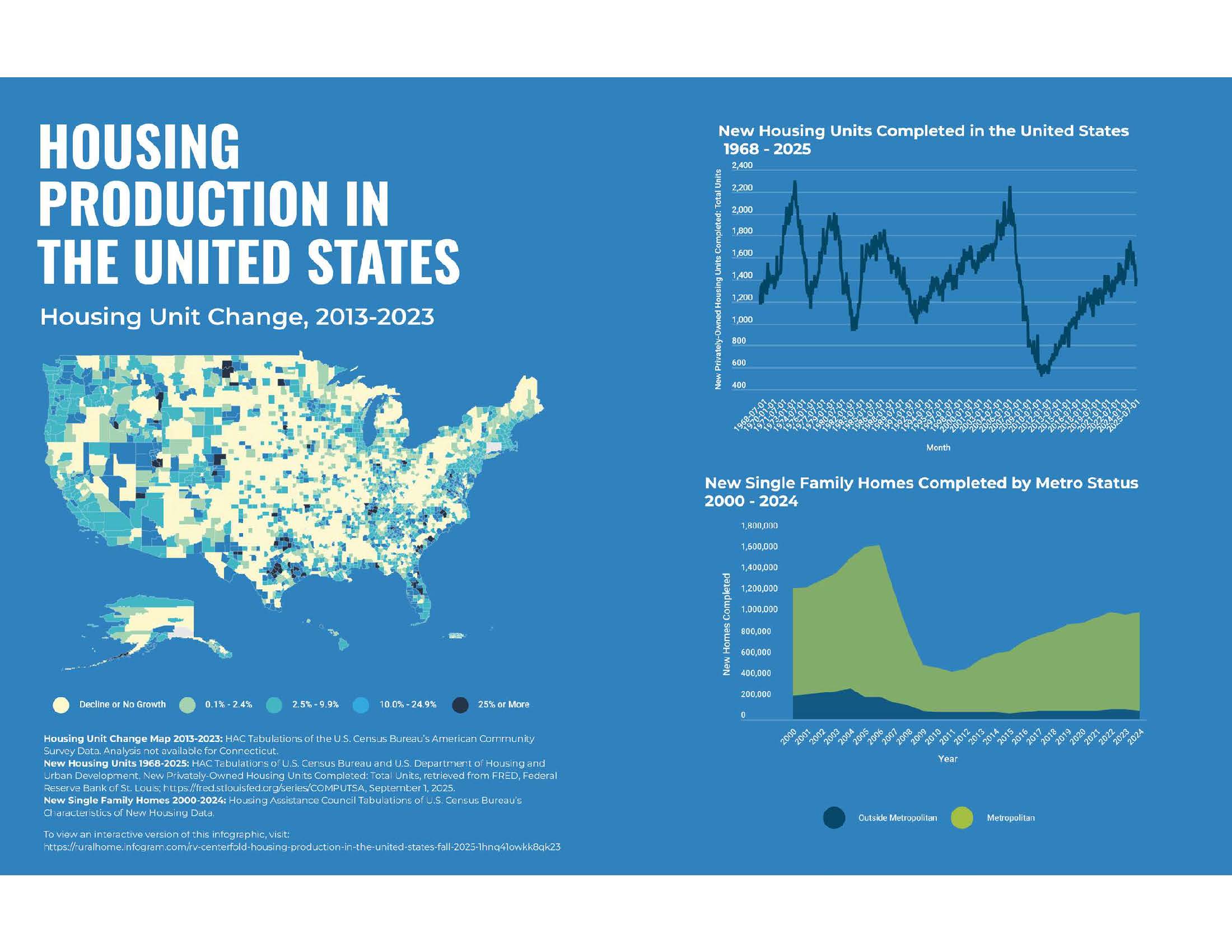
Between 2013 and 2023, rural counties experienced an estimated 1% overall increase in their housing stock compared to a 10% increase for non-rural counties. HAC’s analysis reveals that rural counties experienced a relatively minor increase in new homes constructed over the 10-year period. Simultaneously, there was a substantial reduction in the existing rural housing stock. Homes built before 2013 declined by 6.5% in rural counties, compared to only a 1.6% decline for non-rural counties. This 1.62 million rural housing unit decline offset many of the 1.87 million new homes constructed or placed, resulting in an estimated 246,053 net increase in rural homes. Source: HAC tabulations of U.S. Census Bureau’s American Community Survey.
The American Council for an Energy-Efficient Economy will provide free technical assistance to local governments and their community-based partners for programs that support rental efficiency upgrades while also preserving and/or expanding housing affordability. This TA can guide research, community engagement, program reviews, and development of implementation guidance, focused primarily on growing local governments’ and CBOs’ knowledge, resources, and information sharing. ACEEE will hold an informational webinar on November 18. Applications are due January 9.
The Justice Department has determined that the Consumer Financial Protection Bureau cannot draw more funds from the Federal Reserve – its usual method of obtaining operating resources – and will run out of funding within a few months unless Congress appropriates money for it. Courts have previously ruled against Justice’s interpretation of the governing statute, Politico reports, and a congressional appropriation seems unlikely.
The Consumer Financial Protection Bureau has proposed revisions to its regulations implementing the Equal Credit Opportunity Act, which applies to mortgage lending as well as other types of lending. The changes would eliminate recognition of disparate impact claims, revise provisions related to discouraging applicants, and change standards for special purpose credit programs. Comments are due December 15.
In April 2024, HUD and USDA adopted updated energy efficiency requirements for new construction under some of their programs. These standards have gone into effect for HUD’s HOME and Housing Trust Fund programs, but earlier this year both HUD and USDA delayed the effective dates for other programs. In July, the agencies requested comments on the standards, saying they were reviewing them again. Now HUD has extended the compliance date to May 28, 2026 for the Federal Housing Administration’s multifamily and single-family insurance programs, the Public Housing Capital Fund, and Section 8 project-based vouchers. The compliance dates for Choice Neighborhoods, Section 202, and Section 811 are extended until the FY26 funding notices for those programs are issued. HAC has supported adoption and implementation of these standards.
The Federal Housing Finance Agency, which oversees Fannie Mae and Freddie Mac, issued a report on their 2024 achievements related to housing goals, Duty to Serve goals, and funding allocations for the Housing Trust Fund and Capital Magnet Fund. Both met their single-family and multifamily housing goals, except for Fannie Mae’s single-family very low-income home purchase goal. Both also met their Duty to Serve goals, with both rated Low Satisfactory for rural housing activities.
Resources for Disaster Response, Recovery, and Resilience: A Toolkit for Advocates and Community-Based Organizations offers communication tools that advocates can utilize before and after disasters. Published by the National Low-Income Housing Coalition, the toolkit is designed to arm organizations grappling with a disaster or preparing for a future disaster with information, enabling them to easily understand major issues that may arise during disaster recovery and respond effectively through advocacy.
The Center for Indian Country Development at the Federal Reserve Bank of Minneapolis surveyed Native Community Development Financial Institutions nationwide. CICD reports that 94% are nonprofit organizations and 73% are independent entities rather than Tribally owned. More of them offer home improvement loans than home purchase loans (39% compared to 29%). When loans become delinquent, Native CDFIs tend to rely on nonpunitive measures such as working with borrowers to restructure their loans. More than half (52%) reported that scarcity of capital has been one of their biggest challenges. Other reported challenges include hiring staff, lack of donor awareness, lack of potential client awareness, infrastructure, geographic location, and funder requirements.
Counties outside metropolitan areas, as a whole, lost population for much of the 2010s, but from 2021 to 2024 their populations grew, according to Post-Pandemic Migration Has Reshaped Rural Population Change, a recent blog post from Harvard’s Joint Center for Housing Studies. The growth was driven by a sharp increase in domestic migration and a smaller increase in international migration, which together offset aggregate natural population loss (more deaths than births). Counties farther from metro areas saw smaller increases in migration than counties adjacent to metro areas. Now, the research indicates, migration is slowing while natural population loss is increasing, leaving non-adjacent counties at higher risk of near-term population loss.
HAC job listings and application links are available on our website.
HAC’s loan fund provides low interest rate loans to support single- and multifamily affordable housing projects for low-income rural residents throughout the U.S. and territories. Capital is available for all types of affordable and mixed-income housing projects, including preservation, new development, farmworker, senior and veteran housing. HAC loan funds can be used for pre-development, site acquisition, site development, construction/rehabilitation and permanent financing. Contact HAC’s loan fund staff at hacloanfund@ruralhome.org, 202-842-8600.
Please note: HAC is not able to offer loans to individuals or families. Borrowers must be nonprofit or for-profit organizations or government entities (including Tribes).
Please credit the HAC News and provide a link to HAC’s website. Thank you!
Rural America needs – and deserves – more housing. The vitality of small towns
and Tribal lands across the country depends on it. While often overlooked in
national conversations about housing and community development, rural areas
are home to approximately 60 million people, many of whom are essential workers
in food production, education, energy, healthcare, and public safety. Yet these
communities struggle with an aging housing stock, limited new construction, and
infrastructure challenges.
The healthiest and most vibrant rural places are finding ways to build and preserve
housing that local residents can afford. New home construction is critical to
attracting and retaining a workforce, replacing an aging and substandard housing
stock, recovering from natural disasters and helping people invest in the place
they call home.
HAC hopes this issue of Rural Voices can illuminate how access to data, resources,
and innovations can better enable solid decisions, strategies, and solutions
for adding housing in rural communities across the nation. The rural voices in
this issue include experts, practitioners, policymakers, and community-based
organizations that seek to produce more and better housing in rural America. They
share tools, processes, and advice about building in today’s housing landscape.
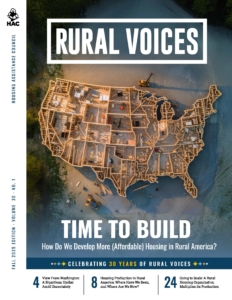
Housing Supply
by Jonathan Harwitz
HAC’s Director of Policy shares his insights on the landscape of affordable housing funding with messages from Congressmen Zach Nunn (R-IA) and Emanuel Cleaver (D-MO).
Housing Production in Rural America
by Keith Wiley and Lance George
Understanding how housing production affects housing affordability in rural America.
Are Public Lands the Answer to Improving Housing Affordability?
by Megan Lawson
A closer look at whether America’s vast public lands can ease the housing crunch.
Making Choices
by Nick Mitchell-Bennett and Dr. Daniel Elkin
Innovations behind factory-built housing and the politics behind rural survival.
Going to Scale
by Tom Collishaw
Insights from a rural housing organization and how it multiplied its production.
You Can Do This Because You Are Small
by Seth Leonard
Finding capital for affordable rural housing.
The National Housing Conference has compiled information on the federal government shutdown’s impact on a range of sources of housing and community development funding. Both HUD and USDA have indicated that, despite the shutdown, they have enough funding to cover rental assistance programs for the month of November. HAC led an effort by several stakeholders who are asking USDA RD to communicate with multifamily owners and managers about Section 521 Rental Assistance, operations, transactions, and the like.
HAC would like to compile information about the shutdown’s impact on the rural communities, organizations, homeowners, and renters who rely on federal housing support. Please let us know about your situation in an email to hac@ruralhome.org.
Expanding the limitations on “reduction in force” layoffs during the shutdown, on October 28 a federal judge replaced an October 15 temporary restraining order with a preliminary injunction that will last indefinitely. Federal agencies may not enforce the RIFs already issued during the shutdown or issue additional RIFs in programs, projects, or activities where workers are represented by the unions that brought the suit. Several unions have joined the suit, which was originally brought by just two of them. The order covers large parts of the federal government, including USDA, HUD, and the Treasury Department.
Over the 20 years since Hurricane Katrina, high-population counties and parishes on the Gulf Coast have experienced the greatest dollar losses from disasters. Yet smaller counties and parishes in Louisiana and Mississippi – such as Cameron, Plaquemines, St. Bernard, and Hancock – have the highest per capita losses, exceeding $150,000 per person in 2024 dollars. Source: Urban Institute, Disasters and the Gulf Coast, 20 Years after Hurricane Katrina.
Missing Census data during the shutdown? Visit Rural Data Central. We have data for suburban and urban communities too!
The CDFI Fund has received strong support after reports that the administration sent layoff notices to the agency’s entire remaining staff. More than 100 Republican Senators and Representatives, spearheaded by Sen. Mike Crapo (R-ID) and Rep. Young Kim (R-CA), signed a letter to the Treasury Department and OMB emphasizing CDFIs’ “important role in supporting economic development in rural, tribal and other underserved communities.” Similar letters were sent by 120 House Democrats, by seven bankers associations, and by Native CDFIs, Tribal Nations, and their partners.
An October 21 memo from the Office of Management and Budget reminds federal agencies that President Trump has instructed them to repeal regulations “without notice and comment” if possible. “To date,” the OMB Memo states, “agencies do not appear to be fully maximizing their energy in carrying out these directives.” It explains some ways for agencies to approach deregulation, including presuming that required government-to-government consultations with Tribes or state and local governments can take place through the standard publication of requests for comments.
HUD has further extended the effective date of portions of its January 2025 HOME regulation. Rather than October 30, 2025, parts of the rule will now be effective on April 30, 2026.
USDA is opening about 2,100 FSA offices to enable farmers to access assistance programs, although local USDA Rural Development field offices remain closed. The department took similar action during the 2018-2019 government shutdown.
Two new Urban Institute analyses using data on Ohio’s state-level Opportunity Zones program confirm previous findings on the national OZ program. The Geographic Spread of Opportunity Zone Capital points out that – before the July 2025 program changes to support rural places – the tax incentive did not draw investment to all designated OZs; rural areas and small cities received less support than large cities. Insights into Opportunity Zone Project Types reports that Ohio’s program supported residential real estate more than other kinds of development but the housing it produced was not necessarily affordable. When users did develop affordable housing, they combined the OZ incentive with other resources such as Low-Income Housing Tax Credits or the HOME program.
According to a blog post by Harvard’s Joint Center for Housing Studies, home prices continued to outpace incomes in many large markets across the country last year. After a minor drop in 2023, home price-to-income ratios continued to rise in 2024 to match high post-pandemic levels. The article includes interactive graphics that illustrate affordability changes in the largest metropolitan areas across the country from 1980 to 2024.
Insurance for Good provides a resources page with information about residual insurance from state or federal programs, which fills gaps when homeowners cannot find or afford insurance in the private market. These programs take a variety of forms, including earthquake insurance in California and the now-expired National Flood Insurance Program.
Essential Funding for Essential Housing, a policy brief from the National Association of Affordable Housing Lenders and the Center for Affordable Housing Lending, describes the critical role that federal funds play in building and maintaining affordable rental housing. It depicts the layers of needed funding – the capital stack – as a Jenga game, where a disruption in one source can lead to the collapse of the entire thing.
HAC job listings and application links are available on our website.
HAC’s loan fund provides low interest rate loans to support single- and multifamily affordable housing projects for low-income rural residents throughout the U.S. and territories. Capital is available for all types of affordable and mixed-income housing projects, including preservation, new development, farmworker, senior and veteran housing. HAC loan funds can be used for pre-development, site acquisition, site development, construction/rehabilitation and permanent financing. Contact HAC’s loan fund staff at hacloanfund@ruralhome.org, 202-842-8600.
Please note: HAC is not able to offer loans to individuals or families. Borrowers must be nonprofit or for-profit organizations or government entities (including Tribes).
Please credit the HAC News and provide a link to HAC’s website. Thank you!