If you need information on affordable rural housing and rural America in a quick, easy-to-digest format, you need the HAC News.

HAC News: January 15, 2019

News Formats. pdf

January 15, 2019
Vol. 48, No. 1

Federal shutdown puts USDA loans on hold, tenants in limbo • National call about shutdown to include HAC • Some HUD Project-Based Rental Assistance contracts expiring during shutdown • House passes USDA and HUD funding bills • Regulators consider requiring evaluations for rural properties, raising appraisal threshold • Fannie Mae implements appraisal waiver in rural high need markets • RD plans to begin accepting Section 538 guarantee applications continuously • Podcast covering affordable housing and community development will feature HAC’s David Lipsetz • Site selection criteria issued for ERS and NIFA relocations • Patenaude resigns HUD position • Broadband access on tribal land lags national averages • White paper reports savings from energy and water efficiency for low- and middle-income renters • Rural Statistic: USDA Section 515 majority minority properties

HAC News Formats. pdf

January 15, 2019
Vol. 48, No. 1

Federal shutdown puts USDA loans on hold, some tenants’ future funding uncertain.
USDA and HUD are currently shut down. They are among the federal agencies permitted to conduct only essential business since their appropriations expired on December 22. Limited functions are continuing at USDA’s national office in Washington, DC and the Customer Service Center in St. Louis, but loan closings are not taking place and applications are not being processed. HAC will continue to post information about the shutdown on our website as it becomes available. To read accounts of the shutdown’s impact from local organizations around the country, visit the National Rural Housing Coalition’s website. The effect is being felt by homebuyers, self-help groups, farmworker housing construction, rental housing rehabilitation and organizational budgets. RD staff provided a great service by getting December’s Section 521 Rental Assistance payments made on schedule in early January, and have unofficially assured HAC and others that January’s RA payments will be made in early February. RA payments each month are for the RA contracts that expired during that month, and obligate a full year of RA funding. It is HAC’s understanding that if the shutdown continues into February, RA contracts expiring that month will not be paid. It is not clear whether Section 542 vouchers will be paid for February.

National call about shutdown to include HAC.
HAC CEO David Lipsetz will join a national call providing updates on the shutdown’s effects on affordable housing and community development programs. The call will be held Tuesday, January 15 at 4:00 Eastern, and is arranged by the National Low Income Housing Coalition. Register here.

Some HUD Project-Based Rental Assistance contracts expiring during shutdown.
About 21,500 households with average incomes under $13,000 per year are impacted by the expiration of 650 PBRA contracts that ended in December, and more are expiring in January and February. HUD will determine whether it has funds available to renew them. Property owners can use their reserves, if available, to cover shortfalls. Public housing capital funding is unavailable, and operating funds cannot carry public housing authorities beyond February.

House passes USDA and HUD funding bills.
Attempting to reopen the federal government, on January 10 the House passed H.R. 265, which would provide USDA appropriations for FY19, and H.R. 267 to fund the departments of Transportation and HUD. Senate Majority Leader Mitch McConnell (R-KY) reportedly does not plan to hold Senate votes on these or other measures that are not supported by President Trump.

Regulators consider requiring evaluations for rural properties, raising appraisal threshold.
The federal agencies that regulate banks and thrifts have proposed revising their appraisal rules to require evaluations (not appraisals) of property value for loans of less than $400,000 secured by rural real estate. Also, loans under $400,000 (rather than the current $250,000) for residential real estate with four or fewer units in any geographic area would receive evaluations rather than appraisals. Comments are due February 5. For more information, contact G. Kevin Lawton, OCC, 202-649-6670.

Fannie Mae implements appraisal waiver in rural high need markets.
For home purchase transactions meeting certain criteria and located in rural high-needs areas, Fannie Mae may waive an appraisal in exchange for a home property inspection. This waiver seeks to address appraisal complexities in remote rural markets and help low-income borrowers avoid unanticipated, potentially high-cost, post-purchase repairs.

RD plans to begin accepting Section 538 guarantee applications continuously.
Comments are due February 15 on a USDA proposal to stop issuing annual Notices of Funding Availability (NOFAs) for the Section 538 multifamily guarantee program. RD would accept applications at any time, using the standards from the most recent NOFA, which was published December 21, 2017. For more information (when USDA reopens), contact Monica Cole, RD, 202-720-1251.

Podcast covering affordable housing and community development will feature HAC’s David Lipsetz.
The Holistic Housing Podcast, hosted by NACCED, brings together thought leaders, policy makers and program implementers across the affordable housing, community development and economic development field. David Lipsetz, HAC’s CEO, will appear later in January discussing the unique nature of affordable housing and community development in rural communities. The podcast is available on iTunes, Stitcher, and TuneIn.

Site selection criteria issued for ERS and NIFA relocations.
In December, USDA Secretary Sonny Perdue announced the department will use criteria related to quality of life, costs, workforce and logistics/IT infrastructure in evaluating the proposals to house the relocated Economic Research Service and National Institute of Food and Agriculture. The Department announced its plan to move these vital agencies in August, basing the decision on “cost savings” despite having conducted no analysis or review of the cost. HAC has raised concerns that the move will further erode the voice of rural communities in federal policy.

Patenaude resigns HUD position.
On December 17, Deputy Secretary Pamela Hughes Patenaude announced she will leave HUD early in 2019. Media reports say FHA Commissioner Brian Montgomery will serve as Acting Deputy Secretary.

Broadband access on tribal land lags national averages.
On reservations, fewer than 55% of households have broadband access, compared to a 78% average for the nation and a 65% average for rural counties. Low rates of access are related to low incomes found on reservations, but lowered access also inhibits larger economic growth, reports the Center for Indian Country Development at the Minneapolis Federal Reserve. Tribes are working to increase access on reservations.

White paper reports savings from energy and water efficiency for low- and middle-income renters.
A new Freddie Mac paper, “Green Improvements in Workforce Housing,” examines the effects of the Green Advantage program, which finances water- and energy-saving upgrades in multifamily workforce housing. Borrowers focused on water-savings improvements, with a projected average cost of $470 per unit and projected average savings of $220 per unit per year.

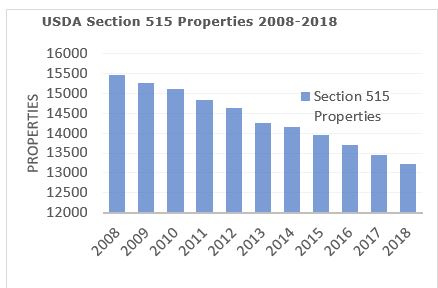
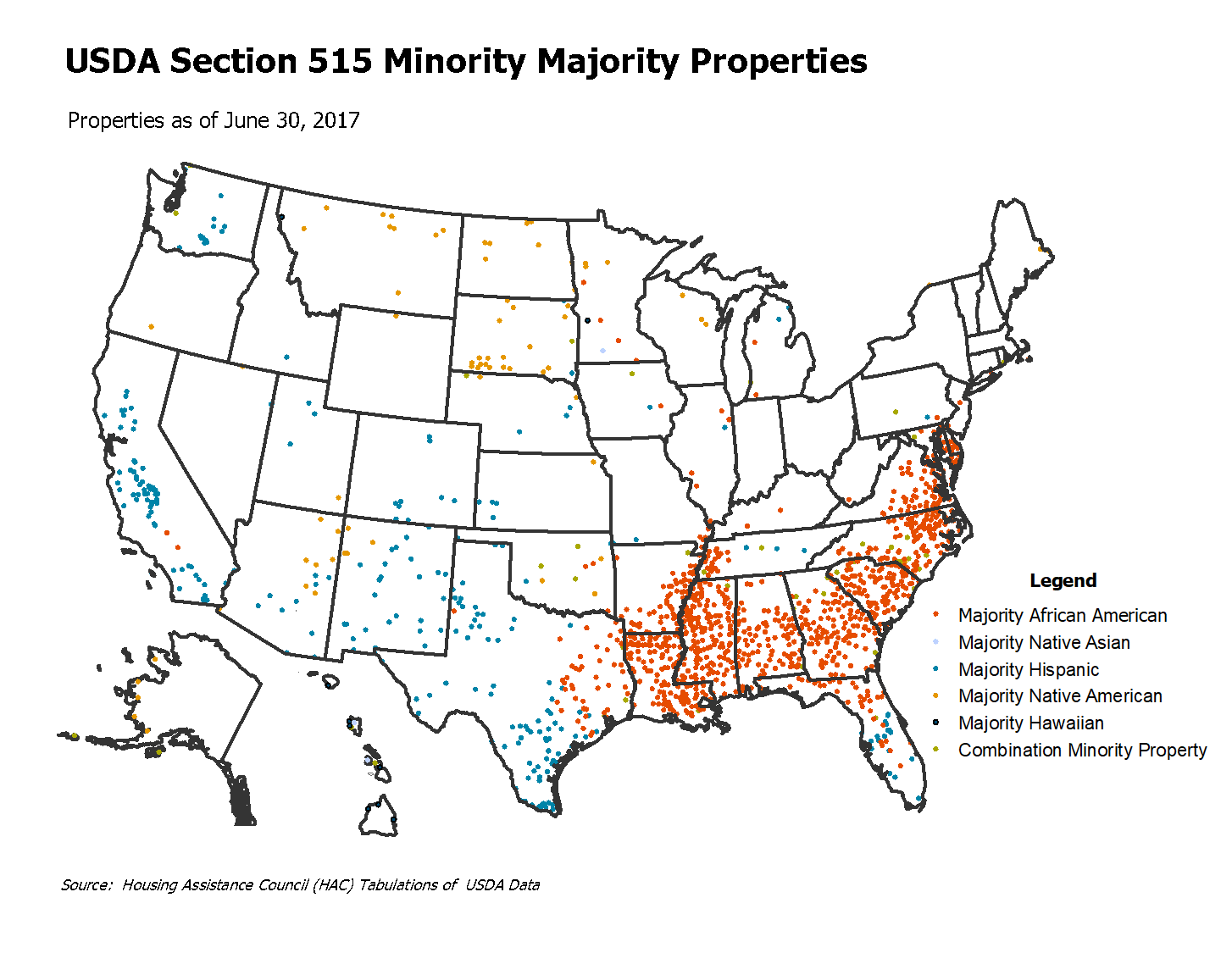
Rural Statistic: USDA Section 515 majority minority properties. In approximately 2,447 USDA Section 515 rural rental housing properties (79,406 occupied units) the majority of the tenants are racial or ethnic minorities. For more information on resident characteristics in USDA’s rural rental housing see HAC’s recently published report, Rental Housing for A 21st Century Rural America.

515

Need capital for your affordable housing project?
HAC’s loan funds provide low interest rate loans to support single- and multifamily affordable housing projects for low-income rural residents throughout the U.S. and territories. Capital is available for all types of affordable and mixed-income housing projects, including preservation, farmworker, senior and veteran housing. HAC loan funds can be used for pre-development, site acquisition, site development and construction/rehabilitation. Contact HAC’s loan fund staff at hacloanfund@ruralhome.org, 202-842-8600.
Please note: HAC is not able to offer loans to individuals or families. Borrowers must be nonprofit or for-profit organizations or government entities (including tribes).
HAC News: December 14, 2018

HAC News Formats. pdf

December 14, 2018
Vol. 47, No. 25

2018 HAC Rural Housing Conference educates, inspires, and advances the rural housing community. • Federal Reserve Board of Governors chairman Jerome Powell addresses HAC conference • HAC awards recognize national, local and federal leadership for rural housing • USDA and HUD spending now expiring December 21 • Congress passes Farm Bill • Increased staff specialization planned for USDA Rural Development • Mark Calabria named to lead Federal Housing Finance Agency • Kathy Kraninger becomes head of Consumer Financial Protection Bureau • Perdue announces RD initiative for broadband and e-connectivity • Executive Order encourages development in Opportunity Zones • HAC’s Rural Voices magazine covers capacity building • Census Bureau releases new data for counties, towns, Native lands and more • Study examines trust lands and manufactured homes in Indian Country

HAC News Formats. pdf

December 14, 2018
Vol. 47, No. 25

2018 HAC Rural Housing Conference educates, inspires, and advances the rural housing community.
Over 600 registrants from 48 states heard from Federal Reserve Chairman Jerome Powell (see item below), Sen. Catherine Cortez Masto (D-NV), HUD Secretary Ben Carson, Rusty Smith from Rural Studio , HAC CEO David Lipsetz, former HAC Executive Director Moises Loza and former Deputy Director Joe Belden, as well as USDA and HUD staff and dozens of other experts. Materials from conference sessions are available through the conference app . Check out photos, comments and daily wrap-up videos on HAC’s social media: Twitter , Facebook , and YouTube . Watch HAC’s website and the HAC News for announcements as additional items, including videos of plenary sessions, become available.

Federal Reserve Board of Governors chairman Jerome Powell addresses HAC conference.
Speaking at the HAC Rural Housing Conference on December 6, Chairman Powell discussed the strength of the economy while acknowledging that not everyone has enjoyed the benefits of the strong economy equally. He stressed the importance of the Community Reinvestment Act and praised HAC’s research on the subject as beneficial to the Fed’s plans around potential CRA reform. His remarks garnered press coverage from the New York Times and Reuters.

HAC awards recognize national, local and federal leadership for rural housing.
At the 2018 HAC Rural Housing Conference, the Cochran/Collings Award for Distinguished Service in Housing for the Rural Poor went to Starry Krueger, President of the Rural Development Leadership Network. Four local leaders received the Skip Jason Community Service Award: Salvador Estrada (Tierra del Sol, NM), Cassie Hicks (University of Southern Mississippi Institute for Disability Studies, MS), Dennis Lalor (South County Housing, CA) (posthumous) and Joe Myer (NCALL Research, DE). Rep. Maxine Waters (D-CA) received the Henry B. González Award for an elected official.

USDA and HUD spending now expiring December 21.
The deadline for negotiations on FY19 appropriations was extended to December 21 because congressional activity was slowed by the death of former President George H.W. Bush on November 30. Various end results, including a government shutdown, are still possible.

Congress passes Farm Bill.
House and Senate conferees reached an agreement on a new five-year Farm Bill, dropping provisions that would have imposed stricter work requirements on food stamp recipients. The Senate passed it on December 11 and the House on December 12. President Trump is expected to sign it into law. The bill requires USDA to have an Under Secretary for Rural Development and requires the appointee be confirmed by the Senate. The Under Secretary position had been eliminated in a 2017 reorganization, replaced by an Assistant to the Secretary for Rural Development. Anne Hazlett has served in that role since June 2017. The bill also maintains local eligibility for USDA rural housing programs after the 2020 Census, so long as a place’s population does not exceed 35,000 and it remains “rural in character.” The bill authorizes a new Rural Innovation Stronger Economy (RISE) grant program, a concept HAC supported, to create rural job accelerators and related programming. HAC and others suggested additional improvements to the bill’s Rural Development title, but in general the 2018 RD title is much like the 2014 version.

Increased staff specialization planned for USDA Rural Development.
At the 2018 HAC Rural Housing Conference, RD officials explained some staffing changes, which are also described in letters from Secretary of Agriculture Sonny Perdue to members of the House and Senate Agriculture Appropriations Subcommittees. An October 10 letter says that applications for the Section 538 rental guarantee program and Section 515 rental loan program will no longer be processed or underwritten in each state office. Twenty-five staff, who will remain in their current state office locations, will work exclusively on either 538 or 515. According to a November 30 letter, instead of handling the Section 502 guaranteed program in each of the 47 state offices, the agency will create a single unit, so the program will be delivered by 275 employees rather than 300. In addition, appraisers, architects, engineers, and others will be “realigned” into the RD Business Center. The November letter says that affected staff will remain in their current locations and implies that unneeded staff will be reassigned rather than laid off. The November letter enumerates other changes being made in the RUS, RBS, and Community Facilities staffs, and additional changes are described in the HAC News, 11/30/18.

Mark Calabria named to lead Federal Housing Finance Agency.
President Trump will nominate Calabria, currently chief economist for Vice President Mike Pence, to serve a five-year term as director of FHFA, which regulates Fannie Mae, Freddie Mac, and the Federal Home Loan Bank system. The term of Melvin Watt, the current director, ends in January. FHFA director nominees must be confirmed by the Senate.

Kathy Kraninger becomes head of Consumer Financial Protection Bureau.
Kraninger, most recently an associate director at the Office of Management and Budget, was confirmed by the Senate on December 6 and sworn in on December 10. She takes over from Mick Mulvaney, head of OMB, who has been CFPB’s acting director.

Perdue announces RD initiative for broadband and e-connectivity.
On December 13 Secretary of Agriculture Sonny Perdue announced a new ReConnect Program to provide broadband infrastructure in rural areas with populations under 20,000. State and local governments, tribes, nonprofits, for-profits, limited liability companies, and coops are eligible for funding. Applications for grants are due April 29, for loan and grant combinations May 29, and for low-interest loans June 28. For more information, contact Chad Parker, RUS, 202-720-9555.

Executive Order encourages development in Opportunity Zones.
On December 12, President Trump signed an order creating a White House Opportunity and Revitalization Council, to be comprised of 13 federal agencies and chaired by HUD Secretary Ben Carson. The council is charged with targeting existing federal programs to “urban and economically distressed areas,” including Opportunity Zones, and to engage with all levels of government on revitalizing low-income communities. A list and map of all Opportunity Zones are available on the CDFI Fund’s website. A supportive statement issued by Anne Hazlett, USDA Assistant to the Secretary for Rural Development, says “USDA Rural Development programs will award priority points on applications from private sector intermediaries for projects built in opportunity zone census tracts as well as in other select programs for projects that directly benefit communities located in Opportunity Zones.”

HAC’s Rural Voices magazine covers capacity building.
The conference issue of Rural Voicesdescribes what it means to build the capacity of rural housing organizations, why it is important, who does it, how it is done and how it is financed.

Census Bureau releases new data for counties, towns, Native lands and more.
The newest American Community Survey data has been released on the Census Bureau’s American Fact Finder website. This five-year data provides estimates of demographic characteristics, income, housing, education and other subjects for states, counties, and smaller areas such as zip codes, census tracts, and American Indian Areas/Alaska Native Areas/Hawaiian Home Lands. For the first time, broadband-related data is included.

Study examines trust lands and manufactured homes in Indian Country.
The Center for Indian Country Development at the Federal Reserve Bank of Minneapolis has released new research, reported in a blog post titled “Race, Location, and Manufactured-Home Loans on American Indian Reservations.” They examine the statistically higher rate of loan applications at the intersection of manufactured housing, American Indian identity, and reservation trust land. Much of this research was shared at the 2018 HAC Rural Housing Conference session “Homeownership in Indian Country – Creating the Opportunity for Choice.”

Happy holidays from HAC!
The board and staff of the Housing Assistance Council wish peace, prosperity and affordable housing to all! HAC’s offices will be closed from December 24 to January 1.

Need capital for your affordable housing project?
HAC’s loan funds provide low interest rate loans to support single- and multifamily affordable housing projects for low-income rural residents throughout the U.S. and territories. Capital is available for all types of affordable and mixed-income housing projects, including preservation, farmworker, senior and veteran housing. HAC loan funds can be used for pre-development, site acquisition, site development and construction/rehabilitation. Contact HAC’s loan fund staff at hacloanfund@ruralhome.org, 202-842-8600.
Please note: HAC is not able to offer loans to individuals or families. Borrowers must be nonprofit or for-profit organizations or government entities (including tribes).
HAC News: November 30, 2018

HAC News Formats. pdf

November 30, 2018
Vol. 47, No. 24

REP. MAXINE WATERS TO SPEAK AT 2018 HAC RURAL HOUSING CONFERENCE • FY19 spending set to expire December 7 for part of U.S. government • Affordable Housing Program regulation changes finalized • RD offers energy efficiency loans to rural electric service providers for relending • Rural Broadband Access Loans and Loan Guarantees available • GAO recommends ways to improve tribal access to broadband • Rural statistic: rural bank deserts • USDA RD posts several guidance documents on multifamily properties • Coalition analyzes HUD intent to reduce public housing stock • Authority for environmental matters and single-family loan servicing transferred away from Rural Housing Service • Disaster recovery funding underused for vulnerable populations

HAC News Formats. pdf

November 30, 2018
Vol. 47, No. 24

REP. MAXINE WATERS TO SPEAK AT 2018 HAC RURAL HOUSING CONFERENCE.
On-site registration will begin at 8 a.m. on Tuesday, December 4 for the conference , to be held December 4-7 at the Capital Hilton in Washington, DC. Other confirmed speakers include Federal Reserve Chair Jerome Powell , Senator Catherine Cortez Masto (D-NV), and HUD Secretary Ben Carson . The conference agenda is online.

FY19 spending set to expire December 7 for part of U.S. government.
USDA and HUD, along with a number of other federal departments and agencies, are still operating under a continuing resolution that ends December 7. Because of the ongoing dispute on spending for a U.S.-Mexico border wall, it is not yet clear whether Congress will approve appropriations, use a short-term continuing resolution to extend negotiations, or adopt a long-term CR to keep FY18 funding levels in place for the rest of FY19, which began October 1. President Trump could veto whatever Congress passes, leading to a partial government shutdown.

Affordable Housing Program regulation changes finalized.
Amendments to the program’s governing rule make numerous changes, including giving individual Federal Home Loan Banks additional authority to allocate their AHP funds and authorizing the Banks to establish separate competitive funds that target specific affordable housing needs in their districts. The changes will take effect gradually through January 1, 2021. For more information, contact Ted Wartell, FHFA, 202-649-3157.

RD offers energy efficiency loans to rural electric service providers for relending.
Rural Energy Savings Program loans are available to utility districts, local governments, nonprofits, and other entities that provide rural electric service. Recipients will reloan the funds to customers for energy efficiency improvements or to replace a manufactured housing unit with another, energy efficient manufactured home. Letters of intent are due September 30, 2019. For more information, contact Robert Coates, RUS, 202-260-5415.

Rural Broadband Access Loans and Loan Guarantees available.
The Rural Utilities Service will accept applications through September 30, 2019 from nonprofits, tribes and state or local governments for construction, improvement and acquisition of broadband facilities and equipment. Applications will be evaluated every 90 days. Loan guarantees will not be available in FY19. For more information, contact Shawn Arner, RUS, 202-720-0800.

GAO recommends ways to improve tribal access to broadband.
A 2018 Federal Communications Commission analysis estimated that 35% of Americans living on tribal lands lack broadband service, compared to 8% of Americans overall. FCC concluded that increased access to available radio frequency spectrum could expand broadband service on tribal lands. Tribal Broadband: FCC Should Undertake Efforts to Better Promote Tribal Access to Spectrum, a new Government Accountability Office report, recommends how the FCC could increase tribes’ ability to use available spectrum. For more information, contact Mark Goldstein, GAO, 202-512-2834.

Rural statistic: rural bank deserts.
An increasing number of rural areas lack any access to traditional depository institutions and their products. Approximately 274 counties – almost exclusively rural – have one or less bank branch or have only small-asset lender branches, limiting their ability to fully engage with resources such as the Community Reinvestment Act. For more information on rural banks and CRA, please visit HAC’s resource page on the Community Reinvestment Act in rural America.

USDA RD posts several guidance documents on multifamily properties.
Administrative Notice 4862 explains the process of obtaining professional resources for large portfolio deals and the use of the contract method for construction and/or renovation of new or existing multifamily properties. Allowable expenses that can be paid by project income in Section 514 and 515 rental properties are clarified in an Unnumbered Letter (Sept. 21, 2018). Changes to policies and procedures for supervised bank accounts of multifamily properties are explained in an Unnumbered Letter (Sept. 28, 2018). An Unnumbered Letter (Oct. 26, 2018) provides guidance in the development of rent incentive options to address high vacancies.

Coalition analyzes HUD intent to reduce public housing stock.
A November 13 letter from HUD to public housing agency directors promotes the “repositioning” of their units with “a goal to reposition 105,000 public housing units to a more sustainable platform by September 30, 2019.” The National Low Income Housing Coalition posted the letter and an analysis. Some units could be converted to vouchers through the Rental Assistance Demonstration and others demolished. HUD’s letter promises forthcoming guidance on two other options: voluntary conversions to vouchers and releasing the “declarations of trust” that give HUD a formal legal interest in public housing property.

Authority for environmental matters and single-family loan servicing transferred away from Rural Housing Service.
USDA has announced that some authority related to environmental laws has been transferred to the Rural Development Business Center from the Rural Housing Service, Rural Business-Cooperative Service and Rural Utilities Service. Authority to service RHS single-family loans is also moving to the RD Business Center. Anne Hazlett, Assistant to the Secretary for RD, has been given the power to transfer loan servicing for multifamily housing, community facilities, RUS and RBS to the RD Business Center in the future. For more information, contact Melissa McClellan, USDA, 202-720-5565.

Disaster recovery funding underused for vulnerable populations.
In a November 15 webinar the Disaster Housing Recovery Coalition explained how federal disaster assistance programs have failed to address the housing needs of disaster survivors, especially for low-income and minority populations. The coalition recommends congressional oversight hearings and legislation to ensure survivors get the housing disaster recovery assistance they need on a timely basis without racial disparities.

Need capital for your affordable housing project?
HAC’s loan funds provide low interest rate loans to support single- and multifamily affordable housing projects for low-income rural residents throughout the U.S. and territories. Capital is available for all types of affordable and mixed-income housing projects, including preservation, farmworker, senior and veteran housing. HAC loan funds can be used for pre-development, site acquisition, site development and construction/rehabilitation. Contact HAC’s loan fund staff at hacloanfund@ruralhome.org, 202-842-8600.
Please note: HAC is not able to offer loans to individuals or families. Borrowers must be nonprofit or for-profit organizations or government entities (including tribes).
HAC News: November 9, 2018

HAC News Formats. pdf

November 11, 2018
Vol. 47, No. 23

EARLY BIRD RATE EXTENDED FOR 2018 HAC RURAL HOUSING CONFERENCE, NEW SPEAKERS ANNOUNCED • House committee leadership will change under Democratic majority • Congress to return for lame-duck session • November is National Native American Heritage Month • National Hunger and Homelessness Awareness Week is November 10-18 • HUD offers funds for public and private entities doing fair housing work. • Revisions proposed to Federal Home Loan Bank housing goals regulation • Labor Department proposes online ads for U.S. farmworkers • Online tool refined for rural mortgage eligibility • Creative placemaking webinar series announced • New HUD database lists fair housing organizations • Report describes use of state housing trust funds in rural areas • HUD report looks at who uses homebuyer education and housing counseling • New resource guide offered to help address rural opioid epidemic

HAC News Formats. pdf

November 11, 2018
Vol. 47, No. 23

EARLY BIRD RATE EXTENDED FOR 2018 HAC RURAL HOUSING CONFERENCE, NEW SPEAKERS ANNOUNCED.
By popular demand, early bird registration rates have been extended! Register now for the conference, to be held December 4-7 at the Capital Hilton in Washington, DC. Federal Reserve Chair Jerome Powell and Senator Catherine Cortez Masto (D-NV) are now confirmed as speakers, as is HUD Secretary Ben Carson.

House committee leadership will change under Democratic majority.
Control of House committees will shift to Democrats when the 116th Congress takes office in January. Rep. Maxine Waters (D-CA) is expected to become Chair of the House Financial Services Committee, which has jurisdiction over matters related to authorizing housing programs, including USDA’s rural housing programs. Important Appropriations Committee changes will be in the Agriculture and Transportation-HUD subcommittees, where Rep. Sanford Bishop (D-GA) and Rep. David Price (D-NC), respectively, are currently the top Democratic members. Rep. Collin Peterson (D-MN) is likely to Chair the House Agriculture Committee, with jurisdiction over the Farm Bill.

Congress to return for lame-duck session.
The 115th Congress will be back in session beginning November 13 and will need to finish appropriations for fiscal year 2019, which began October 1. USDA, HUD, and several other federal agencies are funded under a continuing resolution through December 7, so full-year funding or another short-term CR will be needed.

November is National Native American Heritage Month.
President Trump’s proclamation also recognizes November 23 as Native American Heritage Day.

National Hunger and Homelessness Awareness Week is November 10-18.
Participating groups around the country will hold educational, service, fundraising and advocacy events during the week, sponsored by the National Coalition for the Homeless and the National Student Campaign Against Hunger and Homelessness.

HUD offers funds for public and private entities doing fair housing work.
Fair Housing Initiatives Program grants are available from three programs, each with a December 19 application deadline: the Education and Outreach Initiative, the Fair Housing Organization Initiative, and the Private Enforcement Initiative. For more information, contact Myron Newry, HUD.

Revisions proposed to Federal Home Loan Bank housing goals regulation.
A proposed rule from the Federal Housing Finance Agency would replace four separate goals for single-family affordable housing with one, set a separate housing goal for small lenders, and make other changes. Comments are due January 31, 2019. For more information, contact Ted Wartell, FHFA, 202-649-3157.

Labor Department proposes online ads for U.S. farmworkers.
Before receiving permission to hire farmworkers from outside the U.S. with H-2A temporary visas, an employer must show it has attempted to recruit U.S. farmworkers. The Department of Labor is proposing to require employers to recruit through online advertisements instead of the newspaper ads that are currently required. Secretary of Agriculture Sonny Perdue described the change as “one way to modernize H-2A.” Comments are due December 10. For more information, contact William W. Thompson, II, DOL, 202-513-7350.

Online tool refined for rural mortgage eligibility.
USDA Rural Development’s website now allows potential borrowers to enter information online in order to make a preliminary determination of eligibility for the Section 502 direct mortgage program. Anyone can enter general household composition, monthly income, other debts and credit, estimated property taxes, hazard insurance and location, and receive a preliminary eligibility determination. Potential borrowers can submit applications for official USDA determinations regardless of their eligibility assessment results.

Creative placemaking webinar series announced.
The six monthly webinars will offer practical advice for meeting the challenges of collaborative creative placemaking work in all communities. The first webinar, on November 14, will feature a Native community leader, Julie Garreau, discussing her work with the Cheyenne River Youth Project in South Dakota. The series is offered by LISC, the National Endowment for the Arts, and the Kresge Foundation.

New HUD database lists fair housing organizations.
HUD has launched a new database of fair housing organizations, providing contact information for organizations that receive HUD funding to help ensure fair housing opportunities around the U.S.

Report describes use of state housing trust funds in rural areas.
In State Housing Trust Funds: A Rural Housing Lifeline, the Center for Community Change explains how states are using housing trust funds to meet the unique needs of their rural communities. These funds are flexible in addressing a wide range of housing needs and are being used for homeownership, rental housing, and homeless prevention.

HUD report looks at who uses homebuyer education and housing counseling.
A study of low-, moderate- and middle-income prospective first-time homebuyers in 28 metro areas found that 55% of those who were offered one-on-one or remote counseling used it, and about one-third of them completed their curriculum. Who Participates in Homebuyer Education and Counseling Services and Why? reports that both initiation and completion rates were much lower for in-person services rather than remote services. Participation did not vary by race, ethnicity, age, marital status, or household size, but women and people with college educations were more likely to participate than others. Later research will consider the effectiveness of education and counseling, and whether in-person or remote services are more effective.

New resource guide offered to help address rural opioid epidemic.
USDA and the White House Office of National Drug Control Policy have released a Rural Resource Guide to Help Communities Address Substance Use Disorder and Opioid Misuse, a listing of federal programs intended to serve as a one-stop-shop to support local groups attempting to address the opioid crisis. The Rural Resource Guide is the second tool announced in USDA’s opioid Community Toolbox. The first was a Community Assessment Tool, an interactive data map.

HAC offers Section 502 packaging training in December.
This three-day advanced course trains experienced participants to assist potential borrowers and work with RD staff, other nonprofits, and regional intermediaries to deliver successful Section 502 loan packages. The training will be held December 5-7 in Washington, DC (simultaneously with HAC’s conference). For more information, contact HAC staff , 404-892-4824.

Need capital for your affordable housing project?
HAC’s loan funds provide low interest rate loans to support single- and multifamily affordable housing projects for low-income rural residents throughout the U.S. and territories. Capital is available for all types of affordable and mixed-income housing projects, including preservation, farmworker, senior and veteran housing. HAC loan funds can be used for pre-development, site acquisition, site development and construction/rehabilitation. Contact HAC’s loan fund staff at hacloanfund@ruralhome.org, 202-842-8600.
Please note: HAC is not able to offer loans to individuals or families. Borrowers must be nonprofit or for-profit organizations or government entities (including tribes).

HAC News: October 25, 2018

HAC News Formats. pdf

October 25, 2018
Vol. 47, No. 22

EARLY BIRD RATE ENDS OCTOBER 31 FOR 2018 HAC RURAL HOUSING CONFERENCE• Comments on USDA income banding proposal due October 30, HAC posts draft response • Proposed regulations released for Opportunity Zones • HUD reports homelessness fell in cities over past ten years, increased in suburban and rural areas • Indian Community Development Block Grant funds available • Information from HAC’s Community Reinvestment Act webinar posted • USDA used all Section 502 direct funding in FY 2018, Section 504 fell short • Water infrastructure bill becomes law • Census data guide the targeting of over $30 billion in federal funds per year for rural areas • New poll shows rural optimism, mixed with concern for jobs and the opioid epidemic • Changes proposed for H-2A temporary farmworker visa forms • Economic growth is uneven within rural and urban places, not just between rural and urban, researcher notes •Framing the conversation helps build support for affordable housing • Interactive maps show who’s most impacted by Hurricane Florence • Almost one-quarter of housing tax credit units may lose affordability by 2030, says new report • Housing tax credit target area designations released

HAC News Formats. pdf

October 25, 2018
Vol. 47, No. 22

EARLY BIRD RATE ENDS OCTOBER 31 FOR 2018 HAC RURAL HOUSING CONFERENCE.
Register now for the conference, to be held December 4-7 at the Capital Hilton in Washington, DC. HUD Secretary Ben Carson is confirmed as one of the keynote speakers.

Comments on USDA income banding proposal due October 30, HAC posts draft response.
On August 31 USDA published a proposed rule for its single-family housing direct loan and grant programs that would adopt a two-tier income limit structure, revise the methodology to determine area loan limits and make other changes. The proposed change to the income limit structure is intended to minimize the observed disconnect between minimum wages and the low median income in many areas. The proposed change to the methodology is intended to streamline the process and improve the reliability of the data set used to establish the area loan limits. HAC agrees that these are desirable goals, but HAC’s draft comment letter expresses concern that the proposed solutions will divert limited program resources to applicants with much higher incomes. HAC strongly urges USDA to take positive steps to assure the program continues to serve those who are most in need.

Proposed regulations released for Opportunity Zones.
The IRS’s proposed regulations and other guidance were released on October 19, explaining how individuals, corporations and others can delay or eliminate capital gains taxes by investing in Qualified Opportunity Funds that undertake development in designated Opportunity Zones. Comments will be due 60 days after publication in the Federal Register, which has not yet been scheduled. The IRS will hold a public hearing on the proposal on January 10, 2019. For more information, contact Erika C. Reigle, IRS, 202-317-7006.

HUD reports homelessness fell in cities over past ten years, increased in suburban and rural areas.
The first part of HUD’s 2017 Annual Homeless Assessment Report, released in December, focused on people who were homeless on a single night in January 2017. The just-released second part presents nationwide data on those who were homeless at any time during fiscal year 2017. It includes figures for rural (nonmetropolitan) areas, usually combining them with numbers for suburbs. From 2007 to 2017, the share of people experiencing homelessness decreased in principal cities from 76.9% to 72.5% and increased in suburban and rural areas from 23.1% to 27.5%, while the shares of population and poverty population did not change.

Indian Community Development Block Grant funds available.
Tribal governments and tribal organizations can apply by January 7, 2019 for HUD ICDBG grants to provide housing, living environments, or economic opportunities primarily for low- and moderate-income people. For more information, contact HUD staff.

Information from HAC’s Community Reinvestment Act webinar posted.
A recording and slides from HAC’s October 24 webinar on “Proposed Changes to CRA – What Does it Mean for Rural America?” is posted online. Comments on the proposed CRA changes are due to the Office of the Comptroller of the Currency by November 19.

USDA used all Section 502 direct funding in FY 2018, Section 504 fell short.
USDA obligated about $1.1 billion for 7,199 Section 502 direct loans, up from $999.99 million (7,187 loans) last year. Obligations to very low-income borrowers accounted for 33% of that total, less than last year’s 38%. Only 71% of the $28 million available for Section 504 homeowner repair loans was used, along with 94% of the $30 million for Section 504 grants; there were 206 fewer loans than in FY17 and 178 fewer grants. On the multifamily side, USDA obligated the entire $1.35 billion available for 268,514 Section 521 Rental Assistance units. Last year, it funded 302,451 units ($1.37 billion). There were also 6,353 rural housing vouchers totaling $26.7 million in FY18, compared to last year’s 5,609 vouchers representing $22.0 million. More information is provided in HAC’s obligation report, and a more detailed HAC report on FY18 performance is forthcoming.

Water infrastructure bill becomes law.
On October 23, President Trump signed into law the bipartisan Water Infrastructure Act of 2018. Intended to provide safe drinking water for communities across the country, the act includes new programs with specific priorities benefiting rural Americans.

Census data guide the targeting of over $30 billion in federal funds per year for rural areas.
The annual total for all 320 census-guided federal assistance programs – including those that are not specifically rural – was $850 billion in FY16, according to George Washington University’s Institute of Public Policy, which presented findings and other details to the Congressional Rural Caucus on October 11. For more information, contact Prof. Andrew Reamer, GWU, 202-994-7866.

New poll shows rural optimism, mixed with concern for jobs and the opioid epidemic.
According to a new poll from National Public Radio, the Robert Wood Johnson Foundation and the Harvard T.H. Chan School of Public Health, rural Americans are largely concerned about opioids and economic conditions in their communities, but are optimistic overall. Eight in 10 said they feel their lives are turning out either as expected, or better. Nationally 25% of rural residents cited drug addiction/abuse as the biggest problem facing their community, compared to 21% who cited economic concerns.

Changes proposed for H-2A temporary farmworker visa forms.
The Department of Labor has suggested revisions to the forms and information employers submit to DOL for its determination whether U.S. farmworkers are available and whether conditions for U.S. workers would be affected by hiring workers from other countries through the temporary H-2A visa program. Comments are due in mid-December. For more information, contact William W. Thompson II, DOL, 202-513-7350.

Economic growth is uneven within rural and urban places, not just between rural and urban, researcher notes.
Rural America is not a monolithic entity mired in economic depression while urban/suburban areas are thriving, writes scholar Richard Florida in the first of a series of articles for CityLab. Other pieces in the series cover jobs, economic mobility, and wages, with future items on the urban-rural divide expected to cover population growth, college grads, and the knowledge-based creative class.

Framing the conversation helps build support for affordable housing.
Finding a Frame for Affordable Housing, by the FrameWorks Institute and Enterprise Community Partners, presents research findings and a companion piece, Piecing it Together: A Framing Playbook for Affordable Housing Advocates, illustrates ways for advocates to use these techniques in their communications. The authors recommend describing housing and development issues in terms of fairness.

Interactive maps show who’s most impacted by Hurricane Florence.
Maps for North and South Carolina, posted along with information about the need for civil legal aid after disasters, show where vulnerable groups such as children, people with disabilities, farmworkers and more live in the storm-affected parts of the states.

Almost one-quarter of housing tax credit units may lose affordability by 2030, says new report.
Balancing Priorities: Preservation and Neighborhood Opportunity in the Low Income Housing Tax Credit Program Beyond Year 30, published by the National Low Income Housing Coalition and the Public and Affordable Housing Research Corporation, reports that the Low Income Housing Tax Credit has financed about 3 million affordable rental housing units nationwide. Federal law requires most of them to remain affordable for at least 30 years, with some states extending the affordability period beyond that. Eleven percent of these properties, and 5.6% of the units, also have loans from USDA’s Section 515 program. Nationwide, almost 500,000 LIHTC units will reach the 30-year mark by 2030. Around the same time, unless preventive action is taken, rural places will also experience significant annual loss of Section 515 properties, as detailed in HAC’s recent report, Rental Housing for a 21st Century Rural America: A Platform for Preservation.

Housing tax credit target area designations released.
HUD has published its annual designations of Difficult Development Areas and Qualified Census Tracts for purposes of the Low Income Housing Tax Credit. For more information, contact Michael K. Hollar , HUD, 202-402-5878.

HAC offers Section 502 packaging training in December.
This three-day advanced course trains experienced participants to assist potential borrowers and work with RD staff, other nonprofits, and regional intermediaries to deliver successful Section 502 loan packages. The training will be held December 5-7 in Washington, DC (simultaneously with HAC’s conference). For more information, contact HAC staff , 404-892-4824.

Need capital for your affordable housing project?
HAC’s loan funds provide low interest rate loans to support single- and multifamily affordable housing projects for low-income rural residents throughout the U.S. and territories. Capital is available for all types of affordable and mixed-income housing projects, including preservation, farmworker, senior, and veteran housing. HAC loan funds can be used for pre-development, site acquisition, site development, and construction/rehabilitation. Contact HAC’s loan fund staff at hacloanfund@ruralhome.org, 202-842-8600.
Please note: HAC is not able to offer loans to individuals or families. Borrowers must be nonprofit or for-profit organizations or government entities (including tribes).

HAC News: October 12, 2018

HAC News Formats. pdf

October 12, 2018
Vol. 47, No. 21

HUD SECRETARY TO SPEAK AT THE 2018 HAC RURAL HOUSING CONFERENCE • USDA will reallocate rental assistance that was held in reserve • New report on rural rental housing production released • HAC updates disaster guide and issues supplement for recent hurricanes • Public charge proposal would limit admission to U.S. for immigrants who have used assistance or may need it in the future • AmeriCorps grant competition open • Fannie Mae offers funds for innovative health and housing ideas • Data map shows social mobility for every census tract • USDA launches interactive data tool to help address opioid epidemic • Bi-partisan opioid response bill to become law • USDA moves to modernize homeownership programs’ field staff functions as staffing levels decline • Public input sought for modifications to Fannie Mae’s Duty to Serve plan • Research indicates rural families benefit from the Earned Income Tax Credit • USDA manufactured housing pilots expanding further • HAC webinar to cover proposed changes to Community Reinvestment Act

HAC News Formats. pdf

October 12, 2018
Vol. 47, No. 21

HUD SECRETARY TO SPEAK AT THE 2018 HAC RURAL HOUSING CONFERENCE.
Register now for the conference, to be held December 4-7 at the Capital Hilton in Washington, DC. HUD Secretary Ben Carson is confirmed as one of the keynote speakers.

USDA will reallocate rental assistance that was held in reserve.
Over 2,900 units of Section 521 Rental Assistance, which had been used in properties that left USDA’s portfolio during FY 2017 and 2018 and have been held in the Rural Housing Service Administrator’s reserve, are now being reallocated to the states where they were formerly used. USDA’s Unnumbered Letter (dated September 19, 2018) lists the number of units for each state. These units cannot be used as incentives for owners who want to prepay their USDA mortgages. For more information, contact a USDA RD State Office.

New report on rural rental housing production released.
HAC, in conjunction with the Urban Institute, published Rental Housing for a 21st Century Rural America: A Platform for Production. The report analyzes the demand for new affordable rental housing in rural places and suggests ways to increase funding and capacity to deliver new units. It acts as a companion piece to HAC’s Rental Housing for a 21st Century Rural America: A Platform for Preservation.

HAC updates disaster guide and issues supplement for recent hurricanes.
The full disaster guide provides updated contact lists and information on relevant organizations to contact after a disaster including FEMA, HUD and USDA, while a Florence-specific supplement provides more detailed information on short- and long-term resources to residents and communities affected by Florence in Georgia, North Carolina, South Carolina and Virginia and a supplement for Hurricane Michael covers Florida and other states. A recent GAO blog post and report explain how decisions about disaster declarations and individual assistance are made, along with recommendations.

Public charge proposal would limit admission to U.S. for immigrants who have used assistance or may need it in the future.
The Department of Homeland Security proposes to revise the standards used to determine whether noncitizens may become “public charges” who need government assistance and to require them “to demonstrate that they have not received, are not currently receiving, nor are likely to receive, public benefits.” Housing Choice Vouchers, project-based Section 8 and public housing are specifically mentioned. The changes would apply to those who are in the U.S. and want to adjust their status (for example, to obtain a green card), as well as to those wanting to enter the U.S. as nonimmigrants or immigrants. Comments are due December 10. For more information, contact Mark Phillips, DHS, 202-272-8377.

AmeriCorps grant competition open.
Nonprofits, tribes, local and state governments and institutions of higher education can compete for grants that will be used to engage AmeriCorps community service members. FY19 funding priorities are economic opportunity, education, prescription drug and opioid abuse, veterans and military families, rural intermediaries, public safety and faith-based organizations. Deadlines vary by state. For more information, contact Corporation for National and Community Service staff.

Fannie Mae offers funds for innovative health and housing ideas.
Applications are due November 1 for a new round of Fannie Mae’s Innovation Challenge, seeking innovative technologies, policies, practices and/or programs at the intersection of affordable housing and health and wellness. Public, private and nonprofit organizations, as well as individuals and teams, are eligible, with cross-sector teams encouraged.

Data map shows social mobility for every census tract.
A Harvard University team worked with the Census Bureau and Brown University to create a new tool, the Opportunity Atlas. Using data from Census and IRS, it shows average outcomes in adulthood of people who grew up in each census tract, including data on income, graduation, incarceration, and employment rates. It is the first dataset that provides such longitudinal information at a detailed neighborhood level.

USDA launches interactive data tool to help address opioid epidemic.
USDA Assistance Secretary Anne Hazlett has announced the creation of an opioid misuse Community Assessment Tool. It combines substance misuse data with socioeconomic, census and other public information to provide community leaders and policymakers with a more complete understanding of how to address the opioid epidemic on a local level. This tool was launched following President Trump’s declaration of October as National Substance Abuse Prevention Month.

Bi-partisan opioid response bill to become law.
Passed overwhelmingly by the Senate on October 3 and the House on September 28, H.R. 6 addresses the opioid crisis, which has hit hard in rural areas. Among the legislation’s many provisions are amendments to Medicare regulations and authorization of federal funding, to be distributed through states, to provide temporary housing for people in recovery. President Trump is expected to sign the bill into law.

USDA moves to modernize homeownership programs’ field staff functions as staffing levels decline.
Recognizing that RD’s overall staffing has been declining, an Unnumbered Letter (August 31, 2018) explains agency plans to standardize state staffing for the single-family housing programs. The letter also says that, because vacant positions cannot be filled, “core SFH functions in some states will be impacted, in some cases severely,” and promises more information about that impact soon. For more information, contact an RD State Office.

Public input sought for modifications to Fannie Mae’s Duty to Serve plan.
The Federal Housing Finance Agency asks for comments on four of 22 requests from Fannie Mae (none from Freddie Mac) tomodify its Underserved Markets Plan under the Duty to Serve program. The proposed changes relate to distressed properties, manufactured housing chattel loans, rural LIHTC properties and small financial institutions in rural areas. Comments are due November 2. For more information, contact FHFA staff.

Research indicates rural families benefit from the Earned Income Tax Credit.
A new research brief from the Carsey School of Public Policy highlights the Earned Income Tax Credit’s impact on families with children. EITC Continues to Reach Families in Poor Places shows that the share of people who file for the EITC who are also families with children is especially high in the poorest counties, many of which are nonmetropolitan. The researchers argue this data suggests that EITC can provide additional support for families in places where other services may not be readily available or accessible.

USDA manufactured housing pilots expanding further.
One pilot allows the Section 502 direct and guarantee programs to finance existing manufactured homes that are not already financed by USDA. The second reduces the required land lease term for energy-efficient homes in nonprofit communities. RD State Directors can ask for their states to be added to either pilot. For more information, contact an RD State Office.

HAC webinar to cover proposed changes to Community Reinvestment Act.
The Office of the Comptroller of the Currency recently issued a call for input on a proposed new framework to transform and modernize its Community Reinvestment Act rules. Join HAC on October 24 at 2:00 pm Eastern for an overview of the proposed changes and a discussion on how rural communities can weigh in. Registration is free.

HAC offers Section 502 packaging training courses in Nebraska and DC.
This three-day advanced course trains experienced participants to assist potential borrowers and work with RD staff, other nonprofits, and regional intermediaries to deliver successful Section 502 loan packages. The training will be held October 30-November 1 in Lincoln, NE and again December 5-7 in Washington, DC (simultaneously with HAC’s conference). For more information, contact HAC staff, 404-892-4824.

Need capital for your affordable housing project?
HAC’s loan funds provide low interest rate loans to support single- and multifamily affordable housing projects for low-income rural residents throughout the U.S. and territories. Capital is available for all types of affordable and mixed-income housing projects, including preservation, farmworker, senior, and veteran housing. HAC loan funds can be used for pre-development, site acquisition, site development, and construction/rehabilitation. Contact HAC’s loan fund staff at hacloanfund@ruralhome.org, 202-842-8600.
Please note: HAC is not able to offer loans to individuals or families. Borrowers must be nonprofit or for-profit organizations or government entities (including tribes).

HAC News: September 28, 2018

HAC News Formats. pdf

September 28, 2018
Vol. 47, No. 20

HAC publishes rental housing preservation study • Housing programs funded to December 7 • Farm Bill may expire September 30 • Legislation would increase affordable housing, including rural and tribal housing • USDA extends some deadlines for rental preservation funding • Researchers look at connection between housing and health • Homeland Security to propose rule limiting admission to U.S. for noncitizens expected to use benefits • Rural Voices reviews “What Broadband Means for Rural America” • USDA offers new web resource for mortgage packagers and intermediaries • CFPB requests comments on data collection • September 15 through October 15 is National Hispanic Heritage Month

HAC News Formats. pdf

September 28, 2018
Vol. 47, No. 20

REGISTRATION IS NOW OPEN FOR THE 2018 HAC RURAL HOUSING CONFERENCE!
The conference will be held December 4-7 at the Capital Hilton in Washington, DC.

HAC publishes rental housing preservation study.
Rental Housing for a 21st Century Rural America: A Platform for Preservation presents HAC’s comprehensive assessment of USDA’s multifamily housing investments. This multifaceted review considers not only the property characteristics, but also the tenant and market dynamics in which these properties exist. The ultimate goal of this project is to inform strategies that help preserve this integral housing resource for rural communities and residents. For more information, contact Lance George, HAC.

Housing programs funded to December 7.
Senate and House negotiators have not yet agreed on some non-housing aspects of the “minibus” bill that combines the USDA and Transportation-HUD appropriations measures with Interior-Environment and Financial Services. As a result, those departments will be funded through December 7 by a continuing resolution included in the appropriations bill for the Labor-HHS-Education and Defense departments.

Farm Bill may expire September 30.
The House and Senate have not yet worked out their differences on H.R. 2, the 2014 Farm Bill expiring September 30. Negotiations will continue, with or without a short-term reauthorization measure. Without one, Farm Bill programs such as SNAP (Food Stamps) and crop insurance can continue so long as they are funded in appropriations measures, but a number of smaller programs cannot. USDA’s rural housing programs are not impacted because they are not generally covered in Farm Bills. The 2014 Farm Bill did allow growing places to remain eligible for the rural housing programs until their populations reach 35,000; that provision made a permanent change in the statutory definition and does not expire if the Farm Bill expires.

Legislation would increase affordable housing, including rural and tribal housing.
The American Housing and Economic Mobility Act, introduced by Senator Elizabeth Warren (D-Mass.) on September 26, would add funding to several existing housing programs. It would provide FY 2019 funding of $140 million for direct Section 502 loans, $28 million for Section 514 loans and $100 million for Section 516 grants, $180 million for Section 515 loans, $75 million for the Section 523 self-help program, and $2.5 billion for Indian Housing Block Grants, as well as $45 billion annually for ten years for the national Housing Trust Fund. Among its other provisions, the bill would also expand the Fair Housing Act to ban discrimination based on sexual orientation, gender identity, marital status, and source of income; strengthen the Community Reinvestment Act; incentivize local governments to remove regulatory and zoning barriers that impact the private sector’s ability to develop rental housing for middle-income people; and create some new housing assistance efforts. The bill’s costs would be covered by reforms to the federal estate tax.

USDA extends some deadlines for rental preservation funding.
A funding notice for USDA’s Multifamily Preservation and Revitalization (MPR) program was published September 5, 2017, establishing deadlines in 2017 and 2018. A new notice extends them into 2019. It also makes the payment deferral-only option available to all owners, not just those with USDA mortgages maturing by 2023. For more information, contact Dean Greenwalt, USDA, 314-457-5933.

Researchers look at connection between housing and health.
Articles in the latest issue of HUD’s Cityscape periodical examine the health impact of interventions targeting specific aspects of housing, state and local efforts to bridge the divide between health and housing, and new evidence on the link.

Homeland Security to propose rule limiting admission to U.S. for noncitizens expected to use benefits.
The “public charge” rule has not yet been officially published in the Federal Register. When it is, the Department of Homeland Security announced, the public will have 60 days to submit comments.

Rural Voices reviews “What Broadband Means for Rural America.”
A new issue of HAC’s Rural Voices magazine explores how local rural housing organizations and local governments can help bring broadband to rural America, increasing the potential for innovation, educational opportunity, and economic growth.

USDA offers new web resource for mortgage packagers and intermediaries.
The new page includes resources for packaging Section 502 direct applications, handouts from past packaging trainings, information on upcoming training sessions, and USDA’s Loan Packaging Express newsletter.

CFPB requests comments on data collection.
A new report, Sources and Uses of Data at the Bureau of Consumer Financial Protection, describes the CFPB’s data governance program as well as what data it collects, where the data come from, and how data are used and reused. The CFPB requests input on several subjects including the overall effectiveness and efficiency of its data collections, suggestions for change, ways to reduce reporting burden and ways to make data collections from financial institutions more effective and efficient. Comments are due in late December.

September 15 through October 15 is National Hispanic Heritage Month.

NEW! HAC offers Section 502 packaging training courses in Nebraska and DC.
This three-day advanced course trains experienced participants to assist potential borrowers and work with RD staff, other nonprofits, and regional intermediaries to deliver successful Section 502 loan packages. The training will be held October 30-November 1 in Lincoln, NE and again December 5-7 in Washington, DC (simultaneously with HAC’s conference). For more information, contact HAC staff, 404-892-4824.

Need capital for your affordable housing project?
HAC’s loan funds provide low interest rate loans to support single- and multifamily affordable housing projects for low-income rural residents throughout the U.S. and territories. Capital is available for all types of affordable and mixed-income housing projects, including preservation, farmworker, senior, and veteran housing. HAC loan funds can be used for pre-development, site acquisition, site development, and construction/rehabilitation. Contact HAC’s loan fund staff at hacloanfund@ruralhome.org, 202-842-8600.
Please note: HAC is not able to offer loans to individuals or families. Borrowers must be nonprofit or for-profit organizations or government entities (including tribes).

HAC News: September 13, 2018

HAC News Formats. pdf

September 13, 2018
Vol. 47, No. 19

Congress still working on appropriations for FY19 and on Farm Bill • Rural homeownership funds on track to be fully used this fiscal year • Puerto Rican families’ hotel aid ends September 13 • U.S. poverty falls for third year in a row • USDA proposes making two-tier “income banding” permanent for homebuyers • FY19 Fair Market Rents posted •Grants offered for repairs to water and waste systems impacted by Hurricanes Harvey, Irma and Maria • RUS to stop publishing funding notices in Federal Register • HUD to expedite waivers for public housing agencies in major disaster areas • USDA extends deadline for ERS and NIFA headquarters • Common platform suggested for some USDA loan guarantees • Report shows first homes financed by national Housing Trust Fund • States implementing Opportunity Zones, report says

HAC News Formats. pdf

September 13, 2018
Vol. 47, No. 19

REGISTRATION IS NOW OPEN FOR THE 2018 HAC RURAL HOUSING CONFERENCE!
The conference will be held December 4-7 at the Capital Hilton in Washington, DC.

Congress still working on appropriations for FY19 and on Farm Bill.
Congress has divided appropriations bills for FY19, which begins October 1, into several “minibuses.” The USDA and Transportation-HUD measures are combined with the Interior Department’s bill, and the programs’ funding levels are still under discussion in conference committee. At press time it is not clear which bills may pass before the end of the month and which parts of the government may operate under continuing resolutions or, possibly, be shut down. If the Democrats win a majority in either the House or the Senate in the November elections, they are likely to make changes in FY19 appropriations. Congress is also working to finish negotiations on the Farm Bill because the current version expires September 30.

Rural homeownership funds on track to be fully used this fiscal year.
As of August 31, USDA has made 6,209 mortgages from its Section 502 direct program totaling about $945.6 billion, higher than the $911.7 billion obligated by the same date last year. It seems likely to use all available funds for this program by the end of FY18 on September 30, as it did last year. The proportion of Section 502 direct funds loaned to very low-income borrowers is currently 33.2%, below its 37.6% at this time last year and 38.1% at the end of last year.

Puerto Rican families’ hotel aid ends September 13.
A federal judge has allowed FEMA to end its Temporary Shelter Assistance program for Hurricane Maria evacuees who have been staying in hotels. The judge encouraged FEMA and others to work together to help find temporary housing. Agencies in New York, Florida, and Massachusetts are assisting those who need aid.

U.S. poverty falls for third year in a row.
Annual Census Bureau data on income, poverty, and health insurance show an official U.S. poverty rate of 12.3% in 2017, down from 12.7% in 2016. In nonmetro areas, poverty dropped from 15.8% in 2016 to 14.8% in 2017. National poverty rates for African-Americans and Hispanics remained higher than those of other races/ethnicities, at 21.2% and 18.3%, respectively.

USDA proposes making two-tier “income banding” permanent for homebuyers.
A proposed rule would make several changes to the Section 502 direct and guaranteed loans, including adopting a pilot that broadens eligibility and has been tested in select states since FY16. To qualify for a mortgage, a family with between one and four people would need to have an income below HUD’s four-person limit, and a family with between five and eight would need to fall below the eight-person amount. Comments are due October 30. For more information, contact Shannon Chase, RD, 515-305-0399.

FY19 Fair Market Rents posted.
HUD’s Fair Market Rents for FY19 will be effective on October 1 unless HUD receives requests by that date for reevaluation of specific area FMRs. For more information, contact local HUD program staff.

Grants offered for repairs to water and waste systems impacted by Hurricanes Harvey, Irma and Maria.
The Rural Utilities Service has over $163 million to make grants for repairs to drinking water systems and sewer and solid waste disposal systems impacted by Hurricanes Harvey, Irma, and Maria in Florida, Georgia, South Carolina, Texas and the territories of Puerto Rico and Virgin Islands. Applications will be accepted until funds are exhausted. Contact an RD state office.

RUS to stop publishing funding notices in Federal Register.
Effective immediately, USDA’s Rural Utilities Service will post Notices of Funds Availability only on grants.gov and on its own site. For more information, contact Michele Brooks, RD, 202-690-1078.

HUD to expedite waivers for public housing agencies in major disaster areas.
For the rest of calendar year 2018, HUD will use an expedited process to review requests from PHAs located in major disaster areas for waivers from HUD regulatory and/or administrative requirements. For more information, contact Shelia Bethea, HUD, 202-402-8120.

USDA extends deadline for ERS and NIFA headquarters.
October 15 is now the deadline for submissions of interest for new Economic Research Service and National Institute of Food and Agriculture headquarters. (See HAC News, 8/15/18.) For more information, contact Donald K. Bice, USDA, 202-720-3291.

Common platform suggested for some USDA loan guarantees.
RD proposes to create a “common platform” for making, servicing, and monitoring four (non-housing) guaranteed loan programs: the Community Program Guaranteed loan program, the Water and Waste Disposal Guaranteed loan program, the Business and Industry Guaranteed loan program, and the Rural Energy for America Program guaranteed loans. Comments are due October 22, 2018. Listening sessions are scheduled for several dates, ending September 20. To request government-to-government consultation, a tribe may contact RD’s Native American Coordinator, 720-544-2911. For other information, contact Michele Brooks, USDA, 202-690-1078.

Report shows first homes financed by national Housing Trust Fund.
Issued by the National Low Income Housing Coalition, Getting Started: First Homes Being Built with 2016 National Housing Trust Fund Awards summarizes information from 42 states that are using HTF money to build or preserve rental homes for extremely low-income households. States are prioritizing projects to serve people experiencing homelessness, people with disabilities, elderly individuals, veterans, and other special needs populations.

States implementing Opportunity Zones, report says.
CDFA Opportunity Zones Report: State of the States, an update from the Council of Development Finance Agencies, includes descriptions of several states’ outreach and planning strategies as they move forward with Opportunity Zones, a new financing vehicle created in the December tax law.

NEW! HAC offers Section 502 packaging training course in Nebraska, Oct. 30-Nov. 1.
This three-day advanced course trains experienced participants to assist potential borrowers and work with RD staff, other nonprofits, and regional intermediaries to deliver successful Section 502 loan packages. The registration fee is $500. The training will be held October 30-November 1 in Lincoln, NE. For more information, contact HAC staff, 404-892-4824.

Need capital for your affordable housing project?
HAC’s loan funds provide low interest rate loans to support single- and multifamily affordable housing projects for low-income rural residents throughout the U.S. and territories. Capital is available for all types of affordable and mixed-income housing projects, including preservation, farmworker, senior, and veteran housing. HAC loan funds can be used for pre-development, site acquisition, site development, and construction/rehabilitation. Contact HAC’s loan fund staff at hacloanfund@ruralhome.org, 202-842-8600.
Please note: HAC is not able to offer loans to individuals or families. Borrowers must be nonprofit or for-profit organizations or government entities (including tribes).

HAC News: August 30, 2018

HAC News Formats. pdf

August 30, 2018
Vol. 47, No. 18

Rental Housing for a 21st Century Rural America to be released by HAC on Sept. 6 • Community Reinvestment Act comments requested • Court dismisses fair housing challenge • USDA launches broadband web page • HAC sets webinar on veterans’ supportive housing for September 12 • State of Homelessness in America data online • Members sought by August 31 for new USDA Rural Workforce Innovation Network • USDA considers changes to interest cap and regulations for guaranteed loans • Census Bureau plans to reach hard-to-count groups in 2020 evaluated • Area Agencies on Aging develop services and programming tailored to rural clients • Senate committee narrowly approves Consumer Financial Protection Bureau nomination • Young people eligible for the FOCUS Climate Gap Year, deadline August 31

HAC News Formats. pdf

August 30, 2018
Vol. 47, No. 18

Rental Housing for a 21st Century Rural America to be released by HAC on Sept. 6.
The report, subtitled A Platform for Preservation, presents HAC’s examination of the loss of USDA-financed rural rental housing. HAC conducted a comprehensive assessment of USDA’s multifamily housing investments to better understand this issue and inform strategies that preserve this resource for rural communities and residents. Register for a live-streamed release event on September 6. For more information, contact Lance George, HAC.

Community Reinvestment Act comments requested.
On August 28 the Office of the Comptroller of the Currency issued a call for input on its regulations implementing the Community Reinvestment Act, which requires banks to help meet the credit needs of the communities they serve. OCC’s notice says it is building a new framework to transform or modernize its CRA rules. In the past the three agencies that regulate banks and thrifts have developed CRA regulations together, but for this change OCC is acting on its own. OCC is part of the Treasury Department, which released a report in April identifying possible CRA changes. Comments will be due in mid-November, 75 days after the notice is published in the Federal Register. For more information, contact Vonda J. Eanes, OCC, 202-649-5470. In 2015-2016, HAC conducted one of the few analyses of CRA specifically in rural America; the three resulting reports are available here, here, and here.

Court dismisses fair housing challenge.
On August 17 a federal judge dismissed a suit filed by the National Fair Housing Alliance, Texas Low Income Housing Information Service, and Texas Appleseed that challenged HUD’s withdrawal of the assessment tool intended to help local governments meet their obligations to affirmatively further fair housing. The judge ruled the plaintiffs did not prove they were harmed by the tool’s withdrawal, and therefore they lacked legal standing to challenge HUD’s action.

USDA launches broadband web page.
The new page offers information about existing USDA broadband programs and the e-Connectivity pilot program currently in development. It includes ways for internet service providers and users to share feedback.

HAC sets webinar on veterans’ supportive housing for September 12.
The first of two free webinars on the subject will provide an overview of the HUD-VASH program for veterans who are homeless or at risk of becoming homeless. Topics will include who is eligible for services and how to make a referral for a veteran to be assessed for admission, how HUD-VASH vouchers are allocated, and the difference between tenant-based and project-based HUD-VASH vouchers. Register online. For more information, contact HAC staff, 404-892-4824.

State of Homelessness in America data online.
Maps, charts, and narrative from the National Alliance to End Homelessness show trends in homelessness, homeless assistance, and at-risk populations at the national and state levels.

Members sought by August 31 for new USDA Rural Workforce Innovation Network.
USDA’s Rural Development Innovation Center invites organizations to join a national network of public-private partners to support rural workforce development and skills management. Email RD.Innovation@osec.usda.gov by August 31.

USDA considers changes to interest cap and regulations for guaranteed loans.
USDA requests comments by October 16 as it considers raising or eliminating the maximum allowable interest rate cap on Section 502 guaranteed loans. Comments are due October 22 on proposed changes to the Section 502 guaranteed regulation. For further information, contact Kate Jensen, USDA, 503-894-2382.

Census Bureau plans to reach hard-to-count groups in 2020 evaluated.
The Government Accountability Office reports the Census Bureau will use a variety of outreach strategies to reach people in hard-to-count groups such as minorities, rural residents, and homeless persons. 2020 Census: Actions Needed to Address Challenges to Enumerating Hard-to-Count Groups recommends administrative changes to improve Census Bureau efforts for 2020 and the future.

Area Agencies on Aging develop services and programming tailored to rural clients.
An issue brief from the National Association of Area Agencies on Aging reports that rural AAAs have smaller budgets and fewer staff than non-rural AAAs. There are no statistically significant differences in program offerings based on geography, though rural AAAs are less likely to provide some services, such as adult day care. Rural AAAs Structure and Services includes case examples of innovation by rural agencies, including home repair and housekeeping services that help seniors in rural Maine to age in place.

Senate committee narrowly approves Consumer Financial Protection Bureau nomination.
The Senate Banking, Housing and Urban Affairs Committee passed the nomination of Kathleen Kraninger to serve as director of the Consumer Financial Protection Bureau by a 13-12 party-line vote on August 23. Consideration by the full Senate has not yet been scheduled.

Young people eligible for the FOCUS Climate Gap Year, deadline August 31.
U.S. rural (and urban) young people can apply by August 31 for a FOCUS Climate Gap Year, “a hands-on leadership program for young people interested in exploring the world, and immersing themselves in climate impacts and solutions.”

HAC offers Section 502 packaging training in September.
This three-day advanced course trains experienced participants to assist potential borrowers and work with RD staff, other nonprofits, and regional intermediaries to deliver successful Section 502 loan packages. The registration fee is $750. The training will be held September 24-26 in Liverpool, NY. For more information, contact HAC staff, 404-892-4824.

Nominate local and national leaders for HAC awards by SEPTEMBER 14.
HAC is still accepting nominations for its 2018 Cochran/Collings National Service and Skip Jason Community Service Leadership Awards. The awards will be presented at the 2018 HAC Rural Housing Conference in December. Past awardees are listed on HAC’s site. Complete the online nomination form. For more information, contact Lilla Sutton, HAC, 202-842-8600.

Save the date for the 2018 HAC Rural Housing Conference!
The conference will be held December 4-7 at the Capital Hilton in Washington, DC. The HAC News will announce when conference registration opens and when the hotel room block is available for reservations.

Need capital for your affordable housing project?
HAC’s loan funds provide low interest rate loans to support single- and multifamily affordable housing projects for low-income rural residents throughout the U.S. and territories. Capital is available for all types of affordable and mixed-income housing projects, including preservation, farmworker, senior, and veteran housing. HAC loan funds can be used for pre-development, site acquisition, site development, and construction/rehabilitation. Contact HAC’s loan fund staff at hacloanfund@ruralhome.org, 202-842-8600.
Please note: HAC is not able to offer loans to individuals or families. Borrowers must be nonprofit or for-profit organizations or government entities (including tribes).

HAC News: August 15, 2018

HAC News Formats. pdf

August 15, 2018
Vol. 47, No. 17

HUD requests comments on Affirmatively Furthering Fair Housing • Deadline for lead-based paint reduction grants extended • HAC seeks Director of Lending • USDA to move Economic Research Service out of DC • Senate bills would create refundable tax credits for cost-burdened renters • HAC explores rural broadband gap • Federal strategic plan to end homelessness released • Rural Studio to spread affordable housing design nationwide • New portfolio manager named for USDA rental housing programs • Online tool offers data on reservations • Wage growth lower than inflation in past year, generally stagnant over decades, analyses show • Senate committee delays vote on CFPB nomination

HAC News Formats. pdf

August 15, 2018
Vol. 47, No. 17

HUD requests comments on Affirmatively Furthering Fair Housing.
An “Advance Notice of Proposed Rulemaking” seeks input for amendments to HUD’s Affirmatively Furthering Fair Housing (AFFH) regulations. Questions ask about the extent of appropriate community participation, the type of data or qualitative information to be used, reporting, evaluation, and more. Comments will be due in mid-October. For more information, contact Krista Mills, HUD, 202-402-6577. In May, HUD withdrew the Assessment Tool local governments were using to develop Assessments of Fair Housing to meet their AFFH obligations; comments on that action were filed last month. Separately, comments on HUD’s disparate impact standard for analysis of fair housing violations are due August 20.

Deadline for lead-based paint reduction grants extended.
Applications for HUD’s Lead-Based Paint Hazard Reduction Program grants are now due on September 25, not August 2.

HAC seeks Director of Lending.
The Director of Lending will be the entrepreneurial leader and manager of HAC’s lending and community investment functions. S/he will report directly to the CEO; manage programs and staff; serve as the primary liaison to the Board of Directors’ Loan Committee; develop relationships with borrowers and funding sources; and help lead HAC’s strategic planning, policy and program development. The ideal candidate will be energetic, innovative and willing to take on a thought leadership role in the industry of CDFIs, affordable housing, and rural community development. Visit HAC’s site for a complete job description and application information.

USDA to move Economic Research Service out of DC.
USDA Secretary Sonny Perdue announced on August 9 that the Economic Research Service will be “realigned” with the Office of the Chief Economist, and employees of ERS and the National Institute of Food and Agriculture will be relocated outside the Washington, DC area by the end of 2019. USDA requests expressions of interest from potential locations by September 14. The Daily Yonder collected comments about the changes, most of which express concern.

Senate bills would create refundable tax credits for cost-burdened renters.
The Rent Relief Act of 2018 (S. 3250), introduced in July by Sen. Kamala Harris (D-CA), is similar to H.R. 3670, introduced in September 2017 by Rep. Joseph Crowley (D-NY). The Housing, Opportunity, Mobility, and Equity Act of 2018 (S. 3342) was introduced August 1 by Sen. Cory Booker (D-NJ). All three bills would cover all or part of the rent amounts paid by low-income tenants that exceed 30% of their incomes. A National Low Income Housing Coalition factsheet compares the provisions in the two Senate bills.

HAC explores rural broadband gap.
“Disconnect in Rural America,” a new HAC Rural Research Note, reports that 27% of nonmetro households lack broadband subscriptions (including cellular data plans), compared to 17.1% in metro areas. There are gaps in broadband access at all income levels and all ages. The upcoming fall issue of Rural Voices, HAC’s quarterly magazine, will describe how some rural communities have helped overcome the physical and financial challenges of providing broadband access for their residents and businesses.

Federal strategic plan to end homelessness released.
The U.S. Interagency Council on Homelessness adopted Home, Together as the 2018-2022 federal strategic plan to prevent and end homelessness. “Tailoring strategies for rural communities” is listed as an area of increased focus. The plan does not include specific timeframes for achieving its goals.

Rural Studio to spread affordable housing design nationwide.
The Rural Studio at Auburn University in Alabama, known for developing small, affordable 20K Homes, is now collaborating with HAC on several projects and with Fannie Mae as part of its Duty to Serve work. Auburn issued a press release on the Rural Studio’s 20K Initiative, a program that involves collaboration with a wide range of partners and is intended to support both housing and local economies in rural places.

New portfolio manager named for USDA rental housing programs.
USDA Rural Development has hired Nancie-Ann Bodell, who has worked at HUD, to be director of the Portfolio Management Division for Multifamily Housing Programs. Stephanie White retired from this position in 2017.

Online tool offers data on reservations.
The Reservation Profiles Database, provided by the Center for Indian Country Development at the Federal Reserve Bank of Minneapolis, has data and graphs showing demographic, economic, and homeownership indicators for American Indian reservations with at least 2,500 residents.

Wage growth lower than inflation in past year, generally stagnant over decades, analyses show.
A Washington Post analysis of data from the Bureau of Labor Statistics shows that wages increased 2.7% from July 2017 to July 2018, while the cost of living rose 2.9%. At the same time, the Post notes, corporate profits have soared. A separate report from the Pew Research Center found that the current real average wage (that is, the wage after accounting for inflation) is about the same as it was in 1978. Since 2000, Pew states, wages have grown much faster for the highest earners than for those at the bottom of the scale, contributing to widening income inequality.

Senate committee delays vote on CFPB nomination.
The Senate Banking, Housing and Urban Affairs Committee has postponed votes on several Administration nominees including Kathleen Kraninger, proposed to serve as director of the Consumer Financial Protection Bureau. The committee held a hearing July 19 on Kraninger’s nomination.

HAC offers Section 502 packaging training in September.
This three-day advanced course trains experienced participants to assist potential borrowers and work with RD staff, other nonprofits, and regional intermediaries to deliver successful Section 502 loan packages. The registration fee is $750. The training will be held September 24-26 in Liverpool, NY. For more information, contact HAC staff, 404-892-4824.

Deadline extended to nominate local and national leaders for HAC awards.
HAC is still accepting nominations for its 2018 Cochran/Collings National Service and Skip Jason Community Service Leadership Awards. The awards will be presented at the 2018 HAC Rural Housing Conference in December. Past awardees are listed on HAC’s site. Complete the online nomination form. For more information, contact Lilla Sutton, HAC, 202-842-8600.

Save the date for the 2018 HAC Rural Housing Conference!
The conference will be held December 4-7 at the Capital Hilton in Washington, DC. The HAC News will announce when conference registration opens and when the hotel room block is available for reservations.

Need capital for your affordable housing project?
HAC’s loan funds provide low interest rate loans to support single- and multifamily affordable housing projects for low-income rural residents throughout the U.S. and territories. Capital is available for all types of affordable and mixed-income housing projects, including preservation, farmworker, senior, and veteran housing. HAC loan funds can be used for pre-development, site acquisition, site development, and construction/rehabilitation. Contact HAC’s loan fund staff at hacloanfund@ruralhome.org, 202-842-8600.
Please note: HAC is not able to offer loans to individuals or families. Borrowers must be nonprofit or for-profit organizations or government entities (including tribes).

GET THE HAC NEWS!

Sign-up for HAC information products

SIGN UP HERE

Housing Assistance Council   |  1828 L Street. N.W., Suite 505, Washington, D.C. 20036
(202) 842-8600 (202) 347-3441 hac@ruralhome.org |

Board Portal

HAC is an equal opportunity provider, employer, and lender. | Civil Rights | Privacy