Tag Archive for: National Rural Housing Conference

HAC News: August 3, 2023

Vol. 52, No. 16

TOP STORIES

Congress recesses without agreement on spending

The House and Senate Appropriations Committees have approved versions of most of the 12 appropriations bills needed to fund the government for fiscal year 2024. But their drafts differ, the full House has passed only one bill, the Senate has not passed any of them, and Congress has recessed for the month of August. It is not clear whether it will be possible for legislators to agree on even a continuing resolution to keep the government open after September 30. The Senate plans to reconvene on September 5, the House on September 12. The new fiscal year begins on October 1.

Senate proposes to increase HUD’s funding

On July 20 the Senate Appropriations Committee unanimously approved S. 2437, a bill to fund HUD for fiscal year 2024. Like the House bill, H.R. 4820, the Senate’s version maintains aid for tenants. It holds many other programs at their FY23 funding levels, rejecting the House’s proposed cuts to HOME, Section 202 elderly housing, Section 811 housing for people with disabilities, and the Self-Help Homeownership Opportunity Program (SHOP). It includes no funding, however, for the new Preservation and Reinvestment Initiative for Community Enhancement (PRICE) program for manufactured housing. More details are available on HAC’s site for both the HUD and USDA bills.

USDA close to finalizing eligible areas changes

After a review process that began in March, USDA RD has posted a map showing proposed changes in area eligibility for its housing programs (click on a housing program name and then click on “Proposed Eligibility Areas”). The revised boundaries will be effective October 1. For a complete review of comments received or to ask questions regarding rural area boundaries, contact a USDA RD State Office. The agency’s announcement explains that for areas whose designation will change from rural to non-rural (places that were previously eligible and are becoming ineligible), a one-time notice will be published 30 days prior to implementation date confirming the updated boundaries.

Senate approves Tribal Trust Land Homeownership Act

S. 70, the Tribal Trust Land Homeownership Act of 2023, was unanimously approved by the Senate on July 18. The bill sets specific timelines for the Bureau of Indian Affairs processing of mortgages on Tribal trust land, requiring a decision within 30 days after BIA receives all documentation. The House has not voted on the bill, H.R. 3597, but it was included in a July 12 hearing held by the House Committee on Natural Resources Subcommittee on Indian and Insular Affairs.

RuralSTAT

Revised determinations classify 1,186 (38%) of the 3,144 counties in the United States in the country’s 387 Metropolitan Statistical Areas and 1,958 (62%) outside metro areas. Source: OMB, Revised Delineations of Metropolitan Statistical Areas, Micropolitan Statistical Areas, and Combined Statistical Areas, and Guidance on Uses of the Delineations of These Areas.

OPPORTUNITIES

New program aims to build HUD tenants’ capacity for preservation

The Tenant Education and Outreach program will make grants to nonprofits, for-profits, or HUD-approved housing counseling agencies with experience providing support and technical assistance to low-income tenants or community-based tenant organizations. These intermediaries will make and oversee administration of sub-awards to help local tenant organizations serving project-based Section 8 properties to work with property management, improve management, and advocate for the preservation of affordability. Apply by October 23. For more information, contact HUD staff, TEO@hud.gov.

Pathways to Removing Obstacles to Housing preview available

HUD has posted a preview of the funding notice for its new Pathways to Removing Obstacles to Housing (PRO Housing) program. The final version will be posted on grants.gov in September, with an application deadline of October 30. This competition will use the CDBG statutory and regulatory framework to award $85 million that was included in HUD’s FY23 appropriation for the identification and removal of barriers to affordable housing production and preservation. Local and state governments, metropolitan planning organizations, and multijurisdictional entities are eligible. Public participation is required. HUD will offer several webinars in August. For more information, contact Jessie Handforth Kome, HUD, 202-708-3587 ext. 5539 (phone) or 202-708-0033 (fax), or send questions to CDBG-PROHousing@hud.gov.

Preview for homeownership initiative posted

HUD published a preview of the funding notice for its FY23 Homeownership Initiative. It intends to publish the final notice in FY24 with a 30-day application period. This initiative will make grants to HUD-approved intermediaries, multistate organizations, and state HFAs to provide culturally sensitive, linguistically appropriate housing counseling that results in home purchase, mortgage origination, and preservation of ownership among underserved communities. For more information or to submit questions, email housing.counseling@hud.gov using the email subject line: FY 2023 Homeownership Initiative NOFO, or call Melissa Noe, HUD, 312-913-8648.

CAPITOL HILL

NAHASDA reauthorization passes Senate

The Senate approved a measure to reauthorize and revise the Native American Housing Assistance and Self-Determination Act on July 27, attached as an amendment to the National Defense Authorization Act. NAHASDA, which governs HUD’s housing programs for American Indian, Alaska Native, and Native Hawaiian communities, has not been authorized since 2013. The House passed a different version of the NDAA on July 14, without the NAHASDA amendment. A conference committee will need to resolve the differences between the bills when Congress reconvenes in September.

Senate measure would streamline disaster assistance

The Senate unanimously passed the Disaster Assistance Simplification Act, S. 1528, on July 28. The bill would establish a unified intake system, managed by FEMA, for all federal disaster aid programs.

REGULATIONS AND FEDERAL AGENCIES

Agencies remind landlords to share information with applicants

USDA, HUD, the CFPB, FHFA, and the Federal Trade Commission are distributing information to landlords, operators, and stakeholders on their responsibilities to alert rental applicants about information that is collected in tenant screening reports. USDA says owners of USDA-financed rental properties should post a memorandum in common areas easily visible to all residents and visitors, outlining the legal requirements for property owners and/or landlords.

USDA plans to host a listening session in fall 2023 for rural tenants to discuss ways to advance renter protections.

HUD also announced it intends to issue a proposed rule to affirm a provision of the 2020 Coronavirus Aid, Relief, and Economic Security Act that is already in effect. It will require housing providers to give written notification at least 30 days before evicting tenants in public housing and properties with project-based rental assistance for nonpayment of rent.

USDA launches Tribal pilots for Section 502 guarantee program

Two pilot programs are intended to increase affordable homeownership opportunities for people on Tribal lands – the Tribal Property Valuation Pilot Program, which provides a flexible appraisal option, and the Tribal Rehabilitation Pilot Program, which permits rehabilitation loans for homeowners. Both are effective from July 26, 2023 to July 28, 2025. For more information, contact Laurie Mohr, USDA, 314-679-6917.

Section 184 program area expanded

HUD Dear Lender Letter 2023-06 expands the Section 184 Native American home loan guarantee program into 23 counties in Tennessee and 14 counties in Texas and provides the 2023 maximum loan limits for the newly added counties.

New federal guidance allows Medicaid to cover housing expenses

States have increased flexibility to support housing, and other health-related social needs that impact a person’s health, using Medicaid funding. A Shelterforce article, How States Can Use Medicaid to Address Housing Costs, explains ways states have deployed these funds to cover housing costs and related expenses.

Proposal would address appraisal reconsiderations

The Federal Reserve Board, CFPB, FDIC, National Credit Union Administration, and Office of the Comptroller of the Currency request comments on proposed interagency guidance to address reconsiderations of appraisals. Their notice explains that there is uncertainty about how financial institutions’ requests for re-assessments intersect with appraisal independence requirements and compliance with federal consumer protection laws, including those related to nondiscrimination. Comments are due September 19. For more information, contact Siddarth Rao, OCC, 732-635-2070.

Metro area determinations revised

A July 21 Office of Management and Budget bulletin titled Revised Delineations of Metropolitan Statistical Areas, Micropolitan Statistical Areas, and Combined Statistical Areas, and Guidance on Uses of the Delineations of These Areas provides lists for these types of Core-Based Statistical Areas, applying standards OMB published in 2021. The revisions do not have any immediate impact on housing programs.

USDA posts equity plans

The department has developed equity plans for each of its mission areas, including Rural Development. RD’s plan lists accomplishments including creation of the Rural Partners Network and new actions such as participation in the Property Appraisal and Valuation Equity (PAVE) interagency task force.

HUD issues supplemental RAD notice

Rental Assistance Demonstration Supplemental Notice 4B (Notice H-2023-08/PIH 2023-19, Rev 4B) provides additional flexibilities for PHAs and multifamily housing owners participating in RAD. It also promotes water- and energy-efficiency investments and includes new requirements that address climate resilience and adopt stronger energy efficiency standards. Additionally, the notice provides $12 million to support preservation transactions of eligible housing for the elderly. HUD will offer an overview of the notice in an August 9 webinar.

PUBLICATIONS AND MEDIA

HUD releases national estimates of homelessness for 2021

The 2021 Annual Homeless Assessment Report (AHAR): Part 2 presents the most recent national estimates of homelessness for the year, supplementing Part 1, which reported data gathered on a single night at the national, state, and Continuum of Care levels. Because of the pandemic, data for 2021 were reliable only for sheltered people. The report points out that rural areas have fewer shelter options, so people experiencing homelessness there may be more likely to be unsheltered or doubled-up and therefore would not be included in these figures. The data show that 78% of households experiencing sheltered homelessness were in urban areas, 15% in suburbs, and 7% in rural areas in 2021. The rural share in 2019 was 9%.

GAO recommends better use of SHOP data

A new report from the Government Accountability Office, Affordable Housing: HUD Could Improve Use of Data for the Self-Help Homeownership Opportunity Program, concludes that, while HUD collects some data from SHOP grantees, it has not used that data to inform key program decisions, such as setting the cap on the amount of SHOP funds grantees can spend on each housing unit or evaluating the geographic diversity of units produced. GAO recommends that HUD use project-level and market data to make better-informed program decisions for SHOP. HUD’s response, which is appended to GAO’s report, indicates it will increase its analyses.

Heat has notable impact on colonias and farmworkers

Two recent reports consider the effect of the summer’s extreme heat on vulnerable populations. A July 29 New York Times article titled In Border Towns, a “Dangerous Combination” of Heat and Water Cutoffs describes the difficulties of keeping cool in the Texas colonias, where running water is not reliable. Farmworkers and Heat Stress in the United States, a report released August 2 by the Environmental Defense Fund and La Isla Network, notes that farmworkers are at exceptionally high risk for heat-related illness due to the strenuous nature of their work, which primarily takes place outdoors, and the risk is growing as heat increases because of climate change. The study cites poor housing conditions as a complicating factor.

HAC

HAC is hiring for several positions

  • The Senior Housing Specialist – Multifamily is a senior-level role that combines expertise in multifamily housing programs, specifically focusing on USDA 515 and HUD rural housing programs, with the responsibility of providing technical assistance, with a particular focus on transfers of USDA 515 properties. This position plays a leadership role in offering specialized knowledge on USDA 515 transfers and affordable housing preservation, supporting the success of affordable housing initiatives, and ensuring program compliance. This position is eligible for telecommuting.
  • The Financial Controller is responsible for day-to-day management of HAC’s finance and accounting processes, applying technical and leadership skills to determine proper application of accounting policies, practices, activities, and recording of transactions in accordance with GAAP and applicable industry standards. The successful candidate will have experience in a complex organization and will demonstrate a strong customer service orientation, balanced communication style, and robust critical and strategic thinking skills. This position is eligible for a hybrid schedule.
  • The Senior Human Resources and Payroll Administrator oversees all aspects of human resources and payroll practices and processes. People are HAC’s most important asset and this individual will be an impactful contributor to ensure we have a happy and productive workplace where everyone is inspired to bring their best work, realize their professional growth aspirations, and participate in helping HAC accomplish its mission. This position is eligible for a hybrid schedule.
  • The Executive Assistant supports the work of HAC’s Chief Executive Officer, senior leadership, and board of directors. The position is a blend of administrative work and project assignments. Duties and responsibilities include maintaining an effective and well-organized Executive Office, serving as the primary point of contact for the CEO, and managing the meetings, materials, and other needs of HAC’s board of directors. This position is based in Washington, DC.

National Rural Housing Conference registration is open

Register by August 11 for early bird rates at the 2023 National Rural Housing Conference! Stakeholders in the field of rural affordable housing, community development, and placemaking will come together October 24-27 in Washington, DC. The 2023 conference theme is Build Rural – both a literal and figurative appeal to explore and provoke action to build and renew rural communities by addressing housing affordability and preservation, community infrastructure and essential facilities creation and revitalization, resident led placemaking, capacity building, and community inclusion and justice efforts.

Need capital for your affordable housing project?

HAC’s loan fund provides low interest rate loans to support single- and multifamily affordable housing projects for low-income rural residents throughout the U.S. and territories. Capital is available for all types of affordable and mixed-income housing projects, including preservation, new development, farmworker, senior and veteran housing. HAC loan funds can be used for pre-development, site acquisition, site development, construction/rehabilitation and permanent financing. Contact HAC’s loan fund staff at hacloanfund@ruralhome.org, 202-842-8600.

Please note: HAC is not able to offer loans to individuals or families. Borrowers must be nonprofit or for-profit organizations or government entities (including tribes).

Want to reprint a HAC News item?

Please credit the HAC News and provide a link to HAC’s website. Thank you!
HAC News: July 20, 2023

Vol. 52, No. 15

TOP STORIES

House committee approves HUD funding measure

On July 18 the House Appropriations Committee passed an FY24 spending bill for the Departments of Transportation and HUD that would maintain funding for tenant vouchers, public housing, and Native American housing programs but would cut programs including HOME, Section 202 elderly housing, Section 811 housing for people with disabilities, and SHOP. HOME would be the most drastically impacted, with its funding cut from $1.5 billion in FY23 to $500 million in FY24. The bill also proposes to block HUD’s Affirmatively Furthering Fair Housing regulations. More details are available on HAC’s website. The Senate Appropriations Committee is scheduled to mark up its FY24 Transportation-HUD appropriations bill on July 20, but has not yet made the bill’s contents public. HAC’s site will be updated when more information becomes available.

Torres Small confirmed as USDA Deputy Secretary

Xochitl Torres Small was confirmed by the Senate on July 11 and sworn in on July 17 as Deputy Secretary at USDA, after serving as Under Secretary for Rural Development since October 2021. Roger Glendenning is now Acting Under Secretary.

National Rural Housing Conference registration opens!

Register by August 11 for early bird rates at the 2023 National Rural Housing Conference! Stakeholders in the field of rural affordable housing, community development, and placemaking will come together October 24-27 in Washington, DC. The 2023 conference theme is Build Rural. Thriving rural communities don’t happen by accident.  It takes collaborative effort, leadership, investment and planning to build equitable and just communities. Build Rural is both a literal and figurative appeal to explore and provoke action to build and renew rural communities by addressing housing affordability and preservation, community infrastructure and essential facilities creation and revitalization, resident led placemaking, capacity building, and community inclusion and justice efforts.

RuralSTAT

In the parts of North and South Carolina outside metro areas, home prices and median household income both grew between 2016 and 2021, but home prices increased by 13 percentage points more than incomes. Source: Federal Reserve Bank of Richmond.

OPPORTUNITIES

EPA offers Greenhouse Gas Reduction Fund grants

All three funding notices under the new $27 billion Greenhouse Gas Reduction Fund have now been released. Details and resources are posted on EPA’s website. For more information, email ggrf@epa.gov.

  • The $14 billion National Clean Investment Fund will make grants to two or three national nonprofit lenders or coalitions, which will partner with the private sector to finance clean technology projects in homes, businesses, and communities. An informational webinar is scheduled for July 26. Applications are due October 12.
  • The $6 billion Clean Communities Investment Accelerator will make grants to between two and seven hub nonprofit organizations, enabling them to provide funding and technical assistance to public, quasi-public, and nonprofit community lenders. An informational webinar is scheduled for July 27. Applications are due October 12.
  • The $7 billion Solar for All program, announced in June, will award up to 60 grants to states, territories, Tribal governments, municipalities, and nonprofits to expand the number of low-income and disadvantaged communities primed for residential solar investment. Notices of intent to apply are due July 31 for states, DC, and Puerto Rico; August 14 for territories, municipalities, and nonprofits; and August 28 for Tribal governments and intertribal consortia. Applications are due September 26.

Community Facilities disaster grants available

USDA has $50 million for Community Facilities grants to repair essential community facilities damaged by presidentially declared disasters in calendar year 2022. Applications will be accepted until funds are expended. Contact a USDA RD state office to discuss a potential project. For more information, contact Surabhi Dabir, USDA, 202-768-5875.

PHAs eligible for radon funding

Under the Radon Testing and Mitigation Demonstration for Public Housing, HUD will fund public housing agencies to conduct testing and, if applicable, mitigation of radon in the units they manage and to support the development of a plan for future testing and mitigation as needed. The deadline is August 21. For more information, contact Rhona P. Julien, HUD, 202-402-6842.

REGULATIONS AND FEDERAL AGENCIES

Some Section 504 repair program rules waived for disaster areas

A pilot program in 24 states and territories, effective from July 18, 2023 through July 18, 2025, waives four regulatory requirements for Section 504 loans and grants in presidentially declared disaster areas. The waivers (1) remove the requirement for grant recipients to be at least 62 years old, (2) allow the program to cover costs incurred before an application, (3) allow the program to cover the cost of moving or delivering a manufactured home, and (4) allow assistance to applicants who are not currently living at the property. For more information, contact Anthony Williams, USDA, anthonyl.williams@usda.gov, 202-720-9649.

USDA taking applications for Discrimination Financial Assistance Program

On July 7, USDA opened the application process for farmers, ranchers, and forest landowners who experienced discrimination in USDA farm lending programs prior to January 2021. The program’s website offers applications in English and Spanish, information on how to get help to apply, and other resources and details about the program. Applications can be filed online, by mail, or in person at the program’s local offices. USDA will consider all applications submitted by October 31; this is not a first come, first served process. Eight organizations including the Federation of Southern Cooperatives, Intertribal Agriculture Council, and Rural Coalition will assist applicants. For more information, call 1-800-721-0970 or email info@22007apply.gov.

Energy efficiency comment deadline extended

The deadline is now August 7 to submit comments on HUD’s and USDA’s adoption of updated energy efficiency standards for some of the housing they finance.

Online platforms agree to improve information about junk fees for renters

The White House and HUD announced on July 19 that three of the largest online rental platforms – AffordableHousing.com, Zillow, and Apartments.com – will provide new tools to help inform renters about fees that increase the actual cost of a rental unit, such as application fees, move-in fees, and “convenience fees” for paying rent online. HUD also released a brief on Transparency in Rental Fees summarizing research on these fees and strategies to encourage transparency and fairness in the rental market. Several states have taken actions to limit or require disclosure of these fees. An article about efforts to create websites to help find affordable housing is available here.

2023 income limits for single-family rural housing published

USDA RD has released FY23 income limits for the Section 502 direct loan program and Section 504 direct loan and grant programs. Relevant websites, systems, and worksheets have been updated.

Corrections made for Section 538 lender submission process

A notice corrects errors in some provisions of USDA’s April update to the lender submission process for Section 538 guarantees. For more information, contact Jonathan Bell, USDA, MFHprocessing1@usda.gov, 254-742-9764.

EVENTS

Webinar on rural disaster preparedness set for August 1

Rural Disaster Preparedness: Partnering for Resilience and Resources, a new Rural Opportunity and Development (ROAD) Session on August 1, is hosted by Aspen Institute’s Community Strategies Group in collaboration with HAC, the Rural Community Assistance Partnership, Rural LISC, the International Economic Development Council, and the Federal Reserve Board. The webinar will be offered both virtually and in-person in Washington, DC.

PUBLICATIONS AND MEDIA

Online disaster guide supports survivors of floods in Vermont

To assist our rural partners and communities affected by the recent flash flooding in Vermont, HAC offers an online resource guide with information for individuals and families in the disaster area. Other disaster resources from HAC include Rural Resilience in the Face of Disaster and a Disaster Response for Rural Communities Guide.

Mortgages under $150,000 should be more available, researchers say

Small Mortgages Are Too Hard to Get, an issue brief by the Pew Charitable Trusts, reports that from 2018 to 2021, only 26% of properties that sold for less than $150,000 were financed using a mortgage, compared with 71% of higher-cost homes. Inability to obtain small mortgages may make homeownership impossible or lead buyers to use alternative financing arrangements, which tend to be riskier and costlier than mortgages. The brief examines reasons for the shortage of small mortgages and suggests solutions.

Research presents persistent poverty by census tracts rather than counties

Efforts to address persistent poverty – poverty rates above 20% for at least 30 years – have focused on county-level designations, and 81% of persistent poverty counties are outside metro areas. Advancing Economic Development in Persistent-Poverty Communities, an Economic Innovation Group analysis, suggests analyzing long-term poverty at the census tract level in order to capture more urban places. This would bring the total persistent poverty area population to 35 million, compared to about 20 million using the county definition. The report proposes typologies that would show key differences and similarities, as well as a development assessment that would identify strengths and weaknesses in local economies and could inform development strategies.

HAC

Leonel Parra becomes HAC’s Chief Financial Officer

HAC is excited to welcome Leonel Parra as our new CFO. With extensive expertise in the nonprofit, financial and professional services, technology, and manufacturing sectors, Leonel brings a wealth of knowledge that will help HAC sustain our unprecedented growth and deepen our impact. More details about Leonel’s background are available on HAC’s website.

HAC provides input on Duty to Serve

On July 17-19 the FHFA hosted its annual series of listening sessions on Fannie Mae’s and Freddie Mac’s Duty to Serve, focusing on the three components of the Duty to Serve Plans: rural housing, manufactured housing, and affordable housing preservation. Jonathan Harwitz, HAC’s Director of Public Policy, provided oral comments, accompanied by longer written comments, on behalf of HAC. HAC’s comments, which will be posted here, focused on maintaining USDA Section 515 preservation as a core goal of the rural Duty to Serve Plans; permitting targeted equity investments in CDFIs; using, and further refining, the new Colonias Census Tract definition; and meeting rural LIHTC equity investment goals. FHFA is still accepting written comments (at the link, select Duty to Serve Listening Sessions).

Need capital for your affordable housing project?

HAC’s loan fund provides low interest rate loans to support single- and multifamily affordable housing projects for low-income rural residents throughout the U.S. and territories. Capital is available for all types of affordable and mixed-income housing projects, including preservation, new development, farmworker, senior and veteran housing. HAC loan funds can be used for pre-development, site acquisition, site development, construction/rehabilitation and permanent financing. Contact HAC’s loan fund staff at hacloanfund@ruralhome.org, 202-842-8600.

Please note: HAC is not able to offer loans to individuals or families. Borrowers must be nonprofit or for-profit organizations or government entities (including tribes).

Want to reprint a HAC News item?

Please credit the HAC News and provide a link to HAC’s website. Thank you!

2023 National Rural Housing Conference

Online Registration is now closed – register on-site!

NRHC Conference Website

2023 National Rural Housing Conference

We’re back! The 2023 National Rural Housing Conference (NRHC) is taking place on October 24-27, 2023, in Washington, DC. The Conference convenes stakeholders in the field of rural affordable housing, community development, and placemaking. Practitioners from local nonprofits, federal agencies, Congress, state and local governments, and other industry leaders will gather for two-and-a-half days of training, networking, and reconnecting to #BuildRural!

Don’t miss this unforgettable experience that promises to amplify your knowledge and passion for creating thriving rural communities!

Build Rural

Sponsor the HAC Conference

Sponsor the HAC Conference

The 2023 NRHC theme is Build Rural.  Thriving rural communities don’t happen by accident.  It takes collaborative effort, leadership, investment and planning to build equitable and just communities.  Build Rural is both a literal and figurative appeal to explore and provoke action to build and renew rural communities by addressing housing affordability and preservation, community infrastructure and essential facilities creation and revitalization, resident led placemaking, capacity building, and community inclusion and justice efforts.

Build Rural is a platform to share successes and best practices for addressing the nexus of housing and community development.  It’s a space to highlight and enhance the narrative of rural America through presentations of stories, data, programs, policies, and approaches.

Self-Help Housing Trainings from HAC’s Conference

Self-Help Housing

There are many potential homeowners who fall short financially but are able to contribute time and labor toward the construction or rehabilitation of their homes.

The self-help housing model helps bridge the gap in housing affordability by having participant families work together to build their homes. Instead of requiring a down payment, the prospective homeowners contribute their own labor to the project. When these families work together, they learn valuable construction skills and build a sense of community with their neighbors.

These five workshops, first recorded at HAC’s Virtual National Rural Housing Conference, provide an overview of the self-help housing process, how it works, and information on how local organizations can incorporate it into their efforts.

This session provides an overview of USDA’s Mutual Self-Help Housing program. It covers funding possibilities, regulation requirements, and the grant application process, as well as eligible grant uses, program development, staffing needs, and feasibility.

USDA-supported self-help housing rehab activities (acquisition/rehab and owner-occupied rehab) can be viable additions to affordable housing work. This session is designed for organizations currently active in the program as well, as those considering it. Workshop leaders share the latest instructions and guidance governing rehab activities and show before-and-after pictures of self-help projects. The discussion focuses on challenges, successes, and best practices in delivering the program. The audience was able to ask questions about the impacts of COVID. One of the presenters shares the key to the self-help method with a quote.

“Helping people help themselves benefits the participants and the community while making better use of scarce resources.”

In this session, experts present information on recent improvements to SHARES for group coordinators. Workshop leaders also provide an overview of how to use e-Forms for submitting Section 502 and 504 applications. A nonprofit marketing specialist provides strategies for how to use social media, email marketing, and design to share about your work with self-help programs. Self-help grantees are encouraged to share their updates on https://www.selfhelphousingspotlight.org/.

Learn what’s new in Section 502 loan packaging and how to avoid common errors and omissions that cause delays in processing 502 loan applications. This session will help packagers improve the quality and completeness of applications to get faster loan closings for families.

5 challenges in 502 Packaging

  1. Significant Delinquencies, how credit worthiness impacts application processing and what can be done to streamline this step.
  2. How to account for full-time student income and student loan debt.
  3. COVID’s impact on calculating income and how to account for variations.
  4. What forms of verification are acceptable and what can a packager use to verify application details?
  5. What has COVID’s impact been on budgets and materials and how to best incorporate them into the loan process?

The coronavirus pandemic’s cost overages, material delays, and numerous other challenges have intensified the need for leveraged funds in self-help housing programs. Learn how leveraged funds can not only increase affordability and resources for applicants, but also build an organization’s capacity and control. Leveraging can also better position an organization for program diversification to address community needs.

Registration is now open for the HAC Rural Housing Conference

slider 1600x400 rnd3

ABOUT THE CONFERENCE

Register-Now-Button

The biennial HAC Rural Housing Conference brings together stakeholders in the field of rural affordable housing from local nonprofits, federal agencies, Congress, state and local governments, and other industry leaders for two-and-a-half days of training, discussion, and networking.

The Conference features nearly 40 workshops where participants will learn best practices for housing development, organizational management, resource development, and innovative approaches to housing and community development. The Conference also includes a pre-Conference day, packed with gatherings for coalitions, association, and working groups.

For rural nonprofits, the Conference provides an excellent opportunity to network and improve connections to federal agencies and national nonprofit organizations. For many of the attendees, this conference represents their sole opportunity during the year to connect with these important policy makers and experts.

Retool, Rebuild, Renew

This year’s conference theme is Retool, Rebuild, Renew. Although these verbs could describe the construction or rehab of housing, the theme is not about bricks and mortar. It’s about our movement. The rural housing network has a proud history of accomplishment and has empowered, improved, and made lasting impacts across rural America. However, for a number of years, we have been in a defensive posture-the support and resources necessary for our network have been threatened. It is past time to shift from a reactive to a proactive posture. It is time go on the offensive and retool our collective talents, rebuild the innovative spirit that got us where we are, and renew our passion for the mission that guides us. HAC’s Rural Housing Conference will help get us back on track to expand the accomplishments of the past.

For more information on the HAC Rural Housing Conference, visit HAC’s registration portal.

Conference app

Discussion Topics and Papers

National Rural Housing Conference 2012

AC_banner-02

Materials from the 2012 HAC Conference
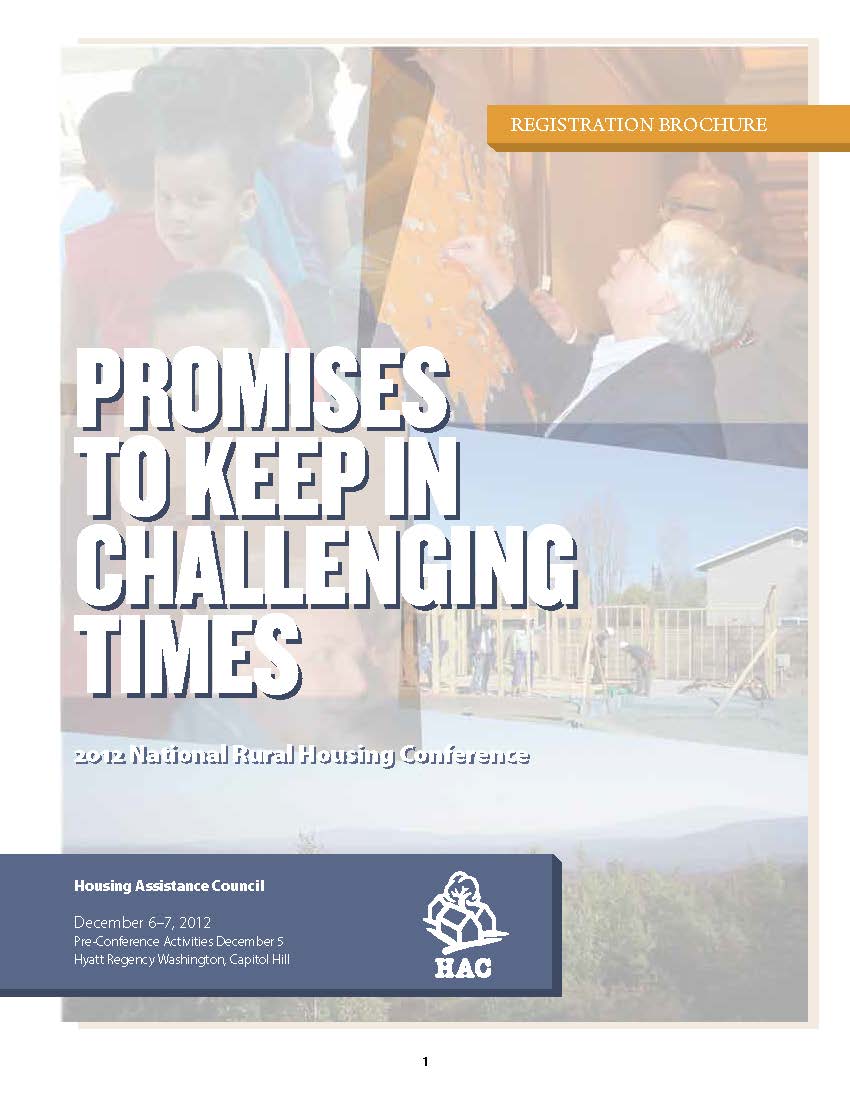
Promises to Keep in Challenging Times

Thank You to everyone who attended the 2012 National Rural Housing Conference. Look forward to seeing you all again in 2014!

Join the National
Rural Housing Conference group
on LinkedIn and network with your fellow attendees before you even attend!

LinkedIn

HAC’s National Rural Housing Conference is an expression of our continuing commitment to provide local organizations with the resources needed to build affordable housing in rural America. The Conference will bring together more than 700 community-based housing advocates for a celebration of our collective efforts to develop and sustain affordable housing in rural communities. Based on the theme, “Promises to keep in Challenging Times” the Conference will focus on the promise America made through the Housing Act of 1949 and how those promises still apply even in the face of America’s new fiscal reality. Scheduled events will include numerous workshops, networking sessions, peer-learning opportunities, our awards program and entertainment.

The theme brings to mind the vision and promises America has made through the Housing Act of 1949 and all subsequent housing legislation and policy. While these promises, that include the opportunity for quality affordable housing, still remain the country continues to face a difficult fiscal situation with many questions or concerns about what can be done to protect affordable housing as an industry in the future, particularly in rural areas. Keeping the vision and promises is important, not just to increase the quality of life for low-income Americans, but also to build stronger and more sustainable communities as a whole.

Where:

The Hyatt Regency Washington on Capitol Hill
400 New Jersey Avenue, N.W.
Washington, DC 20001

When:

December 6-7, 2012

Pre-Conference Activities December 5

Stay Informed:

Sign up for the HAC News [vresponse][/vresponse]

Donate to the Conference:

Help HAC keep registration fees low for our participants.
Please donate to HAC’s conference.

Join the Conversation:

Join the National Rural Housing Conference Group on LinkedIn and tweet your thoughts, expectations and ideas for the Conference using hashtags #nrhc12 and #rural2012.

Don’t forget to Follow HAC for more on the Conference and all things rural housing.

[addthis2][/addthis2]

HAC News: November 7, 2012

HAC News Formats. pdf

November 7, 2012
Vol. 41, No. 22

• November is National Native American Heritage Month • November 10-18 is National Hunger and Homelessness Awareness Week • Rural housing on Senate Majority Leader’s list • Disaster recovery information available from USDA and HAC • VA offers funds to help families’ housing stability • LIHTC can serve extremely low-income tenants, research finds • Some income exclusions apply to USDA RD multifamily occupants • USDA RD offers guidance on using Section 538 loans for Section 515 properties • Treatment of farmworkers and others by large food companies varies, research finds • CBO reports on income tax’s effect on owning and renting • Child poverty increased in rural areas and nationwide from 2010 to 2011 • National Rural Housing Conference early bird registration deadline is November 9!


November 7, 2012
Vol. 41, No. 22

NOVEMBER IS NATIONAL NATIVE AMERICAN HERITAGE MONTH. President Obama’s proclamation also names November 23 (the day after Thanksgiving) Native American Heritage Day.

NOVEMBER 10-18 IS NATIONAL HUNGER AND HOMELESSNESS AWARENESS WEEK. Information about this annual event, sponsored by the National Coalition for the Homeless and the National Student Campaign Against Hunger and Homelessness, is posted online.

RURAL HOUSING ON SENATE MAJORITY LEADER’S LIST. The National Journal published a list of unfinished legislative items compiled by the staff of Majority Leader Harry Reid (D-NV) and noted there are too many to complete during Congress’s lame duck session, which will begin soon. “Rural housing” appears on the list without further explanation, probably referring to the effort to preserve eligibility for housing programs in places with growing populations. See HAC News, 9/26/12.

DISASTER RECOVERY INFORMATION AVAILABLE FROM USDA AND HAC. HAC has updated Picking up the Pieces, its guide to resources for rural housing in disaster areas, and published a Hurricane Sandy supplement. USDA is sending letters to Section 502 direct and guaranteed borrowers in and around the Hurricane Sandy disaster areas summarizing available loan servicing assistance, including possible payment moratoria for direct borrowers. Owners and renters in USDA assisted properties should contact USDA RD offices. Vacant houses and apartments with USDA financing may be available for hurricane survivors through FEMA, 800-621-FEMA. Additional federal disaster information is posted at https://www.disasterassistance.gov.

VA OFFERS FUNDS TO HELP FAMILIES’ HOUSING STABILITY. The Supportive Services for Veteran Families program makes grants to nonprofits, consumer coops, and Tribally Designated Housing Entities to provide or coordinate supportive services to very low-income veteran families to remain in or transition into permanent housing. Deadline is February 1, 2013. Contact John Kuhn, VA, 877-737-0111, SSVF@va.gov.

SOME INCOME EXCLUSIONS APPLY TO USDA RD MULTIFAMILY OCCUPANTS. An Unnumbered Letter (October 9, 2012) provides a copy of a July 24 HUD Federal Register notice (see HAC News, 7/25/12) listing exclusions to income for numerous programs, and announces that RD Handbook changes will be published soon. Contact Laura Horn, RD, 202-720-5443.

USDA RD OFFERS GUIDANCE ON USING SECTION 538 LOANS FOR SECTION 515 PROPERTIES. Section 538 guaranteed loans can finance revitalization of existing properties with Section 515 direct loans. An Unnumbered Letter (October 9, 2012) instructs USDA staff on reconciling procedural differences between the programs. Contact Tammy Daniels, RD, 202-720-0021.

TREATMENT OF FARMWORKERS AND OTHERS BY LARGE FOOD COMPANIES VARIES, RESEARCH FINDS. Worker Equity in Food and Agriculture, published by the Tellus Institute and Sustainalytics, examines wages and working conditions (not housing) at the 100 largest U.S. companies in food and agriculture. “Worker equity” is evaluated at the farm, factory, retail, and restaurant stages.

CBO REPORTS ON INCOME TAX’S EFFECT ON OWNING AND RENTING. A Congressional Budget Office working paper, “Taxation of Owner-Occupied and Rental Housing,” concludes that federal income tax advantages tend to make owning more advantageous than renting for higher-income households, but lower-income households can find renting cheaper than owning. The paper also examines how four different possible changes to the tax code (including repealing the mortgage interest deduction) would affect these calculations. Contact Larry Ozanne, CBO, larry.ozanne@cbo.gov.

CHILD POVERTY INCREASED IN RURAL AREAS AND NATIONWIDE FROM 2010 TO 2011. The Carsey Institute at the University of New Hampshire reports that American Community Survey data show 45% of U.S. children live below 200% of the poverty level, and 10.1% live below 50% of poverty. “Over Sixteen Million Children in Poverty in 2011” includes data for urban/rural/suburban geographies, regions, and states.

NATIONAL RURAL HOUSING CONFERENCE EARLY BIRD REGISTRATION DEADLINE IS NOVEMBER 9! The 2012 conference, “Promises to Keep in Challenging Times,” will be December 6-7, with pre-conference activities on December 5, at the Hyatt Regency Washington on Capitol Hill in Washington, DC. Register now to take advantage of the special early bird discount! Start networking in advance – join the conference LinkedIn group. Questions? Contact Dan Stern, HAC, dan@ruralhome.org or 202-842-8600.

HAC News: October 24, 2012

HAC News Formats. pdf

October 24, 2012
Vol. 41, No. 21

• October 21-27 is National Childhood Lead Poisoning Prevention Week • HAC invites applications for rural veterans assistance • Section 8 OCAFs announced • Federal homelessness plan amended • Toolkit offered for Independent Foreclosure Review outreach • LIHTC can serve extremely low-income tenants, research finds • Census reports on sheltered population • HUD launches app for FMRs and Income Limits • LIHEAP assistance to older manufactured homes higher per square foot • GAO raises concerns about air exchange standards in HUD Code • National Rural Housing Conference early bird registration deadline is November 9!


October 24, 2012
Vol. 41, No. 21

OCTOBER 21-27 IS NATIONAL CHILDHOOD LEAD POISONING PREVENTION WEEK. Details and resources are available from the federal Centers for Disease Control and Prevention, leadinfo@cdc.gov.

HAC INVITES APPLICATIONS FOR RURAL VETERANS ASSISTANCE. A new HAC initiative will provide grants of up to $30,000 to support bricks-and-mortar projects that help rural low-income, elderly, and disabled veterans and active military personnel with housing needs. Send a letter of intent by 5:00 p.m. Eastern time on October 31. Application guidelines are posted on HAC’s website. Contact Janice Clark, HAC.

SECTION 8 OCAFS ANNOUNCED. HUD’s new Operating Cost Adjustment Factors apply to project-based assistance contracts with an anniversary date on or after February 11, 2013. See Federal Register, 10/16/12. Contact Stan Houle, HUD, 202-402-2572.

FEDERAL HOMELESSNESS PLAN AMENDED. In September the U.S. Interagency Council on Homelessness amended Opening Doors: Federal Strategic Plan to Prevent and End Homelessness, its plan to end homelessness among families, children, and youth by 2020. The amendment offers strategies and supports to improve educational outcomes for children and youth and steps to assist unaccompanied youth experiencing homelessness. Contact USICH, 202-708-4663.

TOOLKIT OFFERED FOR INDEPENDENT FORECLOSURE REVIEW OUTREACH. The Federal Reserve Board has made materials available to help local nonprofits reach residents whose homes were foreclosed in 2009-2010 by any of 14 mortgage servicers and who are eligible for an independent review. Call 888-952-9105.

LIHTC CAN SERVE EXTREMELY LOW-INCOME TENANTS, RESEARCH FINDS. The Furman Center and Moelis Institute at New York University examined data from urban, suburban, and rural Low-Income Housing Tax Credit properties in 16 states and found that 40% of the units are occupied by extremely low-income tenants (with incomes below 30% of area median). Because almost 70% of those ELI tenants receive some form of rental assistance, researchers concluded that “rental assistance is currently an indispensable part of the equation to serve those households.” The results are reported in “What Can We Learn about the Low Income Housing Tax Credit Program by Looking at the Tenants?”

CENSUS REPORTS ON SHELTERED POPULATION. The Emergency and Transitional Shelter Population: 2010 summarizes data on age, sex, and race/ethnicity for the 209,000 people counted in such shelters nationwide by the 2010 Census (not the entire homeless population). Data are aggregated by state and a map shows the number of people in shelters in every county. Over 60% of counties have no sheltered population.

HUD LAUNCHES APP FOR FMRS AND INCOME LIMITS. The map-based app for Android and iPhone allows users to search Fair Market Rents and Income Limits.

LIHEAP ASSISTANCE TO OLDER MANUFACTURED HOMES HIGHER PER SQUARE FOOT. A Government Accountability Office study found that the Low Income Home Energy Assistance Program provided about 33¢ per square foot of assistance to pre-1976 manufactured homes compared to about 20¢ per square foot for site-built homes. About 3% of total LIHEAP funds went to older manufactured homes. The study used data for 2005, the most recent available. Worker and Family Assistance: Home Energy Assistance for Low-Income Occupants of Manufactured Homes (GAO-12-848R) is available online or from GAO, 866-801-7077. Contact Frank Rusco, GAO, 202-512-3841.

GAO RAISES CONCERNS ABOUT AIR EXCHANGE STANDARDS IN HUD CODE. Standards for placement of air intake and exhaust vents are outdated and ventilation systems are not tested, GAO reports, in manufactured homes built after 1976 under HUD’s Manufactured Home Construction and Safety Standards. Manufactured Housing Standards: Testing and Performance Evaluation Could Better Ensure Safe Indoor Air Quality (GAO-13-52) is available online or from GAO, 866-801-7077. Contact Mathew J. Scirè, GAO, 202-512-8678.

NATIONAL RURAL HOUSING CONFERENCE EARLY BIRD REGISTRATION DEADLINE IS NOVEMBER 9! The 2012 conference, “Promises to Keep in Challenging Times,” will be December 6-7, with pre-conference activities on December 5, at the Hyatt Regency Washington on Capitol Hill in Washington, DC. Register now to take advantage of the special early bird discount! Start networking in advance – join the conference LinkedIn group. Questions? Contact Dan Stern, HAC, dan@ruralhome.org or 202-842-8600.

2012 National Rural Housing Conference – Marketing Materials

Thank you for your interest in assisting HAC with marketing the 2012 National Rural Housing Conference. Please use any of the materials and templates on this page as a starting point, but feel free to customize as you see fit.

About the Conference:

When: December 6-7, 2012 with pre-conference activities on December 5
Where: Hyatt Regency Washington on Capitol Hill
400 New Jersey Ave NW
Washington, DC 20001

Conference Brochure

brochure_2012_cover

Share

twitter

facebookbutton

linkedin

Marketing Email (Copy the Contents of the Email Below – html source)

NRHC 2012 Conference Banner
Register Now for the National Rural Housing Conference

Interested in learning more about rural housing and networking with innovative organizations from across the U.S.? Join the Housing Assistance Council (HAC) at the 2012 National Rural Housing ConferencePromises to Keep in Challenging Times on December 6-7 in Washington, DC.

The Conference is a gathering of housing and community development organizations that serve rural areas, national housing and rural related associations and groups, federal agency and hill staff, and stakeholders interested in affordable housing in rural America.

Register before November 9 to take advantage of early-bird discount rates.

For more information, download the registration brochure.

Questions? Contact Dan Stern at HAC, (202) 842-8600.

Conference Banner (Right Click and choose “Save Target As”)

AC_banner-02

Conference Footer (Right Click and choose “Save Target As”)

hac_conf12_footer

HAC News: August 22, 2012

HAC News Formats. pdf

August 22, 2012
Vol. 41, No. 17

• USDA to use FY12 Section 515 funds for prepayment incentives • CBS News airs story on Section 502 guarantee foreclosures • Grants offered for senior volunteers in specific places • HUD releases general section for FY13 NOFAs • Funds exhausted for Section 502 guarantee program refinances • FHFA requests comments about eminent domain for foreclosures • Public Housing Assessment System scoring process explained • CFPB proposes regulations on high cost mortgages and homeownership counseling • Some mortgage disclosures to be combined • Blueprint for better farmworker housing published • HAC Seeks Nominations for Rural Housing Awards • Register Now for the National Rural Housing Conference!


August 22,2012
Vol. 41, No. 17

USDA TO USE FY12 SECTION 515 FUNDS FOR PREPAYMENT INCENTIVES. An email message from USDA to congressional offices explains that the department has canceled its NOFA for new construction funding. A Supreme Court ruling in a different context (Salazar v. Ramah Navajo Chapter) required the government to pay amounts to fulfill contractual obligations even if Congress did not appropriate enough funds. Owners of over 100 Section 515 properties have been on a waiting list for incentives (equity loans and/or Rental Assistance) from USDA to keep these properties in the program, so the FY12 funds will be used for those incentives.

CBS NEWS AIRS STORY ON SECTION 502 GUARANTEE FORECLOSURES. Like a May 25 Wall Street Journal article, the August 16 CBS story criticizes USDA’s collection tactics when a borrower with high medical bills fell behind on mortgage payments.

GRANTS OFFERED FOR SENIOR VOLUNTEERS IN SPECIFIC PLACES. The Corporation for National and Community Service requests letters of intent by September 10 from public agencies, tribes, nonprofits, and institutions of higher education interested in Retired and Senior Volunteer Program funding. RSVP grants can be used to cover expenses such as volunteer recruitment, training, and travel for purposes including low-income housing. Partial matching funds are required. Applications are due October 11. A draft NOFA, list of program areas, information about technical assistance calls, and more are posted on CNCS’s site.

HUD RELEASES GENERAL SECTION FOR FY13 NOFAS. The general section’s information applies to next year’s NOFAs and does not itself offer funding. Contact HUD’s grants management office, 202-402-4802.

FUNDS EXHAUSTED FOR SECTION 502 GUARANTEE PROGRAM REFINANCES. USDA has used all its FY12 money for this program. Lenders can submit loan applications reflecting FY13 fees (upfront guarantee fee of 2% and annual fee of 0.4%) to USDA, which will hold them until FY13 funding becomes available. Contact an RD office.

FHFA REQUESTS COMMENTS ABOUT EMINENT DOMAIN FOR FORECLOSURES. The Federal Housing Finance Agency, which oversees Fannie Mae, Freddie Mac, and the Federal Home Loan Bank system, is considering taking action on its “significant concerns” about the impact on lenders when local governments use eminent domain powers to seize properties before foreclosure in order to provide affordable housing. Comments are due September 7. See Federal Register, 8/9/12. Contact FHFA, eminentdomainOGC@fhfa.gov.

PUBLIC HOUSING ASSESSMENT SYSTEM SCORING PROCESS EXPLAINED. HUD provides additional information about the process for issuing scores under the Physical Condition Indicator of the PHAS under a February 23, 2011 notice, applicable to HUD-assisted multifamily and public housing properties. See Federal Register, 8/9/12 or HUD’s site. Contact Claudia J. Yarus, HUD, 202-475-8830.

CFPB PROPOSES REGULATIONS ON HIGH COST MORTGAGES AND HOMEOWNERSHIP COUNSELING.Comments are due September 7 on Consumer Financial Protection Bureau changes to implement provisions of the Dodd-Frank Act that expand the types of mortgage loans subject to the Home Ownership and Equity Protection Act of 1994, revise triggers for HOEPA coverage, impose other restrictions on HOEPA mortgages, including a counseling re-quirement, and impose homeownership counseling requirements in connection with the Truth in Lending Act and the Real Estate Settlement Procedures Act. See CFPB’s site or regulations.gov. Contact Paul Seja, CFPB, 202-435-7700.

SOME MORTGAGE DISCLOSURES TO BE COMBINED. To implement another Dodd-Frank provision, the Consumer Financial Protection Bureau proposes to combine some of the disclosures and forms required by the Truth in Lending Act and RESPA. Comments are due November 6. See CFPB’s site or regulations.gov. Contact David Friend, CFPB, 202-435-7700.

BLUEPRINT FOR BETTER FARMWORKER HOUSING PUBLISHED. The report summarizes policy and research changes identified at a California Rural Legal Assistance forum, and a working group on health and housing will continue the effort. Contact spodesta@crla.org.

HAC SEEKS NOMINATIONS FOR RURAL HOUSING AWARDS. Nominations are due September 28 for the Cochran/Collings Award for national rural housing service and the Skip Jason Community Service Award. The honors will be presented at the National Rural Housing Conference in December. Complete the online form to submit a nomination or contact Lilla Sutton, HAC, 202-842-8600, lilla@ruralhome.org to request a paper form.

REGISTER NOW FOR THE NATIONAL RURAL HOUSING CONFERENCE!
HAC has opened registration for the 2012 National Rural Housing Conference, which will take place December 6-7, with pre-conference activities on December 5, at the Hyatt Regency Washington on Capitol Hill in Washington, DC. Register now to take advantage of the special early bird discount! Start networking in advance – join the conference LinkedIn group. Questions? Contact Dan Stern, HAC, dan@ruralhome.org or 202-842-8600.

Tag Archive for: National Rural Housing Conference

Nothing Found

Sorry, no posts matched your criteria

GET THE HAC NEWS!

Sign-up for HAC information products

SIGN UP HERE

Housing Assistance Council   |  1828 L Street. N.W., Suite 505, Washington, D.C. 20036
(202) 842-8600 (202) 347-3441 hac@ruralhome.org |

Board Portal

HAC is an equal opportunity provider, employer, and lender. | Civil Rights | Privacy