Tag Archive for: Fair Housing

HAC CEO Responds to FY 2027 Budget Proposal

On Friday, April 3rd, the White House released its full Fiscal Year (FY) 2027 Budget Proposal. While there are a few improvements over FY 2026 for housing affordability programs, the Housing Assistance Council (HAC) is gravely concerned about the number of programs that are slated for underfunding or elimination.

“The FY 2027 budget includes positive steps, such as restored support for USDA’s Section 502 Direct program,” said David Lipsetz, President & CEO of the Housing Assistance Council. “We welcome support for low-income homeownership during an affordability crisis. However, the proposal falls short of what is needed by failing to preserve the nation’s aging stock of rural rental housing and eliminating proven initiatives.”

At the U.S. Department of Agriculture (USDA), funding for both USDA’s Section 515 Rural Rental Housing and its Multifamily Preservation and Revitalization programs would remain at FY 2026 levels, but the budget fails to provide returns on investment or asset management fees for nonprofit and public agency owners.  Additionally, although the budget continues to support Stand‑Alone Rental Assistance to protect tenants when USDA mortgages mature, it proposes eliminating Section 542 vouchers without clearly addressing the impact on current households currently in the voucher program.

If enacted, the Administration’s budget proposal would be particularly damaging to people experiencing homelessness and unaffordable housing by eliminating a number of Department of Housing and Urban Development (HUD) programs that have a proven track record when it comes to serving Americans. The proposal eliminates the HOME Investment Partnerships Program, the Community Development Block Grant (CDBG), the Continuum of Care Program, the Housing Opportunities for Persons with AIDS (HOPWA) Program, Native American programs and Native Hawaiian Housing Block Grants, and fair housing activities.

HAC commends the Administration’s focus on rural-serving Community Development Financial Institutions (CDFIs) in its Treasury Department funding proposal. But our organization recognizes we live in a deeply interconnected nation. We have argued that if rural areas are left behind, the whole nation suffers. The opposite is true also; thus we cannot condone the Administration’s dramatic funding reduction and consolidation of the current CDFI grant programs into a single Rural Community Development Fund.

Perhaps most concerning, the proposal severely cuts funding for capacity building and technical assistance for rural communities. More than anywhere in America, small towns and rural places can struggle to maintain the expertise needed to succeed in the complex world of housing and community development. The budget calls for eliminating Rural Capacity Building at HUD and both the Rural Community Development Initiative and Preservation Technical Assistance at USDA. Such cuts to technical assistance and capacity building programs will prevent community organizations from getting new housing projects off the ground, while also limiting the critical resources they need to complete ongoing projects.

HAC urges Congress to strengthen the FY 2027 budget by restoring technical assistance for rural housing preservation, ensuring rental assistance transitions do not leave tenants behind, fully funding all programs at HUD, and providing nonprofit owners with the tools they need to sustain affordable housing over the long term. In addition, HAC also urges Congress to continue the efforts begun in the Fiscal Year 2026 appropriations bill by specifically adding language to compel the Administration to spend appropriated funding. Read HAC’s full analysis of the Administration’s Fiscal Year 2027 budget proposal for USDA and for HUD.

PRT, HAC, HOPE Release Opportunity Zone 2.0 Recommendations

The Housing Assistance Council (HAC) in collaboration with Partners for Rural Transformation (PRT) and Hope Credit Union/Hope Enterprise Corporation/Hope Policy Institute (HOPE) Wednesday released recommendations for the Opportunity Zone 2.0 designations to drive investments into rural communities facing persistent poverty.

PRT President Farah Ahmad said: “Opportunity Zones hold tremendous potential to drive investment into rural communities facing persistent poverty across the country – if they are done correctly. This guide offers a framework for state policymakers and local practitioners to ensure that this once-in-a-decade opportunity is not missed in the rural communities millions of people call home.”

HAC President and CEO David Lipsetz said: “Investment in persistently poor rural places is an essential step to address our nation’s affordable housing crisis. State officials have an important opening this year to identify the right places for this investment. This guide explains what’s at stake and how they can take action.”

HOPE Senior Advisor for Policy and Advocacy Diane Standaert said: “With this upcoming round of Opportunity Zone selections, states have a once-in-decade chance to get it right for rural places. HOPE’s experience demonstrates how it’s possible to align community-driven solutions, private investors, and public policy to drive transformative change in rural communities, including those experiencing persistent poverty. With advance planning as recommended in this guide, states can ensure they do not overlook solutions for economic opportunity in the rural areas that need it most.”

Created by the Tax Cuts and Jobs Act of 2017, Opportunity Zones spur economic growth and job creation in low-income communities while providing tax benefits to investors. The first round of Opportunity Zones generated $120 billion in new investments across the country. However, only a fraction of that, about $6 billion, flowed into rural communities by 2022, and even less reached areas experiencing persistent poverty.

The program was amended in the One Big Beautiful Bill Act (OBBBA) and added new incentives for rural communities, including a 30% step-up in basis points for investments and a 50% threshold for showing substantial improvement to rehabilitation projects. However, an overly broad definition of “rural” risks funding being diverted away from targeted rural and Native communities. For example, Atlantic City meets the definition of a “rural Opportunity Zone” under the OBBBA.

Activating Rural Investments in the Next Round of Opportunity Zones: Recommendations for States  can be found here. The recommendations follow four guidelines:

  • Engage Rural Communities, Native Communities, and Practitioners: Hearing directly from rural communities through organizations like Community Development Financial Institutions and non-profit developers will help state and local leaders designate Opportunity Zones that will have the greatest impact.
  • Create a Map that Targets Unique Rural Needs and Development Goals: Mapping tools can assist state and local leaders in designating rural areas where investment is needed most and illuminate the opportunities to leverage additional investment incentives.
  • Create Priorities in State Funding Programs: States can take a more active role in driving investment into rural communities facing persistent poverty by prioritizing projects within preexisting state programs to attract additional resources and investors.  
  • Create an Assessment Tool: Establishing a clear decision-making rubric can ensure high-impact selections are made in a transparent manner.

PRT, HAC, and HOPE hosted a webinar on the guide for state policymakers, regional development hubs, and local non-profits on March 12. The recording is available here.   

HAC Opposes HUD Proposal to Eliminate Disparate Impact Fair Housing Rules

The Department of Housing and Urban Development has proposed to change its Fair Housing Act regulations. The revisions would eliminate HUD’s rules on disparate impact — the legal concept that conduct is discriminatory if it has inequitable effects, even if there was no intent to discriminate. HAC does not support the proposed change and strongly urges HUD to retain and enforce its current rule. HAC argues that:

  • “Housing affordability and fair housing connect through the principle of ‘disparate impact.’”
  • Rural borrowers more often receive loans with more costly terms and rural residents are disproportionately members of protected classes.
  • Court decisions have not invalidated disparate impact liability.
  • HUD has an explicit statutory responsibility to ensure equal opportunity and freedom from discrimination.
HAC Disparate Impact Comments 2026 Final

HAC’s Comments on Affirmatively Furthering Fair Housing

In February 2023, the U.S. Department of Housing and Urban Development (HUD) requested public comments on a proposed regulation that is intended to ensure that HUD and entities receiving funding from HUD will “Affirmatively Further Fair Housing” (AFFH). This rule would implement the Fair Housing Act’s requirement for HUD and its awardees to proactively take meaningful actions to overcome patterns of segregation, promote fair housing choice, eliminate disparities in housing-related opportunities, and foster inclusive communities that are free from discrimination. The 2023 proposed rule is based on a 2015 rule that was never fully implemented.

HAC supports many aspects of HUD’s proposal. HAC also supports suggestions for improvements made in comment letters prepared by the National Community Reinvestment Coalition and National Housing Law Project, and HAC — along with many other organizations — signed those letters. In addition, to emphasize some points that are particularly relevant to AFFH efforts in rural America, HAC submitted its own comment letter.

In its letter, HAC makes three primary points regarding state and local governments’ development of AFFH Equity Plans:

  • Community engagement must be offered in many different ways.
  • Analyses must be conducted in smaller geographic areas.
  • Data on USDA-supported housing must be specifically included.

Read HAC’s full comments here.

HUD AFFH 2023 Comment Letter

HAC Agrees with HUD Fair Housing Rule

HAC has submitted a comment letter supporting HUD’s proposed cancellation of a fair housing regulation issued by the Trump administration in September 2020. This rule governs fair housing violation claims based on policies or actions with “disparate impacts” on categories of people protected by the Fair Housing Act.

The 2020 HUD rule, which would have made it more difficult to prove a disparate impact claim, never went into effect. A federal judge issued an injunction that left a 2013 disparate impact regulation in place while a lawsuit against the 2020 version was underway.

In June 2021, HUD proposed to reinstate the 2013 rule. HAC – along with thousands of others – supports that action.

As HAC’s comments pointed out:

Fair access to housing is essential. Research shows that decent, affordable housing improves residents’ physical and mental health, their ability to hold jobs, their children’s performance in school. Children’s life chances are deeply impacted by the neighborhoods where they grow up. Enforcing the Fair Housing Act against discrimination, both intended and incidental, helps our nation move towards inclusive and equitable rural, urban and suburban communities, where all residents can thrive.

HAC Supports Fair Housing Rule

HAC has submitted comments strongly supporting HUD’s decision to replace a fair housing regulation it issued in 2020. The new interim final rule is a positive step in a years-long process to require states, localities, and public housing agencies that receive HUD funds to “affirmatively further fair housing” (AFFH). As HAC’s comments note, working towards equality is essential. It is inherently the right thing to do – and it is crucial because research shows children’s life chances are deeply impacted by the neighborhoods where they grow up. Taking active steps to eliminate discrimination and segregation in homes and neighborhoods through enforcement of the Affirmatively Furthering Fair Housing requirement leads to inclusive and equitable rural, urban and suburban communities, where all residents can thrive.

The interim final rule does not mandate any specific fair housing planning mechanism for recipients of HUD funds. HUD plans to request comments on that subject through a separate notice.

HAC News: February 20, 2020

News Formats. pdf

February 20, 2020
Vol. 49, No. 4

February is National African American History Month • Administration’s budget proposes cuts in many housing programs, but not rural rental preservation CRA comment period extended to April 8 VA offers per diem funds for veterans’ housing stabilization HUD joins in proposing rule changes for faith-based organization FCC launches fund to spread broadband in rural America, legislators concerned White House releases guide to help local communities tackle the rural opiod and drug crisis Comments requested on alternative measures of poverty HUD asks tribes for input on two-year funding notices CEOs and nonprofit leaders sought for Achieving Excellence program Appalachia Gets Special Funding. The Black Rural South Deserves It Too Colorado’s Housing Crisis has Gotten So Bad that Small Towns are Now Building People Homes The Rural Health Safety Net Under Pressure: Rural Housing Volunerability The Trump Administration’s Latest Attack on Fair Housing Where Light Pollution is Seeping into the Rural Night Sky • HAC Seeks is Hiring an Executive Assistant • SAVE THE DATE FOR HAC’S 2020 RURAL HOUSING CONFERENCE!Need capital for your affordable housing project?

HAC News Formats. pdf

February 20, 2020
Vol. 49, No. 4

February is National African American History Month.

Administration’s budget proposes cuts in many housing programs, but not rural rental preservation.

Like its past budgets, the Administration’s proposal for Fiscal Year 2021 proposes to eliminate many housing programs, including USDA’s Section 502 direct loans for homebuyers, Section 515 and 514/516 loans and grants for rental housing production, and HUD’s CDBG, HOME and SHOP, while supporting renewal of Section 521 Rental Assistance contracts and Section 542 vouchers. Unlike previous versions, the budget proposes to increase USDA’s MPR preservation program to $40 million from $28 million in FY20. It would also fund two repair programs, Section 504 grants for very low-income elderly homeowners and Section 533 Housing Preservation Grants. The House and Senate usually do not follow the budget closely when developing their appropriations legislation for the year.

CRA comment period extended to April 8.

The Federal Deposit Insurance Corporation and the Office of the Comptroller of the Currency have extended the deadline for input on their proposed changes to Community Reinvestment Act regulations. Comments will be due on April 8 rather than on March 9, as originally scheduled.

VA offers per diem funds for veterans’ housing stabilization.

The Department of Veterans Affairs’ Homeless Providers Grant and Per Diem Program will fund nonprofits, state and local governments and tribes to provide per diem payments to facilitate housing stabilization for veterans who are homeless or at risk of becoming homeless. Apply by April 22. For more information, contact Jeffery Quarles, VA, 813-979-3570.

HUD joins in proposing rule changes for faith-based organizations.

Like the proposed rules published by USDA and other agencies in January, HUD’s proposal would delete the requirement for faith-based social service providers to refer beneficiaries to an alternative provider if desired. Faith-based organizations would not be required to provide notices unless secular organizations have the same requirements. Comments to HUD are due April 13. (Comments on the USDA proposal are due February 18.) For more information, contact Richard Youngblood, HUD, 202-402-5958.

FCC launches fund to spread broadband in rural America, legislators concerned.

The Federal Communications Commission adopted rules on January 30 for its new Rural Digital Opportunity Fund. Up to $20.4 billion will be released in two phases. The first phase will begin later this year and target areas wholly without broadband, while the second phase will open to those partially served by broadband. The FCC’s report includes details and the final regulations. Members of the House have written to FCC Chairman Ajit Pai expressing concerns about the RDOF’s coordination with state-level broadband efforts.

White House releases guide to help local communities tackle the rural opioid and drug crisis.

The Rural Community Action Guide aims to educate the public by providing an overview of the challenges rural communities face when addressing prescription opioid misuse and the use of illicit substances. It also showcases localized efforts implemented to help mitigate the impact of substance use disorder. HAC provided the housing chapter for the guide.

Comments requested on alternative measures of poverty.

OMB invites the public to comment by April 14 on questions asked by the Interagency Technical Working Group on Evaluating Alternative Measures of Poverty to help inform its recommendations on producing additional measures of poverty. The Working Group has issued a consensus interim report but has not yet decided whether to recommend development of a new poverty measure. For more information, contact Kerrie Leslie, OMB, 202-395-1093.

HUD asks tribes for input on two-year funding notices.

For recent tribal funding competitions, HUD has experimented with offering two years of appropriations in a single Notice of Funding Availability. It requests comments from tribes by March 13 about this approach, sent to ONAP_ICDBG@hud.gov or by mail to the address provided in the request.

CEOs and nonprofit leaders sought for Achieving Excellence program.

The NeighborWorks Achieving Excellence program, in collaboration with Harvard University’s Kennedy School of Government, offers senior leaders of nonprofits a 16-month program that addresses an organizational challenge or opportunity defined by each participant. Applications are due April 15.

Recent publications and media of interest

HAC is hiring an Executive Assistant.

The Executive Assistant supports the work of HAC’s CEO and Board of Directors. Based in Washington, DC, the position is a blend of administrative work and project assignments for an earlycareer professional. The candidate will manage the CEO’s calendar, organize meetings, plan events and make travel arrangements while working on special initiatives and assignments as the candidate grows into a career in policy, program administration or nonprofit management. Email a resume and brief cover letter to jobs@ruralhome.org with “Executive Assistant” in the subject line. Applications will be considered as received. HAC is an equal opportunity employer and lender.


SAVE THE DATE FOR HAC’S 2020 RURAL HOUSING CONFERENCE!

The conference will be held in Washington, DC on December 2-4, 2020 with pre-conference meetings on December 1. The HAC News will announce more details, including registration, as they become available.


Need capital for your affordable housing project? HAC’s loan funds provide low interest rate loans to support single- and multifamily affordable housing projects for low-income rural residents throughout the U.S. and territories. Capital is available for all types of affordable and mixed-income housing projects, including preservation, farmworker, senior and veteran housing. HAC loan funds can be used for pre-development, site acquisition, site development and construction/rehabilitation. Contact HAC’s loan fund staff at hacloanfund@ruralhome.org, 202-842-8600.

Please note: HAC is not able to offer loans to individuals or families. Borrowers must be nonprofit or for-profit organizations or government entities (including tribes).

HAC News: November 9, 2018

HAC News Formats. pdf

November 11, 2018
Vol. 47, No. 23

EARLY BIRD RATE EXTENDED FOR 2018 HAC RURAL HOUSING CONFERENCE, NEW SPEAKERS ANNOUNCED • House committee leadership will change under Democratic majority • Congress to return for lame-duck session • November is National Native American Heritage Month • National Hunger and Homelessness Awareness Week is November 10-18 • HUD offers funds for public and private entities doing fair housing work. • Revisions proposed to Federal Home Loan Bank housing goals regulation • Labor Department proposes online ads for U.S. farmworkers • Online tool refined for rural mortgage eligibility • Creative placemaking webinar series announced • New HUD database lists fair housing organizations • Report describes use of state housing trust funds in rural areas • HUD report looks at who uses homebuyer education and housing counseling • New resource guide offered to help address rural opioid epidemic

HAC News Formats. pdf

November 11, 2018
Vol. 47, No. 23

EARLY BIRD RATE EXTENDED FOR 2018 HAC RURAL HOUSING CONFERENCE, NEW SPEAKERS ANNOUNCED.
By popular demand, early bird registration rates have been extended! Register now for the conference, to be held December 4-7 at the Capital Hilton in Washington, DC. Federal Reserve Chair Jerome Powell and Senator Catherine Cortez Masto (D-NV) are now confirmed as speakers, as is HUD Secretary Ben Carson.

House committee leadership will change under Democratic majority.
Control of House committees will shift to Democrats when the 116th Congress takes office in January. Rep. Maxine Waters (D-CA) is expected to become Chair of the House Financial Services Committee, which has jurisdiction over matters related to authorizing housing programs, including USDA’s rural housing programs. Important Appropriations Committee changes will be in the Agriculture and Transportation-HUD subcommittees, where Rep. Sanford Bishop (D-GA) and Rep. David Price (D-NC), respectively, are currently the top Democratic members. Rep. Collin Peterson (D-MN) is likely to Chair the House Agriculture Committee, with jurisdiction over the Farm Bill.

Congress to return for lame-duck session.
The 115th Congress will be back in session beginning November 13 and will need to finish appropriations for fiscal year 2019, which began October 1. USDA, HUD, and several other federal agencies are funded under a continuing resolution through December 7, so full-year funding or another short-term CR will be needed.

November is National Native American Heritage Month.
President Trump’s proclamation also recognizes November 23 as Native American Heritage Day.

National Hunger and Homelessness Awareness Week is November 10-18.
Participating groups around the country will hold educational, service, fundraising and advocacy events during the week, sponsored by the National Coalition for the Homeless and the National Student Campaign Against Hunger and Homelessness.

HUD offers funds for public and private entities doing fair housing work.
Fair Housing Initiatives Program grants are available from three programs, each with a December 19 application deadline: the Education and Outreach Initiative, the Fair Housing Organization Initiative, and the Private Enforcement Initiative. For more information, contact Myron Newry, HUD.

Revisions proposed to Federal Home Loan Bank housing goals regulation.
A proposed rule from the Federal Housing Finance Agency would replace four separate goals for single-family affordable housing with one, set a separate housing goal for small lenders, and make other changes. Comments are due January 31, 2019. For more information, contact Ted Wartell, FHFA, 202-649-3157.

Labor Department proposes online ads for U.S. farmworkers.
Before receiving permission to hire farmworkers from outside the U.S. with H-2A temporary visas, an employer must show it has attempted to recruit U.S. farmworkers. The Department of Labor is proposing to require employers to recruit through online advertisements instead of the newspaper ads that are currently required. Secretary of Agriculture Sonny Perdue described the change as “one way to modernize H-2A.” Comments are due December 10. For more information, contact William W. Thompson, II, DOL, 202-513-7350.

Online tool refined for rural mortgage eligibility.
USDA Rural Development’s website now allows potential borrowers to enter information online in order to make a preliminary determination of eligibility for the Section 502 direct mortgage program. Anyone can enter general household composition, monthly income, other debts and credit, estimated property taxes, hazard insurance and location, and receive a preliminary eligibility determination. Potential borrowers can submit applications for official USDA determinations regardless of their eligibility assessment results.

Creative placemaking webinar series announced.
The six monthly webinars will offer practical advice for meeting the challenges of collaborative creative placemaking work in all communities. The first webinar, on November 14, will feature a Native community leader, Julie Garreau, discussing her work with the Cheyenne River Youth Project in South Dakota. The series is offered by LISC, the National Endowment for the Arts, and the Kresge Foundation.

New HUD database lists fair housing organizations.
HUD has launched a new database of fair housing organizations, providing contact information for organizations that receive HUD funding to help ensure fair housing opportunities around the U.S.

Report describes use of state housing trust funds in rural areas.
In State Housing Trust Funds: A Rural Housing Lifeline, the Center for Community Change explains how states are using housing trust funds to meet the unique needs of their rural communities. These funds are flexible in addressing a wide range of housing needs and are being used for homeownership, rental housing, and homeless prevention.

HUD report looks at who uses homebuyer education and housing counseling.
A study of low-, moderate- and middle-income prospective first-time homebuyers in 28 metro areas found that 55% of those who were offered one-on-one or remote counseling used it, and about one-third of them completed their curriculum. Who Participates in Homebuyer Education and Counseling Services and Why? reports that both initiation and completion rates were much lower for in-person services rather than remote services. Participation did not vary by race, ethnicity, age, marital status, or household size, but women and people with college educations were more likely to participate than others. Later research will consider the effectiveness of education and counseling, and whether in-person or remote services are more effective.

New resource guide offered to help address rural opioid epidemic.
USDA and the White House Office of National Drug Control Policy have released a Rural Resource Guide to Help Communities Address Substance Use Disorder and Opioid Misuse, a listing of federal programs intended to serve as a one-stop-shop to support local groups attempting to address the opioid crisis. The Rural Resource Guide is the second tool announced in USDA’s opioid Community Toolbox. The first was a Community Assessment Tool, an interactive data map.

HAC offers Section 502 packaging training in December.
This three-day advanced course trains experienced participants to assist potential borrowers and work with RD staff, other nonprofits, and regional intermediaries to deliver successful Section 502 loan packages. The training will be held December 5-7 in Washington, DC (simultaneously with HAC’s conference). For more information, contact HAC staff , 404-892-4824.

Need capital for your affordable housing project?
HAC’s loan funds provide low interest rate loans to support single- and multifamily affordable housing projects for low-income rural residents throughout the U.S. and territories. Capital is available for all types of affordable and mixed-income housing projects, including preservation, farmworker, senior and veteran housing. HAC loan funds can be used for pre-development, site acquisition, site development and construction/rehabilitation. Contact HAC’s loan fund staff at hacloanfund@ruralhome.org, 202-842-8600.
Please note: HAC is not able to offer loans to individuals or families. Borrowers must be nonprofit or for-profit organizations or government entities (including tribes).

Rural Voices: Working Toward Access for All

50 Years of the Fair Housing Act

Safe and affordable homes, free of discrimination, should be equally accessible to all. This edition of Rural Voices explores the state of fair housing half a century after the adoption of the Fair Housing Act and includes contributions from a federal agency, national nonprofits, and practitioners in the field.

VIEW FROM WASHINGTON

HUD’s Fair Housing Office: Combating Discrimination
Anna María Farías

In a nation founded on the principles of justice and equality, it is unacceptable for anyone to be denied the housing of their choice.

FEATURES

Working Towards Fair Housing in 2018’s Rural America
by Leslie R. Strauss

Rural fair housing advocates rely on outreach, education, cultural sensitivity, and partnerships to address issues that may not have been evident 50 years ago.

HUD Suspends Implementation of Affirmatively Furthering Fair Housing Rule
by Renee Williams

In early 2018 HUD suspended implementation of a regulation put into place in 2015.

Vermont Tackles Fair Housing Along with Housing Affordability
by Ted Wimpey

Vermont’s Fair Housing Project encourages residents and local governments to improve zoning and permitting in order to further fair housing and the development of affordable housing.

Disasters Don’t Discriminate, Recovery Shouldn’t Either
by Maddie Sloan

Disaster recovery must be designed to be fair for all, even if pre-disaster housing situations were not.

Nuisance and Crime-Free Ordinances: The Next Fair Housing Frontier
by Renee Williams and Marie Flannery

Fair housing laws may conflict with local laws and policies that penalize tenants for calling law enforcement or having a history of arrest or conviction.

Fighting Hate with Fair Housing Laws

The recent increase in hate crimes includes housing-related hate activity, which can have criminal or civil remedies.

Fighting Hate in North Dakota
by Michelle Rydz

A statewide coalition supports victims of hate crimes, including crimes that are related to housing.

INFOGRAPHIC

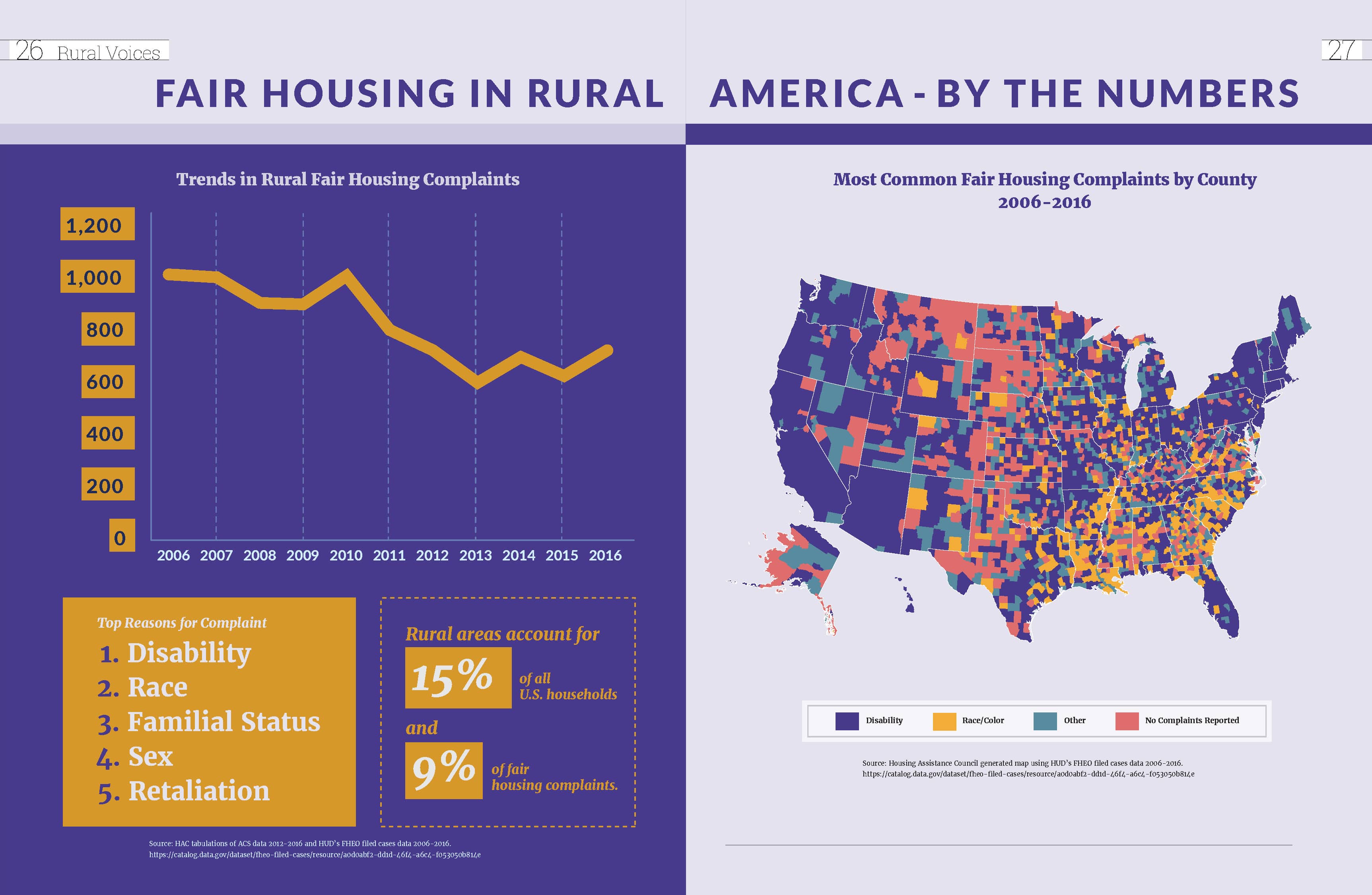
rv-may-2018-infographicFair Housing in Rural America – By the Numbers


Rural Voices would like to hear what you have to say about one, or all, of these issues. Please comment on these stories by sending a tweet to #RuralVoicesMag, discuss on the Rural Affordable Housing Group on LinkedIn, or on our Facebook page.

HAC News: April 6, 2016

HAC News Formats. pdf

April 6, 2016
Vol. 45, No. 6

• April is Fair Housing Month • HUD issues guidance on fair housing for those with criminal • New federal rule protects religious liberties of beneficiaries and providers • CFPB proposes to expand provisions for small rural lenders • FY16 income limits released • Section 538 loan guarantees available • ROSS funds offered • Fair housing assessment tool for PHAs released • Medicaid can provide supportive housing services, issue brief says • Housing problems contribute to higher health care spending, researchers report • U.S. lacks 7.2 million rents for extremely low-income renters • USDA spending in FY15 emphasized guarantees, celebrated self-help • HAC presents third CRA webinar

HAC News Formats. pdf

April 6, 2016
Vol. 45, No. 6

April is Fair Housing Month.

HUD issues guidance on fair housing for those with criminal records. HUD’s Office of General Counsel explains that the Fair Housing Act bans discrimination based on criminal history. Contact a HUD local office.

New federal rule protects religious liberties of beneficiaries and providers. USDA, HUD, VA, and other agencies published a joint regulation to implement Executive Order 13559. Beneficiaries receiving federal social service programs’ aid through faith-based organizations cannot be discriminated against based on religion and may request an alternative provider. Agencies’ funding decisions must be based solely on merit, without regard to an organization’s religious affiliation or lack thereof. Contact Norah Deluhery, USDA, 202-720-2032; Paula Lincoln, HUD, 202-708-2404; Stephen B. Dillard, VA, 202-461-7689.

CFPB proposes to expand provisions for small rural lenders. An interim final rule expands the identification of small rural creditors that are eligible to originate balloon-payment qualified mortgages and that are exempt from the requirement to establish escrow accounts for higher-priced mortgages. Comments are due April 25. Contact Carl Owens, CFPB, 202-435-7700.

FY16 income limits released. The median family incomes and income limits are used by HUD, USDA, and other agencies.

Section 538 loan guarantees available. Commitments will be made first to approved and complete applica-tions from prior years’ notices, then to approved applicants applying under this notice through December 31, 2017. Contact a USDA RD state office.

ROSS funds offered. Nonprofits, PHAs, and tribal entities are eligible for HUD’s Resident Opportunity and Self-Sufficiency Program, which enables them to hire service coordinators to assess residents’ needs and link them to supportive services. Deadline is May 16. Contact Dina.Lehmann-Kim@hud.gov.

Fair housing assessment tool for PHAs released. Comments are due May 23 on the tool for PHAs to plan fair housing compliance (see HAC News, 3/18/16). Contact Dustin Parks, HUD, 202-708-1112.

Medicaid can provide supportive housing services, issue brief says. The Technical Assistance Collaborative’s Using Medicaid to Finance and Deliver Services in Supportive Housing: Challenges and Opportunities for Community Behavioral Health Organizations and Behavioral Health Authorities reports some states are finding that Medicaid can be a cost-effective resource to finance and deliver some of the flexible services and supports that people with behavioral health disorders need to succeed in settings like integrated permanent supportive housing.

Housing problems contribute to higher health care spending, researchers report.Housing as a Health Care Investment,” by the National Housing Conference and Children’s HealthWatch, says homelessness and unstable or unaffordable housing can harm the health of vulnerable infants and young children and contribute to higher health care spending. It includes policy recommendations.

U.S. lacks 7.2 million rents for extremely low-income renters. The Gap: The Affordable Housing Gap Analysis, 2016, published by the National Low Income Housing Coalition, documents a shortage of 7.2 million affordable and available rental units for the nation’s 10.4 million extremely low-income renter households, those with incomes at or below 30% of their area median. Three-quarters of ELI renters are severely cost-burdened, spending more than half their income on rent and utilities. The report provides data at the national, state, and metro area levels.

USDA spending in FY15 emphasized guarantees, celebrated self-help. HAC’s annual USDA Rural Housing Program Funding Activity Year End Report includes detailed data for each program and each state. The Section 502 program guaranteed 134,000 loans and made 7,000 direct loans. Over 800 self-help loans were made, and USDA celebrated the program’s 50th anniversary and 50,000th house. More than 8,600 rental units were repaired or rehabilitated with multifamily program funds, and 2,187 new units were built. Demand for Section 542 preservation vouchers rose to 4,400 units representing $15.6 million, with half those funds coming from the Multifamily Preservation and Revitalization program.

HAC presents third CRA webinar. “CRA in Rural America Part III: Investments in Rural Communities,” set for April 13 at 2:00 Eastern time, will provide an evaluation of lenders that consistently earn outstanding CRA ratings. To register click here. Contact Shonterria Charleston, HAC, 404-892-4824. Materials from the first two CRA webinars are posted here.

GET THE HAC NEWS!

Sign-up for HAC information products

SIGN UP HERE

Housing Assistance Council   |  1828 L Street. N.W., Suite 505, Washington, D.C. 20036
(202) 842-8600 (202) 347-3441 hac@ruralhome.org |

Board Portal

HAC is an equal opportunity provider, employer, and lender. | Civil Rights | Privacy