News
Jennifer Emerling / There Is More Work To Be Done
Jennifer Emerling / There Is More Work To Be Done
“There’s seven agencies that deal with housing, including USDA,” Agriculture Secretary Brooke Rollins said in a recent interview with Agri-Pulse (subscription required), quoted in Farm Policy News. “There are 12 agencies that deal with rural prosperity and rural programming, and not that some of that won’t remain,” she said, “but this is the first time maybe that our country is taking a really hard look at how we organize our government.” Rollins told Agri-Pulse that the administration’s plan for downsizing and reorganizing USDA should be ready by mid-May. It is not clear whether the plan will be public at that time. HAC has long argued that, while the system of federal housing programs should be improved, rural housing needs the Rural Housing Service at USDA.
Committees in the House are meeting this week and in May to develop pieces of the budget reconciliation bill. On April 30 the Financial Services Committee adopted provisions that would reduce the Consumer Financial Protection Bureau’s funding but would not eliminate the agency altogether. Their bill would also rescind unobligated funds from HUD’s Green and Resilient Retrofit Program. The House Agriculture Committee has not scheduled its markup or released draft text, and Senate committees have not yet begun their work on the bill.
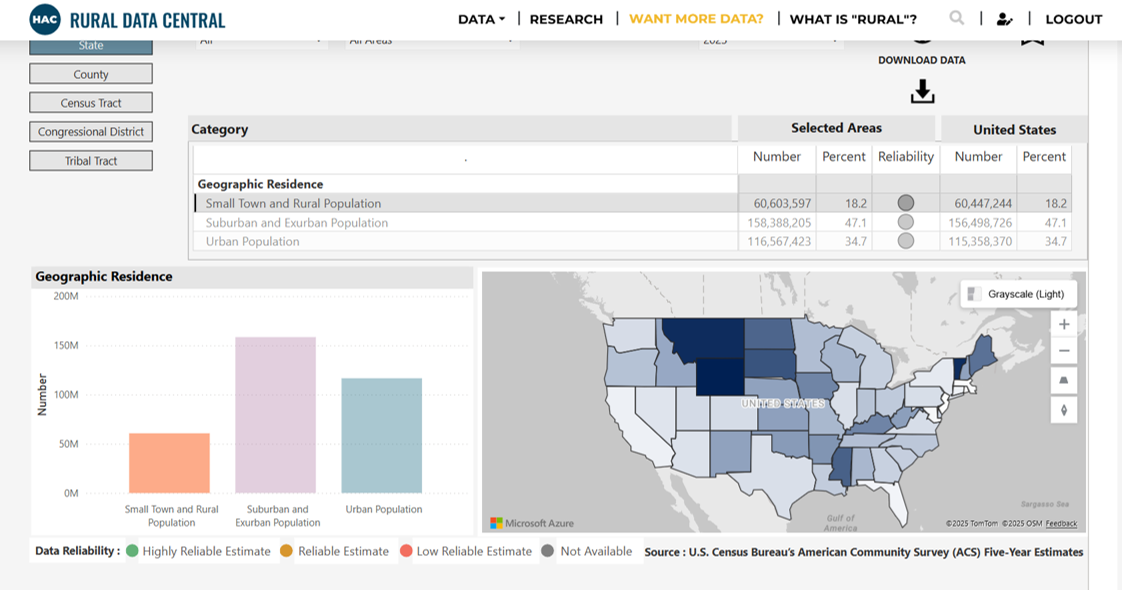
Rural Data Central is designed as a resource to help rural communities, organizations, and decisionmakers with data to inform strategies and solutions. Rural Data Central compiles over 275 million data points into one accessible and easy-to-use tool. Sign up for Rural Data Central today to get the data you need for your community.
A Department of Government Efficiency team has been assigned to NeighborWorks America, according to news reports, although the team’s assignment is not known. NeighborWorks is a private, independent nonprofit chartered by Congress, not a part of the government. It provides grants, technical assistance, and training to almost 250 community development organizations around the country. The majority of its annual funding is appropriated by Congress. Its board is comprised of five members from federal agencies, but because of firings and resignations at those agencies there are currently only two board members.
Several federal agencies and museums celebrate the month here.
Approximately 60.6 million people live in rural and small town communities, making up 18% of the U.S. population. To better understand the social, economic, housing, and finance dynamics in your nation, state, county, census tract, congressional district, continuum of care, or tribal tract, visit Rural Data Central. Source: U.S. Census American Community Survey from HAC’s Rural Data Central.
HUD is making available $2.2 million to provide rental assistance for Native American veterans through the Tribal HUD-Veterans Affairs Supportive Housing (VASH) program. Tribes and Tribally Designated Housing Entities can apply for funds by August 15.
These grants from HUD are noncompetitive and can be used to eliminate or lessen problems that pose an imminent threat to public health or safety of Tribal residents. Tribes and Tribal organizations are eligible. Applications are due September 30.
Artificial intelligence is reviewing regulations at HUD, comparing them to the statutes they implement, and suggesting revisions, according to Wired. HUD staff are reviewing the AI’s recommendations and HUD’s Office of General Counsel will make final decisions, Wired reports. A source told the publication that this method will be used throughout the government.
HUD has filed a proposed regulation titled “Rescission of Affirmative Fair Housing Marketing Regulations.” No further details are available. The proposal is under review at the Office of Management and Budget, a required step in the rulemaking process. In March, HUD published an interim final rule that canceled a 2021 AFFH interim rule and returned the AFFH requirements to their pre-1994 version but did not rescind them.
Enterprise Community Partners announced on April 24 that HUD has restored its agreements under the Community Compass and Distressed Cities programs, enabling it to continue providing technical assistance in a variety of communities. HUD previously reinstated Section 4 agreements with Enterprise and the Local Initiatives Support Corporation.
Manufactured housing developers are currently required to meet energy standards for multi-section homes by July 1, 2025. The Department of Energy proposes to delay that date until after it publishes a final rule establishing enforcement procedures. Comments are due May 27.
Since 2008, New Markets Tax Credits have been used successfully for affordable homeownership projects. NMTCs generate flexible financing, including a portion that does not have to be repaid which can bring significant net benefit to homeownership projects and sponsors. This equity and subsidy generated can be used to address market gaps, create additional affordability, or increase the capacity of nonprofit developers. HAC will be applying to the CDFI Fund for NMTCs during the 2026 award round, which is expected to open this fall. HAC’s NMTC program will target rural affordable homeownership projects. We need your help to build a robust pipeline of projects. To learn more about NMTCs for homeownership and HAC’s planned 2026 NMTCs program, please join us for an online session on May 7 or May 13.
The International Economic Development Council is hosting the 2025 Rural Retreat with the theme Rural Recharged: New Energy, New Possibilities. Taking place in Great Falls, MT from June 23 to 25, this cross-sector event will bring together diverse communities dedicated to creating new energy and opportunities for rural and tribal places across America.
The administration’s hopes to build affordable housing on federal land are examined in a New York Times article. Housing on Federal Lands Aims to Ease Affordability Crisis points out that the idea has bipartisan support and that suitable property is available near existing cities and towns. The land is almost all in the western U.S. and would need infrastructure before housing could be placed there. The article, which is summarized in the Rural Blog, identifies more pros, cons, and open questions that will need to be addressed.
A National Mortgage Professional article describes how states and rural communities are looking to expand access to accessory dwelling units (ADUs) to help increase housing supply. The article features a story of a New Hampshire man who turned his garage attic into an apartment for family members.
HAC’s loan fund provides low interest rate loans to support single- and multifamily affordable housing projects for low-income rural residents throughout the U.S. and territories. Capital is available for all types of affordable and mixed-income housing projects, including preservation, new development, farmworker, senior and veteran housing. HAC loan funds can be used for pre-development, site acquisition, site development, construction/rehabilitation and permanent financing. Contact HAC’s loan fund staff at hacloanfund@ruralhome.org, 202-842-8600.
Please note: HAC is not able to offer loans to individuals or families. Borrowers must be nonprofit or for-profit organizations or government entities (including Tribes).
Please credit the HAC News and provide a link to HAC’s website. Thank you!

 HAC CEO Responds to FY 2026 Budget Cuts