The Housing Assistance Council is an independent, non-partisan and regularly responds to Congressional committees, Member offices, federal agencies, and policy advocacy coalitions with the research and information needed to make informed policy decisions. Our research work, Rural Data Portal, and Veterans Data Central all provide valuable, educational context to frame the rural policy conversation. If you want to know how a new program or policy could impact America’s small towns and rural places, please don’t hesitate to contact us at policy@ruralhome.org.

HAC’s Recommendations to the CFPB on HMDA Rule Assessment

HAC submitted comments in response to the Consumer Financial Protection Bureau’s (CFPB) Request for Information regarding the Home Mortgage Disclosure Act (HMDA) Rule Assessment. HAC and our rural stakeholders have relied on HMDA data for decades to improve our understanding of rural mortgage markets. The CFPB will use these stakeholder comments to help better evaluate the effectiveness of these changes in meeting the purposes and objectives of Title X of the Dodd-Frank Act.

Key takeaways:

  • Reporting Threshold

    HAC strongly urges the CFPB to return to the 25-origination reporting threshold, for closed-end loans, as opposed to the new 100-origination threshold, in order to more accurately capture rural markets that are disproportionately served by small financial institutions.

  • Reliability Index

    HAC Recommends that the CFPB resource and publish a HMDA “Reliability Index.” While not a fix for overly limited reporting thresholds, the development of an indicator would be helpful for the CFPB, data users, and consumers.

  • Additional Data

    HAC applauds increased HMDA data reporting, but additional data and reporting are still needed. While the new housing data points – specifically those on manufactured housing – enhance the HMDA data usefulness, more data could improve an understanding of certain underserved markets. This is particularly true when it comes to tribal lands and specific loan programs.

  • Data Browser

    HAC applauds CFPB’s HMDA data browser, which offers improved access to HMDA data over previous interfaces.

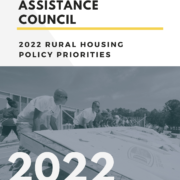
HAC’s 2022 Rural Housing Policy Priorities

Federal policy has an important and lasting impact on rural places. For the last 50 years, the Housing Assistance Council (HAC) has been the voice for the poorest of the poor in the most rural places. Our deeply rooted work in communities across the country informs our research and drives our policy positions. Our independent and non-partisan work with members of Congress, federal agencies, affordable housing and community development organizations, and other stakeholders ensures the most vulnerable rural populations – especially those in high-needs regions like the Mississippi Delta, rural Appalachia, farmworker communities, the Southwest border colonias and Indian Country – have improved access to safe and affordable housing opportunities.

Rural America is home to about 20 percent of the U.S. population and covers more than 90 percent of the U.S. landmass. Its small towns and rural regions are demographically and economically varied, and face a wide array of local challenges and opportunities for developing their communities and housing. While each place is unique, HAC has documented several themes. Persistent poverty is a predominantly rural condition. Habitable rural housing is in severely short supply. The adequate housing that does exist is often unaffordable because rural incomes are low and run well below the national median. Rural housing lacks adequate plumbing and kitchen facilities at a rate above the national average. Overcrowding is not uncommon in some rural regions. Decades of stagnant rural house prices have denied owners the wealth and mobility so often associated with buying a home. Complicating these challenges, a lack of reliable rural data obscures rural realities.

In addressing these issues, HAC’s policy priorities include:

  1. Building the capacity of local affordable housing and community development organizations deeply rooted in rural places;
  2. Expanding access to credit and safe, affordable lending in underserved rural communities;
  3. Improving the overall quality, availability and affordability of housing to buy and rent in small towns and rural places; and
  4. Preserving, increasing and tailoring resources for federal affordable housing programs serving rural populations.

We invite you to view our 2022 Policy Priorities and explore the various policy issues facing rural communities.

HAC's Policy Priorities for 2022

Federal Funding Extended to February 18

Hours before a temporary spending measure was set to expire on December 3, both houses of Congress passed and President Biden signed another continuing resolution that will carry funding through February 18, 2022. Fiscal year 2022 began on October 1, 2021.

The measure holds most government programs, including housing programs at USDA and HUD, at their fiscal 2021 funding levels. Bills proposing increased resources for housing at both USDA and HUD passed the House of Representatives in July 2021 and have been introduced in the Senate.


HAC Urges Census Bureau to Expand Data Offerings

The Housing Assistance Council (HAC) has submitted comments to the U.S. Census Bureau on its new 2020 Census Data Product Planning Crosswalk

HAC urges the U.S. Census Bureau to provide sub-county geographies in all elements of the new Data Product Planning Crosswalk, as well as all public-use data products it produces. Political and economic geography is an important consideration when determining the population and residential patterns of an area. The county is a commonly used unit of geography. In many rural areas, the county is often identified within political, social, and economic contexts.  However, county-based designations are not the optimum criteria on which to assess or research social, economic and housing conditions.

The Housing Assistance Council is pleased to have this opportunity to provide comments to the U.S. Census Bureau on its new 2020 Census Data Product Planning Crosswalk. HAC looks forward to working with the Census Bureau to continually improve the provision of data for all communities – urban, suburban, and rural.

Read HAC’s Comments.

Shawn Poynter/ There is More Work to be Done

UPDATE – 120 organizations sign on to Support rural housing and capacity building in the Build Back Better Act

Thank you! With your help 120 organizations signed on Congressional leadership yesterday in support of the robust rural housing and rural capacity building investments in the House bills for the Build Back Better Act. Nearly 120 organizations from across the country signed on to support these important investments.

Read the Letter

HAC Rural Housing Reconciliation Sign-On


Congress is currently working to negotiate the Build Back Better Act. Rural housing and capacity building programs are currently included in the bill and we want to make sure they continue to be top priorities. HAC is circulating a sign-on letter to Congressional leadership in support of maintaining rural housing and capacity building investments in the Build Back Better Act. You can view the text of the letter below. As a valued friend of HAC, we hope that you will add your organization’s name to this effort.

If you have any questions, please reach out to HAC’s Government Relations Manager, Samantha Booth, at samantha@ruralhome.org. The deadline to sign on is Tuesday, October 12. We appreciate your help.


Updated Sept. 14 – Rural Rental Housing and Repairs for Homeowners Included in Draft Bill

UPDATE September 14, 2021 – More rural housing funding has been added to the House Financial Services Committee’s portion of the reconciliation package. It now includes:

  • $4.36 billion for new construction, rehabilitation, and preservation of Section 515 rental housing and Section 514/516 farmworker housing;
  • $200 million for Section 521 Rental Assistance;
  • $70 million in budget authority for Section 502 direct homeownership loans (estimated to support loans totaling about $3.7 billion);
  • $95 million for Section 504 repair grants; and
  • $25 million for Section 523 self-help.

The bill sets no time limits for spending most of these funds, although the Rental Assistance money would expire on September 30, 2024.

Funding for HUD’s Self-Help Homeownership Opportunity Program (SHOP) was also added when the draft was revised. An additional $50 million would be available for SHOP over 10 years. As noted below, the bill provides substantial new funding for numerous HUD programs.

The Financial Services Committee began its consideration of the bill on September 13 and is continuing on September 14. The markup session will also consider a bill to reauthorize the Native American Housing Assistance and Self-Determination Act (NAHASDA), which would establish a new annual 5 percent setaside for tribes under USDA’s Section 502, 504, 515, 533, and 538 programs, as well as the Rural Utilities Service programs.

The Financial Service Committee’s portion of the reconciliation bill will be combined with pieces from other committees to create the full $3.5 trillion package. The House is expected to approve it. Then it will be considered in the Senate, where it needs only a majority vote to pass, but it is not yet clear whether enough Senators will vote for it.


September 9, 2021 – Congress’s $3.5 trillion reconciliation package includes $5 billion for USDA’s rural rental housing programs and $100 million for repairs to rural owner-occupied homes. The House Financial Services Committee released legislative text on September 9, providing details that were not previously available.

The $5 billion rural rental total would be used for new construction of Section 515 rental housing and 514/516 farmworker housing, and for preserving existing properties through the Multifamily Preservation and Revitalization program.

USDA’s Section 504 grant program, which covers the costs of health and safety repairs to owner-occupied homes in rural areas, would receive $100 million. These grants are usually available only to homeowners age 62 or older, but that age restriction would be waived for this pool of funds. The requirement that homeowners have very low incomes would remain in place.

The bill would also provide significant funding for numerous HUD programs including $35 billion for HOME and $8.5 billion for Community Development Block Grants. The colonias on the U.S.-Mexico border would receive a $1 billion setaside of CDBG funds.

The  Financial Services Committee will mark up this bill on September 13. (At the same session the committee will also consider two other bills, one to assist renters in the wake of the Supreme Court’s invalidation of the federal eviction moratorium, and one to reauthorize the Native American Housing Assistance and Self-Determination Act.)

All funds appropriated through the reconciliation bill would be in addition to the usual annual funding for these programs. Congress has not completed work on USDA’s or HUD’s annual appropriations for fiscal year 2022, which begins on October 1, 2021. The year is likely to begin with a continuing resolution holding programs at their FY21 levels.

HAC’s Statement on the End of the CDC’s Eviction Moratorium

The Housing Assistance Council (HAC) is concerned by the Supreme Court’s decision ending the national eviction moratorium. Without federal protection, hundreds of thousands of families now face the threat of eviction. Across America, many of these families will lose their homes.

“This pandemic and the unprecedented job loss it caused have exacerbated the housing challenges that rural communities have faced for a long time,” stated HAC CEO David Lipsetz. Millions of tenants, homeowners, and landlords across the country have fallen behind on rent and mortgage payments. Rural residents including Native Americans and farmworkers are among the Americans hardest hit by the pandemic and its housing impacts.

The end of the eviction moratorium is particularly troubling because housing loss poses serious dangers for renters’ health, as well as their finances. Eviction increases the risk of COVID-19 transmission and falls hardest on people of color, who are most likely to be evicted. Plus, renters with eviction records find it much harder to rent decent housing in the future since landlords often screen applicants with prior evictions.

Assistance to help cover rent, utilities, mortgages, and other costs is available from the federal government, states, and county or city governments. HAC has compiled links to resources for tenants, homeowners, and landlords on our website: ruralhome.org.

HAC works to ensure that everyone has a safe, decent, and affordable place to call home. We will continue to serve rural communities with dedication and compassion, just as we have for the last 50 years.

HAC Agrees with HUD Fair Housing Rule

HAC has submitted a comment letter supporting HUD’s proposed cancellation of a fair housing regulation issued by the Trump administration in September 2020. This rule governs fair housing violation claims based on policies or actions with “disparate impacts” on categories of people protected by the Fair Housing Act.

The 2020 HUD rule, which would have made it more difficult to prove a disparate impact claim, never went into effect. A federal judge issued an injunction that left a 2013 disparate impact regulation in place while a lawsuit against the 2020 version was underway.

In June 2021, HUD proposed to reinstate the 2013 rule. HAC – along with thousands of others – supports that action.

As HAC’s comments pointed out:

Fair access to housing is essential. Research shows that decent, affordable housing improves residents’ physical and mental health, their ability to hold jobs, their children’s performance in school. Children’s life chances are deeply impacted by the neighborhoods where they grow up. Enforcing the Fair Housing Act against discrimination, both intended and incidental, helps our nation move towards inclusive and equitable rural, urban and suburban communities, where all residents can thrive.

HAC Supports Fair Housing Rule

HAC has submitted comments strongly supporting HUD’s decision to replace a fair housing regulation it issued in 2020. The new interim final rule is a positive step in a years-long process to require states, localities, and public housing agencies that receive HUD funds to “affirmatively further fair housing” (AFFH). As HAC’s comments note, working towards equality is essential. It is inherently the right thing to do – and it is crucial because research shows children’s life chances are deeply impacted by the neighborhoods where they grow up. Taking active steps to eliminate discrimination and segregation in homes and neighborhoods through enforcement of the Affirmatively Furthering Fair Housing requirement leads to inclusive and equitable rural, urban and suburban communities, where all residents can thrive.

The interim final rule does not mandate any specific fair housing planning mechanism for recipients of HUD funds. HUD plans to request comments on that subject through a separate notice.

Biden’s USDA Housing Budget Proposes Increases in Section 502 Mortgages and Rental Preservation

The Biden administration’s first full budget request, covering the fiscal year that begins on October 1, 2021, would maintain this year’s spending levels on rural housing programs and make available more loans for rural homebuyers. The Section 502 direct loan program, though which USDA makes loans directly to first-time purchasers, would be raised from $1 billion to $1.5 billion. The Section 502 guarantee program, which guarantees mortgages made by banks, would increase from $24 billion to $30 billion.

Fiscal year 2022 funding for most rural housing programs would remain at the same levels as in fiscal year 2021, with modest increases for self-help housing, rental assistance, and rental vouchers. The budget also indicates that the American Jobs Plan – the administration’s infrastructure proposal – would provide an additional $2 billion in rural housing spending. It does not give any details about how that money would be used.

The budget proposes to eliminate some protections for Section 521 Rental Assistance (RA). It would delete a requirement that recaptured RA be reused for rehab, preservation, or RA, and it would eliminate longstanding provisions requiring a 12-month delay before recapturing unused RA from Section 514/516 farmworker housing and mandating that farmworker housing RA be reused in other farmworker housing if possible. Language that allows recaptured RA to be used for “current needs” would be left in place.

Also deleted would be a provision from FY20 and FY21 appropriations that allows owners to request RA renewals for 20-year periods, subject to annual appropriations, which fund RA contracts for one year at a time.

The Multifamily Preservation and Revitalization (MPR) program, the Section 542 voucher program, and both farmworker housing programs would be shifted to new places in the budgetary scheme, an administrative move that would not alter the functioning of any of these programs.

The administration’s budget is the first step in the annual appropriations process. Each house of Congress will now craft its own proposal and differences will be worked out in the months to come.

USDA Rural Dev. Prog.

(dollars in millions)

FY20 Final Approp. FY21 Final Approp. Amer. Rescue Plan Act FY 22 Admin. Budget
502 Single Fam. Direct $1,000 $1,000 $656.6 $1,500
502 Single Family Guar. 24,000 24,000 30,000
504 VLI Repair Loans 28 28 18.3a 28
504 VLI Repair Grants 30 30 30
515 Rental Hsg. Direct Lns. 40 40 40
514 Farm Labor Hsg. Lns. 28 28 28
516 Farm Labor Hsg. Grts. 10 10 10
521 Rental Assistance 1,375 1,410 100 1,450
523 Self-Help TA 31 31 32
533 Hsg. Prsrv. Grants 15 15 15
538 Rental Hsg. Guar. 230 230 230
Rental Prsrv. Demo. (MPR) 28 28 32
542 Rural Hsg. Vouchers 32 40 45
Rental Prsrv. TA 1 2 0
Rural Cmnty. Dev’t Init. 4 6 6

a The American Rescue Plan Act of 2021 provides $39 million in budget authority to refinance Section 502 direct loans and Section 504 loans for homeowners impacted by the coronavirus pandemic. USDA expects this funding to generate $656.6 million in Section 502 direct loans and $18.3 million in Section 504 loans.


GET THE HAC NEWS!

Sign-up for HAC information products

SIGN UP HERE

Housing Assistance Council   |  1828 L Street. N.W., Suite 505, Washington, D.C. 20036
(202) 842-8600 (202) 347-3441 hac@ruralhome.org |

Board Portal

HAC is an equal opportunity provider, employer, and lender. | Civil Rights | Privacy