HAC’s full length research reports provide detailed information and analysis on a wide array of social, economic, and housing issues that impact affordable housing needs and provision in rural America.

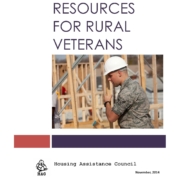
Rural Veterans Resource Guide

The report contains program sheets that describe various programs and initiatives available for veterans as well as eligibility requirements and additional resources for each program. Keywords are provided to better help orient the guide. Each keyword can be found at the back of the report with a list of corresponding programs and their page numbers within the guide. HAC’s Veteran Resource Guide aims to provide insights into how to better utilize available resources. Knowing where to refer veterans to for needed services is critical in ensuring that veterans receive the services that will enable them to remain in safe, secure housing.

INTRODUCTION
ELIGIBILITY FOR VA PROGRAMS
DEFINITIONS
GLOSSARY OF ABBREVIATIONS
REPORT SECTIONS

HOUSING

HEALTH

COMMUNITY PROGRAMS

OTHER PROGRAMS

A Brief History of Rural Mutual Self-Help Housing in the United States

The U.S. Department of Agriculture (USDA) has been funding mutual self-help housing since the early 1960s. The self-help housing model uses homeowner contributed labor to reduce the costs of their homes. This report provides a historical overview of the USDA program, including a brief narrative summary and detailed tables, updated through Fiscal Year 2013.

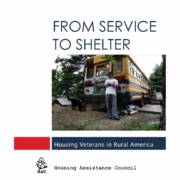
From Service to Shelter: Housing Veterans in Rural America

No veteran who has risked his or her life to protect our homes should return to find that they are not able have their own. For their sacrifice, it is imperative that we ensure our veterans have access to safe, affordable, and secure housing. This can be particularly challenging in rural America due to vast geographies, limited resources, and less social service infrastructure. The overall demographic picture of veterans will undergo major shifts in the coming years. As two wars overseas wind down, more veterans will be coming home. Returning to all corners of our nation, they will have housing needs to be addressed. The demographic changes associated with the baby boom generation and the overall graying of America will also shape veterans housing needs. The aging veteran population will have its own unique challenges. Ensuring that their housing needs are met is the least we can do to thank them for their service to this country.

Fiscal Year (FY) 2013 USDA Rural Housing Program Obligations Year End Report


In Fiscal Year 2013, USDA’s Rural Development (RD) Agency obligated approximately $23.4 billion in loans, grants, and loan guarantees which were used to build, purchase, repair, or support 177,387 units of affordable housing for low- and moderate-income families in rural areas.

The Housing Assistance Council tabulated data using the USDA Finance Office obligation reports (USDA/Rural Development report code 205c, d and e) and data from the USDA Single Family Housing and Multifamily Housing Divisions in the National Office. The comprehensive report includes tables and maps showing obligation data by program. In addition, data are compiled for each State’s program activity. The report also includes data by fiscal year for each of the programs since program inception.

This document is available by its individual chapters or as one large compiled document. The compilation document is formatted to print as double sided pages for printers that are able to print on both sides of the paper. Each chapter starts with a divider page which is intentionally blank to maintain consistency throughout the document.

2014, 151 pages

Contents

Introduction/Table of Contents

I. Summary of USDA Rural Housing Obligations
II. Single Family Housing Program Obligations
III. Multi-Family Housing Program Obligations
IV. Other Program Obligations
V. Rural Housing Program Historical Activity
VI. State Obligation Tables
VII. About the Data


All Files are in PDF format and require Adobe Acrobat Reader.

Questions about the data on this page? Contact Michael Feinberg, michael@ruralhome.org 202-842-8600

If you are having trouble connecting downloading any files on this page, contact Dan Stern, dan@ruralhome.org 202-842-8600.

Publications List

Back to HAC Home Page
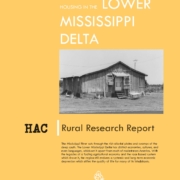
Housing in the Lower Mississippi Delta

The Mississippi River cuts through the rich alluvial plains and swamps of the deep south. The Lower Mississippi Delta has distinct economies, cultures, and even languages, which set it apart from much of mainstream America. With the legacies of a fading agricultural economy and the race based system which drove it, the region still endures a systemic and long-term economic depression which stifles the quality of life for many of its inhabitants.

Updated September 2013

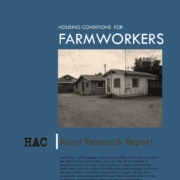
Housing Conditions for Rural Farmworkers

More than 1 million people work harvesting fields, farms, and orchards in the United States. Farmworkers, who are often ethnic minorities or immigrants, earn low wages and experience working conditions that hinder their ability to access affordable and quality housing. Farmworker housing conditions are further exacerbated by legal, cultural, and geographic circumstances that often keep this population outside of the mainstream and contribute to their economic marginalization.

Updated September 2013

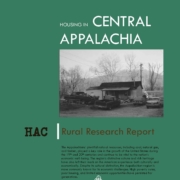
Housing in Central Appalachia


This Rural Research Report details the housing, economic and social characteristics of Central Appalachia.

The Appalachians’ plentiful natural resources, including coal, natural gas, and timber, played a key role in the growth of the United States during the 19th and 20th centuries and continue to be vital to the nation’s economic well-being. The region’s distinctive culture and rich heritage have also left their mark on the American experience both culturally and economically. Despite its cultural distinction, the Appalachian region is more commonly known for its economic challenges. High poverty rates, poor housing, and limited economic opportunities have persisted for generations.

Updated September 2013

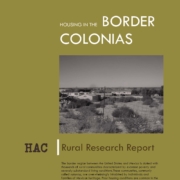
Housing in the Border Colonias

Updated September 2013The border region between the United States and Mexico is dotted with thousands of rural communities characterized by extreme poverty and severely substandard living conditions. These communities, commonly called colonias, are overwhelmingly inhabited by individuals and families of Mexican heritage. Poor housing conditions are common in the colonias with an old, deteriorating housing stock, combined with newer units that do not meet building codes.

Accounting & Financial Operations for Nonprofits in Rural Housing


Accounting & Financial Operations for Nonprofits in Rural Housing
Print copy: $4.00
Provides an overview of critical accounting and financial areas for which nonprofits are responsible.
2nd ed. 2004, 42 pages, ISBN 1-58064-050-8

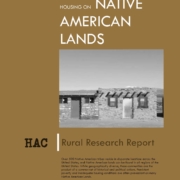
Housing on Native American Lands

Over 500 Native American tribes reside in disparate locations across the United States, and Native American lands can be found in all regions of the United States. While geographically diverse, these communities are the product of a common set of historical and political actions. Persistent poverty and inadequate housing conditions are often prevalent on many Native American Lands.

GET THE HAC NEWS!

Sign-up for HAC information products

SIGN UP HERE

Housing Assistance Council   |  1828 L Street. N.W., Suite 505, Washington, D.C. 20036
(202) 842-8600 (202) 347-3441 hac@ruralhome.org |

Board Portal

HAC is an equal opportunity provider, employer, and lender. | Civil Rights | Privacy