HAC’s full length research reports provide detailed information and analysis on a wide array of social, economic, and housing issues that impact affordable housing needs and provision in rural America.

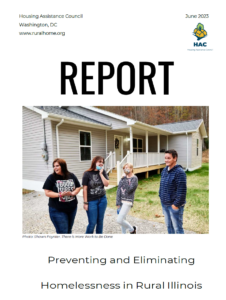
Preventing and Eliminating Rural Homelessness in Illinois

Homelessness and housing related issues manifest differently in rural environments. Highly effective urban solutions aimed at homelessness too often falter in rural America, where service provision is different and those who are homeless are often less conspicuous, but no less in need of assistance.

Recognizing the importance and unique nature of rural homelessness, the State of Illinois is committing resources to help end homelessness in rural Illinois. As part of that effort, the Housing Assistance Council (HAC) partnered with the Supportive Housing Providers Association (SHPA) and the Illinois Department of Human Services to undertake a data and information collection effort that will help inform strategies, solutions, and policies with the goal of preventing and eliminating homelessness in rural Illinois.
Download the document.

USDA Rural Development Housing Activity Report – Fiscal Year 2024

Since the 1950s, the United States Department of Agriculture (USDA) has provided financial assistance for the construction, repair, and affordability of millions of homes for low- and moderate-income rural residents. USDA accomplishes this activity through its Rural Development (RD) agency.In Fiscal Year (FY) 2024, USDA obligated roughly 49,000 loans, loan guarantees, and grants totaling about $7.7 billion, and over $1.5 billion in Rental Assistance to approximately 212,000 rural renters. The Housing Assistance Council (HAC) presents a review of most USDA housing resources obligated in FY24 and their historical trends.

Download the document.

USDA Rural Development Housing Activity Report – Fiscal Year 2023

Since the 1950s, the United States Department of Agriculture (USDA) has provided financial assistance for the construction, repair, and affordability of millions of homes for low- and moderate-income rural residents. USDA accomplishes this activity through its Rural Development (RD) agency. In Fiscal Year (FY) 2023, USDA obligated roughly 65,500 loans, loan guarantees, and grants totaling about $10.6 billion, and over $1.5 billion in Rental Assistance to approximately 228,000 rural renters. The Housing Assistance Council (HAC) presents a review of most USDA housing resources obligated in Fiscal Year 2023 and their historical trends.

Download the document.

A Methodological Approach to Estimate Residential Heirs’ Property in the United States

The Housing Assistance Council (HAC), in partnership with Fannie Mae, developed a methodology to estimate the prevalence of heirs’ properties in two categories, most likely heirs’ properties and properties that are at risk of currently being or soon becoming heirs’ properties throughout the United States. Slightly over 500,000 properties were identified as potential heirs’ properties with nearly two thirds (64.6%) located in rural areas.  Despite challenges including the lack of uniformity of tax assessment data collection and reporting, the conservative estimated assessed value of identified heirs’ properties is $32.3 billion in 44 states and the District of Columbia.

Taking Stock of Rural America

5 DECADES OF TAKING STOCK IN RURAL AMERICA

RURAL PEOPLE, RURAL PLACES, RURAL HOUSING

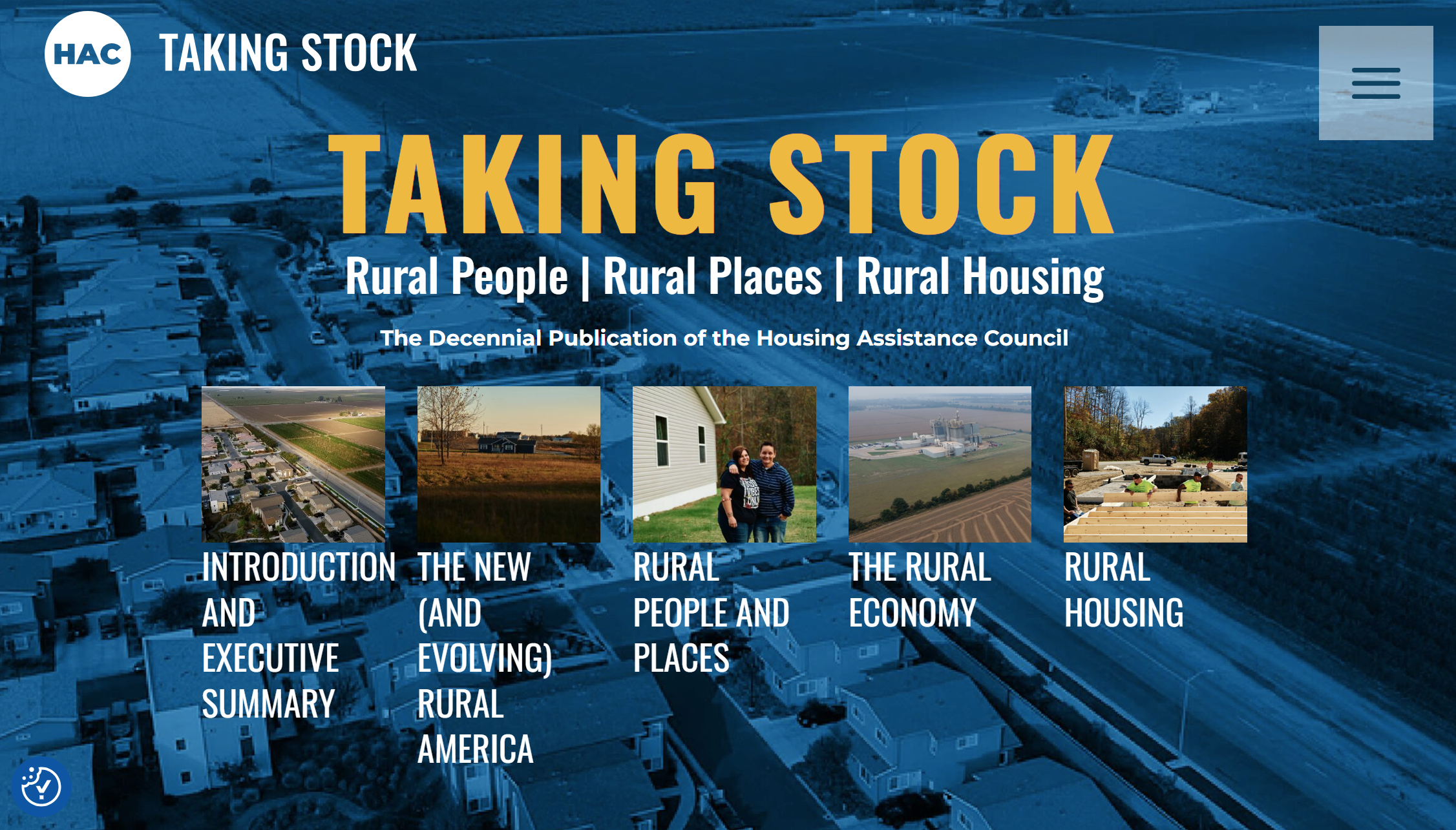
First published in 1984, Taking Stock is a decennial research publication of the Housing Assistance Council. The 2023 edition of Taking Stock continues this legacy of presenting social, economic, and housing trends for rural places and rural people.


In the early 1980s, the Housing Assistance Council (HAC) published its initial Taking Stock report. This seminal work was one of the first comprehensive assessments of rural housing and rural poverty conditions in the United States. The first Taking Stock also exposed the plight and housing need of the nation’s high poverty rural areas. HAC’s decennial Taking Stock analysis continued in 1990, 2000, and 2010 and has increasingly expanded to cover a broader scope of social, economic, and housing trends in rural areas. The 2023 edition of Taking Stock continues its legacy of presenting a composite picture of trends and issues important to rural people, places, and housing.

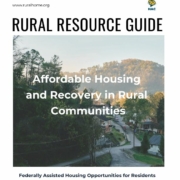
Rural Resource Guide: Affordable Housing and Recovery in Rural Communities

Federally Assisted Housing Opportunities for Residents with Substance Use Disorders and Opioid Use Disorders

Substance Use Disorder (SUD) and opioid misuse have proliferated across the U.S. in the past decade – and rural America has been particularly impacted. Effectively addressing the opioid epidemic and supporting recovery includes a holistic community approach with an essential shared foundation; safe, stable, affordable housing. In an effort to equip local organizations with proper resources the Housing Assistance Council presents its new Rural Resource Guide: Affordable Housing and Recovery in Rural Communities, Federally Assisted Housing Opportunities for Residents with Substance Use Disorders and Opioid Use Disorders.

The guide serves as a resource to housing practitioners seeking to provide homes to households affected by substance use disorders. It presents the federal regulations for federally subsidized housing programs from the U.S. Department of Housing and Urban Development, the Internal Revenue Service, and the U.S. Department of Agriculture.

Resource Guide Launch Webinar


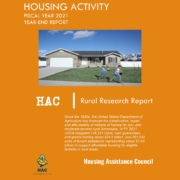
Fiscal Year 2021 USDA Rural Development Housing Activity Report

Since the 1950s, USDA has provided financial assistance for the construction, repair, and affordability of millions of homes for low- and moderate-income rural Americans. USDA accomplishes this activity through its Rural Development (RD) agency. In FY 2021, USDA obligated 139,221 loans, loan guarantees, and grants totaling about $24.2 billion. Since the first USDA housing loan was made (around 1950), the agency has funded the construction, purchase, or repair of over 5.5 million rural housing units representing $384.1 billion.

Beginning in 1978, USDA also provided funding for rental assistance to help tenants better afford to rent housing in agency-financed multi-family housing units. In FY 2021, USDA obligated 291,455 annual units of tenant assistance representing about $1.54 billion through the combined total of the Section 521 Rental Assistance and the Section 542 Rural Housing Voucher programs. Since the late 1970s, USDA has funded over $28.8 billion for rental assistance and tenant vouchers representing nearly 4.4 million annual units.

Download the document.

USDA Housing Activity Report - Fiscal Year 2021

Understanding the Colonias Investment Areas

Located along the U.S. and Mexico border, colonias communities lack a widely accepted definition and standardized boundaries, hindering investment. Fannie Mae and the Housing Assistance Council (HAC) have partnered to address this underserved market. Insights gained from our research are leading to greater understanding of the colonias region and potential investment opportunities.


Working Toward a Better Understanding of Colonia Communities for Mortgage Access and Finance

This research proposes an industry-standard, universal definition of colonias communities. The adoption of this definition can increase the effectiveness of future research and can help increase the understanding of potential investment opportunities. Learn more about this unique region and the 2.5 million people who call it home.


Colonias Mapping Tool


Find colonias communities and explore detailed tract and county data using our interactive mapping tool.

Download census tract level data that defines Colonias Investment Areas. The data also identifies how many communities in each Colonias Investment Area are associated with a federal, state, or local program.

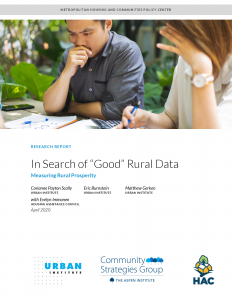
In Search of “Good” Rural Data

In Search of "Good" Rural Data Cover Image

The Housing Assistance Council has long been working to address the shortcomings of rural data for rural housing developers nationwide. The efforts of one organization alone, however, cannot address the significant issues with rural data collection, dissemination, and use. Data is essential to understanding demographics, housing costs, poverty, housing finance, and financial well-being. This report familiarizes us with the limitations of commonly used data sets and identifying shortcomings that could be addressed through new methods. Check out this new report, “In Search of Good Data: Measuring Rural Prosperity,” now.

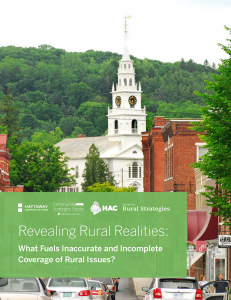
Revealing Rural Realities: What Fuels Inaccurate and Incomplete Coverage of Rural Issues?

Rural Prosperity Report Cover

This report underscores and articulates how ongoing changes in the structure and business of media and journalism contribute to the gap between rural realities and public perception of rural America. It also highlights the outsized role that social media is playing in shaping public perceptions. Interviewees shared their recommendations for overcoming the challenges they identified and for making the most of emerging opportunities. Accordingly, this report provides a set of recommendations that could result in better rural-focused journalism.

GET THE HAC NEWS!

Sign-up for HAC information products

SIGN UP HERE

Housing Assistance Council   |  1828 L Street. N.W., Suite 505, Washington, D.C. 20036
(202) 842-8600 (202) 347-3441 hac@ruralhome.org |

Board Portal

HAC is an equal opportunity provider, employer, and lender. | Civil Rights | Privacy