Summer 2001: Faith-based Initiatives and Housing Development

The theme for the Summer 2001 issue of Rural Voices, faith-based initiatives, is ubiquitous these days.

The theme for the Summer 2001 issue of Rural Voices, faith-based initiatives, is ubiquitous these days.

  • Support for the Armies of Compassion
  • Concerns About the President’s Faith-based Initiative: Opeining Public Coffers
  • Faith in Action: Faith-based or Inspired by Faith?
  • AAHSA Members’ Faith-based Housing and Services for the Elderly
  • The B’nai B’rith Senior Housing Program
  • A Collaborative Faith-based Initiative
  • The Challenges of Housing and Conservation
  • Some Myths of Faith-based Enterprise
  • ‘Little Washington’ Has a Big Faith-based Housing and Economic Development Agency
  • A History of Collaboration
  • VIEW FROM WASHINGTON: Faith-based Legislation Advances in Congress
Why Housing Matters: HAC's 2000 Report on the State of the Nation's Rural Housing

Why Housing Matters: HAC’s 2000 Report on the State of the Nation’s Rural Housing
Executive Summary
Print copy: $9.00
Combines analyses of data and other studies with stories of people who explain housing assistance’s impact on them.
2000, 38 pages, ISBN 1-58064-108-3

Nonprofit Capacity Self-Assessment Workbook for Community-Based Housing Organizations

Nonprofit Capacity Self-Assessment Workbook for Community-Based Housing Organizations
Print copy: $4.00
To assist nonprofits to meet grant application requirements and other needs, this workbook helps them assess their own capacity and set goals for improving it.
2000, 42 pages, ISBN 1-58064-110-5

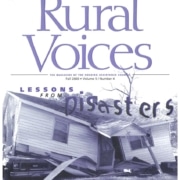
Rural Voices: Lessons from Disasters

The Fall 2000 issue of Rural Voices addresses some of what can be learned from recent major disasters.

Natural disasters remind us how little control we have over our world -homes and lives can be wiped out in seconds. One year ago, Hurricanes Dennis and Floyd devastated large sections of the eastern U.S., with heavy rains and flooding damaging communities far inland. This summer, news stories have focused on fires in the west. Less dramatic disasters happen all the time -a tornado strikes a single town or a river floods in one county.

The Fall 2000 issue of Rural Voices addresses some of what can be learned from recent major disasters. Preparatory steps to guard against damage are summarized by staff of the Federal Emergency Management Agency’s Project Impact, which helps to make communities disaster resistant. An experienced architect from Texas presents specific design and construction tips for wind resistance. A Kentucky state official describes her agency’s role in recovering from serious flooding. A Minnesota rural infrastructure expert suggests elements of a manual to guide emergency procedures. And a North Carolina advocate examines the challenges and successes of that state’s ongoing efforts to recover from last year’s hurricanes.

A great deal of additional information is available for rural communities to prepare for and recover from these kinds of disas-ters and others. Most of the articles in this issue suggest sources of further advice, and most of it is available free.

A key theme running through all these articles is the importance of advance planning and preparation. Rural communities can exert some control after all, either to reduce damage or to hasten recovery after a disaster.

Rural Voices: Policy & Rural Housing


The Summer 2000 issue of Rural Voices examines some aspects of government policies on the federal, state, and local levels, and their impact on housing conditions for low-income rural residents.

Read more

Homebuyer Education and Counseling: Examining Rural Provider Networks in Texas, Florida and South Dakota

Homebuyer Education and Counseling: Examining Rural Provider Networks in Texas, Florida and South Dakota
Print copy: $4.00
A preliminary examination of the existing education and counseling organizational capacity identifies different problems in each state studied.
2000, 31 pages, ISBN 1-58064-106-7

Rural Voices: Initiatives in the Mississippi Delta

The Spring 2000 issue of Rural Voices focuses on the Delta – not so much on its problems, which are well documented, but on what is being done and what can be done to improve its future.

The Mississippi Delta region has made significant contributions to our nation, yet it remains one of the poorest parts of the country. The Spring 2000 issue of Rural Voices focuses on the Delta – not so much on its problems, which are well documented, but on what is being done and what can be done to improve its future.

The issue begins with Representative Bennie Thompson urging us to make a national commitment to improving housing and opportunity, not only in the Delta but in all of rural America, and President Bill Clinton promising federal assistance for the Delta. Most of the magazine contains descriptions of initiatives working to improve housing and to enhance community and economic development in the Delta, written by the people who are actually undertaking the efforts described.

The new Administrator of the Rural Housing Service speaks up in this issue of Rural Voices as well. In a “Q&A” session, James C. Kearney addresses important topics facing his agency in the year 2000. The Administration’s new housing budget for 2001 is mentioned in that interview, and is covered in more detail in our View from Washington department.

Rural Boomtowns: The Relationship Between Economic Development and Affordable Housing

Throughout the 1990s, several communities in rural America experienced rapid economic development. These boomtowns — extremely high growth areas — are at the extreme end of the growth/decline axis, and are sufficiently important phenomena that their low-income housing needs should be given special attention. They have become boomtowns for a variety of reasons: gaming, the military, tourism, retired residents, even prisons.

Overall, there is a general lack of understanding about how variables such as the types of jobs created, wage levels paid, population trends and the capacity for housing construction impact a community’s low-income housing needs. The purpose of this study is to examine the relationship between economic development and the need for low-income housing in selected high growth rural areas.

(Report, 2000)

Rural Voices: Developing Organizations and Leaders

Developing our own organizations is one of the cha llenges we face as we work to develop our rural communities. Leadership, structure, staffing, planning, funding -the list of topics involved in bui lding organizational capacity can be daunting. The Winter 1999-2000 issue of Rural Voices addresses some of these subjects and how they relate to rural housing.

First, experts present recommendations on how to develop an organ ization, and list resou rces t hat can help. The role of women as leaders is cons idered next, including moving quotations from a recent study and a profile of one strong rura l woman. Another piece describes one way rural leaders can obta in academic degrees while work ing in t heir communities. The state of ru ral phi lanthropy is considered by experts in that field. One philanthropic effort, the Bank of America’s Rura l 2000 Initiative, is described in more detai l in a separate article.

As always, the magazine touches on some additional topics as well as its theme. The tenth anniversary of the Affordable Housing Program is celebrated, and the View from Wash ington department summarizes the fund ing outlook for housing programs in fisca l yea r 2000.

Environmental Concerns in Choosing a Site for Rural Housing Development – Report

Presents information on a variety of environmental issues and how to conduct preliminary or detailed research about a site.
Revised ed. 2000, 68 pages, ISBN 1-58064-045-1

Environmental Concerns in Choosing a Site for Rural Housing Development (PDF)

GET THE HAC NEWS!

Sign-up for HAC information products

SIGN UP HERE

Housing Assistance Council   |  1828 L Street. N.W., Suite 505, Washington, D.C. 20036
(202) 842-8600 (202) 347-3441 hac@ruralhome.org |

Board Portal

HAC is an equal opportunity provider, employer, and lender. | Civil Rights | Privacy