Tag Archive for: tribal housing

HAC research explores the possibilities for improved mortgage finance on reservations

Contact: Christina Davila, christinad@ruralhome.org, 202-842-8600
Dan Stern, dan@ruralhome.org, 202-842-8600

Washington, D.C., May 22, 2018- HAC’s recently released rural research report, Exploring the Challenges and Opportunities for Mortgage Finance in Indian Country, confirms mortgage lending activity is limited on many reservations and explores possible solutions to addressing the issues. The current lending conditions on many reservation lands include low origination rates, high denial rates, and involve a high proportion of loans for manufactured homes.

The report provides a sweeping picture of the mortgage market on reservations, where:

  • Fewer than 1,000 mortgage loans are made annually
  • Nearly half of mortgage loan applications are denied annually
  • Almost one-fifth of homes are manufactured homes
  • Two of the 20 largest-volume lenders are Native-owned institutions

Considering the findings in this report, HAC recommends that efforts to address the challenges of mortgage lending on reservations include improvements in education of lenders and borrowers, expanding the capacity of tribes, small lenders, and federal regulators, better targeted financial policies, and increased access to data.

“HAC is proud to present this report said David Lipsetz, HAC’s Executive Director. “This report improves our understanding of mortgage lending on tribal reservations and for Native American people, and we look forward to expanding our efforts to better serve organizations providing housing on tribal lands. HAC would like to thank the Wells Fargo Housing Foundation for their support of this research.”

“This report is a great resource for anyone working in housing on reservations,’ said Marvin Ginn, Executive Director of Native Community Finance based in Laguna, New Mexico. “It illustrates the challenges we face as housers for Native American populations, and provides recommendations that can help ease those challenges. This sort of research can help us better target our efforts and improve our work on reservations.”

HAC will present a more detailed analysis of the findings, and how they impact real-world practitioners in a webinar training on Wednesday, May 23, 2018 at 2 PM Eastern.

About the Housing Assistance Council
The Housing Assistance Council helps build homes and communities across rural America. Founded in 1971 and headquartered in Washington, D.C., HAC is a national nonprofit dedicated to helping local rural organizations build affordable homes by providing below-market financing, technical assistance, training, research, and information services. To learn more, visit www.ruralhome.org.
###

Rural Voices: Meeting Native American Housing Needs

This issue of Rural Voices focuses on the progress being made in improving the housing conditions of Native Americans. Considerable challenges, including substandard conditions, overcrowding, insufficient funding, and persistent poverty, face Indian Country, but tribes and their housing organizations are equally persistent in working to overcome them. Rural Voices authors share what readers need to know when working with tribes, highlight innovative projects, discuss funding opportunities, and further describe challenges for a varied population of Native American tribes across the country. The Wells Fargo Housing Foundation has provided generous support for this issue of Rural Voices, and for HAC’s other work on Native American housing needs and solutions.

VIEW FROM WASHINGTON

Building a Stronger Indian Country: The BUILD Act and Indian Housing
by Senator John Hoeven

The BUILD Act aims to improve the development of tribal housing projects and reauthorize critical Indian housing programs.

FEATURES

Creating Sustainable Homelands through Homeownership on Trust Lands
by Patrice H. Kunesh

A multifaceted approach can help leverage resources to improve housing and economic development in Indian Country.

Partnering with Tribes to Address Housing Needs
by Deana Around Him and Yvette Roubideaux

Open communication, cultural humility, and respect go a long way when working together with tribes.

Important Considerations for Working with Tribes
by Twila Martin Kekahbah

Understanding tribal governance,sovereignty, and the barriers to tribal development is critical to doing business with American Indian tribes.

Housing Solutions that Work for Native Americans
by Anthony Walters

The Native American Housing Assistance and Self-Determination Act is an important tool in meeting tribal housing needs.

Helping Native Americans Become Homeowners through Section 184
by Jeff Bowman and Tanya Krueger

This Native-owned bank has what it takes to successfully use HUD’s Section 184 program to meet tribal members’ housing needs.

Native Community Finance Serves Native Americans in New Mexico
by Marvin Ginn

Native CDFIs provide funds and services to improve Native American housing conditions.

Housing for Holistic Rez Living
by James “JC” Crawford

Sisseton Wahpeton Oyate has had major success in integrating housing and community needs.

INFOGRAPHIC

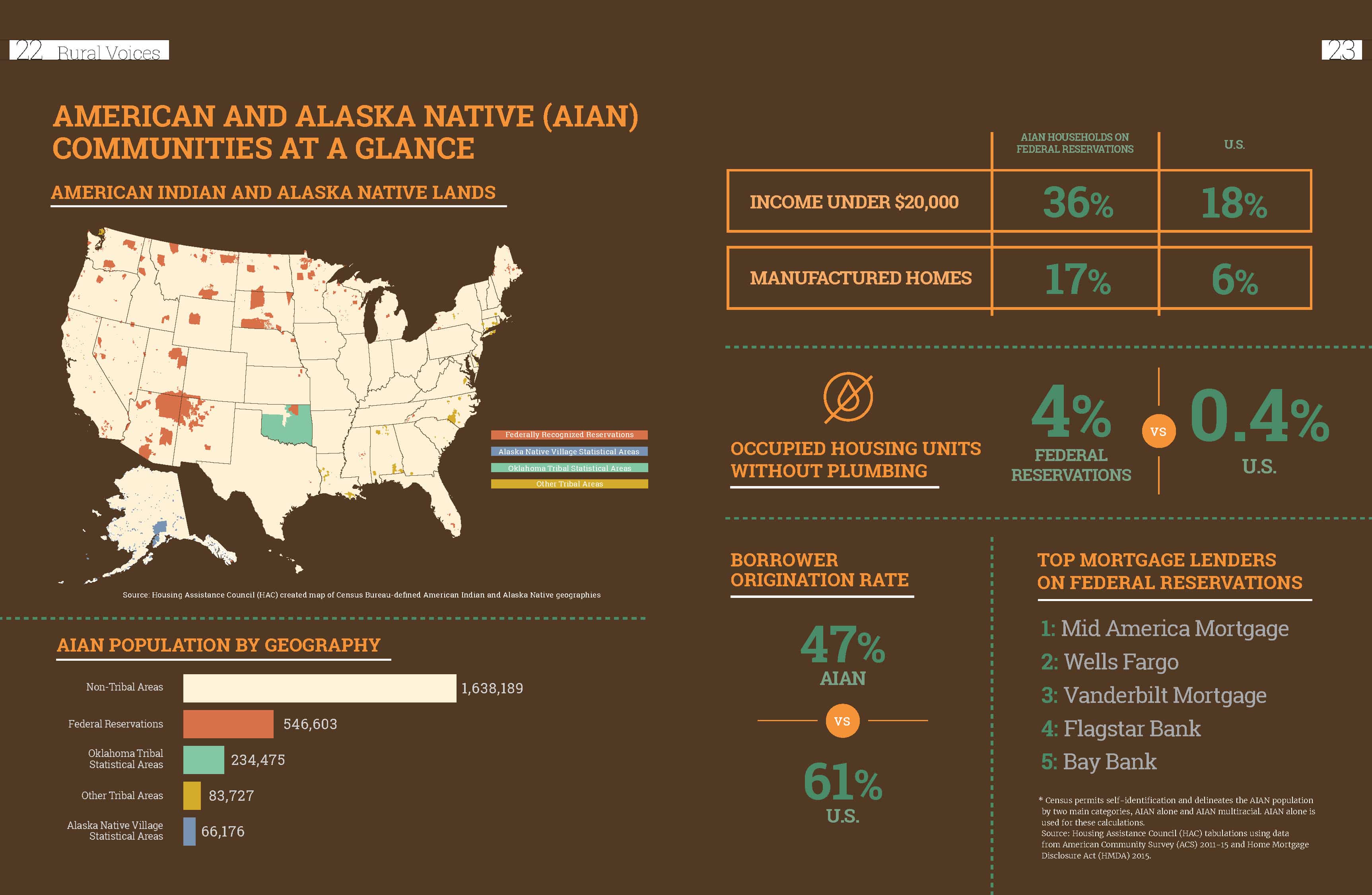
American and Alaska Native (AIAN) Communities at a Glance InfographicAmerican and Alaska Native (AIAN) Communities at a Glance


Rural Voices would like to hear what you have to say about one, or all, of these issues. Please feel free to comment on this story by sending a tweet to #RuralVoicesMag, discuss on the Rural Affordable Housing Group on LinkedIn, or on our Facebook page.

Underestimating Bureaucracy in Bureaus

Rural Voices - Spring 2015This story appears in the 2015 Spring Edition of Rural Voices

Cutting through red tape on tribal lands comes with unique pitfalls

by Marvin Ginn

As a community development officer with a regional bank, I worked to begin mortgage lending on Tribal Trust Lands. I thought the process would be very similar to ‘fee simple’ lending and started getting clients approved for the mortgage. Well, this went downhill really quickly. I determined that we would need mortgage codes in place for this process.

When you are dealing with Tribal Sovereignty, there are many issues that can come up. A mortgage code must be in place and accepted by the different branches of the federal government in order for mortgage lenders to have any type of recourse. These codes lay out the policies and procedures for leases, eviction, lean priority and foreclosure.

What I had not considered is that many of our tribal leaders did not understand that this process would never endanger lands belonging to the tribe. Two different tribes made this process difficult for me. One of the tribes required 100 percent approval from the tribal council before the code could be passed. This approval process involved presentations over several years to the council before we could secure the necessary votes. The challenge was the elders’ mistrust of the system and fears they might lose their land to these mortgage lenders. I spent many long days at the tribe getting this done.

I thought the process would be very similar to ‘fee simple’ lending and started getting clients approved for the mortgage. Well, this went downhill really quickly.

The other tribe provided a similar challenge, but I was working directly with a tribal member who had already been approved for a loan, rather than a full council. It still took us three years to get the codes in place before we started building. To this day, there are still a few tribes that do not have mortgage codes in place.

This issue was further complicated by separate documentation for the home sites. We were mainly dealing with HUD, and we had a lease that covered their requirements. Little did I know, the HUD lease documentation was not sufficient for USDA or VA administered loans.

We then had to write leases that included the concerns of each department of the government. Yet another complication were National Environmental Policy Act (NEPA) requirements. Again, we encountered the challenge of different reporting formats for each department of the government. Today, things have changed and the process is more streamlined. But improvements are still needed.

We worked with HUD, USDA, VA and the Bureau of Indian Affairs (BIA) to adopt the same format on the NEPA documents. Most of our leases are accepted by each department, but we still have challenges with wording in some of the leases. I can now close a loan within six to nine months which is far better than my first one which took me three years. I know this still sounds like an incredibly long time, but we are making progress and the effect of having affordable housing in Indian country is positive.

Marvin Ginn is Executive Director of Native Community Finance (NCF). NCF provides financial education, community oriented affordable loans, VITA/TCE tax site, IDA program, and mortgage assistance services. NCF is one of three certified Native Community Development FinancialInstitutions in New Mexico.

A Conversation with the HUD Secretary

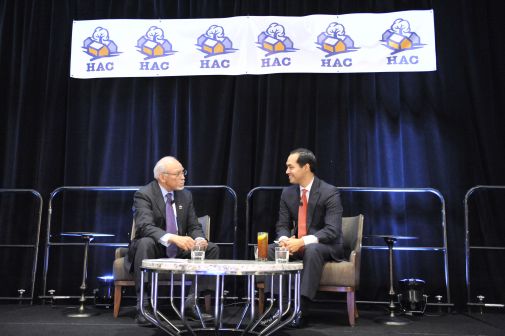
Moises Loza interviews Secretary Julian Castro #R3ConfHAC was fortunate to be visited by two Cabinet Secretaries and several members of Congress at the 2014 HAC Rural Housing Conference. During one of those visit, HUD Secretary Julián Castro sat down with HAC’s Executive Director Moises Loza to discuss HUD’s role in rural America, his passion for public service, and how he thinks HUD can better serve rural communities across the country.

View the entire discussion on Youtube

Moises began the discussion by asking How is HUD working in Rural America and what should HUD’s role be in rural places?

[youtube]jpc7DMQ23mU[/youtube]

Secretary Castro then shared his most poignant experience at HUD so far – visiting the Pine Ridge Reservation in South Dakota. He went on to discuss what HUD could do to address housing issues and challenges on Native American Lands.

[youtube]JgPX4OITIcY[/youtube]

The theme of the 2014 HAC Rural Housing Conference, Retool, Rebuild, Renew, emphasizes the need for housing organizations to train and engage the next generation of rural housing professionals to take over the field as many of the current practitioners transition towards retirement. While this topic was discussed at length in the opening plenary session, Moises asked Secretary Castro for his perspective on motivating young people to enter the afordable housing and public service fields.

[youtube]egudvSB6Vq8[/youtube]

Mr. Castro also spoke to the importance of a strong public housing infrastructure as a means of providing affordable housing in rural areas…

[youtube]QEOQxmYz728[/youtube]

And expressed his support for the CDBG program as a vehicle for community and housing development in rural and urban areas.

[youtube]uvxtZe2Rz8s[/youtube]

More from the chat

In a surprising moment, Moises revealed that he had known the Secretary’s “activist” mother from his days in Texas, which lead to a conversation about what compelled Mr. Castro to seek a career in public service.

youtube]h5UCfZUFjqs[/youtube]

The Secretary reflects on how his experience as Mayor of San Antonio will help him at HUD.

[youtube]iF3joV7a7oM[/youtube]

Moises asked the Secretary what can and should be done about credit standards and their impact on homeownership.

[youtube]nmFPwruJmHE[/youtube]

From around the web

Secretary Castro on The Daily Show with John Stewart

What does affordable housing mean to you? Rural families share their stories

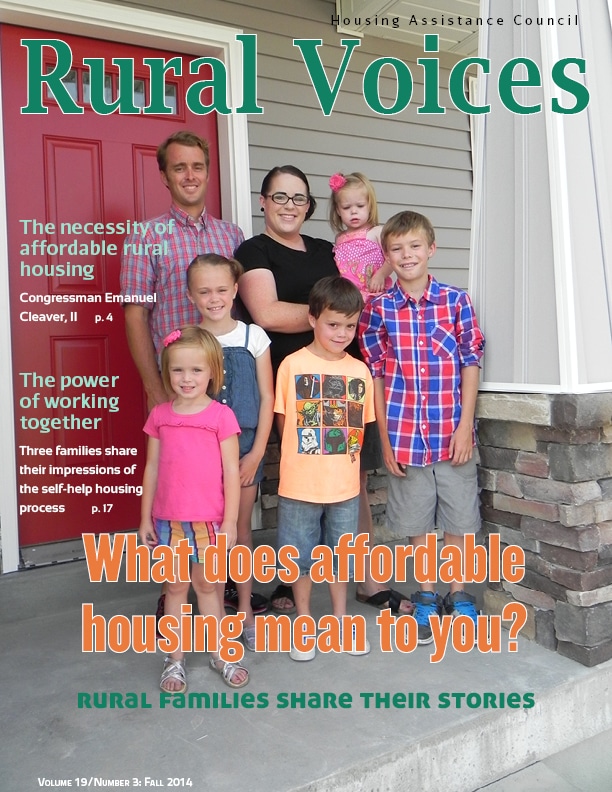
The Fall 2014 issue of Rural Voices presents the perspectives of rural families, their challenges of living in unaffordable or substandard conditions, and how they ultimately utilized federal resources to obtain quality housing. These success stories almost always involve innovative community-based organizations that provide the vital link between housing resources and the families who need them.

What does affordable housing mean to you?The Fall 2014 issue of Rural Voices presents the perspectives of rural families, their challenges of living in unaffordable or substandard conditions, and how they ultimately utilized federal resources to obtain quality housing. These success stories almost always involve innovative community-based organizations that provide the vital link between housing resources and the families who need them.

VIEW FROM WASHINGTON

Affordable Rural Housing: It’s Not a Nicety But a Necessity
by Congressman Emanuel Cleaver, II, Missouri’s Fifth District

Congressman Emanuel Cleaver, II, shares his housing story and offers his views on housing across the country

FEATURES

The Balancing Act
by Joey Henderson, Florida Home Partnership, Inc.

A single mother’s self-help journey

“Our Home, Our Community”
by Lucero Cortez and Erika Parkinson, Catholic Charities of Yakima

Zaida Elena Lopez and Ivan Chavez

Making Almost Heaven a Reality in Rural West Virginia
by John David, Southern Appalchian Labor School (SALS)

Converting a log cabin to a modern home means this widow does not have to live in the cold

The Power of Working Together

Three families share their experiences with USDA’s Mutual Self-Help Program

“I’ve lived here my whole life.”

Leslie Robbins, Jr.

Self-Help, Sweat Equity and Success
by BC EchoHawk, National American Indian Housing Council (NAIHC)

“It made me feel good, it made me powerful and I’m looking forward to spending whatever days I have, God bless me, in that house.”

A Farmer’s Fight
byYuqi Wang, Bill Emerson National Hunger Fellow

Many Hmong farmers have recently experienced financial problems from faulty loans

Additional Content

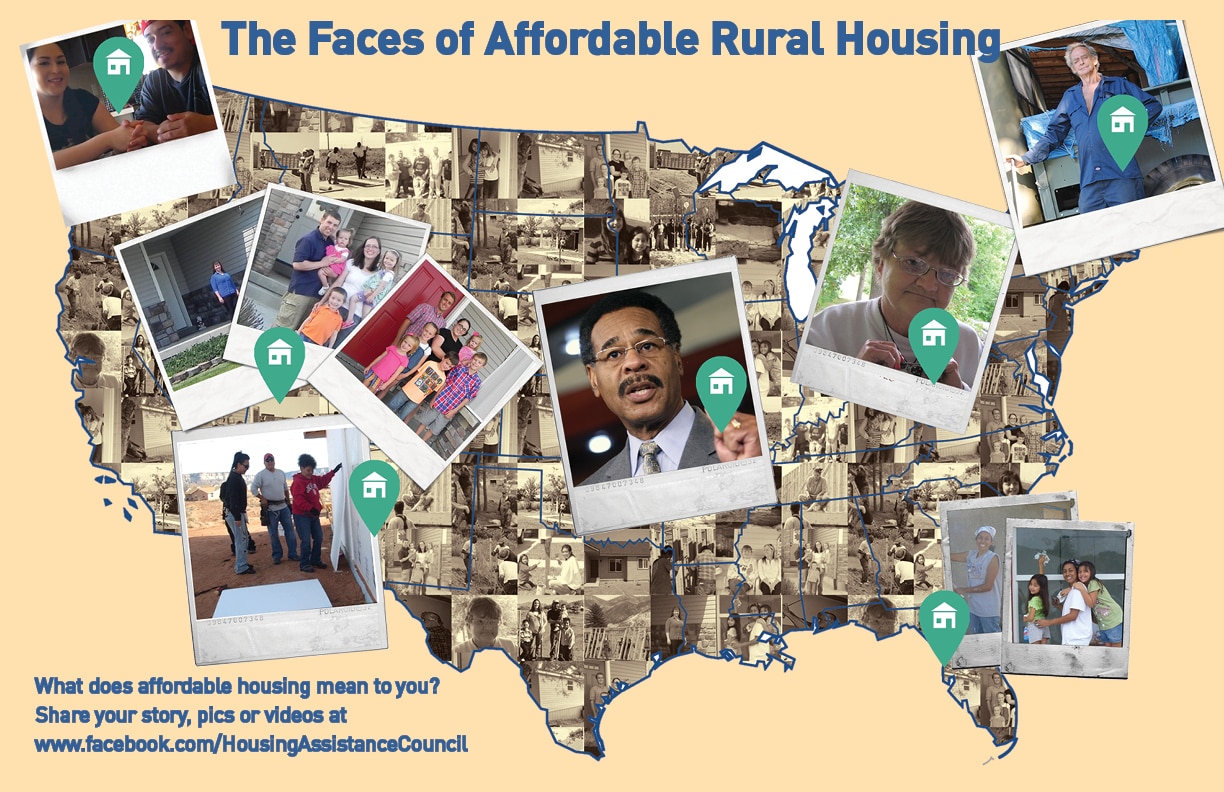
rv-fall-2014-mapThe Faces of Affordable Housing

What does Affordable Housing Mean to You?

“We wouldn’t want to live any place else”

The Davis Family (SALS, WV)

Rural Voices would like to hear what you have to say about one, or all, of these issues. Please feel free to comment on this story by sending a tweet to #RuralVoicesMag, discuss on the Rural Affordable Housing Group on LinkedIn, or on our Facebook page.

HAC News: April 2, 2014

HAC News Formats. pdf

April 2, 2014
Vol. 43, No. 7

• April is National Fair Housing Month • House subcommittee hearing on FY15 RD budget set for Friday • Waters proposes GSE reform bill • USDA offers Household Water Well System grants • Deadline extended for RD environmental rules comments • NLIHC report confirms housing costs still out of reach • GAO addresses tribes’ housing challenges • New index shows wide opportunity gap for children of different races/ethnicities • Report stresses home- and community-based services for seniors • Rural housing and youth spotlighted in Rural Voices • HAC training “Housing for Seniors and Veterans in Rural America”

April 2, 2014
Vol. 43, No. 7

APRIL IS NATIONAL FAIR HOUSING MONTH. HUD offers information for download and a press release.

HOUSE SUBCOMMITTEE HEARING ON FY15 RD BUDGET SET FOR FRIDAY. At 10:00 a.m. Eastern time on April 4, USDA Rural Development officials will testify on the Administration’s FY15 budget request before the House Agriculture Appropriations Subcommittee. The hearing will be webcast. Updates will be posted on HAC’s site.

WATERS PROPOSES GSE REFORM BILL. On March 27 Rep. Maxine Waters (D-CA), Ranking Member of the House Financial Services Committee, released a discussion draft of a bill that would replace Fannie Mae and Freddie Mac with a lender cooperative and would fund the National Housing Trust Fund. It would also replace the affordable housing goals, instead requiring the cooperative to “facilitate” service to all income levels, including borrowers in underserved urban and rural markets. There are also two proposals in the Senate (see HAC News, 3/19/14) and H.R. 2767, introduced by Rep. Jeb Hensarling (R-TX), which passed the House Committee in July 2013 (see HAC News, 8/1/13).

USDA OFFERS HOUSEHOLD WATER WELL SYSTEM GRANTS. Nonprofits can use these funds to establish lending programs for homeowners, who can borrow up to $11,000 to construct or repair household water wells for existing homes. This year’s competition will give points to high-poverty places and to colonias or substantially underserved trust areas. Deadline is May 27. Contact Joyce M. Taylor, RUS, 202-720-9589.

DEADLINE EXTENDED FOR RD ENVIRONMENTAL RULES COMMENTS. Comments on environmental policies and procedures are now due May 7 instead of April 7. (See HAC News, 2/5/14.) Contact Mark S. Plank, RD, 202-720-1649.

NLIHC REPORT CONFIRMS HOUSING COSTS STILL OUT OF REACH. The National Low Income Housing Coalition’s annual Out of Reach report, prepared with HAC assistance for nonmetro data, shows a gap remains between rural rent and rural renters’ incomes. NLIHC estimates that the average hourly wage for nonmetro renters nationwide is $10.24, which falls $3 short of the Housing Wage necessary to afford a two-bedroom home at HUD’s Fair Market Rent. The nonmetro Housing Wage is out of reach for those earning the average renter wage in all but two states (Alaska and North Dakota), though the gap is very small in four other states (Arizona, Nevada, Oklahoma, and Wyoming). The report and data for states, counties, and metro areas are online, as is a HAC Rural Research Note.

GAO ADDRESSES TRIBES’ HOUSING CHALLENGES. Native American Housing: Additional Actions Needed to Better Support Tribal Efforts, GAO-14-255, is based on site visits, interviews, and sources including HAC. It states that challenges tribes face in their use of Indian Housing Block Grant funds are “largely related to remoteness and other geographical factors, land use regulations, lack of adequate infrastructure, differing federal agency requirements, potential reduction in training opportunities and program support, limited administrative capacity, conflict within tribes, and cultural factors.” GAO recommends changes such as federal agency coordination of environmental impact requirements.

NEW INDEX SHOWS WIDE OPPORTUNITY GAP FOR CHILDREN OF DIFFERENT RACES/ETHNICITIES. Race for Results: Building a Path to Opportunity for All Childrencompiles indicators on health, education, family environment, and neighborhood poverty into a single index and presents results for each state. Nationally, Asian/Pacific Islander and White children have far higher index scores than Latino and Native American children, and African-American children have the lowest. At the state level, the lowest scores were among American Indian children in South Dakota. Scores vary across states for all groups, but the range of scores is widest for American Indian children and narrowest for Latino children.

REPORT STRESSES HOME- AND COMMUNITY-BASED SERVICES FOR SENIORS. Aging in Every Place: Supportive Service Programs for High and Low Density Communities says such services are a cost-effective way to help older adults maintain their quality of life as they age in their homes. Published by the Center for Housing Policy at the National Housing Conference, the report notes that successful programs in rural places often offer transportation, use existing community centers, or bring services to the homes of those who are unable to travel.

RURAL HOUSING AND YOUTH SPOTLIGHTED IN RURAL VOICES. Looking to the Future: Housing and Youth in Rural America is the latest issue of HAC’s magazine. Sign up online for email notices when new issues are published, or request one free print subscription per organization from Dan Stern, HAC, 202-842-8600.

JOIN HAC APRIL 22-23 FOR “HOUSING SENIORS AND VETERANS IN RURAL AMERICA: PRESERVATION, DEVELOPMENT, AND SERVICES,” held in Phoenix, AZ. The agenda, targeted to rural housing providers, will feature discussions of federal and other housing programs for veterans and the aging, including home repair, rental housing, and services for the homeless. Successful best practices will be featured. Register online.

Tag Archive for: tribal housing

HAC research explores the possibilities for improved mortgage finance on reservations

Contact: Christina Davila, christinad@ruralhome.org, 202-842-8600
Dan Stern, dan@ruralhome.org, 202-842-8600

Washington, D.C., May 22, 2018- HAC’s recently released rural research report, Exploring the Challenges and Opportunities for Mortgage Finance in Indian Country, confirms mortgage lending activity is limited on many reservations and explores possible solutions to addressing the issues. The current lending conditions on many reservation lands include low origination rates, high denial rates, and involve a high proportion of loans for manufactured homes.

The report provides a sweeping picture of the mortgage market on reservations, where:

  • Fewer than 1,000 mortgage loans are made annually
  • Nearly half of mortgage loan applications are denied annually
  • Almost one-fifth of homes are manufactured homes
  • Two of the 20 largest-volume lenders are Native-owned institutions

Considering the findings in this report, HAC recommends that efforts to address the challenges of mortgage lending on reservations include improvements in education of lenders and borrowers, expanding the capacity of tribes, small lenders, and federal regulators, better targeted financial policies, and increased access to data.

“HAC is proud to present this report said David Lipsetz, HAC’s Executive Director. “This report improves our understanding of mortgage lending on tribal reservations and for Native American people, and we look forward to expanding our efforts to better serve organizations providing housing on tribal lands. HAC would like to thank the Wells Fargo Housing Foundation for their support of this research.”

“This report is a great resource for anyone working in housing on reservations,’ said Marvin Ginn, Executive Director of Native Community Finance based in Laguna, New Mexico. “It illustrates the challenges we face as housers for Native American populations, and provides recommendations that can help ease those challenges. This sort of research can help us better target our efforts and improve our work on reservations.”

HAC will present a more detailed analysis of the findings, and how they impact real-world practitioners in a webinar training on Wednesday, May 23, 2018 at 2 PM Eastern.

About the Housing Assistance Council
The Housing Assistance Council helps build homes and communities across rural America. Founded in 1971 and headquartered in Washington, D.C., HAC is a national nonprofit dedicated to helping local rural organizations build affordable homes by providing below-market financing, technical assistance, training, research, and information services. To learn more, visit www.ruralhome.org.
###

Rural Voices: Meeting Native American Housing Needs

This issue of Rural Voices focuses on the progress being made in improving the housing conditions of Native Americans. Considerable challenges, including substandard conditions, overcrowding, insufficient funding, and persistent poverty, face Indian Country, but tribes and their housing organizations are equally persistent in working to overcome them. Rural Voices authors share what readers need to know when working with tribes, highlight innovative projects, discuss funding opportunities, and further describe challenges for a varied population of Native American tribes across the country. The Wells Fargo Housing Foundation has provided generous support for this issue of Rural Voices, and for HAC’s other work on Native American housing needs and solutions.

VIEW FROM WASHINGTON

Building a Stronger Indian Country: The BUILD Act and Indian Housing
by Senator John Hoeven

The BUILD Act aims to improve the development of tribal housing projects and reauthorize critical Indian housing programs.

FEATURES

Creating Sustainable Homelands through Homeownership on Trust Lands
by Patrice H. Kunesh

A multifaceted approach can help leverage resources to improve housing and economic development in Indian Country.

Partnering with Tribes to Address Housing Needs
by Deana Around Him and Yvette Roubideaux

Open communication, cultural humility, and respect go a long way when working together with tribes.

Important Considerations for Working with Tribes
by Twila Martin Kekahbah

Understanding tribal governance,sovereignty, and the barriers to tribal development is critical to doing business with American Indian tribes.

Housing Solutions that Work for Native Americans
by Anthony Walters

The Native American Housing Assistance and Self-Determination Act is an important tool in meeting tribal housing needs.

Helping Native Americans Become Homeowners through Section 184
by Jeff Bowman and Tanya Krueger

This Native-owned bank has what it takes to successfully use HUD’s Section 184 program to meet tribal members’ housing needs.

Native Community Finance Serves Native Americans in New Mexico
by Marvin Ginn

Native CDFIs provide funds and services to improve Native American housing conditions.

Housing for Holistic Rez Living
by James “JC” Crawford

Sisseton Wahpeton Oyate has had major success in integrating housing and community needs.

INFOGRAPHIC

American and Alaska Native (AIAN) Communities at a Glance InfographicAmerican and Alaska Native (AIAN) Communities at a Glance


Rural Voices would like to hear what you have to say about one, or all, of these issues. Please feel free to comment on this story by sending a tweet to #RuralVoicesMag, discuss on the Rural Affordable Housing Group on LinkedIn, or on our Facebook page.

Underestimating Bureaucracy in Bureaus

Rural Voices - Spring 2015This story appears in the 2015 Spring Edition of Rural Voices

Cutting through red tape on tribal lands comes with unique pitfalls

by Marvin Ginn

As a community development officer with a regional bank, I worked to begin mortgage lending on Tribal Trust Lands. I thought the process would be very similar to ‘fee simple’ lending and started getting clients approved for the mortgage. Well, this went downhill really quickly. I determined that we would need mortgage codes in place for this process.

When you are dealing with Tribal Sovereignty, there are many issues that can come up. A mortgage code must be in place and accepted by the different branches of the federal government in order for mortgage lenders to have any type of recourse. These codes lay out the policies and procedures for leases, eviction, lean priority and foreclosure.

What I had not considered is that many of our tribal leaders did not understand that this process would never endanger lands belonging to the tribe. Two different tribes made this process difficult for me. One of the tribes required 100 percent approval from the tribal council before the code could be passed. This approval process involved presentations over several years to the council before we could secure the necessary votes. The challenge was the elders’ mistrust of the system and fears they might lose their land to these mortgage lenders. I spent many long days at the tribe getting this done.

I thought the process would be very similar to ‘fee simple’ lending and started getting clients approved for the mortgage. Well, this went downhill really quickly.

The other tribe provided a similar challenge, but I was working directly with a tribal member who had already been approved for a loan, rather than a full council. It still took us three years to get the codes in place before we started building. To this day, there are still a few tribes that do not have mortgage codes in place.

This issue was further complicated by separate documentation for the home sites. We were mainly dealing with HUD, and we had a lease that covered their requirements. Little did I know, the HUD lease documentation was not sufficient for USDA or VA administered loans.

We then had to write leases that included the concerns of each department of the government. Yet another complication were National Environmental Policy Act (NEPA) requirements. Again, we encountered the challenge of different reporting formats for each department of the government. Today, things have changed and the process is more streamlined. But improvements are still needed.

We worked with HUD, USDA, VA and the Bureau of Indian Affairs (BIA) to adopt the same format on the NEPA documents. Most of our leases are accepted by each department, but we still have challenges with wording in some of the leases. I can now close a loan within six to nine months which is far better than my first one which took me three years. I know this still sounds like an incredibly long time, but we are making progress and the effect of having affordable housing in Indian country is positive.

Marvin Ginn is Executive Director of Native Community Finance (NCF). NCF provides financial education, community oriented affordable loans, VITA/TCE tax site, IDA program, and mortgage assistance services. NCF is one of three certified Native Community Development FinancialInstitutions in New Mexico.

A Conversation with the HUD Secretary

Moises Loza interviews Secretary Julian Castro #R3ConfHAC was fortunate to be visited by two Cabinet Secretaries and several members of Congress at the 2014 HAC Rural Housing Conference. During one of those visit, HUD Secretary Julián Castro sat down with HAC’s Executive Director Moises Loza to discuss HUD’s role in rural America, his passion for public service, and how he thinks HUD can better serve rural communities across the country.

View the entire discussion on Youtube

Moises began the discussion by asking How is HUD working in Rural America and what should HUD’s role be in rural places?

[youtube]jpc7DMQ23mU[/youtube]

Secretary Castro then shared his most poignant experience at HUD so far – visiting the Pine Ridge Reservation in South Dakota. He went on to discuss what HUD could do to address housing issues and challenges on Native American Lands.

[youtube]JgPX4OITIcY[/youtube]

The theme of the 2014 HAC Rural Housing Conference, Retool, Rebuild, Renew, emphasizes the need for housing organizations to train and engage the next generation of rural housing professionals to take over the field as many of the current practitioners transition towards retirement. While this topic was discussed at length in the opening plenary session, Moises asked Secretary Castro for his perspective on motivating young people to enter the afordable housing and public service fields.

[youtube]egudvSB6Vq8[/youtube]

Mr. Castro also spoke to the importance of a strong public housing infrastructure as a means of providing affordable housing in rural areas…

[youtube]QEOQxmYz728[/youtube]

And expressed his support for the CDBG program as a vehicle for community and housing development in rural and urban areas.

[youtube]uvxtZe2Rz8s[/youtube]

More from the chat

In a surprising moment, Moises revealed that he had known the Secretary’s “activist” mother from his days in Texas, which lead to a conversation about what compelled Mr. Castro to seek a career in public service.

youtube]h5UCfZUFjqs[/youtube]

The Secretary reflects on how his experience as Mayor of San Antonio will help him at HUD.

[youtube]iF3joV7a7oM[/youtube]

Moises asked the Secretary what can and should be done about credit standards and their impact on homeownership.

[youtube]nmFPwruJmHE[/youtube]

From around the web

Secretary Castro on The Daily Show with John Stewart

What does affordable housing mean to you? Rural families share their stories

The Fall 2014 issue of Rural Voices presents the perspectives of rural families, their challenges of living in unaffordable or substandard conditions, and how they ultimately utilized federal resources to obtain quality housing. These success stories almost always involve innovative community-based organizations that provide the vital link between housing resources and the families who need them.

What does affordable housing mean to you?The Fall 2014 issue of Rural Voices presents the perspectives of rural families, their challenges of living in unaffordable or substandard conditions, and how they ultimately utilized federal resources to obtain quality housing. These success stories almost always involve innovative community-based organizations that provide the vital link between housing resources and the families who need them.

VIEW FROM WASHINGTON

Affordable Rural Housing: It’s Not a Nicety But a Necessity
by Congressman Emanuel Cleaver, II, Missouri’s Fifth District

Congressman Emanuel Cleaver, II, shares his housing story and offers his views on housing across the country

FEATURES

The Balancing Act
by Joey Henderson, Florida Home Partnership, Inc.

A single mother’s self-help journey

“Our Home, Our Community”
by Lucero Cortez and Erika Parkinson, Catholic Charities of Yakima

Zaida Elena Lopez and Ivan Chavez

Making Almost Heaven a Reality in Rural West Virginia
by John David, Southern Appalchian Labor School (SALS)

Converting a log cabin to a modern home means this widow does not have to live in the cold

The Power of Working Together

Three families share their experiences with USDA’s Mutual Self-Help Program

“I’ve lived here my whole life.”

Leslie Robbins, Jr.

Self-Help, Sweat Equity and Success
by BC EchoHawk, National American Indian Housing Council (NAIHC)

“It made me feel good, it made me powerful and I’m looking forward to spending whatever days I have, God bless me, in that house.”

A Farmer’s Fight
byYuqi Wang, Bill Emerson National Hunger Fellow

Many Hmong farmers have recently experienced financial problems from faulty loans

Additional Content

rv-fall-2014-mapThe Faces of Affordable Housing

What does Affordable Housing Mean to You?

“We wouldn’t want to live any place else”

The Davis Family (SALS, WV)

Rural Voices would like to hear what you have to say about one, or all, of these issues. Please feel free to comment on this story by sending a tweet to #RuralVoicesMag, discuss on the Rural Affordable Housing Group on LinkedIn, or on our Facebook page.

HAC News: April 2, 2014

HAC News Formats. pdf

April 2, 2014
Vol. 43, No. 7

• April is National Fair Housing Month • House subcommittee hearing on FY15 RD budget set for Friday • Waters proposes GSE reform bill • USDA offers Household Water Well System grants • Deadline extended for RD environmental rules comments • NLIHC report confirms housing costs still out of reach • GAO addresses tribes’ housing challenges • New index shows wide opportunity gap for children of different races/ethnicities • Report stresses home- and community-based services for seniors • Rural housing and youth spotlighted in Rural Voices • HAC training “Housing for Seniors and Veterans in Rural America”

April 2, 2014
Vol. 43, No. 7

APRIL IS NATIONAL FAIR HOUSING MONTH. HUD offers information for download and a press release.

HOUSE SUBCOMMITTEE HEARING ON FY15 RD BUDGET SET FOR FRIDAY. At 10:00 a.m. Eastern time on April 4, USDA Rural Development officials will testify on the Administration’s FY15 budget request before the House Agriculture Appropriations Subcommittee. The hearing will be webcast. Updates will be posted on HAC’s site.

WATERS PROPOSES GSE REFORM BILL. On March 27 Rep. Maxine Waters (D-CA), Ranking Member of the House Financial Services Committee, released a discussion draft of a bill that would replace Fannie Mae and Freddie Mac with a lender cooperative and would fund the National Housing Trust Fund. It would also replace the affordable housing goals, instead requiring the cooperative to “facilitate” service to all income levels, including borrowers in underserved urban and rural markets. There are also two proposals in the Senate (see HAC News, 3/19/14) and H.R. 2767, introduced by Rep. Jeb Hensarling (R-TX), which passed the House Committee in July 2013 (see HAC News, 8/1/13).

USDA OFFERS HOUSEHOLD WATER WELL SYSTEM GRANTS. Nonprofits can use these funds to establish lending programs for homeowners, who can borrow up to $11,000 to construct or repair household water wells for existing homes. This year’s competition will give points to high-poverty places and to colonias or substantially underserved trust areas. Deadline is May 27. Contact Joyce M. Taylor, RUS, 202-720-9589.

DEADLINE EXTENDED FOR RD ENVIRONMENTAL RULES COMMENTS. Comments on environmental policies and procedures are now due May 7 instead of April 7. (See HAC News, 2/5/14.) Contact Mark S. Plank, RD, 202-720-1649.

NLIHC REPORT CONFIRMS HOUSING COSTS STILL OUT OF REACH. The National Low Income Housing Coalition’s annual Out of Reach report, prepared with HAC assistance for nonmetro data, shows a gap remains between rural rent and rural renters’ incomes. NLIHC estimates that the average hourly wage for nonmetro renters nationwide is $10.24, which falls $3 short of the Housing Wage necessary to afford a two-bedroom home at HUD’s Fair Market Rent. The nonmetro Housing Wage is out of reach for those earning the average renter wage in all but two states (Alaska and North Dakota), though the gap is very small in four other states (Arizona, Nevada, Oklahoma, and Wyoming). The report and data for states, counties, and metro areas are online, as is a HAC Rural Research Note.

GAO ADDRESSES TRIBES’ HOUSING CHALLENGES. Native American Housing: Additional Actions Needed to Better Support Tribal Efforts, GAO-14-255, is based on site visits, interviews, and sources including HAC. It states that challenges tribes face in their use of Indian Housing Block Grant funds are “largely related to remoteness and other geographical factors, land use regulations, lack of adequate infrastructure, differing federal agency requirements, potential reduction in training opportunities and program support, limited administrative capacity, conflict within tribes, and cultural factors.” GAO recommends changes such as federal agency coordination of environmental impact requirements.

NEW INDEX SHOWS WIDE OPPORTUNITY GAP FOR CHILDREN OF DIFFERENT RACES/ETHNICITIES. Race for Results: Building a Path to Opportunity for All Childrencompiles indicators on health, education, family environment, and neighborhood poverty into a single index and presents results for each state. Nationally, Asian/Pacific Islander and White children have far higher index scores than Latino and Native American children, and African-American children have the lowest. At the state level, the lowest scores were among American Indian children in South Dakota. Scores vary across states for all groups, but the range of scores is widest for American Indian children and narrowest for Latino children.

REPORT STRESSES HOME- AND COMMUNITY-BASED SERVICES FOR SENIORS. Aging in Every Place: Supportive Service Programs for High and Low Density Communities says such services are a cost-effective way to help older adults maintain their quality of life as they age in their homes. Published by the Center for Housing Policy at the National Housing Conference, the report notes that successful programs in rural places often offer transportation, use existing community centers, or bring services to the homes of those who are unable to travel.

RURAL HOUSING AND YOUTH SPOTLIGHTED IN RURAL VOICES. Looking to the Future: Housing and Youth in Rural America is the latest issue of HAC’s magazine. Sign up online for email notices when new issues are published, or request one free print subscription per organization from Dan Stern, HAC, 202-842-8600.

JOIN HAC APRIL 22-23 FOR “HOUSING SENIORS AND VETERANS IN RURAL AMERICA: PRESERVATION, DEVELOPMENT, AND SERVICES,” held in Phoenix, AZ. The agenda, targeted to rural housing providers, will feature discussions of federal and other housing programs for veterans and the aging, including home repair, rental housing, and services for the homeless. Successful best practices will be featured. Register online.

GET THE HAC NEWS!

Sign-up for HAC information products

SIGN UP HERE

Housing Assistance Council   |  1828 L Street. N.W., Suite 505, Washington, D.C. 20036
(202) 842-8600 (202) 347-3441 hac@ruralhome.org |

Board Portal

HAC is an equal opportunity provider, employer, and lender. | Civil Rights | Privacy