Tag Archive for: Rural Housing

HAC News: October 24, 2012

HAC News Formats. pdf

October 24, 2012
Vol. 41, No. 21

• October 21-27 is National Childhood Lead Poisoning Prevention Week • HAC invites applications for rural veterans assistance • Section 8 OCAFs announced • Federal homelessness plan amended • Toolkit offered for Independent Foreclosure Review outreach • LIHTC can serve extremely low-income tenants, research finds • Census reports on sheltered population • HUD launches app for FMRs and Income Limits • LIHEAP assistance to older manufactured homes higher per square foot • GAO raises concerns about air exchange standards in HUD Code • National Rural Housing Conference early bird registration deadline is November 9!


October 24, 2012
Vol. 41, No. 21

OCTOBER 21-27 IS NATIONAL CHILDHOOD LEAD POISONING PREVENTION WEEK. Details and resources are available from the federal Centers for Disease Control and Prevention, leadinfo@cdc.gov.

HAC INVITES APPLICATIONS FOR RURAL VETERANS ASSISTANCE. A new HAC initiative will provide grants of up to $30,000 to support bricks-and-mortar projects that help rural low-income, elderly, and disabled veterans and active military personnel with housing needs. Send a letter of intent by 5:00 p.m. Eastern time on October 31. Application guidelines are posted on HAC’s website. Contact Janice Clark, HAC.

SECTION 8 OCAFS ANNOUNCED. HUD’s new Operating Cost Adjustment Factors apply to project-based assistance contracts with an anniversary date on or after February 11, 2013. See Federal Register, 10/16/12. Contact Stan Houle, HUD, 202-402-2572.

FEDERAL HOMELESSNESS PLAN AMENDED. In September the U.S. Interagency Council on Homelessness amended Opening Doors: Federal Strategic Plan to Prevent and End Homelessness, its plan to end homelessness among families, children, and youth by 2020. The amendment offers strategies and supports to improve educational outcomes for children and youth and steps to assist unaccompanied youth experiencing homelessness. Contact USICH, 202-708-4663.

TOOLKIT OFFERED FOR INDEPENDENT FORECLOSURE REVIEW OUTREACH. The Federal Reserve Board has made materials available to help local nonprofits reach residents whose homes were foreclosed in 2009-2010 by any of 14 mortgage servicers and who are eligible for an independent review. Call 888-952-9105.

LIHTC CAN SERVE EXTREMELY LOW-INCOME TENANTS, RESEARCH FINDS. The Furman Center and Moelis Institute at New York University examined data from urban, suburban, and rural Low-Income Housing Tax Credit properties in 16 states and found that 40% of the units are occupied by extremely low-income tenants (with incomes below 30% of area median). Because almost 70% of those ELI tenants receive some form of rental assistance, researchers concluded that “rental assistance is currently an indispensable part of the equation to serve those households.” The results are reported in “What Can We Learn about the Low Income Housing Tax Credit Program by Looking at the Tenants?”

CENSUS REPORTS ON SHELTERED POPULATION. The Emergency and Transitional Shelter Population: 2010 summarizes data on age, sex, and race/ethnicity for the 209,000 people counted in such shelters nationwide by the 2010 Census (not the entire homeless population). Data are aggregated by state and a map shows the number of people in shelters in every county. Over 60% of counties have no sheltered population.

HUD LAUNCHES APP FOR FMRS AND INCOME LIMITS. The map-based app for Android and iPhone allows users to search Fair Market Rents and Income Limits.

LIHEAP ASSISTANCE TO OLDER MANUFACTURED HOMES HIGHER PER SQUARE FOOT. A Government Accountability Office study found that the Low Income Home Energy Assistance Program provided about 33¢ per square foot of assistance to pre-1976 manufactured homes compared to about 20¢ per square foot for site-built homes. About 3% of total LIHEAP funds went to older manufactured homes. The study used data for 2005, the most recent available. Worker and Family Assistance: Home Energy Assistance for Low-Income Occupants of Manufactured Homes (GAO-12-848R) is available online or from GAO, 866-801-7077. Contact Frank Rusco, GAO, 202-512-3841.

GAO RAISES CONCERNS ABOUT AIR EXCHANGE STANDARDS IN HUD CODE. Standards for placement of air intake and exhaust vents are outdated and ventilation systems are not tested, GAO reports, in manufactured homes built after 1976 under HUD’s Manufactured Home Construction and Safety Standards. Manufactured Housing Standards: Testing and Performance Evaluation Could Better Ensure Safe Indoor Air Quality (GAO-13-52) is available online or from GAO, 866-801-7077. Contact Mathew J. Scirè, GAO, 202-512-8678.

NATIONAL RURAL HOUSING CONFERENCE EARLY BIRD REGISTRATION DEADLINE IS NOVEMBER 9! The 2012 conference, “Promises to Keep in Challenging Times,” will be December 6-7, with pre-conference activities on December 5, at the Hyatt Regency Washington on Capitol Hill in Washington, DC. Register now to take advantage of the special early bird discount! Start networking in advance – join the conference LinkedIn group. Questions? Contact Dan Stern, HAC, dan@ruralhome.org or 202-842-8600.

HAC News: October 10, 2012

HAC News Formats. pdf

October 10, 2012
Vol. 41, No. 20

• Presidential candidates’ and parties’ positions limited on rural and housing • USDA and BIA commit to work together for Indian Country housing improvement • Continuum of Care comment deadline extended • HUD requests comment on smoke-free policies • FY12 Fair Market Rents finalized • Difficult Development Areas announced • Additional instructions provided on RAD • Poll Finds Support for Modifying Mortgage Interest Deduction


October 10, 2012
Vol. 41, No. 20

PRESIDENTIAL CANDIDATES’ AND PARTIES’ POSITIONS LIMITED ON RURAL AND HOUSING. The candidates on rural issues: On October 9 the Romney campaign released “Agricultural Prosperity: Mitt Romney’s Vision for a Vibrant Rural America,” which addresses taxes, trade, regulation, and energy as they relate to farmers and ranchers. The Obama campaign’s web page entitled “Rural America” mentions agriculture, rural businesses, rural veterans, and energy and another post responds to Romney’s rural paper. The parties on rural issues: The Republican platform discusses agriculture but does not include other rural issues. The Democratic platform mentions rural small business, education, and infrastructure – though not housing – in addition to agriculture and energy. The candidates on housing: Romney’s white paper on housing, “Securing the American Dream and the Future of Housing Policy,” covers the housing finance crisis and the Romney-Ryan plan to “revitalize the private sector’s role in the housing market.” The issues section of Obama’s campaign website does not include housing, although a site search retrieved information about Administration initiatives on foreclosure and housing finance. The parties on housing and poverty: The Republican Party platform supports homeownership and mortgage finance reform, and acknowledges a role for government in “enforcing non-discrimination laws and assisting low-income families and the elderly with safe and adequate shelter, especially through the use of housing vouchers.” Its anti-poverty plank calls for “the federal government’s entire system of public assistance [to] be reformed to ensure that it promotes work.” The Democratic Party platform sup-ports homeownership and foreclosure relief, but does not mention rental housing. It states, “We must make ending poverty a national priority” through jobs, safety net programs, lending, an increased minimum wage, a strong labor movement, education, and attention to inequality. The parties on Native peoples: Both parties acknowledge the federal government’s special relationship with American Indians, Alaska Natives, and Native Hawaiians. Both support tribal self-governance and respect Native culture.

USDA AND BIA COMMIT TO WORK TOGETHER FOR INDIAN COUNTRY HOUSING IMPROVEMENT. Two Memoranda of Understanding, effective for five years, apply to housing as well as other rural development programs, farm programs, and conservation. They pledge better understanding and coordinated processes related to housing. Contact Tedd Buelow, RD, 720-544-2911.

CONTINUUM OF CARE COMMENT DEADLINE EXTENDED. Interim CoC regulations were published July 31 with comments due October 1. The deadline is now November 16. See Federal Register, 9/28/12, or regulations.gov. Contact Ann Marie Oliva, HUD, 202-708-4300.

HUD REQUESTS COMMENT ON SMOKE-FREE POLICIES. The department requests best practices and practical strategies from housing providers who have implemented smoke-free policies and input from housing providers that have decided not to implement such a policy and from those impacted by that decision. Comments are due November 5. See Federal Register, 10/4/12 or regulations.gov. Contact Shauna Sorrells, HUD, 202-402-2769.

FY12 FAIR MARKET RENTS FINALIZED. See Federal Register, 10/5/12, or HUDUser.org. Contact local HUD program staff.

DIFFICULT DEVELOPMENT AREAS ANNOUNCED. HUD designates DDAs for purposes of the Low-Income Housing Tax Credit. Adoption of small area DDAs (see HAC News, 11/1/11) has been delayed. Qualified Census Tracts for 2013 were designated in April 2012 (see HAC News, 5/2/12). See Federal Register, 9/28/12 or HUDUser.org. Contact Michael K. Hollar, HUD, 202-402-5878.

ADDITIONAL INSTRUCTIONS PROVIDED ON RAD. HUD’s information is for PHAs and owners applying under the Rental Assistance Demonstration to convert public and assisted housing to long-term, project-based Section 8 rental assistance. See Federal Register, 9/28/12, or HUD’s website. Contact HUD RAD staff.

POLL FINDS SUPPORT FOR MODIFYING MORTGAGE INTEREST DEDUCTION. A poll conducted in August for the National Low Income Housing Coalition found that 56% of Americans favor replacing the mortgage interest deduction with a tax credit that would provide the same percentage benefit for all households regardless of income. Nearly two-thirds (63%) support capping the size of mortgage for which one can get a tax break at $500,000. In addition, 68% believe that not being able to find affordable housing is a large or very large national problem. Strong majorities support federal programs to build or rehabilitate affordable rental housing (69%) and federal programs to help low-income families pay their rent (59%). When asked how to use the savings the federal government would gain from the proposed modifications to the mortgage interest deduction, 63% of those polled would make ending homelessness a top or high priority use. Contact Amy Clark, NLIHC, 202-662-1530, ext. 227.

2012 National Rural Housing Conference – Marketing Materials

Thank you for your interest in assisting HAC with marketing the 2012 National Rural Housing Conference. Please use any of the materials and templates on this page as a starting point, but feel free to customize as you see fit.

About the Conference:

When: December 6-7, 2012 with pre-conference activities on December 5
Where: Hyatt Regency Washington on Capitol Hill
400 New Jersey Ave NW
Washington, DC 20001

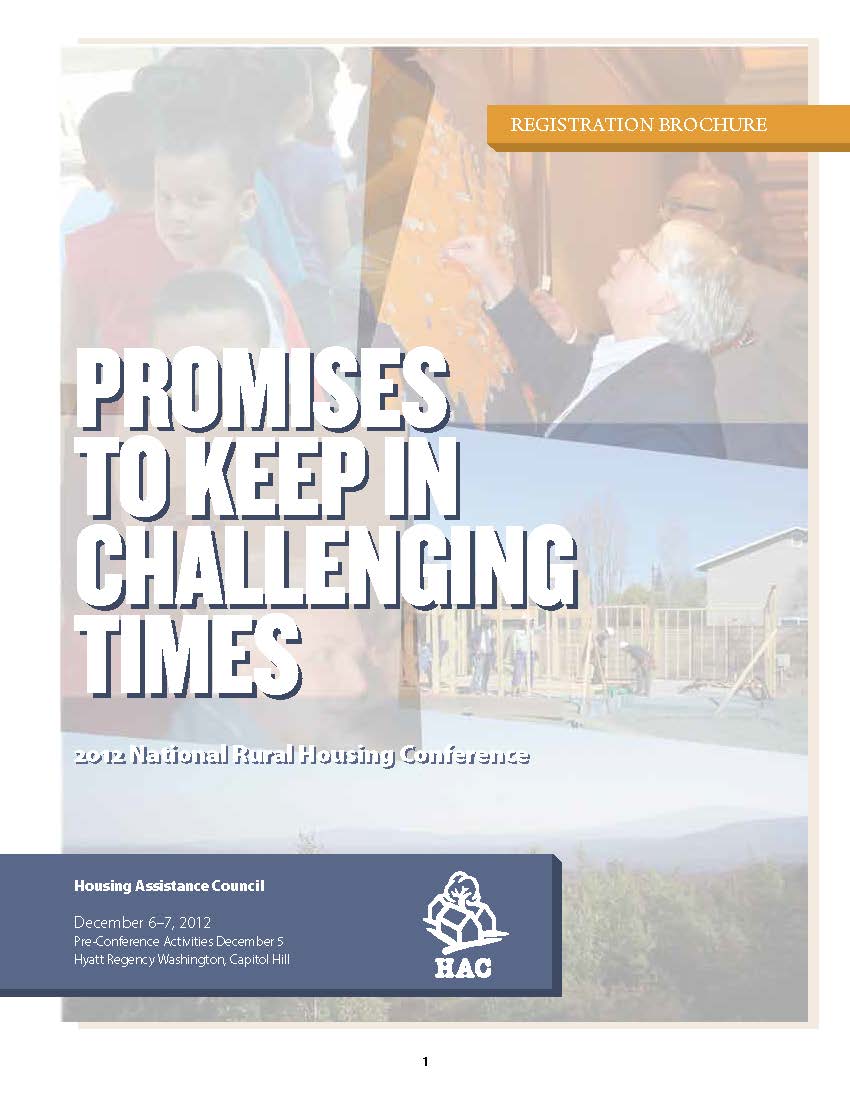
Conference Brochure

brochure_2012_cover

Share

twitter

facebookbutton

linkedin

Marketing Email (Copy the Contents of the Email Below – html source)

NRHC 2012 Conference Banner
Register Now for the National Rural Housing Conference

Interested in learning more about rural housing and networking with innovative organizations from across the U.S.? Join the Housing Assistance Council (HAC) at the 2012 National Rural Housing ConferencePromises to Keep in Challenging Times on December 6-7 in Washington, DC.

The Conference is a gathering of housing and community development organizations that serve rural areas, national housing and rural related associations and groups, federal agency and hill staff, and stakeholders interested in affordable housing in rural America.

Register before November 9 to take advantage of early-bird discount rates.

For more information, download the registration brochure.

Questions? Contact Dan Stern at HAC, (202) 842-8600.

Conference Banner (Right Click and choose “Save Target As”)

AC_banner-02

Conference Footer (Right Click and choose “Save Target As”)

hac_conf12_footer

Affordable Housing for Rural Veterans – Grantees

Veterans of the United States military services put their lives in danger to protect their country and its residents. However, when they return home they are not always able to find housing and access to services in their communities. The Housing Assistance Council (HAC), in partnership with The Home Depot Foundation, has created the Affordable Housing for Rural Veterans (AHRV) grant program to provide rural organizations with the financial resources to support their ability to meet or help meet the affordable housing needs of veterans in rural areas.

Highlights of 2017 Grant Activities included small grants for rural nonprofit organizations. HAC made the awards in summer 2017. AHRV grants support bricks-and-mortar projects that help veterans with home repair and rehab needs, support homeless veterans, or help veterans become homeowners, tap into available housing programs and secure affordable rental housing. Grantees are listed below.

2017 Affordable Housing for Rural Veterans – About the Grantees

  • Greenhouse Ministries, in Murfreesboro, Tennessee will use $30,000 to support rehabilitation of six veterans’ homes in rural Rutherford, Tennessee. For additional information about Greenhouse Ministries visit https://www.greenhousemin.org/.
  • NeighborWorks Umpqua, in Roseburg, Oregon will use $30,000 to perform critical repairs on three veteran-owned homes in Roseburg. For additional information about NeighborWorks Umpqua, visit https://www.nwumpqua.org.
  • North East Community Action Corporaton (NECAC), in Bowling Green, Missouri, will utilize $30,000 to support repair and rehabilitation of 8 to 10 veteran homes throughout its 12-county service area. For additonal information about NECAC, visit https://www.necac.org/.
  • Northwest Regional Housing Authority, Harrison, Arkansas, will utilize $30,000 to perform homeowner repairs on 5 to 10 veteran homes throughout its three-county service area. For additional information about Northwest Regional Housing Authority, visit https://www.nwregionalhousing.org/.
  • O.C.E.A.N., Inc. in Toms River, New Jersey, will utilize $30,000 to support the developent of 10 single-family housing units for veterns in Tuckertown, New Jersey. For additional information about O.C.E.A.N., Inc., visit https://www.oceaninc.org/.
  • Open Hands Outreach in Coolidge, Arizona, will utilize $14,225 to support the rehabilitation and expansion of a multi-tenant single-room occupancy (SRO) facility. For additional information about Open Hands Outreach, visit https://www.ohopcharity.org.
  • The Vets Place, in Northfield, Vermont, will utilize $30,000 to complete whole facility window replacement and weatherization on a 26-unit SRO transitional facility for veterans. For additional information on The Vets Place, visit https://www.vermontveteransplace.org/.
  • Western Maine Community Action (WMCA) in East Wilton, Maine, will use $30,000 to support home reconstruction for one rural veteran in Franklin County. More information about WMCA can be found at https://wmca.org.
  • White Mountain Apache Housing Authority, in Whiteriver, Arizona, will use $30,000 to repair three veteran homes on the Fort Apache Indian Reservation. For more information about White Mountain Apache Housing Authority visit https://www.wmahousingauthority.org/.

Affordable Housing for Rural Veterans – Information and Resources

Building knowledge around affordable housing for rural veterans is critical to meeting the needs of that population. Assistance providers have very little in the way of models or information on program development or effective use of resources. To facilitate networking between rural organizations and to assist in the development of effective programs, HAC’s Affordable Housing for Rural Veterans Initiative provides the following information resources:

Veterans Data Central

An extensive data utility that provides detailed information on the situation of veterans down to the level of every U.S. county. Included are demographic and economic indicators, housing characteristics, VA housing and mortgage finance information, and veteran homelessness. The site provides approximately 420 veteran-specific data indicators and over 650,000 data points dedicated solely to information on veterans.

Supporting Veterans in Your State

A set of fact sheets — one for each state, the District of Columbia, and the US — provides details on the veterans’ population including proportion, prevalence by county, median income, poverty levels, unemployment rate, disability, median home value, housing problems, homelessness, and other factors.

HAC Publications

HAC Lists

Sign up to be a stakeholder in the veterans’ program to get periodic announcements about grants, events, and resources for rural veterans’ housing programs. Contact Shonterria Charleston at shonterria@ruralhome.org or call 202.842.8600 x 131.

Sign up for HAC News for current updates on other housing issues as well as government programs

Additional Resources

FEDERAL PROGRAMS AND RESOURCES
The U.S. Department of Veterans Affairs (VA)
The VA provides benefits, services, information and support to veterans of the U.S. Military services, including the veterans Home Loan Program.

HUD Veterans Affairs Supportive Housing (HUD-VASH)
HUD-VASH combines the Housing Choice Voucher rental assistance program with case management and clinical services from the VA.

USDA Rural Development Community Facilities Program

NATIONAL ORGANIZATIONS

The Home Depot Foundation: https://www.homedepotfoundation.org/

Volunteers of America: https://www.voa.org/Get-Help/National-Network-of-Services/Veterans

National Alliance to End Homelessness: https://www.endhomelessness.org/pages/veterans

National Coalition for Homeless Veterans: https://www.nchv.org/

Is there a resource that we have not listed here that you would like to see? Email HAC to share your ideas.

September 2012: America’s Rural Heroes


The September 2012 of Rural Voices, America’s Rural Heroes.

Read more

Affordable Housing for Rural Veterans

Rural Veterans and Local Nonprofits Receive Housing Support

Funded by The Home Depot Foundation

Washington, D.C., September 21, 2018 – Veterans and their families in eleven rural communities will have better lives, thanks to The Home Depot Foundation and the Housing Assistance Council. The Foundation is awarding grants totaling $306,500 to eleven local nonprofit housing associations around the country to build or preserve housing for veterans in rural America.

The funds are part of The Home Depot Foundation’s Veteran Housing Grants Program, which wascreated to support the development and repair of housing for veterans. Too many American veterans and their families face major housing challenges, aggravated by issues like unemployment, age and service-related disabilities. The Home Depot Foundation is dedicated to giving back to those who have already given so much for our country.

Read More…


homedepotfoundationlogoMade possible with the Generous Support of The Home Depot Foundation

Veterans Data Central

A Resource for Informing Strategies to Help Veterans

The Housing Assistance Council (HAC), in partnership with The Home Depot Foundation, JPMorgan Chase & Co., and the Wells Fargo Housing Foundation has created the Affordable Housing for Rural Veterans (AHRV) initiative to provide rural organizations with the technical assistance, training, information, and financial resources they need to improve their ability to serve veterans.

Veterans of the United States military services put their lives in danger to protect their country and its citizens. However, when they return home they are not always able to find housing and access to services in their communities.

Sponsored by:With Generous Support from JP Morgan Chase & Co.

In Partnership with The Home Depot Foundation, JP Morgan Chase Co, and The Wells Fargo Housing Foundation

Past Trainings

December 5, 2017: Affordable Housing Solutions for Rural Veterans: A Symposium – Recording

October 20, 2017: Veterans Aging Summit – Website

August 10, 2016: Overview on VA REO Property Preservation and Maintenance and Access Opportunities for Nonprofits – Materials: Presentation | Recording | Handbook

July 13, 2016: VA Specially Adapted Housing Grant Program – Materials: Presentation | Recording | Application

June 8, 2016: VA Housing Resources for Heroes: An In-depth Overview of the VA Home Loan Guaranty Benefit – Materials

May 18, 2016: Serving Our Aging Veterans: A Symposium – Materials

May 20, 2015: Serving Veterans in Rural America: A Symposium – Materials

May 6, 2015: Access to Health and Homeless Services for Rural Veterans – Materials

August 20, 2014: Building a Community for Veterans: Patriot Place, Tennessee – Materials

July 23, 2014: Canal Street Housing: Housing for Homeless Veterans – Materials

June 25, 2014: From Service to Shelter, Housing for Veterans in Rural America – Materials

April 22-23, 2014: Housing Seniors and Veterans in Rural America: Preservation, Development, & Services

April 9, 2014: Serving Veterans in Rural America – A Symposium – Summary and Materials

August 28-29, 2013: Housing Seniors and Veterans in Rural America: Preservation, Development and Services – Materials

Link to more Information and Resources

Link to Information about Initiative Grantees

USDA to Use FY12 Section 515 Funds for Prepayment Incentives, No New Construction

HAC has learned that the following message was sent by USDA’s Office of Congressional Relations to members of Congress on August 20.

. . . RHS will forego the release of the NOFA for Sec. 515 new construction projects. This decision not to fund new construction was due to the need to conform with the law as interpreted by the Supreme Court (Salazar v. Ramah), which stated that if agencies had outstanding contracts and sufficient appropriations, they must fund any of those contracts. OGC determined that the decision was relevant to the contracts, known as Rental Assistance Incentive contracts, entered into by the Rural Housing Service to avert prepayment of Section 515 rental housing through offers of prepayment incentives to the project owners.

We understand our stakeholders’ disappointment in RD’s decision not to fund 515 new construction. RD had intended to issue a NOFA; the notice was in clearance at the time of the Salazar decision. The delay led to insufficient time for Federal Register notice of a NOFA, application process and ultimate obligation prior to the end of the fiscal year. The Supreme Court’s decision has forced RD to change its priorities and use 515 appropriations to fund prepayment incentives (equity loans and RA). However, the limited funding left in the 515 program will be used to rehabilitate existing 515 housing, or facilitate the sale of RD inventory properties to owners adept at finding additional resources to revitalize the properties. There is an urgent need for RD to revitalize its existing portfolio of aging rental housing. Since the cost to rehabilitate our existing housing is less than the cost of new construction, the limited funding left in the 515 program will go further and in the time required, prior to fiscal year end.

HAC News: August 22, 2012

HAC News Formats. pdf

August 22, 2012
Vol. 41, No. 17

• USDA to use FY12 Section 515 funds for prepayment incentives • CBS News airs story on Section 502 guarantee foreclosures • Grants offered for senior volunteers in specific places • HUD releases general section for FY13 NOFAs • Funds exhausted for Section 502 guarantee program refinances • FHFA requests comments about eminent domain for foreclosures • Public Housing Assessment System scoring process explained • CFPB proposes regulations on high cost mortgages and homeownership counseling • Some mortgage disclosures to be combined • Blueprint for better farmworker housing published • HAC Seeks Nominations for Rural Housing Awards • Register Now for the National Rural Housing Conference!


August 22,2012
Vol. 41, No. 17

USDA TO USE FY12 SECTION 515 FUNDS FOR PREPAYMENT INCENTIVES. An email message from USDA to congressional offices explains that the department has canceled its NOFA for new construction funding. A Supreme Court ruling in a different context (Salazar v. Ramah Navajo Chapter) required the government to pay amounts to fulfill contractual obligations even if Congress did not appropriate enough funds. Owners of over 100 Section 515 properties have been on a waiting list for incentives (equity loans and/or Rental Assistance) from USDA to keep these properties in the program, so the FY12 funds will be used for those incentives.

CBS NEWS AIRS STORY ON SECTION 502 GUARANTEE FORECLOSURES. Like a May 25 Wall Street Journal article, the August 16 CBS story criticizes USDA’s collection tactics when a borrower with high medical bills fell behind on mortgage payments.

GRANTS OFFERED FOR SENIOR VOLUNTEERS IN SPECIFIC PLACES. The Corporation for National and Community Service requests letters of intent by September 10 from public agencies, tribes, nonprofits, and institutions of higher education interested in Retired and Senior Volunteer Program funding. RSVP grants can be used to cover expenses such as volunteer recruitment, training, and travel for purposes including low-income housing. Partial matching funds are required. Applications are due October 11. A draft NOFA, list of program areas, information about technical assistance calls, and more are posted on CNCS’s site.

HUD RELEASES GENERAL SECTION FOR FY13 NOFAS. The general section’s information applies to next year’s NOFAs and does not itself offer funding. Contact HUD’s grants management office, 202-402-4802.

FUNDS EXHAUSTED FOR SECTION 502 GUARANTEE PROGRAM REFINANCES. USDA has used all its FY12 money for this program. Lenders can submit loan applications reflecting FY13 fees (upfront guarantee fee of 2% and annual fee of 0.4%) to USDA, which will hold them until FY13 funding becomes available. Contact an RD office.

FHFA REQUESTS COMMENTS ABOUT EMINENT DOMAIN FOR FORECLOSURES. The Federal Housing Finance Agency, which oversees Fannie Mae, Freddie Mac, and the Federal Home Loan Bank system, is considering taking action on its “significant concerns” about the impact on lenders when local governments use eminent domain powers to seize properties before foreclosure in order to provide affordable housing. Comments are due September 7. See Federal Register, 8/9/12. Contact FHFA, eminentdomainOGC@fhfa.gov.

PUBLIC HOUSING ASSESSMENT SYSTEM SCORING PROCESS EXPLAINED. HUD provides additional information about the process for issuing scores under the Physical Condition Indicator of the PHAS under a February 23, 2011 notice, applicable to HUD-assisted multifamily and public housing properties. See Federal Register, 8/9/12 or HUD’s site. Contact Claudia J. Yarus, HUD, 202-475-8830.

CFPB PROPOSES REGULATIONS ON HIGH COST MORTGAGES AND HOMEOWNERSHIP COUNSELING.Comments are due September 7 on Consumer Financial Protection Bureau changes to implement provisions of the Dodd-Frank Act that expand the types of mortgage loans subject to the Home Ownership and Equity Protection Act of 1994, revise triggers for HOEPA coverage, impose other restrictions on HOEPA mortgages, including a counseling re-quirement, and impose homeownership counseling requirements in connection with the Truth in Lending Act and the Real Estate Settlement Procedures Act. See CFPB’s site or regulations.gov. Contact Paul Seja, CFPB, 202-435-7700.

SOME MORTGAGE DISCLOSURES TO BE COMBINED. To implement another Dodd-Frank provision, the Consumer Financial Protection Bureau proposes to combine some of the disclosures and forms required by the Truth in Lending Act and RESPA. Comments are due November 6. See CFPB’s site or regulations.gov. Contact David Friend, CFPB, 202-435-7700.

BLUEPRINT FOR BETTER FARMWORKER HOUSING PUBLISHED. The report summarizes policy and research changes identified at a California Rural Legal Assistance forum, and a working group on health and housing will continue the effort. Contact spodesta@crla.org.

HAC SEEKS NOMINATIONS FOR RURAL HOUSING AWARDS. Nominations are due September 28 for the Cochran/Collings Award for national rural housing service and the Skip Jason Community Service Award. The honors will be presented at the National Rural Housing Conference in December. Complete the online form to submit a nomination or contact Lilla Sutton, HAC, 202-842-8600, lilla@ruralhome.org to request a paper form.

REGISTER NOW FOR THE NATIONAL RURAL HOUSING CONFERENCE!
HAC has opened registration for the 2012 National Rural Housing Conference, which will take place December 6-7, with pre-conference activities on December 5, at the Hyatt Regency Washington on Capitol Hill in Washington, DC. Register now to take advantage of the special early bird discount! Start networking in advance – join the conference LinkedIn group. Questions? Contact Dan Stern, HAC, dan@ruralhome.org or 202-842-8600.

HAC News: August 8, 2012

HAC News Formats. pdf

August 8, 2012
Vol. 41, No. 16

• Leaders agree on continuing resolution, Congress recesses • House members plan letter requesting rural definition extension in CR • OMB tells agencies to continue spending, advises Congress to change sequestration • Fees for some Section 502 loan guarantees to increase October 1 • FEMA requests comments on emergency housing assistance • Interim Continuum of Care rule issued • IRS proposes rule on submetered utilities in LIHTC properties • Circular A-133 Compliance Supplement for 2012 available • Federal regulators release 2012 list of distressed or underserved tracts for CRA • Senate subcommittee considers changes to HUD’s rental assistance programs • Job growth slower in rural places than urban ones • Different skills result in different wages in rural and urban places, study concludes • Study examines potential for increasing energy efficiency in manufactured homes

August 8, 2012
Vol. 41, No. 16

LEADERS AGREE ON CONTINUING RESOLUTION, CONGRESS RECESSES. In late July Republicans and Democrats in Congress, along with the White House, announced they will develop a continuing resolution to fund the government for the first six months of FY13, starting October 1, 2012. Most programs will remain at FY12 funding levels. Congress has recessed until September 10, so the CR will be considered in September.

HOUSE MEMBERS PLAN LETTER REQUESTING RURAL DEFINITION EXTENSION IN CR. The National Rural Housing Coalition reports Rep. Jeff Fortenberry (R-NE) and others will send a letter to House leadership asking that the FY13 CR include an extension of language keeping growing rural communities eligible for USDA rural housing programs. Background information on this issue is posted on HAC’s website.

OMB TELLS AGENCIES TO CONTINUE SPENDING, ADVISES CONGRESS TO CHANGE SEQUESTRATION. A July 31 memo from OMB’s Acting Director tells heads of federal departments and agencies to continue normal spending and operations since Congress has over five months to change the January 1 spending cuts required by the Budget Control Act. On August 7 President Obama signed into law the Sequestration Transparency Act of 2012, which requires an Administration report within 30 days estimating sequestration’s impact on programs.

FEES FOR SOME SECTION 502 LOAN GUARANTEES TO INCREASE OCTOBER 1. An email has notified stakeholders that, while the upfront fee for purchase transactions will remain at 2%, the upfront fee for refinances will rise from 1.5% in FY12 to 2% in FY13. Annual fees for both purchases and refinances will rise from 0.30% in FY12 to 0.40% next year. Contact Debbie Terrell, RD, 918-534-3254.

FEMA REQUESTS COMMENTS ON EMERGENCY HOUSING ASSISTANCE. Comments are due September 28 on proposed revisions to regulations on FEMA’s housing repair, replacement, and construction assistance. The changes are intended to clarify eligibility criteria and implement legislative changes enacted in 2006, not to create new eligibility requirements or add burdens for applicants. Contact Lumumba T. Yancey, FEMA, 202-212-1000.

INTERIM CONTINUUM OF CARE RULE ISSUED. The regulation takes effect August 30 and comments are due October 1. Contact Ann Marie Oliva, HUD, 202-708-4300.

IRS PROPOSES RULE ON SUBMETERED UTILITIES IN LIHTC PROPERTIES. The change would clarify that utility costs paid by a tenant based on actual consumption in a submetered rent-restricted unit are treated as paid by the tenant directly to the utility company. IRS will hold a public hearing on November 27 in Washington, DC. Comments are due October 9. Contact David Selig, IRS, 202-622-3040.

CIRCULAR A-133 COMPLIANCE SUPPLEMENT FOR 2012 AVAILABLE. The supplement provides guidance on audits of federally funded nonprofits and government entities. Comments are due October 31.

FAIR MARKET RENTS PROPOSED FOR FY13. Comments are due September 4 on FMRs that will take effect October 1. Contact local HUD program staff or HUD User, 1-800-245-2691.

FEDERAL REGULATORS RELEASE 2012 LIST OF DISTRESSED OR UNDERSERVED TRACTS FOR CRA. Lender activities in these distressed or underserved nonmetropolitan middle-income geographies can receive credit in Community Reinvestment Act evaluations.

SENATE SUBCOMMITTEE CONSIDERS CHANGES TO HUD’S RENTAL ASSISTANCE PROGRAMS. On August 1 the Banking Committee’s Housing Subcommittee held a hearing titled “Streamlining and Strengthening HUD’s Rental Housing Assistance Programs.” Witnesses discussed provisions of several reform bills introduced in Congress.

JOB GROWTH SLOWER IN RURAL PLACES THAN URBAN ONES. The Daily Yonder examined changes in counties’ numbers of jobs from June 2011 to June 2012. Jobs increased by 1.77% in urban counties and by 0.86% in rural counties. One-third of rural and exurban counties lost jobs during this 12-month period.

DIFFERENT SKILLS RESULT IN DIFFERENT WAGES IN RURAL AND URBAN PLACES, STUDY CONCLUDES. “Workforce Skills across the Urban-Rural Hierarchy,” by New York Federal Reserve Bank staff and others, is a preliminary report on research that examined job skills and income levels across a spectrum of places from urban to rural. Researchers found that jobs clustered in urban areas require higher levels of skills than those clustered in rural areas, and that these differences help explain the higher wages in urban areas. Contact Kevin Stolarick

STUDY EXAMINES POTENTIAL FOR INCREASING ENERGY EFFICIENCY IN MANUFACTURED HOMES. Noting that energy efficiency in manufactured homes lags behind that of site-built homes, the American Council for an Energy-Efficient Economy reports that improvements can be made in new construction and existing homes. Contact Patrick Kiker, ACEEE, 202-507-4043.

Tag Archive for: Rural Housing

HAC News: October 24, 2012

HAC News Formats. pdf

October 24, 2012
Vol. 41, No. 21

• October 21-27 is National Childhood Lead Poisoning Prevention Week • HAC invites applications for rural veterans assistance • Section 8 OCAFs announced • Federal homelessness plan amended • Toolkit offered for Independent Foreclosure Review outreach • LIHTC can serve extremely low-income tenants, research finds • Census reports on sheltered population • HUD launches app for FMRs and Income Limits • LIHEAP assistance to older manufactured homes higher per square foot • GAO raises concerns about air exchange standards in HUD Code • National Rural Housing Conference early bird registration deadline is November 9!


October 24, 2012
Vol. 41, No. 21

OCTOBER 21-27 IS NATIONAL CHILDHOOD LEAD POISONING PREVENTION WEEK. Details and resources are available from the federal Centers for Disease Control and Prevention, leadinfo@cdc.gov.

HAC INVITES APPLICATIONS FOR RURAL VETERANS ASSISTANCE. A new HAC initiative will provide grants of up to $30,000 to support bricks-and-mortar projects that help rural low-income, elderly, and disabled veterans and active military personnel with housing needs. Send a letter of intent by 5:00 p.m. Eastern time on October 31. Application guidelines are posted on HAC’s website. Contact Janice Clark, HAC.

SECTION 8 OCAFS ANNOUNCED. HUD’s new Operating Cost Adjustment Factors apply to project-based assistance contracts with an anniversary date on or after February 11, 2013. See Federal Register, 10/16/12. Contact Stan Houle, HUD, 202-402-2572.

FEDERAL HOMELESSNESS PLAN AMENDED. In September the U.S. Interagency Council on Homelessness amended Opening Doors: Federal Strategic Plan to Prevent and End Homelessness, its plan to end homelessness among families, children, and youth by 2020. The amendment offers strategies and supports to improve educational outcomes for children and youth and steps to assist unaccompanied youth experiencing homelessness. Contact USICH, 202-708-4663.

TOOLKIT OFFERED FOR INDEPENDENT FORECLOSURE REVIEW OUTREACH. The Federal Reserve Board has made materials available to help local nonprofits reach residents whose homes were foreclosed in 2009-2010 by any of 14 mortgage servicers and who are eligible for an independent review. Call 888-952-9105.

LIHTC CAN SERVE EXTREMELY LOW-INCOME TENANTS, RESEARCH FINDS. The Furman Center and Moelis Institute at New York University examined data from urban, suburban, and rural Low-Income Housing Tax Credit properties in 16 states and found that 40% of the units are occupied by extremely low-income tenants (with incomes below 30% of area median). Because almost 70% of those ELI tenants receive some form of rental assistance, researchers concluded that “rental assistance is currently an indispensable part of the equation to serve those households.” The results are reported in “What Can We Learn about the Low Income Housing Tax Credit Program by Looking at the Tenants?”

CENSUS REPORTS ON SHELTERED POPULATION. The Emergency and Transitional Shelter Population: 2010 summarizes data on age, sex, and race/ethnicity for the 209,000 people counted in such shelters nationwide by the 2010 Census (not the entire homeless population). Data are aggregated by state and a map shows the number of people in shelters in every county. Over 60% of counties have no sheltered population.

HUD LAUNCHES APP FOR FMRS AND INCOME LIMITS. The map-based app for Android and iPhone allows users to search Fair Market Rents and Income Limits.

LIHEAP ASSISTANCE TO OLDER MANUFACTURED HOMES HIGHER PER SQUARE FOOT. A Government Accountability Office study found that the Low Income Home Energy Assistance Program provided about 33¢ per square foot of assistance to pre-1976 manufactured homes compared to about 20¢ per square foot for site-built homes. About 3% of total LIHEAP funds went to older manufactured homes. The study used data for 2005, the most recent available. Worker and Family Assistance: Home Energy Assistance for Low-Income Occupants of Manufactured Homes (GAO-12-848R) is available online or from GAO, 866-801-7077. Contact Frank Rusco, GAO, 202-512-3841.

GAO RAISES CONCERNS ABOUT AIR EXCHANGE STANDARDS IN HUD CODE. Standards for placement of air intake and exhaust vents are outdated and ventilation systems are not tested, GAO reports, in manufactured homes built after 1976 under HUD’s Manufactured Home Construction and Safety Standards. Manufactured Housing Standards: Testing and Performance Evaluation Could Better Ensure Safe Indoor Air Quality (GAO-13-52) is available online or from GAO, 866-801-7077. Contact Mathew J. Scirè, GAO, 202-512-8678.

NATIONAL RURAL HOUSING CONFERENCE EARLY BIRD REGISTRATION DEADLINE IS NOVEMBER 9! The 2012 conference, “Promises to Keep in Challenging Times,” will be December 6-7, with pre-conference activities on December 5, at the Hyatt Regency Washington on Capitol Hill in Washington, DC. Register now to take advantage of the special early bird discount! Start networking in advance – join the conference LinkedIn group. Questions? Contact Dan Stern, HAC, dan@ruralhome.org or 202-842-8600.

HAC News: October 10, 2012

HAC News Formats. pdf

October 10, 2012
Vol. 41, No. 20

• Presidential candidates’ and parties’ positions limited on rural and housing • USDA and BIA commit to work together for Indian Country housing improvement • Continuum of Care comment deadline extended • HUD requests comment on smoke-free policies • FY12 Fair Market Rents finalized • Difficult Development Areas announced • Additional instructions provided on RAD • Poll Finds Support for Modifying Mortgage Interest Deduction


October 10, 2012
Vol. 41, No. 20

PRESIDENTIAL CANDIDATES’ AND PARTIES’ POSITIONS LIMITED ON RURAL AND HOUSING. The candidates on rural issues: On October 9 the Romney campaign released “Agricultural Prosperity: Mitt Romney’s Vision for a Vibrant Rural America,” which addresses taxes, trade, regulation, and energy as they relate to farmers and ranchers. The Obama campaign’s web page entitled “Rural America” mentions agriculture, rural businesses, rural veterans, and energy and another post responds to Romney’s rural paper. The parties on rural issues: The Republican platform discusses agriculture but does not include other rural issues. The Democratic platform mentions rural small business, education, and infrastructure – though not housing – in addition to agriculture and energy. The candidates on housing: Romney’s white paper on housing, “Securing the American Dream and the Future of Housing Policy,” covers the housing finance crisis and the Romney-Ryan plan to “revitalize the private sector’s role in the housing market.” The issues section of Obama’s campaign website does not include housing, although a site search retrieved information about Administration initiatives on foreclosure and housing finance. The parties on housing and poverty: The Republican Party platform supports homeownership and mortgage finance reform, and acknowledges a role for government in “enforcing non-discrimination laws and assisting low-income families and the elderly with safe and adequate shelter, especially through the use of housing vouchers.” Its anti-poverty plank calls for “the federal government’s entire system of public assistance [to] be reformed to ensure that it promotes work.” The Democratic Party platform sup-ports homeownership and foreclosure relief, but does not mention rental housing. It states, “We must make ending poverty a national priority” through jobs, safety net programs, lending, an increased minimum wage, a strong labor movement, education, and attention to inequality. The parties on Native peoples: Both parties acknowledge the federal government’s special relationship with American Indians, Alaska Natives, and Native Hawaiians. Both support tribal self-governance and respect Native culture.

USDA AND BIA COMMIT TO WORK TOGETHER FOR INDIAN COUNTRY HOUSING IMPROVEMENT. Two Memoranda of Understanding, effective for five years, apply to housing as well as other rural development programs, farm programs, and conservation. They pledge better understanding and coordinated processes related to housing. Contact Tedd Buelow, RD, 720-544-2911.

CONTINUUM OF CARE COMMENT DEADLINE EXTENDED. Interim CoC regulations were published July 31 with comments due October 1. The deadline is now November 16. See Federal Register, 9/28/12, or regulations.gov. Contact Ann Marie Oliva, HUD, 202-708-4300.

HUD REQUESTS COMMENT ON SMOKE-FREE POLICIES. The department requests best practices and practical strategies from housing providers who have implemented smoke-free policies and input from housing providers that have decided not to implement such a policy and from those impacted by that decision. Comments are due November 5. See Federal Register, 10/4/12 or regulations.gov. Contact Shauna Sorrells, HUD, 202-402-2769.

FY12 FAIR MARKET RENTS FINALIZED. See Federal Register, 10/5/12, or HUDUser.org. Contact local HUD program staff.

DIFFICULT DEVELOPMENT AREAS ANNOUNCED. HUD designates DDAs for purposes of the Low-Income Housing Tax Credit. Adoption of small area DDAs (see HAC News, 11/1/11) has been delayed. Qualified Census Tracts for 2013 were designated in April 2012 (see HAC News, 5/2/12). See Federal Register, 9/28/12 or HUDUser.org. Contact Michael K. Hollar, HUD, 202-402-5878.

ADDITIONAL INSTRUCTIONS PROVIDED ON RAD. HUD’s information is for PHAs and owners applying under the Rental Assistance Demonstration to convert public and assisted housing to long-term, project-based Section 8 rental assistance. See Federal Register, 9/28/12, or HUD’s website. Contact HUD RAD staff.

POLL FINDS SUPPORT FOR MODIFYING MORTGAGE INTEREST DEDUCTION. A poll conducted in August for the National Low Income Housing Coalition found that 56% of Americans favor replacing the mortgage interest deduction with a tax credit that would provide the same percentage benefit for all households regardless of income. Nearly two-thirds (63%) support capping the size of mortgage for which one can get a tax break at $500,000. In addition, 68% believe that not being able to find affordable housing is a large or very large national problem. Strong majorities support federal programs to build or rehabilitate affordable rental housing (69%) and federal programs to help low-income families pay their rent (59%). When asked how to use the savings the federal government would gain from the proposed modifications to the mortgage interest deduction, 63% of those polled would make ending homelessness a top or high priority use. Contact Amy Clark, NLIHC, 202-662-1530, ext. 227.

2012 National Rural Housing Conference – Marketing Materials

Thank you for your interest in assisting HAC with marketing the 2012 National Rural Housing Conference. Please use any of the materials and templates on this page as a starting point, but feel free to customize as you see fit.

About the Conference:

When: December 6-7, 2012 with pre-conference activities on December 5
Where: Hyatt Regency Washington on Capitol Hill
400 New Jersey Ave NW
Washington, DC 20001

Conference Brochure

brochure_2012_cover

Share

twitter

facebookbutton

linkedin

Marketing Email (Copy the Contents of the Email Below – html source)

NRHC 2012 Conference Banner
Register Now for the National Rural Housing Conference

Interested in learning more about rural housing and networking with innovative organizations from across the U.S.? Join the Housing Assistance Council (HAC) at the 2012 National Rural Housing ConferencePromises to Keep in Challenging Times on December 6-7 in Washington, DC.

The Conference is a gathering of housing and community development organizations that serve rural areas, national housing and rural related associations and groups, federal agency and hill staff, and stakeholders interested in affordable housing in rural America.

Register before November 9 to take advantage of early-bird discount rates.

For more information, download the registration brochure.

Questions? Contact Dan Stern at HAC, (202) 842-8600.

Conference Banner (Right Click and choose “Save Target As”)

AC_banner-02

Conference Footer (Right Click and choose “Save Target As”)

hac_conf12_footer

Affordable Housing for Rural Veterans – Grantees

Veterans of the United States military services put their lives in danger to protect their country and its residents. However, when they return home they are not always able to find housing and access to services in their communities. The Housing Assistance Council (HAC), in partnership with The Home Depot Foundation, has created the Affordable Housing for Rural Veterans (AHRV) grant program to provide rural organizations with the financial resources to support their ability to meet or help meet the affordable housing needs of veterans in rural areas.

Highlights of 2017 Grant Activities included small grants for rural nonprofit organizations. HAC made the awards in summer 2017. AHRV grants support bricks-and-mortar projects that help veterans with home repair and rehab needs, support homeless veterans, or help veterans become homeowners, tap into available housing programs and secure affordable rental housing. Grantees are listed below.

2017 Affordable Housing for Rural Veterans – About the Grantees

  • Greenhouse Ministries, in Murfreesboro, Tennessee will use $30,000 to support rehabilitation of six veterans’ homes in rural Rutherford, Tennessee. For additional information about Greenhouse Ministries visit https://www.greenhousemin.org/.
  • NeighborWorks Umpqua, in Roseburg, Oregon will use $30,000 to perform critical repairs on three veteran-owned homes in Roseburg. For additional information about NeighborWorks Umpqua, visit https://www.nwumpqua.org.
  • North East Community Action Corporaton (NECAC), in Bowling Green, Missouri, will utilize $30,000 to support repair and rehabilitation of 8 to 10 veteran homes throughout its 12-county service area. For additonal information about NECAC, visit https://www.necac.org/.
  • Northwest Regional Housing Authority, Harrison, Arkansas, will utilize $30,000 to perform homeowner repairs on 5 to 10 veteran homes throughout its three-county service area. For additional information about Northwest Regional Housing Authority, visit https://www.nwregionalhousing.org/.
  • O.C.E.A.N., Inc. in Toms River, New Jersey, will utilize $30,000 to support the developent of 10 single-family housing units for veterns in Tuckertown, New Jersey. For additional information about O.C.E.A.N., Inc., visit https://www.oceaninc.org/.
  • Open Hands Outreach in Coolidge, Arizona, will utilize $14,225 to support the rehabilitation and expansion of a multi-tenant single-room occupancy (SRO) facility. For additional information about Open Hands Outreach, visit https://www.ohopcharity.org.
  • The Vets Place, in Northfield, Vermont, will utilize $30,000 to complete whole facility window replacement and weatherization on a 26-unit SRO transitional facility for veterans. For additional information on The Vets Place, visit https://www.vermontveteransplace.org/.
  • Western Maine Community Action (WMCA) in East Wilton, Maine, will use $30,000 to support home reconstruction for one rural veteran in Franklin County. More information about WMCA can be found at https://wmca.org.
  • White Mountain Apache Housing Authority, in Whiteriver, Arizona, will use $30,000 to repair three veteran homes on the Fort Apache Indian Reservation. For more information about White Mountain Apache Housing Authority visit https://www.wmahousingauthority.org/.

Affordable Housing for Rural Veterans – Information and Resources

Building knowledge around affordable housing for rural veterans is critical to meeting the needs of that population. Assistance providers have very little in the way of models or information on program development or effective use of resources. To facilitate networking between rural organizations and to assist in the development of effective programs, HAC’s Affordable Housing for Rural Veterans Initiative provides the following information resources:

Veterans Data Central

An extensive data utility that provides detailed information on the situation of veterans down to the level of every U.S. county. Included are demographic and economic indicators, housing characteristics, VA housing and mortgage finance information, and veteran homelessness. The site provides approximately 420 veteran-specific data indicators and over 650,000 data points dedicated solely to information on veterans.

Supporting Veterans in Your State

A set of fact sheets — one for each state, the District of Columbia, and the US — provides details on the veterans’ population including proportion, prevalence by county, median income, poverty levels, unemployment rate, disability, median home value, housing problems, homelessness, and other factors.

HAC Publications

HAC Lists

Sign up to be a stakeholder in the veterans’ program to get periodic announcements about grants, events, and resources for rural veterans’ housing programs. Contact Shonterria Charleston at shonterria@ruralhome.org or call 202.842.8600 x 131.

Sign up for HAC News for current updates on other housing issues as well as government programs

Additional Resources

FEDERAL PROGRAMS AND RESOURCES
The U.S. Department of Veterans Affairs (VA)
The VA provides benefits, services, information and support to veterans of the U.S. Military services, including the veterans Home Loan Program.

HUD Veterans Affairs Supportive Housing (HUD-VASH)
HUD-VASH combines the Housing Choice Voucher rental assistance program with case management and clinical services from the VA.

USDA Rural Development Community Facilities Program

NATIONAL ORGANIZATIONS

The Home Depot Foundation: https://www.homedepotfoundation.org/

Volunteers of America: https://www.voa.org/Get-Help/National-Network-of-Services/Veterans

National Alliance to End Homelessness: https://www.endhomelessness.org/pages/veterans

National Coalition for Homeless Veterans: https://www.nchv.org/

Is there a resource that we have not listed here that you would like to see? Email HAC to share your ideas.

September 2012: America’s Rural Heroes


The September 2012 of Rural Voices, America’s Rural Heroes.

Read more

Affordable Housing for Rural Veterans

Rural Veterans and Local Nonprofits Receive Housing Support

Funded by The Home Depot Foundation

Washington, D.C., September 21, 2018 – Veterans and their families in eleven rural communities will have better lives, thanks to The Home Depot Foundation and the Housing Assistance Council. The Foundation is awarding grants totaling $306,500 to eleven local nonprofit housing associations around the country to build or preserve housing for veterans in rural America.

The funds are part of The Home Depot Foundation’s Veteran Housing Grants Program, which wascreated to support the development and repair of housing for veterans. Too many American veterans and their families face major housing challenges, aggravated by issues like unemployment, age and service-related disabilities. The Home Depot Foundation is dedicated to giving back to those who have already given so much for our country.

Read More…


homedepotfoundationlogoMade possible with the Generous Support of The Home Depot Foundation

Veterans Data Central

A Resource for Informing Strategies to Help Veterans

The Housing Assistance Council (HAC), in partnership with The Home Depot Foundation, JPMorgan Chase & Co., and the Wells Fargo Housing Foundation has created the Affordable Housing for Rural Veterans (AHRV) initiative to provide rural organizations with the technical assistance, training, information, and financial resources they need to improve their ability to serve veterans.

Veterans of the United States military services put their lives in danger to protect their country and its citizens. However, when they return home they are not always able to find housing and access to services in their communities.

Sponsored by:With Generous Support from JP Morgan Chase & Co.

In Partnership with The Home Depot Foundation, JP Morgan Chase Co, and The Wells Fargo Housing Foundation

Past Trainings

December 5, 2017: Affordable Housing Solutions for Rural Veterans: A Symposium – Recording

October 20, 2017: Veterans Aging Summit – Website

August 10, 2016: Overview on VA REO Property Preservation and Maintenance and Access Opportunities for Nonprofits – Materials: Presentation | Recording | Handbook

July 13, 2016: VA Specially Adapted Housing Grant Program – Materials: Presentation | Recording | Application

June 8, 2016: VA Housing Resources for Heroes: An In-depth Overview of the VA Home Loan Guaranty Benefit – Materials

May 18, 2016: Serving Our Aging Veterans: A Symposium – Materials

May 20, 2015: Serving Veterans in Rural America: A Symposium – Materials

May 6, 2015: Access to Health and Homeless Services for Rural Veterans – Materials

August 20, 2014: Building a Community for Veterans: Patriot Place, Tennessee – Materials

July 23, 2014: Canal Street Housing: Housing for Homeless Veterans – Materials

June 25, 2014: From Service to Shelter, Housing for Veterans in Rural America – Materials

April 22-23, 2014: Housing Seniors and Veterans in Rural America: Preservation, Development, & Services

April 9, 2014: Serving Veterans in Rural America – A Symposium – Summary and Materials

August 28-29, 2013: Housing Seniors and Veterans in Rural America: Preservation, Development and Services – Materials

Link to more Information and Resources

Link to Information about Initiative Grantees

USDA to Use FY12 Section 515 Funds for Prepayment Incentives, No New Construction

HAC has learned that the following message was sent by USDA’s Office of Congressional Relations to members of Congress on August 20.

. . . RHS will forego the release of the NOFA for Sec. 515 new construction projects. This decision not to fund new construction was due to the need to conform with the law as interpreted by the Supreme Court (Salazar v. Ramah), which stated that if agencies had outstanding contracts and sufficient appropriations, they must fund any of those contracts. OGC determined that the decision was relevant to the contracts, known as Rental Assistance Incentive contracts, entered into by the Rural Housing Service to avert prepayment of Section 515 rental housing through offers of prepayment incentives to the project owners.

We understand our stakeholders’ disappointment in RD’s decision not to fund 515 new construction. RD had intended to issue a NOFA; the notice was in clearance at the time of the Salazar decision. The delay led to insufficient time for Federal Register notice of a NOFA, application process and ultimate obligation prior to the end of the fiscal year. The Supreme Court’s decision has forced RD to change its priorities and use 515 appropriations to fund prepayment incentives (equity loans and RA). However, the limited funding left in the 515 program will be used to rehabilitate existing 515 housing, or facilitate the sale of RD inventory properties to owners adept at finding additional resources to revitalize the properties. There is an urgent need for RD to revitalize its existing portfolio of aging rental housing. Since the cost to rehabilitate our existing housing is less than the cost of new construction, the limited funding left in the 515 program will go further and in the time required, prior to fiscal year end.

HAC News: August 22, 2012

HAC News Formats. pdf

August 22, 2012
Vol. 41, No. 17

• USDA to use FY12 Section 515 funds for prepayment incentives • CBS News airs story on Section 502 guarantee foreclosures • Grants offered for senior volunteers in specific places • HUD releases general section for FY13 NOFAs • Funds exhausted for Section 502 guarantee program refinances • FHFA requests comments about eminent domain for foreclosures • Public Housing Assessment System scoring process explained • CFPB proposes regulations on high cost mortgages and homeownership counseling • Some mortgage disclosures to be combined • Blueprint for better farmworker housing published • HAC Seeks Nominations for Rural Housing Awards • Register Now for the National Rural Housing Conference!


August 22,2012
Vol. 41, No. 17

USDA TO USE FY12 SECTION 515 FUNDS FOR PREPAYMENT INCENTIVES. An email message from USDA to congressional offices explains that the department has canceled its NOFA for new construction funding. A Supreme Court ruling in a different context (Salazar v. Ramah Navajo Chapter) required the government to pay amounts to fulfill contractual obligations even if Congress did not appropriate enough funds. Owners of over 100 Section 515 properties have been on a waiting list for incentives (equity loans and/or Rental Assistance) from USDA to keep these properties in the program, so the FY12 funds will be used for those incentives.

CBS NEWS AIRS STORY ON SECTION 502 GUARANTEE FORECLOSURES. Like a May 25 Wall Street Journal article, the August 16 CBS story criticizes USDA’s collection tactics when a borrower with high medical bills fell behind on mortgage payments.

GRANTS OFFERED FOR SENIOR VOLUNTEERS IN SPECIFIC PLACES. The Corporation for National and Community Service requests letters of intent by September 10 from public agencies, tribes, nonprofits, and institutions of higher education interested in Retired and Senior Volunteer Program funding. RSVP grants can be used to cover expenses such as volunteer recruitment, training, and travel for purposes including low-income housing. Partial matching funds are required. Applications are due October 11. A draft NOFA, list of program areas, information about technical assistance calls, and more are posted on CNCS’s site.

HUD RELEASES GENERAL SECTION FOR FY13 NOFAS. The general section’s information applies to next year’s NOFAs and does not itself offer funding. Contact HUD’s grants management office, 202-402-4802.

FUNDS EXHAUSTED FOR SECTION 502 GUARANTEE PROGRAM REFINANCES. USDA has used all its FY12 money for this program. Lenders can submit loan applications reflecting FY13 fees (upfront guarantee fee of 2% and annual fee of 0.4%) to USDA, which will hold them until FY13 funding becomes available. Contact an RD office.

FHFA REQUESTS COMMENTS ABOUT EMINENT DOMAIN FOR FORECLOSURES. The Federal Housing Finance Agency, which oversees Fannie Mae, Freddie Mac, and the Federal Home Loan Bank system, is considering taking action on its “significant concerns” about the impact on lenders when local governments use eminent domain powers to seize properties before foreclosure in order to provide affordable housing. Comments are due September 7. See Federal Register, 8/9/12. Contact FHFA, eminentdomainOGC@fhfa.gov.

PUBLIC HOUSING ASSESSMENT SYSTEM SCORING PROCESS EXPLAINED. HUD provides additional information about the process for issuing scores under the Physical Condition Indicator of the PHAS under a February 23, 2011 notice, applicable to HUD-assisted multifamily and public housing properties. See Federal Register, 8/9/12 or HUD’s site. Contact Claudia J. Yarus, HUD, 202-475-8830.

CFPB PROPOSES REGULATIONS ON HIGH COST MORTGAGES AND HOMEOWNERSHIP COUNSELING.Comments are due September 7 on Consumer Financial Protection Bureau changes to implement provisions of the Dodd-Frank Act that expand the types of mortgage loans subject to the Home Ownership and Equity Protection Act of 1994, revise triggers for HOEPA coverage, impose other restrictions on HOEPA mortgages, including a counseling re-quirement, and impose homeownership counseling requirements in connection with the Truth in Lending Act and the Real Estate Settlement Procedures Act. See CFPB’s site or regulations.gov. Contact Paul Seja, CFPB, 202-435-7700.

SOME MORTGAGE DISCLOSURES TO BE COMBINED. To implement another Dodd-Frank provision, the Consumer Financial Protection Bureau proposes to combine some of the disclosures and forms required by the Truth in Lending Act and RESPA. Comments are due November 6. See CFPB’s site or regulations.gov. Contact David Friend, CFPB, 202-435-7700.

BLUEPRINT FOR BETTER FARMWORKER HOUSING PUBLISHED. The report summarizes policy and research changes identified at a California Rural Legal Assistance forum, and a working group on health and housing will continue the effort. Contact spodesta@crla.org.

HAC SEEKS NOMINATIONS FOR RURAL HOUSING AWARDS. Nominations are due September 28 for the Cochran/Collings Award for national rural housing service and the Skip Jason Community Service Award. The honors will be presented at the National Rural Housing Conference in December. Complete the online form to submit a nomination or contact Lilla Sutton, HAC, 202-842-8600, lilla@ruralhome.org to request a paper form.

REGISTER NOW FOR THE NATIONAL RURAL HOUSING CONFERENCE!
HAC has opened registration for the 2012 National Rural Housing Conference, which will take place December 6-7, with pre-conference activities on December 5, at the Hyatt Regency Washington on Capitol Hill in Washington, DC. Register now to take advantage of the special early bird discount! Start networking in advance – join the conference LinkedIn group. Questions? Contact Dan Stern, HAC, dan@ruralhome.org or 202-842-8600.

HAC News: August 8, 2012

HAC News Formats. pdf

August 8, 2012
Vol. 41, No. 16

• Leaders agree on continuing resolution, Congress recesses • House members plan letter requesting rural definition extension in CR • OMB tells agencies to continue spending, advises Congress to change sequestration • Fees for some Section 502 loan guarantees to increase October 1 • FEMA requests comments on emergency housing assistance • Interim Continuum of Care rule issued • IRS proposes rule on submetered utilities in LIHTC properties • Circular A-133 Compliance Supplement for 2012 available • Federal regulators release 2012 list of distressed or underserved tracts for CRA • Senate subcommittee considers changes to HUD’s rental assistance programs • Job growth slower in rural places than urban ones • Different skills result in different wages in rural and urban places, study concludes • Study examines potential for increasing energy efficiency in manufactured homes

August 8, 2012
Vol. 41, No. 16

LEADERS AGREE ON CONTINUING RESOLUTION, CONGRESS RECESSES. In late July Republicans and Democrats in Congress, along with the White House, announced they will develop a continuing resolution to fund the government for the first six months of FY13, starting October 1, 2012. Most programs will remain at FY12 funding levels. Congress has recessed until September 10, so the CR will be considered in September.

HOUSE MEMBERS PLAN LETTER REQUESTING RURAL DEFINITION EXTENSION IN CR. The National Rural Housing Coalition reports Rep. Jeff Fortenberry (R-NE) and others will send a letter to House leadership asking that the FY13 CR include an extension of language keeping growing rural communities eligible for USDA rural housing programs. Background information on this issue is posted on HAC’s website.

OMB TELLS AGENCIES TO CONTINUE SPENDING, ADVISES CONGRESS TO CHANGE SEQUESTRATION. A July 31 memo from OMB’s Acting Director tells heads of federal departments and agencies to continue normal spending and operations since Congress has over five months to change the January 1 spending cuts required by the Budget Control Act. On August 7 President Obama signed into law the Sequestration Transparency Act of 2012, which requires an Administration report within 30 days estimating sequestration’s impact on programs.

FEES FOR SOME SECTION 502 LOAN GUARANTEES TO INCREASE OCTOBER 1. An email has notified stakeholders that, while the upfront fee for purchase transactions will remain at 2%, the upfront fee for refinances will rise from 1.5% in FY12 to 2% in FY13. Annual fees for both purchases and refinances will rise from 0.30% in FY12 to 0.40% next year. Contact Debbie Terrell, RD, 918-534-3254.

FEMA REQUESTS COMMENTS ON EMERGENCY HOUSING ASSISTANCE. Comments are due September 28 on proposed revisions to regulations on FEMA’s housing repair, replacement, and construction assistance. The changes are intended to clarify eligibility criteria and implement legislative changes enacted in 2006, not to create new eligibility requirements or add burdens for applicants. Contact Lumumba T. Yancey, FEMA, 202-212-1000.

INTERIM CONTINUUM OF CARE RULE ISSUED. The regulation takes effect August 30 and comments are due October 1. Contact Ann Marie Oliva, HUD, 202-708-4300.

IRS PROPOSES RULE ON SUBMETERED UTILITIES IN LIHTC PROPERTIES. The change would clarify that utility costs paid by a tenant based on actual consumption in a submetered rent-restricted unit are treated as paid by the tenant directly to the utility company. IRS will hold a public hearing on November 27 in Washington, DC. Comments are due October 9. Contact David Selig, IRS, 202-622-3040.

CIRCULAR A-133 COMPLIANCE SUPPLEMENT FOR 2012 AVAILABLE. The supplement provides guidance on audits of federally funded nonprofits and government entities. Comments are due October 31.

FAIR MARKET RENTS PROPOSED FOR FY13. Comments are due September 4 on FMRs that will take effect October 1. Contact local HUD program staff or HUD User, 1-800-245-2691.

FEDERAL REGULATORS RELEASE 2012 LIST OF DISTRESSED OR UNDERSERVED TRACTS FOR CRA. Lender activities in these distressed or underserved nonmetropolitan middle-income geographies can receive credit in Community Reinvestment Act evaluations.

SENATE SUBCOMMITTEE CONSIDERS CHANGES TO HUD’S RENTAL ASSISTANCE PROGRAMS. On August 1 the Banking Committee’s Housing Subcommittee held a hearing titled “Streamlining and Strengthening HUD’s Rental Housing Assistance Programs.” Witnesses discussed provisions of several reform bills introduced in Congress.

JOB GROWTH SLOWER IN RURAL PLACES THAN URBAN ONES. The Daily Yonder examined changes in counties’ numbers of jobs from June 2011 to June 2012. Jobs increased by 1.77% in urban counties and by 0.86% in rural counties. One-third of rural and exurban counties lost jobs during this 12-month period.

DIFFERENT SKILLS RESULT IN DIFFERENT WAGES IN RURAL AND URBAN PLACES, STUDY CONCLUDES. “Workforce Skills across the Urban-Rural Hierarchy,” by New York Federal Reserve Bank staff and others, is a preliminary report on research that examined job skills and income levels across a spectrum of places from urban to rural. Researchers found that jobs clustered in urban areas require higher levels of skills than those clustered in rural areas, and that these differences help explain the higher wages in urban areas. Contact Kevin Stolarick

STUDY EXAMINES POTENTIAL FOR INCREASING ENERGY EFFICIENCY IN MANUFACTURED HOMES. Noting that energy efficiency in manufactured homes lags behind that of site-built homes, the American Council for an Energy-Efficient Economy reports that improvements can be made in new construction and existing homes. Contact Patrick Kiker, ACEEE, 202-507-4043.

GET THE HAC NEWS!

Sign-up for HAC information products

SIGN UP HERE

Housing Assistance Council   |  1828 L Street. N.W., Suite 505, Washington, D.C. 20036
(202) 842-8600 (202) 347-3441 hac@ruralhome.org |

Board Portal

HAC is an equal opportunity provider, employer, and lender. | Civil Rights | Privacy