Tag Archive for: Rural Housing

HAC News: November 11, 2015

HAC News Formats. pdf

November 11, 2015
Vol. 44, No. 23

HAC NEWS GOING FULLY DIGITAL • November is National Native American Heritage Month • Congress and USDA agree to fund Rental Assistance shortages • Two rural housing supporters resigning from Congress • USDA issues new standards for underwriting MPR preservation deals • BIA amends Housing Improvement Program rule • Public housing smoking ban proposed • Interim rule requires new tracking for CDBG grantees • Clean Power Plan can help fund energy efficiency in affordable housing • Unnumbered Letter on TRID now available • HUD reports on homelessness • A few spaces still available for HAC’s November 19-20 trainings

HAC News Formats. pdf

October 11, 2015
Vol. 44, No. 23

HAC NEWS GOING FULLY DIGITAL. Beginning in 2016, the print version of the HAC News will no longer be available. The News will still be published every two weeks, will still provide the same concise updates on issues important to rural housers, and will still be free. Back issues will continue to be available online at http://ruralhome.org.

November is National Native American Heritage Month. Read President Obama’s proclamation here.

Congress and USDA agree to fund Rental Assistance shortages. On November 5 the chairs and ranking members of the House and Senate Agriculture Appropriations Subcommittees – Reps. Robert Aderholt (R-AL) and Sam Farr (D-CA), and Sens. Jerry Moran (R-KS) and Jeff Merkley (D-OR) – met with USDA Secretary Tom Vilsack. The parties agreed to provide Section 521 Rental Assistance funds for properties that were short funded in FY15, either because they used up RA funds before their one-year contracts expired or because their contracts expired near the end of the fiscal year and USDA had run out of contract renewal monies (see HAC News, 10/28/15). At least some property owners have been told they are about to receive back payments. Congress will need to increase the $1.167 billion for RA provided in the FY16 funding bills that passed both Appropriations Committees in July 2015 (see HAC News, 6/25/15).

Two rural housing supporters resigning from Congress. Rep. Sam Farr (D-CA) has served as chair and ranking member of the House Agriculture Appropriations Subcommittee. Rep. Rubén Hinojosa (D-TX) co-founded the Congressional Rural Housing Caucus.

USDA issues new standards for underwriting MPR preservation deals. An Unnumbered Letter dated October 26, 2015 replaces a UL dated September 30, 2013 that emphasized reducing costs to the government. The new policy stresses long-term property viability, meeting tenants’ needs for affordable housing, and completing transactions in a timely and efficient manner. Contact multifamily housing staff in an RD State Office.

BIA amends Housing Improvement Program rule. A final rule issued by the Interior Department’s Bureau of Indian Affairs is intended to align HIP with other federal requirements, allow leveraging of funds, and give tribes more flexibility. Contact Les Jensen, BIA, 907-586-7397.

Public housing smoking ban proposed. HUD suggests requiring PHAs to ban smoking in all indoor areas, including living units, and in outdoor areas within 25 feet of buildings. HUD’s press release says more than 228,000 public housing units are already smoke-free, and this proposal would cover another 940,000 homes. Comments will be due 60 days after publication in the Federal Register. Contact Leroy Ferguson, HUD, 202-402-2411.

Interim rule requires new tracking for CDBG grantees. Community Development Block Grant grantees will have to track their obligations and expenditures of CDBG funds by specific fiscal years. HUD also makes some technical corrections in CDBG regulations. The new rule takes effect December 14 and comments are due January 11, 2016. Contact Stanley Gimont, HUD, 202-708-3587.

Clean Power Plan can help fund energy efficiency in affordable housing. A proposed federal plan published by EPA offers opportunities to fund energy efficiency in affordable housing as part of state implementation plans. Several organizations joined to offer a primer for affordable housing advocates, as well as other resources and more information at https://energyefficiencyforall.org/. Comments on the proposed federal plan are due January 21.

Unnumbered Letter on TRID now available. The UL (dated October 6, 2015) offers guidance on compliance with new mortgage disclosure requirements for direct Section 502 and 504 loans (see HAC News, 10/14/15).

HUD reports on homelessness. The 2014 Annual Homeless Assessment Report (AHAR) Part 2 says homelessness declined by 6.3% since 2007, then increased by 4.6% from 2013 to 2014 although homeless people without shelter fell by 10% during that year. 70% of those who used shelter in 2014 were in major cities. Between 2007 and 2014, the number of people in families with children using shelters increased by 48.1% in suburban and rural areas from 2007 to 2014 and decreased by 5% in cities. Part 1 was released in October 2014 (see HAC News, 11/12/14).

A few spaces still available for HAC’s November 19-20 trainings. The cost is $75 each for these courses in North Charleston, SC. Register online for either Sharpening Your Skills: Financial Management for Rural Nonprofits or Utilizing the Low Income Housing Tax Credit Program: Creating and Preserving Affordable Housing. These are concurrent sessions; register for only one. Contact Shonterria Charleston, HAC, 404-892-4824.
HAC News: October 28, 2015

HAC News Formats. pdf

October 28, 2015
Vol. 44, No. 22

• Budget deal raises spending caps • USDA has funds to renew expired Rental Assistance contracts • Senate subcommittee questions USDA on Rental Assistance funds • House panels hold hearings on new legislation and HUD • HUD launches Tribal HUD-VASH program • New Markets Tax Credits allocations available • CFPB updates lists of rural counties • Additional fair housing regulations proposed • HMDA regulations revised • HUD offers training to qualify manufactured housing installers • New report supports HOME program • Rural Voices celebrates 20 years • Two HAC trainings offered November 19-20

HAC News Formats. pdf

October 28, 2015
Vol. 44, No. 22

Budget deal raises spending caps. The Bipartisan Budget Act of 2015 will add $25 billion to the Budget Control Act’s cap for non-defense discretionary spending in FY16 and $15 billion in FY17. The House and Senate Appropriations Committees will divide the $25 billion among agencies, so it is not yet clear how the increases will impact specific programs.

USDA has funds to renew expired Rental Assistance contracts. Using funds from the Continuing Resolution (see HAC News, 9/30/15), USDA is renewing RA contracts that have expired (not contracts that used up funds before their expiration dates). Renewals are for a full year, not just the term of the CR. Priority goes to those that expired after FY15 RA funds ran out in August. The agency is using a new RA Obligation Tool, which it expects will improve accuracy and reduce the number of RA contracts using up their funds before the end of their terms; each contract’s funding will be based on that property’s spending rather than a statewide average.

Senate subcommittee questions USDA on Rental Assistance funds. An October 21 hearing, “Review of Rural Development in the 21st Century,” covered many topics, including the FY15 shortfall in Section 521 Rental Assistance funding. Subcommittee chair Sen. Jerry Moran (R-KS) and ranking member Sen. Jeff Merkley (D-OR) were particularly surprised to hear RHS Administrator Tony Hernandez say the CR does not give it the authority to use FY16 funds to cover amounts not paid in FY15 to “re-renew” RA contracts that used up their dollars before they expired. (See HAC News, 9/2/15 and 9/30/15.)

House panels hold hearings on new legislation and HUD. A subcommittee and the full Financial Services Committee considered “The Future of Housing in America: Federal Housing Reforms that Create Housing Opportunity and “The Future of Housing in America: 50 Years of HUD and its Impact on Federal Housing Policyon October 21 and 22. The subcommittee focused on H.R. 3700, which would make changes in many programs (see HAC News, 10/14/15), while the committee examined HUD’s history and accomplishments.

HUD launches Tribal HUD-VASH program. The program will fund Indian tribes and tribally designated housing entities to provide rental assistance and supportive services to Native American veterans who are homeless or at risk of homelessness living on or near reservations or other Indian areas. Contact Randall Akers, HUD, 202-402-7914.

New Markets Tax Credits allocations available. Applications for Calendar Year 2015 NMTCs are due December 16. Applicants not yet certified as Community Development Entities must submit apply for CDE status by November 6. Contact the CDFI Fund’s NMTC Program Manager, cdfihelp@cdfi.treas.gov, 202-653-0421.

CFPB updates lists of rural counties. The Consumer Financial Protection Bureau’s listsof “rural counties” and “rural or underserved counties” identify areas where some mortgage activity regulations are waived.

Additional fair housing regulations proposed. Comments are due December 21 on HUD’s suggested standards for evaluating complaints of quid pro quo harassment and hostile environment harassment. The proposed rule also clarifies the operation of traditional principles of direct and vicarious liability under the Fair Housing Act. Contact Lynn Grosso, HUD, 202-402-5361.

HMDA regulations revised. The Consumer Financial Protection Bureau has issued a final rule adding some new reporting requirements for Home Mortgage Disclosure Act data. There are other changes as well, and the rule also provides compliance guidance. Contact CFPB’s Office of Regulations, 202-435-7700.

HUD offers training to qualify manufactured housing installers. HUD training and licenses are available in 13 states that do not operate their own installation programs. Contact Pamela Beck Danner, HUD, 202-708-6423.

New report supports HOME program. On October 28 the HOME Coalition released “Building HOME: The HOME Investment Partnerships Programs Impact on America’s Families and Communities,” analyzing HOME’s economic impact at the national level and in all 50 states.

Rural Voices celebrates 20 years. The Fall issue of HAC’s quarterly magazine updates some of the more than 500 articles published since 1995. Sign up online for email notices when new issues are published.

Two HAC trainings offered November 19-20. The cost is $75 each for these courses in North Charleston, SC. Register online for either Sharpening Your Skills: Financial Management for Rural Nonprofits or Utilizing the Low Income Housing Tax Credit Program: Creating and Preserving Affordable Housing. These are concurrent sessions; register for only one. Advance registration is required. Contact Shonterria Charleston, HAC, 404-892-4824.
HAC News: October 14, 2015

HAC News Formats. pdf

October 14, 2015
Vol. 44, No. 21

• Deadline approaches for rural veteran housing projects • Celebration of Service supports rural veterans through November 11 • Hensarling request for suggestions includes USDA housing programs • FY15 USDA housing spending went mostly to guarantees, rental assistance • USDA implements integrated mortgage disclosure for direct Section 502 and 504 loans • Bill would authorize preservation program, allow some lenders to approve Section 502 guarantees • Section 8 OCAFs set • HUD issues guidance on determining homeless status of youth • Child poverty fell in 2014 but remains higher than in 2009 • Profiles show housing affordability for renters by state and locality

HAC News Formats. pdf

October 14, 2015
Vol. 44, No. 21

Deadline approaches for rural veteran housing projects. The Home Depot Foundation will make grants to nonprofits, tribally designated housing entities, and housing authorities serving veterans at or below 80% of area median income in rural areas. Projects may be new construction or rehab, temporary or permanent housing, in progress or beginning within 12 months. Concept papers are due October 30. Contact Shonterria Charleston, HAC, 404-892-4824.

Celebration of Service supports rural veterans through November 11. Each Monday until November 11, the Home Depot Foundation’s Team Depot Facebook page will highlight one of its nonprofit partners (HAC was featured September 21). For each like, comment, and share of these spotlight posts the foundation will donate $1 (up to $1 million total), which will be split between HAC and eight other nonprofits serving veterans. Dollars will also be donated for #ServiceSelfie posts on Twitter or Instagram.

Hensarling request for suggestions includes USDA housing programs. The September 30, 2015 HAC News reported that House Financial Services Committee Chair Jeb Hensarling (R-TX) seeks proposals for improvements to HUD and its programs. HAC has learned that the committee is also interested in ideas on USDA rural housing. The request includes specific topics for comment. Contact transformhousing@mail.house.gov.

FY15 USDA housing spending went mostly to guarantees, rental assistance. HAC’s analysis of USDA data shows that as of the end of September – the end of FY15 – USDA obligated 149,108 loans, loan guarantees, and grants totaling about $19.9 billion. This is $312 million less and 4,743 fewer (in number) obligations than at the same time last year. About 94% of the total loan and grant dollars obligated represent Section 502 guaranteed loans. USDA also obligated 249,468 units of tenant assistance representing over $1.1 billion through the Section 521 Rental Assistance and Section 542 Rural Housing Voucher programs. This represents about $19.96 million or 7,051 fewer units than this time last year. Watch the HAC News and ruralhome.org for a more detailed analysis of FY15 spending. Contact Michael Feinberg, HAC, 202-842-8600.

USDA implements integrated mortgage disclosure for direct Section 502 and 504 loans. A Section 502 or 504 loan is now subject to the Consumer Financial Protection Bureau’s new Truth in Lending Act and Real Estate Settlement Procedures Act Integrated Mortgage Disclosures (TRID) rule if a security interest will be taken on the property. In an email to stakeholders, USDA RD explains this regulation is expected to impact almost every aspect of mortgage transactions. RD has developed training materials and conducted webinars for its staff, and will issue an Unnumbered Letter. Sign up online to receive emails with information about RD’s single-family housing programs.

Bill would authorize preservation program, allow some lenders to approve Section 502 guarantees. The Housing Opportunity through Modernization Act, H.R. 3700, was recently introduced by Rep. Blaine Luetkemeyer (R-MO). It includes two provisions for USDA rural housing programs: it would authorize the Multifamily Preservation and Revitalization demonstration that has been funded for several years, and would allow USDA to delegate its Section 502 loan guarantee authority to preferred lenders. It would make a number of changes to HUD programs, some relating to income calculations and limits; it would also allow public housing agencies to create replacement reserves, extend the Family Unification Program, create inspection policies for PHAs’ units, and change utility reimbursements.

Section 8 OCAFs set. HUD’s new operating cost adjustment factors will apply to Section 8 project-based assistance contracts with anniversary dates on or after February 11, 2016. Contact Stan Houle, HUD, 202-402-2572.

HUD issues guidance on determining homeless status of youth. The document uses hypothetical scenarios to help providers understand how youth meet HUD’s definition of homelessness to receive Continuum of Care or Emergency Solutions Grants housing and services. An October 28 webinar will review the guidance and provide over-views of resources available to serve youth who meet and do not meet HUD’s definition of homeless.

Child poverty fell in 2014 but remains higher than in 2009. Research from the Carsey School of Public Policy at the University of New Hampshire analyzing American Community Survey data found that child poverty declined in rural places, suburbs, and cities, with the largest declines in rural America. Overall poverty rates are 38.4% for African-American children, 13.0% for non-Hispanic white children, and 32.1% for Hispanic children. Half (51.1%) of all rural African-American children live in poverty.

Profiles show housing affordability for renters by state and locality. The National Low Income Housing Coalition’s Housing Profiles, updated with Out of Reach 2015 data (see HAC News, 5/27/15), give one-page snapshots of affordable rental housing stock and affordability in each state and congressional district.

HAC News: September 30, 2015

HAC News Formats. pdf

September 30, 2015
Vol. 44, No. 20

• Continuing Resolution keeps federal government open • USDA uses all 502 direct funds • House Financial Services Committee chair invites suggestions to improve housing assistance • AmeriCorps opens FY16 application period • Whole house inspections instituted for 502 direct loans • CFPB amends rule on rural credit access • EPA rule adds pesticide protections for farmworkers • HUD publishes General Section for FY16 NOFAs • Continuum of Care NOFA released • Administration selects Rural IMPACT poverty reduction locations • Rural mortgage lending declined in 2014 • Increase in cost-burdened renters projected

HAC News Formats. pdf

September 30, 2015
Vol. 44, No. 20

Continuing Resolution keeps federal government open. Funding will continue, mostly at FY15 levels, through December 11. The CR includes language providing a short-term fix for Section 521 Rental Assistance contracts that run out of funds before their one-year term ends and could not be renewed (see HAC News, 9/2/15): it gives USDA authority to waive the prohibition on early renewals. It also includes the “anomaly” the Administration requested (see HAC News, 9/2/15), enabling USDA to spend a disproportionate amount of RA dollars early in the fiscal year.

USDA uses all 502 direct funds. By September 22, USDA RD obligated 7,043 Section 502 direct loans, using all of its Section 502 direct funds for FY15. This is the first time since FY12 all available money for that program was used. Very low-income borrowers received 31.8% of the total. Another 6,104 applications were submitted by September 22. RD also used all its FY15 Section 504 grant funds, but not all of the Section 504 loan money.

House Financial Services Committee chair invites suggestions to improve housing assistance. Committee chairman Rep. Jeb Hensarling (R-TX) requests specific proposals and recommendations on HUD restructuring, innovative approaches to address housing affordability that respect individual rights and promote individual responsibility, targeting housing assistance to address generational cycles of poverty, and examples of successful implementation of such proposals. Send ideas to transformhousing@mail.house.gov.

AmeriCorps opens FY16 application period. The Corporation for National and Community Service covers part or all of the cost of a community service position. Funding priorities include disaster services, veterans and military families, and more. Organizations that propose to operate in only one state must apply through State or Territory Commissions. Deadlines vary among states.A separate funding notice for Tribes will be released later this fall. Contact americorpsgrants@cns.gov.

Whole house inspections instituted for 502 direct loans. Beginning October 1, a Section 502 direct borrower purchasing an existing home must have a whole house inspection rather than separate inspections on the home’s major systems. Contact a USDA RD local office.

CFPB amends rule on rural credit access. A new Consumer Financial Protection Bureau final rule on mortgage lending by small creditors makes changes including expanding the definitions of small creditors and rural places. Contact Jeffrey Haywood, CFPB, 202-435-7700.

EPA rule adds pesticide protections for farmworkers. A new final rule enhances requirements for training, recordkeeping, protective equipment, and more. The rule requires workers applying pesticides to be 18 or over. On family-owned farms, immediate family members are exempt from many provisions. Most changes will take effect in about 14 months. Contact Kathy Davis, EPA, 703-308-7002.

HUD publishes General Section for FY16 NOFAs. The General Section’s provisions apply to funding notices issued during the fiscal year.

Continuum of Care NOFA released. CoCs can apply by November 20 for FY15 homelessness program funds. Contact a local HUD CPD Field Office or ask questions at https://www.hudexchange.info/get-assistance/.

Administration selects Rural IMPACT poverty reduction locations. Ten sites will participate in the “Rural Integration Models for Parents and Children to Thrive” (Rural IMPACT) technical assistance demonstration. HHS will run the effort in collaboration with USDA and others, providing technical assistance to the selected sites to plan and implement changes to alleviate child poverty.

Rural mortgage lending declined in 2014. A HAC analysis of recently released Home Mortgage Disclosure Act data shows that home mortgage lending in rural areas dropped by about 25% from 2013 levels. Almost the entire change was due to decreases in refinances. The rate of high cost mortgage lending increased from 2013 to 2014. The level of high cost rural loans for manufactured homes was six times higher than the national rate for single-family homes. Additional analysis will be posted at www.ruralhome.org. Contact Keith Wiley, HAC, 202-842-8600.

Increase in cost-burdened renters projected. The number of households spending 50% or more of their income on rent is expected to rise at least 11% by 2025, according to Projecting Trends in Severely Cost-Burdened Renters: 2015-2025 by Enterprise Community Partners and the Harvard Joint Center for Housing Studies. The numbers of severely burdened households ages 65 to 74 will rise by 42% and those ages 75 and older by 39%. Hispanic households will have the largest increase among racial and ethnic groups, with the number of severely burdened Hispanic households increasing by 27%.

HAC News: September 16, 2015

HAC News Formats. pdf

September 16, 2015
Vol. 44, No. 19

• September 15-October 15 is National Hispanic Heritage Month • Government shutdown possible • USDA likely to spend all 502 direct funds but not 504 loan funds • Rural poverty rate unchanged, incomes stagnant, Census Bureau reports • Home Depot Foundation seeks proposals for rural veteran housing projects • Members of House Ag Committee question USDA officials • Section 502 packaging rule delayed again • Procedure changed for completing manufactured homes onsite • PHAs to get more flexibility for flat rents • FY16 Fair Market Rents proposed • GAO reports on overlap in rental housing programs • Two HAC trainings offered November 19-20

HAC News Formats. pdf

September 16, 2015
Vol. 44, No. 19

SEPTEMBER 15-OCTOBER 15 IS NATIONAL HISPANIC HERITAGE MONTH.

GOVERNMENT SHUTDOWN POSSIBLE. It seems unlikely Congress will pass final versions of any appropriations bills before the October 1 start of the new fiscal year, and the Administration has threatened presidential vetoes of the bills passed so far because of their low funding levels. Issues including Iran, abortion, tax measures, and the federal debt ceiling may be involved in efforts to pass a short-term Continuing Resolution, possibly lasting into December, that would keep the government working at FY15 funding levels. A government shutdown is also a possibility.

USDA LIKELY TO SPEND ALL 502 DIRECT FUNDS BUT NOT 504 LOAN FUNDS. As of September 15, USDA RD’s year-end efforts seem to be working: the agency has obligated 90.3% of its FY15 Section 502 direct loan dollars and expects to commit the rest by September 30. While 98.1% of Section 504 grant funds have been obligated, Section 504 loans are at only 51.3%. Contact a state or local USDA RD office.

RURAL POVERTY RATE UNCHANGED, INCOMES STAGNANT, CENSUS BUREAU REPORTS. The national (14.8%) and nonmetro (16.5%) poverty rates were statistically unchanged from 2013 to 2014, according to Income and Poverty in the United States: 2014, as were national and rural median incomes. In nonmetro places the rates of people lacking health insurance dropped from 12.8% in 2013 to 10.7% in 2014. HAC’s summary of the Census Bureau’s data is posted online.

HOME DEPOT FOUNDATION SEEKS PROPOSALS FOR RURAL VETERAN HOUSING PROJECTS. Awards will go to nonprofits, tribally designated housing entities, and housing authorities serving veterans at or below 80% of area median income in rural areas. Projects may be new construction or rehab, temporary or permanent housing, in progress or beginning within 12 months. Concept papers are due October 30. Contact Shonterria Charleston, HAC, 404-892-4824.

MEMBERS OF HOUSE AG COMMITTEE QUESTION USDA OFFICIALS. Hearings on September 15 and 16 covered all of USDA’s mission areas including Rural Development. Members mentioned overlap between HUD and USDA housing programs and the Section 502 mortgage programs’ “duplication” of private sector offerings. RD Under Secretary Lisa Mensah and RHS Administrator Tony Hernandez described the unique features of USDA’s housing programs, noted that staff cuts pose serious challenges for program delivery, promised increasing automation of loan processing, and emphasized the value of “trusted nonprofits” and “partners.”

SECTION 502 PACKAGING RULE DELAYED AGAIN. The final rule creating a certified loan application packaging process for Section 502 direct loans (see HAC News, 4/29/15), set to become effective on October 1, 2015 (see HAC News, 6/10/15), has now been deferred until October 1, 2016. Contact Brooke Baumann, RD, 202-690-4250.

PROCEDURE CHANGED FOR COMPLETING MANUFACTURED HOMES ONSITE. A new HUD regulation is intended to simplify the process. Contact Pamela B. Danner, HUD, 202-708-6423.

PHAS TO GET MORE FLEXIBILITY FOR FLAT RENTS. Comments are due November 9 on a HUD interim rule that supersedes part of an earlier proposed rule (see HAC News, 1/7/15). Contact Todd Thomas, HUD, 678-732-2056.

FY16 FAIR MARKET RENTS PROPOSED. These are the first FMRs using metropolitan area definitions issued by OMB in 2013, incorporating the 2010 Decennial Census data. HUD also invites feedback on alternative methodologies for setting FMRs. Comments are due October 8. Contact HUD USER, 800-245-2691.

GAO REPORTS ON OVERLAP IN RENTAL HOUSING PROGRAMS. Affordable Rental Housing: Assistance Is Provided by Federal, State, and Local Programs, but There Is Incomplete Information on Collective Performancereiterates earlier GAO findings about overlap among federal housing programs, and adds a sample of state and local programs. The report notes that overlap can have positive effects, such as helping to meet program objectives. It reviews activities of the Rental Policy Working Group, which includes representatives from several federal agencies and works with state and local agencies, and it notes collaboration efforts by state and local agencies. GAO recommends HUD work with the Rental Policy Working Group, states, and localities “to develop an approach for compiling and reporting on the collective performance of federal, state, and local rental assistance programs.”

TWO HAC TRAININGS OFFERED NOVEMBER 19-20. The cost is $75 each for these courses in North Charleston, SC. Register online for either Sharpening Your Skills: Financial Management for Rural Nonprofits or Utilizing the Low Income Housing Tax Credit Program: Creating and Preserving Affordable Housing. These are concurrent sessions; register for only one. Advance registration is required. Contact Shonterria Charleston, HAC, 404-892-4824.

HAC News: September 2, 2015

HAC News Formats. pdf

September 2, 2015
Vol. 44, No. 18

• Administration asks for permission to spend more rural Rental Assistance early in FY16 • Some RA contracts running out of funds early cannot be renewed • House’s FY16 appropriations bills exceed caps set in budget deal • HUD offers ICDBG funds • Grants available for domestic violence HIV/AIDS housing • USDA reports on review of Section 523 self-help TA • Comment period reopened for RD economic and community development setaside • CDFI Program interim rule issued • HUD corrects errors in AFFH and voucher portability rules • Report reviews progress in Texas colonias

HAC News Formats. pdf

September 2, 2015
Vol. 44, No. 18

ADMINISTRATION ASKS FOR PERMISSION TO SPEND MORE RURAL RENTAL ASSISTANCE EARLY IN FY16. The White House has requested a number of “anomalies” – changes from FY15 appropriations – it wants Congress to include in a Continuing Resolution that would fund the government in early FY16. The list includes one rural housing item, asking that Section 521 Rental Assistance funds “may be apportioned up to the rate for operations necessary to pay ongoing debt service for the section 514 and 515 multifamily direct loan programs.” Noting that “the timing of contract renewals has shifted heavily to the first few months of the fiscal year,” the Administration wants to be able to spend a disproportionate amount of RA dollars at the beginning of the fiscal year. It does not ask for additional funding.

SOME RA CONTRACTS RUNNING OUT OF FUNDS EARLY CANNOT BE RENEWED. Under the FY15 appropriations act, Section 521 RA contracts dated December 16, 2014 or later cannot be renewed early if they use up their funding before their full 12-month terms (see HAC News, 12/10/14). USDA RD estimates that in FY15, 50 properties will run out of RA money before their terms end, and that in early FY16, 700-800 projects will be affected. Owners can ask RD for the mitigation measures offered at the end of FY13, such as deferral of RD payments (see HAC News, 10/1/13), but when those changes are not enough to cover operating costs RD staff reportedly are telling property owners they can request permission to raise rents. The National Housing Law Project has informed RD that raising rents in this situation is illegal. HAC is offering to share information among owners and others; please send contact information to Leslie Strauss, HAC, leslie@ruralhome.org, 202-842-8600, and identify any specific properties in this situation.

HOUSE’S FY16 APPROPRIATIONS BILLS EXCEED CAPS SET IN BUDGET DEAL. The Office of Management and Budget calculates that, if the spending limits enacted in the 2011 Budget Control Act are not raised, the House’s funding levels for FY16 would result in sequestration of $1.8 billion in non-defense spending and $3 million in defense. The Senate’s bills would require sequestration of $1 million in defense spending.

HUD OFFERS ICDBG FUNDS. Indian tribes and tribal organizations can apply by October 14 for Indian Community Development Block Grants. Contact Gloria N. Green, HUD.

GRANTS AVAILABLE FOR DOMESTIC VIOLENCE HIV/AIDS HOUSING. October 23 is the deadline for states, units of local government, and nonprofits to request funds to provide housing assistance and supportive services to low-income persons living with HIV/AIDS who need housing assistance as a result of sexual assault, domestic violence, dating violence, or stalking, and for whom emergency shelter services or other crisis intervention services are unavailable or insufficient. Contact Amy Palilonis, HUD, 202-402-5916.

USDA REPORTS ON REVIEW OF SECTION 523 SELF-HELP TA. A recent internal review of the Section 523 Mutual Self-Help Technical Assistance Grant Program, summarized in AN 4789 (August 13, 2015), found that overall the program performed well. Some of the “areas of concern” that “must be addressed” are self-help homes built with limited homeowner sweat equity due to factors other than reduced property values; grant extensions for reasons the agency believes should have been within the grantee’s control; and grantee failure to use construction contracts for subcontracted work that clearly identify the work to be completed, specifications, price, and payments. Contact a Regional Technical and Management Assistance contractor.

COMMENT PERIOD REOPENED FOR RD ECONOMIC AND COMMUNITY DEVELOPMENT SETASIDE. Comments are due September 18 on an interim rule setting aside 10% of funds from some RD non-housing programs for projects that help implement development plans (see HAC News, 5/27/15). Contact Farah Ahmad, RBS, 202-245-1169.

CDFI PROGRAM INTERIM RULE ISSUED. Comments are due October 30 on changes implementing the Uniform Administrative Requirements, Cost Principles, and Audit Requirements for Federal Awards published in December 2014 (see HAC News, 12/22/14) and making technical corrections and other updates. Contact Amber Kuchar, CDFI Fund.

HUD CORRECTS ERRORS IN AFFH AND VOUCHER PORTABILITY RULES. There was a typographical error in the final rule on Affirmatively Furthering Fair Housing (see HAC News, 7/8/15) and some text was missing from the Housing Choice Voucher portability process regulation (see HAC News, 8/19/15).

REPORT REVIEWS PROGRESS IN TEXAS COLONIAS. Las Colonias in the 21st Century: Progress along the Texas-Mexico Border, published by the Dallas Federal Reserve Bank, focuses on infrastructure, housing, economic opportunity, education, and health in the six Texas counties with the highest concentrations of colonias. The vast majority of residents (96%) characterize themselves as Hispanic or Latino, almost two-thirds are U.S. citizens, and more than 40% are poor. A shortage of decent, affordable housing remains, but the report highlights housing successes by community-based nonprofits.

HAC News: August 19, 2015

HAC News Formats. pdf

August 19, 2015
Vol. 44, No. 17

• USDA launches “all hands” effort to spend Section 502 direct • The Home Depot Foundation seeks proposals for rural veteran housing projects • 2015-2017 housing goals set for Fannie Mae and Freddie Mac • HUD issues voucher portability final rule and Section 8 renewal guidebook • RA management requirements continue • MPR funding notice corrected • RD letter tells how to reconcile Section 538 and Section 515 for preservation • Mortgage disclosures date delayed • Disaster staffing toolkit available for multifamily housing • SAMHSA offers rural homelessness webinars • USDA reports on child poverty in nonmetro counties • Hurricane Katrina tenth anniversary approaches • Two HAC trainings offered September 15-16

HAC News Formats. pdf

August 19, 2015
Vol. 44, No. 17

USDA LAUNCHES “ALL HANDS” EFFORT TO SPEND SECTION 502 DIRECT. Unable to use all of its Section 502 direct funding in the last few years, the agency has taken steps to facilitate loan processing before FY15 ends on September 30. A letter from RD Under Secretary Lisa Mensah reminds all Rural Development employees of temporary measures available, including obligation of loans subject to obtaining acceptable appraisals and (for new construction) plan certifications. Overtime is authorized for staff to process applications. The agency also seeks help from local partners, including submission of new applications. Funds were divided among states earlier in the fiscal year but are now available in all states on a first-come, first-served basis. More details are posted on HAC’s website. Contact a state or local USDA RD office.

THE HOME DEPOT FOUNDATION SEEKS PROPOSALS FOR RURAL VETERAN HOUSING PROJECTS. Awards will go to nonprofits, tribally designated housing entities, and housing authorities serving veterans at or below 80% of area median income in rural areas. Projects may be new construction or rehab, temporary or permanent housing, in progress or beginning within 12 months. Concept papers are due October 30. Contact Shonterria Charleston, HAC, 404-892-4824.

2015-2017 HOUSING GOALS SET FOR FANNIE MAE AND FREDDIE MAC. The Federal Housing Finance Agency established identical benchmarks for both Fannie and Freddie in all categories, requiring the housing finance entities to purchase mortgages on affordable single- and multifamily properties. There are no specifically rural goals, but for the first time there is a goal for rental units in small multifamily properties (five to fifty units). Contact Ted Wartell, FHFA, 202-649-3157.

HUD ISSUES VOUCHER PORTABILITY FINAL RULE AND SECTION 8 RENEWAL GUIDEBOOK. The regulation is intended to improve the Housing Choice Voucher program’s portability process for voucher holders to move between jurisdictions. Contact Becky Primeaux, HUD, 202-708-0477. The updated guidebook is effective November 5, 2015.

RA MANAGEMENT REQUIREMENTS CONTINUE. An Unnumbered Letter dated July 2, 2015 confirms the National Office must approve all transfers of Section 521 Rental Assistance. Contact Stephanie White, USDA, 202-720-1615.

MPR FUNDING NOTICE CORRECTED. A USDA notice rectifies small errors in the announcement of available Multifamily Preservation and Revitalization funds (see HAC News, 8/5/15). The deadline remains December 1. Contact a Housing Programs Specialist at a USDA RD State Office.

RD LETTER TELLS HOW TO RECONCILE SECTION 538 AND SECTION 515 FOR PRESERVATION. An Unnumbered Letter dated July 30, 2015 addresses the procedural differences between the two programs when a Section 538 guaranteed loan is being used to preserve a property with a Section 515 loan. Contact Tammy S. Daniels, RD, 202-720-0021.

MORTGAGE DISCLOSURES DATE DELAYED. The Consumer Financial Protection Bureau’s TILA-RESPA Integrated Disclosures rule takes effect October 3, 2015 rather than August 1. Contact Pedro De Oliveira, CFPB, 202-435-7700.

DISASTER STAFFING TOOLKIT AVAILABLE FOR MULTIFAMILY HOUSING. The toolkit, released by Enterprise Community Partners and HUD, is intended to help organizations develop comprehensive disaster staffing plans to protect buildings, engage residents, and continue business operations in the event of a disaster. The toolkit and other resources are online.

SAMHSA OFFERS RURAL HOMELESSNESS WEBINARS. The federal Substance Abuse and Mental Health Services Administration is holding several free webinars through the end of August. Register online.

USDA REPORTS ON CHILD POVERTY IN NONMETRO COUNTIES. The Economic Research Service found nonmetro child poverty increased from 19% in 2000 to 26% in 2013. Rates tended to be higher in counties with high proportions of minority residents. “Understanding the Geography of Growth in Rural Child Poverty” and a gallery of charts link the rise to weak job markets and increases in single-parent families, noting also that changes in family structure could be connected to job market problems.

HURRICANE KATRINA TENTH ANNIVERSARY APPROACHES. The Times-Picayune offers information on the August 29, 2015 disaster and commemoration events; Census Bureau data indicate changes in population, housing stock, and more; and a HUD press release summarizes the department’s recovery efforts.

TWO HAC TRAININGS OFFERED SEPTEMBER 15-16. The cost is $75 each for these courses in North Charleston, SC. Register online for Sharpening Your Skills: Financial Management for Rural Nonprofits or Utilizing the LIHTC Program: Creating and Preserving Affordable Housing. Contact Shonterria Charleston, HAC, 404-892-4824.

HAC News: August 5, 2015

HAC News Formats. pdf

August 5, 2015
Vol. 44, No. 16

• Americans with Disabilities Act turns 25 • FY16 appropriations stall • USDA offers debt deferral for maturing mortgages as well as MPR preservation funds • HUD has funding for fair housing, Jobs Plus, and Main Street • Rural broadband loans and loan guarantees available, new rule published • Tenants displaced by maturing mortgages eligible for LOPEs • USDA proposes changes to multifamily owners’ financial reporting • Promise Zone comments requested • HUD suggests changes to faith-based organizations regulations • Inspector General recommends reducing number of overincome families in public housing • HAC explains federal funding and sequestration • Two HAC trainings offered September 15-16

HAC News Formats. pdf

August 5, 2015
Vol. 44, No. 16

AMERICANS WITH DISABILITIES ACT TURNS 25. A presidential proclamation recognizes July 26, 2015 as the 25th anniversary of the ADA. Additional information is online from HUD and the Justice Department.

FY16 APPROPRIATIONS STALL. All 12 spending bills have passed the House and Senate Appropriations Committees, but further progress seems unlikely. Legislators do not agree whether to continue sequestration, and the Administration has written a series of letters asking Congress to reverse sequestration and make “commonsense” cuts for FY16, focusing most recently on the Senate Appropriations Committee’s USDA appropriations bill. The House is in recess and the Senate goes out of session after this week, with both houses returning on September 8. A Continuing Resolution is likely for at least the early part of FY16.

USDA OFFERS DEBT DEFERRAL FOR MATURING MORTGAGES AS WELL AS MPR PRESERVATION FUNDS. The Multifamily Preservation and Revitalization demonstration can be used for existing Section 515 and Section 514/516 properties. No additional Section 521 Rental Assistance is available. Properties with USDA multifamily mortgages maturing on or before December 31, 2018 are eligible for debt deferral to extend the affordable use of the housing and continue its RA eligibility. Applications that request debt deferrals and also other MPR funding tools are due December 1. Applications requesting only debt deferral are due December 31. Contact a Housing Programs Specialist at a USDA RD State Office.

HUD HAS FUNDING FOR FAIR HOUSING, JOBS PLUS, AND MAIN STREET. Fair housing organizations and other nonprofits can apply by August 26 for Fair Housing Initiative Program funds; contact Myron P. Newry, HUD, 202-402-7095. Applications from PHAs are due September 28 for the Jobs Plus Pilot; contact HUD staff, jobsplus@hud.gov. Small communities’ governments are eligible for the HOPE VI Main Street Grant Program with an August 27 deadline; contact Lawrence Gnessin, HUD.

RURAL BROADBAND LOANS AND LOAN GUARANTEES AVAILABLE, NEW RULE PUBLISHED. Get an application guide online or request one from Shawn Arner, RUS, 202-720-0800. Deadline is September 30. Comments are due September 28 on an interim rule that implements changes made by the 2014 Farm Bill. Contact Kenneth Kuchno, RUS, 202-720-9554.

TENANTS DISPLACED BY MATURING MORTGAGES ELIGIBLE FOR LOPEs. Tenants who cannot stay in their Section 515 apartments because of rent increases after the mortgage expires are now entitled to receive Letters of Priority Entitlement giving them priority on the waiting lists of other Section 515 properties. Contact a USDA RD State Office.

USDA PROPOSES CHANGES TO MULTIFAMILY OWNERS’ FINANCIAL REPORTING. To reduce the burden on owners, RD suggests removing engagement requirements and unit-based requirements for annual financial reporting on Section 515 and 514/516 properties and replacing them with risk-based audit requirements based on HUD’s. Comments are due in early October. Contact Stephanie White, USDA, 202-720-1615.

PROMISE ZONE COMMENTS REQUESTED. The third and final round of the Promise Zones Initiative will select five urban communities, one rural, and one tribal. Comments on the proposed selection process, criteria and submissions are due September 28. Contact Bryan Herdliska, PromiseZones@hud.gov, 202-402-6758.

HUD SUGGESTS CHANGES TO FAITH-BASED ORGANIZATIONS REGULATIONS. The revisions would implement an Executive Order that clarifies religious providers are welcome to compete for federal funding and provides protections for program beneficiaries, including a referral process for those who object to an organization’s religious character. Comments are due in early October. Contact Paula Lincoln, HUD, 202-708-2404.

INSPECTOR GENERAL RECOMMENDS REDUCING NUMBER OF OVERINCOME FAMILIES IN PUBLIC HOUSING. HUD OIG Audit Report Number 2015-PH-0002, Overincome Families Residing in Public Housing Units, says over 25,000 families in public housing have incomes over the eligibility limits because HUD gives public housing authorities discretion to set policies that would require overincome families to move and some PHAs allow them to stay. The study included PHAs of all sizes. OIG recommends that HUD direct housing authorities to establish policies to reduce the number of overincome families in public housing, so more eligible low-income families can receive housing assistance.

HAC EXPLAINS FEDERAL FUNDING AND SEQUESTRATION. The Federal Budget, Appropriations, Sequestration and Rural Communities: Expanding the Conversation, a new HAC policy note, tells how spending caps impact housing programs.

TWO HAC TRAININGS OFFERED SEPTEMBER 15-16. The cost is $75 each for these courses in North Charleston, SC. Register online for Sharpening Your Skills: Financial Management for Rural Nonprofits or Utilizing the LIHTC Program: Creating and Preserving Affordable Housing. Contact Shonterria Charleston, HAC, 404-892-4824.

HAC News: July 22, 2015

HAC News Formats. pdf

July 22, 2015
Vol. 44, No. 15

• Senate committee passes USDA FY16 spending bill • Small Building Risk Sharing Initiative launched • OMB issues 2015 Circular A-133 compliance supplement • HHUD requests comments on AFFH Assessment Tool • Child poverty persists, 2015 Kids Count data show • “50 Years, 50,000 Homes” celebrated in HAC’s magazine • HAC is hiring for three positions

HAC News Formats. pdf

July 22, 2015
Vol. 44, No. 15

SENATE COMMITTEE PASSES USDA FY16 SPENDING BILL. The Senate Appropriations Committee approved S. 1800 on July 16, with most rural housing program funding at the same levels as the measure passed by the House Appropriations Committee on July 8. Like the House bill, the Senate rejects a cut in Section 523 self-help funding, prohibits early renewal of Rental Assistance contracts that run out of funds before the end of their one-year terms, and does not impose a minimum rent on tenants. The Senate committee’s report says the committee has asked GAO to study maturing multifamily mortgages and to review USDA’s calculations of the amount of RA needed. It encourages USDA to continue its rental preservation efforts and tells the agency its FY17 budget request should show “the true amount needed to renew all expiring rental assistance contracts.” Floor votes have not been scheduled in either chamber. [tdborder][/tdborder]

USDA Rural Dev. Prog.
(dollars in millions)

FY13
Approp.a

FY14
Approp.

FY15
Approp.

FY16 Budget Proposal

FY16 House Cmte. Bill
(H.R. 3049)

FY16 Senate Cmte. Bill
(S. 1800)

502 Single Fam. Direct
Self-Help setaside

$900
5

$900
5

$900
5

$900
0

$900
5

$900
5

502 Single Family Guar.

24,000

24,000

24,000

24,000

24,000

24,000

504 VLI Repair Loans

28

26.3

26.3

26.3

26.3

26.3

504 VLI Repair Grants

29.5

28.7

28.7

26

28.7

28.7

515 Rental Hsg. Direct Lns.

31.3

28.4

28.4

42.3

28.4

28.4

514 Farm Labor Hsg. Lns.

20.8

23.9

23.6

23.9

23.9

23.6

516 Farm Labor Hsg. Grts.

7.1

8.3

8.3

8.3

8.3

8.3

521 Rental Assistance

907.1

1,110

1,089

1,172

1,167

1,167

523 Self-Help TA

30

25

27.5

10

27.5

27.5

533 Hsg. Prsrv. Grants

3.6

3.5

3.5

0

3.5

3.5

538 Rental Hsg. Guar.

150

150

150

200

150

200

Rental Prsrv. Demo. (MPR)

17.8

20

17

19

17

17

542 Rural Hsg. Vouchers

10

12.6

7

15

7

7

Rural Cmnty. Dev’t Init.

6.1

6

4

4

4

4

a. Figures shown do not include 5% sequester or 2.5% across the board cut.

SMALL BUILDING RISK SHARING INITIATIVE LAUNCHED. HUD is implementing an initiative proposed in 2013 (see HAC News, 11/13/13), to facilitate the financing of small multifamily properties through risk sharing. CDFIs, nonprofit lenders, and public and quasi-public agencies can apply at any time for designation as Qualified Participating Entities; for-profit lenders can apply beginning in January 2016. QPEs will underwrite, originate, and service loans for acquisition, refinancing, rehab, and/or equity take outs, but not new construction, up to $3 million (or $5 million in HUD-designated ‘‘High Cost Areas”). HUD will share 50% of the risk. Contact Diana Talios, HUD, 202-402-7125.

OMB ISSUES 2015 CIRCULAR A-133 COMPLIANCE SUPPLEMENT. The supplement will apply to audits of fiscal years beginning after June 30, 2014. Comments are due October 31. Contact a federal awarding agency.

HUD REQUESTS COMMENTS ON AFFH ASSESSMENT TOOL. Jurisdictions will use the tool for assessments required by HUD’s new Affirmatively Furthering Fair Housing rule (see HAC News, 7/8/15). Comments are due August 17. Contact Camille E. Acevedo, HUD, 202-708-1793.

CHILD POVERTY PERSISTS, 2015 KIDS COUNT DATA SHOW. The Annie E. Casey Foundation’s annual research found improvements in child health and education, but the number of U.S. children living in high-poverty neighborhoods is the highest since 1990. One in four children in the U.S. lives in a low-income working family, and economic indicators are lowest for children of color. Data are presented for the U.S. and for each state, county, school district, and congresssional district.

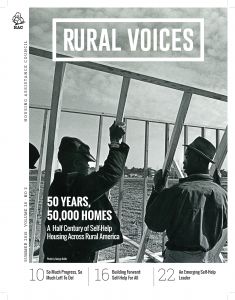
“50 YEARS, 50,000 HOMES” CELEBRATED IN HAC’S MAGAZINE. The latest issue of Rural Voices marks the 50th anniversary of the self-help housing program and recognizes the achievements of the nonprofit sponsors, the USDA programs, and the families who have become successful homeowners. Sign up online to receive email notices when new issues are published.

HAC IS HIRING FOR THREE POSITIONS. HAC seeks a Housing Specialist in Albuquerque, Atlanta, Kansas City, Sacramento, or Washington, DC; a Loan Officer/Underwriter in Washington, DC; and a Development Manager in Washington, DC. Visit HAC’s website for job descriptions and application information.

50 Years, 50,000 Homes

A Half Century of Self-Help Housing Across Rural America

This edition of Rural Voices, “50 Years, 50,000 Homes,” celebrates the construction of the 50,000th self-help home to be built with USDA support and the achievements of the nonprofit sponsors, the USDA programs, and most importantly, the families who have become successful homeowners.

A Half Century of Self-Help Housing Across Rural America

Download a pdf version of Rural Voices
50 Years, 50,000 Homes

This edition of Rural Voices, “50 Years, 50,000 Homes,” celebrates the construction of the 50,000th self-help home to be built with USDA support and the achievements of the nonprofit sponsors, the USDA programs, and most importantly, the families who have become successful homeowners.

Views from Washington

Successful Federal-Local Partnerships
by U.S. Representative Harold “Hal” Rogers

Local partners help USDA housing programs make meaningful impacts to the lives of local rural residents

Neighbors Helping Neighbors Build a Better Life
by U.S. Representative Sam Farr

A program that helped create the real American Dream for over 50 years.

With Many Dedicated Partners, USDA Helps 50,000 Families Achieve the American Dream
by Secretary Tom Vilsack

USDA Secretary Tom Vilsack discusses USDA’s Self-Help Housing Program.

FEATURES

So Much Progress, So Much Left To Do!
by Peter Carey

A simple concept still holds promise in a complicated housing world

Looking Back: The Beginnings and Evolution of USDA’s Self-Help Housing Movement
by Bob Marshall

Early efforts in rural California became a Self-Help Housing model for the nation

Building Forward: Self-Help For All
by Russell Huxtable

Let’s build on fifty years of history and expand this life changing program!

Self-Help Housing Changed Our Lives
by Noelle McKay and Stefanie Kompathoum

Families share their experience with the Self-Help Housing Program

An Emerging Self-Help Leader
by Mi’shell French

Discusses personal growth and sustaining the momentum through Self-Help Housing

Self-Help Housing and “SHOP” in the Rio Grande Valley
by Nancy Hanson

HUD’s Self -Help Homeownership Opportunity Program helps make self-help building sites affordable

Technical Assistance is the Essential Ingredient to Self-Help Housing
by Suzy Huard

USDA’S Section 523 Technical Assistance Grants make Mutual Self-Help housing possible

Expanding Service in Michigan’s Upper Peninsula
by Mike Shimon

A local Habitat for Humanity provider reaches more families using the USDA Mutual Self-Help program

Neither Wind, Nor Rain…Can Stop a Determined Self-Help Provider
by Linda Smith

A local nonprofit is up to the challenge when disaster strikes twice.

Additional Content

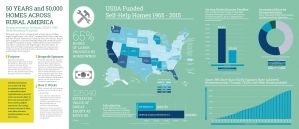
Celebrating 50 Years of helping families help themselvesCelebrating 50 Years of helping families help themselves.(8.5″ X 11″ printable pdf)

Celebrating 50 Years of helping families help themselves.(25.5″ X 11″ original document)

Rural Voices would like to hear what you have to say about one, or all, of these issues. Please feel free to comment on this story by sending a tweet to #RuralVoicesMag, discuss on the Rural Affordable Housing Group on LinkedIn, or on our Facebook page.

GET THE HAC NEWS!

Sign-up for HAC information products

SIGN UP HERE

Housing Assistance Council   |  1828 L Street. N.W., Suite 505, Washington, D.C. 20036
(202) 842-8600 (202) 347-3441 hac@ruralhome.org |

Board Portal

HAC is an equal opportunity provider, employer, and lender. | Civil Rights | Privacy