Tag Archive for: Affordable Housing

Making a Difference in Rural America

Administrator Tony HernandezUSDA Rural Housing Services Administrator Tony HernandezNewly appointed Rural Housing Service administrator shares his thoughts and priorities for USDA’s housing initiatives.

I am honored and pleased to be the new administrator at the U.S. Department of Agriculture’s (USDA) Rural Housing Service (RHS). For more than 60 years, USDA has helped millions of rural residents become part of the American Dream of homeownership. I look forward to the opportunity to continue and expand this agency’s historic accomplishments.

I have now been on the job for some time and have been impressed by the vital work that we do to provide housing and community facilities in Rural America. In my 26 years in community development, I have strongly believed that housing is a conduit to family, neighborhood and community. I see RHS as a community development agency. The multiple roles we play—catalyst, partner, advocate, regulator and investor—improve people’s lives and create better communities.

With its wide open spaces filled with lush, natural beauty, combined with its small-town charms, rural America is a great place to live and raise a family. And, although rural America is changing due to the rise of new technologies like the Internet and the advent of globalism, one thing still holds true: homeownership remains one of the single-most important factors that help our rural communities thrive and prosper economically.

The resources in our community development toolkit include homeownership programs for rural families. USDA has two primary Single-Family Housing Programs that are a major provider of homeownership opportunities in rural communities. The direct homeownership loan program helps very low- to low-income families. It is designed to open the door to homeownership to those who do not qualify for mortgage credit from conventional lenders. These loans are available to families and individuals with reasonable credit history and dependable income. This is not a government handout. Direct loans are repaid and subsidized to lower the monthly loan payment at a relatively small cost to the government.

My major priority is to focus on enhancing customer service through improved business processes.

For moderate-income families, we offer a guaranteed homeownership loan program and partner with participating private-sector lenders to provide home loans in rural areas at reasonable rates and terms.

For many Americans, especially those in rural areas, a home is the largest asset they will buy in their lifetime. Homeownership provides multiple, long-term benefits. It leads to greater economic security for families, who often can use the equity in their homes to build their credit, finance their children’s educations, improve the value of their property, or finance other necessities such as health care. Homeownership also helps families to plant long-term roots in their community.

Many rural residents who buy homes through USDA programs are first-time homebuyers. We also help current homeowners improve their homes through USDA rehabilitation loans or grants. Very low-income homeowners who are age 62 or older can qualify for grants to make health and safety improvements – such as accessibility accommodations – in addition to repairs. We are proud that USDA helps families start on the path of economic stability and a more secure future through homeownership.

The benefits of our housing programs extend beyond the homeowners themselves. USDA home loans also create economic opportunities for home builders, providers of durable goods such as lumber or appliances, and Realtors. USDA home loans often represent the majority of the business volume for many Realtors. Finally, local governments also benefit from increased revenue through property taxes. In fact, in many jurisdictions, property taxes from homeowners are the largest source of revenue. This is particularly true in rural communities where there are relatively fewer businesses compared to homeowners.

Homeownership is essential to the fabric of life in rural America, for our families, and for the communities in which they live.

Creating viable communities also means providing opportunities for families and seniors to have good rental housing as well as good housing for farm workers. In partnership with multi-family property owners and their property managers the USDA Multi-Family Housing programs assist in creating rental homes that support and encourage families to be part of their communities. USDA also provides rental assistance to help very low-income families and senior citizens find safe, decent housing at an affordable cost. USDA provides these rental assistance subsidies to these families to offset the difference between market rents and a monthly amount they can afford.

I would be remiss if I failed to note that USDA offers several other forms of assistance to rural communities to complement our strong housing programs. In addition to housing, successful communities need community facilities that help them to be and remain a viable community. Our RHS Community Facilities program helps communities finance the development of essential services and buildings such as hospitals, child care centers, libraries, mental health clinics, first responder vehicles and equipment, and other community assets that help make communities strong and self-sufficient.

Our successes are our families. Here are some numbers:

  • In Fiscal Year (FY) 2008, USDA guaranteed loans created approximately 63,000 homebuyers. By FY 2013 (which ended September 30, 2013), annual loan volume had climbed by more than 100,000 loans – an increase of more than 158%.
    From the start of FY 2009 through the end of FY 2013, the program financed more than 700,000 homeowners. Rural Development financed about 3.6 times the number of loans the agency had financed during the previous five years.
  • Loans are only part of the story. The full story is about the people. My major priority is to focus on enhancing customer service through improved business processes. With the reduction of staff that RHS has experienced over the last few years doing more with less requires the team to implement new business processes to better serve our customers, improve the predictability of the process, and enhance productivity of our great staff. Many of the RHS processes have not had dedicated budget dollars to automate. This year’s technology budget has created the opportunity for RHS to implement automation solutions that will improve the quality, standardize processes, improve staff productivity, and provide better customer service.

And to better serve the people, one of my first priorities is to help improve processes and service at our Customer Center in St. Louis. Our success there will enhance customer service, reduce financial and regulatory risks, improve staff productivity, improve staff morale, and create employee development opportunities.

We recently assembled a Single-Family Housing Rapid Improvement Team of experienced staff from St. Louis and Washington, D.C. The team also included lenders, a representative from the Department of Housing and Urban Development, a USDA Rural Development State Director, and a USDA Rural Development Program Director.

Johnston Family Rural Development Home - USDAJohnston Family, USDA Rural Development Home – Creative Commons photo

I have implemented various business improvement techniques to identify other business processes for improvement. The following are some of the areas of focus:

For our Single Family Housing loan guarantee program, we are working to improve our processes for loan loss mitigation to help borrowers who are in danger of default. We are improving our front-end image processing for loan documents. And we are implementing an automated process for loan closing. We are also working towards implementing delegated loan underwriting to reduce workloads for both lenders and RD staff. In addition, we’re working on a single close, construction to permanent loan to streamline processes and reduce costs.

For the Single Family Housing Direct loan program, we are working to improve our processes for acquired properties (Real Estate Owned) to better manage these properties. We are streamlining our loan origination system and implementing a program to work with loan packagers for outreach and loan application submission.

In our Multi-Family programs, we are working on an electronic loan application, we are streamlining the processes for transfers of properties when an owner wishes to sell. To streamline property inspections, we are investing in hand-held devices. We are also working on an electronic loan/grant application for our Community Facilities program.

One of the critical success factors to better customer service is implementing program processes that are understandable, easy to go through, predictable, transparent, and done in partnership with our customers and stakeholders. As part of RHS’s business process improvement, I welcome the wisdom and input of all our great partners on how we can better serve the needs of rural America. Please do not hesitate to contact RHS with your ideas.

As the Administrator of USDA’s Rural Housing Service, I can assure you that I and everyone on our team are committed to improving the lives of rural Americans and creating ladders of opportunity. Using all of our community development tools and through our strategic partnerships we make a huge difference in the lives of millions of rural Americans every day.

I look forward to working with all our stakeholder groups to make a difference through partnership, collaboration, investment, and advocacy for rural America.

Tony Hernandez is Administrator of USDA’s Rural Housing Service.
USDA Multi-Family Fair Housing Occupancy Report FY 2013

USDA’s yearly occupancy survey shows the total number of properties in USDA’s rural rental portfolio fell by 2.48% from April 2012 to September 2013, a decrease of 346 Section 515 properties and 34 Section 514 properties. The reduction covers 5,092 apartments (1.14% of total units). The 2013 report is the first to include demographic data on Section 521 Rental Assistance (RA) households, and they appear generally similar to tenants in Section 515 properties. The average annual income of Section 515 residents has increased slightly to $11,747. For Section 515 tenants with RA, average income is $9,828.

Keeping Rural Seniors in Their Homes

Through my work researching housing for rural seniors, two things have become evident: first, rural America is older than the nation overall, and second, aging in place is the best option for seniors. “Aging in place” refers to older adults living independently in their current residences or communities for as long as possible. The vast majority of rural seniors own their own homes, so this often means remaining there; it can also be accomplished, however, by moving to a more manageable dwelling (such as a smaller apartment).

Numerous reports have proposed that aging in place… Read more

From Food to Housing: Sacrificing Quality for Quantity in the Colonias

From Food to Housing: Sacrificing Quality for Quantity in the Colonias

In November, theWashington Postpublished an article entitled“Too Much of Too Little”about recipients of the Supplemental Nutrition Assistance Program, formerly known as food stamps, in Hidalgo County, Texas, one of the fastest growing and poorest places in the nation. The article highlighted families who are forced to choose between affordable yet unhealthy foods that keep their families fed throughout the month or healthy options that are less affordable and may not feed a family for as long. Low-income Americans dependent upon SNAP are often forced to shop “quantity over quality” in order to stretch paltry food budgets throughout the month. As a result, more and more people who do not have enough food to eat are facing obesity and diabetes at alarming rates.

Read the complete Blog post at Rooflines

HAC News: November 13, 2013

HAC News Formats. pdf

November 13, 2013
Vol. 42, No. 22

• November is Native American Heritage Month • November 16-24 is National Hunger and Homelessness Awareness Week • Fewer rural jobs, more poverty, and declining population, research shows • RD changes multifamily transfer process • HUD considers risk sharing initiative for small multifamily properties • FEMA issues final rule on assistance for housing damage • Housing counseling comment period extended • USDA used most Section 502 funds, but not Section 504 loans, in FY13 • USDA encourages local partnerships to address veteran homelessness • HUD and DOT launch site on housing and transportation costs • Sequestration’s impact on government activities, including housing, described • Research from sources including HAC covers veterans housing issues • Record share of young adults living at home • HAC reports on farmworker housing


November 13, 2013
Vol. 42, No. 22

NOVEMBER IS NATIVE AMERICAN HERITAGE MONTH. President Obama’s proclamation also designates November 29 as Native American Heritage Day. A USDA press release highlights support for Native Americans.

NOVEMBER 16-24 IS NATIONAL HUNGER AND HOMELESSNESS AWARENESS WEEK. Information, planned events, and ideas are available from the National Coalition for the Homeless.

FEWER RURAL JOBS, MORE POVERTY, AND DECLINING POPULATION, RESEARCH SHOWS. The USDA Econom-ic Research Service’s annual “Rural America at a Glance” report says rural unemployment is declining, but – with exceptions in some areas – the change is due to declining populations rather than job creation. An article in the online rural news source the Daily Yonder summarizes ERS’s findings. A separate Daily Yonder analysis of unemploy-ment data in August 2012 and August 2013 includes an interactive map with figures for every county in the U.S.

RD CHANGES MULTIFAMILY TRANSFER PROCESS. An Unnumbered Letter dated September 30, 2013 focuses on determining the financial feasibility of a transfer or preservation transaction, including reducing Rental Assistance. Contact RD State Office preservation staff.

HUD CONSIDERS RISK SHARING INITIATIVE FOR SMALL MULTIFAMILY PROPERTIES. Comments are due January 3 on a proposal for mission-driven lenders, including CDFIs, to originate, underwrite, and service loans with HUD mortgage insurance for refinancing or rehab of small properties. Lenders would assume 50% of the risk on each loan. Contact Lynn Wehrli, HUD, 202-402-5210.

FEMA ISSUES FINAL RULE ON ASSISTANCE FOR HOUSING DAMAGE. Revisions to FEMA’s repair, replacement, and housing construction assistance regulations are intended to clarify the eligibility criteria for assistance and to implement legislative changes. Contact John Carleton, FEMA, 202-212-1000.

HOUSING COUNSELING COMMENT PERIOD EXTENDED. Comments are now due December 12 on changes to HUD’s housing counseling program regulations, published September 13 (see HAC News, 9/11/13). Contact Ruth Román, HUD, 202-708-0317.

USDA USED MOST SECTION 502 FUNDS, BUT NOT SECTION 504 LOANS, IN FY13. Despite USDA’s success-ful efforts to attract borrowers near the end of the year (see HAC News, 8/1/13 and 8/28/13), HAC estimates that USDA used only 53% of its Section 504 home repair loan funds in FY13. Section 504 grant funds were fully used, and Section 502 direct and guaranteed loans were almost entirely obligated. HAC’s final USDA obligations reports for the year are posted online.

USDA ENCOURAGES LOCAL PARTNERSHIPS TO ADDRESS VETERAN HOMELESSNESS. An Unnumbered Letter dated November 8, 2013 suggests that RD field staff inform local organizations about RD housing programs.

HUD AND DOT LAUNCH SITE ON HOUSING AND TRANSPORTATION COSTS. The Location Affordability Portal is intended to provide consumers, researchers, and policymakers with data and resources on combined housing and transportation costs for all parts of the U.S. including remote rural areas.

SEQUESTRATION’S IMPACT ON GOVERNMENT ACTIVITIES, INCLUDING HOUSING, DESCRIBED. Faces of Austerity: How Budget Cuts Have Made Us Sicker, Poorer, and Less Secure, published by NDD United, compiles data, quotes, and individual stories. The Center on Budget and Policy Priorities has updated its data on use of HUD vouchers, including the number of vouchers that will be lost in each state if sequestration continues in FY14.

RESEARCH FROM SOURCES INCLUDING HAC COVERS VETERANS HOUSING ISSUES. “Housing Our Heroes: Veterans in Rural America,” a HAC research brief, summarizes data on demographics, housing conditions, and homelessness. USDA’s Economic Research Service provides demographic and economic data in “Rural Veterans at a Glance.” (ERS uses data for nonmetro areas, while HAC uses a definition of rural based on census tracts.) Housing Instability Among Our Nation’s Veterans, a National Low Income Housing Coalition report, examines housing issues for veterans nationwide. “Rental Assistance Helps More Than 300,000 Veterans Afford Homes, But Large Unmet Needs Remain,” from the Center on Budget and Policy Priorities, also covers the topic on a national basis.

RECORD SHARE OF YOUNG ADULTS LIVING AT HOME. More than one-third of Millennials aged 18-31 are living with their parents, according to A Rising Share of Young Adults Live in Their Parents’ Home, published by the Pew Research Center. A Forbes analysis of the report suggests that federal policies favoring homeownership led to high housing prices that young adults cannot afford.

HAC REPORTS ON FARMWORKER HOUSING. Housing Conditions for Rural Farmworkers explains character-istics of farmworker housing and obstacles to its improvement.

USDA Multi-Family Fair Housing Occupancy Report FY 2012

USDA’s annual occupancy survey shows 2,135 fewer units and 1,254 fewer occupied units (households) in Section 515 and 514/516 properties in 2012 than 2011. There are 1,243 more households receiving Section 521 Rental Assistance and 931 fewer with rental aid from other sources. The number of cost burdened households dropped by 1,562.

Bipartisan Policy Center Report Includes Major Recommendations for Rural Housing

Housing America's Future: New Directions for National Policy

February 25, 2013. The Housing Commission of the Bipartisan Policy Center (BPC) today released its much anticipated report entitled Housing America’s Future: A New Direction for a National Policy. In addition to major recommendations on mortgage finance reform, homeownership, rental housing, and demographic drivers, the BPC’s report devoted substantial attention to rural housing issues and priorities. Championed largely by Commission Co-Chair Kit Bond, former U.S. Senator and Governor from Missouri, the report presents four major recommendations on rural housing:

1. Support and strengthen USDA’s role in rural housing. The report specifically states that Congress should not pursue proposals to shift USDA programs to other government agencies where they will be absorbed by other federal programs, noting that USDA is well-positioned to leverage the existing resources and infrastructure of rural service providers that understand the unique conditions of local markets.

2. Extend the current definition of rural areas through the year 2020. Any area currently classified as rural for the purposes of USDA housing programs should remain so at least until after the receipt of data from the decennial census in 2020, provided the area’s population does not exceed 25,000.

3. Increase budget allocations to serve more households. The report states that additional funding for the Section 502 Direct Loan program would enable more rural households to become homeowners at relatively low cost to the federal government.

4. Dedicate resources for capacity-building and technology to strengthen USDA providers. The BPC recommends that local agencies receiving USDA funds should be incentivized to operate on compatible software to ease data and information sharing. These improvements could help USDA monitor and improve the performance of its rural housing programs.

Read the Rural Housing chapter of the report at:

https://bipartisanpolicy.org/sites/default/files/BPC_Housing%20Report_web.pdf#page=110

Download the full BPC report at:

https://bipartisanpolicy.org/sites/default/files/BPC_Housing%20Report_web.pdf

Founded in 2007 by former Senate Majority Leaders Howard Baker, Tom Daschle, Bob Dole and George Mitchell, the Bipartisan Policy Center (BPC) is a non-profit organization that drives principled solutions through rigorous analysis, reasoned negotiation and respectful dialogue. With projects in multiple issue areas, BPC combines politically balanced policymaking with strong, proactive advocacy and outreach.

A Step Toward Addressing Native American Homelessness

A Step Toward Addressing Native American Homelessness

by Eric Oberdorfer and Leslie Strauss

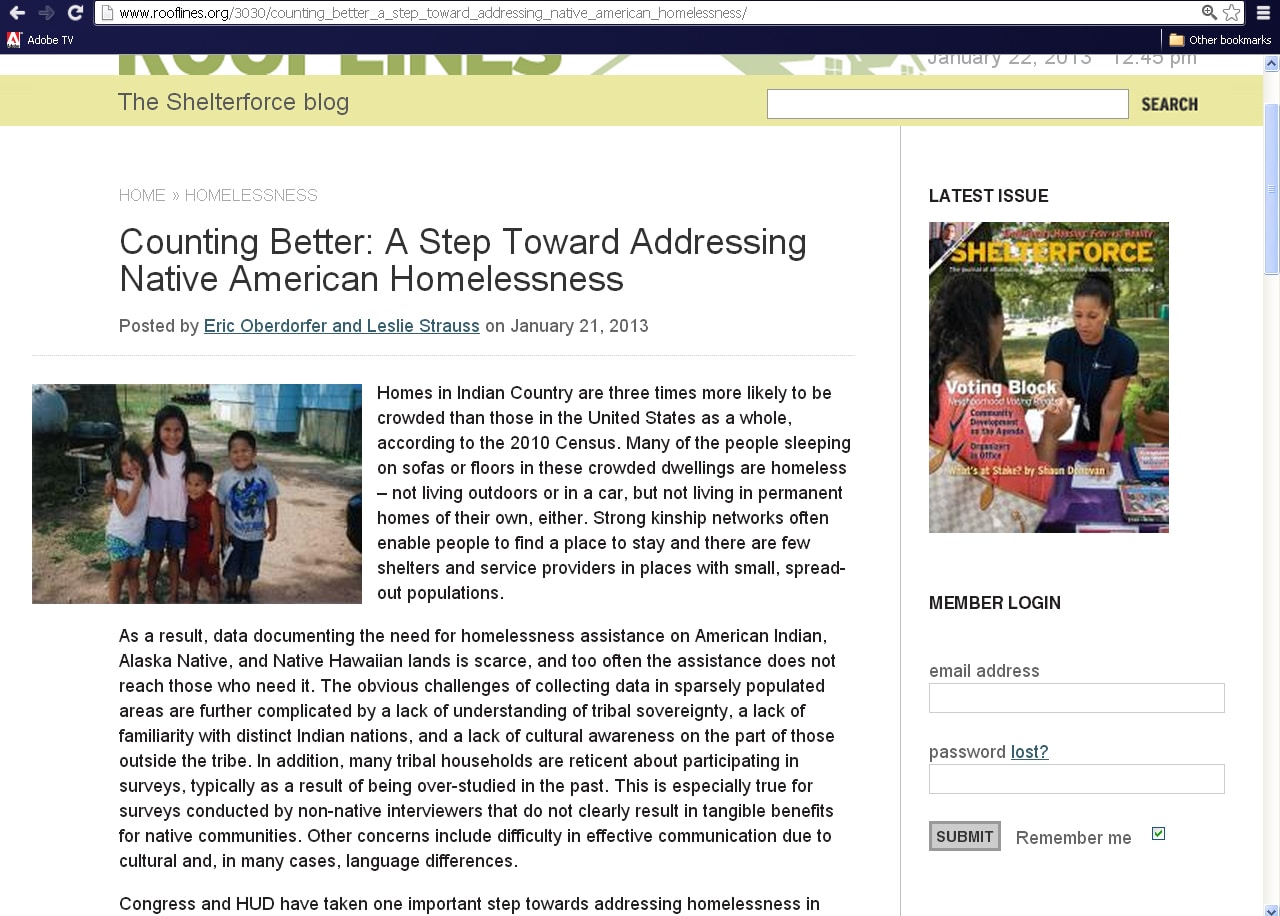
shelterforce_na_blog_postHomes in Indian Country are three times more likely to be crowded than those in the United States as a whole, according to the 2010 Census. Many of the people sleeping on sofas or floors in these crowded dwellings are homeless – not living outdoors or in a car, but not living in permanent homes of their own, either. Strong kinship networks often enable people to find a place to stay and there are few shelters and service providers in places with small, spread-out populations.

Read More…

10 Things That Did Not Happen in Rural Housing in 2012

10 Things That Did Not Happen in Rural Housing in 2012

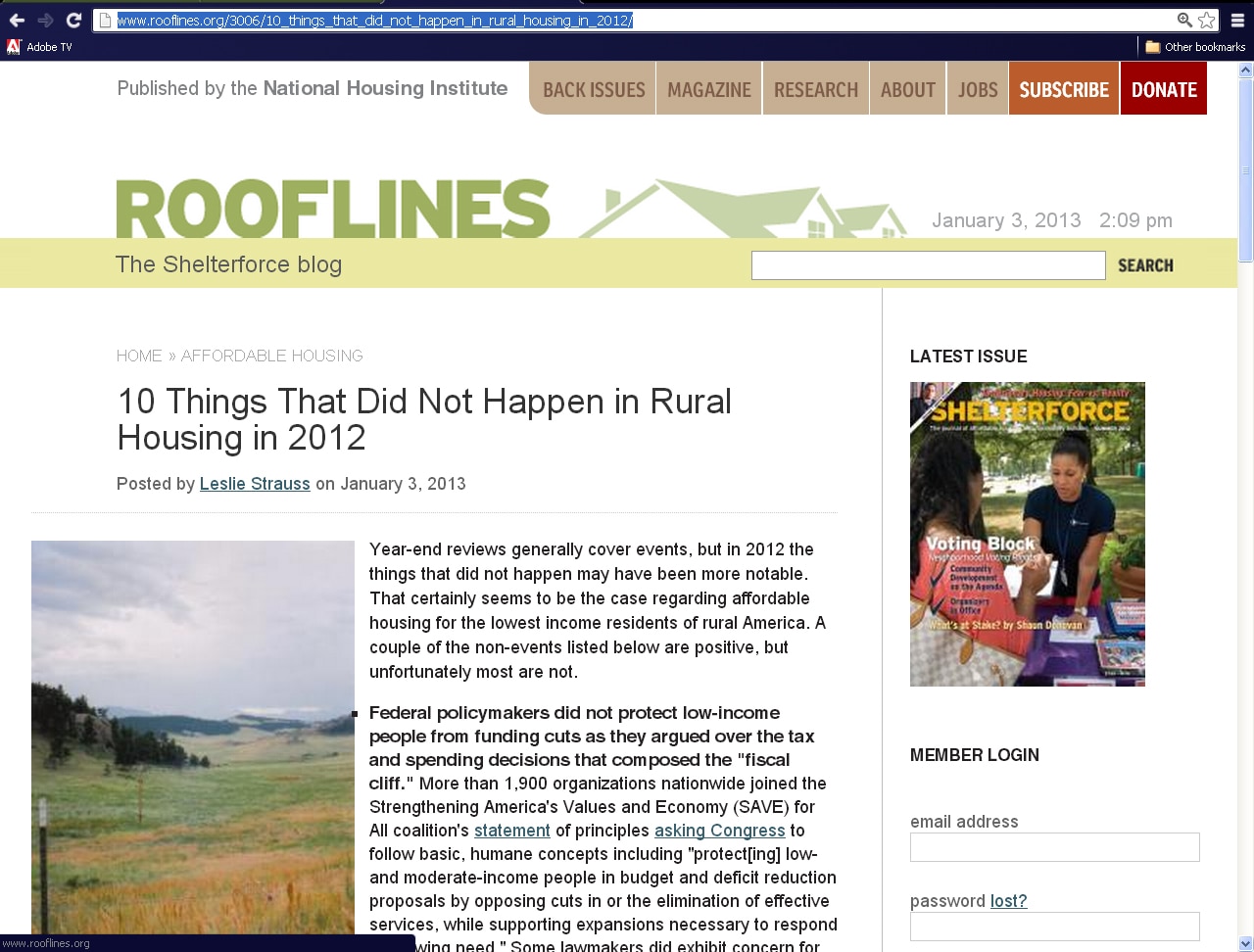
10thingRLblogYear-end reviews generally cover events, but in 2012 the things that did not happen may have been more notable. That certainly seems to be the case regarding affordable housing for the lowest income residents of rural America. A couple of the non-events listed below are positive, but unfortunately most are not. Read More…

Stacey Epperson Honored as Ashoka Fellow

Stacey Epperson, Executive Director of Next Step, has been selected as one of 11 recipients of an Ashoka fellowhip for leading social entrepreneurs. For more information on this award, go to Next Step’s website.

For more on Ashoka, visit https://usa.ashoka.org/.

Tag Archive for: Affordable Housing

Making a Difference in Rural America

Administrator Tony HernandezUSDA Rural Housing Services Administrator Tony HernandezNewly appointed Rural Housing Service administrator shares his thoughts and priorities for USDA’s housing initiatives.

I am honored and pleased to be the new administrator at the U.S. Department of Agriculture’s (USDA) Rural Housing Service (RHS). For more than 60 years, USDA has helped millions of rural residents become part of the American Dream of homeownership. I look forward to the opportunity to continue and expand this agency’s historic accomplishments.

I have now been on the job for some time and have been impressed by the vital work that we do to provide housing and community facilities in Rural America. In my 26 years in community development, I have strongly believed that housing is a conduit to family, neighborhood and community. I see RHS as a community development agency. The multiple roles we play—catalyst, partner, advocate, regulator and investor—improve people’s lives and create better communities.

With its wide open spaces filled with lush, natural beauty, combined with its small-town charms, rural America is a great place to live and raise a family. And, although rural America is changing due to the rise of new technologies like the Internet and the advent of globalism, one thing still holds true: homeownership remains one of the single-most important factors that help our rural communities thrive and prosper economically.

The resources in our community development toolkit include homeownership programs for rural families. USDA has two primary Single-Family Housing Programs that are a major provider of homeownership opportunities in rural communities. The direct homeownership loan program helps very low- to low-income families. It is designed to open the door to homeownership to those who do not qualify for mortgage credit from conventional lenders. These loans are available to families and individuals with reasonable credit history and dependable income. This is not a government handout. Direct loans are repaid and subsidized to lower the monthly loan payment at a relatively small cost to the government.

My major priority is to focus on enhancing customer service through improved business processes.

For moderate-income families, we offer a guaranteed homeownership loan program and partner with participating private-sector lenders to provide home loans in rural areas at reasonable rates and terms.

For many Americans, especially those in rural areas, a home is the largest asset they will buy in their lifetime. Homeownership provides multiple, long-term benefits. It leads to greater economic security for families, who often can use the equity in their homes to build their credit, finance their children’s educations, improve the value of their property, or finance other necessities such as health care. Homeownership also helps families to plant long-term roots in their community.

Many rural residents who buy homes through USDA programs are first-time homebuyers. We also help current homeowners improve their homes through USDA rehabilitation loans or grants. Very low-income homeowners who are age 62 or older can qualify for grants to make health and safety improvements – such as accessibility accommodations – in addition to repairs. We are proud that USDA helps families start on the path of economic stability and a more secure future through homeownership.

The benefits of our housing programs extend beyond the homeowners themselves. USDA home loans also create economic opportunities for home builders, providers of durable goods such as lumber or appliances, and Realtors. USDA home loans often represent the majority of the business volume for many Realtors. Finally, local governments also benefit from increased revenue through property taxes. In fact, in many jurisdictions, property taxes from homeowners are the largest source of revenue. This is particularly true in rural communities where there are relatively fewer businesses compared to homeowners.

Homeownership is essential to the fabric of life in rural America, for our families, and for the communities in which they live.

Creating viable communities also means providing opportunities for families and seniors to have good rental housing as well as good housing for farm workers. In partnership with multi-family property owners and their property managers the USDA Multi-Family Housing programs assist in creating rental homes that support and encourage families to be part of their communities. USDA also provides rental assistance to help very low-income families and senior citizens find safe, decent housing at an affordable cost. USDA provides these rental assistance subsidies to these families to offset the difference between market rents and a monthly amount they can afford.

I would be remiss if I failed to note that USDA offers several other forms of assistance to rural communities to complement our strong housing programs. In addition to housing, successful communities need community facilities that help them to be and remain a viable community. Our RHS Community Facilities program helps communities finance the development of essential services and buildings such as hospitals, child care centers, libraries, mental health clinics, first responder vehicles and equipment, and other community assets that help make communities strong and self-sufficient.

Our successes are our families. Here are some numbers:

  • In Fiscal Year (FY) 2008, USDA guaranteed loans created approximately 63,000 homebuyers. By FY 2013 (which ended September 30, 2013), annual loan volume had climbed by more than 100,000 loans – an increase of more than 158%.
    From the start of FY 2009 through the end of FY 2013, the program financed more than 700,000 homeowners. Rural Development financed about 3.6 times the number of loans the agency had financed during the previous five years.
  • Loans are only part of the story. The full story is about the people. My major priority is to focus on enhancing customer service through improved business processes. With the reduction of staff that RHS has experienced over the last few years doing more with less requires the team to implement new business processes to better serve our customers, improve the predictability of the process, and enhance productivity of our great staff. Many of the RHS processes have not had dedicated budget dollars to automate. This year’s technology budget has created the opportunity for RHS to implement automation solutions that will improve the quality, standardize processes, improve staff productivity, and provide better customer service.

And to better serve the people, one of my first priorities is to help improve processes and service at our Customer Center in St. Louis. Our success there will enhance customer service, reduce financial and regulatory risks, improve staff productivity, improve staff morale, and create employee development opportunities.

We recently assembled a Single-Family Housing Rapid Improvement Team of experienced staff from St. Louis and Washington, D.C. The team also included lenders, a representative from the Department of Housing and Urban Development, a USDA Rural Development State Director, and a USDA Rural Development Program Director.

Johnston Family Rural Development Home - USDAJohnston Family, USDA Rural Development Home – Creative Commons photo

I have implemented various business improvement techniques to identify other business processes for improvement. The following are some of the areas of focus:

For our Single Family Housing loan guarantee program, we are working to improve our processes for loan loss mitigation to help borrowers who are in danger of default. We are improving our front-end image processing for loan documents. And we are implementing an automated process for loan closing. We are also working towards implementing delegated loan underwriting to reduce workloads for both lenders and RD staff. In addition, we’re working on a single close, construction to permanent loan to streamline processes and reduce costs.

For the Single Family Housing Direct loan program, we are working to improve our processes for acquired properties (Real Estate Owned) to better manage these properties. We are streamlining our loan origination system and implementing a program to work with loan packagers for outreach and loan application submission.

In our Multi-Family programs, we are working on an electronic loan application, we are streamlining the processes for transfers of properties when an owner wishes to sell. To streamline property inspections, we are investing in hand-held devices. We are also working on an electronic loan/grant application for our Community Facilities program.

One of the critical success factors to better customer service is implementing program processes that are understandable, easy to go through, predictable, transparent, and done in partnership with our customers and stakeholders. As part of RHS’s business process improvement, I welcome the wisdom and input of all our great partners on how we can better serve the needs of rural America. Please do not hesitate to contact RHS with your ideas.

As the Administrator of USDA’s Rural Housing Service, I can assure you that I and everyone on our team are committed to improving the lives of rural Americans and creating ladders of opportunity. Using all of our community development tools and through our strategic partnerships we make a huge difference in the lives of millions of rural Americans every day.

I look forward to working with all our stakeholder groups to make a difference through partnership, collaboration, investment, and advocacy for rural America.

Tony Hernandez is Administrator of USDA’s Rural Housing Service.
USDA Multi-Family Fair Housing Occupancy Report FY 2013

USDA’s yearly occupancy survey shows the total number of properties in USDA’s rural rental portfolio fell by 2.48% from April 2012 to September 2013, a decrease of 346 Section 515 properties and 34 Section 514 properties. The reduction covers 5,092 apartments (1.14% of total units). The 2013 report is the first to include demographic data on Section 521 Rental Assistance (RA) households, and they appear generally similar to tenants in Section 515 properties. The average annual income of Section 515 residents has increased slightly to $11,747. For Section 515 tenants with RA, average income is $9,828.

Keeping Rural Seniors in Their Homes

Through my work researching housing for rural seniors, two things have become evident: first, rural America is older than the nation overall, and second, aging in place is the best option for seniors. “Aging in place” refers to older adults living independently in their current residences or communities for as long as possible. The vast majority of rural seniors own their own homes, so this often means remaining there; it can also be accomplished, however, by moving to a more manageable dwelling (such as a smaller apartment).

Numerous reports have proposed that aging in place… Read more

From Food to Housing: Sacrificing Quality for Quantity in the Colonias

From Food to Housing: Sacrificing Quality for Quantity in the Colonias

In November, theWashington Postpublished an article entitled“Too Much of Too Little”about recipients of the Supplemental Nutrition Assistance Program, formerly known as food stamps, in Hidalgo County, Texas, one of the fastest growing and poorest places in the nation. The article highlighted families who are forced to choose between affordable yet unhealthy foods that keep their families fed throughout the month or healthy options that are less affordable and may not feed a family for as long. Low-income Americans dependent upon SNAP are often forced to shop “quantity over quality” in order to stretch paltry food budgets throughout the month. As a result, more and more people who do not have enough food to eat are facing obesity and diabetes at alarming rates.

Read the complete Blog post at Rooflines

HAC News: November 13, 2013

HAC News Formats. pdf

November 13, 2013
Vol. 42, No. 22

• November is Native American Heritage Month • November 16-24 is National Hunger and Homelessness Awareness Week • Fewer rural jobs, more poverty, and declining population, research shows • RD changes multifamily transfer process • HUD considers risk sharing initiative for small multifamily properties • FEMA issues final rule on assistance for housing damage • Housing counseling comment period extended • USDA used most Section 502 funds, but not Section 504 loans, in FY13 • USDA encourages local partnerships to address veteran homelessness • HUD and DOT launch site on housing and transportation costs • Sequestration’s impact on government activities, including housing, described • Research from sources including HAC covers veterans housing issues • Record share of young adults living at home • HAC reports on farmworker housing


November 13, 2013
Vol. 42, No. 22

NOVEMBER IS NATIVE AMERICAN HERITAGE MONTH. President Obama’s proclamation also designates November 29 as Native American Heritage Day. A USDA press release highlights support for Native Americans.

NOVEMBER 16-24 IS NATIONAL HUNGER AND HOMELESSNESS AWARENESS WEEK. Information, planned events, and ideas are available from the National Coalition for the Homeless.

FEWER RURAL JOBS, MORE POVERTY, AND DECLINING POPULATION, RESEARCH SHOWS. The USDA Econom-ic Research Service’s annual “Rural America at a Glance” report says rural unemployment is declining, but – with exceptions in some areas – the change is due to declining populations rather than job creation. An article in the online rural news source the Daily Yonder summarizes ERS’s findings. A separate Daily Yonder analysis of unemploy-ment data in August 2012 and August 2013 includes an interactive map with figures for every county in the U.S.

RD CHANGES MULTIFAMILY TRANSFER PROCESS. An Unnumbered Letter dated September 30, 2013 focuses on determining the financial feasibility of a transfer or preservation transaction, including reducing Rental Assistance. Contact RD State Office preservation staff.

HUD CONSIDERS RISK SHARING INITIATIVE FOR SMALL MULTIFAMILY PROPERTIES. Comments are due January 3 on a proposal for mission-driven lenders, including CDFIs, to originate, underwrite, and service loans with HUD mortgage insurance for refinancing or rehab of small properties. Lenders would assume 50% of the risk on each loan. Contact Lynn Wehrli, HUD, 202-402-5210.

FEMA ISSUES FINAL RULE ON ASSISTANCE FOR HOUSING DAMAGE. Revisions to FEMA’s repair, replacement, and housing construction assistance regulations are intended to clarify the eligibility criteria for assistance and to implement legislative changes. Contact John Carleton, FEMA, 202-212-1000.

HOUSING COUNSELING COMMENT PERIOD EXTENDED. Comments are now due December 12 on changes to HUD’s housing counseling program regulations, published September 13 (see HAC News, 9/11/13). Contact Ruth Román, HUD, 202-708-0317.

USDA USED MOST SECTION 502 FUNDS, BUT NOT SECTION 504 LOANS, IN FY13. Despite USDA’s success-ful efforts to attract borrowers near the end of the year (see HAC News, 8/1/13 and 8/28/13), HAC estimates that USDA used only 53% of its Section 504 home repair loan funds in FY13. Section 504 grant funds were fully used, and Section 502 direct and guaranteed loans were almost entirely obligated. HAC’s final USDA obligations reports for the year are posted online.

USDA ENCOURAGES LOCAL PARTNERSHIPS TO ADDRESS VETERAN HOMELESSNESS. An Unnumbered Letter dated November 8, 2013 suggests that RD field staff inform local organizations about RD housing programs.

HUD AND DOT LAUNCH SITE ON HOUSING AND TRANSPORTATION COSTS. The Location Affordability Portal is intended to provide consumers, researchers, and policymakers with data and resources on combined housing and transportation costs for all parts of the U.S. including remote rural areas.

SEQUESTRATION’S IMPACT ON GOVERNMENT ACTIVITIES, INCLUDING HOUSING, DESCRIBED. Faces of Austerity: How Budget Cuts Have Made Us Sicker, Poorer, and Less Secure, published by NDD United, compiles data, quotes, and individual stories. The Center on Budget and Policy Priorities has updated its data on use of HUD vouchers, including the number of vouchers that will be lost in each state if sequestration continues in FY14.

RESEARCH FROM SOURCES INCLUDING HAC COVERS VETERANS HOUSING ISSUES. “Housing Our Heroes: Veterans in Rural America,” a HAC research brief, summarizes data on demographics, housing conditions, and homelessness. USDA’s Economic Research Service provides demographic and economic data in “Rural Veterans at a Glance.” (ERS uses data for nonmetro areas, while HAC uses a definition of rural based on census tracts.) Housing Instability Among Our Nation’s Veterans, a National Low Income Housing Coalition report, examines housing issues for veterans nationwide. “Rental Assistance Helps More Than 300,000 Veterans Afford Homes, But Large Unmet Needs Remain,” from the Center on Budget and Policy Priorities, also covers the topic on a national basis.

RECORD SHARE OF YOUNG ADULTS LIVING AT HOME. More than one-third of Millennials aged 18-31 are living with their parents, according to A Rising Share of Young Adults Live in Their Parents’ Home, published by the Pew Research Center. A Forbes analysis of the report suggests that federal policies favoring homeownership led to high housing prices that young adults cannot afford.

HAC REPORTS ON FARMWORKER HOUSING. Housing Conditions for Rural Farmworkers explains character-istics of farmworker housing and obstacles to its improvement.

USDA Multi-Family Fair Housing Occupancy Report FY 2012

USDA’s annual occupancy survey shows 2,135 fewer units and 1,254 fewer occupied units (households) in Section 515 and 514/516 properties in 2012 than 2011. There are 1,243 more households receiving Section 521 Rental Assistance and 931 fewer with rental aid from other sources. The number of cost burdened households dropped by 1,562.

Bipartisan Policy Center Report Includes Major Recommendations for Rural Housing

Housing America's Future: New Directions for National Policy

February 25, 2013. The Housing Commission of the Bipartisan Policy Center (BPC) today released its much anticipated report entitled Housing America’s Future: A New Direction for a National Policy. In addition to major recommendations on mortgage finance reform, homeownership, rental housing, and demographic drivers, the BPC’s report devoted substantial attention to rural housing issues and priorities. Championed largely by Commission Co-Chair Kit Bond, former U.S. Senator and Governor from Missouri, the report presents four major recommendations on rural housing:

1. Support and strengthen USDA’s role in rural housing. The report specifically states that Congress should not pursue proposals to shift USDA programs to other government agencies where they will be absorbed by other federal programs, noting that USDA is well-positioned to leverage the existing resources and infrastructure of rural service providers that understand the unique conditions of local markets.

2. Extend the current definition of rural areas through the year 2020. Any area currently classified as rural for the purposes of USDA housing programs should remain so at least until after the receipt of data from the decennial census in 2020, provided the area’s population does not exceed 25,000.

3. Increase budget allocations to serve more households. The report states that additional funding for the Section 502 Direct Loan program would enable more rural households to become homeowners at relatively low cost to the federal government.

4. Dedicate resources for capacity-building and technology to strengthen USDA providers. The BPC recommends that local agencies receiving USDA funds should be incentivized to operate on compatible software to ease data and information sharing. These improvements could help USDA monitor and improve the performance of its rural housing programs.

Read the Rural Housing chapter of the report at:

https://bipartisanpolicy.org/sites/default/files/BPC_Housing%20Report_web.pdf#page=110

Download the full BPC report at:

https://bipartisanpolicy.org/sites/default/files/BPC_Housing%20Report_web.pdf

Founded in 2007 by former Senate Majority Leaders Howard Baker, Tom Daschle, Bob Dole and George Mitchell, the Bipartisan Policy Center (BPC) is a non-profit organization that drives principled solutions through rigorous analysis, reasoned negotiation and respectful dialogue. With projects in multiple issue areas, BPC combines politically balanced policymaking with strong, proactive advocacy and outreach.

A Step Toward Addressing Native American Homelessness

A Step Toward Addressing Native American Homelessness

by Eric Oberdorfer and Leslie Strauss

shelterforce_na_blog_postHomes in Indian Country are three times more likely to be crowded than those in the United States as a whole, according to the 2010 Census. Many of the people sleeping on sofas or floors in these crowded dwellings are homeless – not living outdoors or in a car, but not living in permanent homes of their own, either. Strong kinship networks often enable people to find a place to stay and there are few shelters and service providers in places with small, spread-out populations.

Read More…

10 Things That Did Not Happen in Rural Housing in 2012

10 Things That Did Not Happen in Rural Housing in 2012

10thingRLblogYear-end reviews generally cover events, but in 2012 the things that did not happen may have been more notable. That certainly seems to be the case regarding affordable housing for the lowest income residents of rural America. A couple of the non-events listed below are positive, but unfortunately most are not. Read More…

Stacey Epperson Honored as Ashoka Fellow

Stacey Epperson, Executive Director of Next Step, has been selected as one of 11 recipients of an Ashoka fellowhip for leading social entrepreneurs. For more information on this award, go to Next Step’s website.

For more on Ashoka, visit https://usa.ashoka.org/.

GET THE HAC NEWS!

Sign-up for HAC information products

SIGN UP HERE

Housing Assistance Council   |  1828 L Street. N.W., Suite 505, Washington, D.C. 20036
(202) 842-8600 (202) 347-3441 hac@ruralhome.org |

Board Portal

HAC is an equal opportunity provider, employer, and lender. | Civil Rights | Privacy