Success Stories
Shawn Poynter / There Is More Work To Be Done
Shawn Poynter / There Is More Work To Be Done
Serving California’s San Joaquin Valley, Self-Help Enterprises (SHE) is a testament to what’s possible in rural housing development. As one of the nation’s largest and most successful rural housing organizations, SHE has built over 6,600 homes through its mutual self-help housing program. It also manages more than 3,000 affordable rental units. The numbers, however, tell only part of the story, says SHE’s CEO Tom Collishaw.
“Beyond just the house itself, self-help housing has always been about something deeper—something real. It’s not just about building a home; it’s about empowering people, giving them the tools to address their own challenges. The impact goes far beyond just constructing a house. The work becomes a source of pride, the finished product—a turning point for families, something their friends, family, and community can be proud of, and their kids can aspire to.”
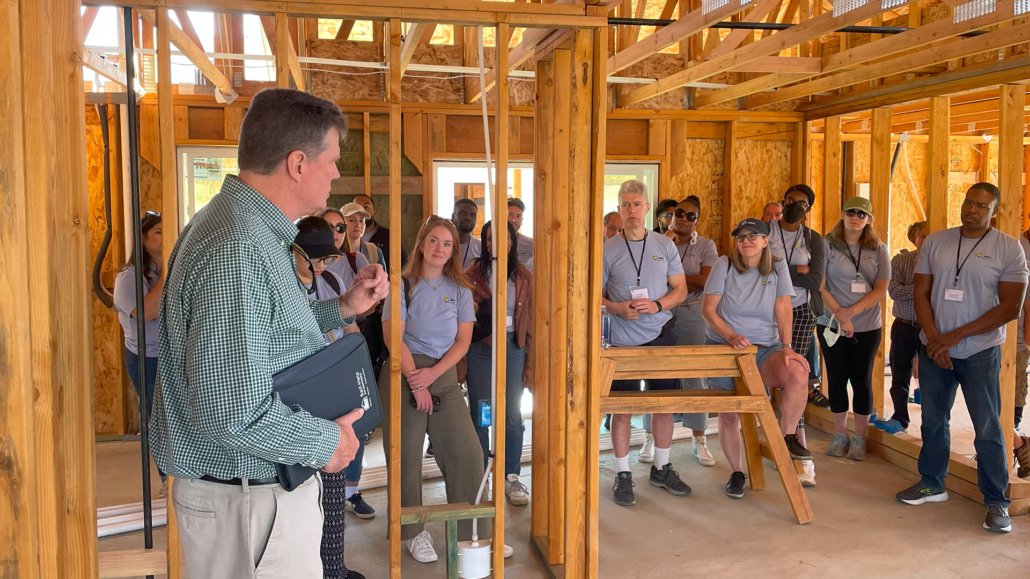
Self-Help Enterprises CEO Tom Collishaw speaks to HAC staff during a site visit to a self-help housing project
For more than 50 years, the Housing Assistance Council (HAC) has played a crucial role in supporting SHE’s work. In fact, when HAC began lending in 1972, SHE received our very first loan: $127,650 for site acquisition and development of a mutual self-help housing development. It’s a relationship that Collishaw describes as “deep” and multifaceted, built on years of financial support, policy advocacy, and a shared mission.
At the heart of the HAC-SHE relationship is the Self-Help Homeownership Opportunity Program (SHOP), a federal initiative in which HAC serves as an intermediary, providing rural organizations with access to capital for land acquisition and infrastructure development. “It’s an honor to be associated with SHE’s success,” notes HAC’s CEO David Lipsetz. “SHE has helped thousands of families build their own homes. SHE has helped California’s central valley prosper. And, SHE has helped HAC and groups across the country see how effective the SHOP program can be.”
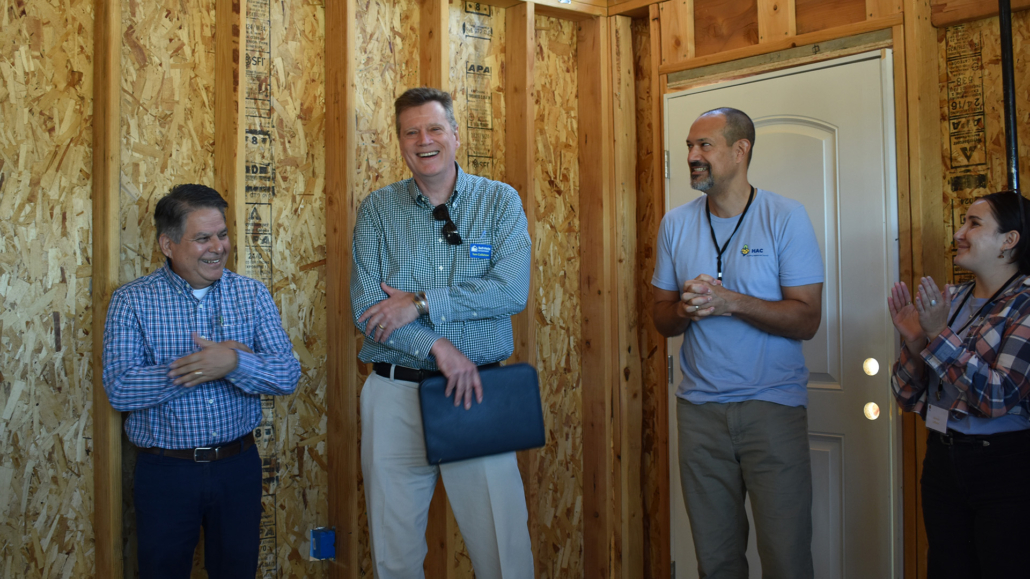
Tom Collishaw, HAC CEO David Lipsetz, and staff from both agencies share a moment of camaraderie inside a SHE housing project
The strength of this partnership is something both organizations value deeply. “Since the inception of the SHOP program, HAC has taken a leadership role—a role that, frankly, they were the only ones really in a position to take,” Collishaw notes. “We’ve appreciated that partnership, the mutual trust we have, and the ability to be flexible where possible.”
The SHOP program’s structure allows HAC to forgive 90% of its loan to SHE when they meet their unit goals, provided SHE reinvests the funds in affordable housing activities. Having access to this flexible capital has been “a critical component” in scaling SHE’s real estate efforts, enabling the organization to acquire land, develop infrastructure, and plan subdivisions without depending solely on traditional pre-development loans, which continue to grow more expensive by the day. This strategy also served as a springboard for SHE to secure approximately $18 million from foundation-type funders, including Heron, Calvert, and The California Endowment.
However, for Collishaw, financial support represents just one aspect of HAC’s role. “I’ve always seen HAC as a thought leader. HAC has been a partner in making sure that the needs of rural America are on the national agenda, particularly at the federal level.”
He also points to HAC’s biennial conference as a vital event for the rural housing community. “There were so many casualties during COVID, but I always thought missing a HAC conference was a particularly difficult one,” he reflects. “There are so many organizations smaller than us that rely on those opportunities to meet with peers.” Even with SHE’s extensive experience, Collishaw values these gatherings as important learning opportunities. “We’ve seen a lot, but that doesn’t mean we know everything. There’s always something to learn from people who have only been doing this for two years. They look at things in an entirely different way, and I’ll come back from conferences saying, ‘What they’re doing in Kentucky is fascinating! Maybe we should think about that.’ Those connections are so valuable.”
This spirit of mutual learning and collaboration is evident in the organizations’ shared history, with leadership frequently moving between the two. Bob Marshall, who served as SHE’s executive director from 1966 to 1990, was on HAC’s board for many years. Later, Peter Carey, who led SHE for 24 years after Marshall, continued this tradition by serving on HAC’s board from 2003 to 2024. “Peter Carey is about the most decent person you could imagine,” Lipsetz recalls. “He is a natural leader, deeply committed to helping others and always thinking two steps ahead. He and SHE have a lot in common.”
The relationship hasn’t been without its debates. For instance, HAC has published leading research on “colonias,” the unincorporated settlements along the US-Mexico border that are characterized by high poverty rates and substandard living conditions. Collishaw recalls discussions about expanding the definition beyond border regions. “We feel like we have colonias right here in Tulare County,” he notes. However, he sees such differences as trivial compared to their shared mission: “At the end of the day, those disagreements are minor because we’re ultimately interested in the same things—the sustainability of rural America and the towns and people that we care about.”
As both organizations navigate new challenges in rural housing, Collishaw and Lipsetz see opportunities to further strengthen their partnership. They highlight emerging initiatives, such as collaborating on Greenhouse Gas Reduction Fund projects, and envision HAC playing a crucial role in supporting a wider network of housing organizations. “We need to be more effective as a single voice,” Collishaw argues, emphasizing the importance of bringing different groups together. “HAC has a role to play—not just on policy but also with the data and research that supports it. We can build a stronger voice, and it has to be unified across a broader coalition.”
For SHE, maintaining its commitment to both rental housing and homeownership remains central to its mission. “You can do both,” Collishaw insists. “We don’t see housing as a ladder where homeownership is the top and rental housing is just a step below. It’s more of a plateau, where different types of housing serve different needs at different times in people’s lives.” When some questioned the organization’s expansion into rental housing, Collishaw recalls a pivotal board discussion where a member offered a perspective that would shape SHE’s future: what makes SHE unique isn’t just that people are doing the construction. “What’s really unique is that we’re creating neighborhoods—places where people depend on and count on each other, where they build a community together.”
This philosophy mirrors the HAC-SHE relationship itself—a partnership built on mutual support and shared values. ‘We’re in a moment right now—a national realization about housing,’ Collishaw observes. With housing emerging as a top priority in mainstream discussions, the HAC-SHE partnership stands ready to advocate for solutions that work for rural communities, ensuring that rural voices are heard.

 RURAL RESEARCH BRIEF: Homelessness Continues to Increase in the U.S. and in...