“We wouldn't want to live any place else”

by Sam and Carol Davis

We bought the house in 1970 and have lived here since then. We were both born in West Virginia and loved it here. This is where our roots are. We moved out of state a couple of times in the early years of our marriage, mainly because of the job situation in West Virginia, but when the opportunity arose, we moved back. It’s been a struggle at times, but we wouldn’t want to live any place else.

Sam and Carol Davis

We heard about a repair program through a family member. Although we had tried to keep our home in good condition, always doing the work ourselves, there were some things that we couldn’t afford to do. We had a wood stove and had always cut all of our wood for the winter. As we aged, it was getting harder and harder to do. Our house is probably over 100 years old. The house has a very strong and sturdy foundation, but very little insulation and no storm windows.

We filed an application with the Southern Appalachian Labor School and found that we were eligible for help through the senior weatherization program and also home improvement. We were hoping to qualify for central heating and possibly vinyl siding (we had wood siding and had been painting it by hand when needed).We not only got a new heating system and siding, we also got new windows and insulation. We also put in a wonderful sidewalk at the back of the house that is the whole length of the house. We love it very much!

I feel we have made lifetime friends through the program. We have corresponded with some of the ones from other states.

We thoroughly enjoyed all of the worker’s hard work and appreciated the workers that made our home more comfortable and easier to maintain. We are enjoying not having to cut wood all summer to be able to keep warm in the winter. Our home is affordable thanks to the insulation and new windows. It is much more energy efficient and convenient.

With the wonderful sidewalk, we can bring our groceries in the back door and not have to carry them up 31 steps at the front of our house.

I feel we have made lifetime friends through the program. We have corresponded with some of the ones from other states.

sam-assisting-with-work

I love to cook and I was able to make lunch for the workers and enjoyed baking and cooking for them. They were so appreciative, respectful and kind. We even had a little birthday party for one of them who came from out of state and couldn’t be with his family for his birthday.

All of this enriched our lives and I hope we made a lasting impression on some of them.

I especially want to thank Vickie Smith and Barbara Painter for being instrumental in the process.

Southern Appalachian Labor School (SALS): is a West Virginia nonprofit that provides education, research, and linkages for working class and disenfranchised peoples in order to promote understanding, empowerment, and change. SALS is committed to developing a real comprehension of the social, economic, and legal structures which affect the lives of the Appalachian people.


A Farmer's Fight

by Yuqi Wang, Bill Emerson National Hunger Fellow

Rural Voices - Fall 2014This story appears in the Fall 2014 issue of Rural VoicesMr. Lee was a poultry farmer in the small town of Vinita, Oklahoma, just an hour northeast of Tulsa. He lost his home and farm to a bank before he had a chance to save them. “It’s too late for you to do anything about it”, the bank said to Mr. Lee as he scrambled to pay the overdue mortgages that he wasn’t even aware he had. Within months his farm and home were closed and sold.

Originally from Laos, Mr. Lee came to the United States in 1987 as a refugee of the Vietnam War. Mr. Lee’s family was one of many Hmong families that migrated to the Ozarks. After visiting his cousin’s poultry farm, Mr. Lee decided to purchase one as well. He took a $290,000 loan from a local bank for his farm and house.

Midwest Winter Vegetable Production Project - MUExtension417Some Hmong farmers have recently experienced financial problems from faulty loans.
Photo: Creative Commons, https://flic.kr/p/gWMvVy

With this type of loan, if a borrower falls short on their mortgage payments, everything on the land can be taken by the bank, including the house. This was exactly what happened to Mr. Lee. When Mr. Lee asked for help, the bank told him “It’s too late.” Later, the court informed him that he had lost his case because the attorney a local nonprofit had secured for him failed to appear in court. After many years spent farming, Mr. Lee is currently working as a night janitor at a high school and is renting an apartment. A different local nonprofit, Hmong National Development, is working with Mr. Lee to explore his options for redress.

We are trying to create stronger linkages between farmers and housing advocates to encourage [farmers] to take advantage of those resources and information whenever they can.

“[Bank] servicing issues are a big problem for the Hmong community, and for newer immigrants,” says Bao Vang, President and CEO of the nonprofit Hmong National Development. “The bank was very unresponsive when Mr. Lee tried to contact them even before problems started and did not help him in a timely manner. This is in part due to a lack of language access where the banks very rarely provide resources and services in the language of their users.”

The Hmong National Development is creating partnerships with organizations in Arkansas, Missouri, and Oklahoma to expand services for immigrants. “We are trying to create stronger linkages between farmers and housing advocates, and we would love to be able to pass on any information to the farmers and to encourage them to take advantage of those resources and information whenever they can” says Bao.

Hmong National Development, Inc. (HND): A national, not-for-profit organization. HND is the leading nonprofit capacity building and policy advocacy organization for the Hmong American community.

"I've lived here my whole life"

Leslie Robbins, Jr.

Rural Voices - Fall 2014This story appears in the Fall 2014 issue of Rural VoicesFor over 70 years, Leslie Robbins, Jr. proudly handled his home and affairs without outside assistance. As a veteran of the United States Army, he was prepared to serve his country in the Korean War, but was injured in a training exercise just weeks before deployment. An unexpected landmine detonation left him hospitalized for four months. Those injuries still bother him to this day.

“Up here in Maine, you go to work right out of diapers and you work all your life.”

After being released from the hospital, he made his way back to his native Western Maine and started working as a truck driver while growing his family. Leslie was no stranger to hard work. “Up here in Maine,” he said, “you go to work right out of diapers and you work all your life.” The job kept him away from his wife and children, as he traveled to 48 states and Canada, but it was good work for someone who “didn’t have much education.”

Unfortunately, when Leslie reached out to the local Veterans Affairs office (VA) for assistance with his home, he was told that his records had been destroyed in a fire and he could not qualify for any programs. Despite this setback, Leslie managed to build his own home for his family and watch his three children grow up and move out on their own. That home served him well throughout his life, but as he aged and moved into retirement, his home aged too and began to need repairs.

Leslie Robbins, Jr.Leslie Robbins, Jr. outside his home in Western Maine

With only Social Security Income to depend on, Leslie was unable to afford the necessary repairs on his home. That is until he came in contact with Western Maine Community Action (WMCA). WMCA helped Leslie secure the necessary financing through a combination of funding from the Housing Assistance Council and the U.S. Department of Energy Weatherization Assistance Program.

With repairs and renovations from WMCA, Leslie now has a new front-entry staircase, new electrical system, a repaired chimney, and his home has been weatherized to better deal with the cold winters in Maine. He says he is saving money on his energy bills and they helped “keep my buns warm in the winter.” Because of WMCA, Leslie is able to age in place, in the same place he has called home for his entire life.

Western Maine Community Action (WMCA): is a social service agency that has been providing services for over 45 years to people living in the western mountain region of Maine. The organization is dedicated to the principle that poverty should not be a permanent condition of people’s lives.

The Power of Working Together

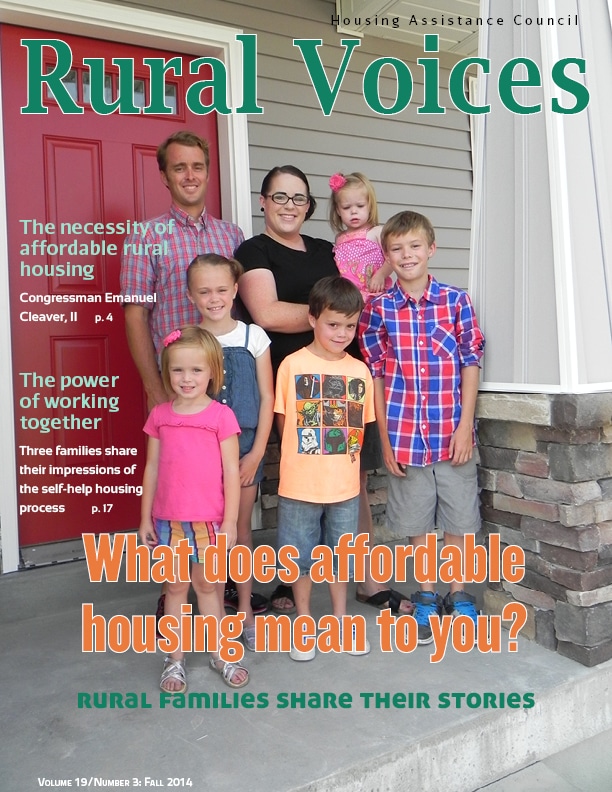
Three families share their experiences with USDA’s Mutual Self-Help Housing Program

Rural Voices - Fall 2014This story appears in the Fall 2014 issue of Rural Voices

Mutual Self-Help is a USDA Rural Development program administered by community-based nonprofit housing organizations that makes housing affordable through “sweat equity”. Families work together as a group to build approximately 65 percent of their homes. This labor not only acts as the down payment, but can substantially reduce the price of the home. However, it is hard work and it does require commitment. Households work together, with each family contributing a minimum of 35 hours of labor per week for approximately 8 to 12 months. The homes are built simultaneously; no one moves in until all the homes are completed.

Dillan and Lacie; Rebecca; and Anita and Robbie all participated in the Neighborhood Nonprofit Housing Corporation (NNHC) mutual self-help program. Below each family recounts their challenges, successes, and experiences building their own home and helping other families build theirs.

How did you first hear about self-help housing?

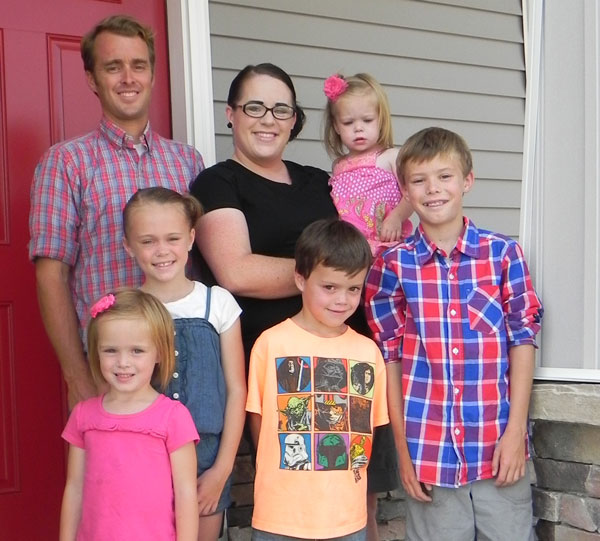
Dillan: When attending school, Lacie and I had no thoughts of buying, let alone, building a brand new house. Because I am a student, the idea of securing a home loan was near impossible, until we heard about Neighborhood Nonprofit’s housing program. A family member mentioned to me an advertisement they had seen in the newspaper one day and I just stopped in the office to see what it was about. Ten months later here we are in the final stages of building our beautiful new home. The process was very simple to qualify for the program and the Neighborhood Nonprofit staff was very helpful.

Dillan and Lacie are both originally from Cache Valley, UT and wanted to raise their children there. Lacie is a stay at home mom. Dillan is a returning student at Utah State University and plans to be a teacher.Dillan and Lacie are both originally from Cache Valley, UT and wanted to raise their children there. Lacie is a stay at home mom. Dillan is a returning student at Utah State University and plans to be a teacher.

Rebecca: I had previously heard about Self-Help housing a couple of years before applying, but I did not want to make such a major decision so soon after my husband’s death. I also didn’t see how I would be able to put in the time needed to build as a single mother. It wasn’t until after I tried unsuccessfully to find affordable housing for my family that I decided to throw in my application and see what happened.

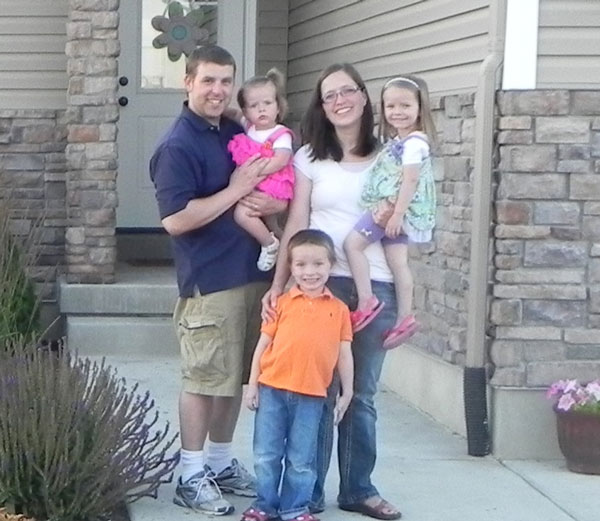
Anita: We heard about the Self-Help program from one of my husband’s coworkers. They had built in the nearby town of Nibley, UT. We decided to look into the program after looking for houses to buy became discouraging. We knew that my staying at home with our children would make it difficult to afford one. We were also excited about the opportunity to learn the skills involved with building a house. We are grateful we learned these skills because we feel more prepared to maintain our home.

What was the construction process like?

Anita: During the time we built, life was so busy! I was pregnant when we started, so my husband did most of the work for the first several months. Life was hard but we were excited for the end result. It took our group ten months to finish all our homes. We worked with really great people. Everyone had the same attitude to work on each other’s home like it was their own. This created a positive working environment. I would say the hardest challenge we faced was everyone getting burned out and not working as fast as we had hoped. I was glad to be able to go out and work too. Working together on our home taught us a lot and was a great benefit to us recently when we finished our basement.

Dillan: While the qualification process was simple, the building process has not been quite as simple. Building each home together has been challenging and rewarding at the same time. The families in our group have worked so hard together and have accomplished so much. The program has not been easy, but it has been worth it. I believe that each family will leave the program with a greater sense of community and friendship because of the hard work that everyone has endured.

Rebecca: My youngest was only three when I started building! Since my oldest was just 12, I was the only one in our family that was able to work on the homes. To be honest, it was a difficult process for me to build; besides having five children and no spouse, I am a student at Utah State University. A typical day would start at 4:30 a.m. I had to get up that early to get everything ready for the day, including dropping off my children at school and getting myself to class. After school was out, I would have to rush to pick up my children and take them to a baby sitter (none of them were old enough to be on the site) and then get myself to the work site. I usually wouldn’t get home until after 10:00pm. I still had to put kids to bed, take a shower (get all the sawdust and grime off that I’m allergic to), and do regular household chores.

Rebecca is a widow with five children ages 16, 15, 12, 10, and 7, and is currently a student at Utah State University pursuing a degree in Social Work.Rebecca is a widow with five children ages 16, 15, 12, 10, and 7, and is currently a student at Utah State University pursuing a degree in Social Work.

What were your living conditions before and after your participation in the self-help program?

Rebecca: Before [the Self-Help program] we had been living in a three-bedroom apartment for about two years. It was definitely cramped; my two daughters shared one bedroom, and my three sons shared another bedroom. We all needed some personal space. In addition, the apartment would flood occasionally, so it had mold and mildew issues and smelled terrible. It was also where we were living when I lost my husband and the children lost their dad. That apartment created some difficult memories for us. It was really healthy, both physically and emotionally, for us to get out of that environment. Every day, I count my blessings – I have a house, a yard, and good neighbors. I love the neighborhood! One especially nice benefit to having our home is having a back-yard big enough to grow a garden. I could never afford to buy fresh produce for my family. Now, we eat fresh food that we’ve grown ourselves!

Anita: Before we built our house, we lived in a townhouse. The community was nice but the main thing that was missing was a private backyard. One of my favorite features of the program was being able to move in having our landscape and fences included in the building process. I love being able to send my own kids out to have fun in our large fenced-in area. One other major unexpected benefit to having a fenced-in backyard was that it helped my preschool business. My city requires all new preschools to have a fenced-in backyard. This could have been an expensive hurdle but thanks to the Self-Help specifications, this was included.

Gerber-family-cropped-webAnita and her husband Robbie have three children all under the age of six. Anita is a stay at home mom who started her own preschool business. Robbie is a conference coordinator for Utah State University.

Dillan: Before the Self-Help program and as students with a large family, our housing conditions have been, at times, hard to deal with. Now that we are able to have a home to call our own it has given our family and especially our children a place to feel comfortable and more importantly a place to stay for a long time. We now have a “Room with a View,” a place to grow together and create lasting memories.

What specific successes or challenges did you experience?

Dillan: A challenge we faced in our group was learning to work together on a home that wasn’t your own. The workmanship as well as the attitude of all the families involved improved once everyone truly figured out that no one could move in to their own homes before the other houses were completed. No work was completed without the thought of “If it was my home, would I do it like that?” When this concept was grasped, the work excelled in speed and accuracy. Although this and other things were challenges, the successes far exceeded them. A friendship has been made between the families as we worked hard together.

Rebecca: It took a lot of determination to get my weekly hours in and keep up with my other responsibilities. Because it is easier to meet the time requirements if the family is a two parent household (it’s estimated that both husband and wife can come in together one day a week), I had to go in outside of the group’s regular work hours in order to work my full 35 hours per week. During the building process, I had to have two surgeries on my broken leg. While on crutches, and not allowed on site, I had good people that helped donate hours so I could keep up.

I love the neighborhood. I got to know my neighbors really well while we built – both the good and the bad! We learned to work with everyone’s personalities, and I think we learned the importance of not saying things we would regret later. Now, we have a real sense of taking care of each other. It is like having a built-in Neighborhood Watch Program! I have developed some very good friendships from the time we spent building together.

Anita: We are very grateful to have been able to build our home through the Mutual Self Help process. We learned a lot from our construction supervisor and have a lot of respect for him. He made sure things were done the right way. The process was hard; but worth it because we not only got a beautiful home but gained knowledge and friendships.

My father passed away a couple months into the building process. It was very unexpected and very difficult. Because we had to travel to the funeral, the people in our group told us they would donate any hours we needed to cover our weekly hours. Our group was very generous and kind. We truly appreciated them. We know these families care about us. On the anniversary of our open house, we always have a get-together to celebrate. We love the families we built with!

Neighborhood Nonprofit Housing Corporation (NNHC): A Utah-based nonprofit committed to creating quality affordable housing opportunities in their communities and giving households skills necessary to become self-sufficient. NNHC offers programs such as mutual self-help housing, and housing and foreclosure counseling, and as well as loan products.

"Our Home, Our Community"

by Lucero Cortez and Erika Parkinson, Catholic Charities of Yakima

Rural Voices - Fall 2014This story appears in the Fall 2014 issue of Rural VoicesZaida Elena Lopez and Ivan Chavez moved to Washington State from Chicago four years ago in search of work. They moved into a one bedroom house that they rented in an orchard that was very far from the community. This is where they had been raising their four year-old son, Brandon. Zaida explained that this was a very lonely, solitary house to live in as there were no other children for her son to play with. She also explained that besides being very isolated and lonely the house had very poor living conditions. It was poorly insulated and the family was often cold in the winter as the house did not retain heat and their heater rarely worked properly. Furthermore, the bills they paid were very expensive. Zaida told us that her monthly electric bill totaled approximately $400 a month!

screenshot from video jpgZaida Elena Lopez and Ivan Chavez in their new home

Since their move from Chicago to Washington, Zaida is a stay at home mom and Ivan works as a Forklift Driver for an agricultural warehouse. Ivan works nights at the warehouse leaving his wife and son alone. He wanted a more secure living environment for his family, and a better house for them to live in as they think about expanding their family. These many factors made the family want to have their own home that would be safer, larger, and more integrated into the community.

Zaida’s aunt told her about Catholic Charities Housing Services (CCHS) and their Single-Family Home Ownership Program. Her aunt was filling out an application with CCHS, and this motivated Zaida to apply as well. Ivan and Zaida were surprised at how easy the process was, from the moment Lucero Cortez, Program Assistant with CCHS, helped them fill out the application.

“That is where everything started,” Zaida said. “At some point we thought that we were not going to qualify because of my husband’s income, but thank God that CCHS was able to help us and we were able to qualify for a home in the coommunity of Tieton.”

CCHS requires qualified homeowners to put 250 hours in “sweat equity,” which means they help with work on their house while it is being built. This may seem like a deterrent to some families, but Zaida said, “When you are interested in something it doesn’t matter what you have to do to accomplish your goal.” Zaida would come to the house with her son, Brandon, to clean, pick up garbage and debris the contractors left behind, and to weed. The family would often come once or even twice a week to help, and Ivan would sometimes leave work early to spend time helping his wife and son. “My son helped out a lot,” said Zaida. “He would come here and be very happy to clean the house. I told him from day one that this was going to be our house that this would be where we would move.” Brandon can often be heard at the house telling his mom proudly, “This is our little house.”

“We are very thankful to Catholic Charities Housing Services for their support. They made us feel calm through the entire process because whenever we had a problem they would be there,” Zaida said. This home will be a place for Zaida, Ivan, and Brandon to have a community with neighbors and children for Brandon to play with, and will be a great place for them to continue their family in a safer, friendlier environment.

Catholic Charities of the Diocese of Yakima provides help and creates hope for thousands of people each year regardless of religious, social or econimic backgrounds. Catholic Charities provides a myriad of vital services in communities through it’s network of agencies: Catholic Family & Child Service, Catholic Charities Housing Services and the St. Vincent Centers.


The Balancing Act

A single mother’s self-help journey

by Joey Henderson, Florida Home Partnership
Rural Voices - Fall 2014This story appears in the Fall 2014 issue of Rural VoicesMs. Yvette Marie Cabili has managed to overcome numerous obstacles in her life and has not only become a self-help homeowner through Florida Home Partnership (FHP), but has also fulfilled her desire to help others achieve homeownership. Ms. Cabili learned the concept of self-sufficiency and determination from observing her mother, Maria Vazquez.

Immigrating to the United States from Mexico as a teenager, Ms. Vazquez overcame a language barrier and culture shock. Becoming a single parent at age 30, she was committed to raising and providing a better quality of life for Yvette and her younger sister, Melissa. Ms. Vazquez’s determination and persistence would later influence Yvette’s desire to achieve.

Born in the late 70s, Yvette attended elementary and junior high school in Los Angeles, California. Her mother relocated to the Tampa Bay area in the early 1990s with her employer GTE. After graduating from high school in Brandon (a suburb in Tampa), Yvette briefly attended the University of South Florida but soon left to join the United States Army in the late 1990s. Stationed at Ft. Bliss in El Paso, Texas, she served two years as a private first class. She worked as an Information System Operator-Analyst, and later married. Yvette eventually opted to resign from active duty, considering her husband’s active status in the Army. They were also preparing for the birth of their first-born child. With her husband’s reassignment, the family moved to Wiesbaden, Germany after the birth of their second child.
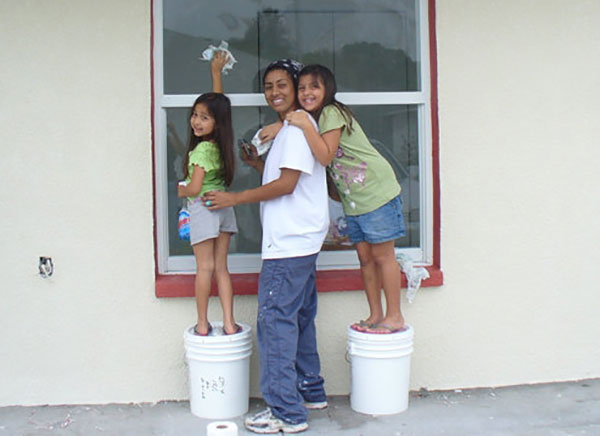
girls-painting-web

As circumstances would have it, Yvette and her husband divorced two years after moving to Germany. She was forced to return to the United States as an unemployed, single parent of two toddlers. Yvette then moved in with her mother and sister. She knew she had to start life over again at the young age of 25 and that this new life would involve struggles, heartaches and sacrifices. She learned from her mother that being a single parent is not a disadvantage, but rather a stage in life’s journey that should be used to cultivate self-determination and to inspire her children to greatness. Yvette saw her mom as a “super hero” and that’s how Yvette wanted her children to see her.

Yvette’s first civilian job was in retail and customer service. Customer service was something Yvette thrived in and felt rewarded by helping others; however, the entry-level pay insufficiently covered her bills. She then secured a better paying job with an insurance company in Lakeland, Florida and decided to also enroll in the local community college. Yvette strived to help her mother with household expenses, but the multiple responsibilities were overwhelming. Her mother’s hairstylist knew of Yvette’s situation and advised her of a self-help homeownership program for low-income first time homebuyers. Yvette’s mother shared the information in hopes that her daughter would qualify for the program.
Yvette was hesitant to apply at first, and asked herself, “What’s the catch?” After doing some research, she obtained the information packet and tried to identify the hidden “catch.” Yvette thoroughly read all the documents and investigated the organization as she knew this decision would not only impact her life but would also completely change her daughters’ lives as well. The only “catch” she found was her own fear. Yvette feared that she would fail and feared that she would let her children down. Instead of letting those feelings discourage her, she reflected back to her desire to be an inspiration for her daughters; thus, she applied for the program.

Yvette was among the few applicants whose credit history was acceptable and revealed no issues preventing her from enrolling in the program. Although her credit was in good standing, the demand of the application process was a challenge. Every other day she received a call from her loan specialist about a paystub that was out of date, a small bonus from her job that had to be explained and employment verification that had to be re-verified. The day came when she received the green light to close on her lot and begin the next phase of becoming a self-help homeowner.

Her perseverance was tested as she strived to commit to raising her daughters with her mother’s help, building a home, and taking college courses. There were many emotional talks with her daughters (ages 6 and 8 at the time) to try to explain that ‘their mother doesn’t like being away from them all the time and that she was doing all this for them’. The program required Yvette to work Saturdays and Sundays on her own home and the homes of the individuals in her group. Yvette had to request a shift change from her employer in order to take opportunity of the self-help homeownership program.

One thing she always mentions to homebuyers, whether they are single or not, is “If I did it, you can too! It’s mind over matter!”

The request for a shift change took some time to be approved; therefore, Melissa was able to stand in for Yvette at the beginning of the program. Once the work schedule was approved, Yvette diligently worked on her home. During days off, she would work 8 to 10 hours cleaning, framing, caulking, painting and much more to meet the sweat equity requirements for building her home and the homes of her future neighbors. Many of her group members came to their homes during the week, but Yvette was unable to do likewise due to her work and college schedules. Yvette would arrive on weekends at the break of dawn and stay until dark to do what she could on her home so she didn’t fall behind.

The demanding requirements of the self-help homeownership program, driving 80 minutes to and from work and completing her course-work to earn an Associates of Arts Degree was at times very overwhelming. She recalled one day, while painting the walls alone in her new home, becoming overcome with tears. Yvette thought as she wept, “Ok, Yvette you can cry but keep painting. The light at the end of the tunnel is reachable.” From her initial request for the FHP Self Help Housing application process to the moment of final inspection, the self-help homeownership program was an emotional rollercoaster. Yvette had her highs and lows but despite the multiple demands, she learned time management, discipline and the basics of building a home. She gained construction skills, home maintenance knowledge and, along with everyone in her group, she grew as a person. She convincingly states that “everyone has the capability of becoming a ‘super hero’!”

[piktochart id=”2620201-single-mother-poverty-chart” height=”373″ width=”600″][/piktochart]

With her never fading smile, Yvette worked diligently and was a tremendous support to her group of self-help homeowners by helping to keep everyone on task. Her positive approach was very contagious, and seemed to motivate her group even during hot and long days. She gave 100% effort in each of the groups she was assigned and fulfilled every task given by her Family Construction Coordinator. Yvette felt that by giving her best to the individuals of her group that they would do the same when it came to working on her home. Yvette realized she had a knack for details when it came to painting; hence, she took on most of the detailed painting tasks (e.g., painting walls along the ceiling’s edge, along the base boards, around trim work, etc.). Yvette gave instructions on her painting techniques to help members in her group improve their methods. Little did she realize that she would instruct hundreds of homeowners on the same tasks years later.

As the eight months to build her home were coming to an end, Yvette realized that her dream of homeownership would soon be achieved. In May of 2008, Yvette not only graduated with an Associate of Arts degree from Hillsborough Community College, she also became a self-help homeowner at the age of 28.

Admiring the expertise demonstrated by the FHP staff, she set as her goal to work for the nonprofit. Her wish would soon come true when Jesse Ornelas, manager of the FHP construction team, recognized Yvette’s leadership potential and approached her about working for FHP. She welcomed the opportunity and later interviewed with the Executive Director. Upon being hired Yvette went from an air-conditioned office job to working outside on construction sites in the Florida climate (heat, cold, rain and shine).
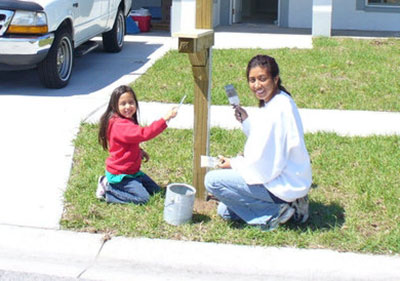
painting-post-webIt has now been five years since Yvette was hired by FHP to work as the Family Construction Coordinator II. In her role, she has assisted 144 first time homeowners achieve their homeownership dreams. Yvette has educated self-help homebuyers about the building process, coordinated their schedules, inspected their work, motivated them to push forward and proudly provided them the keys to their new homes. With the homebuilding process taking 6 to 8 months to complete, Yvette plays an integral role in the future of each of the self-help home buying families. She has witnessed great struggles that some new self-help home buying families endure and overcome during the construction process which in turn re-motivates and re-inspires her.

Being the only female employee at construction sites, Yvette had to overcome some gender stereotyping. She worked as hard and sweated just as much as the next employee. She has even taken classes to increase her understanding about housing construction. Yvette feels blessed to be working for FHP and would never have thought that she would gain so much personal reward and gratitude from a job. Yvette describes her work and the program in two words, “amazing” and “awesome!”

For the past six years, Yvette has enjoyed living in her home with her daughters Teresa and Elycia. She likes the fact that her community is quiet and well kept, with the exception of an occasional stray dog taking liberties in her yard. She enjoys learning to repair things around her home (e.g., repairing a leaky faucet, changing a door knob, replacing a faulty light switch, etc.) which helps enable her to educate other homeowners with confidence. One thing she always mentions to homebuyers, whether they are single or not, is “If I did it, you can too! It’s mind over matter!”

A mud run and obstacle course enthusiast (particularly for events that raise money and awareness for cancer research), Yvette exclaims that, “It [participating in the self-help homeownership program] was very challenging, but worth the sweat and tears.” Yvette is a valued member at Florida Home Partnership and is a model of success for the self-help housing program.

Florida Home Partnership: A non-profit homebuilder that offers affordable homeownership opportunities to low and moderate income first-time homebuyers through the USDA Mutual Self-Help Housing Program. The program began in the early 1960’s, and mirrors the “barn raising” of the Quakers with neighbors helping neighbors to build their homes together. No construction experience is necessary as Florida Home Partnership provides guidance and tools.
Making Almost Heaven a Reality in Rural West Virginia

Converting a log cabin to a modern home means this widow does not have to live in the cold

by John David, Southern Appalachia Labor School (SALS)

Rural Voices - Fall 2014This story appears in the Fall 2014 issue of Rural VoicesNancy and Cecil (Cork) Labus decided 19 years ago to return home to West Virginia and looked for a rural inexpensive house near where Cork had family. They found an old place that had been unoccupied for a decade near Hico, West Virginia in Fayette County.

Fayette County is “at risk” as defined by the Appalachian Regional Commission. Recently, USDA-Rural Development added the county to its “Strikeforce” category citing pervasive poverty and related socio-economic factors. People who once worked hard in coal mining and resource-based industries are struggling to survive and many, such as Nancy and Cork, had health issues.

The house that Nancy and Cork found was actually a three wall log cabin structure with an “add on” on the fourth side. The roof consisted of trusses and rafters made from tree limbs. The house was heated by a wood burner and wires dangled dangerously inside and out. Needless to say the rehabilitation of this house presented a unique challenge to members of YouthBuild, AmeriCorps, and volunteer programs with the Southern Appalachian Labor School (SALS) who participated in helping to rehabilitate Nancy and Cork’s house.

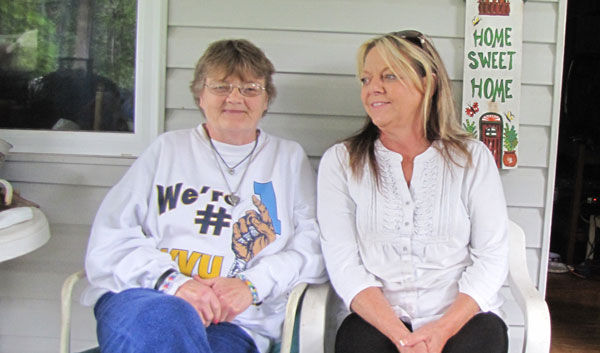
labus-smith-webNancy Labus (left) and Vickie Smith of SALS enjoy a peaceful moment together

Vickie Smith, who has been the SALS Construction Manager and licensed contractor for 20 years, had never seen a house like Cork and Nancy’s before. At first Vickie expressed dismay that the home was on the “to do” list for her. But Nancy, who had heard about the SALS program in a newspaper featured article, was tenacious to see her house rehabilitated. She called SALS over and over for at least a year and until she finally prevailed. SALS then engaged in the tedious process of cobbling together funds from the Pittsburgh Federal Home Loan Bank/United Bank’s Affordable Housing Program, USDA-Rural Development’s Housing Preservation Grant program, residual money from other projects, and tax-credit donations through the West Virginia Neighborhood Investment Program to assemble a “Force to Make a Difference” for the Labus family. The job was turned over to Dave Shaver, a seasoned SALS site supervisor, who has experience with turning around almost impossible to rehabilitate houses into something beautiful.

The rehabilitating process was helped considerably by the grateful attitude exhibited by Nancy and Cork. While they had no children together, Nancy had several by a previous marriage. Her son, along with Cork, worked on the roof as “self-help sweat-equity”. Nancy provided holiday presents and cooked for the crew, which was highly appreciated since the house was a long ways from anywhere. Crew members even helped cook and Nancy now jokes that the nearly two year project took longer than needed because nobody wanted to leave. Daniel David, a crew member from the first day of construction, recalls that the house was tough but the family’s support made everyone more than willing to go the extra mile.

Some of Nancy’s most special moments were being around the crew who contributed so much love, sweat, and tears for her “Home Sweet Home” in Almost Heaven, West Virginia.

The energy audit conducted by SALS on the house was off the charts. The entire house had to be insulated and almost everything inside and outside of the house had to be either replaced or rebuilt. The logs of the cabin had to be sheeted inside and out due to cracks, skeletons of critters in the attic had to be removed, and tree branches supporting the roof had to be reinforced. The windows that were popping out had to be custom made, Energy Star rated, and re-fitted. The back entrance with steps had to be totally re-built since access was impossible, not to mention the wood burner and pipe had to be replaced with an Energy Star HVAC (heat/AC) system. The crew installed all new wiring, and due to a new regional rural water system, the Labus’ old well which contained brown iron-water had to be disconnected and new plumbing installed. Crew members also leveled and fixed the floors because the new added on rooms and porches had various levels, support structures, and underpinning. Nancy recalls a situation where it took three hours and a smoking hot drill to install a light due to the logs and hard wood used throughout the house.

Despite everything that had to be done, Nancy could not hide her excitement at seeing her home coming together. She kept telling crew members “Thank you! Thank you!” and says she cried a lot with happiness. She now says she is “real proud” of her home. As she puts it, “The house is no longer an eyesore along the highway”. Some of Nancy’s most special moments were being around the crew who contributed so much love, sweat, and tears for her “Home Sweet Home” in Almost Heaven West Virginia.

The house was completed nearly five years ago. Then, just last year on December 19, 2013, Cork suddenly died after over 30 years of marriage. In remembrance of him and his memories, Nancy wears a heart-shaped pendant containing some of his ashes. She said the welfare department in West Virginia offered to pay $1,250 for his arrangements, but it wanted to put a repayment lien on the house. Proudly, thanks to having the house done by SALS at no cost, Nancy said she turned down the offer. She told us that she wanted to be “debt-free at last”.

As Vickie and I concluded our visit, Nancy hugged us and cried. But the day was not over. The home health nurse was knocking on the front door. It was time to keep hope alive.

Southern Appalachian Labor School (SALS): is a West Virginia nonprofit that provides education, research, and linkages for working class and disenfranchised peoples in order to promote understanding, empowerment, and change. SALS is committed to developing a real comprehension of the social, economic, and legal structures which affect the lives of the Appalachian people.

Affordable Rural Housing It’s Not a Nicety But a Necessity

View From Washington

Congressman Emanuel Cleaver, II, shares his housing story and offers his views on housing across the country

by The Honorable Emanuel Cleaver, II, Missouri’s Fifth District

Rural Voices - Fall 2014This story appears in the Fall 2014 issue of Rural VoicesOwning a home is part of the American dream. It’s a person’s private piece of paradise. The pride of home ownership often fosters not only a desire to take care of one’s personal property, but also an effort to protect the integrity and appearance of the surrounding neighborhood as well. Affordable housing is a key component to a vibrant, expanding, and prosperous community.

As a little boy, growing up in Waxahachie, Texas, my family and I didn’t have indoor plumbing until I was 7 years old. That’s when we moved up in the world, by moving into public housing. When a move into public housing is considered a monumental step up in the world, you can imagine the delirious euphoria that came years later, when we finally had a home of our own. My father worked three jobs, put my sisters, my mother, and I through college, and moved our family into the first home we ever owned. He still lives there today.

We all have our own personal stories, but the availability of, and access to, affordable housing for everyone, is a national concern as well. The buying and building of houses is a huge contributor to the vitality and viability of a community. Jobs are created or sustained as construction crews, real estate and other professionals, and business owners and employees are in high demand. The influx of tax dollars provides a solid foundation for public services including police, fire, and sanitation workers who help make a neighborhood safe, clean, and a quality place to live. Financial institutions make loans, restaurants sell food, and teachers begin educating our children. Affordable housing helps a community come alive. According to the United States Department of Agriculture (USDA), families and individuals living in Rural Development financed homes in the district I represent, Missouri’s Fifth District, see every dollar spent in the local economy multiply by six times.

So, I am asked all of the time, “What are elected officials doing in Washington to continue improving programs, increasing opportunities, and ensuring affordability for those in rural areas throughout our nation?” Sadly, a better question might be, “What are we doing in Washington at all?”

I say to you without hesitation – Not Enough! And some days, it seems, nothing is getting done at all. Except for arguing. The partisan back-biting, political bickering and agenda motivated maneuvering seem to go on forever. And it needs to stop. There are important issues on our plate. Issues that impact our families and our futures. Issues that need, and deserve, our serious attention right now.

Missouri’s Fifth District stretches all the way from the urban core of Kansas City east to the farms of Marshall. The distance is a whopping 90 miles, but the lifestyles seem even farther apart than that at times. My district truly represents a microcosm of this great nation, with not only urban and rural communities, but suburban ones as well. The needs of these residents vary greatly from region to region. Rural communities have different needs and different concerns than those in the other areas. And while it is my passionate belief that all residents of my district need access to affordable housing options, certainly my rural constituents have special and unique needs that need to be addressed as such.

As a Member of the House Financial Services Committee, and a Member of the Subcommittee on Housing and Insurance, I pay special attention to these issues and concerns. One important issue for rural communities, for instance, is flood insurance. Congress recently enacted the Homeowner Flood Insurance Affordability Act of 2013. This law protects people who have flood insurance from facing dramatic rate hikes. For constituents hit by premium increases they simply can’t afford, it provides relief in the form of a refund. The law also requires the Federal Emergency Management Agency (FEMA) to get the affordability study to Congress that was supposed to be finished almost a year ago.

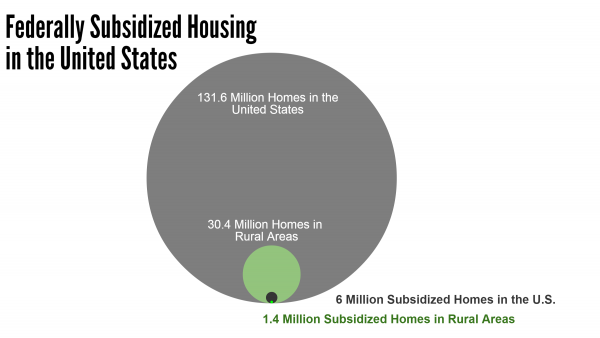
Federally Subsidized Housing Units BubbleSource: HAC Tabulations of HUD and USDA data; National Housing Preservation Database

Folks living in rural areas are particularly well served by their local USDA offices. That agency plays a critical role in bringing the dream of home ownership within reach. For people who choose to live, work, and raise their families in this country’s strong rural communities, many have not only found that the programs focusing on housing loans have helped them buy, but have also vastly improved their quality of life. Other available options provide loans and grants for everything from hospitals, fire stations, and nursing homes, to funding for apartments for those with low-income or the elderly, schools, and housing for farm laborers.

There are issues and complexities that occur in a rural landscape unique only to those communities. The USDA, through Rural Development, has worked for more than half a century to understand those nuances and provide housing options that don’t exist outside of rural America. For instance, USDA’s loan program offers borrowers an opportunity for homeownership with no money down, and allows rural families to stay right where they are. I continue to believe moving rural housing programs under a freestanding FHA is not a move toward efficiency, as many in Washington contend, but one that sets rural communities back and leaves them stuck in the past.

Right now, in Missouri’s Fifth Congressional District, the numbers and dollar amounts for 502 Guaranteed loans active and being serviced in Jackson, Lafayette, Ray, and Saline counties, show an impressive amount of families utilizing the program. There are 1,691 loans totaling more than $170 million.

Affordable housing in rural America is not just a nicety, it’s a necessity. It must be available, accessible, and affordable for those who need it. And, make no mistake, I will continue fighting to make sure it’s just that.

GET THE HAC NEWS!

Sign-up for HAC information products

SIGN UP HERE

Housing Assistance Council   |  1828 L Street. N.W., Suite 505, Washington, D.C. 20036
(202) 842-8600 (202) 347-3441 hac@ruralhome.org |

Board Portal

HAC is an equal opportunity provider, employer, and lender. | Civil Rights | Privacy