So Much Progress, So Much Left To Do!
 This story appears in the 2015 Summer Edition of Rural Voices
by Peter Carey
A simple concept still holds promise in a complicated housing world
More than five decades have passed since the first USDA-financed mutual self-help homes were built in Goshen, California. Much has changed in that time. Computers, cell phones, the internet are the main channels of communication. We’ve been through wars on other continents. We’ve landed on the moon and we’ve eliminated diseases like polio. What we take for granted today would have been science fiction when Lilia Jimenez turned the first spade of dirt for her self-help home in Goshen in 1963.
And yet, many things remain the same, especially for those in the lower rungs of our economy. An unacceptable number of people still live in poverty, and the housing conditions in rural America still pose an obstacle to those who desire the opportunity for a decent home.
Through those five decades one constant has been the fact that responsible homeownership remains the single best way for lower-income people to build the assets needed to move beyond poverty.
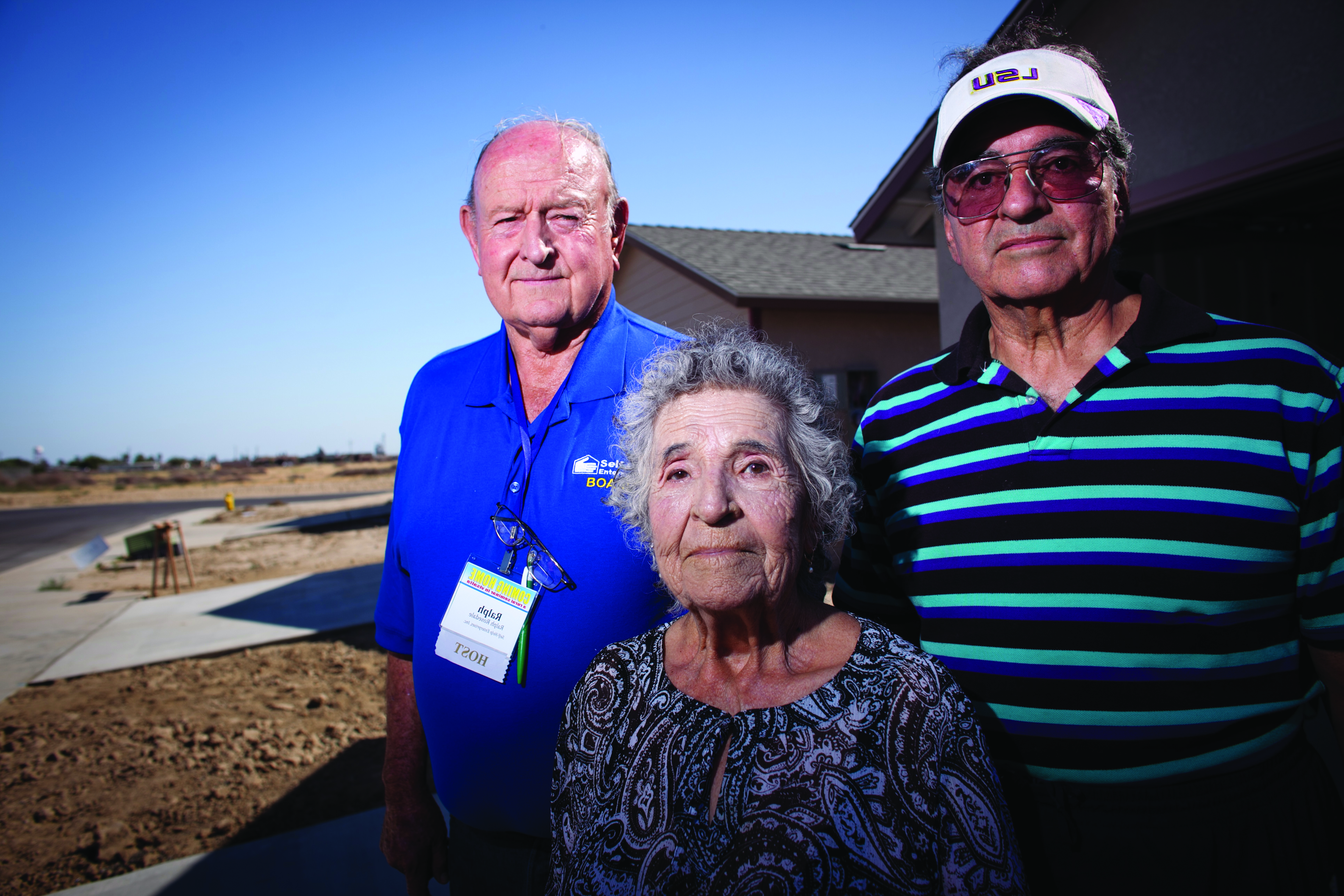 Lilia Jimenez (center) and her family built one of the first self-help homes in the early 1960s. Lilia still occupies the home she helped construct more than 50 years ago in Goshen, CA.
For the early pioneers of mutual self-help housing, the concept of homeownership was a simple one. It wasn’t seen as an investment, or a path to upward mobility, though in hindsight, it was both. For those who lived in generally substandard rental housing, the opportunity to own a home was the first step towards stability. It was the opportunity to provide a safe and secure home for their children. And although the cost of land and building materials was not within the control of potential homeowners, they could reduce the cost of building a home by contributing most of the labor needed to build. And hard work was the one commodity they could provide. We say that “opportunity knocks.” But sometimes it goes unrecognized because it comes disguised as hard work. Self-help homebuilders open that door, and by joining together with neighbors, they seize opportunity, one nail at a time.
In the early days of mutual self-help housing, there was a great deal of skepticism not just of the program, but of the very idea that farmworkers and other low-income people could be good homeowners. Five decades later we know that the answer is a resounding, “Yes!” And there are builders from those early days who have seen generations of children who have benefited from their families’ investment. There are stories across rural America of self-help children who have gone on to become contractors, teachers, elected officials, and business owners, and who take an active role in their communities.
Today we know even more about the negative individual and societal impacts of poor housing conditions and the value of investing in decent housing. Studies have shown that housing quality can affect the ability to learn and socialize in school. There is growing evidence that growing up in a decent home reduces healthcare costs, not just during childhood, but into adulthood. Despite the experience of the recent recession, we know that the single best vehicle for growing assets is homeownership.
Today about 100 nonprofit organizations provide the opportunity for lower-income families to join with their neighbors to invest their sweat and labor to build homes for themselves, their children, and their future. The common denominator that makes this effort possible is USDA Rural Housing Service, which provides both technical assistance funding to the nonprofit sponsor and affordable mortgage financing to the homeowner. Combined with “sweat equity” it is a homeownership model that really works for rural families who can’t afford market rate homes, for neighbors who share in building their dreams, and for the communities they call home.
Fifty thousand homes, affordable, safe, built by the hands that own them. Each home is a legacy for the next generation. For the tens of thousands of children who grow up in a self-help home, each home is a lesson in opportunity, a demonstration of potential, proof that by joining together and working hard, lives truly can be changed. It is a concept that speaks to something that is an inherent part of the American heritage. From the barn-raisings of early days, communities have come together to do the things that could not be achieved alone. It is hard to walk away unmoved from a visit with families who are sharing in the long days and hard work of building homes together. It symbolizes the best of our society and speaks to a universal desire for community. This is the spirit of mutual self-help housing.
Peter Carey served as President and CEO of Self-Help Enterprises (SHE) in Visalia, California from 1990 until his retirement in June 2014. In addition to many other roles over the years, he also served as the Acting Chief Operating Officer of NeighborWorks America from July 2014 through February 2015. He continues to be engaged in housing and community development issues and is currently a member of Housing Assistance Council Board of Directors.
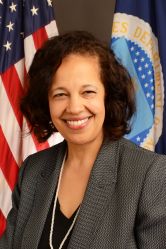 Lisa Afua Serwah Mensah was nominated by President Obama for the position of Under Secretary of USDA Rural Development and she was confirmed by the U.S. Senate in November of 2014. An expert in using financial tools to improve the economic security of the working poor, Ms. Mensah has experience in the private financial sector and has worked extensively on small and micro business development, housing, and financial and savings policy. Prior to joining USDA, she was the founding Executive Director of the Initiative on Financial Security at the Aspen Institute. Ms. Mensah began her career in commercial banking at Citibank before join- ing the Ford Foundation where she was respon- sible for the country’s largest philanthropic grant and loan portfolio of investments in rural America. Ms. Mensah holds an M.A. from the Paul H. Nitze School of Advanced International Studies of The Johns Hopkins University and a B.A. from Harvard University.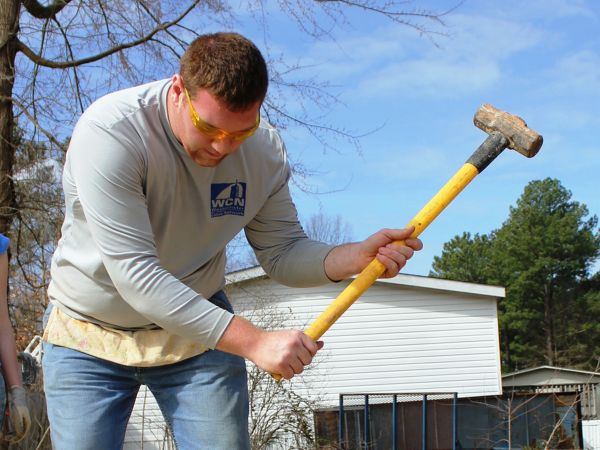
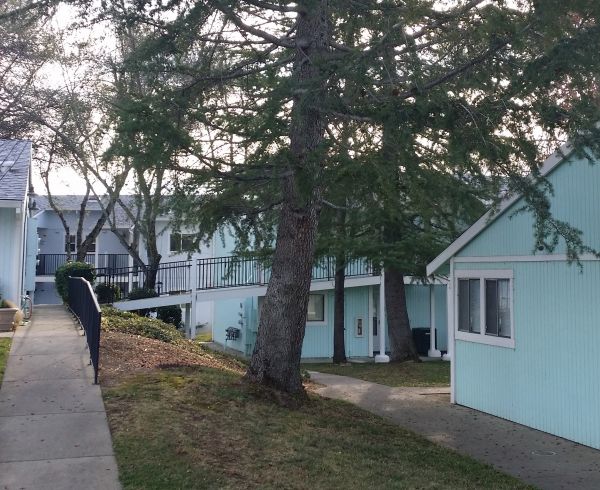
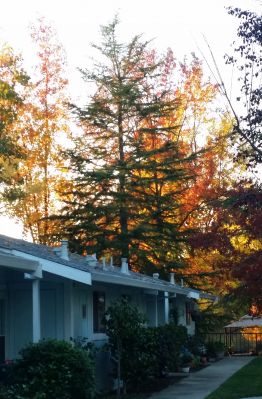 The 24-unit FmHA project (later named Diamond Sunrise I) was completed and occupied in 1987, but the years of struggle took its toll. Interested local citizens, FmHA, and DHCD became increasingly concerned with governance and management. In 1990, DHCD asked the Rural California Housing Corporation (RCHC) to make a servicing visit that showed the Gray Panthers to be a “shell corporation” without an effective board. RCHC, with guidance from FmHA, project residents, and community leaders, negotiated a reconstituted board-based nonprofit, Diamond Sunrise Corporation, to assume control and ownership of the project. RCHC staff joined the board of directors, and assisted the board in overseeing the management of the 24-unit development.


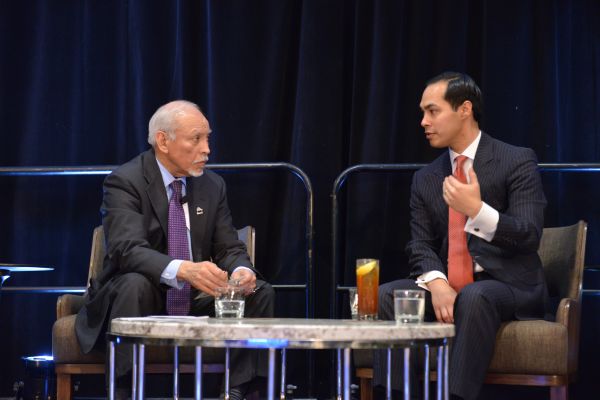
 Loza: The Rural Housing and Economic Development program is something that I think is very dear to the hearts of many people working in rural communities. Any thoughts about whether that initiative could be reinstated or brought back?