45 Years. 45 Stories

We Believe in Rural America

45YearsCoverFor most of our county’s history, the United States was largely a rural nation. That changed sometime in the 1930s when more people began living in and around cities than in the countryside. In the past few decades, the pace of urbanization has accelerated even faster. This fundamental shift is not only in our nation’s demography, but also in our identity and character. What does it mean to live, work, and prosper in 21st century rural America? Rural areas have their share of challenges, some unique, while others are similar to those in the cities and suburbs. But rural citizens also have a strong sense of pride, work ethic, and perseverance.

At the Housing Assistance Council (HAC), we know rural America. For 45 years, HAC has worked to improve the lives and homes of rural Americans all across this land – especially in often forgotten places and among often forgotten populations including Appalachia, the rural South and Mississippi Delta, the Border Colonias, Native American Lands, and migrant and seasonal farmworkers. The following 45 stories represent not only our past accomplishments and efforts over as many years, but also, and possibly more importantly, they offer a glimpse into our activities and aspirations for rural communities today and for the coming 45 years.

We know rural America. More importantly, we believe in rural America.

Read a web friendly version on Issuu.com

Annual Report 2015

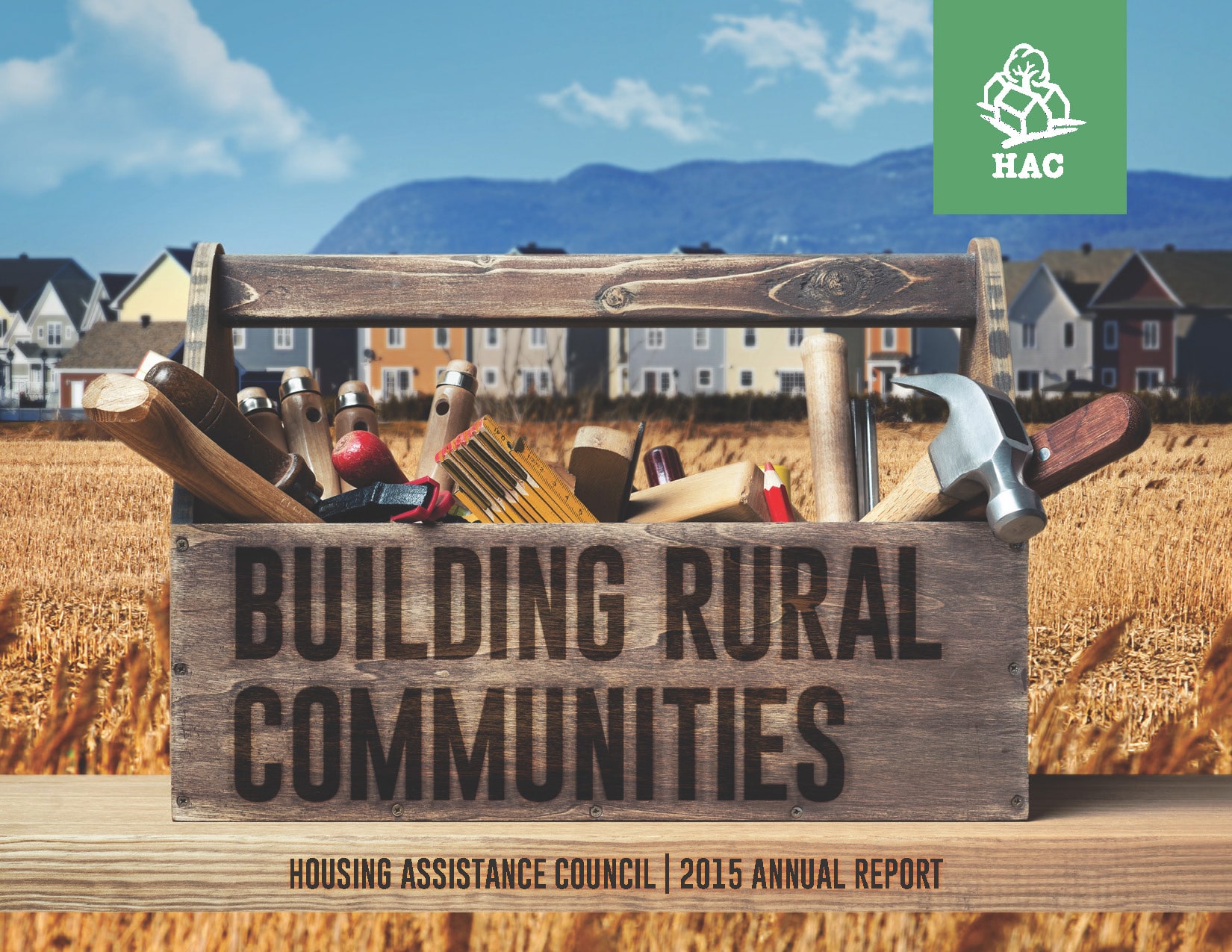
HAC's 2015 Annual Report CoverThe Housing Assistance Council is pleased to present Building Rural Communities, HAC’s 2015 Annual Report.

Read a web-friendly version of this publication on issuu.com.

In 2015 the Housing Assistance Council (HAC) mixed innovation, tried and true techniques, and special attention to special needs to further its mission of improving housing conditions for low-income rural Americans.

Ongoing issues surrounding the preservation of existing decent, affordable rental housing in rural America were one important focus of HAC’s work this year, as a large proportion of U.S. Department of Agriculture rental housing mortgages near the end of their terms. Veterans’ housing needs were another. HAC also continued its strong support of self-help homeownership for families who could not afford to purchase their own homes without the value added by their “sweat equity.” HAC’s loan funds make below-market financing available for those developing or rehabilitating affordable rural housing for both owners and renters.

This year HAC continued to increase its use of technology, delivering webinars and publications online and launching a new Veterans Data Central site to complement its popular Rural Data Portal. Person-to-person interactions remained important as well, with individualized conversations and live training sessions, including peer-to-peer events, providing technical assistance to local rural organizations and governments nationwide.

The importance of HAC’s role as an intermediary remains clear. As always, in 2015 local organizations throughout rural America made good use of HAC’s loans, grants, trainings, technical assistance, and information resources. HAC is proud to continue empowering these groups to provide decent, affordable homes for the lowest income residents of their own communities.

20 Years of Rural Voices

What a Difference 20 Years Makes

This edition, “20 Years of Rural Voices,” highlights and revisits a selection of articles published over the past two decades.

View from Washington

Let’s Recommit to Rural America
by Congressman Bennie Thompson

Rep. Bennie Thompson challenges his colleagues in Congress to re-engage in the fight to keep successful federal rural housing programs alive.s

FEATURES

Self-Help Housing on the Pine Ridge Indian Reservation: Alive and Well
by Leslie Newman

There is more than one way to design a self-help housing program, and collaboration between community organizations helps.

Still Ticking After All These Years: Low-Income Housing Tax Credits in Washington State
by Kim Herman

Tax credits have remained important in rural Washington, financing the production of thousands of homes.

Rural Midwest Housing Remains Complex
by Ann Ziebarth and Jeff Crump

Whether growing, stable, or declining, rural communities in the Midwest face challenges in providing housing for low-income residents.

The Housing Trust Fund Movement Spans the Country
by Mary Brooks

State and local housing trust funds continue to offer flexible funding for affordable housing across the country, and a national fund has been created as well.

Where You Live Matters: Fair Housing is Still the Law and Even Stronger
by Shanna Smith

The Fair Housing Act has been law since 1968, and new developments in 2015 have strengthened it.

Reflections on Cushing Dolbeare and Eleven Years of Housing Change
by Sheila Crowley

Cushing Dolbeare founded the National Low Income Housing Coalition; her legacy guides the organization years after her death.

20 Years Do Make a Difference
by Joe Belden

Many things have changed since 1995, says a veteran rural houser, but rural housing needs and solutions have never been partisan issues, and should not be now.


Rural Voices would like to hear what you have to say about one, or all, of these issues. Please feel free to comment on this story by sending a tweet to #RuralVoicesMag discuss on the Rural Affordable Housing Group on LinkedIn, or on our Facebook page.

Annual Report 2014

ar2014-coverThe mantra ‘retool, rebuild, renew’ resonated throughout the year as HAC continued its work improving housing conditions for the rural poor. Even as the economy begins to improve, many rural communities and Americans continue to struggle with the aftermath of the national housing crisis and recession. Similarly, some rural housing providers have scaled back their efforts in response to critical funding cuts and uncertain markets. Adversity and change have never discouraged HAC or the partners we have developed such strong relationships with across the nation. HAC continues pressing forward to retool our collective talents, rebuild the innovative spirit that got us where we are, and renew our passion for the mission that guides us.

For the entirety of its existence, HAC has worked to recognize housing inadequacies and help facilitate remedies through affordable lending products, technical assistance, and accessible information. As traditional problems linger, new and more complicated constraints of housing distress have emerged. The past decade has taught us the importance of housing to our nation’s economy, communities, and families. As the nation’s fiscal outlook grows more complicated and public sector investment decreases, HAC becomes increasingly integral to the success of building capacity and providing affordable, quality homes in rural America.

All of our efforts serve one goal: to improve housing conditions for the poorest of the poor in the most rural of places. HAC remains dedicated to this mission and to the partners that work tirelessly in pursuit of the day when every family in rural America will have a safe, affordable place to call home.

Remembering Richard Tucker

Richard Tucker dedicated his life to serving the less fortunate. An alumnus of LaSalle College in Philadelphia and Lincoln University in Oxford, Pennsylvania, he served as Executive Vice President of the Philadelphia Housing Development Corporation followed by a position as Executive Director of the Philadelphia Housing Authority. In 1972, Mr Tucker took a position as Deputy Director of the Housing Assistance Council, a new national organization committed to affordable housing for America’s rural poor. Beginning in 1978, Richard worked for the Federal Home Loan Bank System in Washington, D.C., where he was associated with the housing and community development and consumer programs. From October 1989 until his retirement in June 1999, Mr. Tucker served in various positions at the Federal Housing Finance Agency. From November 1989 through January 1991, he was acting director of the agency’s Housing Finance Directorate. During this period he was responsible for the development of the regulations and the implementation of the Federal Home Loan Bank System’s Affordable Housing Program. In retirement, he was the President of the Benjamin Banneker Development Corporation which developed sales housing, proceeds from which he established a scholarship program to benefit college-bound high school seniors in the District of Columbia.

Richard was an outstanding and dedicated member of the HAC Board of Directors for 31 years, including a number of years as Treasurer. Although his accomplishments are too numerous to mention here, he inspired many in the affordable housing field and will be missed dearly.

Richard Tucker 3

Annual Report 2013

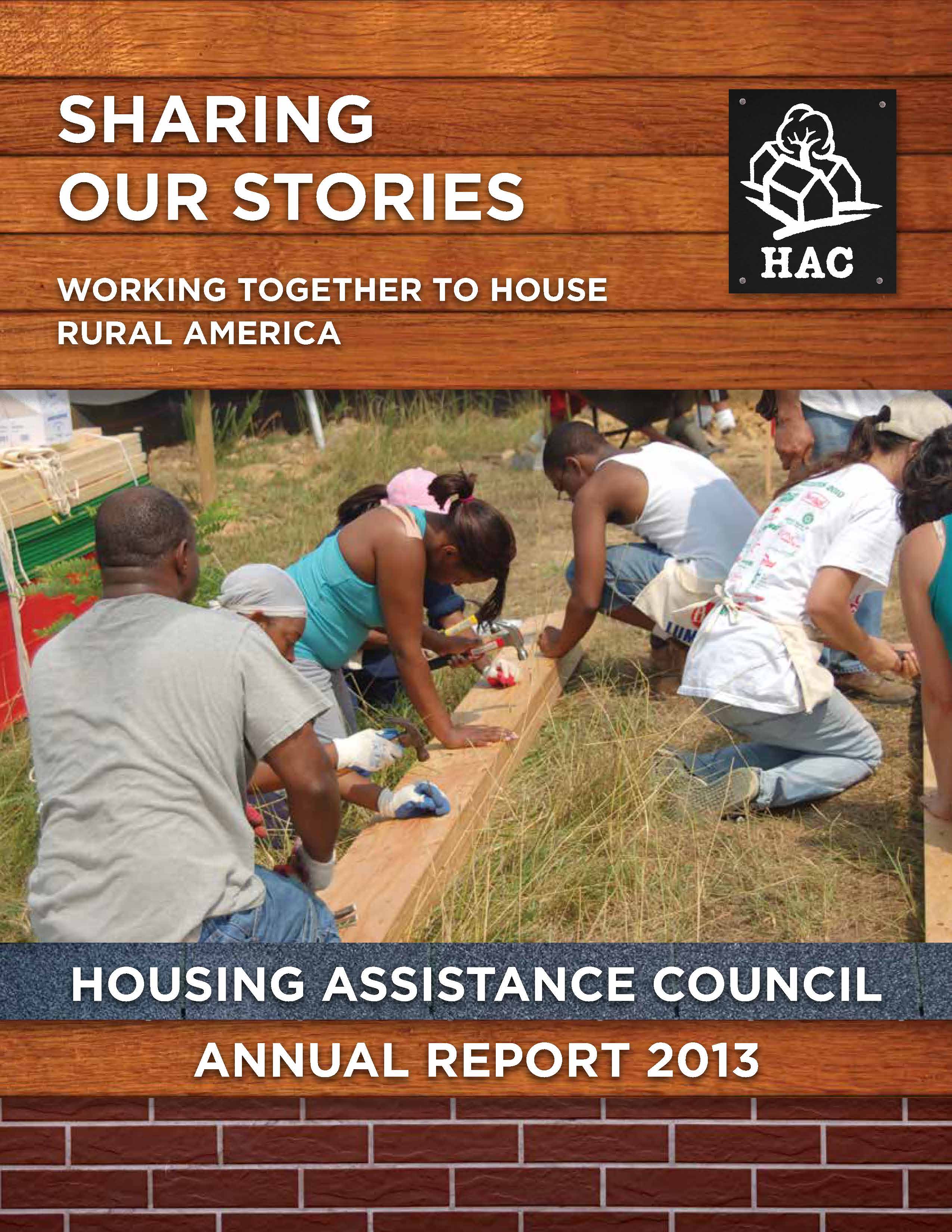
2013 Annual ReportThe achievements of our partners across rural America are a constant source of inspiration. Even during these trying times when organizations are faced with funding cuts, a struggling economy, and a rural housing market still undergoing recovery, dedicated organizations and individuals work daily to improve the lives of low-income rural residents. HAC looks back at 2013 knowing tangible change can still be accomplished through hard work. HAC’s success is linked to the success of our partners.

HAC’s strong relationships with rural housing providers across the country provide a unique insight into in rural communities’ needs and the challenges they face in meeting those needs. These relationships allow strategies to be adapted in order to work across a diverse landscape. Input from partners helps create appropriate policy and programmatic responses and allows HAC to remain a strong advocate for low income rural families. Loan fund programs, trainings, direct one-on-one technical assistance, research and information products, and analyses of federal housing policies ensure that HAC provides the tools necessary for organizations to continue providing safe, secure, affordable housing across rural America. HAC’s resources build and maintain relationships, and these relationships are critical.

HAC’s 2013 annual report highlights these relationships. Beginning with loan and grant making, HAC’s role as a Community Development Financial Institution (CDFI) allows us to help our local partners build and develop needed affordable housing projects. HAC’s training and technical assistance helps rural housing providers operate effectively and efficiently. And finally, HAC’s research and information provides partners with resources to gain access to data, understand federal policies, and stay up to date on news that impacts rural communities. Each service has its role and value for organizations in the field. HAC looks back on 2013 and recognizes not only the challenges, but also the hard-won successes of our partners. We remain committed to the advancement of local efforts and organizations and the ultimate goal of strengthening rural communities across the United States.

A Commitment to Capacity

A Commitment to Capacity
Print Copy: $5.00
This report examines HAC’s loan fund on the occassion of its fortieth year of funding rural affordable housing.
June, 2012

Annual Report 2012

2012 Annual Report

ar2012_coverAfter nearly five years of economic crisis, foreclosure, and declining home values, indicators are finally pointing to the beginnings of a housing recovery. Yet this recovery is not occurring in all places at the same speed. An untold number of rural Americans are still struggling after what was the worst economic recession since the 1930s. Even before the crisis, many rural households and communities struggled with housing problems. While much of the country sees a housing rebound, problems of distress remain in rural America longer than elsewhere because of a lack of economic vitality and diversification. To make things more challenging, federal support for affordable housing is under increasing financial pressure and has been diminishing when it is needed the most.

It is clear that HAC’s role as an intermediary organization and lender is more crucial than ever. Despite decreases in federal funding, a still-struggling economy, and a rural housing market undergoing recovery, HAC continues to further its mission of providing safe, secure, and affordable housing across rural America in some of the most distressed regions of the country. Like all nonprofit organizations, we have made adjustments as we face an uncertain political future and harsh economic realities. But we remain committed to working with partner organizations across the nation and to continue providing housing through our loans and grants, training and technical assistance, and research and information.

HAC has learned the importance of continual dialogue with rural housing practitioners who provide us with firsthand accounts of the need that exists in communities across rural America. With their input, we have been able to help create effective policy and programmatic responses to some of the most challenging issues facing rural affordable housing providers.

Through this landscape, HAC strives to create tangible change for the poorest individuals and families in the most rural parts of America. This annual report demonstrates the ways in which HAC continues to help strengthen rural communities during these challenging times. There is still much more to do, and we are proud to work with you to improve housing and lives in your community.

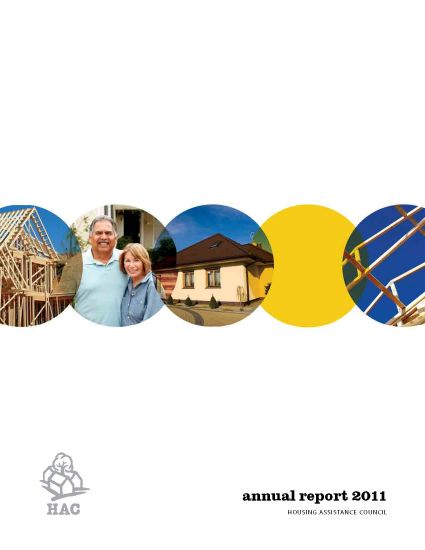
Annual Report 2011

2011 Annual Report

ar_2011_fc

HAC was founded in 1971 to improve housing conditions for the poorest of the poor in the most rural of places. At its founding, HAC’s board and staff knew that building the capacity of local communities would be central to meeting this charge, as local groups would not be able to meet the dire housing needs that existed without first building their own skills. HAC was created to provide these communities with the financial, informational, and technical resources that would ultimately enable them to create affordable, sustainable housing options for rural low-income residents.

In 2011, HAC celebrated its 40th anniversary and throughout the year has had the opportunity to reflect on its ongoing commitment to building capacity in rural communities. In the context of today’s economic and housing problems, the needs of low-income communities have become even more pronounced.

HAC has been steadfast in its support of rural communities and has focused its resources on strengthening the communities that are often suffering the brunt of these economic challenges. This year’s annual report highlights the impact of HAC’s work, specifically illustrating how HAC’s programs have built capacity in rural America.

Looking back over the past year, as well as the past 40 years, HAC is reminded that its success is a reflection of strong relationships with its external partners. HAC maintains these relationships not only through programming, but also through ongoing dialogue with the network of organizations that are working across the nation to create affordable housing. In 2011, HAC completed its stakeholder survey, hearing from more than 270 partners in communities across the nation. These survey respondents shared their insights on how they use HAC’s programs, how their communities have been impacted, and how HAC can improve its delivery of services. We appreciate the time and effort that participants took in providing input, and we look forward to implementing some of what we learned through the process.

In 2011, HAC is proud to have:

  • committed $11.6 million in loans and grants to 94 organizations across rural America to support the construction or preservation of affordable homes and to build local capacity;
  • started a new Rural Senior Housing Initative, which will provide lending, technical assistance, training, grants, and research to support affordable housing solutions for the elderly;
  • received two very strong ratings from the U.S. Government Accountability Office (GAO) and the Opportunity Finance Network (OFN) CARS™, reflecting high assessments of HAC’s work and internal operations;
  • hosted more than 1,500 participants at 18 training events across the nation.
  • published its first coedited issue of Rural Voices with the Rural Community Assistance Partnership (RCAP), highlighting the interconnections between infrastructure and affordable housing development;

HAC looks back on 2011 with pride, knowing that through partnership we have made significant strides in our effort to build capacity, support affordable housing development, and strengthen rural communities. Ever mindful of the challenges ahead, we remain hopeful that 2012 will bring even greater successes.

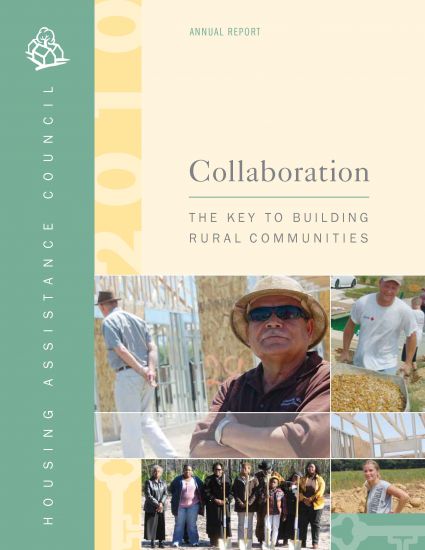
Annual Report 2010

2010 Annual Report

ar_2010_fc

The housing and financial markets were hard hit in 2010 and this has had a profound impact on the affordable housing sector. With government budgets in the red across the nation, common funding sources are being cut and organizations are scrambling to find new sources of revenue to assist the large number of families and individuals in need of affordable housing. This past year has reminded the Housing Assistance Council (HAC) and many of its partners of the significance of collaboration and partnership. In this environment, it is vital that organizations join together to share resources and learn from one another in order to survive.

The 2010 National Rural Housing Conference (NRHC) epitomized the strength of collaboration in these difficult times. For the first time, the NRHC was held jointly with the Rural Community Assistance Partnership’s annual meeting and training conference, allowing the more than 900 people registered to participate in workshops and exchange ideas. In working together to learn important skills and gain insights on current programs and policies, rural housing stakeholders also expressed new appreciation for the partnerships that have kept them afloat during these lean years.

Partnership has always been central to HAC’s success. As an intermediary organization, HAC is built on the many relationships it has developed on the national, state, and—most significantly—local level. This year’s annual report, Collaboration: The Key to Building Rural Communities, highlights the many ways that HAC has partnered during the year to help rural communities meet their housing goals.

Some important examples include the following:

  • Working with national and regional organizations to develop and deliver training on packaging U.S. Department of Agriculture (USDA) Section 502 loans
  • Committing more than $14.2 million in lending to support the development and preservation of 1,200 housing units
  • Approving more than $1.39 million in capacity-building grants to support the administrative and programmatic development of local organizations
  • Completing a comprehensive analysis of Section 502 loan originations for very low-income homebuyers

As HAC looks forward to its 40th anniversary in 2011, we appreciate our continued partnerships with the many organizations that are working to improve rural housing conditions. As we work with these organizations, we gain valuable insights into the needs of these communities and learn the best ways to support these efforts. Everyday, we are reminded that together, we can build rural communities.

GET THE HAC NEWS!

Sign-up for HAC information products

SIGN UP HERE

Housing Assistance Council   |  1828 L Street. N.W., Suite 505, Washington, D.C. 20036
(202) 842-8600 (202) 347-3441 hac@ruralhome.org |

Board Portal

HAC is an equal opportunity provider, employer, and lender. | Civil Rights | Privacy